The Advertising Manager & The Advertising Department Novrita Widiyastuti, S.Sos
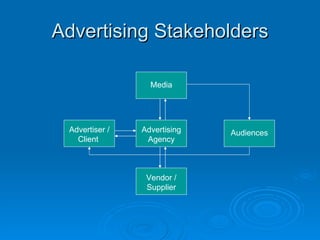
Advertising Stakeholders Advertiser / Client  Audiences Advertising Agency Media Vendor / Supplier
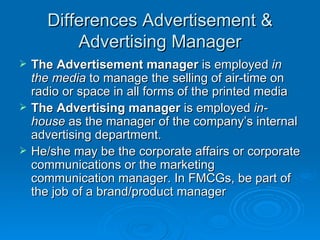
Differences Advertisement & Advertising Manager The Advertisement manager  is employed  in the media  to manage the selling of air-time on radio or space in all forms of the printed media The Advertising manager  is employed  in-house  as the manager of the company’s internal advertising department.  He/she may be the corporate affairs or corporate communications or the marketing communication manager. In FMCGs, be part of the job of a brand/product manager
Advertising management Roles & Responsibilities Strategic planning Planning ad Strategy, work with marketing & sales Determining policy, aims and objectives Develop ad objectives and what result in the market place are expected from the implementation of the ad campaign
Advertising management Roles & Responsibilities Promotional Planning Not restricted to advertising but includes all the activities of the promotional mix in order to develop integrated marketing & communication strategy The detail of communications message & media schedule are not considered at this stage Ad. Agency called to provide rough schedule & costing as preliminary to the budgeting process
Advertising management Roles & Responsibilities Budgeting Calculation cost for the for all promotional activities Planning-Administration and staff (procedures) Planning the department so that it is prepared to deal with the activities handles, and that it is effectively staffed and equipped to undertake its role
Advertising management Roles & Responsibilities Implementing the promotional campaign (tactics) Getting the company’s messages across to target audience & determine the company’s image The advertising manager will be the guardian of the company’s reputation
Advertising management Roles & Responsibilities Agency Selection It is the advertising manager’s duty to find and select the advertising agency.  The selection process includes studying the agencies credentials, considering the service provided, the fee structure, selecting agency for pitching. A Pitching is a final agency selection process involving 2 or 3 short listed agencies presenting their strategy/concept in solving the potential client’s marketing problems
Briefing the agencies The advertising manager will expect to see the ability of each agency to solve the company’s communication problem
Advertising/Campaign brief Background on the company’s market (market size, market share and competitors) Marketing objectives   measurable aims or expected outcomes of marketing activity to be achieved in a given period ) Target Market & Target Audience Product/service   all information about product/service Timing/period   when & how long? Other planned promotional activity   besides advertising Past advertising/promotion campaigns Existing company, product and brand images Market research results
Advertising brief Advertising objective   why your product should be advertised? Proposition (or the for positioning the product, brand or service) Benefits, advantages or features that the product might have that differentiate it from its competitors  (USP) Tone or style required   eg:  Humorous or prestige Mandatory client requirements  (logo, tagline)
Marketing Objectives   Typically involve increasing sales revenue, number of units sold, market share, and product awareness. S pecific  - What is the precise outcome? Who is responsible?  M easurable  - How will progress be measured?  A ttainable  - Can the objective be achieved with a reasonable amount of effort?  R ealistic  - Do you have the ability and resources to get the job done?  T ime dependent  - What is the start or finish date?
Examples of marketing objectives: Increase awareness of our service with commercial companies by making 24 presentations to decision-makers in private sector companies within the next year.  Reach target audience and inform them about the features and benefits of our product and its competitive advantage, resulting in a 5% increase in units sold in six months.  Generate new business within existing accounts for a 10% increase in total sales revenue within one year.
Example of Advertising Objective raise awareness of your company, product, or service within a clearly identified target market  communicate the benefits of your product or service  persuade prospective customers to switch brands  support a marketing event, such as a sale or an exhibition  inform customers where to obtain the product
Advertising management Roles & Responsibilities Working with the agency The decision reached at any client-agency meeting are recorded on a contact report. This is not the minutes of the meeting but a confirmation of decision made and an action plan
Monitoring-Quality control  and approval Establish how the promotional program has affected any change—hopefully positively—measured against research undertaken prior to any activity Works are done on time as scheduled Advertising appeared as per media plan and schedule The quality of work are in line with expectation Costs control Invoices are processed and paid as in terms of agreement  

6 the ad mgr & ad dept

  • 1.
    The Advertising Manager& The Advertising Department Novrita Widiyastuti, S.Sos
  • 2.
    Advertising Stakeholders Advertiser/ Client Audiences Advertising Agency Media Vendor / Supplier
  • 3.
    Differences Advertisement &Advertising Manager The Advertisement manager is employed in the media to manage the selling of air-time on radio or space in all forms of the printed media The Advertising manager is employed in-house as the manager of the company’s internal advertising department. He/she may be the corporate affairs or corporate communications or the marketing communication manager. In FMCGs, be part of the job of a brand/product manager
  • 4.
    Advertising management Roles& Responsibilities Strategic planning Planning ad Strategy, work with marketing & sales Determining policy, aims and objectives Develop ad objectives and what result in the market place are expected from the implementation of the ad campaign
  • 5.
    Advertising management Roles& Responsibilities Promotional Planning Not restricted to advertising but includes all the activities of the promotional mix in order to develop integrated marketing & communication strategy The detail of communications message & media schedule are not considered at this stage Ad. Agency called to provide rough schedule & costing as preliminary to the budgeting process
  • 6.
    Advertising management Roles& Responsibilities Budgeting Calculation cost for the for all promotional activities Planning-Administration and staff (procedures) Planning the department so that it is prepared to deal with the activities handles, and that it is effectively staffed and equipped to undertake its role
  • 7.
    Advertising management Roles& Responsibilities Implementing the promotional campaign (tactics) Getting the company’s messages across to target audience & determine the company’s image The advertising manager will be the guardian of the company’s reputation
  • 8.
    Advertising management Roles& Responsibilities Agency Selection It is the advertising manager’s duty to find and select the advertising agency. The selection process includes studying the agencies credentials, considering the service provided, the fee structure, selecting agency for pitching. A Pitching is a final agency selection process involving 2 or 3 short listed agencies presenting their strategy/concept in solving the potential client’s marketing problems
  • 9.
    Briefing the agenciesThe advertising manager will expect to see the ability of each agency to solve the company’s communication problem
  • 10.
    Advertising/Campaign brief Backgroundon the company’s market (market size, market share and competitors) Marketing objectives  measurable aims or expected outcomes of marketing activity to be achieved in a given period ) Target Market & Target Audience Product/service  all information about product/service Timing/period  when & how long? Other planned promotional activity  besides advertising Past advertising/promotion campaigns Existing company, product and brand images Market research results
  • 11.
    Advertising brief Advertisingobjective  why your product should be advertised? Proposition (or the for positioning the product, brand or service) Benefits, advantages or features that the product might have that differentiate it from its competitors (USP) Tone or style required  eg: Humorous or prestige Mandatory client requirements (logo, tagline)
  • 12.
    Marketing Objectives Typically involve increasing sales revenue, number of units sold, market share, and product awareness. S pecific - What is the precise outcome? Who is responsible? M easurable - How will progress be measured? A ttainable - Can the objective be achieved with a reasonable amount of effort? R ealistic - Do you have the ability and resources to get the job done? T ime dependent - What is the start or finish date?
  • 13.
    Examples of marketingobjectives: Increase awareness of our service with commercial companies by making 24 presentations to decision-makers in private sector companies within the next year. Reach target audience and inform them about the features and benefits of our product and its competitive advantage, resulting in a 5% increase in units sold in six months. Generate new business within existing accounts for a 10% increase in total sales revenue within one year.
  • 14.
    Example of AdvertisingObjective raise awareness of your company, product, or service within a clearly identified target market communicate the benefits of your product or service persuade prospective customers to switch brands support a marketing event, such as a sale or an exhibition inform customers where to obtain the product
  • 15.
    Advertising management Roles& Responsibilities Working with the agency The decision reached at any client-agency meeting are recorded on a contact report. This is not the minutes of the meeting but a confirmation of decision made and an action plan
  • 16.
    Monitoring-Quality control and approval Establish how the promotional program has affected any change—hopefully positively—measured against research undertaken prior to any activity Works are done on time as scheduled Advertising appeared as per media plan and schedule The quality of work are in line with expectation Costs control Invoices are processed and paid as in terms of agreement