Advertising
Management
Name : B.Bala murugan
Class : II-B.Com(SF)
Roll no : 19UR37
Media
Definition:
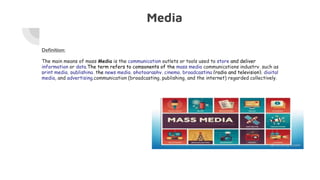
The main means of mass Media is the communication outlets or tools used to store and deliver
information or data.The term refers to components of the mass media communications industry, such as
print media, publishing, the news media, photography, cinema, broadcasting (radio and television), digital
media, and advertising.communication (broadcasting, publishing, and the internet) regarded collectively.
Types of advertising
● Newspaper. Newspaper advertising can promote your business
to a wide range of customers. ...
● Magazine. Advertising in a specialist magazine can reach your
target market quickly and easily. ...
● Radio. ...
● Television. ...
● Directories. ...
● Outdoor and transit. ...
● Direct mail, catalogues and leaflets. ...
● Online
Newspapers :
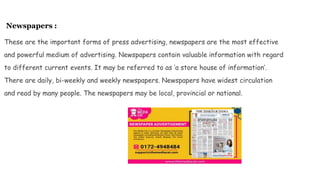
These are the important forms of press advertising, newspapers are the most effective
and powerful medium of advertising. Newspapers contain valuable information with regard
to different current events. It may be referred to as ‘a store house of information’.
There are daily, bi-weekly and weekly newspapers. Newspapers have widest circulation
and read by many people. The newspapers may be local, provincial or national.
Magazines:
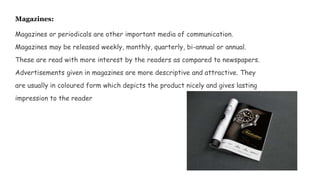
Magazines or periodicals are other important media of communication.
Magazines may be released weekly, monthly, quarterly, bi-annual or annual.
These are read with more interest by the readers as compared to newspapers.
Advertisements given in magazines are more descriptive and attractive. They
are usually in coloured form which depicts the product nicely and gives lasting
impression to the reader
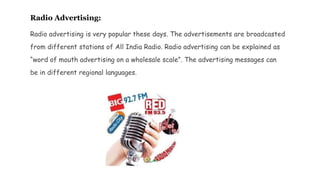
Radio Advertising:
Radio advertising is very popular these days. The advertisements are broadcasted
from different stations of All India Radio. Radio advertising can be explained as
“word of mouth advertising on a wholesale scale”. The advertising messages can
be in different regional languages.
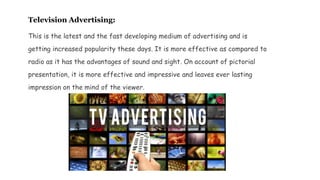
Television Advertising:
This is the latest and the fast developing medium of advertising and is
getting increased popularity these days. It is more effective as compared to
radio as it has the advantages of sound and sight. On account of pictorial
presentation, it is more effective and impressive and leaves ever lasting
impression on the mind of the viewer.
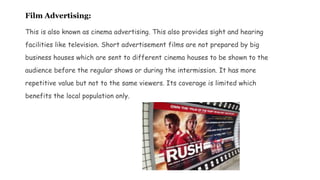
Film Advertising:
This is also known as cinema advertising. This also provides sight and hearing
facilities like television. Short advertisement films are not prepared by big
business houses which are sent to different cinema houses to be shown to the
audience before the regular shows or during the intermission. It has more
repetitive value but not to the same viewers. Its coverage is limited which
benefits the local population only.
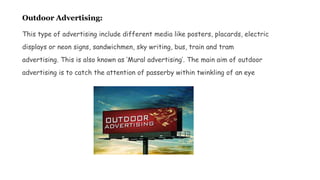
Outdoor Advertising:
This type of advertising include different media like posters, placards, electric
displays or neon signs, sandwichmen, sky writing, bus, train and tram
advertising. This is also known as ‘Mural advertising’. The main aim of outdoor
advertising is to catch the attention of passerby within twinkling of an eye
Nature of advertising
● Has a unique selling proposition
Often, the advertiser need to have a unique selling proposition (USP). This unique selling proposition
makes the product or service stand out of the crowd. Advertising attempts to persuade and
influence the audience through the different kinds of appeal.
● Visually attractive
The visual and non-verbal elements play a dominant role in advertising. An eye-catching
advertisement uses crisp information and focuses on the visual treatment to convey the message.
The visual elements used in the advertisements not only convey the information, but also tell a story.
● Consumer oriented
Advertising broadens the knowledge of the consumers. With this nature of advertising, consumers
can have the know how of the products, brands or services that exist in the market. In fact, every
product or service is designed in a way to keep the consumers satisfied.
● Uses various media
Apart from print platforms like newspapers and magazines, its presence can now also be seen in
audiovisual platforms like, films, hoardings, banners and many such promotional campaigns.
Scope of advertising
● Scope of advertising by budget
There is always a budget allocated for advertising and promotion within the marketing budget.
The budget allocated should be in coordination with the type of advertisement the organization
wants. The resources and other requirements are to be kept in mind for the budget allocation.
● Scope of advertising by deliverables
Once the budget is decided, the marketing plan can be projected further. A detailed scope of
work that deliverables require can be outlined. Agencies can now develop a proposed resource
plan.
● Scope of advertising by allocating deliverables
For creative work, allocating the type of deliverables (TV, online, mobile, press, magazine, etc)
based on the previous campaign requirements can be more insightful after the previous plan.
● Scope of advertising by strategy
Once the deliverables are allocated, advertising agencies can define the strategic
requirements by brand or category and develop a scope of work based on past
Advantages of
Advertising:
(1) Introduces a New Product in the Market:
Advertising plays significant role in the introduction of a new product in the
market. It stimulates the people to purchase the product.
(2) Expansion of the Market:
It enables the manufacturer to expand his market. It helps in exploring new
markets for the product and retaining the existing markets. It plays a sheet
anchor role in widening the marketing for the manufacturer’s products even by
conveying the customers living at the far flung and remote areas.
(3) Increased Sales:
Advertisement facilitates mass production to goods and increases the volume of sales.
In other words, sales can be increased with additional expenditure on advertising with
every increase in sale, selling expenses will decrease
(4) Fights Competition
Advertising is greatly helpful in meeting the forces of competition prevalent in the market.
Continuous advertising is very essential in order to save the product from the clutches of
the competitors.
(5) Enhances Good-Will:
Advertising is instrumental in increasing goodwill of the concern. It introduces the
manufacturer and his product to the people. Repeated advertising and better quality
of products brings more reputation for the manufacturer and enhances goodwill for
the concern.
(6) Educates The Consumers:
Advertising is educational and dynamic in nature. It familiarises the customers with
the new products and their diverse uses and also educates them about the new uses of
existing products
Disadvantages of Advertising
(1) Adds to Costs:
An organisation has to spend large amount on advertising. It increases the cost of the products.
To meet this expenditure, price of the product is raised. No manufacturer pays for the
advertising expenses out of his pocket. Advertising, therefore, leads to unnecessary rise in
prices. In this reference it is said that advertising costs are passed on to the consumers in the
form of high prices.
(2) Undermines Social Values:
Advertisement is a sort of day-dreaming for the people. These days it is taking the
people away from reality and into the realm of artificiality. Through its medium
people get information about new products.
Only very few products are of any use for them. The brilliance of new products
really gets on their nerves. They want to buy them but have no resources at their
command. Consequently, they start feeling upset with their present status. Taking it
as a social evil, it can be said that advertisement undermines social values
(3) Confuses the Buyers:
Many a time distorted version of reality is shown in the advertising. Believing in advertising,
consumers buy the product. On its use, they feel cheated.
They come to realise later that the information given in the advertisement was something else
whereas the actual product was quite different from it. Thus, people lose confidence in
advertising because of wrong presentation. In this reference it is said that advertising confuses
rather than helps
Advertising management

Advertising management

  • 1.
    Advertising Management Name : B.Balamurugan Class : II-B.Com(SF) Roll no : 19UR37
  • 3.
    Media Definition: The main meansof mass Media is the communication outlets or tools used to store and deliver information or data.The term refers to components of the mass media communications industry, such as print media, publishing, the news media, photography, cinema, broadcasting (radio and television), digital media, and advertising.communication (broadcasting, publishing, and the internet) regarded collectively.
  • 4.
    Types of advertising ●Newspaper. Newspaper advertising can promote your business to a wide range of customers. ... ● Magazine. Advertising in a specialist magazine can reach your target market quickly and easily. ... ● Radio. ... ● Television. ... ● Directories. ... ● Outdoor and transit. ... ● Direct mail, catalogues and leaflets. ... ● Online
  • 6.
    Newspapers : These arethe important forms of press advertising, newspapers are the most effective and powerful medium of advertising. Newspapers contain valuable information with regard to different current events. It may be referred to as ‘a store house of information’. There are daily, bi-weekly and weekly newspapers. Newspapers have widest circulation and read by many people. The newspapers may be local, provincial or national.
  • 7.
    Magazines: Magazines or periodicalsare other important media of communication. Magazines may be released weekly, monthly, quarterly, bi-annual or annual. These are read with more interest by the readers as compared to newspapers. Advertisements given in magazines are more descriptive and attractive. They are usually in coloured form which depicts the product nicely and gives lasting impression to the reader
  • 8.
    Radio Advertising: Radio advertisingis very popular these days. The advertisements are broadcasted from different stations of All India Radio. Radio advertising can be explained as “word of mouth advertising on a wholesale scale”. The advertising messages can be in different regional languages.
  • 9.
    Television Advertising: This isthe latest and the fast developing medium of advertising and is getting increased popularity these days. It is more effective as compared to radio as it has the advantages of sound and sight. On account of pictorial presentation, it is more effective and impressive and leaves ever lasting impression on the mind of the viewer.
  • 10.
    Film Advertising: This isalso known as cinema advertising. This also provides sight and hearing facilities like television. Short advertisement films are not prepared by big business houses which are sent to different cinema houses to be shown to the audience before the regular shows or during the intermission. It has more repetitive value but not to the same viewers. Its coverage is limited which benefits the local population only.
  • 11.
    Outdoor Advertising: This typeof advertising include different media like posters, placards, electric displays or neon signs, sandwichmen, sky writing, bus, train and tram advertising. This is also known as ‘Mural advertising’. The main aim of outdoor advertising is to catch the attention of passerby within twinkling of an eye
  • 12.
    Nature of advertising ●Has a unique selling proposition Often, the advertiser need to have a unique selling proposition (USP). This unique selling proposition makes the product or service stand out of the crowd. Advertising attempts to persuade and influence the audience through the different kinds of appeal. ● Visually attractive The visual and non-verbal elements play a dominant role in advertising. An eye-catching advertisement uses crisp information and focuses on the visual treatment to convey the message. The visual elements used in the advertisements not only convey the information, but also tell a story. ● Consumer oriented Advertising broadens the knowledge of the consumers. With this nature of advertising, consumers can have the know how of the products, brands or services that exist in the market. In fact, every product or service is designed in a way to keep the consumers satisfied. ● Uses various media Apart from print platforms like newspapers and magazines, its presence can now also be seen in audiovisual platforms like, films, hoardings, banners and many such promotional campaigns.
  • 13.
    Scope of advertising ●Scope of advertising by budget There is always a budget allocated for advertising and promotion within the marketing budget. The budget allocated should be in coordination with the type of advertisement the organization wants. The resources and other requirements are to be kept in mind for the budget allocation. ● Scope of advertising by deliverables Once the budget is decided, the marketing plan can be projected further. A detailed scope of work that deliverables require can be outlined. Agencies can now develop a proposed resource plan. ● Scope of advertising by allocating deliverables For creative work, allocating the type of deliverables (TV, online, mobile, press, magazine, etc) based on the previous campaign requirements can be more insightful after the previous plan. ● Scope of advertising by strategy Once the deliverables are allocated, advertising agencies can define the strategic requirements by brand or category and develop a scope of work based on past
  • 15.
    Advantages of Advertising: (1) Introducesa New Product in the Market: Advertising plays significant role in the introduction of a new product in the market. It stimulates the people to purchase the product. (2) Expansion of the Market: It enables the manufacturer to expand his market. It helps in exploring new markets for the product and retaining the existing markets. It plays a sheet anchor role in widening the marketing for the manufacturer’s products even by conveying the customers living at the far flung and remote areas.
  • 16.
    (3) Increased Sales: Advertisementfacilitates mass production to goods and increases the volume of sales. In other words, sales can be increased with additional expenditure on advertising with every increase in sale, selling expenses will decrease (4) Fights Competition Advertising is greatly helpful in meeting the forces of competition prevalent in the market. Continuous advertising is very essential in order to save the product from the clutches of the competitors.
  • 17.
    (5) Enhances Good-Will: Advertisingis instrumental in increasing goodwill of the concern. It introduces the manufacturer and his product to the people. Repeated advertising and better quality of products brings more reputation for the manufacturer and enhances goodwill for the concern. (6) Educates The Consumers: Advertising is educational and dynamic in nature. It familiarises the customers with the new products and their diverse uses and also educates them about the new uses of existing products
  • 18.
    Disadvantages of Advertising (1)Adds to Costs: An organisation has to spend large amount on advertising. It increases the cost of the products. To meet this expenditure, price of the product is raised. No manufacturer pays for the advertising expenses out of his pocket. Advertising, therefore, leads to unnecessary rise in prices. In this reference it is said that advertising costs are passed on to the consumers in the form of high prices.
  • 19.
    (2) Undermines SocialValues: Advertisement is a sort of day-dreaming for the people. These days it is taking the people away from reality and into the realm of artificiality. Through its medium people get information about new products. Only very few products are of any use for them. The brilliance of new products really gets on their nerves. They want to buy them but have no resources at their command. Consequently, they start feeling upset with their present status. Taking it as a social evil, it can be said that advertisement undermines social values

  • 20.
    (3) Confuses theBuyers: Many a time distorted version of reality is shown in the advertising. Believing in advertising, consumers buy the product. On its use, they feel cheated. They come to realise later that the information given in the advertisement was something else whereas the actual product was quite different from it. Thus, people lose confidence in advertising because of wrong presentation. In this reference it is said that advertising confuses rather than helps