So-that too-to enough-to
                Such a-that such-that
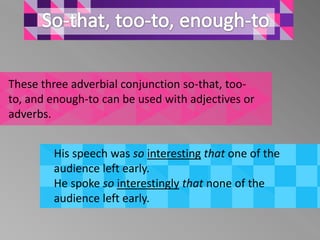
These three adverbial conjunction so-that, too-
to, and enough-to can be used with adjectives or
adverbs.


        His speech was so interesting that one of the
        audience left early.
        He spoke so interestingly that none of the
        audience left early.
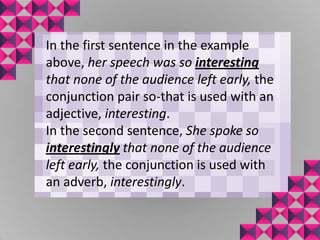
In the first sentence in the example
above, her speech was so interesting
that none of the audience left early, the
conjunction pair so-that is used with an
adjective, interesting.
In the second sentence, She spoke so
interestingly that none of the audience
left early, the conjunction is used with
an adverb, interestingly.
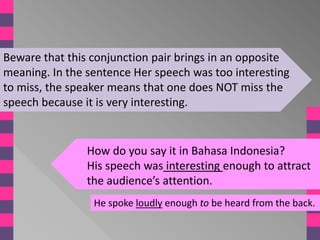
Beware that this conjunction pair brings in an opposite
meaning. In the sentence Her speech was too interesting
to miss, the speaker means that one does NOT miss the
speech because it is very interesting.


                How do you say it in Bahasa Indonesia?
                His speech was interesting enough to attract
                the audience’s attention.
                 He spoke loudly enough to be heard from the back.
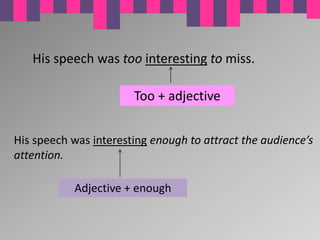
His speech was too interesting to miss.

                       Too + adjective


His speech was interesting enough to attract the audience’s
attention.

           Adjective + enough
Such a-that, such-that

Analysis of a noun phrase, which we
studied in earlier lessons, we symbolized
deictic items by Det. Because deictic items
modifies a noun, their form must match
the characteristics of the noun
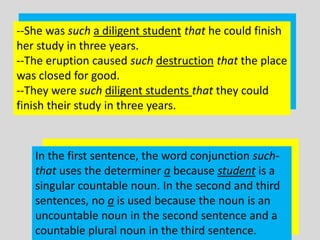
--She was such a diligent student that he could finish
her study in three years.
--The eruption caused such destruction that the place
was closed for good.
--They were such diligent students that they could
finish their study in three years.


   In the first sentence, the word conjunction such-
   that uses the determiner a because student is a
   singular countable noun. In the second and third
   sentences, no a is used because the noun is an
   uncountable noun in the second sentence and a
   countable plural noun in the third sentence.
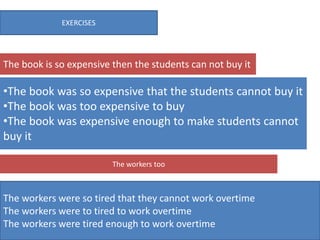
EXERCISES


The book is so expensive then the students can not buy it

•The book was so expensive that the students cannot buy it
•The book was too expensive to buy
•The book was expensive enough to make students cannot
buy it

                         The workers too


The workers were so tired that they cannot work overtime
The workers were to tired to work overtime
The workers were tired enough to work overtime
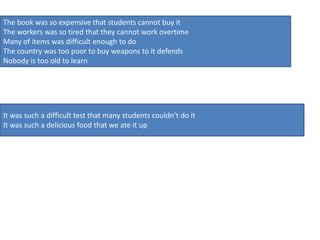
The book was so expensive that students cannot buy it
The workers was so tired that they cannot work overtime
Many of items was difficult enough to do
The country was too poor to buy weapons to it defends
Nobody is too old to learn


It was such a difficult test that many students couldn’t do it
It was such a delicious food that we ate it up
Get the Expresion
Study how to express relieved
          feelings
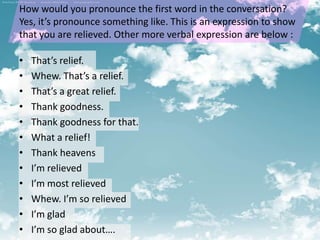
How would you pronounce the first word in the conversation?
Yes, it’s pronounce something like. This is an expression to show
that you are relieved. Other more verbal expression are below :

•   That’s relief.
•   Whew. That’s a relief.
•   That’s a great relief.
•   Thank goodness.
•   Thank goodness for that.
•   What a relief!
•   Thank heavens
•   I’m relieved
•   I’m most relieved
•   Whew. I’m so relieved
•   I’m glad
•   I’m so glad about….
Exercises page 259
1. You are relieved because you have finished your two
    assigment. The mathematics assigment has been especially
    hard for you.
You            : Thanks goodness
Your mother : Homework?
You            : Yes, it’s so bad
Your mother : Was it that hard?
You            : Yes,but it’s done now
Your mother :English?
You            : And mathematics. And physics
Your mother : All right. Go get your dinner now.
2. You are cacthing a class. You are almost late because the bus
   is late. You are in the bust now, and talking to the person
   next to you.

You           : Whew. What a relief. At least.
The person    : Late,aren’t you?
You           : Yes,but i’m save now.
The person    : Teacher,very strict, eh?
You           : Yes, and she get can get quite mean at times.
The person    : Can she, really? But you’re okay now.
You           : Yes, thanks goodness.

Adverbial conjuctions

  • 1.
    So-that too-to enough-to Such a-that such-that
  • 2.
    These three adverbialconjunction so-that, too- to, and enough-to can be used with adjectives or adverbs. His speech was so interesting that one of the audience left early. He spoke so interestingly that none of the audience left early.
  • 3.
    In the firstsentence in the example above, her speech was so interesting that none of the audience left early, the conjunction pair so-that is used with an adjective, interesting. In the second sentence, She spoke so interestingly that none of the audience left early, the conjunction is used with an adverb, interestingly.
  • 4.
    Beware that thisconjunction pair brings in an opposite meaning. In the sentence Her speech was too interesting to miss, the speaker means that one does NOT miss the speech because it is very interesting. How do you say it in Bahasa Indonesia? His speech was interesting enough to attract the audience’s attention. He spoke loudly enough to be heard from the back.
  • 5.
    His speech wastoo interesting to miss. Too + adjective His speech was interesting enough to attract the audience’s attention. Adjective + enough
  • 6.
    Such a-that, such-that Analysisof a noun phrase, which we studied in earlier lessons, we symbolized deictic items by Det. Because deictic items modifies a noun, their form must match the characteristics of the noun
  • 7.
    --She was sucha diligent student that he could finish her study in three years. --The eruption caused such destruction that the place was closed for good. --They were such diligent students that they could finish their study in three years. In the first sentence, the word conjunction such- that uses the determiner a because student is a singular countable noun. In the second and third sentences, no a is used because the noun is an uncountable noun in the second sentence and a countable plural noun in the third sentence.
  • 8.
    EXERCISES The book isso expensive then the students can not buy it •The book was so expensive that the students cannot buy it •The book was too expensive to buy •The book was expensive enough to make students cannot buy it The workers too The workers were so tired that they cannot work overtime The workers were to tired to work overtime The workers were tired enough to work overtime
  • 9.
    The book wasso expensive that students cannot buy it The workers was so tired that they cannot work overtime Many of items was difficult enough to do The country was too poor to buy weapons to it defends Nobody is too old to learn It was such a difficult test that many students couldn’t do it It was such a delicious food that we ate it up
  • 10.
    Get the Expresion Studyhow to express relieved feelings
  • 11.
    How would youpronounce the first word in the conversation? Yes, it’s pronounce something like. This is an expression to show that you are relieved. Other more verbal expression are below : • That’s relief. • Whew. That’s a relief. • That’s a great relief. • Thank goodness. • Thank goodness for that. • What a relief! • Thank heavens • I’m relieved • I’m most relieved • Whew. I’m so relieved • I’m glad • I’m so glad about….
  • 12.
    Exercises page 259 1.You are relieved because you have finished your two assigment. The mathematics assigment has been especially hard for you. You : Thanks goodness Your mother : Homework? You : Yes, it’s so bad Your mother : Was it that hard? You : Yes,but it’s done now Your mother :English? You : And mathematics. And physics Your mother : All right. Go get your dinner now.
  • 13.
    2. You arecacthing a class. You are almost late because the bus is late. You are in the bust now, and talking to the person next to you. You : Whew. What a relief. At least. The person : Late,aren’t you? You : Yes,but i’m save now. The person : Teacher,very strict, eh? You : Yes, and she get can get quite mean at times. The person : Can she, really? But you’re okay now. You : Yes, thanks goodness.