ADVERBIAL
CLAUSES
An adverbial clause (or an adverb clause) is a
group of words which plays the role of an
adverb. (Like all clauses, an adverbial clause
will contain a subject and a verb.)
WHATAREADVERBIAL CLAUSES?
All adverbs (including adverbial clauses) can
usually be categorized as one of the following:
 Adverb Of Time
 Adverb Of
Manner
 Adverb Of Place
 Adverb Of
Reason
 Adverbs of
Comparison
 Adverb Of
Condition
 Adverbs of
Concession
An adverb of time states when something
happens or how often. An adverb of time
often starts with one of the following
subordinating conjunction : after, as, as
long as, as soon as, before, since, until,
when, or while.
Adverb Clauses of Time
List of adverb
clauses of time :
 After
 Before
 When
 While
 Since
 Until
 Once
 Whenever
1. After she graduates, she will get a job.
2. I will leave before he comes.
3. When I arrived, he was talking on
the phone.
4. While I was walking home, it began to
rain.
5. I haven’t seen him since he left this
morning.
6. We stayed there until we finished our work.
7. Whenever I see her, I say hello
ADVERB CLAUSES OF MANNER
An adverb of manner states how something is
done. An adverb of manner often starts with one
of the following subordinating conjunctions: as,
like, how and the way
- I was never allowed to do things as I
wanted to do them.
- I wonder how I learn grammar
ineffectively for almost fifteen years.
- We sometimes do not realize the way
God help us.
ADVERB CLAUSES OF PLACE
An adverbial place clause tells where the action
described by the main verb takes place. An adverb of
place often starts with a preposition (e.g., in, on,
near) or one of the following subordinating
conjunctions: anywhere, everywhere, where, or
wherever.
LISTADVERB CLAUSES OF PLACE :
 Everywhere
 Where
 Wherever
Example :
 Young people have
to go where they can
find jobs.
 Everywhere we
went, people
greeted us warmly.
 She is always
drunk wherever I
meet her.
ADVERB CLAUSES OF REASON
An adverb of reason offers a reason for the
main idea. An adverb of reason often starts
with one of the following subordinating
conjunctions: since, as, because, for.
EXAMPLE :
 I couldn’t come to your party because I was rather
sick.
 The car crashed because the driver was careless.
 Since this is a library research, all sources are taken
from libraries.
 As this is the beginning of the football season, there are
bound to be large crowds at the match.
 As women were not supposed to be novelist, she took
the name George Eliot.
 The manager dismissed Mary, for she was very lazy.
ADVERB CLAUSES OF CONDITION
• adverb of condition states the condition for the
main idea to come into effect. An adverb of
condition often starts with if, unless, only if, even
if, whether or not.
EXAMPLE :
 If it rains, we will not go out.
 She will come if you invite her.
She will take this medicine whether she
likes it or not.
Even if they lose by five goals, people will
still love them.
Unless you love me, I will commit
suicide.
ADVERB OF CONCESSION
• Used to express ideas or actions that are not
expected (contradictive with the fact).
• Although
• Though
• Even though
• Even if
• While
• Whereas
• No matter
• Example :
1. Although he is small, he is very
strong.
2. No matter how smart they are,
they are required to do the
revision.
3. Even though the weather was
cold, I went swimming.
4. In Britain the hottest month of
the year is July, whereas in
Australia it is usually the
coldest.
BY: SAMA
CHERAGHPOUR

Adverbial clauses sama cheraghpour

  • 1.
  • 2.
    An adverbial clause(or an adverb clause) is a group of words which plays the role of an adverb. (Like all clauses, an adverbial clause will contain a subject and a verb.) WHATAREADVERBIAL CLAUSES?
  • 3.
    All adverbs (includingadverbial clauses) can usually be categorized as one of the following:  Adverb Of Time  Adverb Of Manner  Adverb Of Place  Adverb Of Reason  Adverbs of Comparison  Adverb Of Condition  Adverbs of Concession
  • 4.
    An adverb oftime states when something happens or how often. An adverb of time often starts with one of the following subordinating conjunction : after, as, as long as, as soon as, before, since, until, when, or while. Adverb Clauses of Time
  • 5.
    List of adverb clausesof time :  After  Before  When  While  Since  Until  Once  Whenever 1. After she graduates, she will get a job. 2. I will leave before he comes. 3. When I arrived, he was talking on the phone. 4. While I was walking home, it began to rain. 5. I haven’t seen him since he left this morning. 6. We stayed there until we finished our work. 7. Whenever I see her, I say hello
  • 6.
    ADVERB CLAUSES OFMANNER An adverb of manner states how something is done. An adverb of manner often starts with one of the following subordinating conjunctions: as, like, how and the way
  • 7.
    - I wasnever allowed to do things as I wanted to do them. - I wonder how I learn grammar ineffectively for almost fifteen years. - We sometimes do not realize the way God help us.
  • 8.
    ADVERB CLAUSES OFPLACE An adverbial place clause tells where the action described by the main verb takes place. An adverb of place often starts with a preposition (e.g., in, on, near) or one of the following subordinating conjunctions: anywhere, everywhere, where, or wherever.
  • 9.
    LISTADVERB CLAUSES OFPLACE :  Everywhere  Where  Wherever Example :  Young people have to go where they can find jobs.  Everywhere we went, people greeted us warmly.  She is always drunk wherever I meet her.
  • 10.
    ADVERB CLAUSES OFREASON An adverb of reason offers a reason for the main idea. An adverb of reason often starts with one of the following subordinating conjunctions: since, as, because, for.
  • 11.
    EXAMPLE :  Icouldn’t come to your party because I was rather sick.  The car crashed because the driver was careless.  Since this is a library research, all sources are taken from libraries.  As this is the beginning of the football season, there are bound to be large crowds at the match.  As women were not supposed to be novelist, she took the name George Eliot.  The manager dismissed Mary, for she was very lazy.
  • 12.
    ADVERB CLAUSES OFCONDITION • adverb of condition states the condition for the main idea to come into effect. An adverb of condition often starts with if, unless, only if, even if, whether or not.
  • 13.
    EXAMPLE :  Ifit rains, we will not go out.  She will come if you invite her. She will take this medicine whether she likes it or not. Even if they lose by five goals, people will still love them. Unless you love me, I will commit suicide.
  • 14.
    ADVERB OF CONCESSION •Used to express ideas or actions that are not expected (contradictive with the fact).
  • 15.
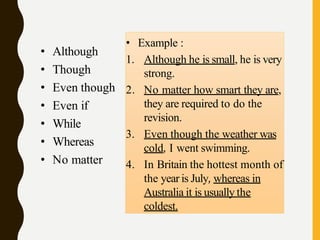
    • Although • Though •Even though • Even if • While • Whereas • No matter • Example : 1. Although he is small, he is very strong. 2. No matter how smart they are, they are required to do the revision. 3. Even though the weather was cold, I went swimming. 4. In Britain the hottest month of the year is July, whereas in Australia it is usually the coldest.
  • 16.