Advancing as a
Scrum Master or Agile Coach
and helping others to understand the role
Rowan Bunning CST - July 2018
@rowanb© 2018 Scrum WithStyle scrumwithstyle.com
Agenda
• Our Current Reality
• What a Scrum Master is not
• What a Scrum Master is
• How a Scrum Master operates
• Servant-as-leader
• Comparing Scrum Master with Agile Coach
• Scrum Master career paths
@rowanb© 2018 Scrum WithStyle scrumwithstyle.com
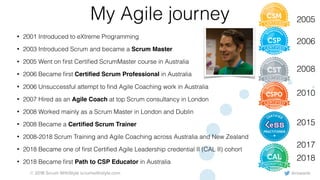
My Agile journey
• 2001 Introduced to eXtreme Programming
• 2003 Introduced Scrum and became a Scrum Master
• 2005 Went on first Certified ScrumMaster course in Australia
• 2006 Became first Certified Scrum Professional in Australia
• 2006 Unsuccessful attempt to find Agile Coaching work in Australia
• 2007 Hired as an Agile Coach at top Scrum consultancy in London
• 2008 Worked mainly as a Scrum Master in London and Dublin
• 2008 Became a Certified Scrum Trainer
• 2008-2018 Scrum Training and Agile Coaching across Australia and New Zealand
• 2018 Became one of first Certified Agile Leadership credential II (CAL II) cohort
• 2018 Became first Path to CSP Educator in Australia
2005
2006
2008
2018
2017
2015
2010
Our Current Reality
© 2018 Scrum WithStyle scrumwithstyle.com @rowanb@rowanb
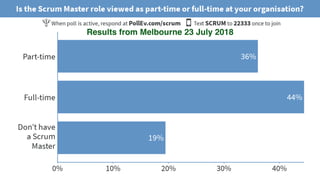
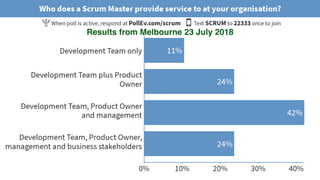
Results from Melbourne 23 July 2018
© 2018 Scrum WithStyle scrumwithstyle.com @rowanb@rowanb
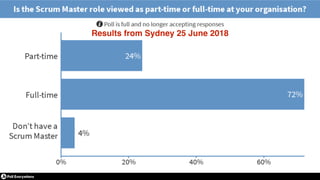
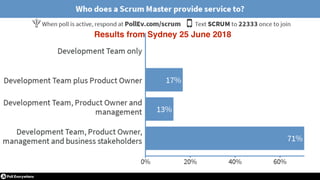
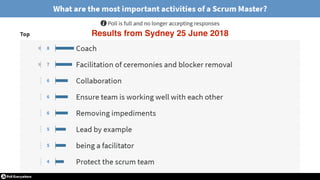
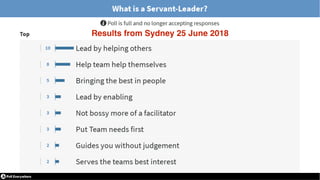
Results from Sydney 25 June 2018
© 2018 Scrum WithStyle scrumwithstyle.com @rowanb@rowanb
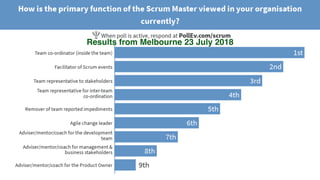
Results from Melbourne 23 July 2018
© 2018 Scrum WithStyle scrumwithstyle.com @rowanb@rowanb
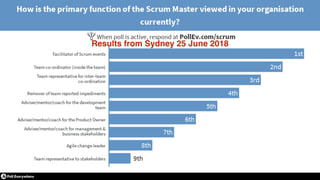
Results from Sydney 25 June 2018
© 2018 Scrum WithStyle scrumwithstyle.com @rowanb@rowanb
Results from Melbourne 23 July 2018
© 2018 Scrum WithStyle scrumwithstyle.com @rowanb@rowanb
Results from Sydney 25 June 2018
What a Scrum Master is not
@rowanb© 2018 Scrum WithStyle scrumwithstyle.com
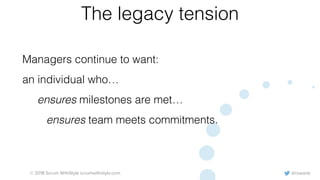
The legacy tension
Managers continue to want:
an individual who…
ensures milestones are met…
ensures team meets commitments.
@rowanb© 2018 Scrum WithStyle scrumwithstyle.com
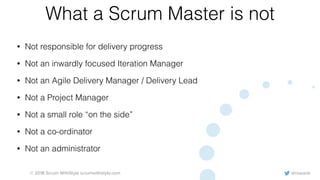
What a Scrum Master is not
• Not responsible for delivery progress
• Not an inwardly focused Iteration Manager
• Not an Agile Delivery Manager / Delivery Lead
• Not a Project Manager
• Not a small role “on the side”
• Not a co-ordinator
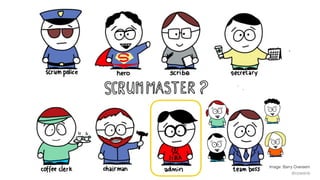
• Not an administrator
Not responsible for delivery
progress
© 2008-18 Scrum WithStyle scrumwithstyle.com
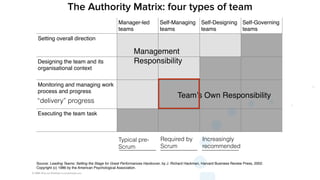
The Authority Matrix: four types of team
Source: Leading Teams: Setting the Stage for Great Performances Hardcover, by J. Richard Hackman, Harvard Business Review Press, 2002.
Copyright (c) 1986 by the American Psychological Association.
Manager-led
teams
Self-Managing
teams
Self-Designing
teams
Self-Governing
teams
Setting overall direction
Designing the team and its
organisational context
Monitoring and managing work
process and progress
Executing the team task
____________ ____________ ____________
© 2015 Scrum WithStyle scrumwithstyle.com
Team’s Own Responsibility
Management
Responsibility
Typical pre-
Scrum
Required by
Scrum
Increasingly
recommended
“delivery” progress
@rowanb© 2018 Scrum WithStyle scrumwithstyle.com
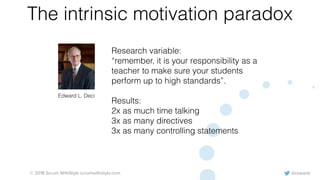
The intrinsic motivation paradox
Edward L. Deci
Research variable:
“remember, it is your responsibility as a
teacher to make sure your students
perform up to high standards”.
Results:
2x as much time talking
3x as many directives
3x as many controlling statements
@rowanb© 2018 Scrum WithStyle scrumwithstyle.com
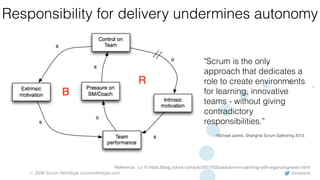
Responsibility for delivery undermines autonomy
Reference: Lv Yi https://blog.odd-e.com/yilv/2017/02/paradox-in-coaching-self-organizing-team.html
"Scrum is the only
approach that dedicates a
role to create environments
for learning, innovative
teams - without giving
contradictory
responsibilities.”
- Michael James, Shanghai Scrum Gathering 2013.
Not an inwardly focused
Iteration Manager
@rowanb© 2018 Scrum WithStyle scrumwithstyle.com
Origins of Iteration Manager
“When teams were struggling to find high-priority work to do on one
particular project in 2000, the solution was to identify someone who could
provide a continual stream of high-priority functionality at a sustainable pace
to the delivery teams. This is the role that has grown into the iteration
manager (IM).”
- ”What Is an Iteration Manager Anyway?", Tiffany Lentz, The ThoughWorks Anthology, 2008.
“The split between release and iteration managers reflects the style and
preferences of the two individuals that do it... We don't think our solution is
one that necessarily everyone should follow.”
- martinfowler.com/articles/planningXpIteration.html
© 2018 Scrum WithStyle scrumwithstyle.com @rowanb@rowanb
© 2018 Scrum WithStyle scrumwithstyle.com
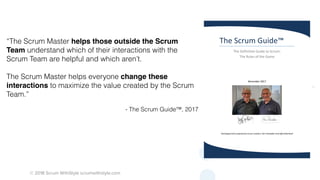
“The Scrum Master helps those outside the Scrum
Team understand which of their interactions with the
Scrum Team are helpful and which aren’t.
The Scrum Master helps everyone change these
interactions to maximize the value created by the Scrum
Team.”
- The Scrum Guide™, 2017
The Scrum Guide™
The Definitive Guide to Scrum:
The Rules of the Game
November 2017
Developed and sustained by Scrum creators: Ken Schwaber and Jeff Sutherland
@rowanb© 2018 Scrum WithStyle scrumwithstyle.com
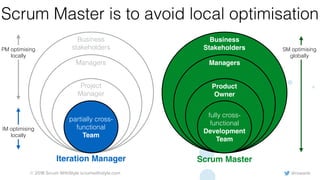
Scrum Master is to avoid local optimisation
Business
stakeholders
Managers
Project
Manager
partially cross-
functional
Team
Business
Stakeholders
Managers
Product
Owner
fully cross-
functional
Development
Team
Iteration Manager Scrum Master
SM optimising
globally
PM optimising
locally
IM optimising
locally
@rowanb© 2018 Scrum WithStyle scrumwithstyle.com
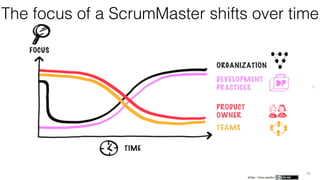
The focus of a ScrumMaster shifts over time
Not a Delivery Manager /
Delivery Lead
@rowanb© 2018 Scrum WithStyle scrumwithstyle.com
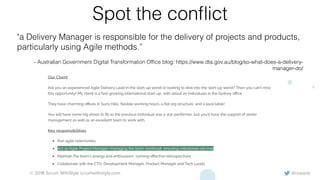
Spot the conflict
"a Delivery Manager is responsible for the delivery of projects and products,
particularly using Agile methods.”
- Australian Government Digital Transformation Office blog: https://www.dta.gov.au/blog/so-what-does-a-delivery-
manager-do/
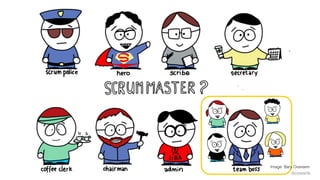
Not a Project Manager
© 2018 Scrum WithStyle scrumwithstyle.com @rowanb@rowanb
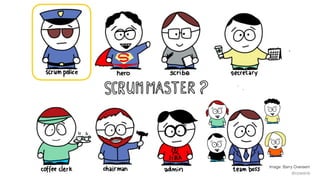
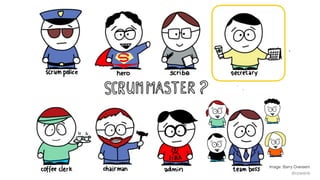
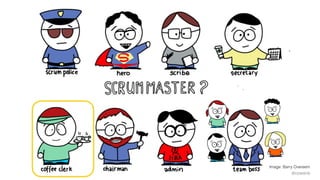
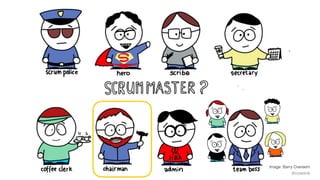
Image: Barry Overeem
© 2018 Scrum WithStyle scrumwithstyle.com @rowanb@rowanb
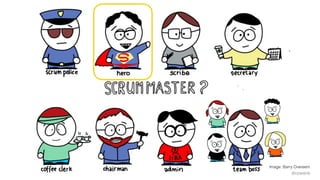
Image: Barry Overeem
© 2018 Scrum WithStyle scrumwithstyle.com @rowanb@rowanb
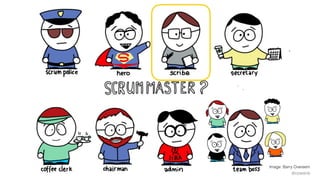
Image: Barry Overeem
© 2018 Scrum WithStyle scrumwithstyle.com @rowanb@rowanb
Image: Barry Overeem
© 2018 Scrum WithStyle scrumwithstyle.com @rowanb@rowanb
Image: Barry Overeem
© 2018 Scrum WithStyle scrumwithstyle.com @rowanb@rowanb
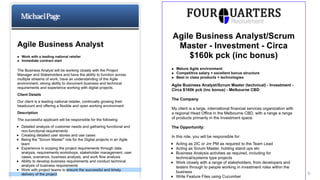
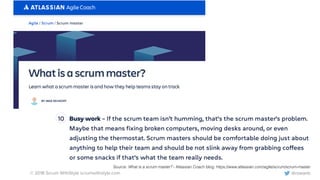
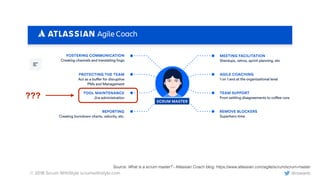
Source: What is a scrum master? - Atlassian Coach blog: https://www.atlassian.com/agile/scrum/scrum-master
© 2018 Scrum WithStyle scrumwithstyle.com @rowanb@rowanb
Image: Barry Overeem
© 2018 Scrum WithStyle scrumwithstyle.com @rowanb@rowanb
Image: Barry Overeem
© 2018 Scrum WithStyle scrumwithstyle.com @rowanb@rowanb
???
Source: What is a scrum master? - Atlassian Coach blog: https://www.atlassian.com/agile/scrum/scrum-master
Not a small role “on the side”
© 2018 Scrum WithStyle scrumwithstyle.com @rowanb@rowanb
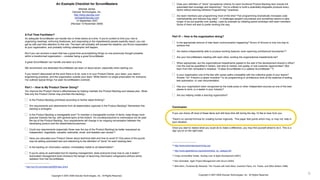
An Example Checklist for ScrumMasters
Michael James
Danube Technologies, Inc.
http://www.danube.com
michael@danube.com
14 September 2007
(Revised 13 November 2009)
A Full Time Facilitator?
An adequate ScrumMaster can handle two or three teams at a time. If you're content to limit your role to
organizing meetings, enforcing timeboxes, and responding to the impediments people explicitly report, you can
get by with part time attention to this role. The team will probably still exceed the baseline, pre-Scrum expectation
at your organization, and probably nothing catastrophic will happen.
But if you can envision a team that has a great time accomplishing things no one previously thought possible,
within a transformed organization -- consider being a great ScrumMaster.
A great ScrumMaster can handle one team at a time.
We recommend one dedicated ScrumMaster per team of about seven, especially when starting out.
If you haven't discovered all the work there is to do, tune in to your Product Owner, your team, your team's
engineering practices, and the organization outside your team. While there's no single prescription for everyone,
I've outlined typical things I've seen ScrumMasters overlook.
Part I -- How Is My Product Owner Doing?
You improve the Product Ownerʼs effectiveness by helping maintain the Product Backlog and release plan. (Note
that only the Product Owner may prioritize the backlog.)
Is the Product Backlog prioritized according to his/her latest thinking?
Are requirements and desirements from all stakeholders captured in the Product Backlog? Remember this
backlog is emergent.
Is the Product Backlog a manageable size? To maintain a manageable number of items, keep things more
granular towards the top, with general epics at the bottom. It's counterproductive to overanalyze too far past
the top of the Product Backlog. Your requirements will change in an ongoing conversation between the
developing product and the stakeholders/customers.
Could any requirements (especially those near the top of the Product Backlog) be better expressed as
independent, negotiable, valuable, estimable, small, and testable user stories1?
Have you educated your Product Owner about technical debt and how to avoid it? One piece of the puzzle
may be adding automated test and refactoring to the definition of "done" for each backlog item.
Is the backlog an information radiator, immediately visible to all stakeholders?
If you're using an automated tool for backlog management, does everyone know how to use it easily?
Automated management tools introduce the danger of becoming information refrigerators without active
radiation from the ScrumMaster.
Copyright © 2007-2009 Danube Technologies, Inc. All Rights Reserved.
1 http://xp123.com/xplor/xp0308/index.shtml
Does your definition of "done" (acceptance criteria) for each functional Product Backlog Item include full
automated test coverage and refactoring? Youʼre unlikely to build a potentially-shippable products every
Sprint without learning eXtreme Programming10 practices.
Are team members pair programming most of the time? Pair programming dramatically increases code
maintainability and reduces bug rates11. It challenges people's boundaries and sometimes seems to take
longer (if we put quantity over quality). Lead by example by initiating paired workdays with team members.
Some of them will start to prefer working this way.
Part IV -- How is the organization doing?
Is the appropriate amount of inter-team communication happening? Scrum of Scrums is only one way to
achieve this.
Are teams independently able to produce working features, even spanning architectural boundaries?12
Are your ScrumMasters meeting with each other, working the organizational impediments list?
When appropriate, are the organizational impediments pasted to the wall of the development director's office?
Can the cost be quantified in dollars, lost time to market, lost quality, or lost customer opportunities? (But
learn from Ken Schwaber's mistakes: "A dead ScrumMaster is a useless ScrumMaster."13)
Is your organization one of the few with career paths compatible with the collective goals of your teams?
Answer "no" if there's a career incentive14 to do programming or architecture work at the expense of testing,
test automation, or user documentation.
Has your organization been recognized by the trade press or other independent sources as one of the best
places to work, or a leader in your industry?
Are you helping create a learning organization?
Conclusion
If you can check off most of these items and still have time left during the day, Iʼd like to hear from you.
Thereʼs no canned formula for creating human ingenuity. This paper lists points which may, or may not, help in
your situation.
Once you start to realize what you could do to make a difference, you may find yourself afraid to do it. This is a
sign you're on the right track.
Copyright © 2007-2009 Danube Technologies, Inc. All Rights Reserved.
10 http://www.extremeprogramming.org/
11 http://www.agilealliance.org/article/articles_by_category/35
12 Craig Larman/Bas Vodde, Scaling Lean & Agile Development (2007)
13 Ken Schwaber, Agile Project Management with Scrum (2004)
14 Alfie Kohn, Punished By Rewards: The Trouble with Gold Stars, Incentive Plans, A's, Praise, and Other Bribes (1999)
Not a co-ordinator
@rowanb© 2018 Scrum WithStyle scrumwithstyle.com
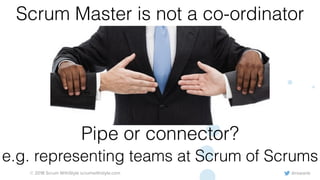
Scrum Master is not a co-ordinator
Pipe or connector?
e.g. representing teams at Scrum of Scrums
Not an administrator
@rowanb© 2018 Scrum WithStyle scrumwithstyle.com
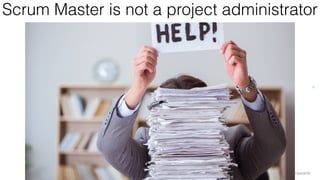
Scrum Master is not a project administrator
© 2018 Scrum WithStyle scrumwithstyle.com @rowanb@rowanb
Image: Bary Overeem
What a Scrum Master is
© 2008-18 Scrum WithStyle scrumwithstyle.com
End-to-end cross-functional, engineering capability
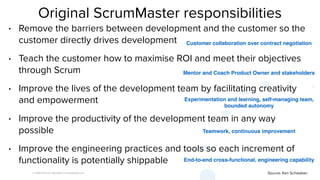
Original ScrumMaster responsibilities
• Remove the barriers between development and the customer so the
customer directly drives development
• Teach the customer how to maximise ROI and meet their objectives
through Scrum
• Improve the lives of the development team by facilitating creativity
and empowerment
• Improve the productivity of the development team in any way
possible
• Improve the engineering practices and tools so each increment of
functionality is potentially shippable
Source: Ken Schwaber.
Customer collaboration over contract negotiation
Mentor and Coach Product Owner and stakeholders
Experimentation and learning, self-managing team,
bounded autonomy
Teamwork, continuous improvement
© 2008-18 Scrum WithStyle scrumwithstyle.com
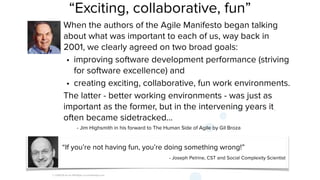
“Exciting, collaborative, fun”
When the authors of the Agile Manifesto began talking
about what was important to each of us, way back in
2001, we clearly agreed on two broad goals:
• improving software development performance (striving
for software excellence) and
• creating exciting, collaborative, fun work environments.
The latter - better working environments - was just as
important as the former, but in the intervening years it
often became sidetracked...
- Jim Highsmith in his forward to The Human Side of Agile by Gil Broza
“If you’re not having fun, you’re doing something wrong!”
- Joseph Pelrine, CST and Social Complexity Scientist
@rowanb© 2018 Scrum WithStyle scrumwithstyle.com
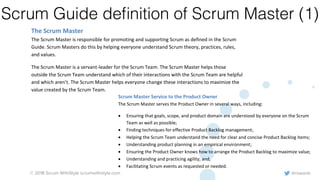
Scrum Guide definition of Scrum Master (1)
Scrum Master Service to the Product Owner
The Scrum Master serves the Product Owner in several ways, including:
• Ensuring that goals, scope, and product domain are understood by everyone on the Scrum
Team as well as possible;
• Finding techniques for effective Product Backlog management;
• Helping the Scrum Team understand the need for clear and concise Product Backlog items;
• Understanding product planning in an empirical environment;
• Ensuring the Product Owner knows how to arrange the Product Backlog to maximize value;
• Understanding and practicing agility; and,
• Facilitating Scrum events as requested or needed.
Scrum Master Service to the Development Team
©2017 Ken Schwaber and Jeff Sutherland. Offered for license under the Attribution Share-Alike license of Creative
Commons, accessible at http://creativecommons.org/licenses/by-sa/4.0/legalcode and also described in summary form
at http://creativecommons.org/licenses/by-sa/4.0/. By utilizing this Scrum Guide, you acknowledge and agree that you
have read and agree to be bound by the terms of the Attribution Share-Alike license of Creative Commons.
Page | 7
coordination. Large Development Teams generate too much complexity for an empirical process
to be useful. The Product Owner and Scrum Master roles are not included in this count unless
they are also executing the work of the Sprint Backlog.
The Scrum Master
The Scrum Master is responsible for promoting and supporting Scrum as defined in the Scrum
Guide. Scrum Masters do this by helping everyone understand Scrum theory, practices, rules,
and values.
The Scrum Master is a servant-leader for the Scrum Team. The Scrum Master helps those
outside the Scrum Team understand which of their interactions with the Scrum Team are helpful
and which aren’t. The Scrum Master helps everyone change these interactions to maximize the
value created by the Scrum Team.
@rowanb© 2018 Scrum WithStyle scrumwithstyle.com
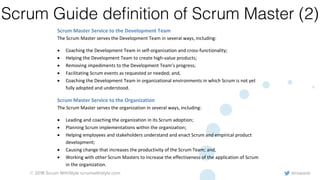
Scrum Guide definition of Scrum Master (2)
• Ensuring the Product Owner knows how to arrange the Product Backlog to maximize value;
• Understanding and practicing agility; and,
• Facilitating Scrum events as requested or needed.
Scrum Master Service to the Development Team
The Scrum Master serves the Development Team in several ways, including:
• Coaching the Development Team in self-organization and cross-functionality;
• Helping the Development Team to create high-value products;
• Removing impediments to the Development Team’s progress;
• Facilitating Scrum events as requested or needed; and,
• Coaching the Development Team in organizational environments in which Scrum is not yet
fully adopted and understood.
Scrum Master Service to the Organization
The Scrum Master serves the organization in several ways, including:
• Leading and coaching the organization in its Scrum adoption;
• Planning Scrum implementations within the organization;
• Helping employees and stakeholders understand and enact Scrum and empirical product
development;
• Causing change that increases the productivity of the Scrum Team; and,
• Working with other Scrum Masters to increase the effectiveness of the application of Scrum
in the organization.
@rowanb© 2018 Scrum WithStyle scrumwithstyle.com
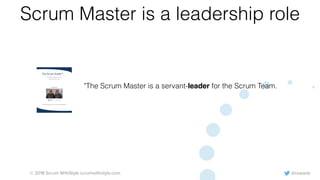
Scrum Master is a leadership role
"The Scrum Master is a servant-leader for the Scrum Team.
The Scrum Guide™
The Definitive Guide to Scrum:
The Rules of the Game
November 2017
Developed and sustained by Scrum creators: Ken Schwaber and Jeff Sutherland
@rowanb© 2018 Scrum WithStyle scrumwithstyle.com
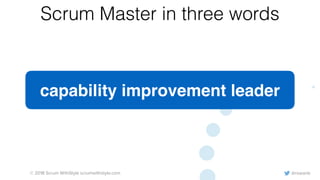
Scrum Master in three words
capability improvement leader
@rowanb© 2018 Scrum WithStyle scrumwithstyle.com
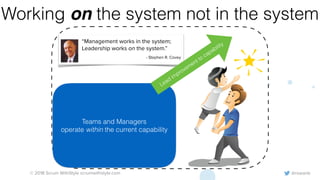
Teams and Managers
Working on the system not in the system
Teams and Managers
operate within the current capability
“Management works in the system;
Leadership works on the system.”
- Stephen R. Covey
Lead improvement to capability
@rowanb© 2018 Scrum WithStyle scrumwithstyle.com
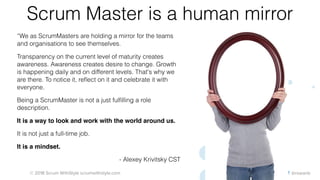
Scrum Master is a human mirror
“We as ScrumMasters are holding a mirror for the teams
and organisations to see themselves.
Transparency on the current level of maturity creates
awareness. Awareness creates desire to change. Growth
is happening daily and on different levels. That's why we
are there. To notice it, reflect on it and celebrate it with
everyone.
Being a ScrumMaster is not a just fulfilling a role
description.
It is a way to look and work with the world around us.
It is not just a full-time job.
It is a mindset.
- Alexey Krivitsky CST
@rowanb© 2018 Scrum WithStyle scrumwithstyle.com
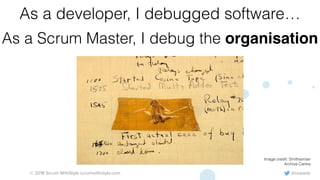
As a developer, I debugged software…
As a Scrum Master, I debug the organisation
Image credit: Smithsonian
Archive Centre
How a Scrum Master operates
© 2018 Scrum WithStyle scrumwithstyle.com @rowanb@rowanb
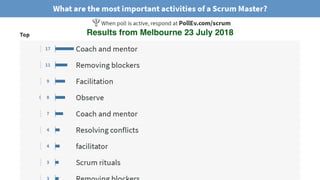
Results from Melbourne 23 July 2018
© 2018 Scrum WithStyle scrumwithstyle.com @rowanb@rowanb
Results from Sydney 25 June 2018
@rowanb© 2018 Scrum WithStyle scrumwithstyle.com
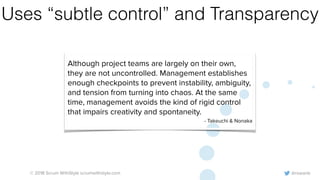
Uses “subtle control” and Transparency
Although project teams are largely on their own,
they are not uncontrolled. Management establishes
enough checkpoints to prevent instability, ambiguity,
and tension from turning into chaos. At the same
time, management avoids the kind of rigid control
that impairs creativity and spontaneity.
- Takeuchi & Nonaka
© 2018 Scrum WithStyle scrumwithstyle.com @rowanb@rowanb
Image: Barry Overeem
@rowanb© 2018 Scrum WithStyle scrumwithstyle.com
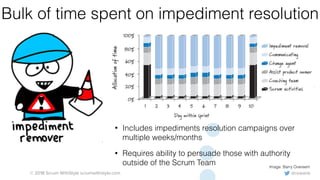
Bulk of time spent on impediment resolution
• Includes impediments resolution campaigns over
multiple weeks/months
• Requires ability to persuade those with authority
outside of the Scrum Team Image: Barry Overeem
@rowanb© 2018 Scrum WithStyle scrumwithstyle.com
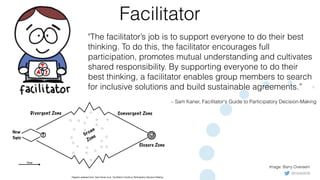
Facilitator
"The facilitator’s job is to support everyone to do their best
thinking. To do this, the facilitator encourages full
participation, promotes mutual understanding and cultivates
shared responsibility. By supporting everyone to do their
best thinking, a facilitator enables group members to search
for inclusive solutions and build sustainable agreements.”
– Sam Kaner, Facilitator's Guide to Participatory Decision-Making
Time
Groan
Zone
Divergent Zone
Closure Zone
New
Topic
? ✔
Diagram adapted from: Sam Kaner et al., Facilitator’s Guide to Participatory Decision-Making
Convergent Zone
Image: Barry Overeem
@rowanb© 2018 Scrum WithStyle scrumwithstyle.com
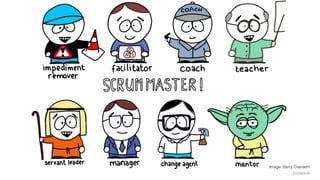
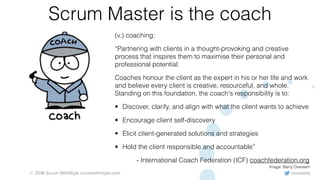
Scrum Master is the coach
(v.) coaching:
“Partnering with clients in a thought-provoking and creative
process that inspires them to maximise their personal and
professional potential.
Coaches honour the client as the expert in his or her life and work
and believe every client is creative, resourceful, and whole.
Standing on this foundation, the coach's responsibility is to:
• Discover, clarify, and align with what the client wants to achieve
• Encourage client self-discovery
• Elicit client-generated solutions and strategies
• Hold the client responsible and accountable”
- International Coach Federation (ICF) coachfederation.org
Image: Barry Overeem
@rowanb© 2018 Scrum WithStyle scrumwithstyle.com
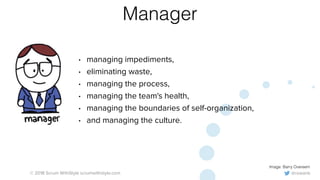
Manager
• managing impediments,
• eliminating waste,
• managing the process,
• managing the team's health,
• managing the boundaries of self-organization,
• and managing the culture.
Image: Barry Overeem
@rowanb© 2018 Scrum WithStyle scrumwithstyle.com
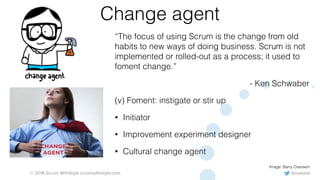
Change agent
“The focus of using Scrum is the change from old
habits to new ways of doing business. Scrum is not
implemented or rolled-out as a process; it used to
foment change.”
- Ken Schwaber
(v) Foment: instigate or stir up
• Initiator
• Improvement experiment designer
• Cultural change agent
Image: Barry Overeem
@rowanb© 2018 Scrum WithStyle scrumwithstyle.com
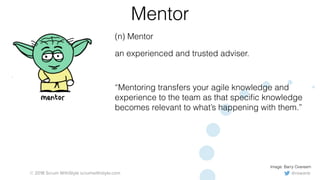
Mentor
(n) Mentor
an experienced and trusted adviser.
“Mentoring transfers your agile knowledge and
experience to the team as that specific knowledge
becomes relevant to what’s happening with them.”
Image: Barry Overeem
@rowanb© 2018 Scrum WithStyle scrumwithstyle.com
Example Improvement Areas
• Done Improve cross-functionality and development practices to produce
Potentially Releasable increments (at least) every Sprint
• Team performance Coach team to high performance, perhaps exceptional
• Impediments Coach management on actively resolving team and
organisational impediments
• Educate management such that they consider Agile and Lean principles in
every decision
• Educate stakeholders so that they understand how to see progress in terms
of value and exploit the competitive advantage of agility
• Create a culture of continuous improvement
Servant-as-leader
© 2018 Scrum WithStyle scrumwithstyle.com @rowanb@rowanb
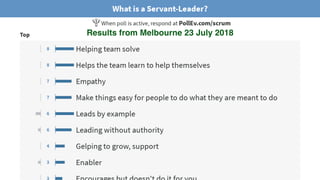
Results from Melbourne 23 July 2018
© 2018 Scrum WithStyle scrumwithstyle.com @rowanb@rowanb
Results from Sydney 25 June 2018
@rowanb© 2018 Scrum WithStyle scrumwithstyle.com
Shepherd to the team
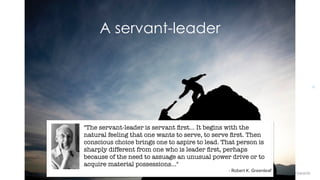
A servant-leader
"The servant-leader is servant first… It begins with the
natural feeling that one wants to serve, to serve first. Then
conscious choice brings one to aspire to lead. That person is
sharply different from one who is leader first, perhaps
because of the need to assuage an unusual power drive or to
acquire material possessions…"
- Robert K. Greenleaf
@rowanb© 2018 Scrum WithStyle scrumwithstyle.com
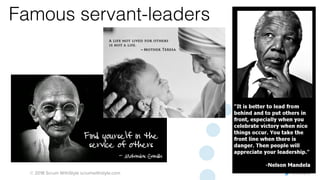
Famous servant-leaders
@rowanb© 2018 Scrum WithStyle scrumwithstyle.com
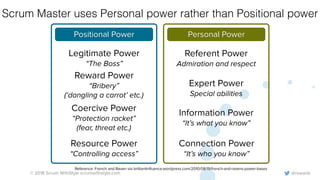
Scrum Master uses Personal power rather than Positional power
Positional Power Personal Power
Legitimate Power
“The Boss”
Reward Power
“Bribery”
(‘dangling a carrot’ etc.)
Coercive Power
“Protection racket”
(fear, threat etc.)
Resource Power
“Controlling access”
Referent Power
Admiration and respect
Expert Power
Special abilities
Information Power
“It’s what you know”
Connection Power
“It’s who you know”
Reference: French and Raven via brilliantinfluence.wordpress.com/2010/08/19/french-and-ravens-power-bases
@rowanb© 2018 Scrum WithStyle scrumwithstyle.com
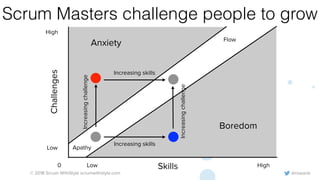
Scrum Masters challenge people to grow
Anxiety
Boredom
High
Low
HighLow Skills
Challenges
0
Flow
Increasingchallenge
Increasingchallenge
Increasing skills
Increasing skills
Apathy
© 2008-18 Scrum WithStyle scrumwithstyle.com
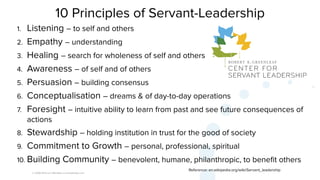
10 Principles of Servant-Leadership
1. Listening – to self and others
2. Empathy – understanding
3. Healing – search for wholeness of self and others
4. Awareness – of self and of others
5. Persuasion – building consensus
6. Conceptualisation – dreams & of day-to-day operations
7. Foresight – intuitive ability to learn from past and see future consequences of
actions
8. Stewardship – holding institution in trust for the good of society
9. Commitment to Growth – personal, professional, spiritual
10. Building Community – benevolent, humane, philanthropic, to benefit others
Reference: en.wikipedia.org/wiki/Servant_leadership
@rowanb© 2018 Scrum WithStyle scrumwithstyle.com
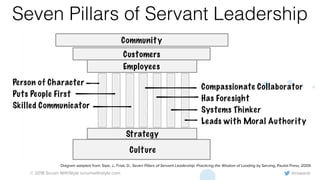
Seven Pillars of Servant Leadership
Diagram adapted from: Sipe, J., Frisk, D., Seven Pillars of Servant Leadership: Practicing the Wisdom of Leading by Serving, Paulist Press, 2009.
@rowanb© 2018 Scrum WithStyle scrumwithstyle.com
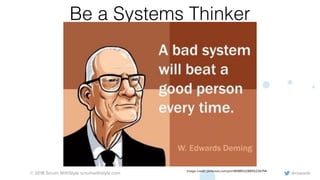
Be a Systems Thinker
Image credit: pinterest.com/pin/481885228855226794
@rowanb© 2018 Scrum WithStyle scrumwithstyle.com
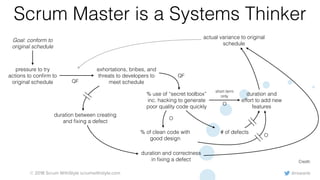
Scrum Master is a Systems Thinker
Goal: conform to
original schedule
pressure to try
actions to confirm to
original schedule
exhortations, bribes, and
threats to developers to
meet schedule
% use of “secret toolbox”
inc. hacking to generate
poor quality code quickly
% of clean code with
good design
# of defects
duration and
effort to add new
features
actual variance to original
schedule
duration between creating
and fixing a defect
duration and correctness
in fixing a defect
O
O
short term
only
QF
QF
O
Credit:
@rowanb© 2018 Scrum WithStyle scrumwithstyle.com
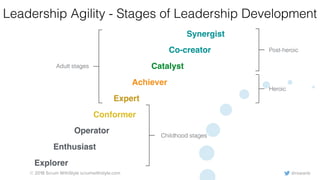
Leadership Agility - Stages of Leadership Development
Explorer
Enthusiast
Operator
Conformer
Expert
Achiever
Catalyst
Co-creator
Synergist
Childhood stages
Adult stages
Heroic
Post-heroic
@rowanb© 2018 Scrum WithStyle scrumwithstyle.com
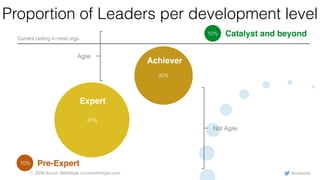
Proportion of Leaders per development level
10%
45%
35%
10%
Pre-Expert
Expert
Achiever
Catalyst and beyondCurrent ceiling in most orgs
Agile
Not Agile
@rowanb© 2018 Scrum WithStyle scrumwithstyle.com
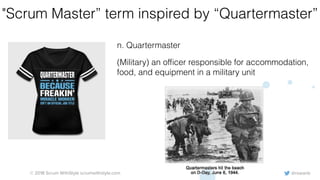
"Scrum Master” term inspired by “Quartermaster”
n. Quartermaster
(Military) an officer responsible for accommodation,
food, and equipment in a military unit
Comparing Scrum Master
with Agile Coach
@rowanb© 2018 Scrum WithStyle scrumwithstyle.com
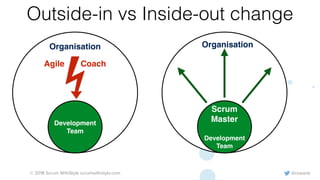
Outside-in vs Inside-out change
Development
Team
Scrum
MasterDevelopment
Team
Agile Coach
Organisation Organisation
@rowanb© 2018 Scrum WithStyle scrumwithstyle.com
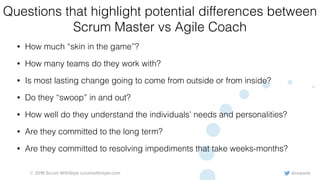
Questions that highlight potential differences between
Scrum Master vs Agile Coach
• How much “skin in the game”?
• How many teams do they work with?
• Is most lasting change going to come from outside or from inside?
• Do they “swoop” in and out?
• How well do they understand the individuals’ needs and personalities?
• Are they committed to the long term?
• Are they committed to resolving impediments that take weeks-months?
@rowanb© 2018 Scrum WithStyle scrumwithstyle.com
Fear of being judged by seagull coach
@rowanb© 2018 Scrum WithStyle scrumwithstyle.com
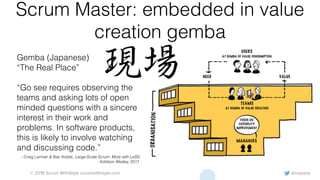
Scrum Master: embedded in value
creation gemba
Gemba (Japanese)
“The Real Place”
“Go see requires observing the
teams and asking lots of open
minded questions with a sincere
interest in their work and
problems. In software products,
this is likely to involve watching
and discussing code.”
- Craig Larman & Bas Vodde, Large-Scale Scrum: More with LeSS,
Addison Wesley, 2017.
@rowanb© 2018 Scrum WithStyle scrumwithstyle.com
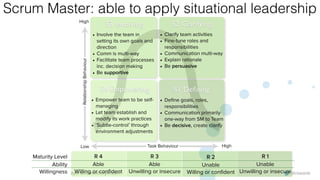
Scrum Master: able to apply situational leadership
RelationshipBehaviour
Task Behaviour High
High
Low
Maturity Level
Ability
Willingness
S3 Involving
• Involve the team in
setting its own goals and
direction
• Comm is multi-way
• Facilitate team processes
inc. decision making
• Be supportive
S2 Clarifying
• Clarify team activities
• Fine-tune roles and
responsibilities
• Communication multi-way
• Explain rationale
• Be persuasive
S4 Empowering
• Empower team to be self-
managing
• Let team establish and
modify its work practices
• ‘Subtle-control’ through
environment adjustments
S1 Defining
• Define goals, roles,
responsibilities
• Communication primarily
one-way from SM to Team
• Be decisive, create clarify
R 1
Unable
Unwilling or insecure
R 2
Unable
Willing or confident
R 3
Able
Unwilling or insecure
R 4
Able
Willing or confident
@rowanb© 2018 Scrum WithStyle scrumwithstyle.com
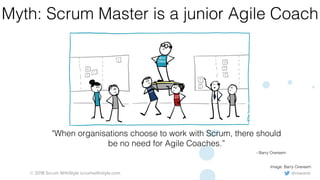
Myth: Scrum Master is a junior Agile Coach
Image: Barry Overeem
"When organisations choose to work with Scrum, there should
be no need for Agile Coaches.”
- Barry Overeem
@rowanb© 2018 Scrum WithStyle scrumwithstyle.com
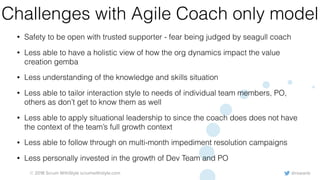
Challenges with Agile Coach only model
• Safety to be open with trusted supporter - fear being judged by seagull coach
• Less able to have a holistic view of how the org dynamics impact the value
creation gemba
• Less understanding of the knowledge and skills situation
• Less able to tailor interaction style to needs of individual team members, PO,
others as don’t get to know them as well
• Less able to apply situational leadership to since the coach does does not have
the context of the team’s full growth context
• Less able to follow through on multi-month impediment resolution campaigns
• Less personally invested in the growth of Dev Team and PO
Scrum Master Career paths
© 2018 Scrum WithStyle scrumwithstyle.com @rowanb@rowanb
@rowanb© 2018 Scrum WithStyle scrumwithstyle.com
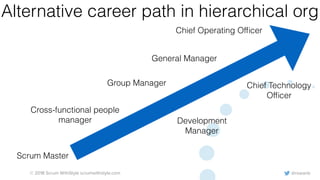
Alternative career path in hierarchical org
General Manager
Chief Operating Officer
Group Manager
Scrum Master
Cross-functional people
manager
Chief Technology
Officer
Development
Manager
Conclusion
© 2018 Scrum WithStyle scrumwithstyle.com @rowanb@rowanb
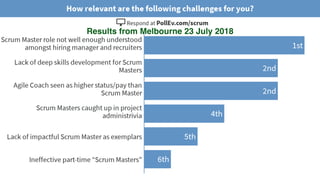
Results from Melbourne 23 July 2018
© 2018 Scrum WithStyle scrumwithstyle.com @rowanb@rowanb
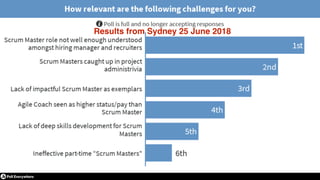
Results from Sydney 25 June 2018
@rowanb© 2018 Scrum WithStyle scrumwithstyle.com
Take-aways
The Scrum Master role remains widely misunderstood
We need to do a better job of explaining our role
It starts with us!
There are far few too many Scrum Masters with the skills and confidence to
be impactful
We need to advance our own development
Path to CSP is such a learning pathway
#sydscrum
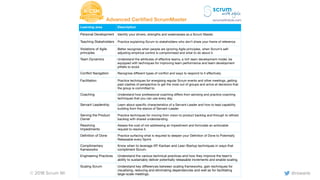
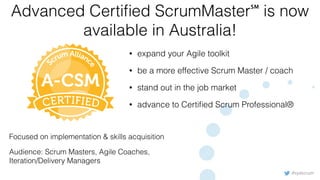
Advanced Certified ScrumMaster℠ is now
available in Australia!
• expand your Agile toolkit
• be a more effective Scrum Master / coach
• stand out in the job market
• advance to Certified Scrum Professional®
Focused on implementation & skills acquisition
Audience: Scrum Masters, Agile Coaches,
Iteration/Delivery Managers
© 2018 Scrum WithStyle scrumwithstyle.com @rowanb@rowanb
Advanced Certified ScrumMaster scrumwithstyle.com
Learning area Description
Personal Development Identify your drivers, strengths and weaknesses as a Scrum Master.
Teaching Stakeholders Practice explaining Scrum to stakeholders who don’t share your frame of reference.
Violations of Agile
principles
Better recognise when people are ignoring Agile principles, when Scrum’s self-
adjusting empirical control is compromised and what to do about it.
Team Dynamics Understand the attributes of effective teams, a rich team development model, be
equipped with techniques for improving team performance and team development
pitfalls to avoid.
Conflict Navigation Recognise different types of conflict and ways to respond to it effectively.
Facilitation Practice techniques for energising regular Scrum events and other meetings, getting
past clashes of perspective to get the most out of groups and arrive at decisions that
the group is committed to.
Coaching Understand how professional coaching differs from advising and practice coaching
techniques that you can use every day.
Servant Leadership Learn about specific characteristics of a Servant-Leader and how to lead capability
building from the stance of Servant-Leader.
Serving the Product
Owner
Practice techniques for moving from vision to product backlog and through to refined
backlog with shared understanding.
Resolving
Impediments
Assess the cost of not addressing an impediment and formulate an actionable
request to resolve it.
Definition of Done Practice surfacing what is required to deepen your Definition of Done to Potentially
Releasable every Sprint.
Complimentary
frameworks
Know when to leverage XP, Kanban and Lean Startup techniques in ways that
compliment Scrum.
Engineering Practices Understand the various technical practices and how they improve the team’s
ability to sustainably deliver potentially releasable increments and enable scaling.
Scaling Scrum Understand key differences between scaling frameworks, gain techniques for
visualising, reducing and eliminating dependencies and well as for facilitating
large-scale meetings.
© 2018 Scrum WithStyle scrumwithstyle.com @rowanb@rowanb
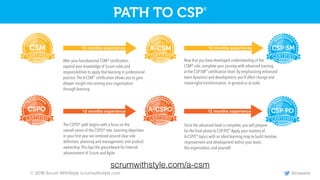
After your foundational CSM® certification,
expand your knowledge of Scrum roles and
responsibilities to apply that learning in professional
practice.The A-CSM™
certification allows you to gain
deeper insight into serving your organization
through learning.
Now that you have developed understanding of the
CSM® role, complete your journey with advanced training
at the CSP-SM™
certification level. By emphasizing enhanced
team dynamics and development, you’ll affect change and
meaningful transformation, in general or at scale.
The CSPO® path begins with a focus on the
overall vision of the CSPO® role. Learning objectives
in your first year are centered around clear role
definition, planning and management, and product
ownership.This lays the groundwork for internal
advancement of Scrum and Agile.
Once the advanced level is complete, you will prepare
for the final phase to CSP-PO.™
Apply your mastery of
A-CSPO™
topics with an ideal learning map to build iterative
improvement and development within your team,
the organization, and yourself.
PATH TO CSP®
A-CSM
A-CSPO
scrumwithstyle.com/a-csm
© 2016 Scrum WithStyle scrumwithstyle.com @rowanb
We’re@rowanb au.linkedin.com/in/rowanbunning
Rowan Bunning
rowan@scrumwithstyle.com scrumwithstyle.com

Advancing as a Scrum Master or Agile Coach

  • 1.
    Advancing as a ScrumMaster or Agile Coach and helping others to understand the role Rowan Bunning CST - July 2018
  • 2.
    @rowanb© 2018 ScrumWithStyle scrumwithstyle.com Agenda • Our Current Reality • What a Scrum Master is not • What a Scrum Master is • How a Scrum Master operates • Servant-as-leader • Comparing Scrum Master with Agile Coach • Scrum Master career paths
  • 3.
    @rowanb© 2018 ScrumWithStyle scrumwithstyle.com My Agile journey • 2001 Introduced to eXtreme Programming • 2003 Introduced Scrum and became a Scrum Master • 2005 Went on first Certified ScrumMaster course in Australia • 2006 Became first Certified Scrum Professional in Australia • 2006 Unsuccessful attempt to find Agile Coaching work in Australia • 2007 Hired as an Agile Coach at top Scrum consultancy in London • 2008 Worked mainly as a Scrum Master in London and Dublin • 2008 Became a Certified Scrum Trainer • 2008-2018 Scrum Training and Agile Coaching across Australia and New Zealand • 2018 Became one of first Certified Agile Leadership credential II (CAL II) cohort • 2018 Became first Path to CSP Educator in Australia 2005 2006 2008 2018 2017 2015 2010
  • 4.
  • 5.
    © 2018 ScrumWithStyle scrumwithstyle.com @rowanb@rowanb Results from Melbourne 23 July 2018
  • 6.
    © 2018 ScrumWithStyle scrumwithstyle.com @rowanb@rowanb Results from Sydney 25 June 2018
  • 7.
    © 2018 ScrumWithStyle scrumwithstyle.com @rowanb@rowanb Results from Melbourne 23 July 2018
  • 8.
    © 2018 ScrumWithStyle scrumwithstyle.com @rowanb@rowanb Results from Sydney 25 June 2018
  • 9.
    © 2018 ScrumWithStyle scrumwithstyle.com @rowanb@rowanb Results from Melbourne 23 July 2018
  • 10.
    © 2018 ScrumWithStyle scrumwithstyle.com @rowanb@rowanb Results from Sydney 25 June 2018
  • 11.
    What a ScrumMaster is not
  • 12.
    @rowanb© 2018 ScrumWithStyle scrumwithstyle.com The legacy tension Managers continue to want: an individual who… ensures milestones are met… ensures team meets commitments.
  • 13.
    @rowanb© 2018 ScrumWithStyle scrumwithstyle.com What a Scrum Master is not • Not responsible for delivery progress • Not an inwardly focused Iteration Manager • Not an Agile Delivery Manager / Delivery Lead • Not a Project Manager • Not a small role “on the side” • Not a co-ordinator • Not an administrator
  • 14.
    Not responsible fordelivery progress
  • 15.
    © 2008-18 ScrumWithStyle scrumwithstyle.com The Authority Matrix: four types of team Source: Leading Teams: Setting the Stage for Great Performances Hardcover, by J. Richard Hackman, Harvard Business Review Press, 2002. Copyright (c) 1986 by the American Psychological Association. Manager-led teams Self-Managing teams Self-Designing teams Self-Governing teams Setting overall direction Designing the team and its organisational context Monitoring and managing work process and progress Executing the team task ____________ ____________ ____________ © 2015 Scrum WithStyle scrumwithstyle.com Team’s Own Responsibility Management Responsibility Typical pre- Scrum Required by Scrum Increasingly recommended “delivery” progress
  • 16.
    @rowanb© 2018 ScrumWithStyle scrumwithstyle.com The intrinsic motivation paradox Edward L. Deci Research variable: “remember, it is your responsibility as a teacher to make sure your students perform up to high standards”. Results: 2x as much time talking 3x as many directives 3x as many controlling statements
  • 17.
    @rowanb© 2018 ScrumWithStyle scrumwithstyle.com Responsibility for delivery undermines autonomy Reference: Lv Yi https://blog.odd-e.com/yilv/2017/02/paradox-in-coaching-self-organizing-team.html "Scrum is the only approach that dedicates a role to create environments for learning, innovative teams - without giving contradictory responsibilities.” - Michael James, Shanghai Scrum Gathering 2013.
  • 18.
    Not an inwardlyfocused Iteration Manager
  • 19.
    @rowanb© 2018 ScrumWithStyle scrumwithstyle.com Origins of Iteration Manager “When teams were struggling to find high-priority work to do on one particular project in 2000, the solution was to identify someone who could provide a continual stream of high-priority functionality at a sustainable pace to the delivery teams. This is the role that has grown into the iteration manager (IM).” - ”What Is an Iteration Manager Anyway?", Tiffany Lentz, The ThoughWorks Anthology, 2008. “The split between release and iteration managers reflects the style and preferences of the two individuals that do it... We don't think our solution is one that necessarily everyone should follow.” - martinfowler.com/articles/planningXpIteration.html
  • 20.
    © 2018 ScrumWithStyle scrumwithstyle.com @rowanb@rowanb
  • 21.
    © 2018 ScrumWithStyle scrumwithstyle.com “The Scrum Master helps those outside the Scrum Team understand which of their interactions with the Scrum Team are helpful and which aren’t. The Scrum Master helps everyone change these interactions to maximize the value created by the Scrum Team.” - The Scrum Guide™, 2017 The Scrum Guide™ The Definitive Guide to Scrum: The Rules of the Game November 2017 Developed and sustained by Scrum creators: Ken Schwaber and Jeff Sutherland
  • 22.
    @rowanb© 2018 ScrumWithStyle scrumwithstyle.com Scrum Master is to avoid local optimisation Business stakeholders Managers Project Manager partially cross- functional Team Business Stakeholders Managers Product Owner fully cross- functional Development Team Iteration Manager Scrum Master SM optimising globally PM optimising locally IM optimising locally
  • 23.
    @rowanb© 2018 ScrumWithStyle scrumwithstyle.com The focus of a ScrumMaster shifts over time
  • 24.
    Not a DeliveryManager / Delivery Lead
  • 25.
    @rowanb© 2018 ScrumWithStyle scrumwithstyle.com Spot the conflict "a Delivery Manager is responsible for the delivery of projects and products, particularly using Agile methods.” - Australian Government Digital Transformation Office blog: https://www.dta.gov.au/blog/so-what-does-a-delivery- manager-do/
  • 26.
  • 27.
    © 2018 ScrumWithStyle scrumwithstyle.com @rowanb@rowanb
  • 28.
    © 2018 ScrumWithStyle scrumwithstyle.com @rowanb@rowanb
  • 29.
    © 2018 ScrumWithStyle scrumwithstyle.com @rowanb@rowanb
  • 30.
    © 2018 ScrumWithStyle scrumwithstyle.com @rowanb@rowanb Image: Barry Overeem
  • 31.
    © 2018 ScrumWithStyle scrumwithstyle.com @rowanb@rowanb Image: Barry Overeem
  • 32.
    © 2018 ScrumWithStyle scrumwithstyle.com @rowanb@rowanb Image: Barry Overeem
  • 33.
    © 2018 ScrumWithStyle scrumwithstyle.com @rowanb@rowanb Image: Barry Overeem
  • 34.
    © 2018 ScrumWithStyle scrumwithstyle.com @rowanb@rowanb Image: Barry Overeem
  • 35.
    © 2018 ScrumWithStyle scrumwithstyle.com @rowanb@rowanb Source: What is a scrum master? - Atlassian Coach blog: https://www.atlassian.com/agile/scrum/scrum-master
  • 36.
    © 2018 ScrumWithStyle scrumwithstyle.com @rowanb@rowanb Image: Barry Overeem
  • 37.
    © 2018 ScrumWithStyle scrumwithstyle.com @rowanb@rowanb Image: Barry Overeem
  • 38.
    © 2018 ScrumWithStyle scrumwithstyle.com @rowanb@rowanb ??? Source: What is a scrum master? - Atlassian Coach blog: https://www.atlassian.com/agile/scrum/scrum-master
  • 39.
    Not a smallrole “on the side”
  • 40.
    © 2018 ScrumWithStyle scrumwithstyle.com @rowanb@rowanb
  • 41.
    © 2018 ScrumWithStyle scrumwithstyle.com @rowanb@rowanb An Example Checklist for ScrumMasters Michael James Danube Technologies, Inc. http://www.danube.com michael@danube.com 14 September 2007 (Revised 13 November 2009) A Full Time Facilitator? An adequate ScrumMaster can handle two or three teams at a time. If you're content to limit your role to organizing meetings, enforcing timeboxes, and responding to the impediments people explicitly report, you can get by with part time attention to this role. The team will probably still exceed the baseline, pre-Scrum expectation at your organization, and probably nothing catastrophic will happen. But if you can envision a team that has a great time accomplishing things no one previously thought possible, within a transformed organization -- consider being a great ScrumMaster. A great ScrumMaster can handle one team at a time. We recommend one dedicated ScrumMaster per team of about seven, especially when starting out. If you haven't discovered all the work there is to do, tune in to your Product Owner, your team, your team's engineering practices, and the organization outside your team. While there's no single prescription for everyone, I've outlined typical things I've seen ScrumMasters overlook. Part I -- How Is My Product Owner Doing? You improve the Product Ownerʼs effectiveness by helping maintain the Product Backlog and release plan. (Note that only the Product Owner may prioritize the backlog.) Is the Product Backlog prioritized according to his/her latest thinking? Are requirements and desirements from all stakeholders captured in the Product Backlog? Remember this backlog is emergent. Is the Product Backlog a manageable size? To maintain a manageable number of items, keep things more granular towards the top, with general epics at the bottom. It's counterproductive to overanalyze too far past the top of the Product Backlog. Your requirements will change in an ongoing conversation between the developing product and the stakeholders/customers. Could any requirements (especially those near the top of the Product Backlog) be better expressed as independent, negotiable, valuable, estimable, small, and testable user stories1? Have you educated your Product Owner about technical debt and how to avoid it? One piece of the puzzle may be adding automated test and refactoring to the definition of "done" for each backlog item. Is the backlog an information radiator, immediately visible to all stakeholders? If you're using an automated tool for backlog management, does everyone know how to use it easily? Automated management tools introduce the danger of becoming information refrigerators without active radiation from the ScrumMaster. Copyright © 2007-2009 Danube Technologies, Inc. All Rights Reserved. 1 http://xp123.com/xplor/xp0308/index.shtml Does your definition of "done" (acceptance criteria) for each functional Product Backlog Item include full automated test coverage and refactoring? Youʼre unlikely to build a potentially-shippable products every Sprint without learning eXtreme Programming10 practices. Are team members pair programming most of the time? Pair programming dramatically increases code maintainability and reduces bug rates11. It challenges people's boundaries and sometimes seems to take longer (if we put quantity over quality). Lead by example by initiating paired workdays with team members. Some of them will start to prefer working this way. Part IV -- How is the organization doing? Is the appropriate amount of inter-team communication happening? Scrum of Scrums is only one way to achieve this. Are teams independently able to produce working features, even spanning architectural boundaries?12 Are your ScrumMasters meeting with each other, working the organizational impediments list? When appropriate, are the organizational impediments pasted to the wall of the development director's office? Can the cost be quantified in dollars, lost time to market, lost quality, or lost customer opportunities? (But learn from Ken Schwaber's mistakes: "A dead ScrumMaster is a useless ScrumMaster."13) Is your organization one of the few with career paths compatible with the collective goals of your teams? Answer "no" if there's a career incentive14 to do programming or architecture work at the expense of testing, test automation, or user documentation. Has your organization been recognized by the trade press or other independent sources as one of the best places to work, or a leader in your industry? Are you helping create a learning organization? Conclusion If you can check off most of these items and still have time left during the day, Iʼd like to hear from you. Thereʼs no canned formula for creating human ingenuity. This paper lists points which may, or may not, help in your situation. Once you start to realize what you could do to make a difference, you may find yourself afraid to do it. This is a sign you're on the right track. Copyright © 2007-2009 Danube Technologies, Inc. All Rights Reserved. 10 http://www.extremeprogramming.org/ 11 http://www.agilealliance.org/article/articles_by_category/35 12 Craig Larman/Bas Vodde, Scaling Lean & Agile Development (2007) 13 Ken Schwaber, Agile Project Management with Scrum (2004) 14 Alfie Kohn, Punished By Rewards: The Trouble with Gold Stars, Incentive Plans, A's, Praise, and Other Bribes (1999)
  • 42.
  • 43.
    @rowanb© 2018 ScrumWithStyle scrumwithstyle.com Scrum Master is not a co-ordinator Pipe or connector? e.g. representing teams at Scrum of Scrums
  • 44.
  • 45.
    @rowanb© 2018 ScrumWithStyle scrumwithstyle.com Scrum Master is not a project administrator
  • 46.
    © 2018 ScrumWithStyle scrumwithstyle.com @rowanb@rowanb Image: Bary Overeem
  • 47.
    What a ScrumMaster is
  • 48.
    © 2008-18 ScrumWithStyle scrumwithstyle.com End-to-end cross-functional, engineering capability Original ScrumMaster responsibilities • Remove the barriers between development and the customer so the customer directly drives development • Teach the customer how to maximise ROI and meet their objectives through Scrum • Improve the lives of the development team by facilitating creativity and empowerment • Improve the productivity of the development team in any way possible • Improve the engineering practices and tools so each increment of functionality is potentially shippable Source: Ken Schwaber. Customer collaboration over contract negotiation Mentor and Coach Product Owner and stakeholders Experimentation and learning, self-managing team, bounded autonomy Teamwork, continuous improvement
  • 49.
    © 2008-18 ScrumWithStyle scrumwithstyle.com “Exciting, collaborative, fun” When the authors of the Agile Manifesto began talking about what was important to each of us, way back in 2001, we clearly agreed on two broad goals: • improving software development performance (striving for software excellence) and • creating exciting, collaborative, fun work environments. The latter - better working environments - was just as important as the former, but in the intervening years it often became sidetracked... - Jim Highsmith in his forward to The Human Side of Agile by Gil Broza “If you’re not having fun, you’re doing something wrong!” - Joseph Pelrine, CST and Social Complexity Scientist
  • 50.
    @rowanb© 2018 ScrumWithStyle scrumwithstyle.com Scrum Guide definition of Scrum Master (1) Scrum Master Service to the Product Owner The Scrum Master serves the Product Owner in several ways, including: • Ensuring that goals, scope, and product domain are understood by everyone on the Scrum Team as well as possible; • Finding techniques for effective Product Backlog management; • Helping the Scrum Team understand the need for clear and concise Product Backlog items; • Understanding product planning in an empirical environment; • Ensuring the Product Owner knows how to arrange the Product Backlog to maximize value; • Understanding and practicing agility; and, • Facilitating Scrum events as requested or needed. Scrum Master Service to the Development Team ©2017 Ken Schwaber and Jeff Sutherland. Offered for license under the Attribution Share-Alike license of Creative Commons, accessible at http://creativecommons.org/licenses/by-sa/4.0/legalcode and also described in summary form at http://creativecommons.org/licenses/by-sa/4.0/. By utilizing this Scrum Guide, you acknowledge and agree that you have read and agree to be bound by the terms of the Attribution Share-Alike license of Creative Commons. Page | 7 coordination. Large Development Teams generate too much complexity for an empirical process to be useful. The Product Owner and Scrum Master roles are not included in this count unless they are also executing the work of the Sprint Backlog. The Scrum Master The Scrum Master is responsible for promoting and supporting Scrum as defined in the Scrum Guide. Scrum Masters do this by helping everyone understand Scrum theory, practices, rules, and values. The Scrum Master is a servant-leader for the Scrum Team. The Scrum Master helps those outside the Scrum Team understand which of their interactions with the Scrum Team are helpful and which aren’t. The Scrum Master helps everyone change these interactions to maximize the value created by the Scrum Team.
  • 51.
    @rowanb© 2018 ScrumWithStyle scrumwithstyle.com Scrum Guide definition of Scrum Master (2) • Ensuring the Product Owner knows how to arrange the Product Backlog to maximize value; • Understanding and practicing agility; and, • Facilitating Scrum events as requested or needed. Scrum Master Service to the Development Team The Scrum Master serves the Development Team in several ways, including: • Coaching the Development Team in self-organization and cross-functionality; • Helping the Development Team to create high-value products; • Removing impediments to the Development Team’s progress; • Facilitating Scrum events as requested or needed; and, • Coaching the Development Team in organizational environments in which Scrum is not yet fully adopted and understood. Scrum Master Service to the Organization The Scrum Master serves the organization in several ways, including: • Leading and coaching the organization in its Scrum adoption; • Planning Scrum implementations within the organization; • Helping employees and stakeholders understand and enact Scrum and empirical product development; • Causing change that increases the productivity of the Scrum Team; and, • Working with other Scrum Masters to increase the effectiveness of the application of Scrum in the organization.
  • 52.
    @rowanb© 2018 ScrumWithStyle scrumwithstyle.com Scrum Master is a leadership role "The Scrum Master is a servant-leader for the Scrum Team. The Scrum Guide™ The Definitive Guide to Scrum: The Rules of the Game November 2017 Developed and sustained by Scrum creators: Ken Schwaber and Jeff Sutherland
  • 53.
    @rowanb© 2018 ScrumWithStyle scrumwithstyle.com Scrum Master in three words capability improvement leader
  • 54.
    @rowanb© 2018 ScrumWithStyle scrumwithstyle.com Teams and Managers Working on the system not in the system Teams and Managers operate within the current capability “Management works in the system; Leadership works on the system.” - Stephen R. Covey Lead improvement to capability
  • 55.
    @rowanb© 2018 ScrumWithStyle scrumwithstyle.com Scrum Master is a human mirror “We as ScrumMasters are holding a mirror for the teams and organisations to see themselves. Transparency on the current level of maturity creates awareness. Awareness creates desire to change. Growth is happening daily and on different levels. That's why we are there. To notice it, reflect on it and celebrate it with everyone. Being a ScrumMaster is not a just fulfilling a role description. It is a way to look and work with the world around us. It is not just a full-time job. It is a mindset. - Alexey Krivitsky CST
  • 56.
    @rowanb© 2018 ScrumWithStyle scrumwithstyle.com As a developer, I debugged software… As a Scrum Master, I debug the organisation Image credit: Smithsonian Archive Centre
  • 57.
    How a ScrumMaster operates
  • 58.
    © 2018 ScrumWithStyle scrumwithstyle.com @rowanb@rowanb Results from Melbourne 23 July 2018
  • 59.
    © 2018 ScrumWithStyle scrumwithstyle.com @rowanb@rowanb Results from Sydney 25 June 2018
  • 60.
    @rowanb© 2018 ScrumWithStyle scrumwithstyle.com Uses “subtle control” and Transparency Although project teams are largely on their own, they are not uncontrolled. Management establishes enough checkpoints to prevent instability, ambiguity, and tension from turning into chaos. At the same time, management avoids the kind of rigid control that impairs creativity and spontaneity. - Takeuchi & Nonaka
  • 61.
    © 2018 ScrumWithStyle scrumwithstyle.com @rowanb@rowanb Image: Barry Overeem
  • 62.
    @rowanb© 2018 ScrumWithStyle scrumwithstyle.com Bulk of time spent on impediment resolution • Includes impediments resolution campaigns over multiple weeks/months • Requires ability to persuade those with authority outside of the Scrum Team Image: Barry Overeem
  • 63.
    @rowanb© 2018 ScrumWithStyle scrumwithstyle.com Facilitator "The facilitator’s job is to support everyone to do their best thinking. To do this, the facilitator encourages full participation, promotes mutual understanding and cultivates shared responsibility. By supporting everyone to do their best thinking, a facilitator enables group members to search for inclusive solutions and build sustainable agreements.” – Sam Kaner, Facilitator's Guide to Participatory Decision-Making Time Groan Zone Divergent Zone Closure Zone New Topic ? ✔ Diagram adapted from: Sam Kaner et al., Facilitator’s Guide to Participatory Decision-Making Convergent Zone Image: Barry Overeem
  • 64.
    @rowanb© 2018 ScrumWithStyle scrumwithstyle.com Scrum Master is the coach (v.) coaching: “Partnering with clients in a thought-provoking and creative process that inspires them to maximise their personal and professional potential. Coaches honour the client as the expert in his or her life and work and believe every client is creative, resourceful, and whole. Standing on this foundation, the coach's responsibility is to: • Discover, clarify, and align with what the client wants to achieve • Encourage client self-discovery • Elicit client-generated solutions and strategies • Hold the client responsible and accountable” - International Coach Federation (ICF) coachfederation.org Image: Barry Overeem
  • 65.
    @rowanb© 2018 ScrumWithStyle scrumwithstyle.com Manager • managing impediments, • eliminating waste, • managing the process, • managing the team's health, • managing the boundaries of self-organization, • and managing the culture. Image: Barry Overeem
  • 66.
    @rowanb© 2018 ScrumWithStyle scrumwithstyle.com Change agent “The focus of using Scrum is the change from old habits to new ways of doing business. Scrum is not implemented or rolled-out as a process; it used to foment change.” - Ken Schwaber (v) Foment: instigate or stir up • Initiator • Improvement experiment designer • Cultural change agent Image: Barry Overeem
  • 67.
    @rowanb© 2018 ScrumWithStyle scrumwithstyle.com Mentor (n) Mentor an experienced and trusted adviser. “Mentoring transfers your agile knowledge and experience to the team as that specific knowledge becomes relevant to what’s happening with them.” Image: Barry Overeem
  • 68.
    @rowanb© 2018 ScrumWithStyle scrumwithstyle.com Example Improvement Areas • Done Improve cross-functionality and development practices to produce Potentially Releasable increments (at least) every Sprint • Team performance Coach team to high performance, perhaps exceptional • Impediments Coach management on actively resolving team and organisational impediments • Educate management such that they consider Agile and Lean principles in every decision • Educate stakeholders so that they understand how to see progress in terms of value and exploit the competitive advantage of agility • Create a culture of continuous improvement
  • 69.
  • 70.
    © 2018 ScrumWithStyle scrumwithstyle.com @rowanb@rowanb Results from Melbourne 23 July 2018
  • 71.
    © 2018 ScrumWithStyle scrumwithstyle.com @rowanb@rowanb Results from Sydney 25 June 2018
  • 72.
    @rowanb© 2018 ScrumWithStyle scrumwithstyle.com Shepherd to the team A servant-leader "The servant-leader is servant first… It begins with the natural feeling that one wants to serve, to serve first. Then conscious choice brings one to aspire to lead. That person is sharply different from one who is leader first, perhaps because of the need to assuage an unusual power drive or to acquire material possessions…" - Robert K. Greenleaf
  • 73.
    @rowanb© 2018 ScrumWithStyle scrumwithstyle.com Famous servant-leaders
  • 74.
    @rowanb© 2018 ScrumWithStyle scrumwithstyle.com Scrum Master uses Personal power rather than Positional power Positional Power Personal Power Legitimate Power “The Boss” Reward Power “Bribery” (‘dangling a carrot’ etc.) Coercive Power “Protection racket” (fear, threat etc.) Resource Power “Controlling access” Referent Power Admiration and respect Expert Power Special abilities Information Power “It’s what you know” Connection Power “It’s who you know” Reference: French and Raven via brilliantinfluence.wordpress.com/2010/08/19/french-and-ravens-power-bases
  • 75.
    @rowanb© 2018 ScrumWithStyle scrumwithstyle.com Scrum Masters challenge people to grow Anxiety Boredom High Low HighLow Skills Challenges 0 Flow Increasingchallenge Increasingchallenge Increasing skills Increasing skills Apathy
  • 76.
    © 2008-18 ScrumWithStyle scrumwithstyle.com 10 Principles of Servant-Leadership 1. Listening – to self and others 2. Empathy – understanding 3. Healing – search for wholeness of self and others 4. Awareness – of self and of others 5. Persuasion – building consensus 6. Conceptualisation – dreams & of day-to-day operations 7. Foresight – intuitive ability to learn from past and see future consequences of actions 8. Stewardship – holding institution in trust for the good of society 9. Commitment to Growth – personal, professional, spiritual 10. Building Community – benevolent, humane, philanthropic, to benefit others Reference: en.wikipedia.org/wiki/Servant_leadership
  • 77.
    @rowanb© 2018 ScrumWithStyle scrumwithstyle.com Seven Pillars of Servant Leadership Diagram adapted from: Sipe, J., Frisk, D., Seven Pillars of Servant Leadership: Practicing the Wisdom of Leading by Serving, Paulist Press, 2009.
  • 78.
    @rowanb© 2018 ScrumWithStyle scrumwithstyle.com Be a Systems Thinker Image credit: pinterest.com/pin/481885228855226794
  • 79.
    @rowanb© 2018 ScrumWithStyle scrumwithstyle.com Scrum Master is a Systems Thinker Goal: conform to original schedule pressure to try actions to confirm to original schedule exhortations, bribes, and threats to developers to meet schedule % use of “secret toolbox” inc. hacking to generate poor quality code quickly % of clean code with good design # of defects duration and effort to add new features actual variance to original schedule duration between creating and fixing a defect duration and correctness in fixing a defect O O short term only QF QF O Credit:
  • 80.
    @rowanb© 2018 ScrumWithStyle scrumwithstyle.com Leadership Agility - Stages of Leadership Development Explorer Enthusiast Operator Conformer Expert Achiever Catalyst Co-creator Synergist Childhood stages Adult stages Heroic Post-heroic
  • 81.
    @rowanb© 2018 ScrumWithStyle scrumwithstyle.com Proportion of Leaders per development level 10% 45% 35% 10% Pre-Expert Expert Achiever Catalyst and beyondCurrent ceiling in most orgs Agile Not Agile
  • 82.
    @rowanb© 2018 ScrumWithStyle scrumwithstyle.com "Scrum Master” term inspired by “Quartermaster” n. Quartermaster (Military) an officer responsible for accommodation, food, and equipment in a military unit
  • 83.
  • 84.
    @rowanb© 2018 ScrumWithStyle scrumwithstyle.com Outside-in vs Inside-out change Development Team Scrum MasterDevelopment Team Agile Coach Organisation Organisation
  • 85.
    @rowanb© 2018 ScrumWithStyle scrumwithstyle.com Questions that highlight potential differences between Scrum Master vs Agile Coach • How much “skin in the game”? • How many teams do they work with? • Is most lasting change going to come from outside or from inside? • Do they “swoop” in and out? • How well do they understand the individuals’ needs and personalities? • Are they committed to the long term? • Are they committed to resolving impediments that take weeks-months?
  • 86.
    @rowanb© 2018 ScrumWithStyle scrumwithstyle.com Fear of being judged by seagull coach
  • 87.
    @rowanb© 2018 ScrumWithStyle scrumwithstyle.com Scrum Master: embedded in value creation gemba Gemba (Japanese) “The Real Place” “Go see requires observing the teams and asking lots of open minded questions with a sincere interest in their work and problems. In software products, this is likely to involve watching and discussing code.” - Craig Larman & Bas Vodde, Large-Scale Scrum: More with LeSS, Addison Wesley, 2017.
  • 88.
    @rowanb© 2018 ScrumWithStyle scrumwithstyle.com Scrum Master: able to apply situational leadership RelationshipBehaviour Task Behaviour High High Low Maturity Level Ability Willingness S3 Involving • Involve the team in setting its own goals and direction • Comm is multi-way • Facilitate team processes inc. decision making • Be supportive S2 Clarifying • Clarify team activities • Fine-tune roles and responsibilities • Communication multi-way • Explain rationale • Be persuasive S4 Empowering • Empower team to be self- managing • Let team establish and modify its work practices • ‘Subtle-control’ through environment adjustments S1 Defining • Define goals, roles, responsibilities • Communication primarily one-way from SM to Team • Be decisive, create clarify R 1 Unable Unwilling or insecure R 2 Unable Willing or confident R 3 Able Unwilling or insecure R 4 Able Willing or confident
  • 89.
    @rowanb© 2018 ScrumWithStyle scrumwithstyle.com Myth: Scrum Master is a junior Agile Coach Image: Barry Overeem "When organisations choose to work with Scrum, there should be no need for Agile Coaches.” - Barry Overeem
  • 90.
    @rowanb© 2018 ScrumWithStyle scrumwithstyle.com Challenges with Agile Coach only model • Safety to be open with trusted supporter - fear being judged by seagull coach • Less able to have a holistic view of how the org dynamics impact the value creation gemba • Less understanding of the knowledge and skills situation • Less able to tailor interaction style to needs of individual team members, PO, others as don’t get to know them as well • Less able to apply situational leadership to since the coach does does not have the context of the team’s full growth context • Less able to follow through on multi-month impediment resolution campaigns • Less personally invested in the growth of Dev Team and PO
  • 91.
  • 92.
    © 2018 ScrumWithStyle scrumwithstyle.com @rowanb@rowanb
  • 93.
    @rowanb© 2018 ScrumWithStyle scrumwithstyle.com Alternative career path in hierarchical org General Manager Chief Operating Officer Group Manager Scrum Master Cross-functional people manager Chief Technology Officer Development Manager
  • 94.
  • 95.
    © 2018 ScrumWithStyle scrumwithstyle.com @rowanb@rowanb Results from Melbourne 23 July 2018
  • 96.
    © 2018 ScrumWithStyle scrumwithstyle.com @rowanb@rowanb Results from Sydney 25 June 2018
  • 97.
    @rowanb© 2018 ScrumWithStyle scrumwithstyle.com Take-aways The Scrum Master role remains widely misunderstood We need to do a better job of explaining our role It starts with us! There are far few too many Scrum Masters with the skills and confidence to be impactful We need to advance our own development Path to CSP is such a learning pathway
  • 98.
    #sydscrum Advanced Certified ScrumMaster℠is now available in Australia! • expand your Agile toolkit • be a more effective Scrum Master / coach • stand out in the job market • advance to Certified Scrum Professional® Focused on implementation & skills acquisition Audience: Scrum Masters, Agile Coaches, Iteration/Delivery Managers
  • 99.
    © 2018 ScrumWithStyle scrumwithstyle.com @rowanb@rowanb Advanced Certified ScrumMaster scrumwithstyle.com Learning area Description Personal Development Identify your drivers, strengths and weaknesses as a Scrum Master. Teaching Stakeholders Practice explaining Scrum to stakeholders who don’t share your frame of reference. Violations of Agile principles Better recognise when people are ignoring Agile principles, when Scrum’s self- adjusting empirical control is compromised and what to do about it. Team Dynamics Understand the attributes of effective teams, a rich team development model, be equipped with techniques for improving team performance and team development pitfalls to avoid. Conflict Navigation Recognise different types of conflict and ways to respond to it effectively. Facilitation Practice techniques for energising regular Scrum events and other meetings, getting past clashes of perspective to get the most out of groups and arrive at decisions that the group is committed to. Coaching Understand how professional coaching differs from advising and practice coaching techniques that you can use every day. Servant Leadership Learn about specific characteristics of a Servant-Leader and how to lead capability building from the stance of Servant-Leader. Serving the Product Owner Practice techniques for moving from vision to product backlog and through to refined backlog with shared understanding. Resolving Impediments Assess the cost of not addressing an impediment and formulate an actionable request to resolve it. Definition of Done Practice surfacing what is required to deepen your Definition of Done to Potentially Releasable every Sprint. Complimentary frameworks Know when to leverage XP, Kanban and Lean Startup techniques in ways that compliment Scrum. Engineering Practices Understand the various technical practices and how they improve the team’s ability to sustainably deliver potentially releasable increments and enable scaling. Scaling Scrum Understand key differences between scaling frameworks, gain techniques for visualising, reducing and eliminating dependencies and well as for facilitating large-scale meetings.
  • 100.
    © 2018 ScrumWithStyle scrumwithstyle.com @rowanb@rowanb After your foundational CSM® certification, expand your knowledge of Scrum roles and responsibilities to apply that learning in professional practice.The A-CSM™ certification allows you to gain deeper insight into serving your organization through learning. Now that you have developed understanding of the CSM® role, complete your journey with advanced training at the CSP-SM™ certification level. By emphasizing enhanced team dynamics and development, you’ll affect change and meaningful transformation, in general or at scale. The CSPO® path begins with a focus on the overall vision of the CSPO® role. Learning objectives in your first year are centered around clear role definition, planning and management, and product ownership.This lays the groundwork for internal advancement of Scrum and Agile. Once the advanced level is complete, you will prepare for the final phase to CSP-PO.™ Apply your mastery of A-CSPO™ topics with an ideal learning map to build iterative improvement and development within your team, the organization, and yourself. PATH TO CSP® A-CSM A-CSPO scrumwithstyle.com/a-csm
  • 101.
    © 2016 ScrumWithStyle scrumwithstyle.com @rowanb We’re@rowanb au.linkedin.com/in/rowanbunning Rowan Bunning rowan@scrumwithstyle.com scrumwithstyle.com