Here are the estimated story points for the items using Planning Poker:
Spain - 13
China - 13
Luxembourg - 5
Denmark - 8
South Africa - 8 (reference point)
Belize - 3
PRACTICAL SCRUM
Like us:
Visit:
Follow me:
Tweet:
CONSTANT
HIGHER
MORE
LEARNING
QUALITY
FUN
Day 1
www.facebook.com/PracticalAgile
www.practical-agile.com
@Linkedin
@PracticalAgile1
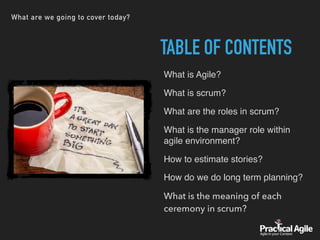
What are wegoing to cover today?
TABLE OF CONTENTS
What is Agile?
What is scrum?
What are the roles in scrum?
What is the manager role within
agile environment?
How to estimate stories?
How do we do long term planning?
What is the meaning of each
ceremony in scrum?
10.
“It ain’t whatyou don’t know
that gets you into troubles.
It’s what you know for sure
that just ain’t so”
Mark Twain
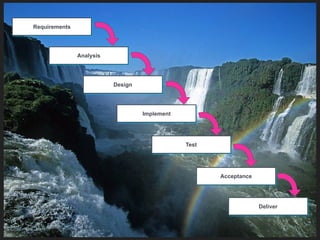
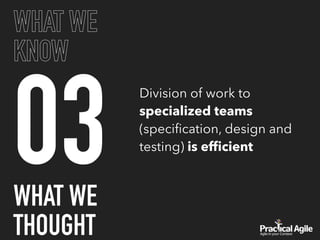
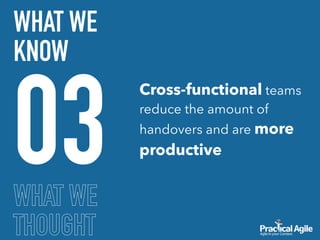
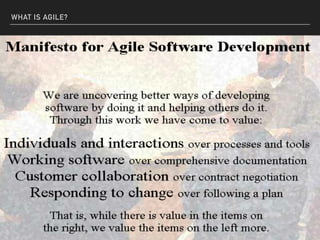
WHAT WE THOUGHT VS. WHAT WE KNOW
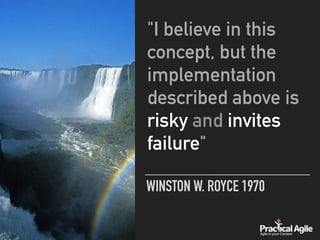
WINSTON W. ROYCE1970
"I believe in this
concept, but the
implementation
described above is
risky and invites
failure"
14.
“It ain’t whatyou don’t know
that gets you into troubles.
It’s what you know for sure
that just ain’t so”
Mark Twain
WHAT WE THOUGHT VS. WHAT WE KNOW
15.
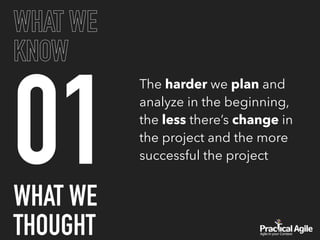
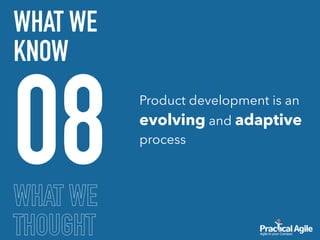
01
WHAT WE
KNOW
The harderwe plan and
analyze in the beginning,
the less there’s change in
the project and the more
successful the project
WHAT WE
THOUGHT
16.
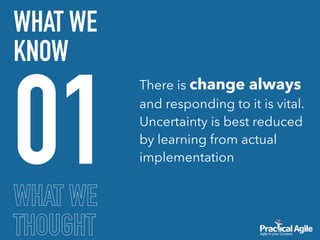
WHAT WE
THOUGHT
01
WHAT WE
KNOW
Thereis change always
and responding to it is vital.
Uncertainty is best reduced
by learning from actual
implementation
17.
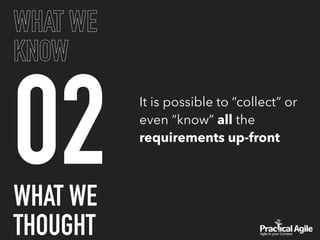
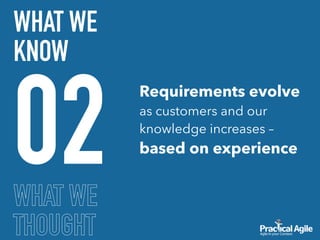
02
WHAT WE
KNOW
It ispossible to “collect” or
even “know” all the
requirements up-front
WHAT WE
THOUGHT
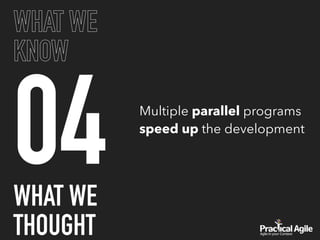
WHAT WE
THOUGHT
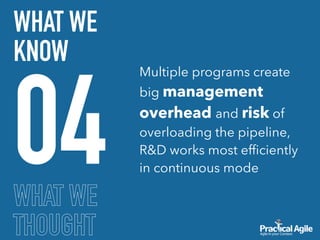
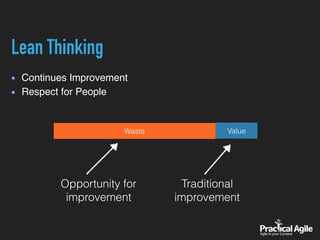
04
WHAT WE
KNOW
Multipleprograms create
big management
overhead and risk of
overloading the pipeline,
R&D works most efficiently
in continuous mode
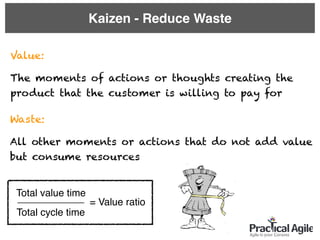
Kaizen - ReduceWaste
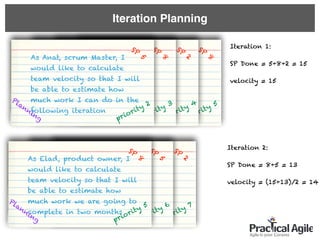
Value:
The moments of actions or thoughts creating the
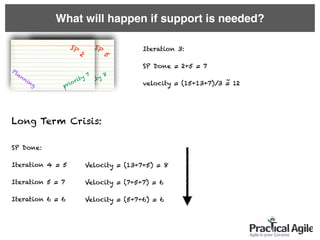
product that the customer is willing to pay for
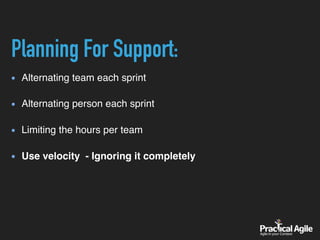
Total value time
Total cycle time
= Value ratio____________
Waste:
All other moments or actions that do not add value
but consume resources
29.
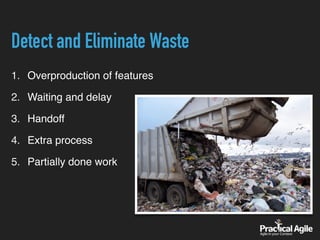
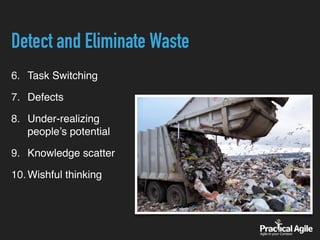
Detect and EliminateWaste
1. Overproduction of features
2. Waiting and delay
3. Handoff
4. Extra process
5. Partially done work
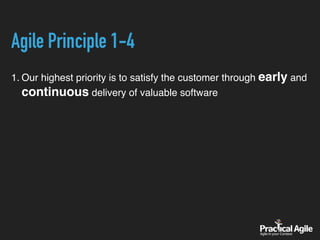
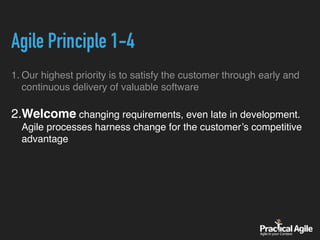
Agile Principle 1-4
1.Our highest priority is to satisfy the customer through early and
continuous delivery of valuable software
43.
Agile Principle 1-4
1.Our highest priority is to satisfy the customer through early and
continuous delivery of valuable software
2.Welcome changing requirements, even late in development.
Agile processes harness change for the customer’s competitive
advantage
44.
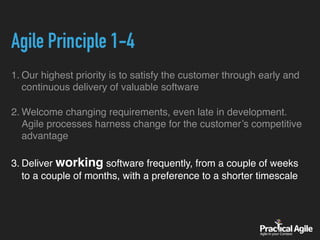
Agile Principle 1-4
1.Our highest priority is to satisfy the customer through early and
continuous delivery of valuable software
2. Welcome changing requirements, even late in development.
Agile processes harness change for the customer’s competitive
advantage
3. Deliver working software frequently, from a couple of weeks
to a couple of months, with a preference to a shorter timescale
45.
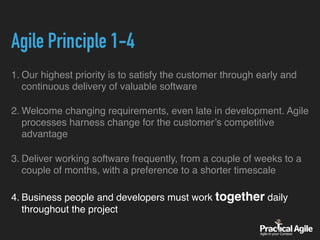
Agile Principle 1-4
1.Our highest priority is to satisfy the customer through early and
continuous delivery of valuable software
2. Welcome changing requirements, even late in development. Agile
processes harness change for the customer’s competitive
advantage
3. Deliver working software frequently, from a couple of weeks to a
couple of months, with a preference to a shorter timescale
4. Business people and developers must work together daily
throughout the project
46.
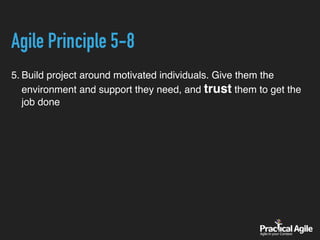
Agile Principle 5-8
5.Build project around motivated individuals. Give them the
environment and support they need, and trust them to get the
job done
47.
Agile Principle 5-8
5.Build project around motivated individuals. Give them the
environment and support they need, and trust them to get the
job done
6. The most efficient and effective method of conveying
information to and within development team is face-to-face
conversation
48.
Agile Principle 5-8
5.Build project around motivated individuals. Give them the
environment and support they need, and trust them to get the
job done
6. The most efficient and effective method of conveying information
to and within development team is face-to-face conversation
7. Working software is the primary measure for progress
49.
Agile Principle 5-8
5.Build project around motivated individuals. Give them the
environment and support they need, and trust them to get the job
done
6. The most efficient and effective method of conveying information to
and within development team is face-to-face conversation
7. Working software is the primary measure for progress
8. Agile processes promote sustainable development. The
sponsors, developers, and users should be able to maintain a
constant pace indefinitely
50.
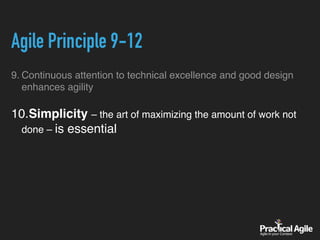
Agile Principle 9-12
9.Continuous attention to technical excellence and good
design enhances agility
51.
Agile Principle 9-12
9.Continuous attention to technical excellence and good design
enhances agility
10.Simplicity – the art of maximizing the amount of work not
done – is essential
52.
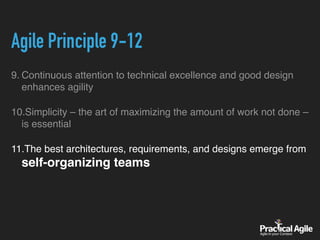
Agile Principle 9-12
9.Continuous attention to technical excellence and good design
enhances agility
10.Simplicity – the art of maximizing the amount of work not done –
is essential
11.The best architectures, requirements, and designs emerge from
self-organizing teams
53.
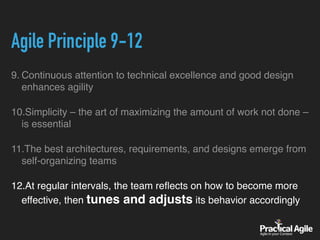
Agile Principle 9-12
9.Continuous attention to technical excellence and good design
enhances agility
10.Simplicity – the art of maximizing the amount of work not done –
is essential
11.The best architectures, requirements, and designs emerge from
self-organizing teams
12.At regular intervals, the team reflects on how to become more
effective, then tunes and adjusts its behavior accordingly
• In ourindustry people got used to create and use META
solutions to problems.
• The problems we are facing have nothing to do with
technology, it is a people issue.
• In this land the basic assumption is that there is no META
solution, just an empirical framework to allow inspect & adapt
cycles.
• This experience is frustrating for those who are looking for
predefined processes and final answers.
• ENTER AT YOUR OWN RISK!!!
57.
WHAT IS SCRUM?
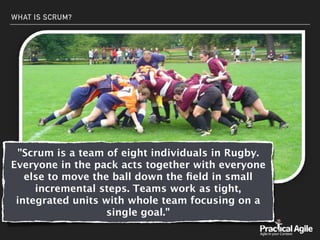
"Scrumis a team of eight individuals in Rugby.
Everyone in the pack acts together with everyone
else to move the ball down the field in small
incremental steps. Teams work as tight,
integrated units with whole team focusing on a
single goal."
58.
THE ORIGIN OF
SCRUM
• Toyota lean concept
• The new, new software
development game
[Takeuchi & Nonaka, 1986]
• Iterative & incremental
development
• Jeff Sutherland
• Ken Schwaber
59.
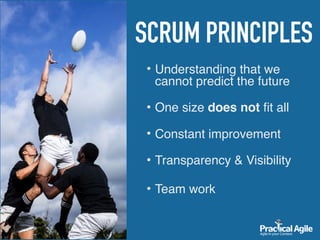
• Understanding thatwe
cannot predict the future
• One size does not fit all
• Constant improvement
• Transparency & Visibility
• Team work
SCRUM PRINCIPLES
60.
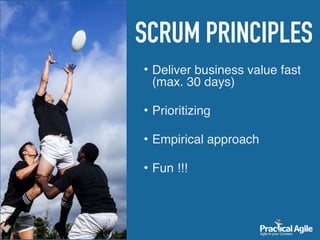
• Deliver businessvalue fast
(max. 30 days)
• Prioritizing
• Empirical approach
• Fun !!!
SCRUM PRINCIPLES
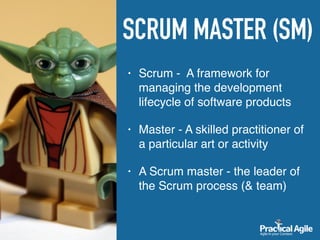
SCRUM MASTER (SM)
•Scrum - A framework for
managing the development
lifecycle of software products
• Master - A skilled practitioner of
a particular art or activity
• A Scrum master - the leader of
the Scrum process (& team)
64.
What does itmeans
“The leader of the scrum process”?
• Coach the team with Scrum
• Coach the PO with Scrum
• Help Facilitate effective ceremonies
• Helps removing impediments
• Help the team grow
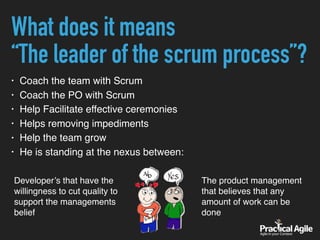
• He is standing at the nexus between:
The product management
that believes that any
amount of work can be
done
Developer’s that have the
willingness to cut quality to
support the managements
belief
65.
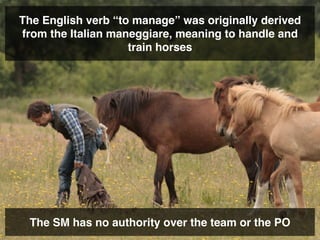
The English verb“to manage” was originally derived
from the Italian maneggiare, meaning to handle and
train horses
The SM has no authority over the team or the PO
66.
WHAT IS THEMANAGER ROLE WITHIN AGILE ENVIRONMENT?
A change in Manager’s role
Stop:
• Assign task and verify completion
• Micro manage to have the “illusion of control”
• Makes decisions for the team
• Limit the information & resources available to the team
Start:
• Trust the team to get the job done
• Gather data
• Coach - observe and ask questions
• Challenge
• Give feedback
67.
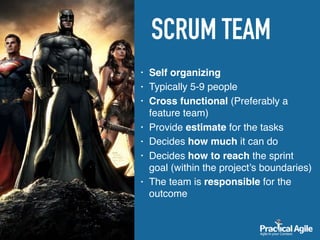
SCRUM TEAM
• Selforganizing
• Typically 5-9 people
• Cross functional (Preferably a
feature team)
• Provide estimate for the tasks
• Decides how much it can do
• Decides how to reach the sprint
goal (within the project’s boundaries)
• The team is responsible for the
outcome
68.
CONCEPT CHANGE
• Decideswhat it can do
• Decides how to do it
• Responsible for the quality
• If the job is successful the team
gets the credit
• If the job is not DONE the team
is responsible
ALL OF US
ARE SMARTER THAN
ANY OF US
69.
THE TEAM IS
WRONG?
•Let the team fail
• Create an environment where it
is ok to fail
• Failure amplifies learning
• Where failure is allowed,
innovation and experiments are
encouraged
• Increases trust
THERE IS NO FAILURE
ONLY FEEDBACK
70.
PRODUCT OWNER (PO)
•Defines the features of the product
• Defines release dates and content
• Responsible for ROI
• Prioritizes feature according to value
• Can change features and priority
once every predefined interval
• Decides what will be worked on in
each iteration
• Accepts or rejects results
71.
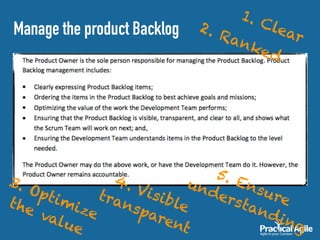
Manage the productBacklog
1. Clear
2. Ranked
3. Optimize
the value
4. Visible
transparent
5. Ensure
understanding
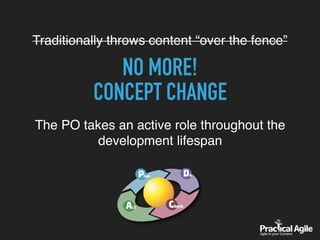
The PO takesan active role throughout the
development lifespan
Traditionally throws content “over the fence”
NO MORE!
CONCEPT CHANGE
74.
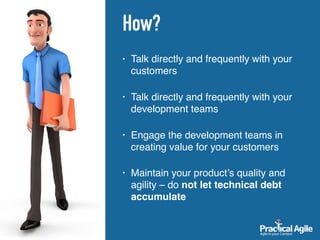
How?
• Talk directlyand frequently with your
customers
• Talk directly and frequently with your
development teams
• Engage the development teams in
creating value for your customers
• Maintain your product’s quality and
agility – do not let technical debt
accumulate
75.
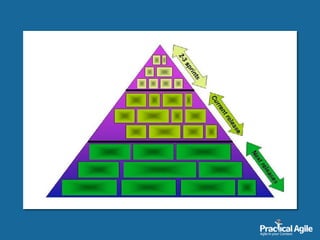
Product Backlog Refinement= Grooming
The team and the PO together review the backlog in order to
make it ready for the next 2-3 sprints
How?
Grooming = Clarifying, Estimating, and Splitting
Recommended to allocate ~5% of the sprint time
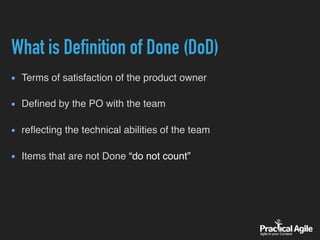
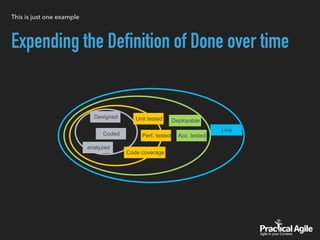
What is Definitionof Done (DoD)
Terms of satisfaction of the product owner
Defined by the PO with the team
reflecting the technical abilities of the team
Items that are not Done “do not count”
80.
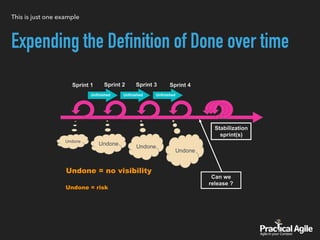
This is justone example
Expending the Definition of Done over time
Designed
Coded
analyzed
Unit tested
Perf. tested
Code coverage
Live
Deployable
Acc. tested
81.
This is justone example
Expending the Definition of Done over time
Undone
Undone
Undone
Undone
Stabilization
sprint(s)
Sprint 1 Sprint 2 Sprint 3 Sprint 4
Undone = risk
Undone = no visibility
Can we
release ?
Unfinished Unfinished Unfinished
EXERCISE
Estimate The FollowingBased On Weight In
Kilograms [No Google Please!!!]
• Chihuahua
• Great Dane
• Staffordshire bull terrier
• Appalachian mountain dog
• Border Collie
• American Cocker spaniel
84.
“IT IS BETTERBE
ROUGHLY RIGHT
THAN PRECISELY
WRONG”
John Maynard Keynes
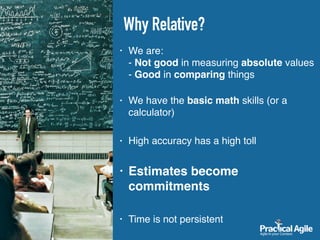
• We are:
- Not good in measuring absolute values
- Good in comparing things
• We have the basic math skills (or a
calculator)
• High accuracy has a high toll
• Estimates become
commitments
• Time is not persistent
Why Relative?
88.
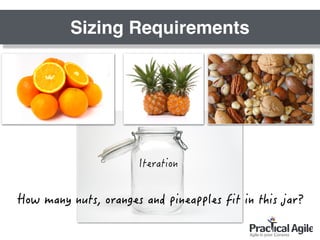
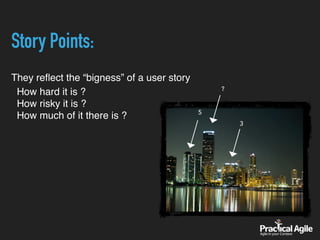
Story Points:
They reflectthe “bigness” of a user story
How hard it is ?
How risky it is ?
How much of it there is ? 5
?
3
89.
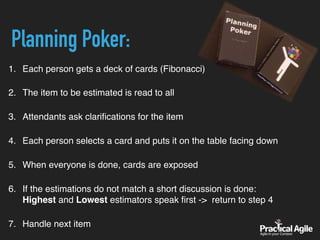
1. Each persongets a deck of cards (Fibonacci)
2. The item to be estimated is read to all
3. Attendants ask clarifications for the item
4. Each person selects a card and puts it on the table facing down
5. When everyone is done, cards are exposed
6. If the estimations do not match a short discussion is done:
Highest and Lowest estimators speak first -> return to step 4
7. Handle next item
Planning Poker:
90.
EXERCISE
Estimate The FollowingBased On Size
Using Planning Poker
• Spain
• China
• Luxembourg
• Denmark
• South Africa - 8 (Reference
point)
• Belize
91.
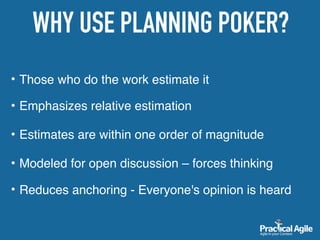
• Those whodo the work estimate it
• Emphasizes relative estimation
• Estimates are within one order of magnitude
• Modeled for open discussion – forces thinking
• Reduces anchoring - Everyone's opinion is heard
WHY USE PLANNING POKER?
92.
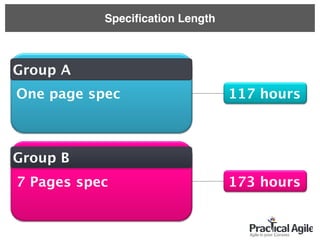
One page spec
GroupA
7 Pages spec
Group B
173 hours
117 hours
Specification Length
93.
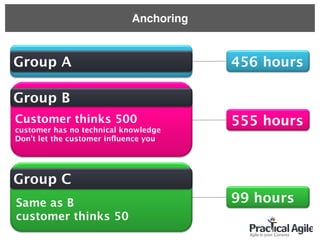
Group A
Customer thinks500
customer has no technical knowledge
Don’t let the customer influence you
Group B
555 hours
456 hours
Same as B
customer thinks 50
Group C
99 hours
Anchoring
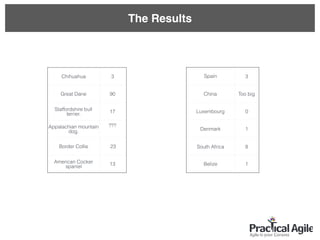
Spain 3
China Toobig
Luxembourg 0
Denmark 1
South Africa 8
Belize 1
Chihuahua 3
Great Dane 90
Staffordshire bull
terrier.
17
Appalachian mountain
dog.
???
Border Collie 23
American Cocker
spaniel
13
The Results
96.
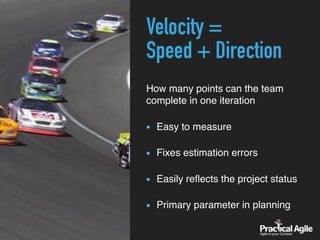
Velocity =
Speed+ Direction
How many points can the team
complete in one iteration
Easy to measure
Fixes estimation errors
Easily reflects the project status
Primary parameter in planning
97.
SP
8
priority 5
priority 4
SP
8
priority3
Planning
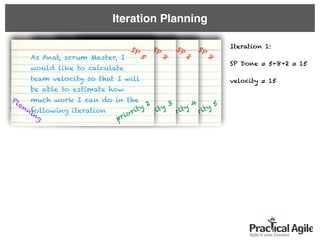
Iteration Planning
As Anat, scrum Master, I
would like to calculate
team velocity so that I will
be able to estimate how
much work I can do in the
following iteration
SP
5
priority 2
Planning
SP
2
Iteration 1:
SP Done = 5+8+2 = 15
velocity = 15
98.
SP
8
priority 5
priority 4
SP
8
priority3
Planning
Iteration Planning
As Anat, scrum Master, I
would like to calculate
team velocity so that I will
be able to estimate how
much work I can do in the
following iteration
SP
5
priority 2
Planning
SP
2
Iteration 1:
SP Done = 5+8+2 = 15
velocity = 15
priority 7
SP
5
priority 6
Planning
As Elad, product owner, I
would like to calculate
team velocity so that I will
be able to estimate how
much work we are going to
complete in two months
SP
8
priority 5
Planning
SP
2
Iteration 2:
SP Done = 8+5 = 13
velocity = (15+13)/2 = 14
99.
SP
5
priority 8
What willhappen if support is needed?
SP
2
priority 7
Long Term Crisis:
Planning
Iteration 3:
SP Done = 2+5 = 7
velocity = (15+13+7)/3 = 12~
SP Done:
Iteration 4 = 5
Iteration 5 = 7
Iteration 6 = 6
Velocity = (13+7+5) = 8
Velocity = (7+5+7) = 6
Velocity = (5+7+6) = 6
100.
Planning For Support:
Alternatingteam each sprint
Alternating person each sprint
Limiting the hours per team
Use velocity - Ignoring it completely
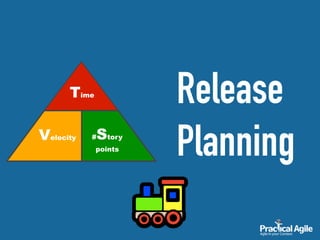
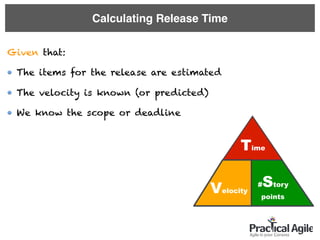
Calculating Release Time
Giventhat:
The items for the release are estimated
The velocity is known (or predicted)
We know the scope or deadline
#Story
points
Time
Velocity
104.
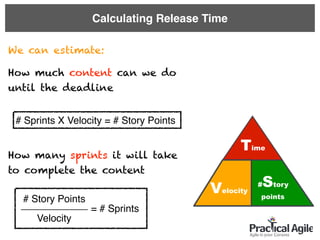
Calculating Release Time
Wecan estimate:
How much content can we do
until the deadline
How many sprints it will take
to complete the content
# Sprints X Velocity = # Story Points
# Story Points
Velocity
= # Sprints____________
#Story
points
Time
Velocity
Sprint Planning
The firstmeeting of the sprint
Length: 2-8 hours
Participants: PO, Team, Scrum Master
Preconditions: Product backlog should be in good shape
Divided into two parts
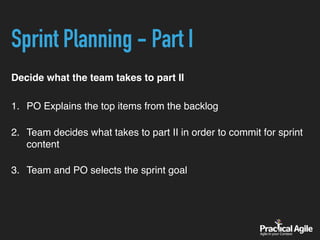
Sprint Planning -Part I
Decide what the team takes to part II
1. PO Explains the top items from the backlog
2. Team decides what takes to part II in order to commit for sprint
content
3. Team and PO selects the sprint goal
109.
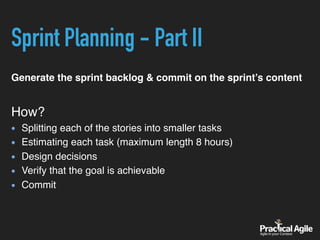
Sprint Planning -Part II
Generate the sprint backlog & commit on the sprint’s content
How?
Splitting each of the stories into smaller tasks
Estimating each task (maximum length 8 hours)
Design decisions
Verify that the goal is achievable
Commit
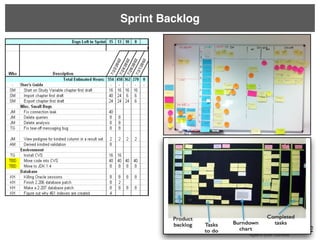
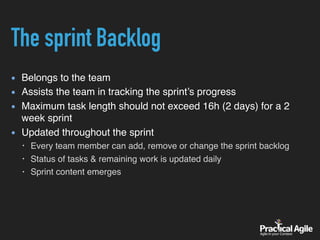
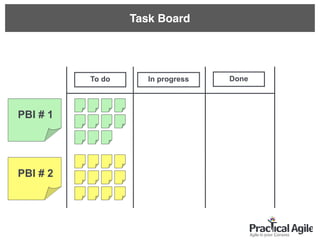
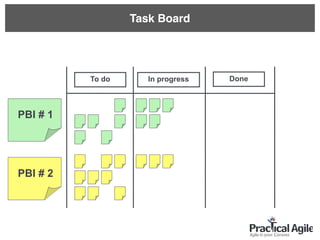
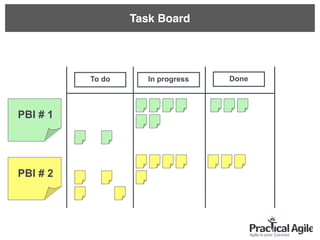
The sprint Backlog
Belongsto the team
Assists the team in tracking the sprint’s progress
Maximum task length should not exceed 16h (2 days) for a 2
week sprint
Updated throughout the sprint
• Every team member can add, remove or change the sprint backlog
• Status of tasks & remaining work is updated daily
• Sprint content emerges
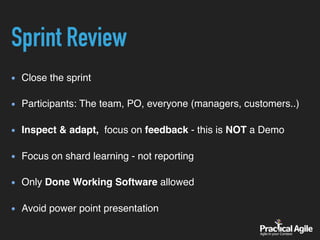
Close the sprint
Participants: The team, PO, everyone (managers, customers..)
Inspect & adapt, focus on feedback - this is NOT a Demo
Focus on shard learning - not reporting
Only Done Working Software allowed
Avoid power point presentation
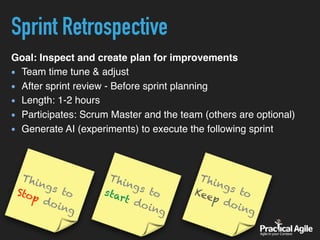
Sprint Review
Goal: Inspect andcreate plan for improvements
Team time tune & adjust
After sprint review - Before sprint planning
Length: 1-2 hours
Participates: Scrum Master and the team (others are optional)
Generate AI (experiments) to execute the following sprint
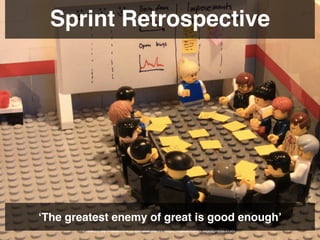
Sprint Retrospective
Things to Stop doing
Things to start doing
Things to Keep doing
131.
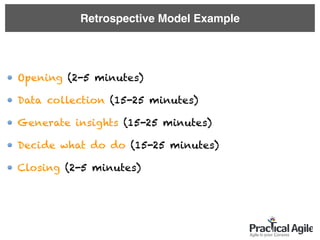
Retrospective Model Example
Opening(2-5 minutes)
Data collection (15-25 minutes)
Generate insights (15-25 minutes)
Decide what do do (15-25 minutes)
Closing (2-5 minutes)


![THE ORIGIN
• Toyota lean concept
• The new, new software
development game
[Takeuchi & Nonaka, 1986]
• Iterative & incremental
development](https://image.slidesharecdn.com/worldmate-170509121320/85/Practical-Scrum-one-day-training-39-320.jpg)
![THE ORIGIN OF
SCRUM
• Toyota lean concept
• The new, new software
development game
[Takeuchi & Nonaka, 1986]
• Iterative & incremental
development
• Jeff Sutherland
• Ken Schwaber](https://image.slidesharecdn.com/worldmate-170509121320/85/Practical-Scrum-one-day-training-58-320.jpg)
![EXERCISE
Estimate The Following Based On Weight In
Kilograms [No Google Please!!!]
• Chihuahua
• Great Dane
• Staffordshire bull terrier
• Appalachian mountain dog
• Border Collie
• American Cocker spaniel](https://image.slidesharecdn.com/worldmate-170509121320/85/Practical-Scrum-one-day-training-83-320.jpg)









![20260201 [FOSDEM] gomodjail - library sandboxing for Go modules.pdf](https://cdn.slidesharecdn.com/ss_thumbnails/20260201fosdemgomodjail-librarysandboxingforgomodules-260201225659-76609ec4-thumbnail.jpg?width=640&height=640&fit=bounds)


