The Scrum Framework
Christian Miles - www.AgileAtWork.co.uk
Hello!I’m Christian Miles
You can find out more at:
www.christianmiles.com
www.agileatwork.co.uk
www.linkedin.christianmiles.com
▣ I have over 20 years experience in the software industry -
including development, development management,
project management, teaching and publications
▣ I’ve worked in Agile teams as a developer and Scrum Master
▣ I’ve coached multiple agile teams and advised many
companies on the process of adopting an Agile mindset
▣ I’ve implemented Scrum, Kanban and Scrumban
▣ This guide is a quick intro to Scrum… It’s not a definitive
guide and in places I’ve altered it to reflect what I’ve found
works best… In my opinion!
A little about me
Christian Miles - www.AgileAtWork.co.uk
▣ Created in the early 90’s and first published in 1995
□ Ken Schwaber
□ Jeff Sutherland
▣ In 2001, Jeff and Ken were amongst the software
development leaders who created the Agile Manifesto
▣ Scrum has been implemented in many areas not just
software development - including marketing, media,
engineering and education
▣ Scrum is just one Framework for ‘being agile’ but probably
the most famous
A brief history of Scrum
Christian Miles - www.AgileAtWork.co.uk
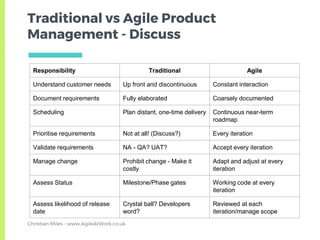
Traditional vs Agile Product
Management - Discuss
Christian Miles - www.AgileAtWork.co.uk
Responsibility Traditional Agile
Understand customer needs Up front and discontinuous Constant interaction
Document requirements Fully elaborated Coarsely documented
Scheduling Plan distant, one-time delivery Continuous near-term
roadmap
Prioritise requirements Not at all! (Discuss?) Every iteration
Validate requirements NA - QA? UAT? Accept every iteration
Manage change Prohibit change - Make it
costly
Adapt and adjust at every
iteration
Assess Status Milestone/Phase gates Working code at every
iteration
Assess likelihood of release
date
Crystal ball? Developers
word?
Reviewed at each
iteration/manage scope
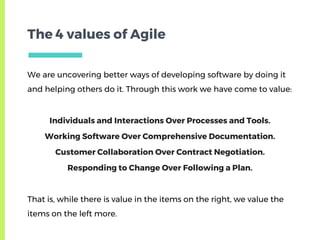
The 4 values of Agile
We are uncovering better ways of developing software by doing it
and helping others do it. Through this work we have come to value:
Individuals and Interactions Over Processes and Tools.
Working Software Over Comprehensive Documentation.
Customer Collaboration Over Contract Negotiation.
Responding to Change Over Following a Plan.
That is, while there is value in the items on the right, we value the
items on the left more.
The 5 core
values of Scrum
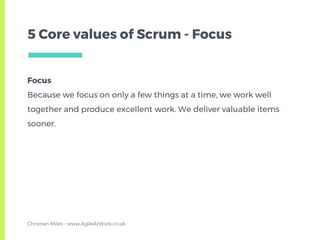
Focus
Because we focus on only a few things at a time, we work well
together and produce excellent work. We deliver valuable items
sooner.
5 Core values of Scrum - Focus
Christian Miles - www.AgileAtWork.co.uk
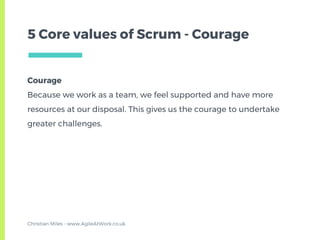
Courage
Because we work as a team, we feel supported and have more
resources at our disposal. This gives us the courage to undertake
greater challenges.
5 Core values of Scrum - Courage
Christian Miles - www.AgileAtWork.co.uk
Openness
As we work together, we express how we're doing, what's in our
way, and our concerns so they can be addressed.
5 Core values of Scrum - Openness
Christian Miles - www.AgileAtWork.co.uk
Commitment
Because we have greater control over our own destiny, we are
more committed to success.
5 Core values of Scrum - Commitment
Christian Miles - www.AgileAtWork.co.uk
Respect
As we work together, sharing successes and failures, we come to
respect each other and to help each other become worthy of
respect.
5 Core values of Scrum - Respect
Christian Miles - www.AgileAtWork.co.uk
The Scrum Framework
▣ The Scrum Framework
▣ Roles
▣ Ceremonies (Meetings)
▣ Artifacts
▣ What Scrum doesn’t cover
Christian Miles - www.AgileAtWork.co.uk
1.
The Scrum
Framework
The Scrum Process
▣ Release Planning
▣ Program Backlog (Not really mentioned in
Scrum - But important in scaling context!)
▣ Product Backlog
▣ Sprint Backlog
▣ The Sprint
▣ The review AKA Demo
▣ Potentially Shippable product increment
Christian Miles - www.AgileAtWork.co.uk
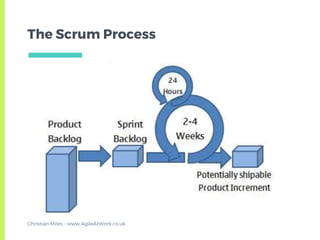
The Scrum Process
Christian Miles - www.AgileAtWork.co.uk
The Sprint
▣ AKA as an Iteration
▣ Deliver a potentially shippable incremental
product
▣ No Change is allowed which would disrupt the
Sprint Goal
▣ The scope may be clarified and re-negotiated
as more is learned - Product owner can not
force changes on team
Christian Miles - www.AgileAtWork.co.uk
The Sprint
▣ Team remains the same
▣ Quality does not decrease to hit deadlines
▣ Sprint lengths do not change
Christian Miles - www.AgileAtWork.co.uk
Sprint 0
▣ Hiring the team?
▣ Hardware/Software setup?
▣ Building a continuous delivery pipeline?
▣ My advice…. Try and avoid at all costs!
Christian Miles - www.AgileAtWork.co.uk
Hardening Sprints
▣ An optional approach!
▣ Its a Sprint left empty at the release planning
stage
▣ Sometimes used to move work from ‘Done’ to
‘Done Done’
▣ IS NOT CONTINGENCY
▣ My advice - Try and avoid… but they are
perhaps a reality with Scrum at scale!
Christian Miles - www.AgileAtWork.co.uk
Cancelling a Sprint
▣ Almost never happens!
▣ Only the Product Owner can cancel a Sprint
▣ Usually only occurs if the Sprint Goal becomes
obsolete….
▣ If it does… Review, retrospective and re-plan
Christian Miles - www.AgileAtWork.co.uk
Who’s Listening?
▣ What's the output of a sprint?
▣ How long does a sprint last?
▣ How are changes to work handled within a
Sprint?
▣ Who can cancel a Sprint?
Christian Miles - www.AgileAtWork.co.uk
2.
Roles
The Scrum Framework
▣ The Roles
□ The chicken and the pig
□ Product Owner
□ Scrum Master
□ Development Team (Everybody else)
□ Stakeholders, business, customers, managers
Christian Miles - www.AgileAtWork.co.uk
The Roles
Christian Miles - www.AgileAtWork.co.uk
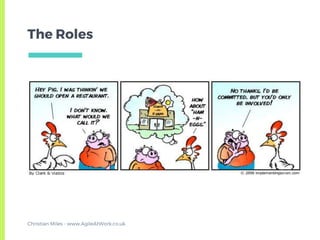
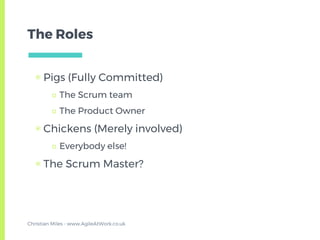
The Roles
▣ Pigs (Fully Committed)
□ The Scrum team
□ The Product Owner
▣ Chickens (Merely involved)
□ Everybody else!
▣ The Scrum Master?
Christian Miles - www.AgileAtWork.co.uk
2.
Roles - The
product Owner
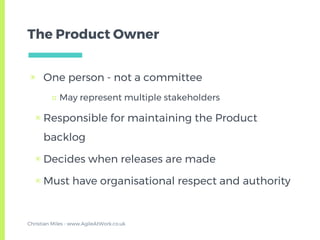
The Product Owner
▣ One person - not a committee
□ May represent multiple stakeholders
▣ Responsible for maintaining the Product
backlog
▣ Decides when releases are made
▣ Must have organisational respect and authority
Christian Miles - www.AgileAtWork.co.uk
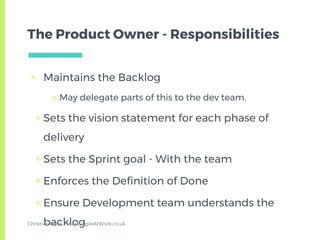
The Product Owner - Responsibilities
▣ Maintains the Backlog
□ May delegate parts of this to the dev team.
▣ Sets the vision statement for each phase of
delivery
▣ Sets the Sprint goal - With the team
▣ Enforces the Definition of Done
▣ Ensure Development team understands the
backlogChristian Miles - www.AgileAtWork.co.uk
The Product Owner - Responsibilities
▣ Must participate in Sprint Planning
▣ Must participate in Sprint Review
▣ May participate in Daily Standup
▣ May participate in Retrospective
□ The retrospective is for the team so ensure that you
have ‘Private’ retrospectives to ensure that the
Product Owner is not interfering with being self-
organising
Christian Miles - www.AgileAtWork.co.uk
2.
Roles - The
Scrum Master
The Scrum Master
▣ The “Servant Leader” -
□ No authority over the team (With the exception of
enforcing Agile practices)
▣ Cannot commit to dates
▣ Is NOT accountable for team success
▣ Has a largely coaching role
▣ Is mainly responsible for holding a mirror up to
the organisation!Christian Miles - www.AgileAtWork.co.uk
The Scrum Master - Responsibilities
▣ Facilities Scrum Ceremonies
▣ Coaches the Scrum Team, Product Owner,
Stakeholders and organisation on being Agile
▣ Protects the Scrum Team
▣ Acts a change agent
Christian Miles - www.AgileAtWork.co.uk
2.
Roles - The
Team
The team (Everyone else)
▣ Usually Between 4 and 8 members
□ 2 Pizza rule - If you can’t feed a team with 2 pizza’s
it's too big
▣ Product Owner is NEVER part of the team
▣ Scrum Master might be… If working on Backlog
items
▣ Cross-functional, Includes testers, BA’s all
considered development
The Team - Responsibilities
▣ Self organising - No appointed leader!
□ Can you have a self organising team with a leader?
▣ Creates a potentially shippable ‘product’ each
sprint
▣ Maintains a Sprint Backlog for each Sprint
▣ Collectively commits to delivering the Sprint
Goal
Christian Miles - www.AgileAtWork.co.uk
Everybody else
▣ Stakeholders, Customers, Managers!
Christian Miles - www.AgileAtWork.co.uk
Who’s Listening?
▣ Product Owner Pig or Chicken?
▣ Is the Scrum Master a pig?
▣ Role of the Product Owner
Christian Miles - www.AgileAtWork.co.uk
3.
Ceremonies
(AKA as
Meetings)
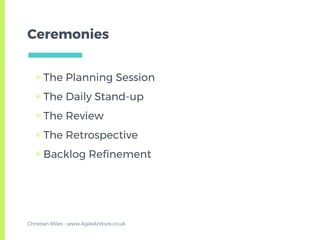
Ceremonies
▣ The Planning Session
▣ The Daily Stand-up
▣ The Review
▣ The Retrospective
▣ Backlog Refinement
Christian Miles - www.AgileAtWork.co.uk
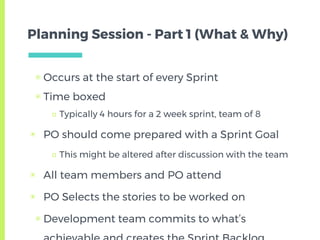
Planning Session - Part 1 (What & Why)
▣ Occurs at the start of every Sprint
▣ Time boxed
□ Typically 4 hours for a 2 week sprint, team of 8
▣ PO should come prepared with a Sprint Goal
□ This might be altered after discussion with the team
▣ All team members and PO attend
▣ PO Selects the stories to be worked on
▣ Development team commits to what’s
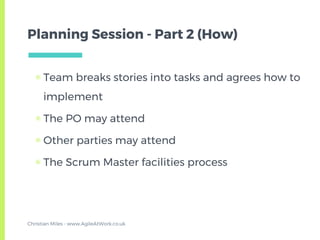
Planning Session - Part 2 (How)
▣ Team breaks stories into tasks and agrees how to
implement
▣ The PO may attend
▣ Other parties may attend
▣ The Scrum Master facilities process
Christian Miles - www.AgileAtWork.co.uk
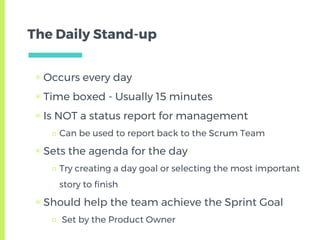
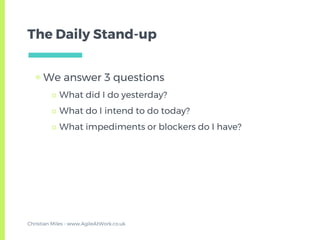
The Daily Stand-up
▣ Occurs every day
▣ Time boxed - Usually 15 minutes
▣ Is NOT a status report for management
□ Can be used to report back to the Scrum Team
▣ Sets the agenda for the day
□ Try creating a day goal or selecting the most important
story to finish
▣ Should help the team achieve the Sprint Goal
□ Set by the Product Owner
The Daily Stand-up
▣ We answer 3 questions
□ What did I do yesterday?
□ What do I intend to do today?
□ What impediments or blockers do I have?
Christian Miles - www.AgileAtWork.co.uk
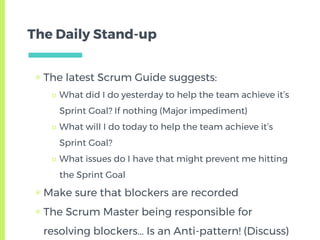
The Daily Stand-up
▣ The latest Scrum Guide suggests:
□ What did I do yesterday to help the team achieve it’s
Sprint Goal? If nothing (Major impediment)
□ What will I do today to help the team achieve it’s
Sprint Goal?
□ What issues do I have that might prevent me hitting
the Sprint Goal
▣ Make sure that blockers are recorded
▣ The Scrum Master being responsible for
resolving blockers… Is an Anti-pattern! (Discuss)
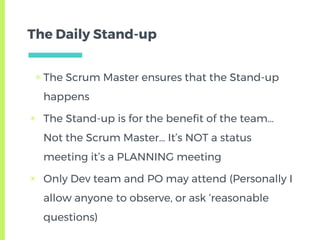
The Daily Stand-up
▣ The Scrum Master ensures that the Stand-up
happens
▣ The Stand-up is for the benefit of the team…
Not the Scrum Master… It’s NOT a status
meeting it’s a PLANNING meeting
▣ Only Dev team and PO may attend (Personally I
allow anyone to observe, or ask ‘reasonable
questions)
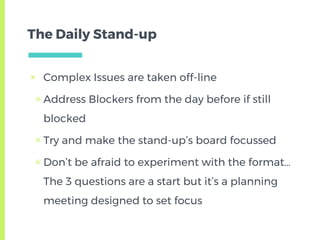
The Daily Stand-up
▣ Complex Issues are taken off-line
▣ Address Blockers from the day before if still
blocked
▣ Try and make the stand-up’s board focussed
▣ Don’t be afraid to experiment with the format…
The 3 questions are a start but it’s a planning
meeting designed to set focus
The Daily Stand-up
Personally…..
▣ Forget the 3 questions! They make it too much
status based - Especially what did I do
yesterday!
▣ Keep it task board based/focused and agree
what the day’s objective is
▣ Allow conversations to continue - that are
useful and helpful - But be mindful of time!
Backlog Refinement
▣ Once known as Backlog Grooming - But had a
name change in 2013!
▣ I like to hold several short sessions each Sprint
▣ The Product Backlog is the responsibility of the
PO- They add stories and sequence
▣ The PO is responsible for ensuring that the
development team understand the Backlog
▣ “Story Writing Workshops” are an excellent way to
achieve this
The Review - Not a demo!
▣ Occurs at the end of the Sprint
▣ Time boxed - Usually around 1 - 2 hours (2 Week
Sprint)
▣ Informal meeting
□ Encourage feedback and collaboration
▣ What was done in the Sprint
▣ Discuss how the Sprint went
Christian Miles - www.AgileAtWork.co.uk
The Review - Not a demo!
▣ Product Owner should enforce the ‘Definition Of
Done’ for each Story
▣ Team might demo to PO
□ Often good to get the PO to do the demonstration
▣ PO determines if the Sprint Goal has been met
▣ PO Should discuss the Product Backlog and
dates
▣ Discuss what should be done next
Christian Miles - www.AgileAtWork.co.uk
The Review - Not a demo!
▣ The entire team attends
▣ The PO attends
▣ Interested Stakeholders may attend
▣ The Scrum Master facilities
Christian Miles - www.AgileAtWork.co.uk
The Retrospective
▣ Occurs at the end of the Sprint, After the Demo
▣ Time Boxed - Between 1 and 2 hours for a 2 week
Sprint
▣ You should hold a large retrospective after each
phase/major release with all stakeholders (Where
possible)
Christian Miles - www.AgileAtWork.co.uk
The Retrospective
▣ How does everyone feel about the Sprint?
▣ What worked well in the last Sprint?
▣ What didn’t work well
▣ Draw up an improvement plan - Improvement
stories should go on the back log
Christian Miles - www.AgileAtWork.co.uk
The Retrospective
▣ Regardless of what we discover… We understand
and truly believe that everyone did the best job
that they could given what they knew at the
time, their situation, skills and abilities.
▣ Collective storytelling - Helps us learn from
shared experiences
▣ Gathering data helps us make empirical based
decisions
Christian Miles - www.AgileAtWork.co.uk
Who’s Listening?
▣ What's the output of the Planning Session?
▣ What’s the purpose of the retrospective?
▣ How long should the planning session last?
▣ What’s the purpose of the Daily Standup?
▣ How many parts is the planning session made
up of?
Christian Miles - www.AgileAtWork.co.uk
4.
Artifacts
(AKA as
Documentation)
The Scrum Framework
▣ Artifacts AKA Documentation
□ The Product Backlog
□ The Sprint Backlog
□ The Vision Statement
□ The Sprint Goal
□ The Definition of Done
□ Impediments - Or risk register
□ Burn down/up charts
□ Task Board
Christian Miles - www.AgileAtWork.co.uk
The Product Backlog
▣ Is the responsibility of the Product Owner to Maintain
□ However the PO may use the team to help maintain
and ‘flesh’ out stories
▣ It should be ordered with the most important stories at the
top
▣ Regular refinement (once known as grooming) is essential
and time should be set aside during every Sprint
▣ Expect around 10% of team time to be spent on backlog
refinement. (About a day for a 2 week sprint/iteration)
The Product Backlog
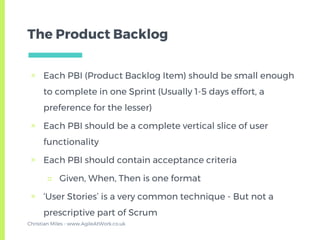
▣ Each PBI (Product Backlog Item) should be small enough
to complete in one Sprint (Usually 1-5 days effort, a
preference for the lesser)
▣ Each PBI should be a complete vertical slice of user
functionality
▣ Each PBI should contain acceptance criteria
□ Given, When, Then is one format
▣ ‘User Stories’ is a very common technique - But not a
prescriptive part of Scrum
Christian Miles - www.AgileAtWork.co.uk
The Product Backlog
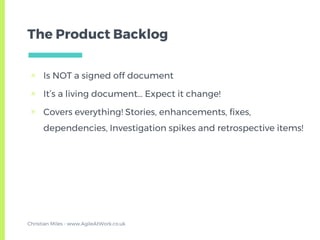
▣ Is NOT a signed off document
▣ It’s a living document… Expect it change!
▣ Covers everything! Stories, enhancements, fixes,
dependencies, Investigation spikes and retrospective items!
Christian Miles - www.AgileAtWork.co.uk
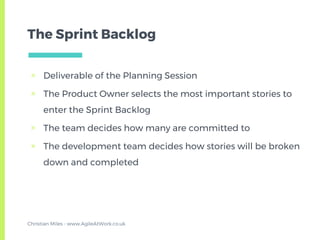
The Sprint Backlog
▣ Deliverable of the Planning Session
▣ The Product Owner selects the most important stories to
enter the Sprint Backlog
▣ The team decides how many are committed to
▣ The development team decides how stories will be broken
down and completed
Christian Miles - www.AgileAtWork.co.uk
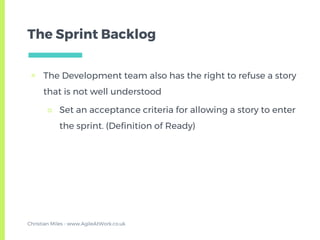
The Sprint Backlog
▣ The Development team also has the right to refuse a story
that is not well understood
□ Set an acceptance criteria for allowing a story to enter
the sprint. (Definition of Ready)
Christian Miles - www.AgileAtWork.co.uk
The Vision Statement
▣ Set by the Product Owner
▣ Should be set for each phase of development
▣ Ensures that everybody on the team is aware of the end
target
Christian Miles - www.AgileAtWork.co.uk
The Sprint Goal
▣ The Sprint Goal should be Set by the Product Owner
▣ However the development team may shape it based on
what they think can be delivered to within the Sprint
▣ It’s purpose is to set the focus in the Sprint
▣ Make sure it’s on the Task Board (Where physical) but make
it visible
Christian Miles - www.AgileAtWork.co.uk
The Definition of Done
▣ The team along with the PO should define the Definition of
Done
▣ Each Sprint should be judged against this definition - The
Product owner is responsible for ensuring the sprint
adheres to it
▣ Ideally ‘Done’ should mean “Done, Done”
□ It’s common to have several definitions…. ‘Done’, ‘Ready
to Release’
Christian Miles - www.AgileAtWork.co.uk
The Definition of Done
▣ Make sure everyone knows the definition of Done and stick
it somewhere visible - On the wall in the team’s area
▣ Definition of ready, ready to release, ready to test!
▣ Define it but don’t be tempted to over define! Just enough
is enough!
Christian Miles - www.AgileAtWork.co.uk
Impediments
▣ Record issues and problems that are discovered
▣ I often record these on the Task Board (Where physical) and
should be brought up in every Stand-up
▣ Create a risks board - on the wall, visible and ensure it’s
addressed every day
□ RAID log, Risks, Assumptions, Issues and Dependencies
□ Or ROAM (Resolved, Owned, Accepted, Mitigated)
Christian Miles - www.AgileAtWork.co.uk
Burndown/Up Charts
▣ Sprint burndown chart….. Work required to complete sprint
(Often done in hours) personally I never use burn-down
charts!!! They’ve been made famous by CSM courses and
software products! But add no real value!
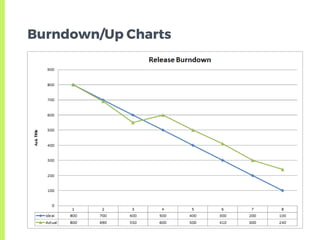
▣ Release burndown chart…. Work on Product Backlog that
needs completing before release (Often done in Story
points)
▣ You also get burn-up charts… Record the effort done,
Christian Miles - www.AgileAtWork.co.uk
Burndown/Up Charts
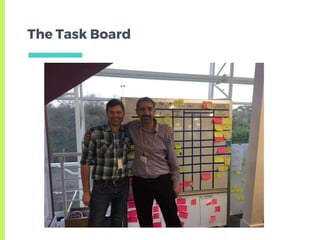
The Task Board
▣ Can be physical or virtual
▣ My personal favourite is physical wherever possible… It aids
transparency and collaboration which in turns breeds trust!
□ Less suitable for teams which are distributed!!
▣ Physical task boards are often called Information Radiators
▣ Virtual boards are known as Information Refrigerators!
Christian Miles - www.AgileAtWork.co.uk
The Task Board
Who’s Listening?
▣ Who owns the Sprint Backlog?
▣ What’s the purpose of the Sprint Goal?
Christian Miles - www.AgileAtWork.co.uk
5.
What Scrum
doesn’t cover
Development Practice
▣ Both Agile, Scrum and Kanban don’t prescribe software
development practices
▣ Remember Scrum and Kanban are used outside of the
world of software development!
▣ XP - eXtreme Programming is often used alongside Agile
practices:
□ Paired programming
□ TDD, BDD (Given, When, Then) - Automated testing
□ Continuous integration
□ Peer review
Christian Miles - www.AgileAtWork.co.uk
Wider Project Management Concerns
▣ Unlike PRINCE2 (PRojects In Controlled Environments)
Scrum does not talk about project initiation, justification,
Sign-offs, Project closure
▣ It does not talk about portfolio management, governance
or quality process procedures
▣ Does not talk about how to scale
▣ Although frameworks like LeSS (Large Scale Scrum), SAFe
(Scaled Agile Framework) and DAD (Disciplined Agile
Delivery) are addressing some of those issues
5.
Not covered on
this course
What I’ve not covered
▣ Lots!
▣ Story writing
▣ Estimation and Velocity
▣ How to identify your Minimum (Marketable/Viable) Product
Christian Miles - www.AgileAtWork.co.uk
Thanks!
Please keep in touch
Find me at www.christianmiles.com
or https://www.linkedin.com/in/christianleemiles
To discover more about Agile….
www.agileatwork.co.uk
https://twitter.com/christianlmiles

Scrum training

  • 1.
    The Scrum Framework ChristianMiles - www.AgileAtWork.co.uk
  • 2.
    Hello!I’m Christian Miles Youcan find out more at: www.christianmiles.com www.agileatwork.co.uk www.linkedin.christianmiles.com
  • 3.
    ▣ I haveover 20 years experience in the software industry - including development, development management, project management, teaching and publications ▣ I’ve worked in Agile teams as a developer and Scrum Master ▣ I’ve coached multiple agile teams and advised many companies on the process of adopting an Agile mindset ▣ I’ve implemented Scrum, Kanban and Scrumban ▣ This guide is a quick intro to Scrum… It’s not a definitive guide and in places I’ve altered it to reflect what I’ve found works best… In my opinion! A little about me Christian Miles - www.AgileAtWork.co.uk
  • 4.
    ▣ Created inthe early 90’s and first published in 1995 □ Ken Schwaber □ Jeff Sutherland ▣ In 2001, Jeff and Ken were amongst the software development leaders who created the Agile Manifesto ▣ Scrum has been implemented in many areas not just software development - including marketing, media, engineering and education ▣ Scrum is just one Framework for ‘being agile’ but probably the most famous A brief history of Scrum Christian Miles - www.AgileAtWork.co.uk
  • 5.
    Traditional vs AgileProduct Management - Discuss Christian Miles - www.AgileAtWork.co.uk Responsibility Traditional Agile Understand customer needs Up front and discontinuous Constant interaction Document requirements Fully elaborated Coarsely documented Scheduling Plan distant, one-time delivery Continuous near-term roadmap Prioritise requirements Not at all! (Discuss?) Every iteration Validate requirements NA - QA? UAT? Accept every iteration Manage change Prohibit change - Make it costly Adapt and adjust at every iteration Assess Status Milestone/Phase gates Working code at every iteration Assess likelihood of release date Crystal ball? Developers word? Reviewed at each iteration/manage scope
  • 6.
    The 4 valuesof Agile We are uncovering better ways of developing software by doing it and helping others do it. Through this work we have come to value: Individuals and Interactions Over Processes and Tools. Working Software Over Comprehensive Documentation. Customer Collaboration Over Contract Negotiation. Responding to Change Over Following a Plan. That is, while there is value in the items on the right, we value the items on the left more.
  • 7.
  • 8.
    Focus Because we focuson only a few things at a time, we work well together and produce excellent work. We deliver valuable items sooner. 5 Core values of Scrum - Focus Christian Miles - www.AgileAtWork.co.uk
  • 9.
    Courage Because we workas a team, we feel supported and have more resources at our disposal. This gives us the courage to undertake greater challenges. 5 Core values of Scrum - Courage Christian Miles - www.AgileAtWork.co.uk
  • 10.
    Openness As we worktogether, we express how we're doing, what's in our way, and our concerns so they can be addressed. 5 Core values of Scrum - Openness Christian Miles - www.AgileAtWork.co.uk
  • 11.
    Commitment Because we havegreater control over our own destiny, we are more committed to success. 5 Core values of Scrum - Commitment Christian Miles - www.AgileAtWork.co.uk
  • 12.
    Respect As we worktogether, sharing successes and failures, we come to respect each other and to help each other become worthy of respect. 5 Core values of Scrum - Respect Christian Miles - www.AgileAtWork.co.uk
  • 13.
    The Scrum Framework ▣The Scrum Framework ▣ Roles ▣ Ceremonies (Meetings) ▣ Artifacts ▣ What Scrum doesn’t cover Christian Miles - www.AgileAtWork.co.uk
  • 14.
  • 15.
    The Scrum Process ▣Release Planning ▣ Program Backlog (Not really mentioned in Scrum - But important in scaling context!) ▣ Product Backlog ▣ Sprint Backlog ▣ The Sprint ▣ The review AKA Demo ▣ Potentially Shippable product increment Christian Miles - www.AgileAtWork.co.uk
  • 16.
    The Scrum Process ChristianMiles - www.AgileAtWork.co.uk
  • 17.
    The Sprint ▣ AKAas an Iteration ▣ Deliver a potentially shippable incremental product ▣ No Change is allowed which would disrupt the Sprint Goal ▣ The scope may be clarified and re-negotiated as more is learned - Product owner can not force changes on team Christian Miles - www.AgileAtWork.co.uk
  • 18.
    The Sprint ▣ Teamremains the same ▣ Quality does not decrease to hit deadlines ▣ Sprint lengths do not change Christian Miles - www.AgileAtWork.co.uk
  • 19.
    Sprint 0 ▣ Hiringthe team? ▣ Hardware/Software setup? ▣ Building a continuous delivery pipeline? ▣ My advice…. Try and avoid at all costs! Christian Miles - www.AgileAtWork.co.uk
  • 20.
    Hardening Sprints ▣ Anoptional approach! ▣ Its a Sprint left empty at the release planning stage ▣ Sometimes used to move work from ‘Done’ to ‘Done Done’ ▣ IS NOT CONTINGENCY ▣ My advice - Try and avoid… but they are perhaps a reality with Scrum at scale! Christian Miles - www.AgileAtWork.co.uk
  • 21.
    Cancelling a Sprint ▣Almost never happens! ▣ Only the Product Owner can cancel a Sprint ▣ Usually only occurs if the Sprint Goal becomes obsolete…. ▣ If it does… Review, retrospective and re-plan Christian Miles - www.AgileAtWork.co.uk
  • 22.
    Who’s Listening? ▣ What'sthe output of a sprint? ▣ How long does a sprint last? ▣ How are changes to work handled within a Sprint? ▣ Who can cancel a Sprint? Christian Miles - www.AgileAtWork.co.uk
  • 23.
  • 24.
    The Scrum Framework ▣The Roles □ The chicken and the pig □ Product Owner □ Scrum Master □ Development Team (Everybody else) □ Stakeholders, business, customers, managers Christian Miles - www.AgileAtWork.co.uk
  • 25.
    The Roles Christian Miles- www.AgileAtWork.co.uk
  • 26.
    The Roles ▣ Pigs(Fully Committed) □ The Scrum team □ The Product Owner ▣ Chickens (Merely involved) □ Everybody else! ▣ The Scrum Master? Christian Miles - www.AgileAtWork.co.uk
  • 27.
  • 28.
    The Product Owner ▣One person - not a committee □ May represent multiple stakeholders ▣ Responsible for maintaining the Product backlog ▣ Decides when releases are made ▣ Must have organisational respect and authority Christian Miles - www.AgileAtWork.co.uk
  • 29.
    The Product Owner- Responsibilities ▣ Maintains the Backlog □ May delegate parts of this to the dev team. ▣ Sets the vision statement for each phase of delivery ▣ Sets the Sprint goal - With the team ▣ Enforces the Definition of Done ▣ Ensure Development team understands the backlogChristian Miles - www.AgileAtWork.co.uk
  • 30.
    The Product Owner- Responsibilities ▣ Must participate in Sprint Planning ▣ Must participate in Sprint Review ▣ May participate in Daily Standup ▣ May participate in Retrospective □ The retrospective is for the team so ensure that you have ‘Private’ retrospectives to ensure that the Product Owner is not interfering with being self- organising Christian Miles - www.AgileAtWork.co.uk
  • 31.
  • 32.
    The Scrum Master ▣The “Servant Leader” - □ No authority over the team (With the exception of enforcing Agile practices) ▣ Cannot commit to dates ▣ Is NOT accountable for team success ▣ Has a largely coaching role ▣ Is mainly responsible for holding a mirror up to the organisation!Christian Miles - www.AgileAtWork.co.uk
  • 33.
    The Scrum Master- Responsibilities ▣ Facilities Scrum Ceremonies ▣ Coaches the Scrum Team, Product Owner, Stakeholders and organisation on being Agile ▣ Protects the Scrum Team ▣ Acts a change agent Christian Miles - www.AgileAtWork.co.uk
  • 34.
  • 35.
    The team (Everyoneelse) ▣ Usually Between 4 and 8 members □ 2 Pizza rule - If you can’t feed a team with 2 pizza’s it's too big ▣ Product Owner is NEVER part of the team ▣ Scrum Master might be… If working on Backlog items ▣ Cross-functional, Includes testers, BA’s all considered development
  • 36.
    The Team -Responsibilities ▣ Self organising - No appointed leader! □ Can you have a self organising team with a leader? ▣ Creates a potentially shippable ‘product’ each sprint ▣ Maintains a Sprint Backlog for each Sprint ▣ Collectively commits to delivering the Sprint Goal Christian Miles - www.AgileAtWork.co.uk
  • 37.
    Everybody else ▣ Stakeholders,Customers, Managers! Christian Miles - www.AgileAtWork.co.uk
  • 38.
    Who’s Listening? ▣ ProductOwner Pig or Chicken? ▣ Is the Scrum Master a pig? ▣ Role of the Product Owner Christian Miles - www.AgileAtWork.co.uk
  • 39.
  • 40.
    Ceremonies ▣ The PlanningSession ▣ The Daily Stand-up ▣ The Review ▣ The Retrospective ▣ Backlog Refinement Christian Miles - www.AgileAtWork.co.uk
  • 41.
    Planning Session -Part 1 (What & Why) ▣ Occurs at the start of every Sprint ▣ Time boxed □ Typically 4 hours for a 2 week sprint, team of 8 ▣ PO should come prepared with a Sprint Goal □ This might be altered after discussion with the team ▣ All team members and PO attend ▣ PO Selects the stories to be worked on ▣ Development team commits to what’s
  • 42.
    Planning Session -Part 2 (How) ▣ Team breaks stories into tasks and agrees how to implement ▣ The PO may attend ▣ Other parties may attend ▣ The Scrum Master facilities process Christian Miles - www.AgileAtWork.co.uk
  • 43.
    The Daily Stand-up ▣Occurs every day ▣ Time boxed - Usually 15 minutes ▣ Is NOT a status report for management □ Can be used to report back to the Scrum Team ▣ Sets the agenda for the day □ Try creating a day goal or selecting the most important story to finish ▣ Should help the team achieve the Sprint Goal □ Set by the Product Owner
  • 44.
    The Daily Stand-up ▣We answer 3 questions □ What did I do yesterday? □ What do I intend to do today? □ What impediments or blockers do I have? Christian Miles - www.AgileAtWork.co.uk
  • 45.
    The Daily Stand-up ▣The latest Scrum Guide suggests: □ What did I do yesterday to help the team achieve it’s Sprint Goal? If nothing (Major impediment) □ What will I do today to help the team achieve it’s Sprint Goal? □ What issues do I have that might prevent me hitting the Sprint Goal ▣ Make sure that blockers are recorded ▣ The Scrum Master being responsible for resolving blockers… Is an Anti-pattern! (Discuss)
  • 46.
    The Daily Stand-up ▣The Scrum Master ensures that the Stand-up happens ▣ The Stand-up is for the benefit of the team… Not the Scrum Master… It’s NOT a status meeting it’s a PLANNING meeting ▣ Only Dev team and PO may attend (Personally I allow anyone to observe, or ask ‘reasonable questions)
  • 47.
    The Daily Stand-up ▣Complex Issues are taken off-line ▣ Address Blockers from the day before if still blocked ▣ Try and make the stand-up’s board focussed ▣ Don’t be afraid to experiment with the format… The 3 questions are a start but it’s a planning meeting designed to set focus
  • 48.
    The Daily Stand-up Personally….. ▣Forget the 3 questions! They make it too much status based - Especially what did I do yesterday! ▣ Keep it task board based/focused and agree what the day’s objective is ▣ Allow conversations to continue - that are useful and helpful - But be mindful of time!
  • 49.
    Backlog Refinement ▣ Onceknown as Backlog Grooming - But had a name change in 2013! ▣ I like to hold several short sessions each Sprint ▣ The Product Backlog is the responsibility of the PO- They add stories and sequence ▣ The PO is responsible for ensuring that the development team understand the Backlog ▣ “Story Writing Workshops” are an excellent way to achieve this
  • 50.
    The Review -Not a demo! ▣ Occurs at the end of the Sprint ▣ Time boxed - Usually around 1 - 2 hours (2 Week Sprint) ▣ Informal meeting □ Encourage feedback and collaboration ▣ What was done in the Sprint ▣ Discuss how the Sprint went Christian Miles - www.AgileAtWork.co.uk
  • 51.
    The Review -Not a demo! ▣ Product Owner should enforce the ‘Definition Of Done’ for each Story ▣ Team might demo to PO □ Often good to get the PO to do the demonstration ▣ PO determines if the Sprint Goal has been met ▣ PO Should discuss the Product Backlog and dates ▣ Discuss what should be done next Christian Miles - www.AgileAtWork.co.uk
  • 52.
    The Review -Not a demo! ▣ The entire team attends ▣ The PO attends ▣ Interested Stakeholders may attend ▣ The Scrum Master facilities Christian Miles - www.AgileAtWork.co.uk
  • 53.
    The Retrospective ▣ Occursat the end of the Sprint, After the Demo ▣ Time Boxed - Between 1 and 2 hours for a 2 week Sprint ▣ You should hold a large retrospective after each phase/major release with all stakeholders (Where possible) Christian Miles - www.AgileAtWork.co.uk
  • 54.
    The Retrospective ▣ Howdoes everyone feel about the Sprint? ▣ What worked well in the last Sprint? ▣ What didn’t work well ▣ Draw up an improvement plan - Improvement stories should go on the back log Christian Miles - www.AgileAtWork.co.uk
  • 55.
    The Retrospective ▣ Regardlessof what we discover… We understand and truly believe that everyone did the best job that they could given what they knew at the time, their situation, skills and abilities. ▣ Collective storytelling - Helps us learn from shared experiences ▣ Gathering data helps us make empirical based decisions Christian Miles - www.AgileAtWork.co.uk
  • 56.
    Who’s Listening? ▣ What'sthe output of the Planning Session? ▣ What’s the purpose of the retrospective? ▣ How long should the planning session last? ▣ What’s the purpose of the Daily Standup? ▣ How many parts is the planning session made up of? Christian Miles - www.AgileAtWork.co.uk
  • 57.
  • 58.
    The Scrum Framework ▣Artifacts AKA Documentation □ The Product Backlog □ The Sprint Backlog □ The Vision Statement □ The Sprint Goal □ The Definition of Done □ Impediments - Or risk register □ Burn down/up charts □ Task Board Christian Miles - www.AgileAtWork.co.uk
  • 59.
    The Product Backlog ▣Is the responsibility of the Product Owner to Maintain □ However the PO may use the team to help maintain and ‘flesh’ out stories ▣ It should be ordered with the most important stories at the top ▣ Regular refinement (once known as grooming) is essential and time should be set aside during every Sprint ▣ Expect around 10% of team time to be spent on backlog refinement. (About a day for a 2 week sprint/iteration)
  • 60.
    The Product Backlog ▣Each PBI (Product Backlog Item) should be small enough to complete in one Sprint (Usually 1-5 days effort, a preference for the lesser) ▣ Each PBI should be a complete vertical slice of user functionality ▣ Each PBI should contain acceptance criteria □ Given, When, Then is one format ▣ ‘User Stories’ is a very common technique - But not a prescriptive part of Scrum Christian Miles - www.AgileAtWork.co.uk
  • 61.
    The Product Backlog ▣Is NOT a signed off document ▣ It’s a living document… Expect it change! ▣ Covers everything! Stories, enhancements, fixes, dependencies, Investigation spikes and retrospective items! Christian Miles - www.AgileAtWork.co.uk
  • 62.
    The Sprint Backlog ▣Deliverable of the Planning Session ▣ The Product Owner selects the most important stories to enter the Sprint Backlog ▣ The team decides how many are committed to ▣ The development team decides how stories will be broken down and completed Christian Miles - www.AgileAtWork.co.uk
  • 63.
    The Sprint Backlog ▣The Development team also has the right to refuse a story that is not well understood □ Set an acceptance criteria for allowing a story to enter the sprint. (Definition of Ready) Christian Miles - www.AgileAtWork.co.uk
  • 64.
    The Vision Statement ▣Set by the Product Owner ▣ Should be set for each phase of development ▣ Ensures that everybody on the team is aware of the end target Christian Miles - www.AgileAtWork.co.uk
  • 65.
    The Sprint Goal ▣The Sprint Goal should be Set by the Product Owner ▣ However the development team may shape it based on what they think can be delivered to within the Sprint ▣ It’s purpose is to set the focus in the Sprint ▣ Make sure it’s on the Task Board (Where physical) but make it visible Christian Miles - www.AgileAtWork.co.uk
  • 66.
    The Definition ofDone ▣ The team along with the PO should define the Definition of Done ▣ Each Sprint should be judged against this definition - The Product owner is responsible for ensuring the sprint adheres to it ▣ Ideally ‘Done’ should mean “Done, Done” □ It’s common to have several definitions…. ‘Done’, ‘Ready to Release’ Christian Miles - www.AgileAtWork.co.uk
  • 67.
    The Definition ofDone ▣ Make sure everyone knows the definition of Done and stick it somewhere visible - On the wall in the team’s area ▣ Definition of ready, ready to release, ready to test! ▣ Define it but don’t be tempted to over define! Just enough is enough! Christian Miles - www.AgileAtWork.co.uk
  • 68.
    Impediments ▣ Record issuesand problems that are discovered ▣ I often record these on the Task Board (Where physical) and should be brought up in every Stand-up ▣ Create a risks board - on the wall, visible and ensure it’s addressed every day □ RAID log, Risks, Assumptions, Issues and Dependencies □ Or ROAM (Resolved, Owned, Accepted, Mitigated) Christian Miles - www.AgileAtWork.co.uk
  • 69.
    Burndown/Up Charts ▣ Sprintburndown chart….. Work required to complete sprint (Often done in hours) personally I never use burn-down charts!!! They’ve been made famous by CSM courses and software products! But add no real value! ▣ Release burndown chart…. Work on Product Backlog that needs completing before release (Often done in Story points) ▣ You also get burn-up charts… Record the effort done, Christian Miles - www.AgileAtWork.co.uk
  • 70.
  • 71.
    The Task Board ▣Can be physical or virtual ▣ My personal favourite is physical wherever possible… It aids transparency and collaboration which in turns breeds trust! □ Less suitable for teams which are distributed!! ▣ Physical task boards are often called Information Radiators ▣ Virtual boards are known as Information Refrigerators! Christian Miles - www.AgileAtWork.co.uk
  • 72.
  • 73.
    Who’s Listening? ▣ Whoowns the Sprint Backlog? ▣ What’s the purpose of the Sprint Goal? Christian Miles - www.AgileAtWork.co.uk
  • 74.
  • 75.
    Development Practice ▣ BothAgile, Scrum and Kanban don’t prescribe software development practices ▣ Remember Scrum and Kanban are used outside of the world of software development! ▣ XP - eXtreme Programming is often used alongside Agile practices: □ Paired programming □ TDD, BDD (Given, When, Then) - Automated testing □ Continuous integration □ Peer review Christian Miles - www.AgileAtWork.co.uk
  • 76.
    Wider Project ManagementConcerns ▣ Unlike PRINCE2 (PRojects In Controlled Environments) Scrum does not talk about project initiation, justification, Sign-offs, Project closure ▣ It does not talk about portfolio management, governance or quality process procedures ▣ Does not talk about how to scale ▣ Although frameworks like LeSS (Large Scale Scrum), SAFe (Scaled Agile Framework) and DAD (Disciplined Agile Delivery) are addressing some of those issues
  • 77.
  • 78.
    What I’ve notcovered ▣ Lots! ▣ Story writing ▣ Estimation and Velocity ▣ How to identify your Minimum (Marketable/Viable) Product Christian Miles - www.AgileAtWork.co.uk
  • 79.
    Thanks! Please keep intouch Find me at www.christianmiles.com or https://www.linkedin.com/in/christianleemiles To discover more about Agile…. www.agileatwork.co.uk https://twitter.com/christianlmiles