1. Domain Analysis ............................................................................................................18
2. Content Analysis ............................................................................................................19
In nature, those that adapt to changes in their environment survive and prosper.The individuals that attack
computer networks are no different.The information technology environment has evolved significantly over the
past decade and attackers have adjusted their tactics along the way.Clear shifts have occurred in the attack
evolution. Attacks haveshifted from servers to web applications and on to web browsers.Along the way,
attackers have evolved from individuals motivated by curiosity, to organised criminalsseeking profit.
Unfortunately, enterprises have largely failed to keep pace and continue to use dated methods to thwart attacks.
Attackers that once targeted enterpriseservers have now realised that it is far easier to exploit client machines
thanks to weak defensesand naive users.Buffer overflows in publicly exposed server-side services have been
replaced by multi-faceted, client-side attacks leveraging social engineering, web browser vulnerabilities and
trusted, yet vulnerable web applications.Web 2.0 technologies, while empowering developers to produce
intuitive, user-friendly applications have also raised the bar on complexity, ensuring that vulnerable web
applications are an accepted part of life on the Internet.The web browser has become a portal for attackers,
allowing them to accesssensitive data on desktop and mobile devices, while often permitting complete control
of a machine as it is recruited into a botnet army.Enterprises must shift focus and adapt if they expect to defend
against modern attacks.
Cloud delivered security orSecurity-as-a-Service (SaaS)solutions have begun to emerge in an effort to tackle the
challenge of web browsersecurity.SaaSsolutions offer an inherent and critical advantage over traditional
hardware or software based SecureWebGateway (SWG)products.SaaSsolutions are able to protect mobile
devices just as easily as they protect assets on the Local Area Network (LAN).This isa game changing
differentiator.Enterprisesare becoming increasingly reliant on remote employees and ‘road warriors’ working
both from laptops and smartphones.Attackers have recognised thisshift. They know all too well that remote
workers are unlikely to be protected byLAN based defensesand mobile devices therefore constitute a ‘target
rich’ environment.SaaSvendors can inspect web traffic regardless of location but few vendors offer ‘trueSaaS’
by requiring that no additional software run on the client device.This not only ensures that remote assets can be
protected ‘out of the box’, but also reduces the cost and complexity associated with managing the overall
solution.
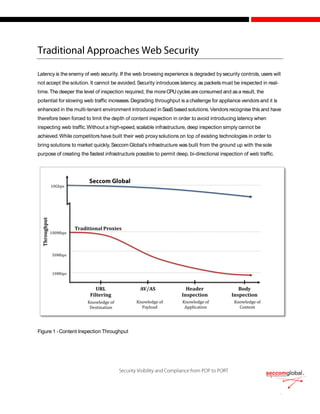
Latency is the enemy of web security. If the web browsing experience is degraded bysecurity controls, users will
not accept the solution. It cannot be avoided.Security introduces latency, as packets must be inspected in real-
time.The deeper the level of inspection required, the moreCPUcycles are consumed and asa result, the
potential for slowing web traffic increases.Degrading throughput is achallenge for appliance vendors and it is
enhanced in the multi-tenant environment introduced inSaaS based solutions.Vendors recognise this and have
therefore been forced to limit the depth of content inspection in order to avoid introducing latency when
inspecting web traffic.Without a high-speed,scalable infrastructure, deep inspection simply cannot be
achieved.While competitors have built their web proxysolutions on top of existing technologies in order to
bring solutions to market quickly,Seccom Global’s infrastructure was built from the ground up with the sole
purpose of creating the fastest infrastructure possible to permit deep, bi-directional inspection of web traffic.
Figure 1 -Content Inspection Throughput
Web pages must be reviewed and evaluated in order to implement security. All security solutions do this.What
is not always apparent is the depth of inspection that takes place.The deeper the level of inspection performed,
the greater the risk of introducing latency to web browsing. Assuch, most vendors limit inspection to only what
can be done quickly. URLscan be quickly matched against block lists, but such an approach offers protection
only against known attacksand doesn’t take into account the dynamic nature of the majority of web content.
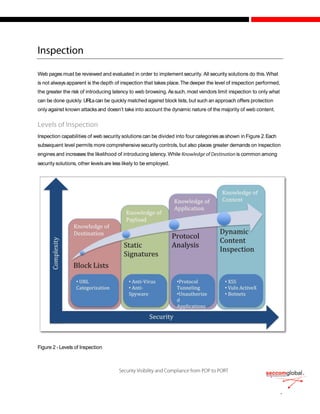
Inspection capabilities of web security solutions can be divided into four categories asshown in Figure 2.Each
subsequent level permits more comprehensivesecurity controls, but also places greater demands on inspection
engines and increases the likelihood of introducing latency.While is common among
security solutions, other levelsare less likely to be employed.
Figure 2 - Levels of Inspection
All web security solutions implement security controls through . If it is possible to know
ahead of time that web content violates asecurity policy, then blocking access to it can be implemented simply
by inspecting the URL of the request.Block lists (aka black lists) follow this approach by archiving URLs
associated with known malicious content.When an end user surfs to a page, the request is checked against the
block list and should a malicioussite be identified, the request is blocked.This is asimple, efficient way to
implement security, but alone provides insufficient protection as entities deployWeb
2.0 basedsites.
Static content is no longer the norm. In aWeb 2.0 world, content is dynamic in nature and user supplied content
is not only accepted, but encouraged.Two individuals can request the same web page but receive markedly
different results.Perhaps the web application customises content based on user preferences or identifies the
web browser version and adjusts accordingly. Maybe the site includes external content such asadvertising space
or news feeds.Assuch, astatic block list simply cannot definitively identify malicious content. Additionally,
thanks to millions of users providing the bulk of content, especially on popular social networking sites, it is
simply not possible to keep up with new content purely by reviewing/updating block lists.Content must be
reviewed dynamically, in real-time in order to implement security.
The web includes asignificant volume of binary content in the form of pictures, video, audio, documents,
executable files, etc. that could be malicious in nature. It is therefore important for such content to be evaluated
by anti-virus (AV)and anti-spyware (AS)engines.While AV/AS has long been an accepted practice on the
desktop, it isstill not employed asan in-line solution in the majority of enterprises.One is not a replacement for
the other.Rather, in combination, host and network based AV/ASsolutions are complimentary and represent an
important component of a defense-in-depth approach to web security.
Host based AV must receive regular signature updatesand should that process be delayed or blocked altogether
for a variety of reasons,a machine can become infected. In-line or network AV/AS will provide protection in
situations where host basedsolutions are either not up to date or have been disabled.The latter is acommon
problem when the machine has become infected. Malicious code often seeks to disable AV/AS to ensure that
subsequent signature updates do not detect and quarantine the initial infection.Employing network based
AV/ASensures that asingle point of failure does not exist when detecting malicious binaries.
Implementing in-line AV/AS in a web security solution is challenging. Once again, due to the real-time nature of
the web, latency can quickly be introduced when running AV/ASengines in-line.This is especially true forSWG
appliances that provide in-line AV/ASusing an entirely separate third party appliance which communicates with
theSWGvia Internet Content Adaptation Protocol (ICAP). ICAP is a message transmission protocol commonly
used to permit standardised communication between devices but such asetup is inefficient and creates
unacceptable latency for most enterprises.Seccom Global has taken a different approach by implementing
AV/AScapabilities directly within the gateway responsible for content inspection. Moreover, files arescanned in
phases to further streamline the process. If for example, the first 1MB of a 100MB file is found to be malicious, the
file will be blocked immediately, without requiring the full download to complete. Additionally, hashing
algorithms are continually employed to quickly identify content that has previously been scanned.The result is
in-line AV/ASat unprecedented speed, resulting in transparent protection for end users.
Today, virtually all protocols are tunneled through HTTP/HTTPS.This is true because ports 80 and 443 always
represent a path to the Internet. Assuch, modern applications requiring external communication typically
employ intelligent techniques to probe the network looking for ways to communicate with remote servers.They
will generally begin by trying an efficient, proprietary protocol on a high numbered port and then slowly regress
to using more common protocols,eventually settling on tunneling traffic through HTTP/HTTPSif needed.For
this reason, traditional firewalls are of limited value. Applications are no longer defined by the ports that they
communicate on. Identifying applications requires inspecting traffic to distinguish unique identifiers, typically
within the URI or headers of the request/response.
Malicious code will often tunnel communications in order to bypass firewalls restricting outbound traffic.
Additionally, employees will leverage applications with tunneling capabilities to bypasssecurity controls on the
LAN. Anonymisersare often leveraged to bypassURL filtering controls, while peer-to-peer (P2P)clients may be
used to transfer files or conduct bandwidth intensive taskssuch assharing media files.Unauthorised
communications such as IRCmay also be tunneled through web protocols. Identifying and blocking such traffic
is not a trivial challenge, as it requires researching the applications in question to understand their traffic
patterns in order to implement appropriate pattern matching technologies. Moreover, research must be
ongoing asapplication upgrades often change the application behavior used for detection.Seccom Global
provides controls to manage popular anonymiser,P2Pand IRCapplications with HTTP/HTTPStunneling
capabilities.Blocking is based on traffic inspection, not simple block lists which can be easily bypassed.
A typical web request leads to dozens of responses from multiple web servers resulting in hundreds of kilobytes
of data. Mashups and user-supplied content ensure that much of the content received has not been vetted in
any way to ensure that it is not malicious in nature. Additionally, legitimate sites are regularly compromised, and
serve asacatalyst for attackers who are then able to leverage the site to attack the many trusting users visiting it
each day.For these reasons,all web content received must be considered to be untrusted regardless of the
source.
Deep content inspection, which permits high-speed pattern matching of all content regardless of location,
without introducing latency, is asignificant but necessary challenge.Threats identified via
simply cannot be identified ahead of time for the simple reason that they don’t exist ahead of time. Dynamic
content requires real-time inspection. Deep inspection at this level covers not just the URL, but all headers and
the full body of all requests and responses.This could not be achieved without a global architecture of proxy
technologies designed specifically for this purpose.Seccom Global is able to achieve this level of inspection in a
SaaSsolution because the system was designed from the ground up with as the goal.
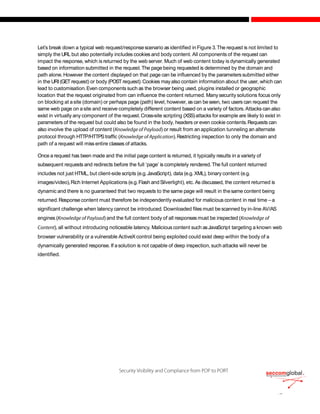
Consider a typical request to asocial networking site such asFacebook. Asingle request to a page can result in
dozens of responses from both facebook.com and third party sites.Content on the site is dynamic in nature and
continually changing as it is provided by millions of users contributing to the site.Security controls relying solely
on the alone will be minimally effective in such asituation.
Figure 3 -WebRequest/Response
Let’s break down a typical web request/responsescenario as identified in Figure 3.The request is not limited to
simply the URL but also potentially includes cookies and body content. All components of the request can
impact the response, which is returned by the web server. Much of web content today is dynamically generated
based on information submitted in the request.The page being requested is determined by the domain and
path alone. However the content displayed on that page can be influenced by the parameterssubmitted either
in the URI(GETrequest) or body (POSTrequest).Cookies mayalso contain information about the user, which can
lead to customisation.Even components such as the browser being used, plugins installed or geographic
location that the request originated from can influence the content returned. Manysecurity solutions focus only
on blocking at asite (domain) or perhaps page (path) level, however, ascan beseen, two users can request the
same web page on asite and receive completely different content based on a variety of factors. Attacks can also
exist in virtually any component of the request.Cross-site scripting (XSS)attacks for example are likely to exist in
parameters of the request but could also be found in the body, headers or even cookie contents.Requests can
also involve the upload of content ( ) or result from an application tunneling an alternate
protocol through HTTP/HTTPStraffic ( ).Restricting inspection to only the domain and
path of a request will miss entire classes of attacks.
Once a request has been made and the initial page content is returned, it typically results in a variety of
subsequent requests and redirects before the full ‘page’ is completely rendered.The full content returned
includes not just HTML, but client-side scripts (e.g.JavaScript), data (e.g.XML), binary content (e.g.
images/video),Rich Internet Applications (e.g.Flash andSilverlight), etc. As discussed, the content returned is
dynamic and there is no guaranteed that two requests to the same page will result in thesame content being
returned.Response content must therefore be independently evaluated for malicious content in real time – a
significant challenge when latency cannot be introduced. Downloaded files must bescanned by in-line AV/AS
engines ( ) and the full content body of all responses must be inspected (
), all without introducing noticeable latency. Malicious content such asJavaScript targeting a known web
browser vulnerability or a vulnerable ActiveX control being exploited could exist deep within the body of a
dynamically generated response. If asolution is not capable of deep inspection, such attacks will never be
identified.
Seccom Global employs the onlySaaSbased web security solution capable of achieving deep, real-time
inspection at all levels – .With high-speed gateways
deployed around the world and geoIP technology, web traffic is always routed to the gateway in the closest
geographic proximity. This eliminates needless latency caused by inefficient routing. Once traffic reaches the
Seccom Global gateway, scanning running on a purpose built system allows gateway
engines to efficiently scan content in asingle pass to implement security at all levels.This architecture permits
security controls that can inspect content bi-directionally, at any level, whether or not it is encrypted.
Beyond the ability to implement security in real time, aSaaSarchitecture permits unique abilities to identify
previously unknown threats and leverage this knowledge to protect all clients.This is known as the network
effect.The knowledge that can be obtained from the system grows exponentially as users are added to the
system.Seccom Global taps into this potential by implementing off-line processes to further inspect content
using methods that simply could not be performed in real-time due to the time involved to perform the depth of
analysis necessary.
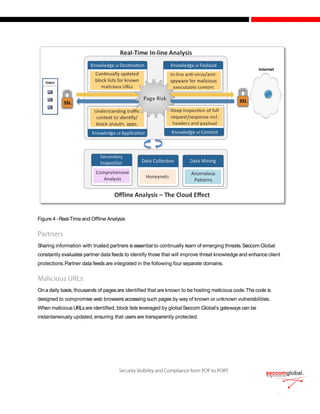
Off-line analysis includes data mining to identify anomalous traffic patterns.When attacksare identified,
signatures are created to ensure that further attacksare identified, blocked and reported in real-time. In this way,
knowledge gained from asingle targeted attack can be leveraged to protect all usersacrossall companies.This
is the power of the network effect.
Binary filesare continuously re-analysed using multiple AV/ASengines from a multitude of vendors.Such
analysis would not be possible in real time due to the latency that such a process would introduce but can be
implemented via offline processing where latency is not a concern.
Figure 4 -Real-Time and Offline Analysis
Sharing information with trusted partners is essential to continually learn of emerging threats.Seccom Global
constantly evaluates partner data feeds to identify those that will improve threat knowledge and enhance client
protections.Partner data feeds are integrated in the following four separate domains.
On a daily basis, thousands of pagesare identified that are known to be hosting malicious code.The code is
designed to compromise web browsers accessing such pages by way of known or unknown vulnerabilities.
When malicious URLsare identified, block lists leveraged by globalSeccom Global‘s gateways can be
instantaneously updated, ensuring that users are transparently protected.
Phishing has become a lucrative industry for attackers.Setting up sites designed to social engineer victims into
sharing confidential data such as credit card and social security numbers is trivial to do. Thesites can be quickly
assembled and disappearshortly after they first emerge. Receiving multiple feeds identifying such sites and
quickly disseminating the information to gateways where it can be leveraged is a critical component to protect
against phishing attacks.
The growth of botnets is one of the greatest threats facing enterprises today.For this reason,Seccom Global
works with partners to identify known botnet command and control (C&C)servers.With such information, it is
possible to continually monitor outbound requests to identify those destined for C&Cservers, indicating the
presence of infected machines on a given network.
Vulnerabilities are continuously being discovered in applications.Seccom Global not only monitors public
sources to ensure that signature based protections are deployed for applicable client side vulnerabilities but also
participates in a variety of private and commercial programs. In doing so,Seccom Global gains access to
vulnerability details ahead of the general public, enabling the deployment of signatures so that customers can
be protected from attack simply bysurfing the web viaSeccom’s global gateways.
Many times,a definitive rule exists for blocking malicious content.Perhaps,an anti-virussignature has returned a
positive response or a user isattempting to accessaURL,which has been previously black listed. In such cases,
blocking is astraightforward, binary decision. Access to the requested content is either blocked or allowed,
based on a pre-defined security policy. However, new threats emerge every day, for which signatures have not
yet been written. Assuch, the concept of reputation plays an important role in providing comprehensive
security to end-users.
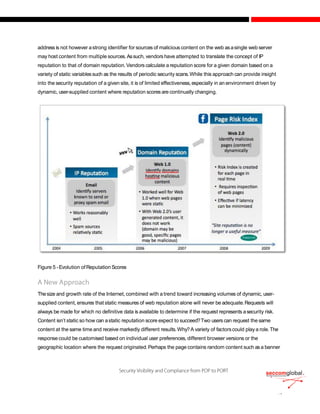
IP reputation has becomestandard functionality for email security vendors.The idea being that if spam email
has previously been identified from a particular source IPaddress, that same address hasan increased likelihood
of delivering spam going forward.The more spam detected, the higher the likelihood that subsequent email
messages will also bespam.This concept worked well for email security asan IPaddress is a reasonable and
consistent identifier for an email server.Web security vendors have attempted to adapt thissame concept. An IP
address is not however astrong identifier for sources of malicious content on the web asasingle web server
may host content from multiple sources.Assuch, vendors have attempted to translate the concept of IP
reputation to that of domain reputation. Vendors calculate a reputation score for a given domain based on a
variety of static variablessuch as the results of periodic security scans.While this approach can provide insight
into the security reputation of a given site, it is of limited effectiveness,especially in an environment driven by
dynamic, user-supplied content where reputation scores are continually changing.
Figure 5 -Evolution ofReputation Scores
Thesize and growth rate of the Internet, combined with a trend toward increasing volumes of dynamic, user-
supplied content, ensures that static measures of web reputation alone will never be adequate.Requests will
always be made for which no definitive data is available to determine if the request represents asecurity risk.
Content isn’t static so how can astatic reputation score expect to succeed?Two users can request the same
content at the same time and receive markedly different results.Why?A variety of factorscould play a role.The
response could be customised based on individual user preferences, different browser versions or the
geographic location where the request originated.Perhaps the page contains random content such asa banner
ad. In short, static reputation scoressimply cannot provide an accurate assessment of dynamic content. For that
reason, dynamically calculated variables are required to automatically assess the risk for any given web
request/responsescenario. No individual metric will provide an accurate risk score for all scenarios.Rather, it is
necessary to leverage a blending of a variety of risk indicators and apply appropriate weighting to each variable
to achieve a comprehensive risk index or score. An ‘in the cloud’ security model is an ideal environment to
calculate such a risk score as it ensures that all requests and responses pass through a central processing node
and therefore allow for complete inspection of all data to and from a given resource.
Calculating a dynamic risk score is achallenging proposition.Thescore must be calculated ‘on the fly’ for every
individual request. Numerous variables must individually by calculated and then combined into an overall risk
score.The calculated score must then be compared to a predefined risk threshold in order to make a block/allow
decision, and this must occur without adding latency to the browsing experience of each and every user.Thanks
to high performance cloud-based architecture developed bySeccom Global we have been able to implement
the first ever 100% dynamically calculated reputation score for web content.Known asPageRisk Index (PRI),
Seccom Global’s patent-pending approach to web reputation is a comprehensive weighting of a variety of risk
indicators in two separate and distinct control categories – domain analysis and content analysis.APRIscore is
calculated for each and every web request (request), which is then compared to previously established
thresholds in order to determine how the request should be handled.
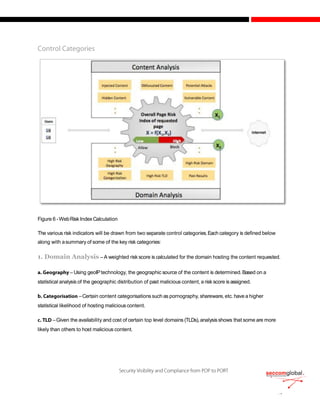
Figure 6 -WebRisk IndexCalculation
The various risk indicators will be drawn from two separate control categories.Each category is defined below
along with asummary of some of the key risk categories:
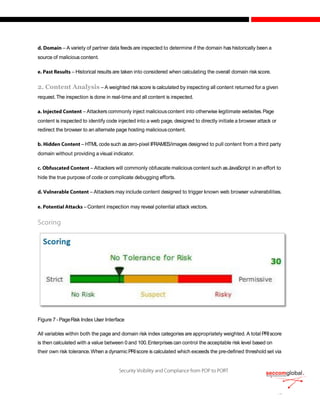
1. Domain Analysis – A weighted risk score is calculated for the domain hosting the content requested.
– Using geoIPtechnology, the geographic source of the content is determined.Based on a
statistical analysis of the geographic distribution of past malicious content, a risk score is assigned.
–Certain content categorisations such as pornography,shareware, etc. have a higher
statistical likelihood of hosting malicious content.
–Given the availability and cost of certain top level domains (TLDs),analysisshows that some are more
likely than others to host malicious content.
– A variety of partner data feeds are inspected to determine if the domain has historically been a
source of malicious content.
– Historical results are taken into considered when calculating the overall domain risk score.
2. Content Analysis – A weighted risk score is calculated by inspecting all content returned for a given
request.The inspection is done in real-time and all content is inspected.
– Attackers commonly inject maliciouscontent into otherwise legitimate websites.Page
content is inspected to identify code injected into a web page, designed to directly initiate a browser attack or
redirect the browser to an alternate page hosting maliciouscontent.
– HTML code such as zero-pixel IFRAMES/images designed to pull content from a third party
domain without providing a visual indicator.
– Attackers will commonly obfuscate malicious content such asJavaScript in an effort to
hide the true purpose of code or complicate debugging efforts.
– Attackers may include content designed to trigger known web browser vulnerabilities.
–Content inspection may reveal potential attack vectors.
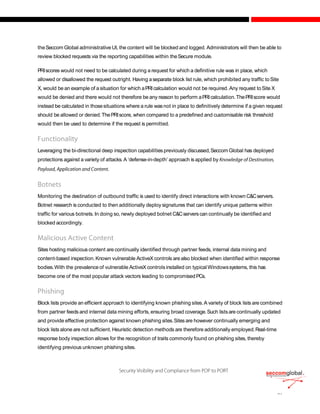
Figure 7 -PageRisk Index User Interface
All variables within both the page and domain risk index categories are appropriately weighted. A total PRIscore
is then calculated with a value between 0 and 100.Enterprises can control the acceptable risk level based on
their own risk tolerance.When a dynamic PRIscore is calculated which exceeds the pre-defined threshold set via
theSeccom Global administrative UI, the content will be blocked and logged. Administrators will then be able to
review blocked requests via the reporting capabilities within theSecure module.
PRIscores would not need to be calculated during a request for which a definitive rule was in place, which
allowed or disallowed the request outright. Having aseparate block list rule, which prohibited any traffic to Site
X, would be an example of a situation for which aPRIcalculation would not be required. Any request to Site X
would be denied and there would not therefore be any reason to perform aPRIcalculation.ThePRIscore would
instead be calculated in thosesituations where a rule wasnot in place to definitively determine if a given request
should be allowed or denied.ThePRIscore, when compared to a predefined and customisable risk threshold
would then be used to determine if the request is permitted.
Leveraging the bi-directional deep inspection capabilities previously discussed,Seccom Global has deployed
protections against a variety of attacks.A ‘defense-in-depth’ approach is applied by
.
Monitoring the destination of outbound traffic is used to identify direct interactions with known C&Cservers.
Botnet research is conducted to then additionally deploysignatures that can identify unique patterns within
traffic for various botnets. In doing so, newly deployed botnet C&Cservers can continually be identified and
blocked accordingly.
Sites hosting malicious content are continually identified through partner feeds, internal data mining and
content-based inspection. Known vulnerable ActiveX controls are also blocked when identified within response
bodies.With the prevalence of vulnerable ActiveX controls installed on typicalWindowssystems, this has
become one of the most popular attack vectors leading to compromisedPCs.
Block lists provide an efficient approach to identifying known phishing sites.A variety of block lists are combined
from partner feeds and internal data mining efforts, ensuring broad coverage.Such listsare continually updated
and provide effective protection against known phishing sites.Sites are however continually emerging and
block lists alone are not sufficient. Heuristic detection methods are therefore additionally employed.Real-time
response body inspection allows for the recognition of traits commonly found on phishing sites, thereby
identifying previous unknown phishing sites.
Both infected machines and end usersseeking to bypassother security controls employ unauthorised
communications.Seccom Global has researched common IRCclients and anonymisers to deploy detections
based not on block lists but on unique patterns within the communication protocols.This ensures that traffic is
blocked regardless of destination.
Cross-site scripting attacks (XSS)are by far the most prevalent web application vulnerability found on otherwise
legitimate websites.XSScan be leveraged by attackers to control scripting languagessuch aJavaScript, which
are then executed within browsers visiting vulnerable sites.Seccom Global employs two separate approaches to
identify XSSvulnerabilities.The first monitors requests and identifies the presence of active script when such
content in not appropriate.The second patent pending approach injects a uniqueSeccom Global cookie into
communication with any domain.When content from the cookie is identified in anysubsequent request,
attempts to steal the cookie’s content—the typical goal of XSSattacks—can be thwarted.
Employing geoIP based technologies,Seccom Global is able to empower administrators to block content from
any geographic location.
Once again, by researching popular applications in the P2Pcategories of file sharing, anonymisersand VoIP
applications,Seccom Global isable to identify and block alternate protocols being tunneled through
HTTP/HTTPStransactions.
With a globally deployed, high-speed architecture,Seccom Global has implemented a platform capable of the
deep content inspection necessary for robust security in a SaaSsolution.TheSeccom Global platform permits all
levels of inspection including .With the ability to
conduct bi-directional, real-time inspection, emerging threats can be addressed without the need to deploy and
managesoftware internally. Protections are maintained, managed and updated continuously without any
necessary intervention on the part of those responsible for administering the service within the enterprise.
Policies can be updated and reports reviewed through an intuitive web portal which permits for uniform
protection of all enterprise clients regardless of location.
Advanced security - Seccom Global

Advanced security - Seccom Global

  • 3.
    1. Domain Analysis............................................................................................................18 2. Content Analysis ............................................................................................................19
  • 5.
    In nature, thosethat adapt to changes in their environment survive and prosper.The individuals that attack computer networks are no different.The information technology environment has evolved significantly over the past decade and attackers have adjusted their tactics along the way.Clear shifts have occurred in the attack evolution. Attacks haveshifted from servers to web applications and on to web browsers.Along the way, attackers have evolved from individuals motivated by curiosity, to organised criminalsseeking profit. Unfortunately, enterprises have largely failed to keep pace and continue to use dated methods to thwart attacks. Attackers that once targeted enterpriseservers have now realised that it is far easier to exploit client machines thanks to weak defensesand naive users.Buffer overflows in publicly exposed server-side services have been replaced by multi-faceted, client-side attacks leveraging social engineering, web browser vulnerabilities and trusted, yet vulnerable web applications.Web 2.0 technologies, while empowering developers to produce intuitive, user-friendly applications have also raised the bar on complexity, ensuring that vulnerable web applications are an accepted part of life on the Internet.The web browser has become a portal for attackers, allowing them to accesssensitive data on desktop and mobile devices, while often permitting complete control of a machine as it is recruited into a botnet army.Enterprises must shift focus and adapt if they expect to defend against modern attacks.
  • 6.
    Cloud delivered securityorSecurity-as-a-Service (SaaS)solutions have begun to emerge in an effort to tackle the challenge of web browsersecurity.SaaSsolutions offer an inherent and critical advantage over traditional hardware or software based SecureWebGateway (SWG)products.SaaSsolutions are able to protect mobile devices just as easily as they protect assets on the Local Area Network (LAN).This isa game changing differentiator.Enterprisesare becoming increasingly reliant on remote employees and ‘road warriors’ working both from laptops and smartphones.Attackers have recognised thisshift. They know all too well that remote workers are unlikely to be protected byLAN based defensesand mobile devices therefore constitute a ‘target rich’ environment.SaaSvendors can inspect web traffic regardless of location but few vendors offer ‘trueSaaS’ by requiring that no additional software run on the client device.This not only ensures that remote assets can be protected ‘out of the box’, but also reduces the cost and complexity associated with managing the overall solution.
  • 7.
    Latency is theenemy of web security. If the web browsing experience is degraded bysecurity controls, users will not accept the solution. It cannot be avoided.Security introduces latency, as packets must be inspected in real- time.The deeper the level of inspection required, the moreCPUcycles are consumed and asa result, the potential for slowing web traffic increases.Degrading throughput is achallenge for appliance vendors and it is enhanced in the multi-tenant environment introduced inSaaS based solutions.Vendors recognise this and have therefore been forced to limit the depth of content inspection in order to avoid introducing latency when inspecting web traffic.Without a high-speed,scalable infrastructure, deep inspection simply cannot be achieved.While competitors have built their web proxysolutions on top of existing technologies in order to bring solutions to market quickly,Seccom Global’s infrastructure was built from the ground up with the sole purpose of creating the fastest infrastructure possible to permit deep, bi-directional inspection of web traffic. Figure 1 -Content Inspection Throughput
  • 8.
    Web pages mustbe reviewed and evaluated in order to implement security. All security solutions do this.What is not always apparent is the depth of inspection that takes place.The deeper the level of inspection performed, the greater the risk of introducing latency to web browsing. Assuch, most vendors limit inspection to only what can be done quickly. URLscan be quickly matched against block lists, but such an approach offers protection only against known attacksand doesn’t take into account the dynamic nature of the majority of web content. Inspection capabilities of web security solutions can be divided into four categories asshown in Figure 2.Each subsequent level permits more comprehensivesecurity controls, but also places greater demands on inspection engines and increases the likelihood of introducing latency.While is common among security solutions, other levelsare less likely to be employed. Figure 2 - Levels of Inspection
  • 9.
    All web securitysolutions implement security controls through . If it is possible to know ahead of time that web content violates asecurity policy, then blocking access to it can be implemented simply by inspecting the URL of the request.Block lists (aka black lists) follow this approach by archiving URLs associated with known malicious content.When an end user surfs to a page, the request is checked against the block list and should a malicioussite be identified, the request is blocked.This is asimple, efficient way to implement security, but alone provides insufficient protection as entities deployWeb 2.0 basedsites. Static content is no longer the norm. In aWeb 2.0 world, content is dynamic in nature and user supplied content is not only accepted, but encouraged.Two individuals can request the same web page but receive markedly different results.Perhaps the web application customises content based on user preferences or identifies the web browser version and adjusts accordingly. Maybe the site includes external content such asadvertising space or news feeds.Assuch, astatic block list simply cannot definitively identify malicious content. Additionally, thanks to millions of users providing the bulk of content, especially on popular social networking sites, it is simply not possible to keep up with new content purely by reviewing/updating block lists.Content must be reviewed dynamically, in real-time in order to implement security. The web includes asignificant volume of binary content in the form of pictures, video, audio, documents, executable files, etc. that could be malicious in nature. It is therefore important for such content to be evaluated by anti-virus (AV)and anti-spyware (AS)engines.While AV/AS has long been an accepted practice on the desktop, it isstill not employed asan in-line solution in the majority of enterprises.One is not a replacement for the other.Rather, in combination, host and network based AV/ASsolutions are complimentary and represent an important component of a defense-in-depth approach to web security. Host based AV must receive regular signature updatesand should that process be delayed or blocked altogether for a variety of reasons,a machine can become infected. In-line or network AV/AS will provide protection in situations where host basedsolutions are either not up to date or have been disabled.The latter is acommon problem when the machine has become infected. Malicious code often seeks to disable AV/AS to ensure that subsequent signature updates do not detect and quarantine the initial infection.Employing network based AV/ASensures that asingle point of failure does not exist when detecting malicious binaries. Implementing in-line AV/AS in a web security solution is challenging. Once again, due to the real-time nature of the web, latency can quickly be introduced when running AV/ASengines in-line.This is especially true forSWG
  • 10.
    appliances that providein-line AV/ASusing an entirely separate third party appliance which communicates with theSWGvia Internet Content Adaptation Protocol (ICAP). ICAP is a message transmission protocol commonly used to permit standardised communication between devices but such asetup is inefficient and creates unacceptable latency for most enterprises.Seccom Global has taken a different approach by implementing AV/AScapabilities directly within the gateway responsible for content inspection. Moreover, files arescanned in phases to further streamline the process. If for example, the first 1MB of a 100MB file is found to be malicious, the file will be blocked immediately, without requiring the full download to complete. Additionally, hashing algorithms are continually employed to quickly identify content that has previously been scanned.The result is in-line AV/ASat unprecedented speed, resulting in transparent protection for end users. Today, virtually all protocols are tunneled through HTTP/HTTPS.This is true because ports 80 and 443 always represent a path to the Internet. Assuch, modern applications requiring external communication typically employ intelligent techniques to probe the network looking for ways to communicate with remote servers.They will generally begin by trying an efficient, proprietary protocol on a high numbered port and then slowly regress to using more common protocols,eventually settling on tunneling traffic through HTTP/HTTPSif needed.For this reason, traditional firewalls are of limited value. Applications are no longer defined by the ports that they communicate on. Identifying applications requires inspecting traffic to distinguish unique identifiers, typically within the URI or headers of the request/response. Malicious code will often tunnel communications in order to bypass firewalls restricting outbound traffic. Additionally, employees will leverage applications with tunneling capabilities to bypasssecurity controls on the LAN. Anonymisersare often leveraged to bypassURL filtering controls, while peer-to-peer (P2P)clients may be used to transfer files or conduct bandwidth intensive taskssuch assharing media files.Unauthorised communications such as IRCmay also be tunneled through web protocols. Identifying and blocking such traffic is not a trivial challenge, as it requires researching the applications in question to understand their traffic patterns in order to implement appropriate pattern matching technologies. Moreover, research must be ongoing asapplication upgrades often change the application behavior used for detection.Seccom Global provides controls to manage popular anonymiser,P2Pand IRCapplications with HTTP/HTTPStunneling capabilities.Blocking is based on traffic inspection, not simple block lists which can be easily bypassed. A typical web request leads to dozens of responses from multiple web servers resulting in hundreds of kilobytes of data. Mashups and user-supplied content ensure that much of the content received has not been vetted in any way to ensure that it is not malicious in nature. Additionally, legitimate sites are regularly compromised, and
  • 11.
    serve asacatalyst forattackers who are then able to leverage the site to attack the many trusting users visiting it each day.For these reasons,all web content received must be considered to be untrusted regardless of the source. Deep content inspection, which permits high-speed pattern matching of all content regardless of location, without introducing latency, is asignificant but necessary challenge.Threats identified via simply cannot be identified ahead of time for the simple reason that they don’t exist ahead of time. Dynamic content requires real-time inspection. Deep inspection at this level covers not just the URL, but all headers and the full body of all requests and responses.This could not be achieved without a global architecture of proxy technologies designed specifically for this purpose.Seccom Global is able to achieve this level of inspection in a SaaSsolution because the system was designed from the ground up with as the goal. Consider a typical request to asocial networking site such asFacebook. Asingle request to a page can result in dozens of responses from both facebook.com and third party sites.Content on the site is dynamic in nature and continually changing as it is provided by millions of users contributing to the site.Security controls relying solely on the alone will be minimally effective in such asituation. Figure 3 -WebRequest/Response
  • 12.
    Let’s break downa typical web request/responsescenario as identified in Figure 3.The request is not limited to simply the URL but also potentially includes cookies and body content. All components of the request can impact the response, which is returned by the web server. Much of web content today is dynamically generated based on information submitted in the request.The page being requested is determined by the domain and path alone. However the content displayed on that page can be influenced by the parameterssubmitted either in the URI(GETrequest) or body (POSTrequest).Cookies mayalso contain information about the user, which can lead to customisation.Even components such as the browser being used, plugins installed or geographic location that the request originated from can influence the content returned. Manysecurity solutions focus only on blocking at asite (domain) or perhaps page (path) level, however, ascan beseen, two users can request the same web page on asite and receive completely different content based on a variety of factors. Attacks can also exist in virtually any component of the request.Cross-site scripting (XSS)attacks for example are likely to exist in parameters of the request but could also be found in the body, headers or even cookie contents.Requests can also involve the upload of content ( ) or result from an application tunneling an alternate protocol through HTTP/HTTPStraffic ( ).Restricting inspection to only the domain and path of a request will miss entire classes of attacks. Once a request has been made and the initial page content is returned, it typically results in a variety of subsequent requests and redirects before the full ‘page’ is completely rendered.The full content returned includes not just HTML, but client-side scripts (e.g.JavaScript), data (e.g.XML), binary content (e.g. images/video),Rich Internet Applications (e.g.Flash andSilverlight), etc. As discussed, the content returned is dynamic and there is no guaranteed that two requests to the same page will result in thesame content being returned.Response content must therefore be independently evaluated for malicious content in real time – a significant challenge when latency cannot be introduced. Downloaded files must bescanned by in-line AV/AS engines ( ) and the full content body of all responses must be inspected ( ), all without introducing noticeable latency. Malicious content such asJavaScript targeting a known web browser vulnerability or a vulnerable ActiveX control being exploited could exist deep within the body of a dynamically generated response. If asolution is not capable of deep inspection, such attacks will never be identified.
  • 13.
    Seccom Global employsthe onlySaaSbased web security solution capable of achieving deep, real-time inspection at all levels – .With high-speed gateways deployed around the world and geoIP technology, web traffic is always routed to the gateway in the closest geographic proximity. This eliminates needless latency caused by inefficient routing. Once traffic reaches the Seccom Global gateway, scanning running on a purpose built system allows gateway engines to efficiently scan content in asingle pass to implement security at all levels.This architecture permits security controls that can inspect content bi-directionally, at any level, whether or not it is encrypted. Beyond the ability to implement security in real time, aSaaSarchitecture permits unique abilities to identify previously unknown threats and leverage this knowledge to protect all clients.This is known as the network effect.The knowledge that can be obtained from the system grows exponentially as users are added to the system.Seccom Global taps into this potential by implementing off-line processes to further inspect content using methods that simply could not be performed in real-time due to the time involved to perform the depth of analysis necessary. Off-line analysis includes data mining to identify anomalous traffic patterns.When attacksare identified, signatures are created to ensure that further attacksare identified, blocked and reported in real-time. In this way, knowledge gained from asingle targeted attack can be leveraged to protect all usersacrossall companies.This is the power of the network effect. Binary filesare continuously re-analysed using multiple AV/ASengines from a multitude of vendors.Such analysis would not be possible in real time due to the latency that such a process would introduce but can be implemented via offline processing where latency is not a concern.
  • 14.
    Figure 4 -Real-Timeand Offline Analysis Sharing information with trusted partners is essential to continually learn of emerging threats.Seccom Global constantly evaluates partner data feeds to identify those that will improve threat knowledge and enhance client protections.Partner data feeds are integrated in the following four separate domains. On a daily basis, thousands of pagesare identified that are known to be hosting malicious code.The code is designed to compromise web browsers accessing such pages by way of known or unknown vulnerabilities. When malicious URLsare identified, block lists leveraged by globalSeccom Global‘s gateways can be instantaneously updated, ensuring that users are transparently protected.
  • 15.
    Phishing has becomea lucrative industry for attackers.Setting up sites designed to social engineer victims into sharing confidential data such as credit card and social security numbers is trivial to do. Thesites can be quickly assembled and disappearshortly after they first emerge. Receiving multiple feeds identifying such sites and quickly disseminating the information to gateways where it can be leveraged is a critical component to protect against phishing attacks. The growth of botnets is one of the greatest threats facing enterprises today.For this reason,Seccom Global works with partners to identify known botnet command and control (C&C)servers.With such information, it is possible to continually monitor outbound requests to identify those destined for C&Cservers, indicating the presence of infected machines on a given network. Vulnerabilities are continuously being discovered in applications.Seccom Global not only monitors public sources to ensure that signature based protections are deployed for applicable client side vulnerabilities but also participates in a variety of private and commercial programs. In doing so,Seccom Global gains access to vulnerability details ahead of the general public, enabling the deployment of signatures so that customers can be protected from attack simply bysurfing the web viaSeccom’s global gateways. Many times,a definitive rule exists for blocking malicious content.Perhaps,an anti-virussignature has returned a positive response or a user isattempting to accessaURL,which has been previously black listed. In such cases, blocking is astraightforward, binary decision. Access to the requested content is either blocked or allowed, based on a pre-defined security policy. However, new threats emerge every day, for which signatures have not yet been written. Assuch, the concept of reputation plays an important role in providing comprehensive security to end-users. IP reputation has becomestandard functionality for email security vendors.The idea being that if spam email has previously been identified from a particular source IPaddress, that same address hasan increased likelihood of delivering spam going forward.The more spam detected, the higher the likelihood that subsequent email messages will also bespam.This concept worked well for email security asan IPaddress is a reasonable and consistent identifier for an email server.Web security vendors have attempted to adapt thissame concept. An IP
  • 16.
    address is nothowever astrong identifier for sources of malicious content on the web asasingle web server may host content from multiple sources.Assuch, vendors have attempted to translate the concept of IP reputation to that of domain reputation. Vendors calculate a reputation score for a given domain based on a variety of static variablessuch as the results of periodic security scans.While this approach can provide insight into the security reputation of a given site, it is of limited effectiveness,especially in an environment driven by dynamic, user-supplied content where reputation scores are continually changing. Figure 5 -Evolution ofReputation Scores Thesize and growth rate of the Internet, combined with a trend toward increasing volumes of dynamic, user- supplied content, ensures that static measures of web reputation alone will never be adequate.Requests will always be made for which no definitive data is available to determine if the request represents asecurity risk. Content isn’t static so how can astatic reputation score expect to succeed?Two users can request the same content at the same time and receive markedly different results.Why?A variety of factorscould play a role.The response could be customised based on individual user preferences, different browser versions or the geographic location where the request originated.Perhaps the page contains random content such asa banner
  • 17.
    ad. In short,static reputation scoressimply cannot provide an accurate assessment of dynamic content. For that reason, dynamically calculated variables are required to automatically assess the risk for any given web request/responsescenario. No individual metric will provide an accurate risk score for all scenarios.Rather, it is necessary to leverage a blending of a variety of risk indicators and apply appropriate weighting to each variable to achieve a comprehensive risk index or score. An ‘in the cloud’ security model is an ideal environment to calculate such a risk score as it ensures that all requests and responses pass through a central processing node and therefore allow for complete inspection of all data to and from a given resource. Calculating a dynamic risk score is achallenging proposition.Thescore must be calculated ‘on the fly’ for every individual request. Numerous variables must individually by calculated and then combined into an overall risk score.The calculated score must then be compared to a predefined risk threshold in order to make a block/allow decision, and this must occur without adding latency to the browsing experience of each and every user.Thanks to high performance cloud-based architecture developed bySeccom Global we have been able to implement the first ever 100% dynamically calculated reputation score for web content.Known asPageRisk Index (PRI), Seccom Global’s patent-pending approach to web reputation is a comprehensive weighting of a variety of risk indicators in two separate and distinct control categories – domain analysis and content analysis.APRIscore is calculated for each and every web request (request), which is then compared to previously established thresholds in order to determine how the request should be handled.
  • 18.
    Figure 6 -WebRiskIndexCalculation The various risk indicators will be drawn from two separate control categories.Each category is defined below along with asummary of some of the key risk categories: 1. Domain Analysis – A weighted risk score is calculated for the domain hosting the content requested. – Using geoIPtechnology, the geographic source of the content is determined.Based on a statistical analysis of the geographic distribution of past malicious content, a risk score is assigned. –Certain content categorisations such as pornography,shareware, etc. have a higher statistical likelihood of hosting malicious content. –Given the availability and cost of certain top level domains (TLDs),analysisshows that some are more likely than others to host malicious content.
  • 19.
    – A varietyof partner data feeds are inspected to determine if the domain has historically been a source of malicious content. – Historical results are taken into considered when calculating the overall domain risk score. 2. Content Analysis – A weighted risk score is calculated by inspecting all content returned for a given request.The inspection is done in real-time and all content is inspected. – Attackers commonly inject maliciouscontent into otherwise legitimate websites.Page content is inspected to identify code injected into a web page, designed to directly initiate a browser attack or redirect the browser to an alternate page hosting maliciouscontent. – HTML code such as zero-pixel IFRAMES/images designed to pull content from a third party domain without providing a visual indicator. – Attackers will commonly obfuscate malicious content such asJavaScript in an effort to hide the true purpose of code or complicate debugging efforts. – Attackers may include content designed to trigger known web browser vulnerabilities. –Content inspection may reveal potential attack vectors. Figure 7 -PageRisk Index User Interface All variables within both the page and domain risk index categories are appropriately weighted. A total PRIscore is then calculated with a value between 0 and 100.Enterprises can control the acceptable risk level based on their own risk tolerance.When a dynamic PRIscore is calculated which exceeds the pre-defined threshold set via
  • 20.
    theSeccom Global administrativeUI, the content will be blocked and logged. Administrators will then be able to review blocked requests via the reporting capabilities within theSecure module. PRIscores would not need to be calculated during a request for which a definitive rule was in place, which allowed or disallowed the request outright. Having aseparate block list rule, which prohibited any traffic to Site X, would be an example of a situation for which aPRIcalculation would not be required. Any request to Site X would be denied and there would not therefore be any reason to perform aPRIcalculation.ThePRIscore would instead be calculated in thosesituations where a rule wasnot in place to definitively determine if a given request should be allowed or denied.ThePRIscore, when compared to a predefined and customisable risk threshold would then be used to determine if the request is permitted. Leveraging the bi-directional deep inspection capabilities previously discussed,Seccom Global has deployed protections against a variety of attacks.A ‘defense-in-depth’ approach is applied by . Monitoring the destination of outbound traffic is used to identify direct interactions with known C&Cservers. Botnet research is conducted to then additionally deploysignatures that can identify unique patterns within traffic for various botnets. In doing so, newly deployed botnet C&Cservers can continually be identified and blocked accordingly. Sites hosting malicious content are continually identified through partner feeds, internal data mining and content-based inspection. Known vulnerable ActiveX controls are also blocked when identified within response bodies.With the prevalence of vulnerable ActiveX controls installed on typicalWindowssystems, this has become one of the most popular attack vectors leading to compromisedPCs. Block lists provide an efficient approach to identifying known phishing sites.A variety of block lists are combined from partner feeds and internal data mining efforts, ensuring broad coverage.Such listsare continually updated and provide effective protection against known phishing sites.Sites are however continually emerging and block lists alone are not sufficient. Heuristic detection methods are therefore additionally employed.Real-time response body inspection allows for the recognition of traits commonly found on phishing sites, thereby identifying previous unknown phishing sites.
  • 21.
    Both infected machinesand end usersseeking to bypassother security controls employ unauthorised communications.Seccom Global has researched common IRCclients and anonymisers to deploy detections based not on block lists but on unique patterns within the communication protocols.This ensures that traffic is blocked regardless of destination. Cross-site scripting attacks (XSS)are by far the most prevalent web application vulnerability found on otherwise legitimate websites.XSScan be leveraged by attackers to control scripting languagessuch aJavaScript, which are then executed within browsers visiting vulnerable sites.Seccom Global employs two separate approaches to identify XSSvulnerabilities.The first monitors requests and identifies the presence of active script when such content in not appropriate.The second patent pending approach injects a uniqueSeccom Global cookie into communication with any domain.When content from the cookie is identified in anysubsequent request, attempts to steal the cookie’s content—the typical goal of XSSattacks—can be thwarted. Employing geoIP based technologies,Seccom Global is able to empower administrators to block content from any geographic location. Once again, by researching popular applications in the P2Pcategories of file sharing, anonymisersand VoIP applications,Seccom Global isable to identify and block alternate protocols being tunneled through HTTP/HTTPStransactions.
  • 22.
    With a globallydeployed, high-speed architecture,Seccom Global has implemented a platform capable of the deep content inspection necessary for robust security in a SaaSsolution.TheSeccom Global platform permits all levels of inspection including .With the ability to conduct bi-directional, real-time inspection, emerging threats can be addressed without the need to deploy and managesoftware internally. Protections are maintained, managed and updated continuously without any necessary intervention on the part of those responsible for administering the service within the enterprise. Policies can be updated and reports reviewed through an intuitive web portal which permits for uniform protection of all enterprise clients regardless of location.