Advanced relationships
• The things in diagrams are connected with one another
through relationships. So, relationships are the
connections between things.
• In UML, the four important relationships are dependency,
generalization, association and realization.
• Each type of relationship has its own graphical
representation.
1.Dependency
• The dependency relationship is also known as using relationship i.e., if the
specification of one thing (for example Graphics class code) changes then it
will automatically affect the behavior of another thing (for example Hello class
using the drawstring method of Graphics class) that uses it.
• A dependency relationship is graphically represented as a dashed arrow.
Realization
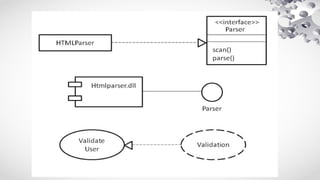
• Realization is a semantic relationship between classifiers,
where one classifier provides the specification which is
implemented by the other classifier. Realization can exist
between an interface and class, interface and a
component and between a use case and collaboration.
• Realization is graphically represented as dashed line with
a hollow arrow head pointing towards the classifier which
provides the specification.
Common Modeling techniques
To model webs of relationships,
• Apply use cases and scenarios to find the relationships between the
abstractions in the system.
• Start by modeling the structural relationships (associations) between the
things. These specify the structure of the system.
• Then, model the generalization-specialization relationships.
• Finally, after modeling the remaining relationships go for dependency
relationships.
• After representing all the relationships, transform their basic representation
by applying the advanced features to your intent.
Interfaces,Types and roles
Interface
• An interface is a collection of operations that are used
to specify a service of a class or acomponent.
Type
• A type is a stereotype of a class used to specify a domain of
objects, together withthe operations (but not the methods)
applicable to the object.
Role
• A role is the behavior of an entityparticipating in a particular
context.
Advanced relationships.Object oriented analysis&Designpptx

Advanced relationships.Object oriented analysis&Designpptx

  • 1.
    Advanced relationships • Thethings in diagrams are connected with one another through relationships. So, relationships are the connections between things. • In UML, the four important relationships are dependency, generalization, association and realization. • Each type of relationship has its own graphical representation.
  • 2.
    1.Dependency • The dependencyrelationship is also known as using relationship i.e., if the specification of one thing (for example Graphics class code) changes then it will automatically affect the behavior of another thing (for example Hello class using the drawstring method of Graphics class) that uses it. • A dependency relationship is graphically represented as a dashed arrow.
  • 3.
    Realization • Realization isa semantic relationship between classifiers, where one classifier provides the specification which is implemented by the other classifier. Realization can exist between an interface and class, interface and a component and between a use case and collaboration. • Realization is graphically represented as dashed line with a hollow arrow head pointing towards the classifier which provides the specification.
  • 5.
    Common Modeling techniques Tomodel webs of relationships, • Apply use cases and scenarios to find the relationships between the abstractions in the system. • Start by modeling the structural relationships (associations) between the things. These specify the structure of the system. • Then, model the generalization-specialization relationships. • Finally, after modeling the remaining relationships go for dependency relationships. • After representing all the relationships, transform their basic representation by applying the advanced features to your intent.
  • 6.
    Interfaces,Types and roles Interface •An interface is a collection of operations that are used to specify a service of a class or acomponent. Type • A type is a stereotype of a class used to specify a domain of objects, together withthe operations (but not the methods) applicable to the object. Role • A role is the behavior of an entityparticipating in a particular context.