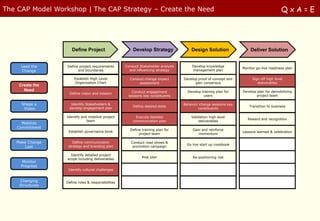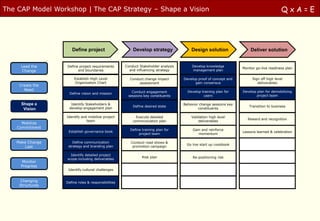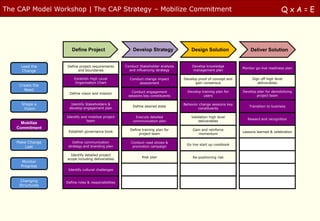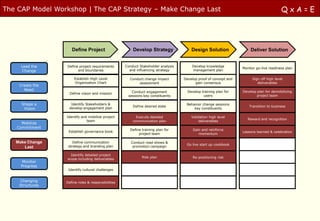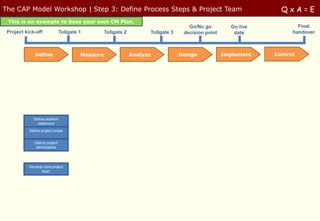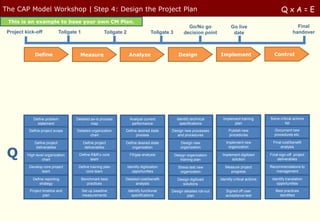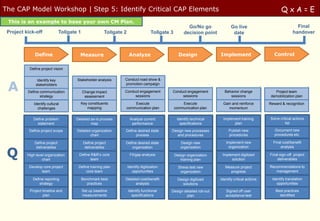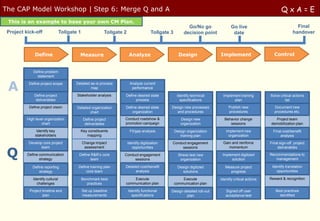
The CAP Model Workshop


         Day 1
The CAP Model Workshop

        Why Do We Need to Change? Why Do We Need to Manage
        Change?
          Change is inescapable…

          •   Business and strategic conditions evolve continuously, so we must be
              able to adapt successfully if we want to remain competitive.

          •   Businesses often fail altogether because they are unable to implement
              desperately needed changes in their work processes or organization.

          At the same time…

          •   Change is difficult, unpredictable, uncomfortable, chaotic, risky and
              unsettling.

          •   The capacity for change may be the key to success, but going through a
              change can also be disruptive and feel threatening.

          •   Because both individuals and entire organizational units routinely resist
              change, it takes careful planning and specialized knowledge and skill to
              lead or implement a change process smoothly and effectively.
The CAP Model Workshop | SARA


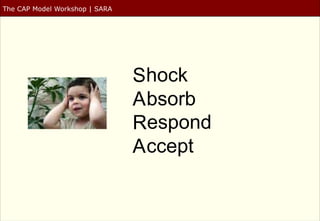
                                Shock
                                A bsorb
                                Respond
                                A ccept
The CAP Model Workshop | What is Change?


                  What is Change?

            Camlin Whiteboard Markers
                   Advertisement
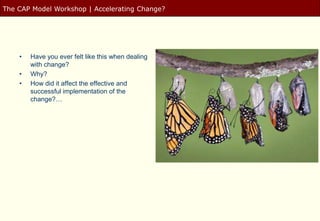
The CAP Model Workshop | Accelerating Change?


    •   Have you ever felt like this when dealing
        with change?
    •   Why?
    •   How did it affect the effective and
        successful implementation of the
        change?…
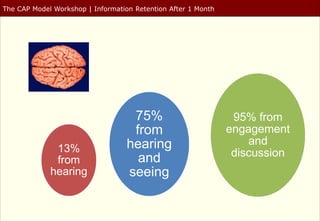
The CAP Model Workshop | Information Retention After 1 Month


                                    75%                         95% from
                                    from                       engagement
                                   hearing                         and
              13%                                               discussion
              from                   and
             hearing               seeing
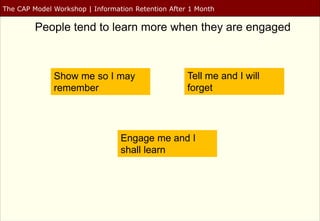
The CAP Model Workshop | Information Retention After 1 Month

         People tend to learn more when they are engaged


              Show me so I may                      Tell me and I will
              remember                              forget


                                 Engage me and I
                                 shall learn
The CAP Model Workshop | Factors for Successful Change Management


        The success of any Change Management initiative depends on the organization’s
        willingness and ability to assume ownership of the change. There are five key
        characteristics of all successful change implementations:

          o Proper Planning: develop and document objectives and lay out how it will be
            achieved

          o Defined Governance: establish appropriate organizational structures, roles
            and responsibilities and associated monitoring arrangements.

          o Committed Leadership: ensure ongoing commitment at the top and across
            the organization

          o Engaged Stakeholders: encourage and sustain stakeholder participation and
            commitment

          o Aligned Workforce: ensure that the workforce understands and is aligned
            with, actively supports, and is willing to bear the burden of changing
The CAP Model Workshop | The Impact of Effective Change Management


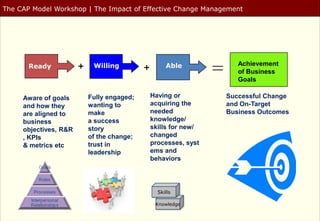
       Ready             Willing             Able               Achievement
                                               Able
        Ready             Willing                               of Business
                                                                Goals

     Aware of goals    Fully engaged;   Having or            Successful Change
     and how they      wanting to       acquiring the        and On-Target
     are aligned to    make             needed               Business Outcomes
     business          a success        knowledge/
     objectives, R&R   story            skills for new/
     , KPIs            of the change;   changed
     & metrics etc     trust in         processes, syst
                       leadership       ems and
                                        behaviors


                                          Skills

                                          Knowledge
The CAP Model Workshop | Commitment to Change

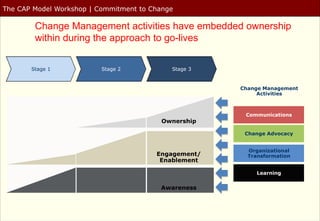
        Change Management activities have embedded ownership
        within during the approach to go-lives


       Stage 1            Stage 2           Stage 3


                                                      Change Management
                                                           Activities


                                                       Communications
                                         Ownership

                                                       Change Advocacy


                                                        Organizational
                                        Engagement/     Transformation
                                         Enablement

                                                           Learning


                                         Awareness
The CAP Model Workshop | Topics


      1. Learning about the critical questions and actions that will steer towards successful change
      2. Creating a shared need for change and vision for your project team
      3. Understanding and dealing with engagement and resistance from key stakeholders and key
         constituents
      4. Building an effective and sustainable implementation plan
      5. The crucial role of communication and engagement
The CAP Model Workshop | Change Research


  • Almost 99% of all changes evaluated as
    “Successful” had a good technical solution
    or approach

  • Over 98% of all changes evaluated as
    “Unsuccessful” also had a good technical
    solution or approach


         What is the differentiating factor between success
                           and failure?
CAP
The CAP Model Workshop | Summary


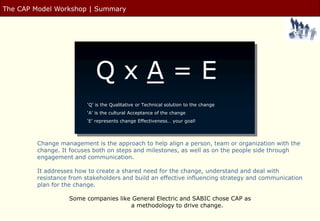
                           QxA=E
                        „Q‟ is the Qualitative or Technical solution to the change
                        „A‟ is the cultural Acceptance of the change
                        „E‟ represents change Effectiveness… your goal!


        Change management is the approach to help align a person, team or organization with the
        change. It focuses both on steps and milestones, as well as on the people side through
        engagement and communication.

        It addresses how to create a shared need for the change, understand and deal with
        resistance from stakeholders and build an effective influencing strategy and communication
        plan for the change.

                  Some companies like General Electric and SABIC chose CAP as
                                     a methodology to drive change.
The CAP Model Workshop | Summary                          QxA=E


           Charles Darwin may have some insight for us:


         It is not the strongest of the species
               that survive, nor the most
       intelligent, but the one most responsive
                        to change.
The CAP Model Workshop | Summary                                               QxA=E


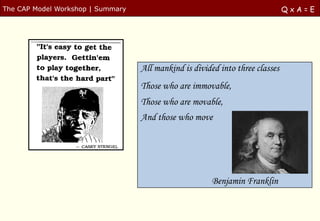
                                   All mankind is divided into three classes
                                   Those who are immovable,
                                   Those who are movable,
                                   And those who move


                                                        Benjamin Franklin
The Change Acceleration Process Model – Summary
The CAP Model Workshop | Summary                                                                         QxA=E

 Change Acceleration Process (CAP):


             Q x A = E
  Is:
  • A strategy to drive effective change
  • A method to engage business teams in a
    dialogue to increase the success
  • To accelerate the implementation of
    organizational change efforts

 Addresses how to :
 • Create a shared need for the change and a vision
 • Understand and deal with resistance from stakeholders
 • Build an effective and sustainable influencing strategy

        It is NOT:
        •   A magic formula that resolve conflicts or resistance
        •   A set of tools that eliminates discussion, consultation or creativity to resolve conflicts
The Change Acceleration Process Model – Summary
The CAP Model Workshop | Introduction                                                                                             QxA=E

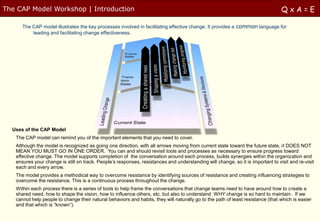
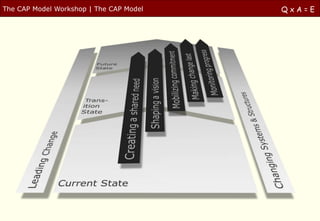
       The CAP model illustrates the key processes involved in facilitating effective change. It provides a common language for
           leading and facilitating change effectiveness.


  Uses of the CAP Model
    The CAP model can remind you of the important elements that you need to cover.
    Although the model is recognized as going one direction, with all arrows moving from current state toward the future state, it DOES NOT
    MEAN YOU MUST GO IN ONE ORDER. You can and should revisit tools and processes as necessary to ensure progress toward
    effective change. The model supports completion of the conversation around each process, builds synergies within the organization and
    ensures your change is still on track. People’s responses, resistances and understanding will change, so it is important to visit and re-visit
    each and every arrow.
    The model provides a methodical way to overcome resistance by identifying sources of resistance and creating influencing strategies to
    overcome the resistance. This is a continuous process throughout the change.
    Within each process there is a series of tools to help frame the conversations that change teams need to have around how to create a
    shared need, how to shape the vision, how to influence others, etc. but also to understand WHY change is so hard to maintain. If we
    cannot help people to change their natural behaviors and habits, they will naturally go to the path of least resistance (that which is easier
    and that which is “known”).
The CAP Model Workshop | The CAP Model   QxA=E
The CAP Model Workshop | Overview                                                                   QxA=E

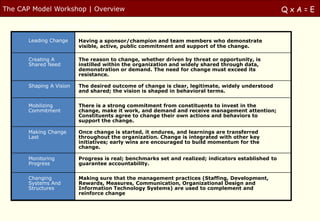
     CAP: A Model for Change
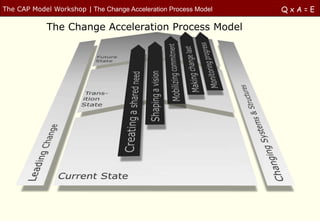
      Leading Change     Having a sponsor/champion and team members who demonstrate
                         visible, active, public commitment and support of the change.

      Creating A         The reason to change, whether driven by threat or opportunity, is
      Shared Need        instilled within the organization and widely shared through data,
                         demonstration or demand. The need for change must exceed its
                         resistance.

      Shaping A Vision   The desired outcome of change is clear, legitimate, widely understood
                         and shared; the vision is shaped in behavioral terms.

      Mobilizing         There is a strong commitment from constituents to invest in the
      Commitment         change, make it work, and demand and receive management attention;
                         Constituents agree to change their own actions and behaviors to
                         support the change.

      Making Change      Once change is started, it endures, and learnings are transferred
      Last               throughout the organization. Change is integrated with other key
                         initiatives; early wins are encouraged to build momentum for the
                         change.

      Monitoring         Progress is real; benchmarks set and realized; indicators established to
      Progress           guarantee accountability.

      Changing           Making sure that the management practices (Staffing, Development,
      Systems And        Rewards, Measures, Communication, Organizational Design and
      Structures         Information Technology Systems) are used to complement and
                         reinforce change
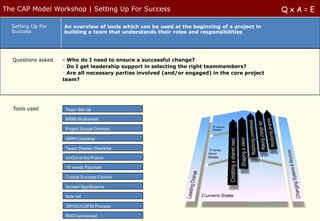
The CAP Model Workshop | Setting Up For Success                                                 QxA=E

  Setting Up For    An overview of tools which can be used at the beginning of a project in
  Success           building a team that understands their roles and responsibilities


  Questions asked   - Who do I need to ensure a successful change?
                    - Do I get leadership support in selecting the right teammembers?
                    - Are all necessary parties involved (and/or engaged) in the core project
                    team?


  Tools used         Team Set Up

                     ARMI Worksheet

                     Project Scope Contract

                     GRPI Checklist

                     Team Charter Checklist

                     In/Out of the Frame

                     15 words Flipchart

                     Critical Success Factors

                     Screen Significance

                     Is/Is not

                     SIPOC/COPIS Process

                     RACI worksheet
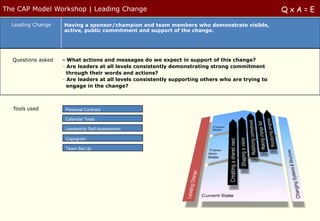
The CAP Model Workshop | Leading Change                                                            QxA=E
  Leading Change    Having a sponsor/champion and team members who demonstrate visible,
                    active, public commitment and support of the change.


  Questions asked   - What actions and messages do we expect in support of this change?
                    - Are leaders at all levels consistently demonstrating strong commitment
                      through their words and actions?
                    - Are leaders at all levels consistently supporting others who are trying to
                      engage in the change?


  Tools used         Personal Contract

                     Calendar Tests

                     Leadership Self-Assessment

                     Capogram

                     Team Set Up
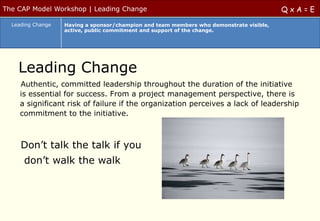
The CAP Model Workshop | Leading Change                                                  QxA=E
  Leading Change   Having a sponsor/champion and team members who demonstrate visible,
                   active, public commitment and support of the change.


    Leading Change
     Authentic, committed leadership throughout the duration of the initiative
     is essential for success. From a project management perspective, there is
     a significant risk of failure if the organization perceives a lack of leadership
     commitment to the initiative.


     Don‟t talk the talk if you
      don‟t walk the walk
The CAP Model Workshop | Leading Change                                                  QxA=E
  Leading Change   Having a sponsor/champion and team members who demonstrate visible,
                   active, public commitment and support of the change.


    Leading Change
     – What actions and messages do we expect in
       support of this change?


     – Are leaders at all levels consistently
       demonstrating strong commitment through their
       words and actions?


     – Are leaders at all levels consistently supporting
       others who are trying to engage in the change?
The CAP Model Workshop | Leading Change


                   Leading Change

              Presented by Steve Jobs
The CAP Model Workshop | Leading Change

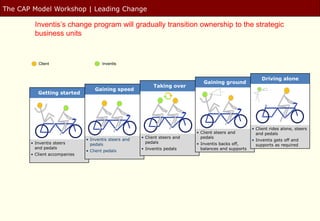
         Inventis’s change program will gradually transition ownership to the strategic
         business units


          Client                     Inventis


                                                                                                           Driving alone
                                                                               Gaining ground
                                                           Taking over
                                  Gaining speed                                         …
                                                                                                              …
          Getting started


                                                                                                      • Client rides alone, steers
                                                                            • Client steers and         and pedals
                                                      • Client steers and     pedals
                              • Inventis steers and                                                   • Inventis gets off and
       • Inventis steers                                pedals              • Inventis backs off,
                                pedals                                                                  supports as required
         and pedals                                   • Inventis pedals       balances and supports
                              • Client pedals
       • Client accompanies
The CAP Model Workshop | Creating A Shared Need                                                     QxA=E

  Creating A Shared   The reason to change, whether driven by threat or opportunity, is instilled
  Need                within the organization and widely shared through data, demonstration or
                      demand. The need for change must exceed its resistance.


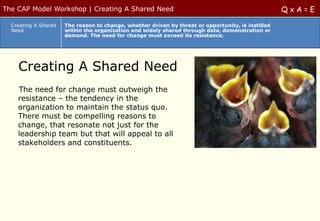
    Creating A Shared Need
    The need for change must outweigh the
    resistance – the tendency in the
    organization to maintain the status quo.
    There must be compelling reasons to
    change, that resonate not just for the
    leadership team but that will appeal to all
    stakeholders and constituents.
The CAP Model Workshop | Creating A Shared Need                                                     QxA=E

  Creating A Shared   The reason to change, whether driven by threat or opportunity, is instilled
  Need                within the organization and widely shared through data, demonstration or
                      demand. The need for change must exceed its resistance.


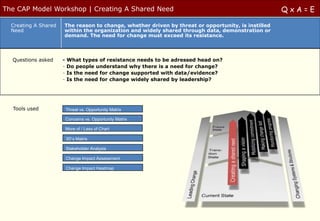
  Questions asked     -   What types of resistance needs to be adressed head on?
                      -   Do people understand why there is a need for change?
                      -   Is the need for change supported with data/evidence?
                      -   Is the need for change widely shared by leadership?


  Tools used              Threat vs. Opportunity Matrix

                          Concerns vs. Opportunity Matrix

                          More of / Less of Chart

                          3D’s Matrix

                          Stakeholder Analysis

                          Change Impact Assessment

                          Change Impact Heatmap
The CAP Model Workshop | Creating A Shared Need                                                     QxA=E

  Creating A Shared   The reason to change, whether driven by threat or opportunity, is instilled
  Need                within the organization and widely shared through data, demonstration or
                      demand. The need for change must exceed its resistance.


    Creating A Shared Need

  – Why Change??!!

  – Who are the key stakeholders and who are key
    constituents?

  – How do we prove the need for change to
    our diverse audience?

  – What resistance or apathy should we expect and how might
    we address it head-on?

  – WIIFM? WIIFU?
The CAP Model Workshop | Creating A Shared Need                                                     QxA=E

  Creating A Shared   The reason to change, whether driven by threat or opportunity, is instilled
  Need                within the organization and widely shared through data, demonstration or
                      demand. The need for change must exceed its resistance.


    Creating A Shared Need
    Key stakeholders versus key constituents:

    A key stakeholder is anyone who controls critical resources, who can hinder
    (or enable) the change initiative by direct or indirect means, who must approve
    certain aspects of the change or who owns a key work process impacted by the
    change initiative.

     A key constituent is anyone in the organization who will be impacted by the
    change. Ask yourself the question “Whose life might/will change after the
    project”.

    A key stakeholder can be a key constituent as well, but not all key constituents
    are automatically key stakeholders. Typically key stakeholders are the decision
    makers, key constituents are the ones impacted by the decisions.
The CAP Model Workshop


         Day 2
The CAP Model Workshop | Shaping A Vision                                                     QxA=E

   Shaping A Vision   The desired outcome of change is clear, legitimate, widely understood
                      and shared; the vision is shaped in behavioral terms.


    Shaping A Vision
    – Where are we heading and why?


    – What will the change look like when we get
      there? (Mindsets, Measures and Behaviors)


    – What will be the milestones to monitor
      progress?


    – How will we consistently communicate the
      new direction and our progress?
The CAP Model Workshop | Shaping A Vision                                                     QxA=E

   Shaping A Vision   The desired outcome of change is clear, legitimate, widely understood
                      and shared; the vision is shaped in behavioral terms.


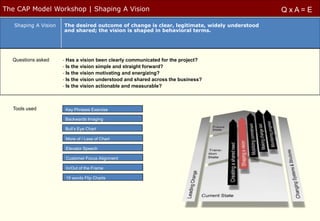
  Questions asked     - Has a vision been clearly communicated for the project?
                      - Is the vision simple and straight forward?
                      - Is the vision motivating and energizing?
                      - Is the vision understood and shared across the business?
                      - Is the vision actionable and measurable?


  Tools used           Key Phrases Exercise

                       Backwards Imaging

                       Bull’s Eye Chart

                       More of / Less of Chart

                       Elevator Speech

                       Customer Focus Alignment

                       In/Out of the Frame

                       15 words Flip Charts
The CAP Model Workshop | Shaping A Vision                                                     QxA=E

   Shaping A Vision   The desired outcome of change is clear, legitimate, widely understood
                      and shared; the vision is shaped in behavioral terms.


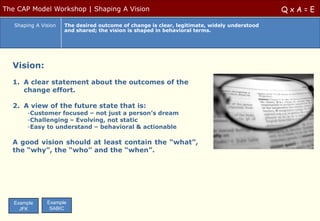
  Vision:
  1. A clear statement about the outcomes of the
     change effort.

  2. A view of the future state that is:
        -Customer focused – not just a person‟s dream
        -Challenging – Evolving, not static
        -Easy to understand – behavioral & actionable

  A good vision should at least contain the “what”,
  the “why”, the “who” and the “when”.


   Example     Example
     JFK        SABIC
Example Vision and Mission: J.F. Kennedy                                     QxA=E


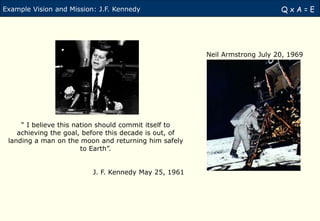
                                                        Neil Armstrong July 20, 1969


     “ I believe this nation should commit itself to
    achieving the goal, before this decade is out, of
 landing a man on the moon and returning him safely
                        to Earth”.


                          J. F. Kennedy May 25, 1961
Example Vision and Mission: SABIC              QxA=E


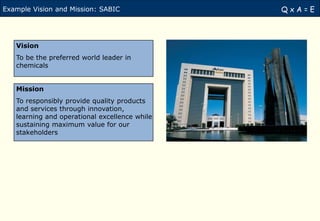
   Vision
   To be the preferred world leader in
   chemicals


   Mission
   To responsibly provide quality products
   and services through innovation,
   learning and operational excellence while
   sustaining maximum value for our
   stakeholders
The CAP Model Workshop | Mobilizing Commitment                                       QxA=E
   Mobilizing   There is a strong commitment from constituents to invest in the
   Commitment   change, make it work, and demand and receive management attention;
                Constituents agree to change their own actions and behaviors to
                support the change.


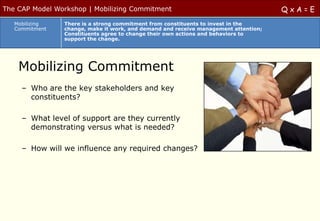
    Mobilizing Commitment
     – Who are the key stakeholders and key
       constituents?

     – What level of support are they currently
       demonstrating versus what is needed?

     – How will we influence any required changes?
The CAP Model Workshop | Mobilizing Commitment                                                  QxA=E
   Mobilizing       There is a strong commitment from constituents to invest in the
   Commitment       change, make it work, and demand and receive management attention;
                    Constituents agree to change their own actions and behaviors to
                    support the change.


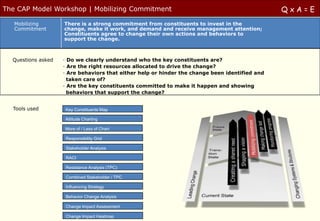
  Questions asked   - Do we clearly understand who the key constituents are?
                    - Are the right resources allocated to drive the change?
                    - Are behaviors that either help or hinder the change been identified and
                      taken care of?
                    - Are the key constituents committed to make it happen and showing
                      behaviors that support the change?


  Tools used         Key Constituents Map

                     Attitude Charting

                     More of / Less of Chart

                     Responsibility Grid

                     Stakeholder Analysis

                     RACI

                     Resistance Analysis (TPC)

                     Combined Stakeholder / TPC

                     Influencing Strategy

                     Behavior Change Analysis

                     Change Impact Assessment

                     Change Impact Heatmap
The CAP Model Workshop | Mobilizing Commitment                                          QxA=E
   Mobilizing     There is a strong commitment from constituents to invest in the
   Commitment     change, make it work, and demand and receive management attention;
                  Constituents agree to change their own actions and behaviors to
                  support the change.


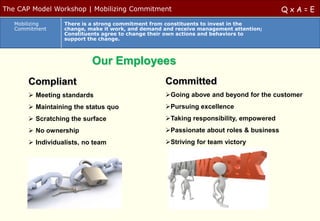
                           Our Employees
       Compliant                                   Committed
        Meeting standards                         Going above and beyond for the customer
        Maintaining the status quo                Pursuing excellence
        Scratching the surface                    Taking responsibility, empowered
        No ownership                              Passionate about roles & business
        Individualists, no team                   Striving for team victory
The CAP Model Workshop | Mobilizing Commitment                                                                QxA=E
   Mobilizing         There is a strong commitment from constituents to invest in the
   Commitment         change, make it work, and demand and receive management attention;
                      Constituents agree to change their own actions and behaviors to
                      support the change.


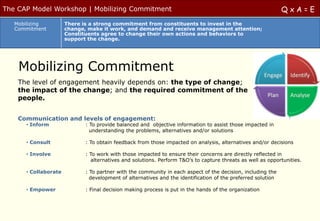
    Mobilizing Commitment
    The level of engagement heavily depends on: the type of change;
    the impact of the change; and the required commitment of the
    people.


    Communication and levels of engagement:
      • Inform               : To provide balanced and objective information to assist those impacted in
                               understanding the problems, alternatives and/or solutions

      • Consult              : To obtain feedback from those impacted on analysis, alternatives and/or decisions

      • Involve              : To work with those impacted to ensure their concerns are directly reflected in
                               alternatives and solutions. Perform T&O‟s to capture threats as well as opportunities.

      • Collaborate          : To partner with the community in each aspect of the decision, including the
                               development of alternatives and the identification of the preferred solution

      • Empower              : Final decision making process is put in the hands of the organization
The CAP Model Workshop | Dealing with Change


                Dealing With Change

            Presented by Garrison Wynn
The CAP Model Workshop | Making Change Last                                                       QxA=E
  Making Change   Once change is started, it endures, and learning is transferred throughout
  Last            the organization. Change is integrated with other key initiatives; early wins
                  are encouraged to build momentum for the change.


    Making Change Last
  – How do we sustain the change and transform
    it into the new “norm”?

  – What resources need to be adjusted or
    sustained?

  – How will we sustain support and resources in
    competition with other initiatives and
    priorities?

  – How will we prevent digression of behaviors
    back to the old habits?
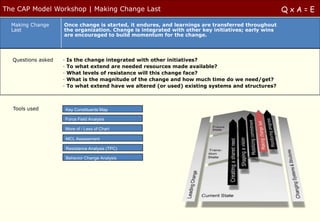
The CAP Model Workshop | Making Change Last                                                         QxA=E
  Making Change     Once change is started, it endures, and learnings are transferred throughout
  Last              the organization. Change is integrated with other key initiatives; early wins
                    are encouraged to build momentum for the change.


  Questions asked   -   Is the change integrated with other initiatives?
                    -   To what extend are needed resources made available?
                    -   What levels of resistance will this change face?
                    -   What is the magnitude of the change and how much time do we need/get?
                    -   To what extend have we altered (or used) existing systems and structures?


  Tools used            Key Constituents Map

                        Force Field Analysis

                        More of / Less of Chart

                        MCL Assessment

                        Resistance Analysis (TPC)

                        Behavior Change Analysis
The CAP Model Workshop | Making Change Last                                                           QxA=E
  Making Change      Once change is started, it endures, and leanings are transferred throughout
  Last               the organization. Change is integrated with other key initiatives; early wins
                     are encouraged to build momentum for the change.


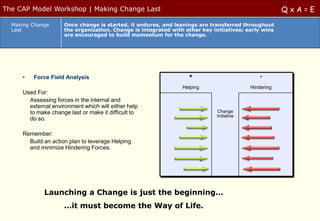
     •   Force Field Analysis                                     +                           -
                                                                Helping                   Hindering
     Used For:
       Assessing forces in the internal and
       external environment which will either help
       to make change last or make it difficult to                           Change
                                                                             Initiative
       do so.

     Remember:
       Build an action plan to leverage Helping
       and minimize Hindering Forces.


             Launching a Change is just the beginning…
                     …it must become the Way of Life.
The CAP Model Workshop | Monitoring Progress                                                QxA=E
   Monitoring    Progress is real; benchmarks set and realized; indicators established to
   Progress      guarantee accountability.


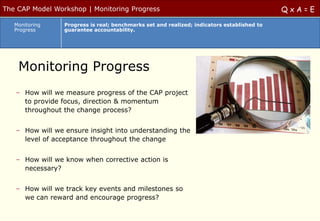
    Monitoring Progress
   – How will we measure progress of the CAP project
     to provide focus, direction & momentum
     throughout the change process?


   – How will we ensure insight into understanding the
     level of acceptance throughout the change


   – How will we know when corrective action is
     necessary?


   – How will we track key events and milestones so
     we can reward and encourage progress?
The CAP Model Workshop | Monitoring Progress                                                   QxA=E
   Monitoring       Progress is real; benchmarks set and realized; indicators established to
   Progress         guarantee accountability.


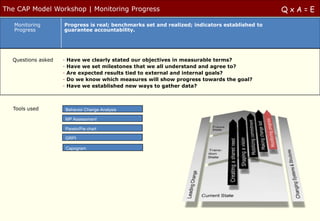
  Questions asked   -   Have we clearly stated our objectives in measurable terms?
                    -   Have we set milestones that we all understand and agree to?
                    -   Are expected results tied to external and internal goals?
                    -   Do we know which measures will show progress towards the goal?
                    -   Have we established new ways to gather data?


  Tools used            Behavior Change Analysis

                        MP Assessment

                        Pareto/Pie chart

                        GRPI

                        Capogram
The CAP Model Workshop | Changing Systems & Structures                              QxA=E
   Changing     Making sure that the management practices (Staffing, Development,
   Systems &    Rewards, Measures, Communication, Organizational Design and
   Structures   Information Technology Systems) are used to complement and
                reinforce change


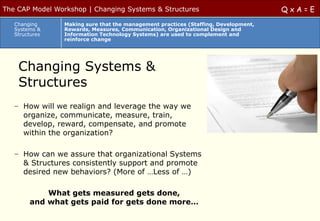
    Changing Systems &
    Structures
   – How will we realign and leverage the way we
     organize, communicate, measure, train,
     develop, reward, compensate, and promote
     within the organization?

   – How can we assure that organizational Systems
     & Structures consistently support and promote
     desired new behaviors? (More of …Less of …)

            What gets measured gets done,
        and what gets paid for gets done more…
The CAP Model Workshop | Changing Systems & Structures                                       QxA=E
   Changing         Making sure that the management practices (Staffing, Development,
   Systems &        Rewards, Measures, Communication, Organizational Design and
   Structures       Information Technology Systems) are used to complement and
                    reinforce change


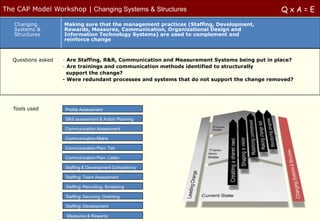
  Questions asked   - Are Staffing, R&R, Communication and Measurement Systems being put in place?
                    - Are trainings and communication methods identified to structurally
                      support the change?
                    - Were redundant processes and systems that do not support the change removed?


   Tools used        Profile Assessment

                    S&S assessment & Action Planning

                    Communication Assessment

                    Communication Matrix

                    Communication Plan: Tell

                    Communication Plan: Listen

                    Staffing & Development Competency

                     Staffing: Team Assessment

                     Staffing: Recruiting, Screening

                     Staffing: Securing, Orienting

                     Staffing: Development

                     Measures & Rewards
The CAP Model Workshop | Changing Systems & Structures            QxA=E

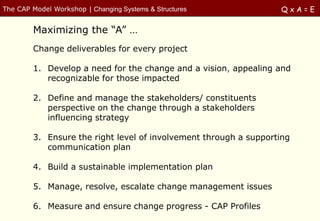
        Maximizing the “A” …
        Change deliverables for every project

        1. Develop a need for the change and a vision, appealing and
           recognizable for those impacted

        2. Define and manage the stakeholders/ constituents
           perspective on the change through a stakeholders
           influencing strategy

        3. Ensure the right level of involvement through a supporting
           communication plan

        4. Build a sustainable implementation plan

        5. Manage, resolve, escalate change management issues

        6. Measure and ensure change progress - CAP Profiles
The CAP Model Workshop | The Change Acceleration Process Model   QxA=E

            The Change Acceleration Process Model
The CAP Model Workshop | The Change Acceleration Process Model                                    QxA=E


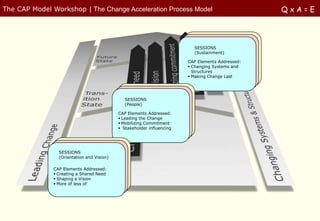
                                                                          SESSIONS
                                                                          (Sustainment)

                                                                        CAP Elements Addressed:
                                                                         Changing Systems and
                                                                          Structures
                                                                         Making Change Last


                                               SESSIONS
                                               (People)

                                            CAP Elements Addressed:
                                             Leading the Change
                                             Mobilizing Commitment
                                             Stakeholder influencing


                 SESSIONS
                 (Orientation and Vision)

               CAP Elements Addressed:
                Creating a Shared Need
                Shaping a Vision
                More of less of
The CAP Model Workshop | The CAP Tools Kit                                           QxA=E


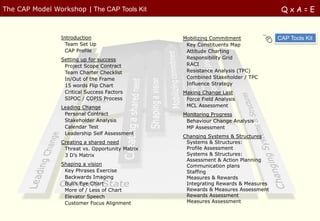
                 Introduction                     Mobilizing Commitment             CAP Tools Kit
                   Team Set Up                     Key Constituents Map
                   CAP Profile                     Attitude Charting
                 Setting up for success            Responsibility Grid
                  Project Scope Contract           RACI
                  Team Charter Checklist           Resistance Analysis (TPC)
                  In/Out of the Frame              Combined Stakeholder / TPC
                  15 words Flip Chart              Influence Strategy
                  Critical Success Factors        Making Change Last
                  SIPOC / COPIS Process            Force Field Analysis
                 Leading Change                    MCL Assessment
                  Personal Contract               Monitoring Progress
                  Stakeholder Analysis             Behaviour Change Analysis
                  Calendar Test                    MP Assessment
                  Leadership Self Assessment
                                                  Changing Systems & Structures
                 Creating a shared need            Systems & Structures:
                  Threat vs. Opportunity Matrix    Profile Assessment
                  3 D‟s Matrix                     Systems & Structures:
                                                   Assessment & Action Planning
                 Shaping a vision                  Communication plans
                  Key Phrases Exercise             Staffing
                  Backwards Imaging                Measures & Rewards
                  Bull‟s Eye Chart                 Integrating Rewards & Measures
                  More of / Less of Chart          Rewards & Measures Assessment
                  Elevator Speech                  Rewards Assessment
                  Customer Focus Alignment         Measures Assessment
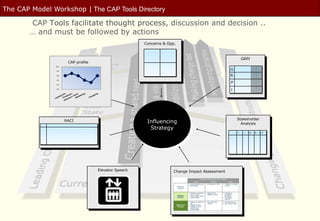
The CAP Model Workshop | The CAP Tools Directory

        CAP Tools facilitate thought process, discussion and decision ..
        … and must be followed by actions
                                                       Concerns & Opp.


                                                                                                        GRPI
                       CAP profile
               10.0

                8.0
                                                                                               G
                6.0                                                                            R
                4.0

                2.0
                                                                                               P
                0.0
                                                                                               I


                                                                                                   Stakeholder
                      RACI                              Influencing                                  Analysis
                                                         Strategy
                                                                                                   --    - +/- + ++


                                     Elevator Speech                Change Impact Assessment
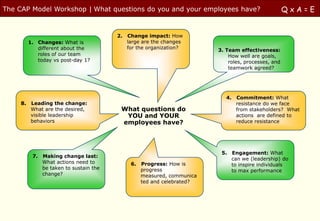
The CAP Model Workshop | What questions do you and your employees have?
        CAP Toolkit facilitates discussion and decision ..                                             QxA=E
           … and must be followed by actions


                                          2.   Change impact: How
          1. Changes: What is                  large are the changes
             different about the               for the organization?       3. Team effectiveness:
             roles of our team                                                 How well are goals,
             today vs post-day 1?                                              roles, processes, and
                                                                               teamwork agreed?


                                                                              4.    Commitment: What
     8.   Leading the change:                                                       resistance do we face
          What are the desired,            What questions do                        from stakeholders? What
          visible leadership                YOU and YOUR                            actions are defined to
          behaviors                        employees have?                          reduce resistance


                                                                            5.     Engagement: What
           7.   Making change last:
                                                                                   can we (leadership) do
                What actions need to            6.   Progress: How is              to inspire individuals
                be taken to sustain the              progress                      to max performance
                change?                              measured, communica
                                                     ted and celebrated?
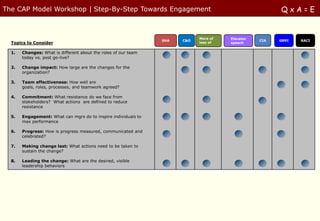
The CAP Model Workshop | Step-By-Step Towards Engagement                                               QxA=E


                                                                            More of   Elevator
                                                                SHA   C&O                        CIA   GRPI   RACI
  Topics to Consider                                                        less of   speech


  1.   Changes: What is different about the roles of our team
       today vs. post go-live?

  2.   Change impact: How large are the changes for the
       organization?

  3.   Team effectiveness: How well are
       goals, roles, processes, and teamwork agreed?

  4.   Commitment: What resistance do we face from
       stakeholders? What actions are defined to reduce
       resistance

  5.   Engagement: What can mgrs do to inspire individuals to
       max performance

  6.   Progress: How is progress measured, communicated and
       celebrated?

  7.   Making change last: What actions need to be taken to
       sustain the change?

  8.   Leading the change: What are the desired, visible
       leadership behaviors
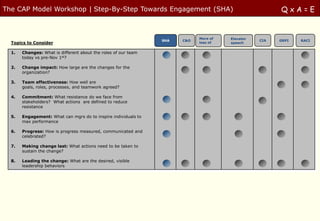
The CAP Model Workshop | Step-By-Step Towards Engagement (SHA)                                         QxA=E


                                                                            More of   Elevator
                                                                SHA   C&O                        CIA   GRPI   RACI
  Topics to Consider                                                        less of   speech


  1.   Changes: What is different about the roles of our team
       today vs pre-Nov 1st?

  2.   Change impact: How large are the changes for the
       organization?

  3.   Team effectiveness: How well are
       goals, roles, processes, and teamwork agreed?

  4.   Commitment: What resistance do we face from
       stakeholders? What actions are defined to reduce
       resistance

  5.   Engagement: What can mgrs do to inspire individuals to
       max performance

  6.   Progress: How is progress measured, communicated and
       celebrated?

  7.   Making change last: What actions need to be taken to
       sustain the change?

  8.   Leading the change: What are the desired, visible
       leadership behaviors
The CAP Model Workshop | Stakeholder Analysis                                                         QxA=E


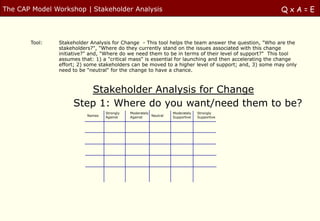
       Tool:   Stakeholder Analysis for Change - This tool helps the team answer the question, "Who are the
               stakeholders?", "Where do they currently stand on the issues associated with this change
               initiative?" and, "Where do we need them to be in terms of their level of support?" This tool
               assumes that: 1) a "critical mass" is essential for launching and then accelerating the change
               effort; 2) some stakeholders can be moved to a higher level of support; and, 3) some may only
               need to be "neutral" for the change to have a chance.


                       Stakeholder Analysis for Change
                    Step 1: Where do you want/need them to be?
                                  Strongly   Moderately           Moderately   Strongly
                          Names   Against    Against    Neutral   Supportive   Supportive
The CAP Model Workshop | Stakeholder Analysis                                                         QxA=E


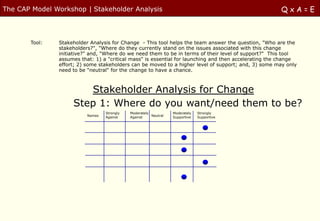
       Tool:   Stakeholder Analysis for Change - This tool helps the team answer the question, "Who are the
               stakeholders?", "Where do they currently stand on the issues associated with this change
               initiative?" and, "Where do we need them to be in terms of their level of support?" This tool
               assumes that: 1) a "critical mass" is essential for launching and then accelerating the change
               effort; 2) some stakeholders can be moved to a higher level of support; and, 3) some may only
               need to be "neutral" for the change to have a chance.


                       Stakeholder Analysis for Change
                    Step 1: Where do you want/need them to be?
                                  Strongly   Moderately           Moderately   Strongly
                          Names   Against    Against    Neutral   Supportive   Supportive
The CAP Model Workshop | Stakeholder Analysis                                                         QxA=E


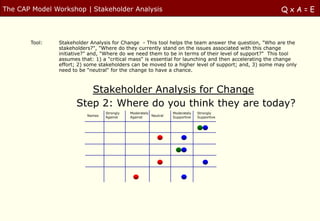
       Tool:   Stakeholder Analysis for Change - This tool helps the team answer the question, "Who are the
               stakeholders?", "Where do they currently stand on the issues associated with this change
               initiative?" and, "Where do we need them to be in terms of their level of support?" This tool
               assumes that: 1) a "critical mass" is essential for launching and then accelerating the change
               effort; 2) some stakeholders can be moved to a higher level of support; and, 3) some may only
               need to be "neutral" for the change to have a chance.


                        Stakeholder Analysis for Change
                     Step 2: Where do you think they are today?
                                  Strongly   Moderately           Moderately   Strongly
                          Names   Against    Against    Neutral   Supportive   Supportive
The CAP Model Workshop | Stakeholder Analysis                                            QxA=E

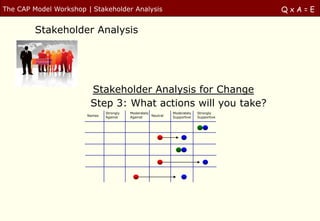
         Stakeholder Analysis

         Committed
         Workforce!


                        Stakeholder Analysis for Change
                        Step 3: What actions will you take?
                               Strongly   Moderately           Moderately   Strongly
                       Names   Against    Against    Neutral   Supportive   Supportive
The CAP Model Workshop | Stakeholder Analysis - Exercise   QxA=E


     In teams:       (appoint lead facilitator per team)


         Spend ~30 minutes on:

          Define stakeholders and key constituents
           (individuals as well as groups)
          Determine stakeholders potential current
           positions
          Determine the Influencing Strategy for top 3
The CAP Model Workshop | Stakeholder Analysis – Exercise Example                        QxA=E


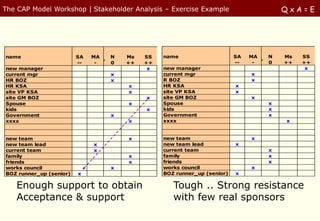
name                     SA   MA   N   Ms   SS   name                     SA   MA   N   Ms   SS
                         --    -   0   ++   ++                            --    -   0   ++   ++
new manager                                  x   new manager                                  x
current mgr                        x             current mgr                   x
HR BOZ                             x             R BOZ                         x
HR KSA                                 x         HR KSA                   x
site VP KSA                            x         site VP KSA              x
site GM BOZ                                 x    site GM BOZ                   x
Spouse                                 x         Spouse                             x
kids                                        x    kids                               x
Government                         x             Government                         x
xxxx                                   x         xxxx                                   x


new team                               x         new team                      x
new team lead                 x                  new team lead            x
current team                  x                  current team                       x
family                                 x         family                             x
friends                                x         friends                            x
works council                      x             works council                 x
BOZ runner_up (senior)   x                       BOZ runner_up (senior)   x

   Enough support to obtain                         Tough .. Strong resistance
   Acceptance & support                             with few real sponsors
The CAP Model Workshop | Stakeholder Analysis - Exercise                                     QxA=E


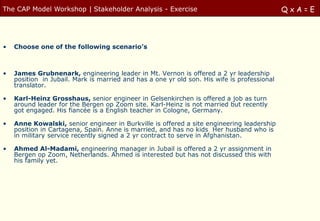
•   Choose one of the following scenario‟s


•   James Grubnenark, engineering leader in Mt. Vernon is offered a 2 yr leadership
    position in Jubail. Mark is married and has a one yr old son. His wife is professional
    translator.

•   Karl-Heinz Grosshaus, senior engineer in Gelsenkirchen is offered a job as turn
    around leader for the Bergen op Zoom site. Karl-Heinz is not married but recently
    got engaged. His fiancée is a English teacher in Cologne, Germany.

•   Anne Kowalski, senior engineer in Burkville is offered a site engineering leadership
    position in Cartagena, Spain. Anne is married, and has no kids Her husband who is
    in military service recently signed a 2 yr contract to serve in Afghanistan.

•   Ahmed Al-Madami, engineering manager in Jubail is offered a 2 yr assignment in
    Bergen op Zoom, Netherlands. Ahmed is interested but has not discussed this with
    his family yet.
The CAP Model Workshop | Stakeholder Analysis - Exercise                                  QxA=E

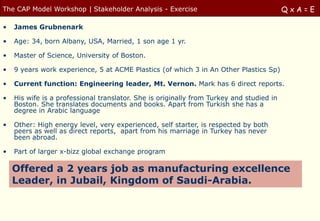
•   James Grubnenark

•   Age: 34, born Albany, USA, Married, 1 son age 1 yr.

•   Master of Science, University of Boston.

•   9 years work experience, 5 at ACME Plastics (of which 3 in An Other Plastics Sp)

•   Current function: Engineering leader, Mt. Vernon. Mark has 6 direct reports.

•   His wife is a professional translator. She is originally from Turkey and studied in
    Boston. She translates documents and books. Apart from Turkish she has a
    degree in Arabic language

•   Other: High energy level, very experienced, self starter, is respected by both
    peers as well as direct reports, apart from his marriage in Turkey has never
    been abroad.

•   Part of larger x-bizz global exchange program

    Offered a 2 years job as manufacturing excellence
    Leader, in Jubail, Kingdom of Saudi-Arabia.
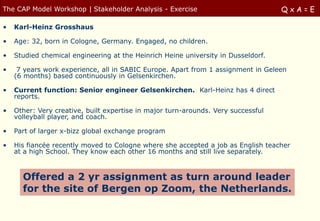
The CAP Model Workshop | Stakeholder Analysis - Exercise                           QxA=E

•   Karl-Heinz Grosshaus

•   Age: 32, born in Cologne, Germany. Engaged, no children.

•   Studied chemical engineering at the Heinrich Heine university in Dusseldorf.

•    7 years work experience, all in SABIC Europe. Apart from 1 assignment in Geleen
    (6 months) based continuously in Gelsenkirchen.

•   Current function: Senior engineer Gelsenkirchen. Karl-Heinz has 4 direct
    reports.

•   Other: Very creative, built expertise in major turn-arounds. Very successful
    volleyball player, and coach.

•   Part of larger x-bizz global exchange program

•   His fiancée recently moved to Cologne where she accepted a job as English teacher
    at a high School. They know each other 16 months and still live separately.


      Offered a 2 yr assignment as turn around leader
      for the site of Bergen op Zoom, the Netherlands.
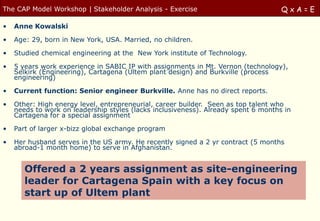
The CAP Model Workshop | Stakeholder Analysis - Exercise                            QxA=E

•   Anne Kowalski

•   Age: 29, born in New York, USA. Married, no children.

•   Studied chemical engineering at the New York institute of Technology.

•   5 years work experience in SABIC IP with assignments in Mt. Vernon (technology),
    Selkirk (Engineering), Cartagena (Ultem plant design) and Burkville (process
    engineering)
•   Current function: Senior engineer Burkville. Anne has no direct reports.

•   Other: High energy level, entrepreneurial, career builder. Seen as top talent who
    needs to work on leadership styles (lacks inclusiveness). Already spent 6 months in
    Cartagena for a special assignment

•   Part of larger x-bizz global exchange program

•   Her husband serves in the US army. He recently signed a 2 yr contract (5 months
    abroad-1 month home) to serve in Afghanistan.

       Offered a 2 years assignment as site-engineering
       leader for Cartagena Spain with a key focus on
       start up of Ultem plant
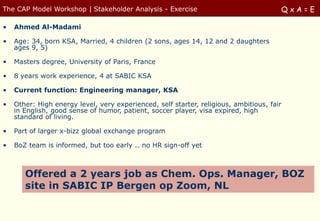
The CAP Model Workshop | Stakeholder Analysis - Exercise                               QxA=E

•   Ahmed Al-Madami

•   Age: 34, born KSA, Married, 4 children (2 sons, ages 14, 12 and 2 daughters
    ages 9, 5)

•   Masters degree, University of Paris, France

•   8 years work experience, 4 at SABIC KSA

•   Current function: Engineering manager, KSA

•   Other: High energy level, very experienced, self starter, religious, ambitious, fair
    in English, good sense of humor, patient, soccer player, visa expired, high
    standard of living.

•   Part of larger x-bizz global exchange program

•   BoZ team is informed, but too early .. no HR sign-off yet


       Offered a 2 years job as Chem. Ops. Manager, BOZ
       site in SABIC IP Bergen op Zoom, NL
The CAP Model Workshop | Stakeholder Analysis - Exercise          QxA=E

         Participants session 1: Bergen op Zoom (September 7/8)


               Team 1                              Team 2
               •                                   •
               •                                   •
               •                                   •
               •                                   •


               Team 3                              Team 4
               •                                   •
               •                                   •
               •                                   •
               •                                   •
               •
The CAP Model Workshop | Influence Strategy                                  QxA=E
     What can I do to positively influence my stakeholders and
     influenced groups?

     • Share the need for change and the goals – again. Ensure the wording
       appeals to their point of view. Also make it very clear this new goal is not
       optional .. Use your Elevator speech

     • Communicate what is in it for them .. Use your C/O analysis

     • Make stakeholders part of the action – involve them in the workshops

     • Use sponsors and key influencers to engage the individuals .. Use your
       SHA

     • Communicate early successes .. Show the change is real and working

     • Lead the change yourself .. Be their role model

     • Deliver yourself what you promised .. Always be credible

     • Try to put yourself in their shoes
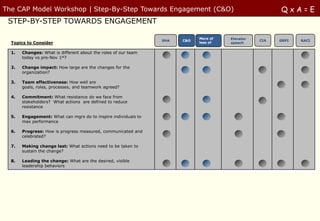
The CAP Model Workshop | Step-By-Step Towards Engagement (C&O)                                         QxA=E
 STEP-BY-STEP TOWARDS ENGAGEMENT

                                                                            More of   Elevator
                                                                SHA   C&O                        CIA   GRPI   RACI
  Topics to Consider                                                        less of   speech


  1.   Changes: What is different about the roles of our team
       today vs pre-Nov 1st?

  2.   Change impact: How large are the changes for the
       organization?

  3.   Team effectiveness: How well are
       goals, roles, processes, and teamwork agreed?

  4.   Commitment: What resistance do we face from
       stakeholders? What actions are defined to reduce
       resistance

  5.   Engagement: What can mgrs do to inspire individuals to
       max performance

  6.   Progress: How is progress measured, communicated and
       celebrated?

  7.   Making change last: What actions need to be taken to
       sustain the change?

  8.   Leading the change: What are the desired, visible
       leadership behaviors
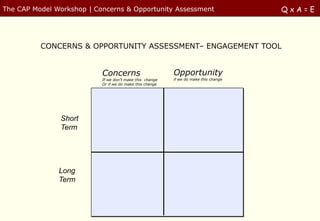
The CAP Model Workshop | Concerns & Opportunity Assessment                            QxA=E


          CONCERNS & OPPORTUNITY ASSESSMENT– ENGAGEMENT TOOL


                           Concerns                       Opportunity
                           If we don’t make this change   if we do make this change
                           Or if we do make this change


               Short
               Term


               Long
               Term
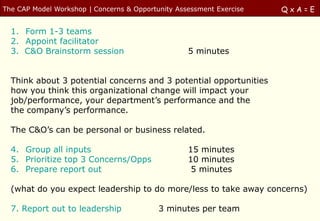
The CAP Model Workshop | Concerns & Opportunity Assessment Exercise   QxA=E


  1. Form 1-3 teams
  2. Appoint facilitator
  3. C&O Brainstorm session                        5 minutes


  Think about 3 potential concerns and 3 potential opportunities
  how you think this organizational change will impact your
  job/performance, your department‟s performance and the
  the company‟s performance.

  The C&O‟s can be personal or business related.

  4. Group all inputs                              15 minutes
  5. Prioritize top 3 Concerns/Opps                10 minutes
  6. Prepare report out                             5 minutes

  (what do you expect leadership to do more/less to take away concerns)

  7. Report out to leadership              3 minutes per team
The CAP Model Workshop | Concerns & Opportunity Assessment Exercise       QxA=E

  1. Form 1-3 teams
  2. Appoint facilitator
  3. C&O Brainstorm session
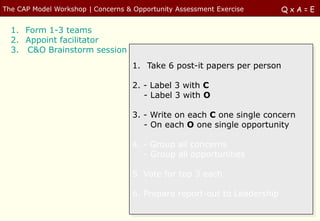
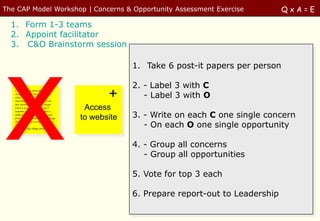
                                    1. Take 6 post-it papers per person

                                    2. - Label 3 with C
                                       - Label 3 with O

                                    3. - Write on each C one single concern
                                       - On each O one single opportunity

                                    4. - Group all concerns
                                       - Group all opportunities

                                    5. Vote for top 3 each

                                    6. Prepare report-out to Leadership
The CAP Model Workshop | Concerns & Opportunity Assessment Exercise        QxA=E
  1. Form 1-3 teams
  2. Appoint facilitator
  3. C&O Brainstorm session

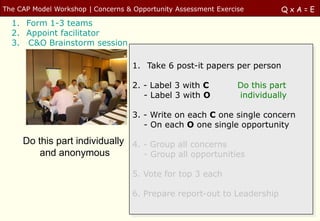
                                    1. Take 6 post-it papers per person

                                    2. - Label 3 with C          Do this part
                                       - Label 3 with O          individually

                                    3. - Write on each C one single concern
                                       - On each O one single opportunity

     Do this part individually 4. - Group all concerns
         and anonymous            - Group all opportunities

                                    5. Vote for top 3 each

                                    6. Prepare report-out to Leadership
The CAP Model Workshop | Concerns & Opportunity Assessment Exercise         QxA=E

  1. Form 1-3 teams
  2. Appoint facilitator
  3. C&O Brainstorm session

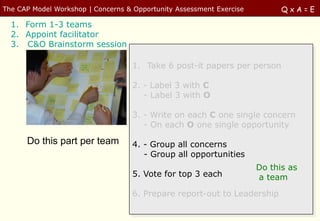
                                    1. Take 6 post-it papers per person

                                    2. - Label 3 with C
                                       - Label 3 with O

                                    3. - Write on each C one single concern
                                       - On each O one single opportunity

      Do this part per team         4. - Group all concerns
                                       - Group all opportunities
                                                                      Do this as
                                    5. Vote for top 3 each            a team
                                    6. Prepare report-out to Leadership
The CAP Model Workshop | Concerns & Opportunity Assessment Exercise         QxA=E

  1. Form 1-3 teams
  2. Appoint facilitator
  3. C&O Brainstorm session

                                    1. Take 6 post-it papers per person

                                    2. - Label 3 with C
                                       - Label 3 with O

                                    3. - Write on each C one single concern
                                       - On each O one single opportunity
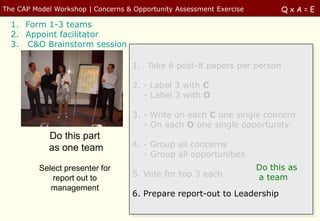
            Do this part
            as one team             4. - Group all concerns
                                       - Group all opportunities
          Select presenter for                                        Do this as
             report out to          5. Vote for top 3 each            a team
             management
                                    6. Prepare report-out to Leadership
The CAP Model Workshop | Concerns & Opportunity Assessment Exercise                              QxA=E

  1. Form 1-3 teams
  2. Appoint facilitator
  3. C&O Brainstorm session

                                                           1. Take 6 post-it papers per person

                                                           2. - Label 3 with C
   I think the most frustating part of
   change is the fact that I don’t know
   where I am going.
   And what’s expected from me in the
   new environment. I’ve seen changes
                                                     +        - Label 3 with O
   where it was very clear, but also I         Access
                                                           3. - Write on each C one single concern
   remember a few in the past where I
   really did not see what was expected
   from me and if I really needed to change   to website
                                                              - On each O one single opportunity
   Myself. And why is it me that needs to
   Change?
   Why don’t they change themselves first?


                                                           4. - Group all concerns
                                                              - Group all opportunities

                                                           5. Vote for top 3 each

                                                           6. Prepare report-out to Leadership
The CAP Model Workshop | Concerns & Opportunity Assessment Exercise                          QxA=E

         Concerns & opportunities exercise
•   Choose one of the following scenario‟s


•   James Grubnenark, engineering leader in Mt. Vernon is offered a 2 yr leadership
    position in Jubail. Mark is married and has a one yr old son. His wife is professional
    translator.

•   Karl-Heinz Grosshaus, senior engineer in Gelsenkirchen is offered a job as turn
    around leader for the Bergen op Zoom site. Karl-Heinz is not married but recently
    got engaged. His fiancée is a English teacher in Cologne, Germany.

•   Anne Kowalski, senior engineer in Burkville is offered a site engineering leadership
    position in Cartagena, Spain. Anne is married, and has no kids Her husband who is
    in military service recently signed a 2 yr contract to serve in Afghanistan.

•   Ahmed Al-Madami, engineering manager in Jubail is offered a 2 yr assignment in
    Bergen op Zoom, Netherlands. Ahmed is interested but has not discussed this with
    his family yet.
The CAP Model Workshop | Concerns & Opportunity Assessment Exercise        QxA=E
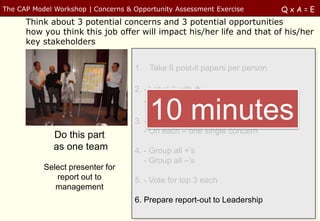
      Think about 3 potential concerns and 3 potential opportunities
      how you think this job offer will impact his/her life and that of his/her
      key stakeholders

                                    1. Take 6 post-it papers per person

                                    2. - Label 3 with C          Do this part
                                       - Label 3 with O          individually

                                    3. - Write on each C one single concern
                                       - On each O one single opportunity

     Do this part individually 4. - Group all concerns
         and anonymous            - Group all opportunities


                                          5 minutes
                                    5. Vote for top 3 each

                                    6. Prepare report-out to Leadership
The CAP Model Workshop | Concerns & Opportunity Assessment Exercise        QxA=E
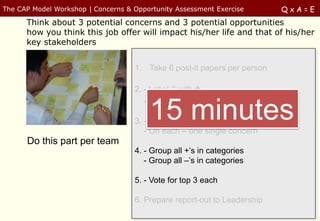
      Think about 3 potential concerns and 3 potential opportunities
      how you think this job offer will impact his/her life and that of his/her
      key stakeholders


                                    1. Take 6 post-it papers per person

                                    2. - Label 3 with +
                                       - Label 3 with –
                                        15 minutes
                                    3. - Write on each + one opportunity
                                       - On each – one single concern
      Do this part per team
                                    4. - Group all +’s in categories
                                       - Group all –’s in categories

                                    5. - Vote for top 3 each

                                    6. Prepare report-out to Leadership
The CAP Model Workshop | Concerns & Opportunity Assessment Exercise         QxA=E
      Think about 3 potential concerns and 3 potential opportunities
      how you think this job offer will impact his/her life and that of his/her
      key stakeholders


                                    1. Take 6 post-it papers per person

                                    2. - Label 3 with +
                                       - Label 3 with –
                                        10 minutes
                                    3. - Write on each + one single opportunity
                                       - On each – one single concern
              Do this part
              as one team           4. - Group all +’s
                                       - Group all –’s
           Select presenter for
              report out to         5. - Vote for top 3 each
              management
                                    6. Prepare report-out to Leadership
The CAP Model Workshop | Concerns & Opportunity Assessment Exercise   QxA=E

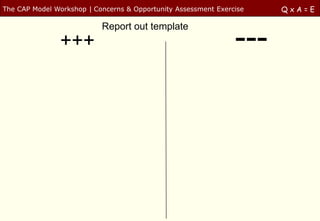
                           Report out template
               +++                                              ---
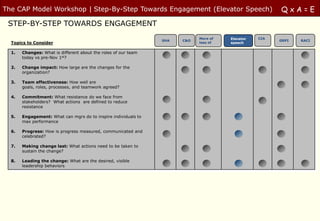
The CAP Model Workshop | Step-By-Step Towards Engagement (Elevator Speech)                             QxA=E
 STEP-BY-STEP TOWARDS ENGAGEMENT
                                                                            More of   Elevator   CIA
                                                                SHA   C&O                              GRPI   RACI
  Topics to Consider                                                        less of   speech


  1.   Changes: What is different about the roles of our team
       today vs pre-Nov 1st?

  2.   Change impact: How large are the changes for the
       organization?

  3.   Team effectiveness: How well are
       goals, roles, processes, and teamwork agreed?

  4.   Commitment: What resistance do we face from
       stakeholders? What actions are defined to reduce
       resistance

  5.   Engagement: What can mgrs do to inspire individuals to
       max performance

  6.   Progress: How is progress measured, communicated and
       celebrated?

  7.   Making change last: What actions need to be taken to
       sustain the change?

  8.   Leading the change: What are the desired, visible
       leadership behaviors
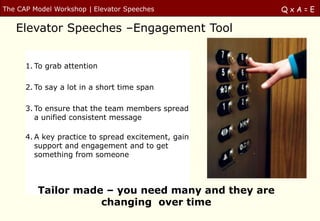
The CAP Model Workshop | Elevator Speeches           QxA=E

   Elevator Speeches –Engagement Tool


      1. To grab attention

      2. To say a lot in a short time span

      3. To ensure that the team members spread
         a unified consistent message

      4. A key practice to spread excitement, gain
         support and engagement and to get
         something from someone


         Tailor made – you need many and they are
                    changing over time
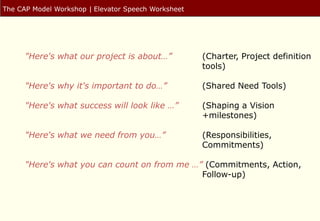
The CAP Model Workshop | Elevator Speech Worksheet


      "Here's what our project is about…”            (Charter, Project definition
                                                     tools)

      "Here's why it's important to do…”             (Shared Need Tools)

      "Here's what success will look like …”         (Shaping a Vision
                                                     +milestones)

      "Here's what we need from you…”                (Responsibilities,
                                                     Commitments)

      "Here's what you can count on from me …” (Commitments, Action,
                                              Follow-up)
The CAP Model Workshop | Elevator Speeches Examples                                QxA=E

    "Here's what our project is about…”
    As part of the [name of your own project], we are taking important steps to position
    Fertilizers for even stronger, profitable growth.
         FERTILIZERS Elevator Speech

    "Here's why it's important to do…”
    We have aggressive growth plans and expect to nearly triple production by [state
    time] – so the years ahead of us will be challenging.

    "Here's what success will look like …”
    With our new structure, we will operate strategically and entrepreneurially with more
    decisions made at lower levels of the organization.

    "Here's what we need from you…”
    To make this change successful, we need every employee to be committed to this new
    way of doing business, to be actively involved, and to understand that such a large
    change will take time.

    "Here's what you can count on from me …”
    At the same time, we are dedicated to giving them the opportunity to develop new
    skills, to work on new projects, to make decisions – and even to make some mistakes,
    which is part of being an entrepreneur. The goal is to grow, together.
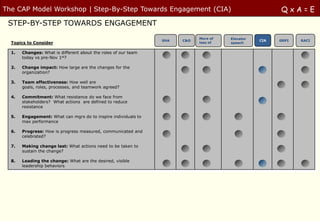
The CAP Model Workshop | Step-By-Step Towards Engagement (CIA)                                         QxA=E
 STEP-BY-STEP TOWARDS ENGAGEMENT
                                                                            More of   Elevator
                                                                SHA   C&O                        CIA   GRPI   RACI
  Topics to Consider                                                        less of   speech


  1.   Changes: What is different about the roles of our team
       today vs pre-Nov 1st?

  2.   Change impact: How large are the changes for the
       organization?

  3.   Team effectiveness: How well are
       goals, roles, processes, and teamwork agreed?

  4.   Commitment: What resistance do we face from
       stakeholders? What actions are defined to reduce
       resistance

  5.   Engagement: What can mgrs do to inspire individuals to
       max performance

  6.   Progress: How is progress measured, communicated and
       celebrated?

  7.   Making change last: What actions need to be taken to
       sustain the change?

  8.   Leading the change: What are the desired, visible
       leadership behaviors
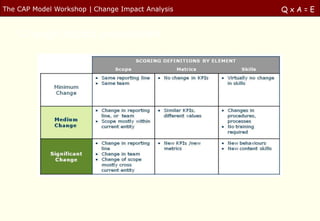
The CAP Model Workshop | Change Impact Analysis   QxA=E


    Change Impact assessment
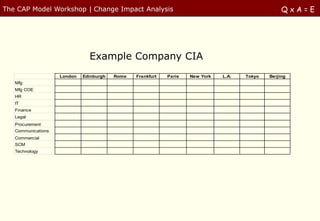
The CAP Model Workshop | Change Impact Analysis                                                    QxA=E


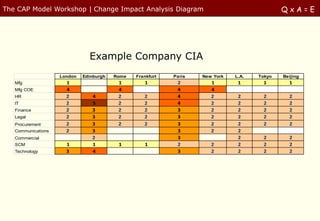
                               Example Company CIA
                    London   Edinburgh   Rome   Frankfurt   Paris   New York   L.A.   Tokyo   Beijing
   Mfg
   Mfg COE
   HR
   IT
   Finance
   Legal
   Procurement
   Communications
   Commercial
   SCM
   Technology
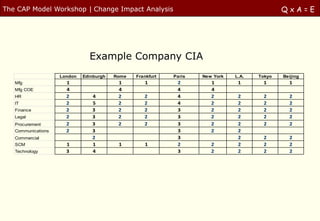
The CAP Model Workshop | Change Impact Analysis                                               QxA=E


                               Example Company CIA
                    London   Edinburgh   Rome   Frankfurt   Paris   New York   L.A.   Tokyo   Beijing
   Mfg                1                   1        1         2         1        1      1        1
   Mfg COE            4                   4                  4         4
   HR                 2         4         2        2         4         2        2      2        2
   IT                 2         5         2        2         4         2        2      2        2
   Finance            2         3         2        2         3         2        2      2        2
   Legal              2         3         2        2         3         2        2      2        2
   Procurement        2         3         2        2         3         2        2      2        2
   Communications     2         3                            3         2        2
   Commercial                   2                            3                  2      2        2
   SCM                1         1         1        1         2         2        2      2        2
   Technology         3         4                            3         2        2      2        2
The CAP Model Workshop | Change Impact Analysis Diagram                                       QxA=E


                               Example Company CIA
                    London   Edinburgh   Rome   Frankfurt   Paris   New York   L.A.   Tokyo   Beijing
   Mfg                1                   1        1         2         1        1      1        1
   Mfg COE            4                   4                  4         4
   HR                 2         4         2        2         4         2        2      2        2
   IT                 2         5         2        2         4         2        2      2        2
   Finance            2         3         2        2         3         2        2      2        2
   Legal              2         3         2        2         3         2        2      2        2
   Procurement        2         3         2        2         3         2        2      2        2
   Communications     2         3                            3         2        2
   Commercial                   2                            3                  2      2        2
   SCM                1         1         1        1         2         2        2      2        2
   Technology         3         4                            3         2        2      2        2
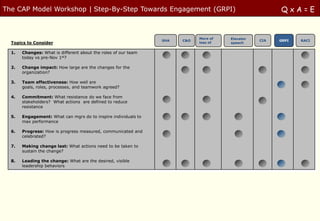
The CAP Model Workshop | Step-By-Step Towards Engagement (GRPI)                                        QxA=E


                                                                            More of   Elevator
                                                                SHA   C&O                        CIA   GRPI   RACI
  Topics to Consider                                                        less of   speech


  1.   Changes: What is different about the roles of our team
       today vs pre-Nov 1st?

  2.   Change impact: How large are the changes for the
       organization?

  3.   Team effectiveness: How well are
       goals, roles, processes, and teamwork agreed?

  4.   Commitment: What resistance do we face from
       stakeholders? What actions are defined to reduce
       resistance

  5.   Engagement: What can mgrs do to inspire individuals to
       max performance

  6.   Progress: How is progress measured, communicated and
       celebrated?

  7.   Making change last: What actions need to be taken to
       sustain the change?

  8.   Leading the change: What are the desired, visible
       leadership behaviors
The CAP Model Workshop | GRPI Check List                                                                                    QxA=E

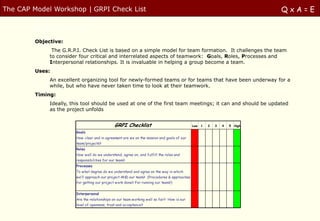
        GRPI exercise
        Objective:
              The G.R.P.I. Check List is based on a simple model for team formation. It challenges the team
             to consider four critical and interrelated aspects of teamwork: Goals, Roles, Processes and
             Interpersonal relationships. It is invaluable in helping a group become a team.
        Uses:
             An excellent organizing tool for newly-formed teams or for teams that have been underway for a
             while, but who have never taken time to look at their teamwork.
        Timing:
             Ideally, this tool should be used at one of the first team meetings; it can and should be updated
             as the project unfolds


                                              GRPI Checklist                               Low   1   2   3   4   5   High

                       Goals
                       How clear and in agreement are we on the mission and goals of our
                       team/projects?
                       Roles
                       How well do we understand, agree on, and fulfill the roles and
                       responsibilities for our team?
                       Processes
                       To what degree do we understand and agree on the way in which
                       we’ll approach our project AND our team? (Procedures & approaches
                       for getting our project work done? For running our team?)


                       Interpersonal
                       Are the relationships on our team working well so far? How is our
                       level of openness, trust and acceptance?
The CAP Model Workshop | GRPI Check List                                                                                      QxA=E

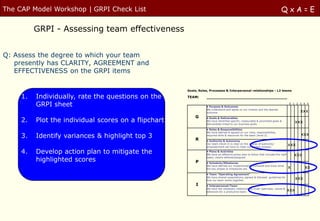
          GRPI - Assessing team effectiveness


Q: Assess the degree to which your team
   presently has CLARITY, AGREEMENT and
   EFFECTIVENESS on the GRPI items

                                                      Goals, Roles, Processes & Interpersonal relationships - L2 teams

     1.   Individually, rate the questions on the     TEAM:

          GRPI sheet                                             • Purpose & Outcomes
                                                                                                                                      0 1 2 3 4 5

                                                                 We understand and agree on our mission and the desired
                                                                 outcome                                                                      xxx
                                                          G
     2.   Plot the individual scores on a flipchart              • Goals & Deliverables
                                                                 We have identified specific, measurable & prioritized goals &
                                                                 deliverables linked to our business goals.
                                                                                                                                          xxx
                                                                 • Roles & Responsibilities
                                                                 We have defined & agreed on our roles, responsibilities,
     3.   Identify variances & highlight top 3                   required skills & resources for the team (level 2).                          xxx
                                                          R      • Authority & Autonomy
                                                                 Our team (level 2) is clear on the degree of authority/
                                                                 empowerment we have to meet our project mission.
                                                                                                                                      xxx
     4.   Develop action plan to mitigate the                    • Plans & Activities
                                                                 We have an effective action plan to follow that includes the right       xxx
          highlighted scores                              P
                                                                 tasks; clearly defined/assigned.

                                                                 • Schedule/Milestones
                                                                 We have defined our implementation schedule and know what
                                                                 the key phases & milestones are.                                     x           xx
                                                                 • Team “Operating Agreement”
                                                                 We have shared expectations, agreed & followed guidelines for
                                                                 how our team works together.
                                                                                                                                            xxx
                                                           I     • Interpersonal/Team
                                                                 We have the necessary relationships, trust, openness, values &
                                                                 behaviors for a productive team.                                     xxx
The CAP Model Workshop | GRPI Check List                                                                                                         QxA=E

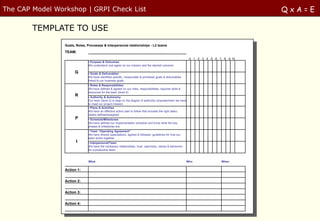
        TEMPLATE TO USE
                 Goals, Roles, Processes & Interpersonal relationships - L2 teams

                 TEAM:
                                                                                                              0 1 2 3 4   5   6   7   8   9 10
                               • Purpose & Outcomes
                               We understand and agree on our mission and the desired outcome

                       G       • Goals & Deliverables
                               We have identified specific, measurable & prioritized goals & deliverables
                               linked to our business goals.
                               • Roles & Responsibilities
                               We have defined & agreed on our roles, responsibilities, required skills &
                               resources for the team (level 2).
                       R       • Authority & Autonomy
                               Our team (level 2) is clear on the degree of authority/ empowerment we have
                               to meet our project mission.
                               • Plans & Activities
                               We have an effective action plan to follow that includes the right tasks;
                               clearly defined/assigned.
                       P       • Schedule/Milestones
                               We have defined our implementation schedule and know what the key
                               phases & milestones are.
                               • Team “Operating Agreement”
                               We have shared expectations, agreed & followed guidelines for how our
                               team works together.
                       I       • Interpersonal/Team
                               We have the necessary relationships, trust, openness, values & behaviors
                               for a productive team.


                               What                                                                          Who                  When

                 Action 1:


                 Action 2:


                 Action 3:


                 Action 4:
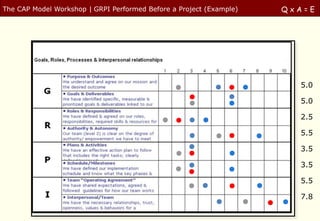
The CAP Model Workshop | GRPI Performed Before a Project (Example)   QxA=E


                                                                       5.0

                                                                       5.0

                                                                       2.5

                                                                       5.5

                                                                       3.5

                                                                       3.5

                                                                       5.5

                                                                       7.8
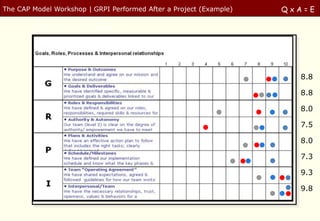
The CAP Model Workshop | GRPI Performed After a Project (Example)   QxA=E

         GRPI exercise - After


                                                                      8.8

                                                                      8.8

                                                                      8.0

                                                                      7.5

                                                                      8.0

                                                                      7.3

                                                                      9.3

                                                                      9.8
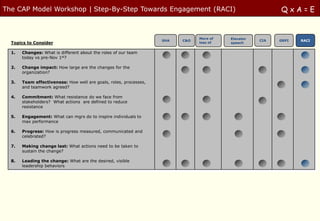
The CAP Model Workshop | Step-By-Step Towards Engagement (RACI)                                           QxA=E


                                                                               More of   Elevator
                                                                   SHA   C&O                        CIA   GRPI   RACI
  Topics to Consider                                                           less of   speech


  1.   Changes: What is different about the roles of our team
       today vs pre-Nov 1st?

  2.   Change impact: How large are the changes for the
       organization?

  3.   Team effectiveness: How well are goals, roles, processes,
       and teamwork agreed?

  4.   Commitment: What resistance do we face from
       stakeholders? What actions are defined to reduce
       resistance

  5.   Engagement: What can mgrs do to inspire individuals to
       max performance

  6.   Progress: How is progress measured, communicated and
       celebrated?

  7.   Making change last: What actions need to be taken to
       sustain the change?

  8.   Leading the change: What are the desired, visible
       leadership behaviors
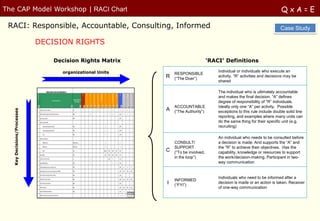
The CAP Model Workshop | RACI Chart                                                                                       QxA=E

 RACI: Responsible, Accountable, Consulting, Informed                                                                     Case Study

                             DECISION RIGHTS

                                Decision Rights Matrix                            „RACI‟ Definitions

                                   organizational Units                               Individual or individuals who execute an
                                                              RESPONSIBLE
                                                          R                           activity. “R” activities and decisions may be
                                                              (“The Doer”)
                                                                                      shared

                                                                                      The individual who is ultimately accountable
                                                                                      and makes the final decision. “A” defines
                                                                                      degree of responsibility of “R” individuals.
                                                              ACCOUNTABLE             Ideally only one “A” per activity. Possible
                                                          A
   Key Decisions/Processes


                                                              (“The Authority”)       exceptions to this rule include double solid line
                                                                                      reporting, and examples where many units can
                                                                                      do the same thing for their specific unit (e.g.
                                                                                      recruiting)

                                                                                      An individual who needs to be consulted before
                                                              CONSULT/                a decision is made. And supports the “A” and
                                                              SUPPORT                 the “R” to achieve their objectives. Has the
                                                          C   (“To be involved,       capability, knowledge or resources to support
                                                              in the loop”)           the work/decision-making. Participant in two-
                                                                                      way communication


                                                                                      Individuals who need to be informed after a
                                                              INFORMED
                                                          I   (“FYI”)
                                                                                      decision is made or an action is taken. Receiver
                                                                                      of one-way communication
The CAP Model Workshop | RACI Chart Exercise                QxA=E

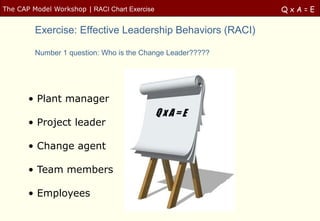
         Exercise: Effective Leadership Behaviors (RACI)

         Number 1 question: Who is the Change Leader?????


       • Plant manager

       • Project leader

       • Change agent

       • Team members

       • Employees
The CAP Model Workshop | RACI Chart Exercise                   QxA=E


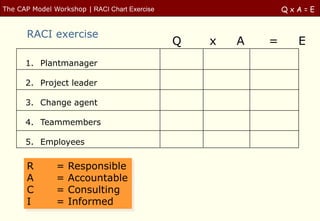
       RACI exercise
                                               Q   x   A   =     E
      1. Plantmanager

      2. Project leader

      3. Change agent

      4. Teammembers

      5. Employees

       R       =   Responsible
       A       =   Accountable
       C       =   Consulting
       I       =   Informed
The CAP Model Workshop | RACI Chart Exercise                        QxA=E


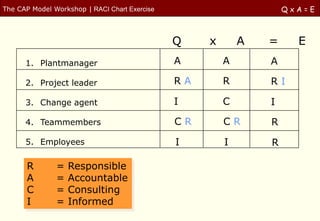
                                               Q    x       A   =     E
      1. Plantmanager                          A        A       A

      2. Project leader                        RA       R       RI

      3. Change agent                          I        C       I

      4. Teammembers                           CR       CR      R
      5. Employees                             I        I       R

       R       =   Responsible
       A       =   Accountable
       C       =   Consulting
       I       =   Informed
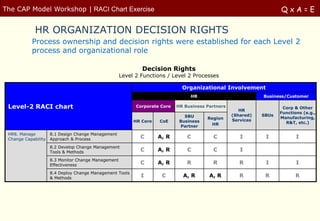
The CAP Model Workshop | RACI Chart Exercise                                                                         QxA=E

             HR ORGANIZATION DECISION RIGHTS
           Process ownership and decision rights were established for each Level 2
           process and organizational role

                                                             Decision Rights
                                                     Level 2 Functions / Level 2 Processes

                                                                              Organizational Involvement
                                                                                 HR                           Business/Customer

 Level-2 RACI chart                                        Corporate Core   HR Business Partners
                                                                                                      HR
                                                                                                                      Corp & Other
                                                                                                                     Functions (e.g.,
                                                                               SBU                 (Shared)   SBUs
                                                                                        Region                       Manufacturing,
                                                          HR Core   CoE      Business              Services
                                                                                          HR                           R&T, etc.)
                                                                             Partner
 HR8. Manage         8.1 Design Change Management
 Change Capability   Approach & Process                     C       A, R        C          C          I        I            I
                     8.2 Develop Change Management
                     Tools & Methods                        C       A, R        C          C          I
                     8.3 Monitor Change Management
                     Effectiveness                          C       A, R        R         R           R        I            I
                     8.4 Deploy Change Management Tools
                     & Methods                               I       C        A, R       A, R         R        R            R
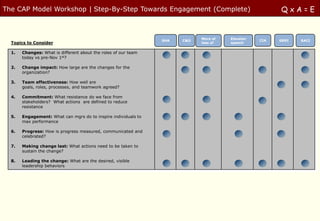
The CAP Model Workshop | Step-By-Step Towards Engagement (Complete)                                    QxA=E


                                                                            More of   Elevator
                                                                SHA   C&O                        CIA   GRPI   RACI
  Topics to Consider                                                        less of   speech


  1.   Changes: What is different about the roles of our team
       today vs pre-Nov 1st?

  2.   Change impact: How large are the changes for the
       organization?

  3.   Team effectiveness: How well are
       goals, roles, processes, and teamwork agreed?

  4.   Commitment: What resistance do we face from
       stakeholders? What actions are defined to reduce
       resistance

  5.   Engagement: What can mgrs do to inspire individuals to
       max performance

  6.   Progress: How is progress measured, communicated and
       celebrated?

  7.   Making change last: What actions need to be taken to
       sustain the change?

  8.   Leading the change: What are the desired, visible
       leadership behaviors
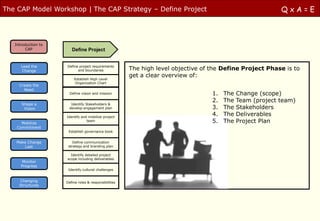
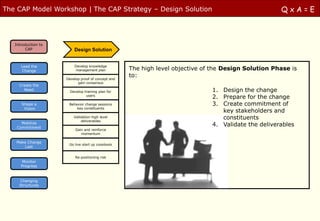
The CAP Model Workshop | The CAP Strategy – Define Project                                                  QxA=E


   Introduction to
        CAP             Define Project


      Lead the       Define project requirements
       Change              and boundaries              The high level objective of the Define Project Phase is to
                                                       get a clear overview of:
                         Establish High Level
                         Organization Chart
     Create the
       Need
                       Define vision and mission                                   1.   The   Change (scope)
                                                                                   2.   The   Team (project team)
      Shape a          Identify Stakeholders &
       Vision         develop engagement plan                                      3.   The   Stakeholders
                     Identify and mobilize project
                                                                                   4.   The   Deliverables
      Mobilize
                                 team                                              5.   The   Project Plan
    Commitment
                      Establish governance book


   Make Change           Define communication
       Last           strategy and branding plan

                       Identify detailed project
                     scope including deliverables
      Monitor
      Progress
                      Identify cultural challenges


     Changing        Define roles & responsibilities
     Structures
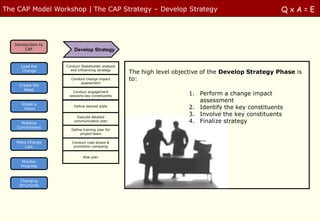
The CAP Model Workshop | The CAP Strategy – Develop Strategy                                          QxA=E


   Introduction to
        CAP              Develop Strategy


      Lead the       Conduct Stakeholder analysis
                       and influencing strategy
       Change                                       The high level objective of the Develop Strategy Phase is
                       Conduct change impact        to:
                            assessment
     Create the
       Need
                        Conduct engagement
                      sessions key constituents                        1. Perform a change impact
                                                                          assessment
      Shape a
       Vision
                         Define desired state                          2. Identify the key constituents
                           Execute detailed
                                                                       3. Involve the key constituents
      Mobilize
                         communication plan                            4. Finalize strategy
    Commitment
                       Define training plan for
                            project team

   Make Change          Conduct road shows &
       Last              promotion campaing


                              Risk plan
      Monitor
      Progress


     Changing
     Structures
The CAP Model Workshop | The CAP Strategy – Design Solution                                           QxA=E


   Introduction to
        CAP              Design Solution


      Lead the           Develop knowledge
       Change            management plan            The high level objective of the Design Solution Phase is
                     Develop proof of concept and
                                                    to:
                           gain consensus
     Create the
       Need            Develop training plan for                               1. Design the change
                                users
                                                                               2. Prepare for the change
      Shape a         Behavior change sessions                                 3. Create commitment of
       Vision             key constituents
                                                                                  key stakeholders and
                         Validation high level
                             deliverables
                                                                                  constituents
      Mobilize
    Commitment
                                                                               4. Validate the deliverables
                          Gain and reinforce
                             momentum

   Make Change
                      Go live start up cookbook
       Last

                          Re-positioning risk
      Monitor
      Progress


     Changing
     Structures
The CAP Model Workshop | The CAP Strategy – Deliver Solution                                             QxA=E


   Introduction to
        CAP               Deliver Solution


      Lead the
       change
                     Monitor go-live readiness plan   The high level objective of the Deliver Solution Phase is
                          Sign off high level
                                                      to:
                             deliverables
     Create the
       need          Develop plan for demobilizing                                1. Implement the change
                             project team
                                                                                  2. Sign off deliverables
      Shape a
                         Transition to business
                                                                                  3. Smooth transition to
       vision
                                                                                     business
                        Reward and recognition                                    4. Reward, recognize and
      Mobilize
    commitment
                                                                                     celebrate
                     Lessons learned & celebration


   Make Change
       Last


      Monitor
      progress


     Changing
     structures
The CAP Model Workshop | The CAP Strategy - Overview                                                                                        QxA=E


   Introduction to
        CAP             Define Project                     Develop Strategy               Design Solution                Deliver Solution


      Lead the       Define project requirements       Conduct Stakeholder analysis       Develop knowledge
                                                                                                                     Monitor go-live readiness plan
       Change              and boundaries                and influencing strategy         management plan

                         Establish High Level            Conduct change impact        Develop proof of concept and        Sign off high level
                         Organization Chart                   assessment                    gain consensus                   deliverables
     Create the
       Need                                               Conduct engagement            Develop training plan for    Develop plan for demobilizing
                       Define vision and mission
                                                        sessions key constituents                users                       project team

      Shape a          Identify Stakeholders &
                                                           Define desired state
                                                                                       Behavior change sessions
                                                                                                                         Transition to business
       Vision         develop engagement plan                                              key constituents

                     Identify and mobilize project           Execute detailed             Validation high level
                                                                                                                        Reward and recognition
                                 team                      communication plan                 deliverables
      Mobilize
    Commitment
                                                         Define training plan for          Gain and reinforce
                      Establish governance book                                                                      Lessons learned & celebration
                                                              project team                    momentum

   Make Change           Define communication             Conduct road shows &
                                                                                       Go live start up cookbook
       Last           strategy and branding plan           promotion campaign

                       Identify detailed project
                                                                Risk plan                  Re-positioning risk
                     scope including deliverables
      Monitor
      Progress
                      Identify cultural challenges


     Changing        Define roles & responsibilities
     Structures
The CAP Model Workshop | The CAP Strategy – Lead the Change                                                                             QxA=E


                    Define Project                     Develop Strategy               Design Solution                Deliver Solution


    Lead the     Define project requirements       Conduct Stakeholder analysis       Develop knowledge
                                                                                                                 Monitor go-live readiness plan
    Change             and boundaries                and influencing strategy         management plan

                     Establish High Level            Conduct change impact        Develop proof of concept and        Sign off high level
                     Organization Chart                   assessment                    gain consensus                   deliverables
    Create the
      Need                                                                          Develop training plan for    Develop plan for demobilizing
                   Define vision and mission          Conduct engagement
                                                    sessions key constituents                users                       project team

     Shape a       Identify Stakeholders &                                        Behavior change sessions key
                                                       Define desired state                                          Transition to business
      Vision      develop engagement plan                                                 constituents

                 Identify and mobilize project           Execute detailed             Validation high level
                                                                                                                    Reward and recognition
                             team                      communication plan                 deliverables
     Mobilize
   Commitment
                                                     Define training plan for          Gain and reinforce
                  Establish governance book                                                                      Lessons learned & celebration
                                                          project team                    momentum

   Make Change       Define communication             Conduct road shows &
                                                                                   Go live start up cookbook
       Last       strategy and branding plan           promotion campaign

                   Identify detailed project
                                                            Risk plan                  Re-positioning risk
                 scope including deliverables
     Monitor
     Progress
                  Identify cultural challenges


    Changing     Define roles & responsibilities
    Structures
The CAP Model Workshop | The CAP Strategy – Create the Need                                                                             QxA=E


                    Define Project                     Develop Strategy               Design Solution                Deliver Solution


     Lead the     Define project requirements      Conduct Stakeholder analysis       Develop knowledge
                                                                                                                 Monitor go-live readiness plan
      Change            and boundaries               and influencing strategy         management plan

                     Establish High Level            Conduct change impact        Develop proof of concept and        Sign off high level
                     Organization Chart                   assessment                    gain consensus                   deliverables
    Create the
      Need                                            Conduct engagement            Develop training plan for    Develop plan for demobilizing
                   Define vision and mission
                                                    sessions key constituents                users                       project team

     Shape a        Identify Stakeholders &                                       Behavior change sessions key
                                                       Define desired state                                          Transition to business
      Vision       develop engagement plan                                                constituents

                 Identify and mobilize project           Execute detailed             Validation high level
                                                                                                                    Reward and recognition
                             team                      communication plan                 deliverables
     Mobilize
   Commitment
                                                     Define training plan for          Gain and reinforce
                  Establish governance book                                                                      Lessons learned & celebration
                                                          project team                    momentum

   Make Change       Define communication             Conduct road shows &
                                                                                   Go live start up cookbook
       Last       strategy and branding plan           promotion campaign

                    Identify detailed project
                                                            Risk plan                  Re-positioning risk
                  scope including deliverables
     Monitor
     Progress
                  Identify cultural challenges


    Changing     Define roles & responsibilities
    Structures
The CAP Model Workshop | The CAP Strategy – Shape a Vision                                                                               QxA=E


                     Define project                     Develop strategy               Design solution                Deliver solution


     Lead the     Define project requirements       Conduct Stakeholder analysis       Develop knowledge
                                                                                                                  Monitor go-live readiness plan
      Change            and boundaries                and influencing strategy         management plan

                      Establish High Level            Conduct change impact        Develop proof of concept and        Sign off high level
                      Organization Chart                   assessment                    gain consensus                   deliverables
    Create the
      Need                                                                           Develop training plan for    Develop plan for demobilizing
                    Define vision and mission          Conduct engagement
                                                     sessions key constituents                users                       project team

     Shape a        Identify Stakeholders &                                        Behavior change sessions key
                                                        Define desired state                                          Transition to business
      Vision       develop engagement plan                                                 constituents

                  Identify and mobilize project           Execute detailed             Validation high level
                                                                                                                     Reward and recognition
                              team                      communication plan                 deliverables
      Mobilize
    Commitment
                                                      Define training plan for          Gain and reinforce
                   Establish governance book                                                                      Lessons learned & celebration
                                                           project team                    momentum

   Make Change        Define communication             Conduct road shows &
                                                                                    Go live start up cookbook
       Last        strategy and branding plan           promotion campaign

                    Identify detailed project
                                                             Risk plan                  Re-positioning risk
                  scope including deliverables
     Monitor
     Progress
                   Identify cultural challenges


     Changing     Define roles & responsibilities
     Structures
The CAP Model Workshop | The CAP Strategy – Mobilize Commitment                                                                         QxA=E


                    Define Project                     Develop Strategy               Design Solution                Deliver Solution


     Lead the    Define project requirements       Conduct Stakeholder analysis       Develop knowledge
                                                                                                                 Monitor go-live readiness plan
      Change           and boundaries                and influencing strategy         management plan

                     Establish High Level            Conduct change impact        Develop proof of concept and        Sign off high level
                     Organization Chart                   assessment                    gain consensus                   deliverables
    Create the
      Need                                                                          Develop training plan for    Develop plan for demobilizing
                   Define vision and mission          Conduct engagement
                                                    sessions key constituents                users                       project team

     Shape a       Identify Stakeholders &                                        Behavior change sessions key
                                                       Define desired state                                          Transition to business
      Vision      develop engagement plan                                                 constituents

                 Identify and mobilize project           Execute detailed             Validation high level
                                                                                                                    Reward and recognition
                             team                      communication plan                 deliverables
     Mobilize
   Commitment                                        Define training plan for          Gain and reinforce
                  Establish governance book                                                                      Lessons learned & celebration
                                                          project team                    momentum

   Make Change       Define communication             Conduct road shows &
                                                                                   Go live start up cookbook
       Last       strategy and branding plan           promotion campaign

                   Identify detailed project
                                                            Risk plan                  Re-positioning risk
                 scope including deliverables
     Monitor
     Progress
                  Identify cultural challenges


    Changing     Define roles & responsibilities
    Structures
The CAP Model Workshop | The CAP Strategy – Make Change Last                                                                            QxA=E


                    Define Project                     Develop Strategy               Design Solution                Deliver Solution


     Lead the    Define project requirements       Conduct Stakeholder analysis       Develop knowledge
                                                                                                                 Monitor go-live readiness plan
      Change           and boundaries                and influencing strategy         management plan

                     Establish High Level            Conduct change impact        Develop proof of concept and        Sign off high level
                     Organization Chart                   assessment                    gain consensus                   deliverables
    Create the
      Need                                                                          Develop training plan for    Develop plan for demobilizing
                   Define vision and mission          Conduct engagement
                                                    sessions key constituents                users                       project team

     Shape a       Identify Stakeholders &                                         Behavior change sessions
                                                       Define desired state                                          Transition to business
      Vision      develop engagement plan                                              key constituents

                 Identify and mobilize project           Execute detailed             Validation high level
                                                                                                                    Reward and recognition
                             team                      communication plan                 deliverables
     Mobilize
   Commitment
                                                     Define training plan for          Gain and reinforce
                  Establish governance book                                                                      Lessons learned & celebration
                                                          project team                    momentum

   Make Change       Define communication             Conduct road shows &
                                                                                   Go live start up cookbook
      Last        strategy and branding plan           promotion campaign

                   Identify detailed project
                                                            Risk plan                  Re-positioning risk
                 scope including deliverables
     Monitor
     Progress
                  Identify cultural challenges


    Changing     Define roles & responsibilities
    Structures
The CAP Model Workshop | The CAP Strategy – Monitor Progress                                                                             QxA=E


                     Define Project                     Develop Strategy               Design Solution                Deliver Solution


     Lead the     Define project requirements       Conduct Stakeholder analysis       Develop knowledge
                                                                                                                  Monitor go-live readiness plan
      Change            and boundaries                and influencing strategy         management plan

                      Establish High Level            Conduct change impact        Develop proof of concept and        Sign off high level
                      Organization Chart                   assessment                    gain consensus                   deliverables
    Create the
      Need                                                                           Develop training plan for    Develop plan for demobilizing
                    Define vision and mission          Conduct engagement
                                                     sessions key constituents                users                       project team

      Shape a       Identify Stakeholders &                                        Behavior change sessions key
                                                        Define desired state                                          Transition to business
       Vision      develop engagement plan                                                 constituents

                  Identify and mobilize project           Execute detailed             Validation high level
                                                                                                                     Reward and recognition
                              team                      communication plan                 deliverables
      Mobilize
    Commitment
                                                      Define training plan for          Gain and reinforce
                   Establish governance book                                                                      Lessons learned & celebration
                                                           project team                    momentum

   Make Change        Define communication             Conduct road shows &
                                                                                    Go live start up cookbook
       Last        strategy and branding plan           promotion campaign

                    Identify detailed project
                                                             Risk plan                  Re-positioning risk
                  scope including deliverables
     Monitor
     Progress
                   Identify cultural challenges


     Changing     Define roles & responsibilities
     Structures
The CAP Model Workshop | The CAP Strategy – Changing Structures                                                                         QxA=E


                    Define Project                     Develop Strategy               Design Solution                Deliver Solution


     Lead the     Define project requirements      Conduct Stakeholder analysis       Develop knowledge
                                                                                                                 Monitor go-live readiness plan
      Change            and boundaries               and influencing strategy         management plan

                     Establish High Level            Conduct change impact        Develop proof of concept and        Sign off high level
                     Organization Chart                   assessment                    gain consensus                   deliverables
    Create the
      Need                                                                          Develop training plan for    Develop plan for demobilizing
                   Define vision and mission          Conduct engagement
                                                    sessions key constituents                users                       project team

     Shape a        Identify Stakeholders &                                        Behavior change sessions
                                                       Define desired state                                          Transition to business
      Vision       develop engagement plan                                               constituents

                 Identify and mobilize project           Execute detailed             Validation high level
                                                                                                                    Reward and recognition
                             team                      communication plan                 deliverables
     Mobilize
   Commitment
                                                     Define training plan for          Gain and reinforce
                  Establish governance book                                                                      Lessons learned & celebration
                                                          project team                    momentum

   Make Change       Define communication             Conduct road shows &
                                                                                   Go live start up cookbook
       Last       strategy and branding plan           promotion campaign

                    Identify detailed project
                                                            Risk plan                  Re-positioning risk
                  scope including deliverables
     Monitor
     Progress
                  Identify cultural challenges


    Changing     Define roles & responsibilities
    Structures
The CAP Model Workshop | Step 1: Define the Project   QxA=E
 This is an example to base your own CM Plan.


           Define


          Define problem
            statement
        Define project scope


           Define project
            deliverables
The CAP Model Workshop | Step 2: Define the Timeline                          QxA=E
 This is an example to base your own CM Plan.
                                                     Go/No go       Go live      Final
 Project kick-off                                  decision point    date      handover


              Define


             Define problem
               statement
           Define project scope


              Define project
               deliverables
The CAP Model Workshop | Step 3: Define Process Steps & Project Team                                                  QxA=E
 This is an example to base your own CM Plan.
                                                                                         Go/No go         Go live           Final
 Project kick-off              Tollgate 1         Tollgate 2             Tollgate 3    decision point      date           handover


              Define                    Measure                Analyze                Design            Implement   Control


             Define problem
               statement
           Define project scope


              Define project
               deliverables


           Develop core project
                  team
The CAP Model Workshop | Step 4: Design the Project Plan                                                                                                     QxA=E
 This is an example to base your own CM Plan.
                                                                                                          Go/No go               Go live                              Final
 Project kick-off              Tollgate 1                Tollgate 2                   Tollgate 3        decision point            date                              handover


              Define                    Measure                        Analyze                       Design               Implement                     Control


             Define problem           Detailed as-is process           Analyze current              Identify technical      Implement training        Solve critical actions
               statement                       map                      performance                   specifications              plan                         list

           Define project scope        Detailed organization      Define desired state         Design new processes            Publish new              Document new
                                               chart                    process                   and procedures               procedures               procedures etc.

              Define project                 Define project       Define desired state                Design new             Implement new              Final cost/benefit


 Q
               deliverables                   deliverables            organization                    organization            organization                  analysis

          High level organization       Define R&R’s core              Fit/gap analysis            Design organization     Implement digitized        Final sign-off project
                   chart                      team                                                    training plan             solution                  deliverables

           Develop core project        Define training plan           Identify digitization          Stress test new         Measure project          Recommendations to
                  team                      core team                    opportunities                organization             progress                  management

             Define reporting               Benchmark best        Detailed cost/benefit             Design digitized      Identify critical actions    Identify translation
                 strategy                      practices                analysis                       solutions                                          opportunities
           Project timeline and             Set up baseline           Identify functional      Design detailed roll-out      Signed off user             Best practices
                   plan                     measurements                specifications                 plan                  acceptance test               identified
The CAP Model Workshop | Step 5: Identify Critical CAP Elements                                                                                              QxA=E
 This is an example to base your own CM Plan.
                                                                                                          Go/No go               Go live                              Final
 Project kick-off              Tollgate 1                Tollgate 2                   Tollgate 3        decision point            date                              handover


              Define                    Measure                        Analyze                       Design               Implement                      Control

           Define project vision


 A
                Identify key           Stakeholder analysis       Conduct road show &
               stakeholders                                       promotion campaign

          Define communication              Change impact         Conduct engagement           Conduct engagement           Behavior change              Project team
                 strategy                    assessment                sessions                     sessions                   sessions                demobilization plan

              Identify cultural          Key constituents             Execute                          Execute              Gain and reinforce        Reward & recognition
                challenges                  mapping               communication plan               communication plan          momentum

             Define problem           Detailed as-is process           Analyze current              Identify technical      Implement training        Solve critical actions
               statement                       map                      performance                   specifications              plan                         list

           Define project scope        Detailed organization      Define desired state         Design new processes            Publish new               Document new
                                               chart                    process                   and procedures               procedures                procedures etc.

              Define project                 Define project       Define desired state                Design new             Implement new              Final cost/benefit


 Q
               deliverables                   deliverables            organization                    organization            organization                  analysis

          High level organization       Define R&R’s core              Fit/gap analysis            Design organization     Implement digitized        Final sign-off project
                   chart                      team                                                    training plan             solution                  deliverables

           Develop core project        Define training plan           Identify digitization          Stress test new         Measure project          Recommendations to
                  team                      core team                    opportunities                organization             progress                  management

             Define reporting               Benchmark best        Detailed cost/benefit             Design digitized      Identify critical actions    Identify translation
                 strategy                      practices                analysis                       solutions                                          opportunities
           Project timeline and             Set up baseline           Identify functional      Design detailed roll-out      Signed off user             Best practices
                   plan                     measurements                specifications                 plan                  acceptance test               identified
The CAP Model Workshop | Step 6: Merge Q and A                                                                                                                 QxA=E
 This is an example to base your own CM Plan.
                                                                                                            Go/No go               Go live                              Final
 Project kick-off                Tollgate 1                Tollgate 2                   Tollgate 3        decision point            date                              handover


              Define                      Measure                        Analyze                       Design               Implement                     Control


             Define problem
               statement


 A         Define project scope


              Define project
                                        Detailed as-is process
                                                 map
                                         Stakeholder analysis
                                                                         Analyze current
                                                                          performance

                                                                    Define desired state              Identify technical      Implement training        Solve critical actions
               deliverables                                               process                       specifications              plan                         list
           Define project vision         Detailed organization      Define desired state         Design new processes            Publish new              Document new
                                                 chart                  organization                and procedures               procedures               procedures etc.
          High level organization              Define project       Conduct roadshow &                  Design new            Behavior change              Project team
                   chart                        deliverables        promotion campaign                  organization             sessions                demobilization plan
                Identify key               Key constituents              Fit/gap analysis            Design organization       Implement new              Final cost/benefit
               stakeholders                   mapping                                                   training plan           organization                  analysis
           Develop core project               Change impact             Identify digitization    Conduct engagement          Gain and reinforce         Final sign-off project


 Q
                  team                         assessment                  opportunities              sessions                  momentum                    deliverables
          Define communication            Define R&R’s core         Conduct engagement                 Stress test new       Implement digitized        Recommendations to
                 strategy                       team                     sessions                       organization              solution                 management

             Define reporting            Define training plan       Detailed cost/benefit             Design digitized         Measure project           Identify translation
                 strategy                     core team                   analysis                       solutions               progress                   opportunities

             Identify cultural                Benchmark best            Execute                          Execute            Identify critical actions   Reward & recognition
               challenges                        practices          communication plan               communication plan
           Project timeline and               Set up baseline           Identify functional      Design detailed roll-out      Signed off user             Best practices
                   plan                       measurements                specifications                 plan                  acceptance test               identified
The CAP Model Workshop | It‟s Not About Tools                    QxA=E


         • Our process and tool focused culture can miss the key to CAP
           and its effectiveness.
         • CAP is a process and toolset designed to facilitate
           discussions! Discussions that explore and appreciate the key
           questions.
         • Effective discussions facilitate change acceptance.
The CAP Model Workshop | Final Exercise – Building Your Own CM CAP Plan   QxA=E


     In teams:       (appoint lead facilitator per team)


         Spend ~30 minutes on:
The CAP Model Workshop | Q & A   QxA=E


        Any questions?

CAP Workshop

  • 1.
    The CAP ModelWorkshop Day 1
  • 2.
    The CAP ModelWorkshop Why Do We Need to Change? Why Do We Need to Manage Change? Change is inescapable… • Business and strategic conditions evolve continuously, so we must be able to adapt successfully if we want to remain competitive. • Businesses often fail altogether because they are unable to implement desperately needed changes in their work processes or organization. At the same time… • Change is difficult, unpredictable, uncomfortable, chaotic, risky and unsettling. • The capacity for change may be the key to success, but going through a change can also be disruptive and feel threatening. • Because both individuals and entire organizational units routinely resist change, it takes careful planning and specialized knowledge and skill to lead or implement a change process smoothly and effectively.
  • 3.
    The CAP ModelWorkshop | SARA Shock A bsorb Respond A ccept
  • 4.
    The CAP ModelWorkshop | What is Change? What is Change? Camlin Whiteboard Markers Advertisement
  • 5.
    The CAP ModelWorkshop | Accelerating Change? • Have you ever felt like this when dealing with change? • Why? • How did it affect the effective and successful implementation of the change?…
  • 6.
    The CAP ModelWorkshop | Information Retention After 1 Month 75% 95% from from engagement hearing and 13% discussion from and hearing seeing
  • 7.
    The CAP ModelWorkshop | Information Retention After 1 Month People tend to learn more when they are engaged Show me so I may Tell me and I will remember forget Engage me and I shall learn
  • 8.
    The CAP ModelWorkshop | Factors for Successful Change Management The success of any Change Management initiative depends on the organization’s willingness and ability to assume ownership of the change. There are five key characteristics of all successful change implementations: o Proper Planning: develop and document objectives and lay out how it will be achieved o Defined Governance: establish appropriate organizational structures, roles and responsibilities and associated monitoring arrangements. o Committed Leadership: ensure ongoing commitment at the top and across the organization o Engaged Stakeholders: encourage and sustain stakeholder participation and commitment o Aligned Workforce: ensure that the workforce understands and is aligned with, actively supports, and is willing to bear the burden of changing
  • 9.
    The CAP ModelWorkshop | The Impact of Effective Change Management Ready Willing Able Achievement Able Ready Willing of Business Goals Aware of goals Fully engaged; Having or Successful Change and how they wanting to acquiring the and On-Target are aligned to make needed Business Outcomes business a success knowledge/ objectives, R&R story skills for new/ , KPIs of the change; changed & metrics etc trust in processes, syst leadership ems and behaviors Skills Knowledge
  • 10.
    The CAP ModelWorkshop | Commitment to Change Change Management activities have embedded ownership within during the approach to go-lives Stage 1 Stage 2 Stage 3 Change Management Activities Communications Ownership Change Advocacy Organizational Engagement/ Transformation Enablement Learning Awareness
  • 11.
    The CAP ModelWorkshop | Topics 1. Learning about the critical questions and actions that will steer towards successful change 2. Creating a shared need for change and vision for your project team 3. Understanding and dealing with engagement and resistance from key stakeholders and key constituents 4. Building an effective and sustainable implementation plan 5. The crucial role of communication and engagement
  • 12.
    The CAP ModelWorkshop | Change Research • Almost 99% of all changes evaluated as “Successful” had a good technical solution or approach • Over 98% of all changes evaluated as “Unsuccessful” also had a good technical solution or approach What is the differentiating factor between success and failure?
  • 13.
    CAP The CAP ModelWorkshop | Summary QxA=E „Q‟ is the Qualitative or Technical solution to the change „A‟ is the cultural Acceptance of the change „E‟ represents change Effectiveness… your goal! Change management is the approach to help align a person, team or organization with the change. It focuses both on steps and milestones, as well as on the people side through engagement and communication. It addresses how to create a shared need for the change, understand and deal with resistance from stakeholders and build an effective influencing strategy and communication plan for the change. Some companies like General Electric and SABIC chose CAP as a methodology to drive change.
  • 14.
    The CAP ModelWorkshop | Summary QxA=E Charles Darwin may have some insight for us: It is not the strongest of the species that survive, nor the most intelligent, but the one most responsive to change.
  • 15.
    The CAP ModelWorkshop | Summary QxA=E All mankind is divided into three classes Those who are immovable, Those who are movable, And those who move Benjamin Franklin
  • 16.
    The Change AccelerationProcess Model – Summary The CAP Model Workshop | Summary QxA=E Change Acceleration Process (CAP): Q x A = E Is: • A strategy to drive effective change • A method to engage business teams in a dialogue to increase the success • To accelerate the implementation of organizational change efforts Addresses how to : • Create a shared need for the change and a vision • Understand and deal with resistance from stakeholders • Build an effective and sustainable influencing strategy It is NOT: • A magic formula that resolve conflicts or resistance • A set of tools that eliminates discussion, consultation or creativity to resolve conflicts
  • 17.
    The Change AccelerationProcess Model – Summary The CAP Model Workshop | Introduction QxA=E The CAP model illustrates the key processes involved in facilitating effective change. It provides a common language for leading and facilitating change effectiveness. Uses of the CAP Model The CAP model can remind you of the important elements that you need to cover. Although the model is recognized as going one direction, with all arrows moving from current state toward the future state, it DOES NOT MEAN YOU MUST GO IN ONE ORDER. You can and should revisit tools and processes as necessary to ensure progress toward effective change. The model supports completion of the conversation around each process, builds synergies within the organization and ensures your change is still on track. People’s responses, resistances and understanding will change, so it is important to visit and re-visit each and every arrow. The model provides a methodical way to overcome resistance by identifying sources of resistance and creating influencing strategies to overcome the resistance. This is a continuous process throughout the change. Within each process there is a series of tools to help frame the conversations that change teams need to have around how to create a shared need, how to shape the vision, how to influence others, etc. but also to understand WHY change is so hard to maintain. If we cannot help people to change their natural behaviors and habits, they will naturally go to the path of least resistance (that which is easier and that which is “known”).
  • 18.
    The CAP ModelWorkshop | The CAP Model QxA=E
  • 19.
    The CAP ModelWorkshop | Overview QxA=E CAP: A Model for Change Leading Change Having a sponsor/champion and team members who demonstrate visible, active, public commitment and support of the change. Creating A The reason to change, whether driven by threat or opportunity, is Shared Need instilled within the organization and widely shared through data, demonstration or demand. The need for change must exceed its resistance. Shaping A Vision The desired outcome of change is clear, legitimate, widely understood and shared; the vision is shaped in behavioral terms. Mobilizing There is a strong commitment from constituents to invest in the Commitment change, make it work, and demand and receive management attention; Constituents agree to change their own actions and behaviors to support the change. Making Change Once change is started, it endures, and learnings are transferred Last throughout the organization. Change is integrated with other key initiatives; early wins are encouraged to build momentum for the change. Monitoring Progress is real; benchmarks set and realized; indicators established to Progress guarantee accountability. Changing Making sure that the management practices (Staffing, Development, Systems And Rewards, Measures, Communication, Organizational Design and Structures Information Technology Systems) are used to complement and reinforce change
  • 20.
    The CAP ModelWorkshop | Setting Up For Success QxA=E Setting Up For An overview of tools which can be used at the beginning of a project in Success building a team that understands their roles and responsibilities Questions asked - Who do I need to ensure a successful change? - Do I get leadership support in selecting the right teammembers? - Are all necessary parties involved (and/or engaged) in the core project team? Tools used Team Set Up ARMI Worksheet Project Scope Contract GRPI Checklist Team Charter Checklist In/Out of the Frame 15 words Flipchart Critical Success Factors Screen Significance Is/Is not SIPOC/COPIS Process RACI worksheet
  • 21.
    The CAP ModelWorkshop | Leading Change QxA=E Leading Change Having a sponsor/champion and team members who demonstrate visible, active, public commitment and support of the change. Questions asked - What actions and messages do we expect in support of this change? - Are leaders at all levels consistently demonstrating strong commitment through their words and actions? - Are leaders at all levels consistently supporting others who are trying to engage in the change? Tools used Personal Contract Calendar Tests Leadership Self-Assessment Capogram Team Set Up
  • 22.
    The CAP ModelWorkshop | Leading Change QxA=E Leading Change Having a sponsor/champion and team members who demonstrate visible, active, public commitment and support of the change. Leading Change Authentic, committed leadership throughout the duration of the initiative is essential for success. From a project management perspective, there is a significant risk of failure if the organization perceives a lack of leadership commitment to the initiative. Don‟t talk the talk if you don‟t walk the walk
  • 23.
    The CAP ModelWorkshop | Leading Change QxA=E Leading Change Having a sponsor/champion and team members who demonstrate visible, active, public commitment and support of the change. Leading Change – What actions and messages do we expect in support of this change? – Are leaders at all levels consistently demonstrating strong commitment through their words and actions? – Are leaders at all levels consistently supporting others who are trying to engage in the change?
  • 24.
    The CAP ModelWorkshop | Leading Change Leading Change Presented by Steve Jobs
  • 25.
    The CAP ModelWorkshop | Leading Change Inventis’s change program will gradually transition ownership to the strategic business units Client Inventis Driving alone Gaining ground Taking over Gaining speed … … Getting started • Client rides alone, steers • Client steers and and pedals • Client steers and pedals • Inventis steers and • Inventis gets off and • Inventis steers pedals • Inventis backs off, pedals supports as required and pedals • Inventis pedals balances and supports • Client pedals • Client accompanies
  • 26.
    The CAP ModelWorkshop | Creating A Shared Need QxA=E Creating A Shared The reason to change, whether driven by threat or opportunity, is instilled Need within the organization and widely shared through data, demonstration or demand. The need for change must exceed its resistance. Creating A Shared Need The need for change must outweigh the resistance – the tendency in the organization to maintain the status quo. There must be compelling reasons to change, that resonate not just for the leadership team but that will appeal to all stakeholders and constituents.
  • 27.
    The CAP ModelWorkshop | Creating A Shared Need QxA=E Creating A Shared The reason to change, whether driven by threat or opportunity, is instilled Need within the organization and widely shared through data, demonstration or demand. The need for change must exceed its resistance. Questions asked - What types of resistance needs to be adressed head on? - Do people understand why there is a need for change? - Is the need for change supported with data/evidence? - Is the need for change widely shared by leadership? Tools used Threat vs. Opportunity Matrix Concerns vs. Opportunity Matrix More of / Less of Chart 3D’s Matrix Stakeholder Analysis Change Impact Assessment Change Impact Heatmap
  • 28.
    The CAP ModelWorkshop | Creating A Shared Need QxA=E Creating A Shared The reason to change, whether driven by threat or opportunity, is instilled Need within the organization and widely shared through data, demonstration or demand. The need for change must exceed its resistance. Creating A Shared Need – Why Change??!! – Who are the key stakeholders and who are key constituents? – How do we prove the need for change to our diverse audience? – What resistance or apathy should we expect and how might we address it head-on? – WIIFM? WIIFU?
  • 29.
    The CAP ModelWorkshop | Creating A Shared Need QxA=E Creating A Shared The reason to change, whether driven by threat or opportunity, is instilled Need within the organization and widely shared through data, demonstration or demand. The need for change must exceed its resistance. Creating A Shared Need Key stakeholders versus key constituents: A key stakeholder is anyone who controls critical resources, who can hinder (or enable) the change initiative by direct or indirect means, who must approve certain aspects of the change or who owns a key work process impacted by the change initiative. A key constituent is anyone in the organization who will be impacted by the change. Ask yourself the question “Whose life might/will change after the project”. A key stakeholder can be a key constituent as well, but not all key constituents are automatically key stakeholders. Typically key stakeholders are the decision makers, key constituents are the ones impacted by the decisions.
  • 30.
    The CAP ModelWorkshop Day 2
  • 31.
    The CAP ModelWorkshop | Shaping A Vision QxA=E Shaping A Vision The desired outcome of change is clear, legitimate, widely understood and shared; the vision is shaped in behavioral terms. Shaping A Vision – Where are we heading and why? – What will the change look like when we get there? (Mindsets, Measures and Behaviors) – What will be the milestones to monitor progress? – How will we consistently communicate the new direction and our progress?
  • 32.
    The CAP ModelWorkshop | Shaping A Vision QxA=E Shaping A Vision The desired outcome of change is clear, legitimate, widely understood and shared; the vision is shaped in behavioral terms. Questions asked - Has a vision been clearly communicated for the project? - Is the vision simple and straight forward? - Is the vision motivating and energizing? - Is the vision understood and shared across the business? - Is the vision actionable and measurable? Tools used Key Phrases Exercise Backwards Imaging Bull’s Eye Chart More of / Less of Chart Elevator Speech Customer Focus Alignment In/Out of the Frame 15 words Flip Charts
  • 33.
    The CAP ModelWorkshop | Shaping A Vision QxA=E Shaping A Vision The desired outcome of change is clear, legitimate, widely understood and shared; the vision is shaped in behavioral terms. Vision: 1. A clear statement about the outcomes of the change effort. 2. A view of the future state that is: -Customer focused – not just a person‟s dream -Challenging – Evolving, not static -Easy to understand – behavioral & actionable A good vision should at least contain the “what”, the “why”, the “who” and the “when”. Example Example JFK SABIC
  • 34.
    Example Vision andMission: J.F. Kennedy QxA=E Neil Armstrong July 20, 1969 “ I believe this nation should commit itself to achieving the goal, before this decade is out, of landing a man on the moon and returning him safely to Earth”. J. F. Kennedy May 25, 1961
  • 35.
    Example Vision andMission: SABIC QxA=E Vision To be the preferred world leader in chemicals Mission To responsibly provide quality products and services through innovation, learning and operational excellence while sustaining maximum value for our stakeholders
  • 36.
    The CAP ModelWorkshop | Mobilizing Commitment QxA=E Mobilizing There is a strong commitment from constituents to invest in the Commitment change, make it work, and demand and receive management attention; Constituents agree to change their own actions and behaviors to support the change. Mobilizing Commitment – Who are the key stakeholders and key constituents? – What level of support are they currently demonstrating versus what is needed? – How will we influence any required changes?
  • 37.
    The CAP ModelWorkshop | Mobilizing Commitment QxA=E Mobilizing There is a strong commitment from constituents to invest in the Commitment change, make it work, and demand and receive management attention; Constituents agree to change their own actions and behaviors to support the change. Questions asked - Do we clearly understand who the key constituents are? - Are the right resources allocated to drive the change? - Are behaviors that either help or hinder the change been identified and taken care of? - Are the key constituents committed to make it happen and showing behaviors that support the change? Tools used Key Constituents Map Attitude Charting More of / Less of Chart Responsibility Grid Stakeholder Analysis RACI Resistance Analysis (TPC) Combined Stakeholder / TPC Influencing Strategy Behavior Change Analysis Change Impact Assessment Change Impact Heatmap
  • 38.
    The CAP ModelWorkshop | Mobilizing Commitment QxA=E Mobilizing There is a strong commitment from constituents to invest in the Commitment change, make it work, and demand and receive management attention; Constituents agree to change their own actions and behaviors to support the change. Our Employees Compliant Committed  Meeting standards Going above and beyond for the customer  Maintaining the status quo Pursuing excellence  Scratching the surface Taking responsibility, empowered  No ownership Passionate about roles & business  Individualists, no team Striving for team victory
  • 39.
    The CAP ModelWorkshop | Mobilizing Commitment QxA=E Mobilizing There is a strong commitment from constituents to invest in the Commitment change, make it work, and demand and receive management attention; Constituents agree to change their own actions and behaviors to support the change. Mobilizing Commitment The level of engagement heavily depends on: the type of change; the impact of the change; and the required commitment of the people. Communication and levels of engagement: • Inform : To provide balanced and objective information to assist those impacted in understanding the problems, alternatives and/or solutions • Consult : To obtain feedback from those impacted on analysis, alternatives and/or decisions • Involve : To work with those impacted to ensure their concerns are directly reflected in alternatives and solutions. Perform T&O‟s to capture threats as well as opportunities. • Collaborate : To partner with the community in each aspect of the decision, including the development of alternatives and the identification of the preferred solution • Empower : Final decision making process is put in the hands of the organization
  • 40.
    The CAP ModelWorkshop | Dealing with Change Dealing With Change Presented by Garrison Wynn
  • 41.
    The CAP ModelWorkshop | Making Change Last QxA=E Making Change Once change is started, it endures, and learning is transferred throughout Last the organization. Change is integrated with other key initiatives; early wins are encouraged to build momentum for the change. Making Change Last – How do we sustain the change and transform it into the new “norm”? – What resources need to be adjusted or sustained? – How will we sustain support and resources in competition with other initiatives and priorities? – How will we prevent digression of behaviors back to the old habits?
  • 42.
    The CAP ModelWorkshop | Making Change Last QxA=E Making Change Once change is started, it endures, and learnings are transferred throughout Last the organization. Change is integrated with other key initiatives; early wins are encouraged to build momentum for the change. Questions asked - Is the change integrated with other initiatives? - To what extend are needed resources made available? - What levels of resistance will this change face? - What is the magnitude of the change and how much time do we need/get? - To what extend have we altered (or used) existing systems and structures? Tools used Key Constituents Map Force Field Analysis More of / Less of Chart MCL Assessment Resistance Analysis (TPC) Behavior Change Analysis
  • 43.
    The CAP ModelWorkshop | Making Change Last QxA=E Making Change Once change is started, it endures, and leanings are transferred throughout Last the organization. Change is integrated with other key initiatives; early wins are encouraged to build momentum for the change. • Force Field Analysis + - Helping Hindering Used For: Assessing forces in the internal and external environment which will either help to make change last or make it difficult to Change Initiative do so. Remember: Build an action plan to leverage Helping and minimize Hindering Forces. Launching a Change is just the beginning… …it must become the Way of Life.
  • 44.
    The CAP ModelWorkshop | Monitoring Progress QxA=E Monitoring Progress is real; benchmarks set and realized; indicators established to Progress guarantee accountability. Monitoring Progress – How will we measure progress of the CAP project to provide focus, direction & momentum throughout the change process? – How will we ensure insight into understanding the level of acceptance throughout the change – How will we know when corrective action is necessary? – How will we track key events and milestones so we can reward and encourage progress?
  • 45.
    The CAP ModelWorkshop | Monitoring Progress QxA=E Monitoring Progress is real; benchmarks set and realized; indicators established to Progress guarantee accountability. Questions asked - Have we clearly stated our objectives in measurable terms? - Have we set milestones that we all understand and agree to? - Are expected results tied to external and internal goals? - Do we know which measures will show progress towards the goal? - Have we established new ways to gather data? Tools used Behavior Change Analysis MP Assessment Pareto/Pie chart GRPI Capogram
  • 46.
    The CAP ModelWorkshop | Changing Systems & Structures QxA=E Changing Making sure that the management practices (Staffing, Development, Systems & Rewards, Measures, Communication, Organizational Design and Structures Information Technology Systems) are used to complement and reinforce change Changing Systems & Structures – How will we realign and leverage the way we organize, communicate, measure, train, develop, reward, compensate, and promote within the organization? – How can we assure that organizational Systems & Structures consistently support and promote desired new behaviors? (More of …Less of …) What gets measured gets done, and what gets paid for gets done more…
  • 47.
    The CAP ModelWorkshop | Changing Systems & Structures QxA=E Changing Making sure that the management practices (Staffing, Development, Systems & Rewards, Measures, Communication, Organizational Design and Structures Information Technology Systems) are used to complement and reinforce change Questions asked - Are Staffing, R&R, Communication and Measurement Systems being put in place? - Are trainings and communication methods identified to structurally support the change? - Were redundant processes and systems that do not support the change removed? Tools used Profile Assessment S&S assessment & Action Planning Communication Assessment Communication Matrix Communication Plan: Tell Communication Plan: Listen Staffing & Development Competency Staffing: Team Assessment Staffing: Recruiting, Screening Staffing: Securing, Orienting Staffing: Development Measures & Rewards
  • 48.
    The CAP ModelWorkshop | Changing Systems & Structures QxA=E Maximizing the “A” … Change deliverables for every project 1. Develop a need for the change and a vision, appealing and recognizable for those impacted 2. Define and manage the stakeholders/ constituents perspective on the change through a stakeholders influencing strategy 3. Ensure the right level of involvement through a supporting communication plan 4. Build a sustainable implementation plan 5. Manage, resolve, escalate change management issues 6. Measure and ensure change progress - CAP Profiles
  • 49.
    The CAP ModelWorkshop | The Change Acceleration Process Model QxA=E The Change Acceleration Process Model
  • 50.
    The CAP ModelWorkshop | The Change Acceleration Process Model QxA=E SESSIONS (Sustainment) CAP Elements Addressed:  Changing Systems and Structures  Making Change Last SESSIONS (People) CAP Elements Addressed:  Leading the Change  Mobilizing Commitment  Stakeholder influencing SESSIONS (Orientation and Vision) CAP Elements Addressed:  Creating a Shared Need  Shaping a Vision  More of less of
  • 51.
    The CAP ModelWorkshop | The CAP Tools Kit QxA=E Introduction Mobilizing Commitment CAP Tools Kit Team Set Up Key Constituents Map CAP Profile Attitude Charting Setting up for success Responsibility Grid Project Scope Contract RACI Team Charter Checklist Resistance Analysis (TPC) In/Out of the Frame Combined Stakeholder / TPC 15 words Flip Chart Influence Strategy Critical Success Factors Making Change Last SIPOC / COPIS Process Force Field Analysis Leading Change MCL Assessment Personal Contract Monitoring Progress Stakeholder Analysis Behaviour Change Analysis Calendar Test MP Assessment Leadership Self Assessment Changing Systems & Structures Creating a shared need Systems & Structures: Threat vs. Opportunity Matrix Profile Assessment 3 D‟s Matrix Systems & Structures: Assessment & Action Planning Shaping a vision Communication plans Key Phrases Exercise Staffing Backwards Imaging Measures & Rewards Bull‟s Eye Chart Integrating Rewards & Measures More of / Less of Chart Rewards & Measures Assessment Elevator Speech Rewards Assessment Customer Focus Alignment Measures Assessment
  • 52.
    The CAP ModelWorkshop | The CAP Tools Directory CAP Tools facilitate thought process, discussion and decision .. … and must be followed by actions Concerns & Opp. GRPI CAP profile 10.0 8.0 G 6.0 R 4.0 2.0 P 0.0 I Stakeholder RACI Influencing Analysis Strategy -- - +/- + ++ Elevator Speech Change Impact Assessment
  • 53.
    The CAP ModelWorkshop | What questions do you and your employees have? CAP Toolkit facilitates discussion and decision .. QxA=E … and must be followed by actions 2. Change impact: How 1. Changes: What is large are the changes different about the for the organization? 3. Team effectiveness: roles of our team How well are goals, today vs post-day 1? roles, processes, and teamwork agreed? 4. Commitment: What 8. Leading the change: resistance do we face What are the desired, What questions do from stakeholders? What visible leadership YOU and YOUR actions are defined to behaviors employees have? reduce resistance 5. Engagement: What 7. Making change last: can we (leadership) do What actions need to 6. Progress: How is to inspire individuals be taken to sustain the progress to max performance change? measured, communica ted and celebrated?
  • 54.
    The CAP ModelWorkshop | Step-By-Step Towards Engagement QxA=E More of Elevator SHA C&O CIA GRPI RACI Topics to Consider less of speech 1. Changes: What is different about the roles of our team today vs. post go-live? 2. Change impact: How large are the changes for the organization? 3. Team effectiveness: How well are goals, roles, processes, and teamwork agreed? 4. Commitment: What resistance do we face from stakeholders? What actions are defined to reduce resistance 5. Engagement: What can mgrs do to inspire individuals to max performance 6. Progress: How is progress measured, communicated and celebrated? 7. Making change last: What actions need to be taken to sustain the change? 8. Leading the change: What are the desired, visible leadership behaviors
  • 55.
    The CAP ModelWorkshop | Step-By-Step Towards Engagement (SHA) QxA=E More of Elevator SHA C&O CIA GRPI RACI Topics to Consider less of speech 1. Changes: What is different about the roles of our team today vs pre-Nov 1st? 2. Change impact: How large are the changes for the organization? 3. Team effectiveness: How well are goals, roles, processes, and teamwork agreed? 4. Commitment: What resistance do we face from stakeholders? What actions are defined to reduce resistance 5. Engagement: What can mgrs do to inspire individuals to max performance 6. Progress: How is progress measured, communicated and celebrated? 7. Making change last: What actions need to be taken to sustain the change? 8. Leading the change: What are the desired, visible leadership behaviors
  • 56.
    The CAP ModelWorkshop | Stakeholder Analysis QxA=E Tool: Stakeholder Analysis for Change - This tool helps the team answer the question, "Who are the stakeholders?", "Where do they currently stand on the issues associated with this change initiative?" and, "Where do we need them to be in terms of their level of support?" This tool assumes that: 1) a "critical mass" is essential for launching and then accelerating the change effort; 2) some stakeholders can be moved to a higher level of support; and, 3) some may only need to be "neutral" for the change to have a chance. Stakeholder Analysis for Change Step 1: Where do you want/need them to be? Strongly Moderately Moderately Strongly Names Against Against Neutral Supportive Supportive
  • 57.
    The CAP ModelWorkshop | Stakeholder Analysis QxA=E Tool: Stakeholder Analysis for Change - This tool helps the team answer the question, "Who are the stakeholders?", "Where do they currently stand on the issues associated with this change initiative?" and, "Where do we need them to be in terms of their level of support?" This tool assumes that: 1) a "critical mass" is essential for launching and then accelerating the change effort; 2) some stakeholders can be moved to a higher level of support; and, 3) some may only need to be "neutral" for the change to have a chance. Stakeholder Analysis for Change Step 1: Where do you want/need them to be? Strongly Moderately Moderately Strongly Names Against Against Neutral Supportive Supportive
  • 58.
    The CAP ModelWorkshop | Stakeholder Analysis QxA=E Tool: Stakeholder Analysis for Change - This tool helps the team answer the question, "Who are the stakeholders?", "Where do they currently stand on the issues associated with this change initiative?" and, "Where do we need them to be in terms of their level of support?" This tool assumes that: 1) a "critical mass" is essential for launching and then accelerating the change effort; 2) some stakeholders can be moved to a higher level of support; and, 3) some may only need to be "neutral" for the change to have a chance. Stakeholder Analysis for Change Step 2: Where do you think they are today? Strongly Moderately Moderately Strongly Names Against Against Neutral Supportive Supportive
  • 59.
    The CAP ModelWorkshop | Stakeholder Analysis QxA=E Stakeholder Analysis Committed Workforce! Stakeholder Analysis for Change Step 3: What actions will you take? Strongly Moderately Moderately Strongly Names Against Against Neutral Supportive Supportive
  • 60.
    The CAP ModelWorkshop | Stakeholder Analysis - Exercise QxA=E In teams: (appoint lead facilitator per team) Spend ~30 minutes on:  Define stakeholders and key constituents (individuals as well as groups)  Determine stakeholders potential current positions  Determine the Influencing Strategy for top 3
  • 61.
    The CAP ModelWorkshop | Stakeholder Analysis – Exercise Example QxA=E name SA MA N Ms SS name SA MA N Ms SS -- - 0 ++ ++ -- - 0 ++ ++ new manager x new manager x current mgr x current mgr x HR BOZ x R BOZ x HR KSA x HR KSA x site VP KSA x site VP KSA x site GM BOZ x site GM BOZ x Spouse x Spouse x kids x kids x Government x Government x xxxx x xxxx x new team x new team x new team lead x new team lead x current team x current team x family x family x friends x friends x works council x works council x BOZ runner_up (senior) x BOZ runner_up (senior) x Enough support to obtain Tough .. Strong resistance Acceptance & support with few real sponsors
  • 62.
    The CAP ModelWorkshop | Stakeholder Analysis - Exercise QxA=E • Choose one of the following scenario‟s • James Grubnenark, engineering leader in Mt. Vernon is offered a 2 yr leadership position in Jubail. Mark is married and has a one yr old son. His wife is professional translator. • Karl-Heinz Grosshaus, senior engineer in Gelsenkirchen is offered a job as turn around leader for the Bergen op Zoom site. Karl-Heinz is not married but recently got engaged. His fiancée is a English teacher in Cologne, Germany. • Anne Kowalski, senior engineer in Burkville is offered a site engineering leadership position in Cartagena, Spain. Anne is married, and has no kids Her husband who is in military service recently signed a 2 yr contract to serve in Afghanistan. • Ahmed Al-Madami, engineering manager in Jubail is offered a 2 yr assignment in Bergen op Zoom, Netherlands. Ahmed is interested but has not discussed this with his family yet.
  • 63.
    The CAP ModelWorkshop | Stakeholder Analysis - Exercise QxA=E • James Grubnenark • Age: 34, born Albany, USA, Married, 1 son age 1 yr. • Master of Science, University of Boston. • 9 years work experience, 5 at ACME Plastics (of which 3 in An Other Plastics Sp) • Current function: Engineering leader, Mt. Vernon. Mark has 6 direct reports. • His wife is a professional translator. She is originally from Turkey and studied in Boston. She translates documents and books. Apart from Turkish she has a degree in Arabic language • Other: High energy level, very experienced, self starter, is respected by both peers as well as direct reports, apart from his marriage in Turkey has never been abroad. • Part of larger x-bizz global exchange program Offered a 2 years job as manufacturing excellence Leader, in Jubail, Kingdom of Saudi-Arabia.
  • 64.
    The CAP ModelWorkshop | Stakeholder Analysis - Exercise QxA=E • Karl-Heinz Grosshaus • Age: 32, born in Cologne, Germany. Engaged, no children. • Studied chemical engineering at the Heinrich Heine university in Dusseldorf. • 7 years work experience, all in SABIC Europe. Apart from 1 assignment in Geleen (6 months) based continuously in Gelsenkirchen. • Current function: Senior engineer Gelsenkirchen. Karl-Heinz has 4 direct reports. • Other: Very creative, built expertise in major turn-arounds. Very successful volleyball player, and coach. • Part of larger x-bizz global exchange program • His fiancée recently moved to Cologne where she accepted a job as English teacher at a high School. They know each other 16 months and still live separately. Offered a 2 yr assignment as turn around leader for the site of Bergen op Zoom, the Netherlands.
  • 65.
    The CAP ModelWorkshop | Stakeholder Analysis - Exercise QxA=E • Anne Kowalski • Age: 29, born in New York, USA. Married, no children. • Studied chemical engineering at the New York institute of Technology. • 5 years work experience in SABIC IP with assignments in Mt. Vernon (technology), Selkirk (Engineering), Cartagena (Ultem plant design) and Burkville (process engineering) • Current function: Senior engineer Burkville. Anne has no direct reports. • Other: High energy level, entrepreneurial, career builder. Seen as top talent who needs to work on leadership styles (lacks inclusiveness). Already spent 6 months in Cartagena for a special assignment • Part of larger x-bizz global exchange program • Her husband serves in the US army. He recently signed a 2 yr contract (5 months abroad-1 month home) to serve in Afghanistan. Offered a 2 years assignment as site-engineering leader for Cartagena Spain with a key focus on start up of Ultem plant
  • 66.
    The CAP ModelWorkshop | Stakeholder Analysis - Exercise QxA=E • Ahmed Al-Madami • Age: 34, born KSA, Married, 4 children (2 sons, ages 14, 12 and 2 daughters ages 9, 5) • Masters degree, University of Paris, France • 8 years work experience, 4 at SABIC KSA • Current function: Engineering manager, KSA • Other: High energy level, very experienced, self starter, religious, ambitious, fair in English, good sense of humor, patient, soccer player, visa expired, high standard of living. • Part of larger x-bizz global exchange program • BoZ team is informed, but too early .. no HR sign-off yet Offered a 2 years job as Chem. Ops. Manager, BOZ site in SABIC IP Bergen op Zoom, NL
  • 67.
    The CAP ModelWorkshop | Stakeholder Analysis - Exercise QxA=E Participants session 1: Bergen op Zoom (September 7/8) Team 1 Team 2 • • • • • • • • Team 3 Team 4 • • • • • • • • •
  • 68.
    The CAP ModelWorkshop | Influence Strategy QxA=E What can I do to positively influence my stakeholders and influenced groups? • Share the need for change and the goals – again. Ensure the wording appeals to their point of view. Also make it very clear this new goal is not optional .. Use your Elevator speech • Communicate what is in it for them .. Use your C/O analysis • Make stakeholders part of the action – involve them in the workshops • Use sponsors and key influencers to engage the individuals .. Use your SHA • Communicate early successes .. Show the change is real and working • Lead the change yourself .. Be their role model • Deliver yourself what you promised .. Always be credible • Try to put yourself in their shoes
  • 69.
    The CAP ModelWorkshop | Step-By-Step Towards Engagement (C&O) QxA=E STEP-BY-STEP TOWARDS ENGAGEMENT More of Elevator SHA C&O CIA GRPI RACI Topics to Consider less of speech 1. Changes: What is different about the roles of our team today vs pre-Nov 1st? 2. Change impact: How large are the changes for the organization? 3. Team effectiveness: How well are goals, roles, processes, and teamwork agreed? 4. Commitment: What resistance do we face from stakeholders? What actions are defined to reduce resistance 5. Engagement: What can mgrs do to inspire individuals to max performance 6. Progress: How is progress measured, communicated and celebrated? 7. Making change last: What actions need to be taken to sustain the change? 8. Leading the change: What are the desired, visible leadership behaviors
  • 70.
    The CAP ModelWorkshop | Concerns & Opportunity Assessment QxA=E CONCERNS & OPPORTUNITY ASSESSMENT– ENGAGEMENT TOOL Concerns Opportunity If we don’t make this change if we do make this change Or if we do make this change Short Term Long Term
  • 71.
    The CAP ModelWorkshop | Concerns & Opportunity Assessment Exercise QxA=E 1. Form 1-3 teams 2. Appoint facilitator 3. C&O Brainstorm session 5 minutes Think about 3 potential concerns and 3 potential opportunities how you think this organizational change will impact your job/performance, your department‟s performance and the the company‟s performance. The C&O‟s can be personal or business related. 4. Group all inputs 15 minutes 5. Prioritize top 3 Concerns/Opps 10 minutes 6. Prepare report out 5 minutes (what do you expect leadership to do more/less to take away concerns) 7. Report out to leadership 3 minutes per team
  • 72.
    The CAP ModelWorkshop | Concerns & Opportunity Assessment Exercise QxA=E 1. Form 1-3 teams 2. Appoint facilitator 3. C&O Brainstorm session 1. Take 6 post-it papers per person 2. - Label 3 with C - Label 3 with O 3. - Write on each C one single concern - On each O one single opportunity 4. - Group all concerns - Group all opportunities 5. Vote for top 3 each 6. Prepare report-out to Leadership
  • 73.
    The CAP ModelWorkshop | Concerns & Opportunity Assessment Exercise QxA=E 1. Form 1-3 teams 2. Appoint facilitator 3. C&O Brainstorm session 1. Take 6 post-it papers per person 2. - Label 3 with C Do this part - Label 3 with O individually 3. - Write on each C one single concern - On each O one single opportunity Do this part individually 4. - Group all concerns and anonymous - Group all opportunities 5. Vote for top 3 each 6. Prepare report-out to Leadership
  • 74.
    The CAP ModelWorkshop | Concerns & Opportunity Assessment Exercise QxA=E 1. Form 1-3 teams 2. Appoint facilitator 3. C&O Brainstorm session 1. Take 6 post-it papers per person 2. - Label 3 with C - Label 3 with O 3. - Write on each C one single concern - On each O one single opportunity Do this part per team 4. - Group all concerns - Group all opportunities Do this as 5. Vote for top 3 each a team 6. Prepare report-out to Leadership
  • 75.
    The CAP ModelWorkshop | Concerns & Opportunity Assessment Exercise QxA=E 1. Form 1-3 teams 2. Appoint facilitator 3. C&O Brainstorm session 1. Take 6 post-it papers per person 2. - Label 3 with C - Label 3 with O 3. - Write on each C one single concern - On each O one single opportunity Do this part as one team 4. - Group all concerns - Group all opportunities Select presenter for Do this as report out to 5. Vote for top 3 each a team management 6. Prepare report-out to Leadership
  • 76.
    The CAP ModelWorkshop | Concerns & Opportunity Assessment Exercise QxA=E 1. Form 1-3 teams 2. Appoint facilitator 3. C&O Brainstorm session 1. Take 6 post-it papers per person 2. - Label 3 with C I think the most frustating part of change is the fact that I don’t know where I am going. And what’s expected from me in the new environment. I’ve seen changes + - Label 3 with O where it was very clear, but also I Access 3. - Write on each C one single concern remember a few in the past where I really did not see what was expected from me and if I really needed to change to website - On each O one single opportunity Myself. And why is it me that needs to Change? Why don’t they change themselves first? 4. - Group all concerns - Group all opportunities 5. Vote for top 3 each 6. Prepare report-out to Leadership
  • 77.
    The CAP ModelWorkshop | Concerns & Opportunity Assessment Exercise QxA=E Concerns & opportunities exercise • Choose one of the following scenario‟s • James Grubnenark, engineering leader in Mt. Vernon is offered a 2 yr leadership position in Jubail. Mark is married and has a one yr old son. His wife is professional translator. • Karl-Heinz Grosshaus, senior engineer in Gelsenkirchen is offered a job as turn around leader for the Bergen op Zoom site. Karl-Heinz is not married but recently got engaged. His fiancée is a English teacher in Cologne, Germany. • Anne Kowalski, senior engineer in Burkville is offered a site engineering leadership position in Cartagena, Spain. Anne is married, and has no kids Her husband who is in military service recently signed a 2 yr contract to serve in Afghanistan. • Ahmed Al-Madami, engineering manager in Jubail is offered a 2 yr assignment in Bergen op Zoom, Netherlands. Ahmed is interested but has not discussed this with his family yet.
  • 78.
    The CAP ModelWorkshop | Concerns & Opportunity Assessment Exercise QxA=E Think about 3 potential concerns and 3 potential opportunities how you think this job offer will impact his/her life and that of his/her key stakeholders 1. Take 6 post-it papers per person 2. - Label 3 with C Do this part - Label 3 with O individually 3. - Write on each C one single concern - On each O one single opportunity Do this part individually 4. - Group all concerns and anonymous - Group all opportunities 5 minutes 5. Vote for top 3 each 6. Prepare report-out to Leadership
  • 79.
    The CAP ModelWorkshop | Concerns & Opportunity Assessment Exercise QxA=E Think about 3 potential concerns and 3 potential opportunities how you think this job offer will impact his/her life and that of his/her key stakeholders 1. Take 6 post-it papers per person 2. - Label 3 with + - Label 3 with – 15 minutes 3. - Write on each + one opportunity - On each – one single concern Do this part per team 4. - Group all +’s in categories - Group all –’s in categories 5. - Vote for top 3 each 6. Prepare report-out to Leadership
  • 80.
    The CAP ModelWorkshop | Concerns & Opportunity Assessment Exercise QxA=E Think about 3 potential concerns and 3 potential opportunities how you think this job offer will impact his/her life and that of his/her key stakeholders 1. Take 6 post-it papers per person 2. - Label 3 with + - Label 3 with – 10 minutes 3. - Write on each + one single opportunity - On each – one single concern Do this part as one team 4. - Group all +’s - Group all –’s Select presenter for report out to 5. - Vote for top 3 each management 6. Prepare report-out to Leadership
  • 81.
    The CAP ModelWorkshop | Concerns & Opportunity Assessment Exercise QxA=E Report out template +++ ---
  • 82.
    The CAP ModelWorkshop | Step-By-Step Towards Engagement (Elevator Speech) QxA=E STEP-BY-STEP TOWARDS ENGAGEMENT More of Elevator CIA SHA C&O GRPI RACI Topics to Consider less of speech 1. Changes: What is different about the roles of our team today vs pre-Nov 1st? 2. Change impact: How large are the changes for the organization? 3. Team effectiveness: How well are goals, roles, processes, and teamwork agreed? 4. Commitment: What resistance do we face from stakeholders? What actions are defined to reduce resistance 5. Engagement: What can mgrs do to inspire individuals to max performance 6. Progress: How is progress measured, communicated and celebrated? 7. Making change last: What actions need to be taken to sustain the change? 8. Leading the change: What are the desired, visible leadership behaviors
  • 83.
    The CAP ModelWorkshop | Elevator Speeches QxA=E Elevator Speeches –Engagement Tool 1. To grab attention 2. To say a lot in a short time span 3. To ensure that the team members spread a unified consistent message 4. A key practice to spread excitement, gain support and engagement and to get something from someone Tailor made – you need many and they are changing over time
  • 84.
    The CAP ModelWorkshop | Elevator Speech Worksheet "Here's what our project is about…” (Charter, Project definition tools) "Here's why it's important to do…” (Shared Need Tools) "Here's what success will look like …” (Shaping a Vision +milestones) "Here's what we need from you…” (Responsibilities, Commitments) "Here's what you can count on from me …” (Commitments, Action, Follow-up)
  • 85.
    The CAP ModelWorkshop | Elevator Speeches Examples QxA=E "Here's what our project is about…” As part of the [name of your own project], we are taking important steps to position Fertilizers for even stronger, profitable growth. FERTILIZERS Elevator Speech "Here's why it's important to do…” We have aggressive growth plans and expect to nearly triple production by [state time] – so the years ahead of us will be challenging. "Here's what success will look like …” With our new structure, we will operate strategically and entrepreneurially with more decisions made at lower levels of the organization. "Here's what we need from you…” To make this change successful, we need every employee to be committed to this new way of doing business, to be actively involved, and to understand that such a large change will take time. "Here's what you can count on from me …” At the same time, we are dedicated to giving them the opportunity to develop new skills, to work on new projects, to make decisions – and even to make some mistakes, which is part of being an entrepreneur. The goal is to grow, together.
  • 86.
    The CAP ModelWorkshop | Step-By-Step Towards Engagement (CIA) QxA=E STEP-BY-STEP TOWARDS ENGAGEMENT More of Elevator SHA C&O CIA GRPI RACI Topics to Consider less of speech 1. Changes: What is different about the roles of our team today vs pre-Nov 1st? 2. Change impact: How large are the changes for the organization? 3. Team effectiveness: How well are goals, roles, processes, and teamwork agreed? 4. Commitment: What resistance do we face from stakeholders? What actions are defined to reduce resistance 5. Engagement: What can mgrs do to inspire individuals to max performance 6. Progress: How is progress measured, communicated and celebrated? 7. Making change last: What actions need to be taken to sustain the change? 8. Leading the change: What are the desired, visible leadership behaviors
  • 87.
    The CAP ModelWorkshop | Change Impact Analysis QxA=E Change Impact assessment
  • 88.
    The CAP ModelWorkshop | Change Impact Analysis QxA=E Example Company CIA London Edinburgh Rome Frankfurt Paris New York L.A. Tokyo Beijing Mfg Mfg COE HR IT Finance Legal Procurement Communications Commercial SCM Technology
  • 89.
    The CAP ModelWorkshop | Change Impact Analysis QxA=E Example Company CIA London Edinburgh Rome Frankfurt Paris New York L.A. Tokyo Beijing Mfg 1 1 1 2 1 1 1 1 Mfg COE 4 4 4 4 HR 2 4 2 2 4 2 2 2 2 IT 2 5 2 2 4 2 2 2 2 Finance 2 3 2 2 3 2 2 2 2 Legal 2 3 2 2 3 2 2 2 2 Procurement 2 3 2 2 3 2 2 2 2 Communications 2 3 3 2 2 Commercial 2 3 2 2 2 SCM 1 1 1 1 2 2 2 2 2 Technology 3 4 3 2 2 2 2
  • 90.
    The CAP ModelWorkshop | Change Impact Analysis Diagram QxA=E Example Company CIA London Edinburgh Rome Frankfurt Paris New York L.A. Tokyo Beijing Mfg 1 1 1 2 1 1 1 1 Mfg COE 4 4 4 4 HR 2 4 2 2 4 2 2 2 2 IT 2 5 2 2 4 2 2 2 2 Finance 2 3 2 2 3 2 2 2 2 Legal 2 3 2 2 3 2 2 2 2 Procurement 2 3 2 2 3 2 2 2 2 Communications 2 3 3 2 2 Commercial 2 3 2 2 2 SCM 1 1 1 1 2 2 2 2 2 Technology 3 4 3 2 2 2 2
  • 91.
    The CAP ModelWorkshop | Step-By-Step Towards Engagement (GRPI) QxA=E More of Elevator SHA C&O CIA GRPI RACI Topics to Consider less of speech 1. Changes: What is different about the roles of our team today vs pre-Nov 1st? 2. Change impact: How large are the changes for the organization? 3. Team effectiveness: How well are goals, roles, processes, and teamwork agreed? 4. Commitment: What resistance do we face from stakeholders? What actions are defined to reduce resistance 5. Engagement: What can mgrs do to inspire individuals to max performance 6. Progress: How is progress measured, communicated and celebrated? 7. Making change last: What actions need to be taken to sustain the change? 8. Leading the change: What are the desired, visible leadership behaviors
  • 92.
    The CAP ModelWorkshop | GRPI Check List QxA=E GRPI exercise Objective: The G.R.P.I. Check List is based on a simple model for team formation. It challenges the team to consider four critical and interrelated aspects of teamwork: Goals, Roles, Processes and Interpersonal relationships. It is invaluable in helping a group become a team. Uses: An excellent organizing tool for newly-formed teams or for teams that have been underway for a while, but who have never taken time to look at their teamwork. Timing: Ideally, this tool should be used at one of the first team meetings; it can and should be updated as the project unfolds GRPI Checklist Low 1 2 3 4 5 High Goals How clear and in agreement are we on the mission and goals of our team/projects? Roles How well do we understand, agree on, and fulfill the roles and responsibilities for our team? Processes To what degree do we understand and agree on the way in which we’ll approach our project AND our team? (Procedures & approaches for getting our project work done? For running our team?) Interpersonal Are the relationships on our team working well so far? How is our level of openness, trust and acceptance?
  • 93.
    The CAP ModelWorkshop | GRPI Check List QxA=E GRPI - Assessing team effectiveness Q: Assess the degree to which your team presently has CLARITY, AGREEMENT and EFFECTIVENESS on the GRPI items Goals, Roles, Processes & Interpersonal relationships - L2 teams 1. Individually, rate the questions on the TEAM: GRPI sheet • Purpose & Outcomes 0 1 2 3 4 5 We understand and agree on our mission and the desired outcome xxx G 2. Plot the individual scores on a flipchart • Goals & Deliverables We have identified specific, measurable & prioritized goals & deliverables linked to our business goals. xxx • Roles & Responsibilities We have defined & agreed on our roles, responsibilities, 3. Identify variances & highlight top 3 required skills & resources for the team (level 2). xxx R • Authority & Autonomy Our team (level 2) is clear on the degree of authority/ empowerment we have to meet our project mission. xxx 4. Develop action plan to mitigate the • Plans & Activities We have an effective action plan to follow that includes the right xxx highlighted scores P tasks; clearly defined/assigned. • Schedule/Milestones We have defined our implementation schedule and know what the key phases & milestones are. x xx • Team “Operating Agreement” We have shared expectations, agreed & followed guidelines for how our team works together. xxx I • Interpersonal/Team We have the necessary relationships, trust, openness, values & behaviors for a productive team. xxx
  • 94.
    The CAP ModelWorkshop | GRPI Check List QxA=E TEMPLATE TO USE Goals, Roles, Processes & Interpersonal relationships - L2 teams TEAM: 0 1 2 3 4 5 6 7 8 9 10 • Purpose & Outcomes We understand and agree on our mission and the desired outcome G • Goals & Deliverables We have identified specific, measurable & prioritized goals & deliverables linked to our business goals. • Roles & Responsibilities We have defined & agreed on our roles, responsibilities, required skills & resources for the team (level 2). R • Authority & Autonomy Our team (level 2) is clear on the degree of authority/ empowerment we have to meet our project mission. • Plans & Activities We have an effective action plan to follow that includes the right tasks; clearly defined/assigned. P • Schedule/Milestones We have defined our implementation schedule and know what the key phases & milestones are. • Team “Operating Agreement” We have shared expectations, agreed & followed guidelines for how our team works together. I • Interpersonal/Team We have the necessary relationships, trust, openness, values & behaviors for a productive team. What Who When Action 1: Action 2: Action 3: Action 4:
  • 95.
    The CAP ModelWorkshop | GRPI Performed Before a Project (Example) QxA=E 5.0 5.0 2.5 5.5 3.5 3.5 5.5 7.8
  • 96.
    The CAP ModelWorkshop | GRPI Performed After a Project (Example) QxA=E GRPI exercise - After 8.8 8.8 8.0 7.5 8.0 7.3 9.3 9.8
  • 97.
    The CAP ModelWorkshop | Step-By-Step Towards Engagement (RACI) QxA=E More of Elevator SHA C&O CIA GRPI RACI Topics to Consider less of speech 1. Changes: What is different about the roles of our team today vs pre-Nov 1st? 2. Change impact: How large are the changes for the organization? 3. Team effectiveness: How well are goals, roles, processes, and teamwork agreed? 4. Commitment: What resistance do we face from stakeholders? What actions are defined to reduce resistance 5. Engagement: What can mgrs do to inspire individuals to max performance 6. Progress: How is progress measured, communicated and celebrated? 7. Making change last: What actions need to be taken to sustain the change? 8. Leading the change: What are the desired, visible leadership behaviors
  • 98.
    The CAP ModelWorkshop | RACI Chart QxA=E RACI: Responsible, Accountable, Consulting, Informed Case Study DECISION RIGHTS Decision Rights Matrix „RACI‟ Definitions organizational Units Individual or individuals who execute an RESPONSIBLE R activity. “R” activities and decisions may be (“The Doer”) shared The individual who is ultimately accountable and makes the final decision. “A” defines degree of responsibility of “R” individuals. ACCOUNTABLE Ideally only one “A” per activity. Possible A Key Decisions/Processes (“The Authority”) exceptions to this rule include double solid line reporting, and examples where many units can do the same thing for their specific unit (e.g. recruiting) An individual who needs to be consulted before CONSULT/ a decision is made. And supports the “A” and SUPPORT the “R” to achieve their objectives. Has the C (“To be involved, capability, knowledge or resources to support in the loop”) the work/decision-making. Participant in two- way communication Individuals who need to be informed after a INFORMED I (“FYI”) decision is made or an action is taken. Receiver of one-way communication
  • 99.
    The CAP ModelWorkshop | RACI Chart Exercise QxA=E Exercise: Effective Leadership Behaviors (RACI) Number 1 question: Who is the Change Leader????? • Plant manager • Project leader • Change agent • Team members • Employees
  • 100.
    The CAP ModelWorkshop | RACI Chart Exercise QxA=E RACI exercise Q x A = E 1. Plantmanager 2. Project leader 3. Change agent 4. Teammembers 5. Employees R = Responsible A = Accountable C = Consulting I = Informed
  • 101.
    The CAP ModelWorkshop | RACI Chart Exercise QxA=E Q x A = E 1. Plantmanager A A A 2. Project leader RA R RI 3. Change agent I C I 4. Teammembers CR CR R 5. Employees I I R R = Responsible A = Accountable C = Consulting I = Informed
  • 102.
    The CAP ModelWorkshop | RACI Chart Exercise QxA=E HR ORGANIZATION DECISION RIGHTS Process ownership and decision rights were established for each Level 2 process and organizational role Decision Rights Level 2 Functions / Level 2 Processes Organizational Involvement HR Business/Customer Level-2 RACI chart Corporate Core HR Business Partners HR Corp & Other Functions (e.g., SBU (Shared) SBUs Region Manufacturing, HR Core CoE Business Services HR R&T, etc.) Partner HR8. Manage 8.1 Design Change Management Change Capability Approach & Process C A, R C C I I I 8.2 Develop Change Management Tools & Methods C A, R C C I 8.3 Monitor Change Management Effectiveness C A, R R R R I I 8.4 Deploy Change Management Tools & Methods I C A, R A, R R R R
  • 103.
    The CAP ModelWorkshop | Step-By-Step Towards Engagement (Complete) QxA=E More of Elevator SHA C&O CIA GRPI RACI Topics to Consider less of speech 1. Changes: What is different about the roles of our team today vs pre-Nov 1st? 2. Change impact: How large are the changes for the organization? 3. Team effectiveness: How well are goals, roles, processes, and teamwork agreed? 4. Commitment: What resistance do we face from stakeholders? What actions are defined to reduce resistance 5. Engagement: What can mgrs do to inspire individuals to max performance 6. Progress: How is progress measured, communicated and celebrated? 7. Making change last: What actions need to be taken to sustain the change? 8. Leading the change: What are the desired, visible leadership behaviors
  • 104.
    The CAP ModelWorkshop | The CAP Strategy – Define Project QxA=E Introduction to CAP Define Project Lead the Define project requirements Change and boundaries The high level objective of the Define Project Phase is to get a clear overview of: Establish High Level Organization Chart Create the Need Define vision and mission 1. The Change (scope) 2. The Team (project team) Shape a Identify Stakeholders & Vision develop engagement plan 3. The Stakeholders Identify and mobilize project 4. The Deliverables Mobilize team 5. The Project Plan Commitment Establish governance book Make Change Define communication Last strategy and branding plan Identify detailed project scope including deliverables Monitor Progress Identify cultural challenges Changing Define roles & responsibilities Structures
  • 105.
    The CAP ModelWorkshop | The CAP Strategy – Develop Strategy QxA=E Introduction to CAP Develop Strategy Lead the Conduct Stakeholder analysis and influencing strategy Change The high level objective of the Develop Strategy Phase is Conduct change impact to: assessment Create the Need Conduct engagement sessions key constituents 1. Perform a change impact assessment Shape a Vision Define desired state 2. Identify the key constituents Execute detailed 3. Involve the key constituents Mobilize communication plan 4. Finalize strategy Commitment Define training plan for project team Make Change Conduct road shows & Last promotion campaing Risk plan Monitor Progress Changing Structures
  • 106.
    The CAP ModelWorkshop | The CAP Strategy – Design Solution QxA=E Introduction to CAP Design Solution Lead the Develop knowledge Change management plan The high level objective of the Design Solution Phase is Develop proof of concept and to: gain consensus Create the Need Develop training plan for 1. Design the change users 2. Prepare for the change Shape a Behavior change sessions 3. Create commitment of Vision key constituents key stakeholders and Validation high level deliverables constituents Mobilize Commitment 4. Validate the deliverables Gain and reinforce momentum Make Change Go live start up cookbook Last Re-positioning risk Monitor Progress Changing Structures
  • 107.
    The CAP ModelWorkshop | The CAP Strategy – Deliver Solution QxA=E Introduction to CAP Deliver Solution Lead the change Monitor go-live readiness plan The high level objective of the Deliver Solution Phase is Sign off high level to: deliverables Create the need Develop plan for demobilizing 1. Implement the change project team 2. Sign off deliverables Shape a Transition to business 3. Smooth transition to vision business Reward and recognition 4. Reward, recognize and Mobilize commitment celebrate Lessons learned & celebration Make Change Last Monitor progress Changing structures
  • 108.
    The CAP ModelWorkshop | The CAP Strategy - Overview QxA=E Introduction to CAP Define Project Develop Strategy Design Solution Deliver Solution Lead the Define project requirements Conduct Stakeholder analysis Develop knowledge Monitor go-live readiness plan Change and boundaries and influencing strategy management plan Establish High Level Conduct change impact Develop proof of concept and Sign off high level Organization Chart assessment gain consensus deliverables Create the Need Conduct engagement Develop training plan for Develop plan for demobilizing Define vision and mission sessions key constituents users project team Shape a Identify Stakeholders & Define desired state Behavior change sessions Transition to business Vision develop engagement plan key constituents Identify and mobilize project Execute detailed Validation high level Reward and recognition team communication plan deliverables Mobilize Commitment Define training plan for Gain and reinforce Establish governance book Lessons learned & celebration project team momentum Make Change Define communication Conduct road shows & Go live start up cookbook Last strategy and branding plan promotion campaign Identify detailed project Risk plan Re-positioning risk scope including deliverables Monitor Progress Identify cultural challenges Changing Define roles & responsibilities Structures
  • 109.
    The CAP ModelWorkshop | The CAP Strategy – Lead the Change QxA=E Define Project Develop Strategy Design Solution Deliver Solution Lead the Define project requirements Conduct Stakeholder analysis Develop knowledge Monitor go-live readiness plan Change and boundaries and influencing strategy management plan Establish High Level Conduct change impact Develop proof of concept and Sign off high level Organization Chart assessment gain consensus deliverables Create the Need Develop training plan for Develop plan for demobilizing Define vision and mission Conduct engagement sessions key constituents users project team Shape a Identify Stakeholders & Behavior change sessions key Define desired state Transition to business Vision develop engagement plan constituents Identify and mobilize project Execute detailed Validation high level Reward and recognition team communication plan deliverables Mobilize Commitment Define training plan for Gain and reinforce Establish governance book Lessons learned & celebration project team momentum Make Change Define communication Conduct road shows & Go live start up cookbook Last strategy and branding plan promotion campaign Identify detailed project Risk plan Re-positioning risk scope including deliverables Monitor Progress Identify cultural challenges Changing Define roles & responsibilities Structures
  • 110.
    The CAP ModelWorkshop | The CAP Strategy – Create the Need QxA=E Define Project Develop Strategy Design Solution Deliver Solution Lead the Define project requirements Conduct Stakeholder analysis Develop knowledge Monitor go-live readiness plan Change and boundaries and influencing strategy management plan Establish High Level Conduct change impact Develop proof of concept and Sign off high level Organization Chart assessment gain consensus deliverables Create the Need Conduct engagement Develop training plan for Develop plan for demobilizing Define vision and mission sessions key constituents users project team Shape a Identify Stakeholders & Behavior change sessions key Define desired state Transition to business Vision develop engagement plan constituents Identify and mobilize project Execute detailed Validation high level Reward and recognition team communication plan deliverables Mobilize Commitment Define training plan for Gain and reinforce Establish governance book Lessons learned & celebration project team momentum Make Change Define communication Conduct road shows & Go live start up cookbook Last strategy and branding plan promotion campaign Identify detailed project Risk plan Re-positioning risk scope including deliverables Monitor Progress Identify cultural challenges Changing Define roles & responsibilities Structures
  • 111.
    The CAP ModelWorkshop | The CAP Strategy – Shape a Vision QxA=E Define project Develop strategy Design solution Deliver solution Lead the Define project requirements Conduct Stakeholder analysis Develop knowledge Monitor go-live readiness plan Change and boundaries and influencing strategy management plan Establish High Level Conduct change impact Develop proof of concept and Sign off high level Organization Chart assessment gain consensus deliverables Create the Need Develop training plan for Develop plan for demobilizing Define vision and mission Conduct engagement sessions key constituents users project team Shape a Identify Stakeholders & Behavior change sessions key Define desired state Transition to business Vision develop engagement plan constituents Identify and mobilize project Execute detailed Validation high level Reward and recognition team communication plan deliverables Mobilize Commitment Define training plan for Gain and reinforce Establish governance book Lessons learned & celebration project team momentum Make Change Define communication Conduct road shows & Go live start up cookbook Last strategy and branding plan promotion campaign Identify detailed project Risk plan Re-positioning risk scope including deliverables Monitor Progress Identify cultural challenges Changing Define roles & responsibilities Structures
  • 112.
    The CAP ModelWorkshop | The CAP Strategy – Mobilize Commitment QxA=E Define Project Develop Strategy Design Solution Deliver Solution Lead the Define project requirements Conduct Stakeholder analysis Develop knowledge Monitor go-live readiness plan Change and boundaries and influencing strategy management plan Establish High Level Conduct change impact Develop proof of concept and Sign off high level Organization Chart assessment gain consensus deliverables Create the Need Develop training plan for Develop plan for demobilizing Define vision and mission Conduct engagement sessions key constituents users project team Shape a Identify Stakeholders & Behavior change sessions key Define desired state Transition to business Vision develop engagement plan constituents Identify and mobilize project Execute detailed Validation high level Reward and recognition team communication plan deliverables Mobilize Commitment Define training plan for Gain and reinforce Establish governance book Lessons learned & celebration project team momentum Make Change Define communication Conduct road shows & Go live start up cookbook Last strategy and branding plan promotion campaign Identify detailed project Risk plan Re-positioning risk scope including deliverables Monitor Progress Identify cultural challenges Changing Define roles & responsibilities Structures
  • 113.
    The CAP ModelWorkshop | The CAP Strategy – Make Change Last QxA=E Define Project Develop Strategy Design Solution Deliver Solution Lead the Define project requirements Conduct Stakeholder analysis Develop knowledge Monitor go-live readiness plan Change and boundaries and influencing strategy management plan Establish High Level Conduct change impact Develop proof of concept and Sign off high level Organization Chart assessment gain consensus deliverables Create the Need Develop training plan for Develop plan for demobilizing Define vision and mission Conduct engagement sessions key constituents users project team Shape a Identify Stakeholders & Behavior change sessions Define desired state Transition to business Vision develop engagement plan key constituents Identify and mobilize project Execute detailed Validation high level Reward and recognition team communication plan deliverables Mobilize Commitment Define training plan for Gain and reinforce Establish governance book Lessons learned & celebration project team momentum Make Change Define communication Conduct road shows & Go live start up cookbook Last strategy and branding plan promotion campaign Identify detailed project Risk plan Re-positioning risk scope including deliverables Monitor Progress Identify cultural challenges Changing Define roles & responsibilities Structures
  • 114.
    The CAP ModelWorkshop | The CAP Strategy – Monitor Progress QxA=E Define Project Develop Strategy Design Solution Deliver Solution Lead the Define project requirements Conduct Stakeholder analysis Develop knowledge Monitor go-live readiness plan Change and boundaries and influencing strategy management plan Establish High Level Conduct change impact Develop proof of concept and Sign off high level Organization Chart assessment gain consensus deliverables Create the Need Develop training plan for Develop plan for demobilizing Define vision and mission Conduct engagement sessions key constituents users project team Shape a Identify Stakeholders & Behavior change sessions key Define desired state Transition to business Vision develop engagement plan constituents Identify and mobilize project Execute detailed Validation high level Reward and recognition team communication plan deliverables Mobilize Commitment Define training plan for Gain and reinforce Establish governance book Lessons learned & celebration project team momentum Make Change Define communication Conduct road shows & Go live start up cookbook Last strategy and branding plan promotion campaign Identify detailed project Risk plan Re-positioning risk scope including deliverables Monitor Progress Identify cultural challenges Changing Define roles & responsibilities Structures
  • 115.
    The CAP ModelWorkshop | The CAP Strategy – Changing Structures QxA=E Define Project Develop Strategy Design Solution Deliver Solution Lead the Define project requirements Conduct Stakeholder analysis Develop knowledge Monitor go-live readiness plan Change and boundaries and influencing strategy management plan Establish High Level Conduct change impact Develop proof of concept and Sign off high level Organization Chart assessment gain consensus deliverables Create the Need Develop training plan for Develop plan for demobilizing Define vision and mission Conduct engagement sessions key constituents users project team Shape a Identify Stakeholders & Behavior change sessions Define desired state Transition to business Vision develop engagement plan constituents Identify and mobilize project Execute detailed Validation high level Reward and recognition team communication plan deliverables Mobilize Commitment Define training plan for Gain and reinforce Establish governance book Lessons learned & celebration project team momentum Make Change Define communication Conduct road shows & Go live start up cookbook Last strategy and branding plan promotion campaign Identify detailed project Risk plan Re-positioning risk scope including deliverables Monitor Progress Identify cultural challenges Changing Define roles & responsibilities Structures
  • 116.
    The CAP ModelWorkshop | Step 1: Define the Project QxA=E This is an example to base your own CM Plan. Define Define problem statement Define project scope Define project deliverables
  • 117.
    The CAP ModelWorkshop | Step 2: Define the Timeline QxA=E This is an example to base your own CM Plan. Go/No go Go live Final Project kick-off decision point date handover Define Define problem statement Define project scope Define project deliverables
  • 118.
    The CAP ModelWorkshop | Step 3: Define Process Steps & Project Team QxA=E This is an example to base your own CM Plan. Go/No go Go live Final Project kick-off Tollgate 1 Tollgate 2 Tollgate 3 decision point date handover Define Measure Analyze Design Implement Control Define problem statement Define project scope Define project deliverables Develop core project team
  • 119.
    The CAP ModelWorkshop | Step 4: Design the Project Plan QxA=E This is an example to base your own CM Plan. Go/No go Go live Final Project kick-off Tollgate 1 Tollgate 2 Tollgate 3 decision point date handover Define Measure Analyze Design Implement Control Define problem Detailed as-is process Analyze current Identify technical Implement training Solve critical actions statement map performance specifications plan list Define project scope Detailed organization Define desired state Design new processes Publish new Document new chart process and procedures procedures procedures etc. Define project Define project Define desired state Design new Implement new Final cost/benefit Q deliverables deliverables organization organization organization analysis High level organization Define R&R’s core Fit/gap analysis Design organization Implement digitized Final sign-off project chart team training plan solution deliverables Develop core project Define training plan Identify digitization Stress test new Measure project Recommendations to team core team opportunities organization progress management Define reporting Benchmark best Detailed cost/benefit Design digitized Identify critical actions Identify translation strategy practices analysis solutions opportunities Project timeline and Set up baseline Identify functional Design detailed roll-out Signed off user Best practices plan measurements specifications plan acceptance test identified
  • 120.
    The CAP ModelWorkshop | Step 5: Identify Critical CAP Elements QxA=E This is an example to base your own CM Plan. Go/No go Go live Final Project kick-off Tollgate 1 Tollgate 2 Tollgate 3 decision point date handover Define Measure Analyze Design Implement Control Define project vision A Identify key Stakeholder analysis Conduct road show & stakeholders promotion campaign Define communication Change impact Conduct engagement Conduct engagement Behavior change Project team strategy assessment sessions sessions sessions demobilization plan Identify cultural Key constituents Execute Execute Gain and reinforce Reward & recognition challenges mapping communication plan communication plan momentum Define problem Detailed as-is process Analyze current Identify technical Implement training Solve critical actions statement map performance specifications plan list Define project scope Detailed organization Define desired state Design new processes Publish new Document new chart process and procedures procedures procedures etc. Define project Define project Define desired state Design new Implement new Final cost/benefit Q deliverables deliverables organization organization organization analysis High level organization Define R&R’s core Fit/gap analysis Design organization Implement digitized Final sign-off project chart team training plan solution deliverables Develop core project Define training plan Identify digitization Stress test new Measure project Recommendations to team core team opportunities organization progress management Define reporting Benchmark best Detailed cost/benefit Design digitized Identify critical actions Identify translation strategy practices analysis solutions opportunities Project timeline and Set up baseline Identify functional Design detailed roll-out Signed off user Best practices plan measurements specifications plan acceptance test identified
  • 121.
    The CAP ModelWorkshop | Step 6: Merge Q and A QxA=E This is an example to base your own CM Plan. Go/No go Go live Final Project kick-off Tollgate 1 Tollgate 2 Tollgate 3 decision point date handover Define Measure Analyze Design Implement Control Define problem statement A Define project scope Define project Detailed as-is process map Stakeholder analysis Analyze current performance Define desired state Identify technical Implement training Solve critical actions deliverables process specifications plan list Define project vision Detailed organization Define desired state Design new processes Publish new Document new chart organization and procedures procedures procedures etc. High level organization Define project Conduct roadshow & Design new Behavior change Project team chart deliverables promotion campaign organization sessions demobilization plan Identify key Key constituents Fit/gap analysis Design organization Implement new Final cost/benefit stakeholders mapping training plan organization analysis Develop core project Change impact Identify digitization Conduct engagement Gain and reinforce Final sign-off project Q team assessment opportunities sessions momentum deliverables Define communication Define R&R’s core Conduct engagement Stress test new Implement digitized Recommendations to strategy team sessions organization solution management Define reporting Define training plan Detailed cost/benefit Design digitized Measure project Identify translation strategy core team analysis solutions progress opportunities Identify cultural Benchmark best Execute Execute Identify critical actions Reward & recognition challenges practices communication plan communication plan Project timeline and Set up baseline Identify functional Design detailed roll-out Signed off user Best practices plan measurements specifications plan acceptance test identified
  • 122.
    The CAP ModelWorkshop | It‟s Not About Tools QxA=E • Our process and tool focused culture can miss the key to CAP and its effectiveness. • CAP is a process and toolset designed to facilitate discussions! Discussions that explore and appreciate the key questions. • Effective discussions facilitate change acceptance.
  • 123.
    The CAP ModelWorkshop | Final Exercise – Building Your Own CM CAP Plan QxA=E In teams: (appoint lead facilitator per team) Spend ~30 minutes on:
  • 124.
    The CAP ModelWorkshop | Q & A QxA=E Any questions?