Zainab Mantasha
Mpharma 2nd
sem
SPER,Jamia Hamdard
Submitted to-Dr.Sayeed Sir
ADULTERATIO
N AND
DETERIORATI
ON
INTRODUCTION
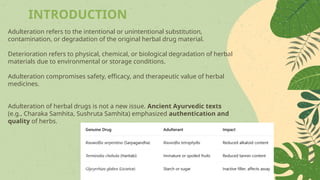
Adulteration refers to the intentional or unintentional substitution,
contamination, or degradation of the original herbal drug material.
Deterioration refers to physical, chemical, or biological degradation of herbal
materials due to environmental or storage conditions.
Adulteration compromises safety, efficacy, and therapeutic value of herbal
medicines.
Adulteration of herbal drugs is not a new issue. Ancient Ayurvedic texts
(e.g., Charaka Samhita, Sushruta Samhita) emphasized authentication and
quality of herbs.
TYPES OF
ADULTERATION
•Intentional Adulteration
•Done deliberately to increase profit.
•Examples:
•Substitution with inferior quality drugs
•Addition of foreign substances (e.g., starch to
powdered drugs)
•Unintentional Adulteration
•Occurs due to negligence, lack of knowledge, or improper
storage.
•Examples:
•Collecting immature or decayed plant material
•Infestation with microbes or insects
Substitution of Herbal
Drugs
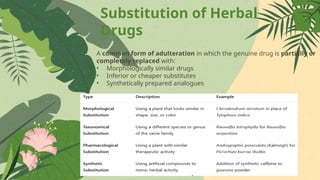
• A common form of adulteration in which the genuine drug is partially or
completely replaced with:
• Morphologically similar drugs
• Inferior or cheaper substitutes
• Synthetically prepared analogues
Causes of
Adulteration
1.Economic Motivation (Intentional Cause)-Profit-driven adulteration
by replacing genuine drugs with cheaper materials.
Example: Using Rauvolfia tetraphylla (cheap) in place of Rauvolfia
serpentina (costly).
2. Scarcity of Raw Materials-Due to seasonal variation, overharvesting,
or endangered status, certain herbs are not available year-round.This
drives substitution with morphologically similar or available alternatives.
3. Ignorance and Misidentification of Collectors or traders without
botanical training may mistake wild species or weeds as genuine
medicinal plants
.Example: Aconitum ferox being confused with Aconitum napellus — a
fatal error.
4. Improper Storage and Handling Exposure to moisture, insects, fungi,
or sunlight can deteriorate raw materials, leading to:Fungal growth Loss
of active constituents
Measures to Prevent
Adulteration
• Ensure purity and identity of raw materials.
• Maintain therapeutic consistency and efficacy.
• Protect consumers from toxicity or substandard quality.
• Comply with pharmacopoeial and regulatory standards.
1.Good Agricultural and Collection Practices (GACP)
• Developed by WHO and national pharmacopoeias.
• Ensures correct cultivation, harvesting, and post-harvest handling.
Key Elements:
• Use of certified seeds or authentic planting material.
• Proper botanical identification of plants.
• Avoid collection from polluted or pesticide-exposed areas.
• Correct time and method of harvesting.
Measures to Prevent
Adulteration
2. Botanical Authentication and Taxonomic Identification-Ensures correct
identification at the species level.
Methods Include: Morphological characters (leaf shape, flower color, etc.)
Microscopy (stomatal index, trichomes, calcium oxalate crystals)
Chemotaxonomy using marker compounds🌿
Example: Differentiate Bacopa monnieri from Centella asiatica by leaf shape
and venation pattern.
3.. Use of Standardized Herbal Monographs
Based on IP, API, USP, British Herbal Pharmacopoeia, etc. Include:Macroscopy
and microscopyTLC/HPTLC/HPLC profiles. Physico-chemical constants (ash,
moisture, extractives)Limit tests for heavy metals, aflatoxins, etc. These
monographs act as a reference to detect and reject adulterated samples.
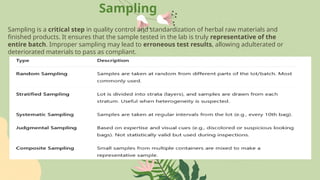
Sampling
Sampling is a critical step in quality control and standardization of herbal raw materials and
finished products. It ensures that the sample tested in the lab is truly representative of the
entire batch. Improper sampling may lead to erroneous test results, allowing adulterated or
deteriorated materials to pass as compliant.
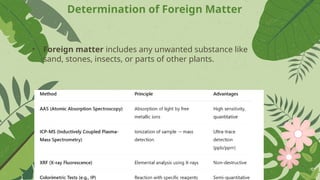
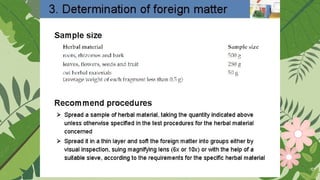
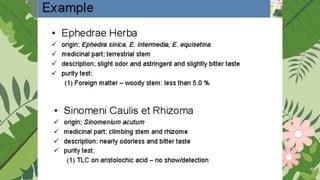
Determination of Foreign Matter
• Foreign matter includes any unwanted substance like
sand, stones, insects, or parts of other plants.
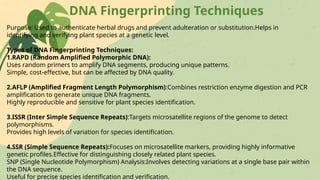
DNA Fingerprinting Techniques
Purpose: Used to authenticate herbal drugs and prevent adulteration or substitution.Helps in
identifying and verifying plant species at a genetic level.
Types of DNA Fingerprinting Techniques:
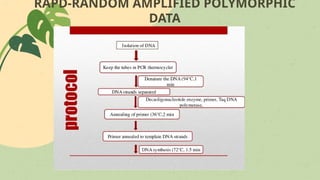
1.RAPD (Random Amplified Polymorphic DNA):
Uses random primers to amplify DNA segments, producing unique patterns.
Simple, cost-effective, but can be affected by DNA quality.
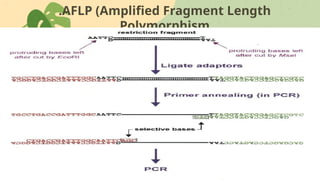
2.AFLP (Amplified Fragment Length Polymorphism):Combines restriction enzyme digestion and PCR
amplification to generate unique DNA fragments.
Highly reproducible and sensitive for plant species identification.
3.ISSR (Inter Simple Sequence Repeats):Targets microsatellite regions of the genome to detect
polymorphisms.
Provides high levels of variation for species identification.
4.SSR (Simple Sequence Repeats):Focuses on microsatellite markers, providing highly informative
genetic profiles.Effective for distinguishing closely related plant species.
SNP (Single Nucleotide Polymorphism) Analysis:Involves detecting variations at a single base pair within
the DNA sequence.
Useful for precise species identification and verification.
RAPD-RANDOM AMPLIFIED POLYMORPHIC
DATA
.AFLP (Amplified Fragment Length
Polymorphism
Detection of Heavy Metals
Heavy Metals of Concern:Lead (Pb), Arsenic (As), Cadmium (Cd), Mercury (Hg),
Chromium (Cr).
Sources of Contamination:Polluted soil, water, and air.Processing during cultivation
and handling.
Health Risks:
Lead: Neurotoxic, kidney damage, developmental toxicity.
Arsenic: Carcinogenic, skin lesions, organ toxicity.
Cadmium: Kidney damage, bone demineralization, carcinogenic.
Mercury: Neurotoxic, developmental delays, organ damage.
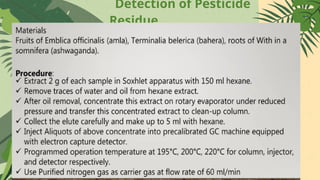
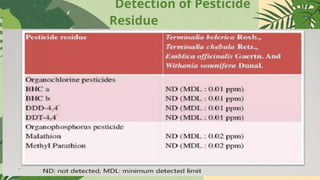
Detection of Pesticide
Residue
Pesticide Residues: Traces of pesticides left on plants after application,
potentially harmful to human health.
Common Pesticides: Organophosphates, carbamates, pyrethroids, and
fungicides.
Detection Methods:
Gas Chromatography (GC): Sensitive for volatile pesticides (e.g.,
organophosphates).
High-Performance Liquid Chromatography (HPLC): Effective for non-
volatile pesticides.
LC-MS/MS (Liquid Chromatography-Mass Spectrometry): Accurate for
detecting low-level residues in complex matrices.
ELISA (Enzyme-Linked Immunosorbent Assay): Fast, specific
screening for certain pesticides.
Ensures herbal drug safety by minimizing toxic pesticide exposure.-
Detection of Pesticide
Residue
Detection of Pesticide
Residue
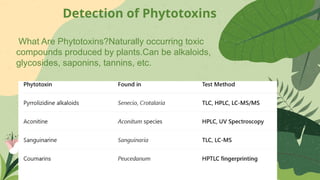
Detection of Phytotoxins
What Are Phytotoxins?Naturally occurring toxic
compounds produced by plants.Can be alkaloids,
glycosides, saponins, tannins, etc.
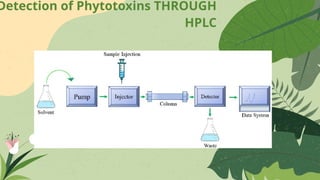
Detection of Phytotoxins THROUGH
HPLC
Table : Chemical analysis for detection of some plant toxins [14, 16, 17,
30, 31]
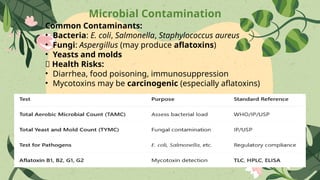
Microbial Contamination
Common Contaminants:
• Bacteria: E. coli, Salmonella, Staphylococcus aureus
• Fungi: Aspergillus (may produce aflatoxins)
• Yeasts and molds
🦠 Health Risks:
• Diarrhea, food poisoning, immunosuppression
• Mycotoxins may be carcinogenic (especially aflatoxins)
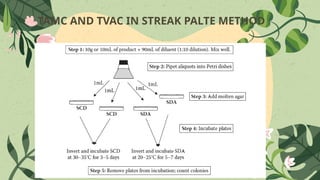
TAMC AND TVAC IN STREAK PALTE METHOD
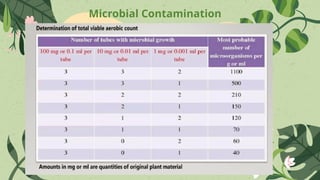
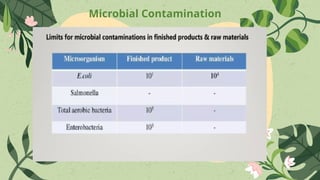
Microbial Contamination
REFERENCES
• https://www.bing.com/search?pglt=299&q=adulteration+and+deterioration+
ppt&cvid=ab25a498672a4d7eb02709fa909d9cb2&gs_lcrp=EgRlZGdlKgYIABB
FGDkyBggAEEUYOTIGCAEQABhA0gEIOTQ5NmowajGoAgiwAgE&FORM=ANN
TA1&PC=HCTS
• .
https://www.slideshare.net/slideshow/adulteration-and-deteriorationpptx/2
59270622
• https://www.slideshare.net/slideshow/unit-2-adulteration-and-deterioration
pptx/266391134
• https://www.bing.com/ck/a?!
&&p=e787a7776bf97a4d7de3ae3bc1dbfaf09693d180cfb00fc0efe923635efc0
10cJmltdHM9MTc0NTM2NjQwMA&ptn=3&ver=2&hsh=4&fclid=2c13c160-
76bb-6641-1b15-
d59c77bd67cc&psq=adulteration+and+deterioration+ppt&u=a1aHR0cHM6L
y93d3cuc2NyaWJkLmNvbS9wcmVzZW50YXRpb24vMzY4ODE5MDMwL0FkdW
x0ZXJhdGlvbi1vZi1DcnVkZS1kcnVncw&ntb=1
THANK YOU

ADULTERATION AND DETERIORATION MPHARMA 2ND SEM.pptx

  • 1.
    Zainab Mantasha Mpharma 2nd sem SPER,JamiaHamdard Submitted to-Dr.Sayeed Sir ADULTERATIO N AND DETERIORATI ON
  • 2.
    INTRODUCTION Adulteration refers tothe intentional or unintentional substitution, contamination, or degradation of the original herbal drug material. Deterioration refers to physical, chemical, or biological degradation of herbal materials due to environmental or storage conditions. Adulteration compromises safety, efficacy, and therapeutic value of herbal medicines. Adulteration of herbal drugs is not a new issue. Ancient Ayurvedic texts (e.g., Charaka Samhita, Sushruta Samhita) emphasized authentication and quality of herbs.
  • 3.
    TYPES OF ADULTERATION •Intentional Adulteration •Donedeliberately to increase profit. •Examples: •Substitution with inferior quality drugs •Addition of foreign substances (e.g., starch to powdered drugs) •Unintentional Adulteration •Occurs due to negligence, lack of knowledge, or improper storage. •Examples: •Collecting immature or decayed plant material •Infestation with microbes or insects
  • 4.
    Substitution of Herbal Drugs •A common form of adulteration in which the genuine drug is partially or completely replaced with: • Morphologically similar drugs • Inferior or cheaper substitutes • Synthetically prepared analogues
  • 5.
    Causes of Adulteration 1.Economic Motivation(Intentional Cause)-Profit-driven adulteration by replacing genuine drugs with cheaper materials. Example: Using Rauvolfia tetraphylla (cheap) in place of Rauvolfia serpentina (costly). 2. Scarcity of Raw Materials-Due to seasonal variation, overharvesting, or endangered status, certain herbs are not available year-round.This drives substitution with morphologically similar or available alternatives. 3. Ignorance and Misidentification of Collectors or traders without botanical training may mistake wild species or weeds as genuine medicinal plants .Example: Aconitum ferox being confused with Aconitum napellus — a fatal error. 4. Improper Storage and Handling Exposure to moisture, insects, fungi, or sunlight can deteriorate raw materials, leading to:Fungal growth Loss of active constituents
  • 6.
    Measures to Prevent Adulteration •Ensure purity and identity of raw materials. • Maintain therapeutic consistency and efficacy. • Protect consumers from toxicity or substandard quality. • Comply with pharmacopoeial and regulatory standards. 1.Good Agricultural and Collection Practices (GACP) • Developed by WHO and national pharmacopoeias. • Ensures correct cultivation, harvesting, and post-harvest handling. Key Elements: • Use of certified seeds or authentic planting material. • Proper botanical identification of plants. • Avoid collection from polluted or pesticide-exposed areas. • Correct time and method of harvesting.
  • 7.
    Measures to Prevent Adulteration 2.Botanical Authentication and Taxonomic Identification-Ensures correct identification at the species level. Methods Include: Morphological characters (leaf shape, flower color, etc.) Microscopy (stomatal index, trichomes, calcium oxalate crystals) Chemotaxonomy using marker compounds🌿 Example: Differentiate Bacopa monnieri from Centella asiatica by leaf shape and venation pattern. 3.. Use of Standardized Herbal Monographs Based on IP, API, USP, British Herbal Pharmacopoeia, etc. Include:Macroscopy and microscopyTLC/HPTLC/HPLC profiles. Physico-chemical constants (ash, moisture, extractives)Limit tests for heavy metals, aflatoxins, etc. These monographs act as a reference to detect and reject adulterated samples.
  • 8.
    Sampling Sampling is acritical step in quality control and standardization of herbal raw materials and finished products. It ensures that the sample tested in the lab is truly representative of the entire batch. Improper sampling may lead to erroneous test results, allowing adulterated or deteriorated materials to pass as compliant.
  • 9.
    Determination of ForeignMatter • Foreign matter includes any unwanted substance like sand, stones, insects, or parts of other plants.
  • 12.
    DNA Fingerprinting Techniques Purpose:Used to authenticate herbal drugs and prevent adulteration or substitution.Helps in identifying and verifying plant species at a genetic level. Types of DNA Fingerprinting Techniques: 1.RAPD (Random Amplified Polymorphic DNA): Uses random primers to amplify DNA segments, producing unique patterns. Simple, cost-effective, but can be affected by DNA quality. 2.AFLP (Amplified Fragment Length Polymorphism):Combines restriction enzyme digestion and PCR amplification to generate unique DNA fragments. Highly reproducible and sensitive for plant species identification. 3.ISSR (Inter Simple Sequence Repeats):Targets microsatellite regions of the genome to detect polymorphisms. Provides high levels of variation for species identification. 4.SSR (Simple Sequence Repeats):Focuses on microsatellite markers, providing highly informative genetic profiles.Effective for distinguishing closely related plant species. SNP (Single Nucleotide Polymorphism) Analysis:Involves detecting variations at a single base pair within the DNA sequence. Useful for precise species identification and verification.
  • 13.
  • 14.
    .AFLP (Amplified FragmentLength Polymorphism
  • 15.
    Detection of HeavyMetals Heavy Metals of Concern:Lead (Pb), Arsenic (As), Cadmium (Cd), Mercury (Hg), Chromium (Cr). Sources of Contamination:Polluted soil, water, and air.Processing during cultivation and handling. Health Risks: Lead: Neurotoxic, kidney damage, developmental toxicity. Arsenic: Carcinogenic, skin lesions, organ toxicity. Cadmium: Kidney damage, bone demineralization, carcinogenic. Mercury: Neurotoxic, developmental delays, organ damage.
  • 16.
    Detection of Pesticide Residue PesticideResidues: Traces of pesticides left on plants after application, potentially harmful to human health. Common Pesticides: Organophosphates, carbamates, pyrethroids, and fungicides. Detection Methods: Gas Chromatography (GC): Sensitive for volatile pesticides (e.g., organophosphates). High-Performance Liquid Chromatography (HPLC): Effective for non- volatile pesticides. LC-MS/MS (Liquid Chromatography-Mass Spectrometry): Accurate for detecting low-level residues in complex matrices. ELISA (Enzyme-Linked Immunosorbent Assay): Fast, specific screening for certain pesticides. Ensures herbal drug safety by minimizing toxic pesticide exposure.-
  • 17.
  • 18.
  • 19.
    Detection of Phytotoxins WhatAre Phytotoxins?Naturally occurring toxic compounds produced by plants.Can be alkaloids, glycosides, saponins, tannins, etc.
  • 20.
  • 21.
    Table : Chemicalanalysis for detection of some plant toxins [14, 16, 17, 30, 31]
  • 22.
    Microbial Contamination Common Contaminants: •Bacteria: E. coli, Salmonella, Staphylococcus aureus • Fungi: Aspergillus (may produce aflatoxins) • Yeasts and molds 🦠 Health Risks: • Diarrhea, food poisoning, immunosuppression • Mycotoxins may be carcinogenic (especially aflatoxins)
  • 23.
    TAMC AND TVACIN STREAK PALTE METHOD
  • 24.
  • 25.
  • 26.
    REFERENCES • https://www.bing.com/search?pglt=299&q=adulteration+and+deterioration+ ppt&cvid=ab25a498672a4d7eb02709fa909d9cb2&gs_lcrp=EgRlZGdlKgYIABB FGDkyBggAEEUYOTIGCAEQABhA0gEIOTQ5NmowajGoAgiwAgE&FORM=ANN TA1&PC=HCTS • . https://www.slideshare.net/slideshow/adulteration-and-deteriorationpptx/2 59270622 •https://www.slideshare.net/slideshow/unit-2-adulteration-and-deterioration pptx/266391134 • https://www.bing.com/ck/a?! &&p=e787a7776bf97a4d7de3ae3bc1dbfaf09693d180cfb00fc0efe923635efc0 10cJmltdHM9MTc0NTM2NjQwMA&ptn=3&ver=2&hsh=4&fclid=2c13c160- 76bb-6641-1b15- d59c77bd67cc&psq=adulteration+and+deterioration+ppt&u=a1aHR0cHM6L y93d3cuc2NyaWJkLmNvbS9wcmVzZW50YXRpb24vMzY4ODE5MDMwL0FkdW x0ZXJhdGlvbi1vZi1DcnVkZS1kcnVncw&ntb=1
  • 27.