PART-I
Mr. Manojkumar K. Munde
Asst.Prof. Pharmaceutical Chemistry
PES Modern College of Pharmacy (for Ladies), Pune, MS, India
9/15/2019 M K Munde 1
CHOLINERGIC AGENTS
CHOLINERGIC AND ANTICHOLINERGIC DRUGS
The nervous system is divided into the somatic nervous system, which controls
organs under voluntary control (mainly muscles) and the autonomic nervous
system (ANS) which regulates individual organ function and homeostasis, and for
the most part is not subject to voluntary control.
The autonomic nervous system is also known as the visceral or automatic
system. The ANS is predominantly an efferent system transmitting impulses
from the central nervous system (CNS) to peripheral organ systems.
The autonomic nervous system consists of sensory neurons and motor
neurons that innervates between the central nervous system (especially the
hypothalamus and medulla oblongata) and various internal organs such as the :
heart, lungs, viscera, glands (both exocrine and endocrine).
9/15/2019 M K Munde
The ANS is divided into two separate divisions called the parasympathetic
and sympathetic systems, on the basis of anatomical and functional
differences.
Both of these systems consist of myelinated preganglionic fibres which
make synaptic connections with unmyelinated postganglionic fibres, and it
is these which then innervate the effector organ.
These synapses usually occur in clusters called ganglia.
9/15/2019 M K Munde
The main nerves of the parasympathetic system are the tenth cranial
nerve, the vagus nerve, which originate in the medulla oblongata.
Other preganglionic parasympathetic neurons also extend from the brain
as well as from the lower tip of the spinal cord.
Each preganglionic parasympathetic neuron synapses with just a few
postganglionic neurons, which are located near or in the effector organ, a
muscle or major gland.
Acetylcholine (ACh) is the neurotransmitter of all the pre and many of the
postganglionic neurons of the parasympathetic system.
9/15/2019 M K Munde
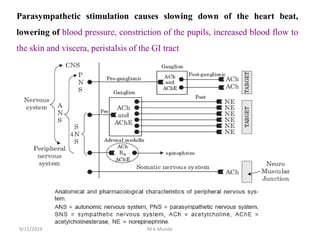
Parasympathetic stimulation causes slowing down of the heart beat,
lowering of blood pressure, constriction of the pupils, increased blood flow to
the skin and viscera, peristalsis of the GI tract
9/15/2019 M K Munde
THE SYMPATHETIC NERVOUS SYSTEM
The preganglionic motor neurons of the sympathetic system arise in the spinal cord.
They pass into sympathetic ganglia, which are organized into two chains that run
parallel to and on either side of the spinal cord.
The neurotransmitter of the preganglionic sympathetic neurons is acetylcholine
(ACh). It stimulates action potentials in the postganglionic neurons.
The neurotransmitter released by the postganglionic neurons is noradrenaline (also
called norepinephrine).
The release of noradrenalin stimulates heartbeat, raises blood pressure, dilates the
pupils, dilates the trachea and bronchi, stimulates the conversion of liver glycogen into
glucose, shunts blood away from the skin and viscera to the skeletal muscles, brain, and
heart, inhibits peristalsis in the GI tract, inhibits contraction of the bladder and rectum.
9/15/2019 M K Munde
NEUROCHEMISTRY
A neurotransmitter is a chemical messenger used by neurons to communicate in one
direction with other neurons.
Communication between neurons is accomplished by the recognition by a receptor for
a specific chemical messenger, picture a ball (neurotransmitter) in a cup (receptor). They
are synthesized primarily in the nerve terminals, stored in vesicles of nerve terminals and
are released in to the extracellular space using calcium ions.
Their action is terminated by reuptake into presynaptic terminal or glial cells by
specific transporter proteins or by catabolism in synaptic cleft or in presynaptic terminal
Neurotransmitters : Chemically, there are four classes of
neurotransmitters.
They are :
1. Acetylcholine
2. Biogenic amines : Indolamines (serotonin and tryptamine are synthesized
from tryptophan), and the catecholamines (dopamine, norepinephrine and
epinephrine are synthesized from tyrosine).9/15/2019 M K Munde
3. Excitatory amino acids : There are three major amino acid neurotransmitters
in the nervous system ; γ-Amino butyric acid (GABA), glycine, glutamic acid
and aspartate.
4. Neuropeptides, over 50 are known.
Amino acid neurotransmitters are the most numerous except for the neuropeptides,
which are synthesized in the nerve cell body and transported in vesicles along the
axon to the axon terminals.
All other neurotransmitters are synthesized at the axon terminals and stored in
synaptic vesicles. These synaptic vesicles release neurotransmitters when the
presynaptic neuron’s electrical properties change sufficiently (i.e. arrival of an action
potential).
Neurotransmitters are released from the vesicles into a tiny space between neurons
called the synapse.
A bit of the released neurotransmitter diffuses across the synaptic space and binds to
receptors on the adjacent neuron.
The whole process takes about one millisecond.9/15/2019 M K Munde
When a neurotransmitter binds to a receptor on another neuron, ion channels
open and ions move in or out of that neuron.
This causes a net change in the electrical properties (membrane potential) of
that neuron and determines its activity.
The change may be inhibitory or excitatory, and is determined by the
receptors on the postsynaptic neuron.
9/15/2019 M K Munde
The chemical transmitter at both pre and postganglionic synapses in the
parasympathetic system is acetylcholine (Ach).
Ach is also the neurotransmitter at sympathetic preganglionic synapses, some
sympathetic postganglionic synapses, the neuromuscular junction (somatic
nervous system), and at some sites in the CNS.
Acetylcholine is the most widespread autonomic transmitter present in the body.
9/15/2019 M K Munde
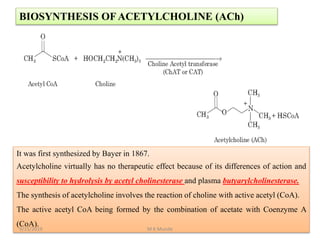
BIOSYNTHESIS OFACETYLCHOLINE (ACh)
It was first synthesized by Bayer in 1867.
Acetylcholine virtually has no therapeutic effect because of its differences of action and
susceptibility to hydrolysis by acetyl cholinesterase and plasma butyarylcholinesterase.
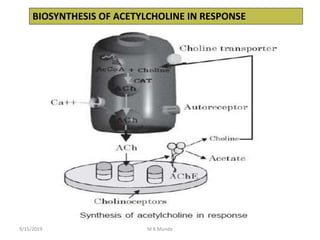
The synthesis of acetylcholine involves the reaction of choline with active acetyl (CoA).
The active acetyl CoA being formed by the combination of acetate with Coenzyme A
(CoA).
9/15/2019 M K Munde
The reaction between acetyl Coenzyme A and choline is catalyzed by the enzyme
cholineacetylase.
There is considerable evidence that the enzyme cholineacetylase is synthesized
within the neuronal perikaryon, then transferred along the axon to its terminals where
the formation of acetylcholine is believed to occur.
9/15/2019 M K Munde
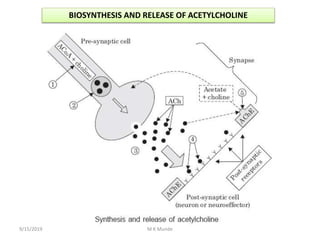
BIOSYNTHESIS AND RELEASE OF ACETYLCHOLINE
9/15/2019 M K Munde
BIOSYNTHESIS OF ACETYLCHOLINE IN RESPONSE
9/15/2019 M K Munde
STORAGE AND RELEASE OF ACh.
ACh is stored in synaptic vesicles, which is released as discrete “Quanta”
in response to depolarization of the nerve terminal and an increased influx
of Ca++.
When a nerve impulse occurs, depolarization of nerve terminal causes
influx of Ca++, which facilitates the fusion of the axonal and vesicular
storage membranes, and release formed acetylcholine into the synaptic cleft
by exocytosis.
The released acetylcholine combines with the receptors at target organ,
remains bound for less than a millisecond and is quickly hydrolysed by
acetycholinesterase enzyme into choline and acetate.
9/15/2019 M K Munde
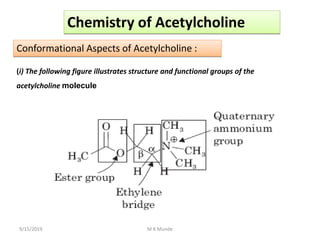
Chemistry of Acetylcholine
Conformational Aspects of Acetylcholine :
(i) The following figure illustrates structure and functional groups of the
acetylcholine molecule
9/15/2019 M K Munde
(ii) Conformational isomers of ACh derived from rotation around the -O-C-C-N axis and
their nomenclatures [the receptor-bound conformation of ACh is (+) ac]
9/15/2019 M K Munde
There are number of different ACh receptors throughout the body.
Acetylcholine acts on two different classes of receptors-nicotinic receptors and
muscarinic receptors (widely distributed within both peripheral and central nervous
systems).
ACETYLCHOLINE RECEPTORS
Nicotinic Receptors
Nicotinic receptors are selectively activated by nicotine and blocked by tubocurarine
or hexamethonium.
These are rosette like pentameric structures which enclose a ligand gated cation
channel, their activation causes opening of the channel and rapid flow of cations
resulting in depolarization and generation of action potential. On the basis of location
and selectivity. They are divided into two types;
9/15/2019 M K Munde
N1 :
These are present at skeletal muscle endplate and mediate skeletal muscle contractions.
They are selectively stimulated by phenyltrimethyl ammonium and are blocked by
tubocurarine.
N2 :
These are present in ganglionic cells, adrenal medullary cells, in spinal cord and in certain
areas of brain.
They are primarily stimulated by dimethylphenylpiperazine and blocked by
hexamethonium.
TYPES OF NICOTINIC RECEPTORS
9/15/2019 M K Munde
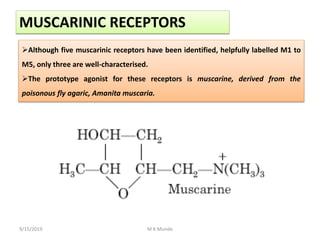
MUSCARINIC RECEPTORS
Although five muscarinic receptors have been identified, helpfully labelled M1 to
M5, only three are well-characterised.
The prototype agonist for these receptors is muscarine, derived from the
poisonous fly agaric, Amanita muscaria.
9/15/2019 M K Munde
M1 receptors –
M1 receptors are mainly found in the nervous system.
They mediate excitatory effects, lowering transmembrane potential by a decrease in
K+ ion conductance; as an added wrinkle, they mediate increased gastric acid secretion
seen with vagal stimulation.
M1 receptors work via phospholipase C, increasing IP3 and DAG levels.
M2 receptors-
M2 receptors mediate the cardiac effects of vagal stimulation.
They are inhibitory (hyperpolarizing membranes by increasing potassium
conductance).
M2 receptors are found presynaptically in a variety of situations. This fits on cardiac
cells and smooth muscle. M2 receptors lower intracellular cAMP levels.
9/15/2019 M K Munde
M3 receptors
M3 receptors are responsible for all the other effects of parasympathetic stimulation, as
they are the cholinergic excitatory receptors found on glands and smooth muscle.
M3 receptors are similar to M1 in their use of phospholipase C.
Physiology is however never simple, vascular smooth muscle relaxes in some
situations due to M3 receptor stimulation.
This relaxation is mediated by endothelial release of nitric oxide (NO), and occurs in
some vascular beds that appear devoid of parasympathetic innervation.
M4 are similar to M2 ; M5 receptors seem similar to M1 and M3 in their effects.
9/15/2019 M K Munde

Actylcholine part 1

  • 1.
    PART-I Mr. Manojkumar K.Munde Asst.Prof. Pharmaceutical Chemistry PES Modern College of Pharmacy (for Ladies), Pune, MS, India 9/15/2019 M K Munde 1 CHOLINERGIC AGENTS
  • 2.
    CHOLINERGIC AND ANTICHOLINERGICDRUGS The nervous system is divided into the somatic nervous system, which controls organs under voluntary control (mainly muscles) and the autonomic nervous system (ANS) which regulates individual organ function and homeostasis, and for the most part is not subject to voluntary control. The autonomic nervous system is also known as the visceral or automatic system. The ANS is predominantly an efferent system transmitting impulses from the central nervous system (CNS) to peripheral organ systems. The autonomic nervous system consists of sensory neurons and motor neurons that innervates between the central nervous system (especially the hypothalamus and medulla oblongata) and various internal organs such as the : heart, lungs, viscera, glands (both exocrine and endocrine). 9/15/2019 M K Munde
  • 3.
    The ANS isdivided into two separate divisions called the parasympathetic and sympathetic systems, on the basis of anatomical and functional differences. Both of these systems consist of myelinated preganglionic fibres which make synaptic connections with unmyelinated postganglionic fibres, and it is these which then innervate the effector organ. These synapses usually occur in clusters called ganglia. 9/15/2019 M K Munde
  • 4.
    The main nervesof the parasympathetic system are the tenth cranial nerve, the vagus nerve, which originate in the medulla oblongata. Other preganglionic parasympathetic neurons also extend from the brain as well as from the lower tip of the spinal cord. Each preganglionic parasympathetic neuron synapses with just a few postganglionic neurons, which are located near or in the effector organ, a muscle or major gland. Acetylcholine (ACh) is the neurotransmitter of all the pre and many of the postganglionic neurons of the parasympathetic system. 9/15/2019 M K Munde
  • 5.
    Parasympathetic stimulation causesslowing down of the heart beat, lowering of blood pressure, constriction of the pupils, increased blood flow to the skin and viscera, peristalsis of the GI tract 9/15/2019 M K Munde
  • 6.
    THE SYMPATHETIC NERVOUSSYSTEM The preganglionic motor neurons of the sympathetic system arise in the spinal cord. They pass into sympathetic ganglia, which are organized into two chains that run parallel to and on either side of the spinal cord. The neurotransmitter of the preganglionic sympathetic neurons is acetylcholine (ACh). It stimulates action potentials in the postganglionic neurons. The neurotransmitter released by the postganglionic neurons is noradrenaline (also called norepinephrine). The release of noradrenalin stimulates heartbeat, raises blood pressure, dilates the pupils, dilates the trachea and bronchi, stimulates the conversion of liver glycogen into glucose, shunts blood away from the skin and viscera to the skeletal muscles, brain, and heart, inhibits peristalsis in the GI tract, inhibits contraction of the bladder and rectum. 9/15/2019 M K Munde
  • 7.
    NEUROCHEMISTRY A neurotransmitter isa chemical messenger used by neurons to communicate in one direction with other neurons. Communication between neurons is accomplished by the recognition by a receptor for a specific chemical messenger, picture a ball (neurotransmitter) in a cup (receptor). They are synthesized primarily in the nerve terminals, stored in vesicles of nerve terminals and are released in to the extracellular space using calcium ions. Their action is terminated by reuptake into presynaptic terminal or glial cells by specific transporter proteins or by catabolism in synaptic cleft or in presynaptic terminal Neurotransmitters : Chemically, there are four classes of neurotransmitters. They are : 1. Acetylcholine 2. Biogenic amines : Indolamines (serotonin and tryptamine are synthesized from tryptophan), and the catecholamines (dopamine, norepinephrine and epinephrine are synthesized from tyrosine).9/15/2019 M K Munde
  • 8.
    3. Excitatory aminoacids : There are three major amino acid neurotransmitters in the nervous system ; γ-Amino butyric acid (GABA), glycine, glutamic acid and aspartate. 4. Neuropeptides, over 50 are known. Amino acid neurotransmitters are the most numerous except for the neuropeptides, which are synthesized in the nerve cell body and transported in vesicles along the axon to the axon terminals. All other neurotransmitters are synthesized at the axon terminals and stored in synaptic vesicles. These synaptic vesicles release neurotransmitters when the presynaptic neuron’s electrical properties change sufficiently (i.e. arrival of an action potential). Neurotransmitters are released from the vesicles into a tiny space between neurons called the synapse. A bit of the released neurotransmitter diffuses across the synaptic space and binds to receptors on the adjacent neuron. The whole process takes about one millisecond.9/15/2019 M K Munde
  • 9.
    When a neurotransmitterbinds to a receptor on another neuron, ion channels open and ions move in or out of that neuron. This causes a net change in the electrical properties (membrane potential) of that neuron and determines its activity. The change may be inhibitory or excitatory, and is determined by the receptors on the postsynaptic neuron. 9/15/2019 M K Munde
  • 10.
    The chemical transmitterat both pre and postganglionic synapses in the parasympathetic system is acetylcholine (Ach). Ach is also the neurotransmitter at sympathetic preganglionic synapses, some sympathetic postganglionic synapses, the neuromuscular junction (somatic nervous system), and at some sites in the CNS. Acetylcholine is the most widespread autonomic transmitter present in the body. 9/15/2019 M K Munde
  • 11.
    BIOSYNTHESIS OFACETYLCHOLINE (ACh) Itwas first synthesized by Bayer in 1867. Acetylcholine virtually has no therapeutic effect because of its differences of action and susceptibility to hydrolysis by acetyl cholinesterase and plasma butyarylcholinesterase. The synthesis of acetylcholine involves the reaction of choline with active acetyl (CoA). The active acetyl CoA being formed by the combination of acetate with Coenzyme A (CoA). 9/15/2019 M K Munde
  • 12.
    The reaction betweenacetyl Coenzyme A and choline is catalyzed by the enzyme cholineacetylase. There is considerable evidence that the enzyme cholineacetylase is synthesized within the neuronal perikaryon, then transferred along the axon to its terminals where the formation of acetylcholine is believed to occur. 9/15/2019 M K Munde
  • 13.
    BIOSYNTHESIS AND RELEASEOF ACETYLCHOLINE 9/15/2019 M K Munde
  • 14.
    BIOSYNTHESIS OF ACETYLCHOLINEIN RESPONSE 9/15/2019 M K Munde
  • 15.
    STORAGE AND RELEASEOF ACh. ACh is stored in synaptic vesicles, which is released as discrete “Quanta” in response to depolarization of the nerve terminal and an increased influx of Ca++. When a nerve impulse occurs, depolarization of nerve terminal causes influx of Ca++, which facilitates the fusion of the axonal and vesicular storage membranes, and release formed acetylcholine into the synaptic cleft by exocytosis. The released acetylcholine combines with the receptors at target organ, remains bound for less than a millisecond and is quickly hydrolysed by acetycholinesterase enzyme into choline and acetate. 9/15/2019 M K Munde
  • 16.
    Chemistry of Acetylcholine ConformationalAspects of Acetylcholine : (i) The following figure illustrates structure and functional groups of the acetylcholine molecule 9/15/2019 M K Munde
  • 17.
    (ii) Conformational isomersof ACh derived from rotation around the -O-C-C-N axis and their nomenclatures [the receptor-bound conformation of ACh is (+) ac] 9/15/2019 M K Munde
  • 18.
    There are numberof different ACh receptors throughout the body. Acetylcholine acts on two different classes of receptors-nicotinic receptors and muscarinic receptors (widely distributed within both peripheral and central nervous systems). ACETYLCHOLINE RECEPTORS Nicotinic Receptors Nicotinic receptors are selectively activated by nicotine and blocked by tubocurarine or hexamethonium. These are rosette like pentameric structures which enclose a ligand gated cation channel, their activation causes opening of the channel and rapid flow of cations resulting in depolarization and generation of action potential. On the basis of location and selectivity. They are divided into two types; 9/15/2019 M K Munde
  • 19.
    N1 : These arepresent at skeletal muscle endplate and mediate skeletal muscle contractions. They are selectively stimulated by phenyltrimethyl ammonium and are blocked by tubocurarine. N2 : These are present in ganglionic cells, adrenal medullary cells, in spinal cord and in certain areas of brain. They are primarily stimulated by dimethylphenylpiperazine and blocked by hexamethonium. TYPES OF NICOTINIC RECEPTORS 9/15/2019 M K Munde
  • 20.
    MUSCARINIC RECEPTORS Although fivemuscarinic receptors have been identified, helpfully labelled M1 to M5, only three are well-characterised. The prototype agonist for these receptors is muscarine, derived from the poisonous fly agaric, Amanita muscaria. 9/15/2019 M K Munde
  • 21.
    M1 receptors – M1receptors are mainly found in the nervous system. They mediate excitatory effects, lowering transmembrane potential by a decrease in K+ ion conductance; as an added wrinkle, they mediate increased gastric acid secretion seen with vagal stimulation. M1 receptors work via phospholipase C, increasing IP3 and DAG levels. M2 receptors- M2 receptors mediate the cardiac effects of vagal stimulation. They are inhibitory (hyperpolarizing membranes by increasing potassium conductance). M2 receptors are found presynaptically in a variety of situations. This fits on cardiac cells and smooth muscle. M2 receptors lower intracellular cAMP levels. 9/15/2019 M K Munde
  • 22.
    M3 receptors M3 receptorsare responsible for all the other effects of parasympathetic stimulation, as they are the cholinergic excitatory receptors found on glands and smooth muscle. M3 receptors are similar to M1 in their use of phospholipase C. Physiology is however never simple, vascular smooth muscle relaxes in some situations due to M3 receptor stimulation. This relaxation is mediated by endothelial release of nitric oxide (NO), and occurs in some vascular beds that appear devoid of parasympathetic innervation. M4 are similar to M2 ; M5 receptors seem similar to M1 and M3 in their effects. 9/15/2019 M K Munde