ADJECTIVES
Adjectives are wordsthat describe or give more information about nouns
(people, places, things, or ideas).
They answer questions like: What kind? How many? Which one?
🔹Examples:
A red apple → (What kind of apple? → red)
Three books → (How many books? → three)
That house → (Which house? → that)
3.
1.PARTICIPLE ADJECTIVES
These areadjectives formed from present or past participles of
verbs.
1. Present Participle (-ing) = describes effect on something
The movie is boring. (It causes boredom)
2.Past Participle (-ed) = describes feeling or result
I am bored. (I feel bored because of the movie)
3. More Examples:
The annoying noise kept me awake.
She looked tired after the trip.
4.
2.COMPOUND ADJECTIVES
Compound adjectivesare made by combining two or more
words, often connected by a hyphen (-).
🔹Examples:
A well-known actor
A five-star hotel
A 15-minute break
An English-speaking country
🔹The hyphen is usually used when the adjective comes before
the noun.
5.
3.ADJECTIVES USED AS
NOUNS(THE + ADJECTIVE)
Sometimes adjectives are used with “the” to refer to a whole
group of people. These are plural and usually refer to social
groups or conditions.
🔹Examples:
The rich should help the poor.
The elderly need special care.
The unemployed are looking for jobs.
These phrases act as plural nouns: no need to add "people" after
them.
6.
4.NOUNS USED ASADJECTIVES
Sometimes, nouns are used before other nouns to
describe them. These are called noun modifiers.
🔹Examples:
Coffee cup (cup for coffee)
School bag (bag used for school)
Chicken soup (soup made from chicken)
The first noun acts like an adjective.
7.
5.ORDER OF ADJECTIVES
Whenyou use more than one adjective before a noun, they usually follow this order:
Quantity / Number → Opinion → Size → Age → Shape → Color → Origin → Material →
Purpose + Noun
🔹Example:
Three lovely small old round red French wooden cooking bowls
Let’s break it down:
Three (quantity)
Lovely (opinion)
Small (size)
Old (age)
Round (shape)
Red (color)
French (origin)
Wooden (material)
Cooking (purpose)
Bowls (noun)
8.
ADVERBS
Adverbs are versatilewords that modify verbs, adjectives, or
other adverbs, providing crucial details about manner, time,
place, frequency, or degree.
They inject precision and depth into language, elevating the
clarity and impact of communication.
This presentation elucidates the diverse types and functions
of adverbs, empowering you to wield them effectively in your
speech and writing.
9.
1.ADVERBS OF MANNER
Adverbsof manner elucidate how an action is performed,
enriching narratives with vivid imagery and nuance.
Examples: swiftly, gracefully, enthusiastically
Usage: They breathe life into sentences, painting a vivid picture
of actions and behaviors.
10.
2. ADVERBS OFTIME
Adverbs of time denote when an action occurs, offering
temporal context and coherence to discourse.
Example: yesterday, now, soon
Usage: They establish timelines and sequence events, guiding
the reader or listener through the narrative chronologically.
11.
3.ADVERBS OF PLACE
Adverbsof place specify where an action unfolds, anchoring
descriptions in tangible settings and locales.
Example: here, there, everywhere
Usage: They transport readers to different environments,
fostering immersive storytelling and spatial awareness.
12.
4.ADVERBS OF FREQUENCY
Adverbsof frequency indicate how often an action transpires,
shaping the rhythm and tempo of communication.
Example: always, occasionally, seldom
Usage: They infuse prose with dynamism, portraying habits,
routines, and anomalies with precision.
13.
5.ADVERBS OF DEGREE
Adverbsof degree quantify or intensify verbs, adjectives, or
other adverbs, amplifying expression and emphasis.
Examples: very, quite, extremely
Usage: They add subtle shades of strength and importance to
language.
14.
6.PLACEMENT OF ADVERBS
Adverbstypically modify verbs, adjectives, or other adverbs, and
are positioned accordingly within sentences.
Example: When placed before the verb, adverbs often emphasize
the action, as in 'She quickly ran to catch the bus,' compared to
'She ran quickly to catch the bus,' where the emphasis is on the
speed of the action.”
15.
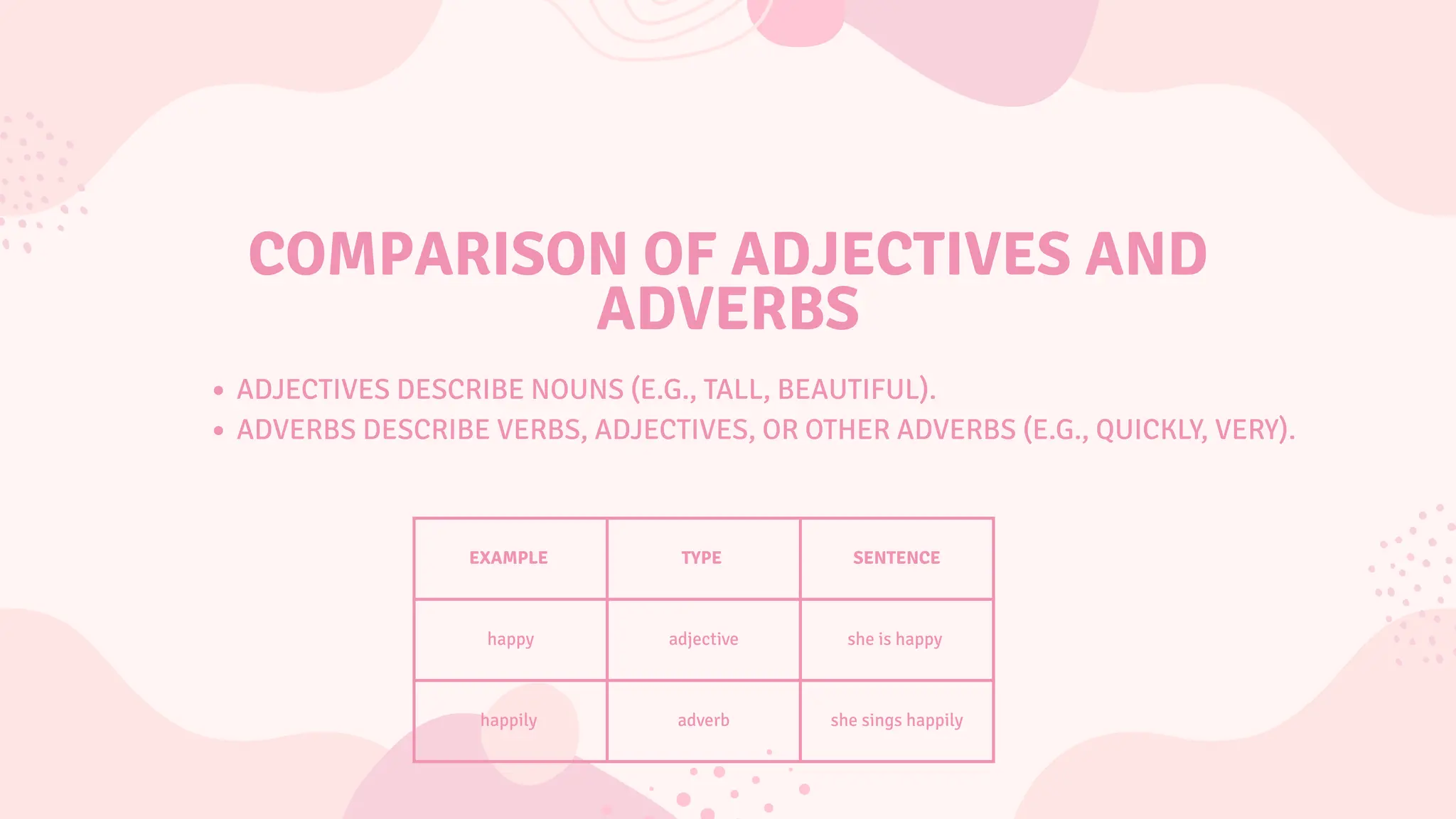
EXAMPLE TYPE SENTENCE
happyadjective she is happy
happily adverb she sings happily
COMPARISON OF ADJECTIVES AND
ADVERBS
ADJECTIVES DESCRIBE NOUNS (E.G., TALL, BEAUTIFUL).
ADVERBS DESCRIBE VERBS, ADJECTIVES, OR OTHER ADVERBS (E.G., QUICKLY, VERY).
16.
ADJECTIVE COMPARATIVE SUPERLATIVE
smallsmaller smallest
big bigger biggest
beautiful more beautiful most beautiful
COMPARATIVE AND SUPERLATIVE
FORMS OF ADJECTIVES
For short adjectives (1 syllable), add -er / -est.
For long adjectives (2+ syllables), use more / most.
Examples:
My house is bigger than yours.
This is the most beautiful place I’ve ever seen.
17.
COMPARATIVE AND SUPERLATIVE
FORMSOF ADVERBS
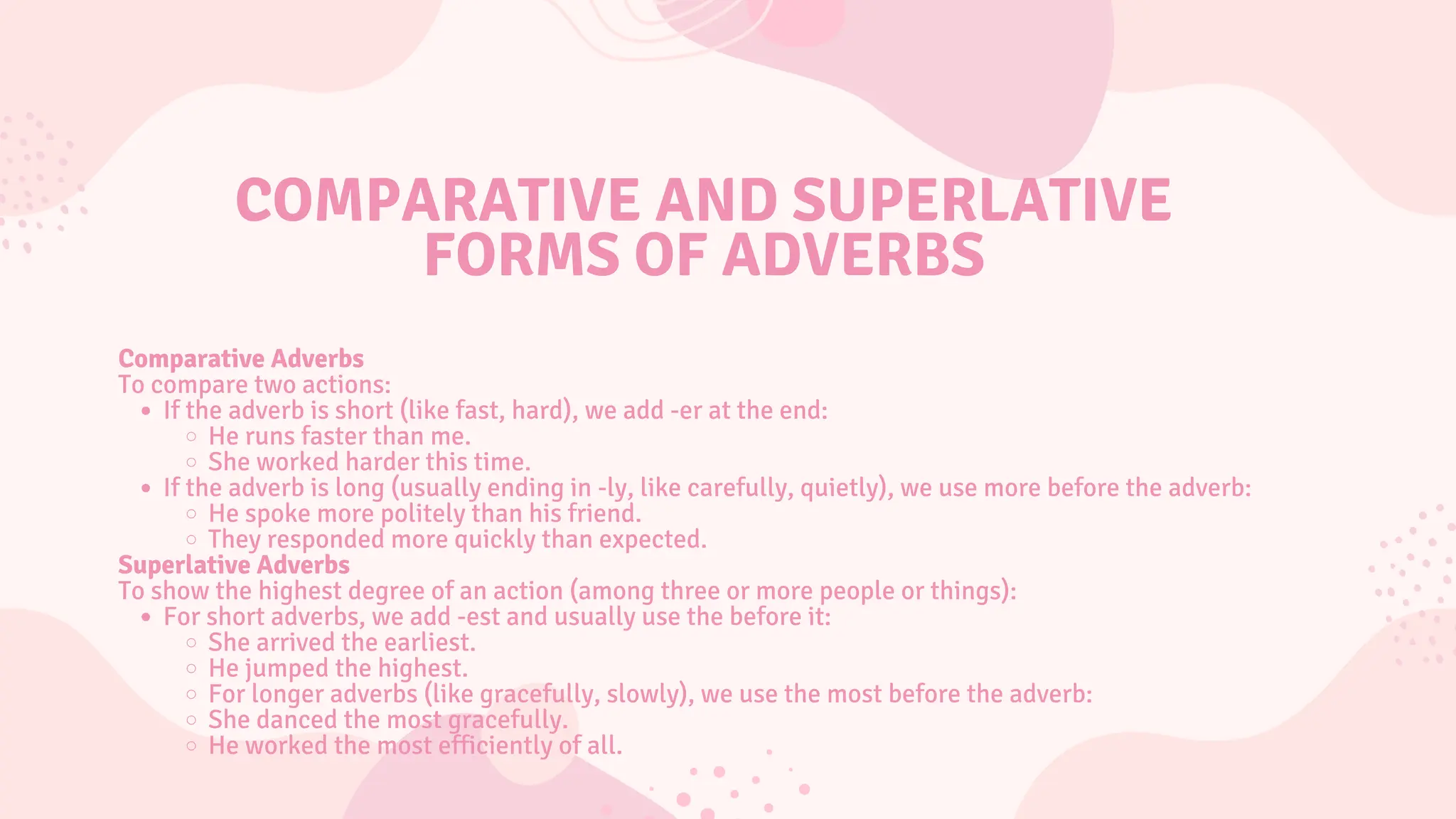
Comparative Adverbs
To compare two actions:
If the adverb is short (like fast, hard), we add -er at the end:
He runs faster than me.
She worked harder this time.
If the adverb is long (usually ending in -ly, like carefully, quietly), we use more before the adverb:
He spoke more politely than his friend.
They responded more quickly than expected.
Superlative Adverbs
To show the highest degree of an action (among three or more people or things):
For short adverbs, we add -est and usually use the before it:
She arrived the earliest.
He jumped the highest.
For longer adverbs (like gracefully, slowly), we use the most before the adverb:
She danced the most gracefully.
He worked the most efficiently of all.
18.
COMPARATIVE FORMS USING
"THAN"
Use"than" to show difference between two things.
Adjectives:
She is taller than her brother.
This book is more interesting than that one.
Adverbs:
He works more efficiently than his coworker.
She arrived earlier than me.
19.
COMPARATIVE FORMS USING
"AS...AS"
Use"as...as" to show equality or lack of it.
Adjectives:
He is as tall as his father. (equal)
This movie is not as good as the previous one. (less)
Adverbs:
She runs as fast as her teammate.
He doesn't speak as clearly as his teacher.
20.
SUPERLATIVE FORMS OF
ADJECTIVESAND ADVERBS
Superlatives describe the highest or lowest degree among three
or more things.
Adjectives:
That was the best movie of the year.
He is the tallest in the class.
Adverbs:
She drives the fastest.
He responded the most quickly.
Use "the" before superlative forms.
21.
Quantifier Used WithExample
more count & non-count nouns He has more books than me.
fewer count nouns She has fewer friends now.
less non-count nouns We have less water today.
the most both They have the most money.
the fewest count nouns He made the fewest mistakes.
the least non-count nouns I have the least experience.
COMPARISON OF NOUNS USING
QUANTIFIERS
We compare nouns using quantifiers like:
22.
OTHER WAYS OFCOMPARISON
Using verbs:
She exceeds him in performance.
He surpasses others in math.
Using phrases:
Compared to last year, sales are up.
In contrast to her sister, she’s more reserved.
Using expressions:
Twice as much/many: “He earns twice as much as I do.”
Half as: “This car uses half as much fuel.”