A formal email
EF Pre-intermediate
Successful Writing - Intermediate
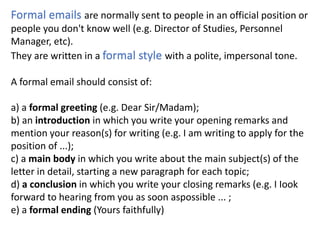
Formal emails are normally sent to people in an official position or
people you don't know well (e.g. Director of Studies, Personnel
Manager, etc).
They are written in a formal style with a polite, impersonal tone.
A formal email should consist of:
a) a formal greeting (e.g. Dear Sir/Madam);
b) an introduction in which you write your opening remarks and
mention your reason(s) for writing (e.g. I am writing to apply for the
position of ...);
c) a main body in which you write about the main subject(s) of the
letter in detail, starting a new paragraph for each topic;
d) a conclusion in which you write your closing remarks (e.g. I Iook
forward to hearing from you as soon aspossible ... ;
e) a formal ending (Yours faithfully)
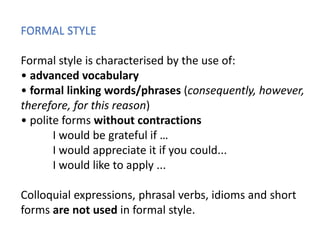
FORMAL STYLE
Formal style is characterised by the use of:
• advanced vocabulary
• formal linking words/phrases (consequently, however,
therefore, for this reason)
• polite forms without contractions
I would be grateful if …
I would appreciate it if you could...
I would like to apply ...
Colloquial expressions, phrasal verbs, idioms and short
forms are not used in formal style.
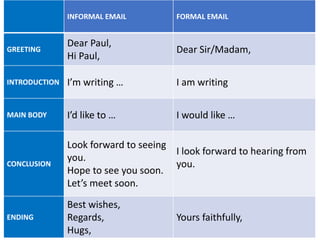
INFORMAL EMAIL FORMAL EMAIL
GREETING
Dear Paul,
Hi Paul,
Dear Sir/Madam,
INTRODUCTION I’m writing … I am writing
MAIN BODY I’d like to … I would like …
CONCLUSION
Look forward to seeing
you.
Hope to see you soon.
Let’s meet soon.
I look forward to hearing from
you.
ENDING
Best wishes,
Regards,
Hugs,
Yours faithfully,

How to write a formal email

  • 1.
    A formal email EFPre-intermediate Successful Writing - Intermediate
  • 2.
    Formal emails arenormally sent to people in an official position or people you don't know well (e.g. Director of Studies, Personnel Manager, etc). They are written in a formal style with a polite, impersonal tone. A formal email should consist of: a) a formal greeting (e.g. Dear Sir/Madam); b) an introduction in which you write your opening remarks and mention your reason(s) for writing (e.g. I am writing to apply for the position of ...); c) a main body in which you write about the main subject(s) of the letter in detail, starting a new paragraph for each topic; d) a conclusion in which you write your closing remarks (e.g. I Iook forward to hearing from you as soon aspossible ... ; e) a formal ending (Yours faithfully)
  • 3.
    FORMAL STYLE Formal styleis characterised by the use of: • advanced vocabulary • formal linking words/phrases (consequently, however, therefore, for this reason) • polite forms without contractions I would be grateful if … I would appreciate it if you could... I would like to apply ... Colloquial expressions, phrasal verbs, idioms and short forms are not used in formal style.
  • 4.
    INFORMAL EMAIL FORMALEMAIL GREETING Dear Paul, Hi Paul, Dear Sir/Madam, INTRODUCTION I’m writing … I am writing MAIN BODY I’d like to … I would like … CONCLUSION Look forward to seeing you. Hope to see you soon. Let’s meet soon. I look forward to hearing from you. ENDING Best wishes, Regards, Hugs, Yours faithfully,