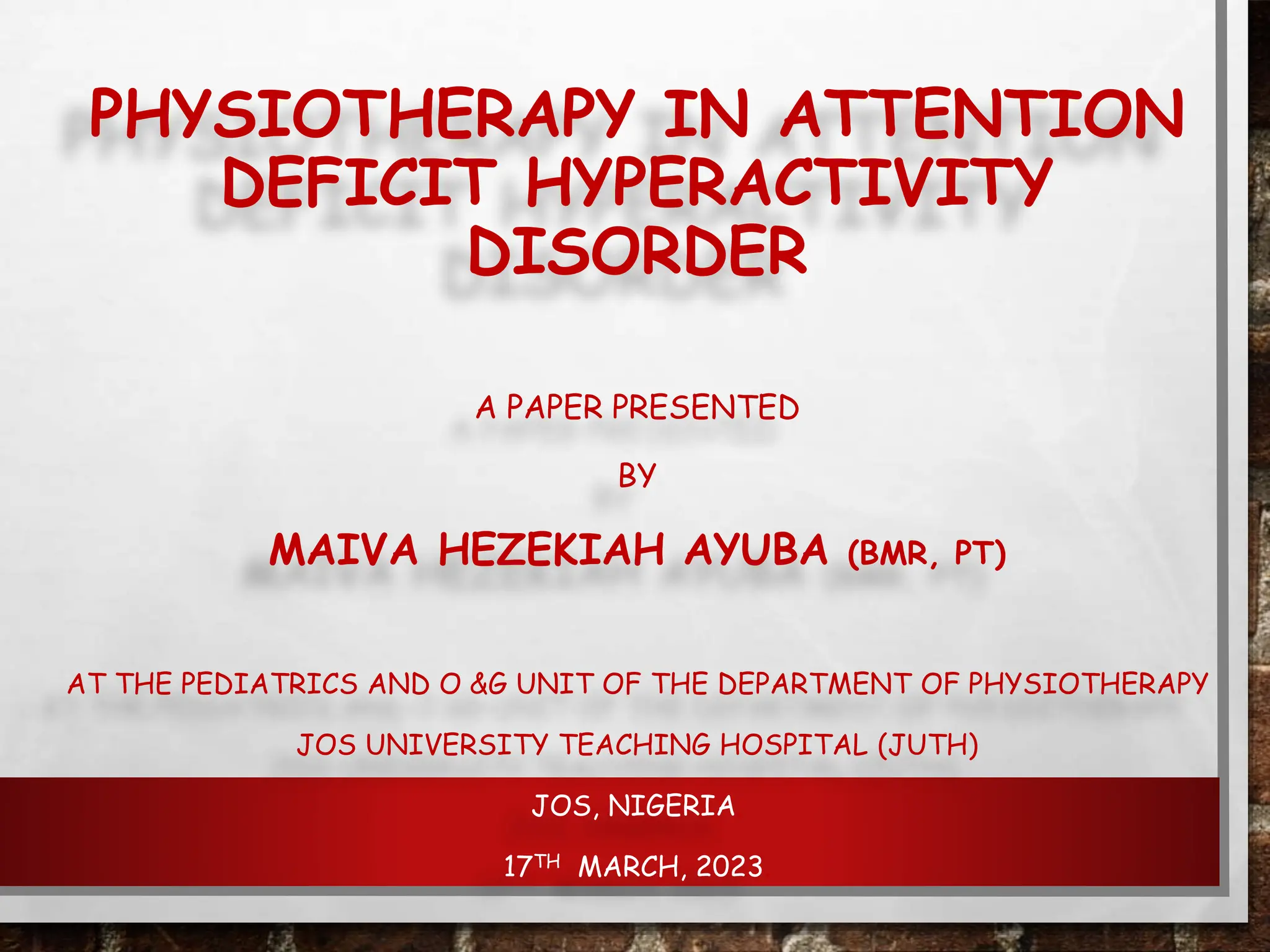
PHYSIOTHERAPY IN ATTENTION
DEFICIT HYPERACTIVITY
DISORDER
A PAPER PRESENTED
BY
MAIVA HEZEKIAH AYUBA (BMR, PT)
AT THE PEDIATRICS AND O &G UNIT OF THE DEPARTMENT OF PHYSIOTHERAPY
JOS UNIVERSITY TEACHING HOSPITAL (JUTH)
JOS, NIGERIA.
17TH MARCH, 2023.
OUTLINE
• INTRODUCTION
• TYPES OF ADHD
• ETIOLOGY
• PATHOPHYSIOLOGY
• SYMPTOMS
• COMORBIDITIES
• MANAGEMENT
• CONCLUSION
• RECOMMENDATION
• REFERENCES
2
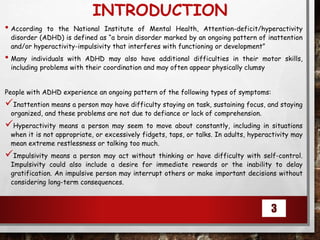
INTRODUCTION
• According to the National Institute of Mental Health, Attention-deficit/hyperactivity
disorder (ADHD) is defined as “a brain disorder marked by an ongoing pattern of inattention
and/or hyperactivity-impulsivity that interferes with functioning or development”
• Many individuals with ADHD may also have additional difficulties in their motor skills,
including problems with their coordination and may often appear physically clumsy
People with ADHD experience an ongoing pattern of the following types of symptoms:
Inattention means a person may have difficulty staying on task, sustaining focus, and staying
organized, and these problems are not due to defiance or lack of comprehension.
Hyperactivity means a person may seem to move about constantly, including in situations
when it is not appropriate, or excessively fidgets, taps, or talks. In adults, hyperactivity may
mean extreme restlessness or talking too much.
Impulsivity means a person may act without thinking or have difficulty with self-control.
Impulsivity could also include a desire for immediate rewards or the inability to delay
gratification. An impulsive person may interrupt others or make important decisions without
considering long-term consequences.
3
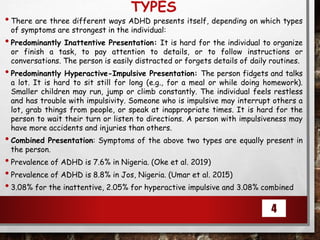
TYPES
•There are three different ways ADHD presents itself, depending on which types
of symptoms are strongest in the individual:
•Predominantly Inattentive Presentation: It is hard for the individual to organize
or finish a task, to pay attention to details, or to follow instructions or
conversations. The person is easily distracted or forgets details of daily routines.
•Predominantly Hyperactive-Impulsive Presentation: The person fidgets and talks
a lot. It is hard to sit still for long (e.g., for a meal or while doing homework).
Smaller children may run, jump or climb constantly. The individual feels restless
and has trouble with impulsivity. Someone who is impulsive may interrupt others a
lot, grab things from people, or speak at inappropriate times. It is hard for the
person to wait their turn or listen to directions. A person with impulsiveness may
have more accidents and injuries than others.
•Combined Presentation: Symptoms of the above two types are equally present in
the person.
•Prevalence of ADHD is 7.6% in Nigeria. (Oke et al. 2019)
•Prevalence of ADHD is 8.8% in Jos, Nigeria. (Umar et al. 2015)
•3.08% for the inattentive, 2.05% for hyperactive impulsive and 3.08% combined
4
ETIOLOGY/CAUSES
•The exact cause of ADHD is not clear but research continues on the topic. Sugar
is a suspect in causing hyperactivity, but there is no reliable proof that this
directly causes ADHD. Although it may play a role in one’s sustain attention, it is
not considered to be a cause of ADHD.
Possible factors that are thought to play a role include:
•Genetics: ADHD can run in families, and studies show that genes may play a role.
•Environment: Factors, such as lead exposure may increase the risk during early
childhood
•Development: Problems with the central nervous system at key moments of
development may play a role.
Other risk factors for ADHD may include:
•Blood relatives with ADHD or other mental health disorders
•Maternal drug use such as alcohol or tobacco use during pregnancy.
•Premature birth/Low Birth Weight
5
PATHOPHYSIOLOGY
• ADHD is associated with cognitive and motivational problems as well as resting-state
abnormalities, associated with impaired brain activity in distinct neuronal networks.
• More fundamental neuronal network approach suggests that in ADHD particularly
Default-Mode-Network (DMN) activity (usually prominent during rest) may interfere
with activity in neuronal networks engaged in task processing, leading to difficulties in
state regulation and periodic attentional lapses.
• The neurotransmitters dopamine (DA) and norepinephrine (NE) are implicated in the
pathophysiology of ADHD.
• Dopamine is a neurotransmitter involved in reward, risk taking, impulsivity, and mood.
• Norepinephrine modulates attention, arousal, and mood.
• Studies on individuals with ADHD suggest a defect in the dopamine receptor D4
(DRD4) receptor gene and overexpression of dopamine transporter-1 (DAT1). The
DRD4 receptor uses DA and NE to modulate attention to and responses to one's
environment. The DAT1 or dopamine transporter protein takes DA/NE into the
presynaptic nerve terminal so it may not have sufficient interaction with the
postsynaptic receptor.
6
SYMPTOMS
INATTENTION
People with symptoms of inattention may often:
Overlook or miss details and make seemingly careless mistakes in schoolwork, at work, or
during other activities
Have difficulty sustaining attention during play or tasks, such as conversations, lectures, or
lengthy reading
Not seem to listen when spoken to directly
Find it hard to follow through on instructions or finish schoolwork, chores, or duties in the
workplace, or may start tasks but lose focus and get easily sidetracked
Have difficulty organizing tasks and activities, doing tasks in sequence, keeping materials
and belongings in order, managing time, and meeting deadlines
Avoid tasks that require sustained mental effort, such as homework, or for teens and older
adults, preparing reports, completing forms, or reviewing lengthy papers
Lose things necessary for tasks or activities, such as school supplies, pencils, books, tools,
wallets, keys, paperwork, eyeglasses, and cell phones
Be easily distracted by unrelated thoughts or stimuli
Be forgetful in daily activities, such as chores and errands
7
SYMPTOMS
HYPERACTIVITY-IMPULSIVITY
People with symptoms of hyperactivity-impulsivity may often:
•Fidget and squirm while seated
•Leave their seats in situations when staying seated is expected, such as in the
classroom or the office
•Run, dash around, or climb at inappropriate times or, in teens and adults, often
feel restless
•Be unable to play or engage in hobbies quietly
•Be constantly in motion or on the go, or act as if driven by a motor
•Talk excessively
•Answer questions before they are fully asked, finish other people’s sentences, or
speak without waiting for a turn in a conversation
•Have difficulty waiting one’s turn
•Interrupt or intrude on others, for example in conversations, games, or activities
8
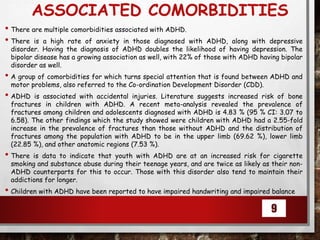
ASSOCIATED COMORBIDITIES
• There are multiple comorbidities associated with ADHD.
• There is a high rate of anxiety in those diagnosed with ADHD, along with depressive
disorder. Having the diagnosis of ADHD doubles the likelihood of having depression. The
bipolar disease has a growing association as well, with 22% of those with ADHD having bipolar
disorder as well.
• A group of comorbidities for which turns special attention that is found between ADHD and
motor problems, also referred to the Co-ordination Development Disorder (CDD).
• ADHD is associated with accidental injuries. Literature suggests increased risk of bone
fractures in children with ADHD. A recent meta-analysis revealed the prevalence of
fractures among children and adolescents diagnosed with ADHD is 4.83 % (95 % CI: 3.07 to
6.58). The other findings which the study showed were children with ADHD had a 2.55-fold
increase in the prevalence of fractures than those without ADHD and the distribution of
fractures among the population with ADHD to be in the upper limb (69.62 %), lower limb
(22.85 %), and other anatomic regions (7.53 %).
• There is data to indicate that youth with ADHD are at an increased risk for cigarette
smoking and substance abuse during their teenage years, and are twice as likely as their non-
ADHD counterparts for this to occur. Those with this disorder also tend to maintain their
addictions for longer.
• Children with ADHD have been reported to have impaired handwriting and impaired balance
9
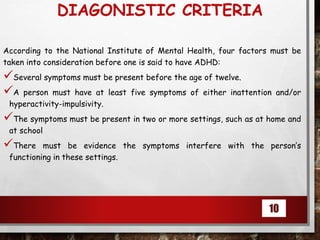
DIAGONISTIC CRITERIA
According to the National Institute of Mental Health, four factors must be
taken into consideration before one is said to have ADHD:
Several symptoms must be present before the age of twelve.
A person must have at least five symptoms of either inattention and/or
hyperactivity-impulsivity.
The symptoms must be present in two or more settings, such as at home and
at school
There must be evidence the symptoms interfere with the person’s
functioning in these settings.
10
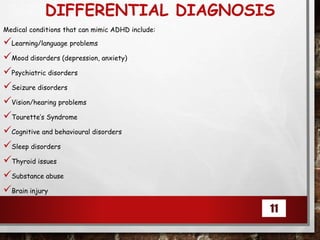
DIFFERENTIAL DIAGNOSIS
Medical conditions that can mimic ADHD include:
Learning/language problems
Mood disorders (depression, anxiety)
Psychiatric disorders
Seizure disorders
Vision/hearing problems
Tourette’s Syndrome
Cognitive and behavioural disorders
Sleep disorders
Thyroid issues
Substance abuse
Brain injury
11
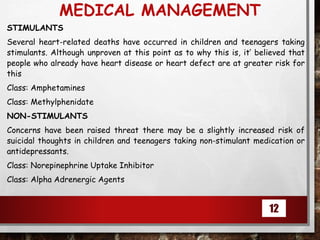
MEDICAL MANAGEMENT
STIMULANTS
Several heart-related deaths have occurred in children and teenagers taking
stimulants. Although unproven at this point as to why this is, it’ believed that
people who already have heart disease or heart defect are at greater risk for
this
Class: Amphetamines
Class: Methylphenidate
NON-STIMULANTS
Concerns have been raised threat there may be a slightly increased risk of
suicidal thoughts in children and teenagers taking non-stimulant medication or
antidepressants.
Class: Norepinephrine Uptake Inhibitor
Class: Alpha Adrenergic Agents
12
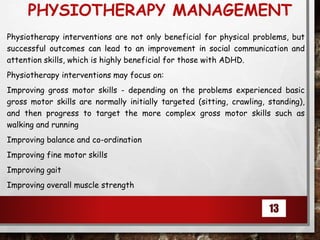
PHYSIOTHERAPY MANAGEMENT
Physiotherapy interventions are not only beneficial for physical problems, but
successful outcomes can lead to an improvement in social communication and
attention skills, which is highly beneficial for those with ADHD.
Physiotherapy interventions may focus on:
Improving gross motor skills - depending on the problems experienced basic
gross motor skills are normally initially targeted (sitting, crawling, standing),
and then progress to target the more complex gross motor skills such as
walking and running
Improving balance and co-ordination
Improving fine motor skills
Improving gait
Improving overall muscle strength
13
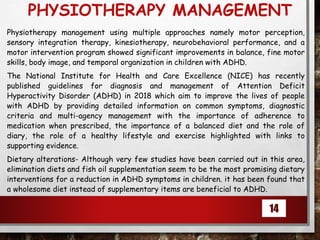
PHYSIOTHERAPY MANAGEMENT
Physiotherapy management using multiple approaches namely motor perception,
sensory integration therapy, kinesiotherapy, neurobehavioral performance, and a
motor intervention program showed significant improvements in balance, fine motor
skills, body image, and temporal organization in children with ADHD.
The National Institute for Health and Care Excellence (NICE) has recently
published guidelines for diagnosis and management of Attention Deficit
Hyperactivity Disorder (ADHD) in 2018 which aim to improve the lives of people
with ADHD by providing detailed information on common symptoms, diagnostic
criteria and multi-agency management with the importance of adherence to
medication when prescribed, the importance of a balanced diet and the role of
diary, the role of a healthy lifestyle and exercise highlighted with links to
supporting evidence.
Dietary alterations- Although very few studies have been carried out in this area,
elimination diets and fish oil supplementation seem to be the most promising dietary
interventions for a reduction in ADHD symptoms in children. it has been found that
a wholesome diet instead of supplementary items are beneficial to ADHD.
14
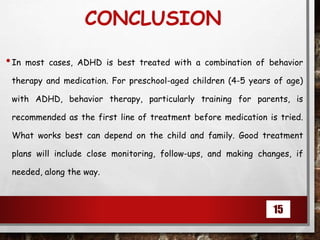
CONCLUSION
•In most cases, ADHD is best treated with a combination of behavior
therapy and medication. For preschool-aged children (4-5 years of age)
with ADHD, behavior therapy, particularly training for parents, is
recommended as the first line of treatment before medication is tried.
What works best can depend on the child and family. Good treatment
plans will include close monitoring, follow-ups, and making changes, if
needed, along the way.
15
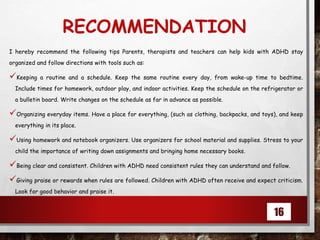
RECOMMENDATION
I hereby recommend the following tips Parents, therapists and teachers can help kids with ADHD stay
organized and follow directions with tools such as:
Keeping a routine and a schedule. Keep the same routine every day, from wake-up time to bedtime.
Include times for homework, outdoor play, and indoor activities. Keep the schedule on the refrigerator or
a bulletin board. Write changes on the schedule as far in advance as possible.
Organizing everyday items. Have a place for everything, (such as clothing, backpacks, and toys), and keep
everything in its place.
Using homework and notebook organizers. Use organizers for school material and supplies. Stress to your
child the importance of writing down assignments and bringing home necessary books.
Being clear and consistent. Children with ADHD need consistent rules they can understand and follow.
Giving praise or rewards when rules are followed. Children with ADHD often receive and expect criticism.
Look for good behavior and praise it.
16
REFERENCES
• Faraone, S. V., Banaschewski, T., Coghill, D., Zheng, Y., Biederman, J., Bellgrove, M. A., . . . Wang, Y. (2021). The World Federation of ADHD
International Consensus Statement: 208 evidence-based conclusions about the disorder. Neuroscience & Biobehavioral Reviews.
doi:10.1016/j.neubiorev.2021.01.022
• Shah A, Banner N, Heginbotham C, Fulford B. 7. American Psychiatric Association (2013) Diagnostic and Statistical Manual of Mental
Disorders, 5th edn. American Psychiatric Publishing, Arlington, VA. 8. Bechara, A., Dolan, S. and Hindes, A.(2002) Decision-making and
addiction (Part II): myopia for the future or hypersensitivity to reward? Neuropsychologia, 40, 1690–1705. 9. Office of Public Sector
Information (2005) The Mental Capacity Act 2005. http://www. Substance Use and Older People. 2014 Dec 31;21(5):9.
• National Institute of Health. Attention Deficit Hyperactivity Disorder; 2016. Available from:
https://www.nimh.nih.gov/health/topics/attention-deficit-hyperactivity-disorder-adhd/index.shtml. (accessed 22 May 2020)
• National Institute of Health . Could I have attention-deficit/Hyperactivity disorder (ADHD)? Available from:
https://www.nimh.nih.gov/health/publications/could-i-have-adhd/index.shtml#pub1. (accessed 22 May 2020)
• Clinic M. Mayoclinic. 2016. Available from: http://www.mayoclinic.org/diseases-conditions/adhd/home/ovc-20196177? (accessed 22 May
2020)
• CHADD. General Prevelence of ADHD. Available from:https://chadd.org/about-adhd/general-prevalence/ (accessed 22 May 2020)
• National Institute of Health. Attention-deficit/Hyperactivity disorder among adults. Available from:
https://www.nimh.nih.gov/health/statistics/prevalence/attention-deficit-hyperactivity-disorder-among-adults.shtml. (accessed 22 May
2020)
• Albrecht B, Sandersleben HU, Gevensleben H, Rothenberger A. Pathophysiology of ADHD and associated problems-starting points for NF
interventions? Frontiers in human neuroscience. 2015; 9 (359) doi:10.3389/fnhum.2015.00359
17

adhd.pptx

  • 1.
    PHYSIOTHERAPY IN ATTENTION DEFICITHYPERACTIVITY DISORDER A PAPER PRESENTED BY MAIVA HEZEKIAH AYUBA (BMR, PT) AT THE PEDIATRICS AND O &G UNIT OF THE DEPARTMENT OF PHYSIOTHERAPY JOS UNIVERSITY TEACHING HOSPITAL (JUTH) JOS, NIGERIA. 17TH MARCH, 2023.
  • 2.
    OUTLINE • INTRODUCTION • TYPESOF ADHD • ETIOLOGY • PATHOPHYSIOLOGY • SYMPTOMS • COMORBIDITIES • MANAGEMENT • CONCLUSION • RECOMMENDATION • REFERENCES 2
  • 3.
    INTRODUCTION • According tothe National Institute of Mental Health, Attention-deficit/hyperactivity disorder (ADHD) is defined as “a brain disorder marked by an ongoing pattern of inattention and/or hyperactivity-impulsivity that interferes with functioning or development” • Many individuals with ADHD may also have additional difficulties in their motor skills, including problems with their coordination and may often appear physically clumsy People with ADHD experience an ongoing pattern of the following types of symptoms: Inattention means a person may have difficulty staying on task, sustaining focus, and staying organized, and these problems are not due to defiance or lack of comprehension. Hyperactivity means a person may seem to move about constantly, including in situations when it is not appropriate, or excessively fidgets, taps, or talks. In adults, hyperactivity may mean extreme restlessness or talking too much. Impulsivity means a person may act without thinking or have difficulty with self-control. Impulsivity could also include a desire for immediate rewards or the inability to delay gratification. An impulsive person may interrupt others or make important decisions without considering long-term consequences. 3
  • 4.
    TYPES •There are threedifferent ways ADHD presents itself, depending on which types of symptoms are strongest in the individual: •Predominantly Inattentive Presentation: It is hard for the individual to organize or finish a task, to pay attention to details, or to follow instructions or conversations. The person is easily distracted or forgets details of daily routines. •Predominantly Hyperactive-Impulsive Presentation: The person fidgets and talks a lot. It is hard to sit still for long (e.g., for a meal or while doing homework). Smaller children may run, jump or climb constantly. The individual feels restless and has trouble with impulsivity. Someone who is impulsive may interrupt others a lot, grab things from people, or speak at inappropriate times. It is hard for the person to wait their turn or listen to directions. A person with impulsiveness may have more accidents and injuries than others. •Combined Presentation: Symptoms of the above two types are equally present in the person. •Prevalence of ADHD is 7.6% in Nigeria. (Oke et al. 2019) •Prevalence of ADHD is 8.8% in Jos, Nigeria. (Umar et al. 2015) •3.08% for the inattentive, 2.05% for hyperactive impulsive and 3.08% combined 4
  • 5.
    ETIOLOGY/CAUSES •The exact causeof ADHD is not clear but research continues on the topic. Sugar is a suspect in causing hyperactivity, but there is no reliable proof that this directly causes ADHD. Although it may play a role in one’s sustain attention, it is not considered to be a cause of ADHD. Possible factors that are thought to play a role include: •Genetics: ADHD can run in families, and studies show that genes may play a role. •Environment: Factors, such as lead exposure may increase the risk during early childhood •Development: Problems with the central nervous system at key moments of development may play a role. Other risk factors for ADHD may include: •Blood relatives with ADHD or other mental health disorders •Maternal drug use such as alcohol or tobacco use during pregnancy. •Premature birth/Low Birth Weight 5
  • 6.
    PATHOPHYSIOLOGY • ADHD isassociated with cognitive and motivational problems as well as resting-state abnormalities, associated with impaired brain activity in distinct neuronal networks. • More fundamental neuronal network approach suggests that in ADHD particularly Default-Mode-Network (DMN) activity (usually prominent during rest) may interfere with activity in neuronal networks engaged in task processing, leading to difficulties in state regulation and periodic attentional lapses. • The neurotransmitters dopamine (DA) and norepinephrine (NE) are implicated in the pathophysiology of ADHD. • Dopamine is a neurotransmitter involved in reward, risk taking, impulsivity, and mood. • Norepinephrine modulates attention, arousal, and mood. • Studies on individuals with ADHD suggest a defect in the dopamine receptor D4 (DRD4) receptor gene and overexpression of dopamine transporter-1 (DAT1). The DRD4 receptor uses DA and NE to modulate attention to and responses to one's environment. The DAT1 or dopamine transporter protein takes DA/NE into the presynaptic nerve terminal so it may not have sufficient interaction with the postsynaptic receptor. 6
  • 7.
    SYMPTOMS INATTENTION People with symptomsof inattention may often: Overlook or miss details and make seemingly careless mistakes in schoolwork, at work, or during other activities Have difficulty sustaining attention during play or tasks, such as conversations, lectures, or lengthy reading Not seem to listen when spoken to directly Find it hard to follow through on instructions or finish schoolwork, chores, or duties in the workplace, or may start tasks but lose focus and get easily sidetracked Have difficulty organizing tasks and activities, doing tasks in sequence, keeping materials and belongings in order, managing time, and meeting deadlines Avoid tasks that require sustained mental effort, such as homework, or for teens and older adults, preparing reports, completing forms, or reviewing lengthy papers Lose things necessary for tasks or activities, such as school supplies, pencils, books, tools, wallets, keys, paperwork, eyeglasses, and cell phones Be easily distracted by unrelated thoughts or stimuli Be forgetful in daily activities, such as chores and errands 7
  • 8.
    SYMPTOMS HYPERACTIVITY-IMPULSIVITY People with symptomsof hyperactivity-impulsivity may often: •Fidget and squirm while seated •Leave their seats in situations when staying seated is expected, such as in the classroom or the office •Run, dash around, or climb at inappropriate times or, in teens and adults, often feel restless •Be unable to play or engage in hobbies quietly •Be constantly in motion or on the go, or act as if driven by a motor •Talk excessively •Answer questions before they are fully asked, finish other people’s sentences, or speak without waiting for a turn in a conversation •Have difficulty waiting one’s turn •Interrupt or intrude on others, for example in conversations, games, or activities 8
  • 9.
    ASSOCIATED COMORBIDITIES • Thereare multiple comorbidities associated with ADHD. • There is a high rate of anxiety in those diagnosed with ADHD, along with depressive disorder. Having the diagnosis of ADHD doubles the likelihood of having depression. The bipolar disease has a growing association as well, with 22% of those with ADHD having bipolar disorder as well. • A group of comorbidities for which turns special attention that is found between ADHD and motor problems, also referred to the Co-ordination Development Disorder (CDD). • ADHD is associated with accidental injuries. Literature suggests increased risk of bone fractures in children with ADHD. A recent meta-analysis revealed the prevalence of fractures among children and adolescents diagnosed with ADHD is 4.83 % (95 % CI: 3.07 to 6.58). The other findings which the study showed were children with ADHD had a 2.55-fold increase in the prevalence of fractures than those without ADHD and the distribution of fractures among the population with ADHD to be in the upper limb (69.62 %), lower limb (22.85 %), and other anatomic regions (7.53 %). • There is data to indicate that youth with ADHD are at an increased risk for cigarette smoking and substance abuse during their teenage years, and are twice as likely as their non- ADHD counterparts for this to occur. Those with this disorder also tend to maintain their addictions for longer. • Children with ADHD have been reported to have impaired handwriting and impaired balance 9
  • 10.
    DIAGONISTIC CRITERIA According tothe National Institute of Mental Health, four factors must be taken into consideration before one is said to have ADHD: Several symptoms must be present before the age of twelve. A person must have at least five symptoms of either inattention and/or hyperactivity-impulsivity. The symptoms must be present in two or more settings, such as at home and at school There must be evidence the symptoms interfere with the person’s functioning in these settings. 10
  • 11.
    DIFFERENTIAL DIAGNOSIS Medical conditionsthat can mimic ADHD include: Learning/language problems Mood disorders (depression, anxiety) Psychiatric disorders Seizure disorders Vision/hearing problems Tourette’s Syndrome Cognitive and behavioural disorders Sleep disorders Thyroid issues Substance abuse Brain injury 11
  • 12.
    MEDICAL MANAGEMENT STIMULANTS Several heart-relateddeaths have occurred in children and teenagers taking stimulants. Although unproven at this point as to why this is, it’ believed that people who already have heart disease or heart defect are at greater risk for this Class: Amphetamines Class: Methylphenidate NON-STIMULANTS Concerns have been raised threat there may be a slightly increased risk of suicidal thoughts in children and teenagers taking non-stimulant medication or antidepressants. Class: Norepinephrine Uptake Inhibitor Class: Alpha Adrenergic Agents 12
  • 13.
    PHYSIOTHERAPY MANAGEMENT Physiotherapy interventionsare not only beneficial for physical problems, but successful outcomes can lead to an improvement in social communication and attention skills, which is highly beneficial for those with ADHD. Physiotherapy interventions may focus on: Improving gross motor skills - depending on the problems experienced basic gross motor skills are normally initially targeted (sitting, crawling, standing), and then progress to target the more complex gross motor skills such as walking and running Improving balance and co-ordination Improving fine motor skills Improving gait Improving overall muscle strength 13
  • 14.
    PHYSIOTHERAPY MANAGEMENT Physiotherapy managementusing multiple approaches namely motor perception, sensory integration therapy, kinesiotherapy, neurobehavioral performance, and a motor intervention program showed significant improvements in balance, fine motor skills, body image, and temporal organization in children with ADHD. The National Institute for Health and Care Excellence (NICE) has recently published guidelines for diagnosis and management of Attention Deficit Hyperactivity Disorder (ADHD) in 2018 which aim to improve the lives of people with ADHD by providing detailed information on common symptoms, diagnostic criteria and multi-agency management with the importance of adherence to medication when prescribed, the importance of a balanced diet and the role of diary, the role of a healthy lifestyle and exercise highlighted with links to supporting evidence. Dietary alterations- Although very few studies have been carried out in this area, elimination diets and fish oil supplementation seem to be the most promising dietary interventions for a reduction in ADHD symptoms in children. it has been found that a wholesome diet instead of supplementary items are beneficial to ADHD. 14
  • 15.
    CONCLUSION •In most cases,ADHD is best treated with a combination of behavior therapy and medication. For preschool-aged children (4-5 years of age) with ADHD, behavior therapy, particularly training for parents, is recommended as the first line of treatment before medication is tried. What works best can depend on the child and family. Good treatment plans will include close monitoring, follow-ups, and making changes, if needed, along the way. 15
  • 16.
    RECOMMENDATION I hereby recommendthe following tips Parents, therapists and teachers can help kids with ADHD stay organized and follow directions with tools such as: Keeping a routine and a schedule. Keep the same routine every day, from wake-up time to bedtime. Include times for homework, outdoor play, and indoor activities. Keep the schedule on the refrigerator or a bulletin board. Write changes on the schedule as far in advance as possible. Organizing everyday items. Have a place for everything, (such as clothing, backpacks, and toys), and keep everything in its place. Using homework and notebook organizers. Use organizers for school material and supplies. Stress to your child the importance of writing down assignments and bringing home necessary books. Being clear and consistent. Children with ADHD need consistent rules they can understand and follow. Giving praise or rewards when rules are followed. Children with ADHD often receive and expect criticism. Look for good behavior and praise it. 16
  • 17.
    REFERENCES • Faraone, S.V., Banaschewski, T., Coghill, D., Zheng, Y., Biederman, J., Bellgrove, M. A., . . . Wang, Y. (2021). The World Federation of ADHD International Consensus Statement: 208 evidence-based conclusions about the disorder. Neuroscience & Biobehavioral Reviews. doi:10.1016/j.neubiorev.2021.01.022 • Shah A, Banner N, Heginbotham C, Fulford B. 7. American Psychiatric Association (2013) Diagnostic and Statistical Manual of Mental Disorders, 5th edn. American Psychiatric Publishing, Arlington, VA. 8. Bechara, A., Dolan, S. and Hindes, A.(2002) Decision-making and addiction (Part II): myopia for the future or hypersensitivity to reward? Neuropsychologia, 40, 1690–1705. 9. Office of Public Sector Information (2005) The Mental Capacity Act 2005. http://www. Substance Use and Older People. 2014 Dec 31;21(5):9. • National Institute of Health. Attention Deficit Hyperactivity Disorder; 2016. Available from: https://www.nimh.nih.gov/health/topics/attention-deficit-hyperactivity-disorder-adhd/index.shtml. (accessed 22 May 2020) • National Institute of Health . Could I have attention-deficit/Hyperactivity disorder (ADHD)? Available from: https://www.nimh.nih.gov/health/publications/could-i-have-adhd/index.shtml#pub1. (accessed 22 May 2020) • Clinic M. Mayoclinic. 2016. Available from: http://www.mayoclinic.org/diseases-conditions/adhd/home/ovc-20196177? (accessed 22 May 2020) • CHADD. General Prevelence of ADHD. Available from:https://chadd.org/about-adhd/general-prevalence/ (accessed 22 May 2020) • National Institute of Health. Attention-deficit/Hyperactivity disorder among adults. Available from: https://www.nimh.nih.gov/health/statistics/prevalence/attention-deficit-hyperactivity-disorder-among-adults.shtml. (accessed 22 May 2020) • Albrecht B, Sandersleben HU, Gevensleben H, Rothenberger A. Pathophysiology of ADHD and associated problems-starting points for NF interventions? Frontiers in human neuroscience. 2015; 9 (359) doi:10.3389/fnhum.2015.00359 17