LAURA A. MARKLEY, MD
T R I P L E B O A R D - C E R T I F I E D :
P E D I A T R I C S / G E N E R A L P S Y C H I A T R Y / C H I L D & A D O L E S C E N T
P S Y C H I A T R Y ;
M E D I C A L D I R E C T O R O F C / L P S Y C H I A T R Y , A K R O N
C H I L D R E N ’ S H O S P I T A L ;
A S S O C I A T E C L I N I C A L P R O F E S S O R O F P E D I A T R I C S &
A S S O C I A T E P R O F E S S O R O F P S Y C H I A T R Y , N E O M E D
M I C H A E L G . R E D O V I A N , M D
B O A R D - C E R T I F I E D C H I L D & A D O L E S C E N T P S Y C H I A T R I S T
O U T P A T I E N T / P H P P S Y C H I A T R I S T , A K R O N C H I L D R E N ’ S
H O S P I T A L
A S S O C I A T E C L I N I C A L P R O F E S S O R O F P S Y C H I A T R Y , N E O M E D
ADHD
© Laura A Markley, MD, FAAP, FAPA, FACLP
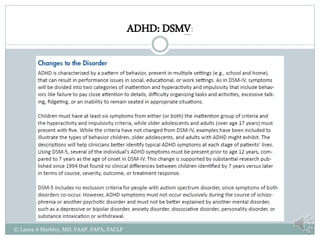
ADHD: DSMV:
© Laura A Markley, MD, FAAP, FAPA, FACLP
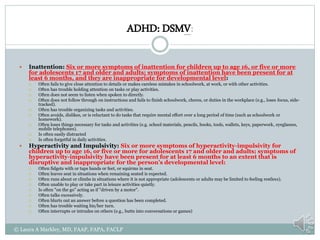
ADHD: DSMV:
 Inattention: Six or more symptoms of inattention for children up to age 16, or five or more
for adolescents 17 and older and adults; symptoms of inattention have been present for at
least 6 months, and they are inappropriate for developmental level:
 Often fails to give close attention to details or makes careless mistakes in schoolwork, at work, or with other activities.
 Often has trouble holding attention on tasks or play activities.
 Often does not seem to listen when spoken to directly.
 Often does not follow through on instructions and fails to finish schoolwork, chores, or duties in the workplace (e.g., loses focus, side-
tracked).
 Often has trouble organizing tasks and activities.
 Often avoids, dislikes, or is reluctant to do tasks that require mental effort over a long period of time (such as schoolwork or
homework).
 Often loses things necessary for tasks and activities (e.g. school materials, pencils, books, tools, wallets, keys, paperwork, eyeglasses,
mobile telephones).
 Is often easily distracted
 Is often forgetful in daily activities.
 Hyperactivity and Impulsivity: Six or more symptoms of hyperactivity-impulsivity for
children up to age 16, or five or more for adolescents 17 and older and adults; symptoms of
hyperactivity-impulsivity have been present for at least 6 months to an extent that is
disruptive and inappropriate for the person’s developmental level:
 Often fidgets with or taps hands or feet, or squirms in seat.
 Often leaves seat in situations when remaining seated is expected.
 Often runs about or climbs in situations where it is not appropriate (adolescents or adults may be limited to feeling restless).
 Often unable to play or take part in leisure activities quietly.
 Is often "on the go" acting as if "driven by a motor".
 Often talks excessively.
 Often blurts out an answer before a question has been completed.
 Often has trouble waiting his/her turn.
 Often interrupts or intrudes on others (e.g., butts into conversations or games)
© Laura A Markley, MD, FAAP, FAPA, FACLP
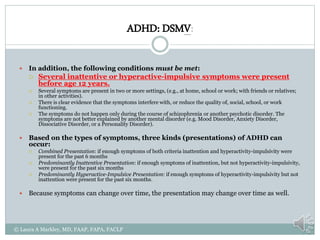
ADHD: DSMV:
 In addition, the following conditions must be met:
 Several inattentive or hyperactive-impulsive symptoms were present
before age 12 years.
 Several symptoms are present in two or more settings, (e.g., at home, school or work; with friends or relatives;
in other activities).
 There is clear evidence that the symptoms interfere with, or reduce the quality of, social, school, or work
functioning.
 The symptoms do not happen only during the course of schizophrenia or another psychotic disorder. The
symptoms are not better explained by another mental disorder (e.g. Mood Disorder, Anxiety Disorder,
Dissociative Disorder, or a Personality Disorder).
 Based on the types of symptoms, three kinds (presentations) of ADHD can
occur:
 Combined Presentation: if enough symptoms of both criteria inattention and hyperactivity-impulsivity were
present for the past 6 months
 Predominantly Inattentive Presentation: if enough symptoms of inattention, but not hyperactivity-impulsivity,
were present for the past six months
 Predominantly Hyperactive-Impulsive Presentation: if enough symptoms of hyperactivity-impulsivity but not
inattention were present for the past six months.
 Because symptoms can change over time, the presentation may change over time as well.
© Laura A Markley, MD, FAAP, FAPA, FACLP
ADHD:
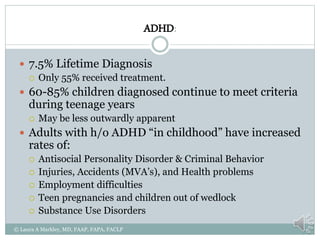
 7.5% Lifetime Diagnosis
 Only 55% received treatment.
 60-85% children diagnosed continue to meet criteria
during teenage years
 May be less outwardly apparent
 Adults with h/o ADHD “in childhood” have increased
rates of:
 Antisocial Personality Disorder & Criminal Behavior
 Injuries, Accidents (MVA’s), and Health problems
 Employment difficulties
 Teen pregnancies and children out of wedlock
 Substance Use Disorders
© Laura A Markley, MD, FAAP, FAPA, FACLP
ADHD Medications
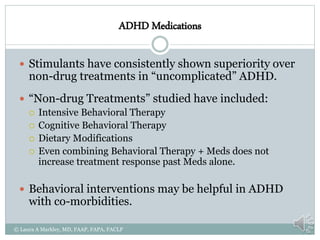
 Stimulants have consistently shown superiority over
non-drug treatments in “uncomplicated” ADHD.
 “Non-drug Treatments” studied have included:
 Intensive Behavioral Therapy
 Cognitive Behavioral Therapy
 Dietary Modifications
 Even combining Behavioral Therapy + Meds does not
increase treatment response past Meds alone.
 Behavioral interventions may be helpful in ADHD
with co-morbidities.
© Laura A Markley, MD, FAAP, FAPA, FACLP
ADHD Medications
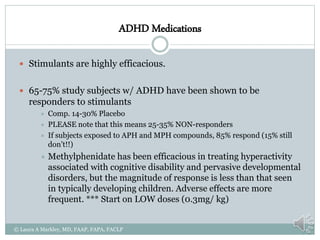
 Stimulants are highly efficacious.
 65-75% study subjects w/ ADHD have been shown to be
responders to stimulants
 Comp. 14-30% Placebo
 PLEASE note that this means 25-35% NON-responders
 If subjects exposed to APH and MPH compounds, 85% respond (15% still
don’t!!)
 Methylphenidate has been efficacious in treating hyperactivity
associated with cognitive disability and pervasive developmental
disorders, but the magnitude of response is less than that seen
in typically developing children. Adverse effects are more
frequent. *** Start on LOW doses (0.3mg/ kg)
© Laura A Markley, MD, FAAP, FAPA, FACLP
ADHD Medications
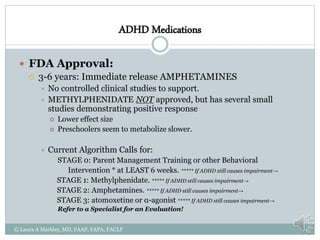
 FDA Approval:
 3-6 years: Immediate release AMPHETAMINES
 No controlled clinical studies to support.
 METHYLPHENIDATE NOT approved, but has several small
studies demonstrating positive response
 Lower effect size
 Preschoolers seem to metabolize slower.
 Current Algorithm Calls for:
STAGE 0: Parent Management Training or other Behavioral
Intervention * at LEAST 6 weeks. ***** If ADHD still causes impairment→
STAGE 1: Methylphenidate. ***** If ADHD still causes impairment→
STAGE 2: Amphetamines. ***** If ADHD still causes impairment→
STAGE 3: atomoxetine or α-agonist ***** If ADHD still causes impairment→
Refer to a Specialist for an Evaluation!
© Laura A Markley, MD, FAAP, FAPA, FACLP
ADHD Medications
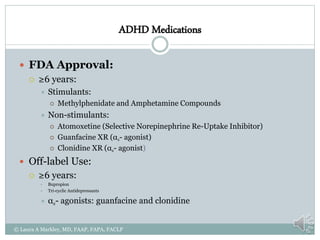
 FDA Approval:
 ≥6 years:
 Stimulants:
 Methylphenidate and Amphetamine Compounds
 Non-stimulants:
 Atomoxetine (Selective Norepinephrine Re-Uptake Inhibitor)
 Guanfacine XR (α2- agonist)
 Clonidine XR (α2- agonist)
 Off-label Use:
 ≥6 years:
 Bupropion
 Tri-cyclic Antidepressants
 α2- agonists: guanfacine and clonidine
© Laura A Markley, MD, FAAP, FAPA, FACLP
ADHD Medications
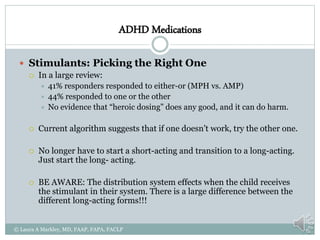
 Stimulants: Picking the Right One
 In a large review:
 41% responders responded to either-or (MPH vs. AMP)
 44% responded to one or the other
 No evidence that “heroic dosing” does any good, and it can do harm.
 Current algorithm suggests that if one doesn’t work, try the other one.
 No longer have to start a short-acting and transition to a long-acting.
Just start the long- acting.
 BE AWARE: The distribution system effects when the child receives
the stimulant in their system. There is a large difference between the
different long-acting forms!!!
© Laura A Markley, MD, FAAP, FAPA, FACLP
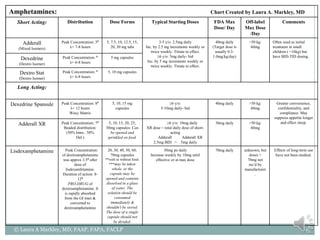
Amphetamines: Chart Created by Laura A. Markley, MD
Short Acting: Distribution Dose Forms Typical Starting Doses FDA Max
Dose/ Day
Off-label
Max Dose
/Day
Comments
Adderall
(Mixed Isomers)
Peak Concentration: 3º
λ= 7-8 hours
5, 7.5, 10, 12.5, 15,
20, 30 mg tabs
3-5 y/o: 2.5mg daily
Inc. by 2.5 mg increments weekly or
twice weekly. Titrate to effect.
≥6 y/o: 5mg daily- bid
Inc. by 5 mg increments weekly or
twice weekly. Titrate to effect.
40mg daily
(Target dose is
usually 0.3-
1.0mg/kg/day)
>50 kg:
60mg
Often used as initial
treatment in small
children ( <16kg) but
have BID-TID dosing.
Dexedrine
(Dextro Isomer)
Peak Concentration: º
λ= 6-8 hours
5 mg capsules
Dextro Stat
(Dextro Isomer)
Peak Concentration: º
λ= 6-8 hours
5, 10 mg capsules
Long Acting:
Dexedrine Spansule Peak Concentration: 8º
λ= 12 hours
Waxy Matrix
5, 10, 15 mg
capsules
≥6 y/o:
5-10mg daily- bid
40mg daily >50 kg:
60mg
Greater convenience,
confidentiality, and
compliance. May
suppress appetite longer
and effect sleep.
Adderall XR Peak Concentration: 7º
Beaded distribution:
(50% Imm.: 50%
Del.)
5, 10, 15, 20, 25,
30mg capsules: Can
be opened and
sprinkled on food.
≥6 y/o: 10mg daily
XR dose = total daily dose of short-
acting
Adderall Adderall XR
2.5mg BID = 5mg daily
30mg daily >50 kg:
60mg
Lisdexamphetamine Peak Concentration:
of dextroamphetamine
was approx 3.5º after
dose of
lisdexamfetamine.
Duration of action: 8-
12º
PRO-DRUG of
dextroamphetamine. It
is rapidly absorbed
from the GI tract &
converted to
dextroamphetamine
20, 30, 40, 50, 60,
70mg capsules
**with or without food.
***may be taken
whole, or the
capsule may be
opened and contents
dissolved in a glass
of water. The
solution should be
consumed
immediately &
shouldn’t be stored.
The dose of a single
capsule should not
be divided.
30mg po daily
Increase weekly by 10mg until
effective or at max dose
70mg daily unknown, but
doses >
70mg not
rec’d by
manufacturer
.
Effects of long-term use
have not been studied.
© Laura A Markley, MD, FAAP, FAPA, FACLP
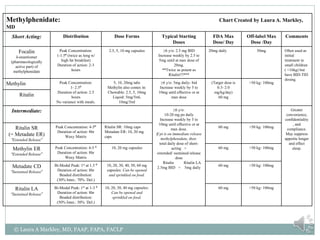
Methylphenidate: Chart Created by Laura A. Markley,
MD
Short Acting: Distribution Dose Forms Typical Starting
Doses
FDA Max
Dose/ Day
Off-label Max
Dose /Day
Comments
Focalin
δ-enantiomer
(pharmacologically
active part) of
methylphenidate
Peak Concentration:
1-1.5º (twice as long w/
high fat breakfast)
Duration of action: 2-3
hours
2.5, 5, 10 mg capsules ≥6 y/o: 2.5 mg BID
Increase weekly by 2.5 to
5mg until at max dose of
20mg.
**Twice as potent as
Ritalin!!!***
20mg daily 50mg Often used as
initial
treatment in
small children
( <16kg) but
have BID-TID
dosing.
Methylin Peak Concentration:
1- 2.5º
Duration of action: 2.5
hours
No variance with meals.
5, 10, 20mg tabs
Methylin also comes in:
Chewable: 2.5, 5, 10mg
Liquid: 5mg/5ml,
10mg/5ml
≥6 y/o: 5mg daily- bid
Increase weekly by 5 to
10mg until effective or at
max dose
(Target dose is
0.3- 2.0
mg/kg/day)
60 mg
>50 kg: 100mg
Ritalin
Intermediate: ≥6 y/o:
10-20 mg po daily
Increase weekly by 5 to
10mg until effective or at
max dose.
If pt is on immediate release
methylphenidate, then:
total daily dose of short-
acting =
extended/ sustained release
dose
Ritalin Ritalin LA
2.5mg BID = 5mg daily
Greater
convenience,
confidentiality
, and
compliance.
May suppress
appetite longer
and effect
sleep.
Ritalin SR
(= Metadate ER)
“Extended Release”
Peak Concentration: 4-5º
Duration of action: 8hr
Waxy Matrix
Ritalin SR: 10mg caps
Metadate ER: 10, 20 mg
caps
60 mg >50 kg: 100mg
Methylin ER
“Extended Release”
Peak Concentration: 4-5 º
Duration of action: 8hr
Waxy Matrix
10, 20 mg capsules 60 mg >50 kg: 100mg
Metadate CD
“Sustained Release”
Bi-Modal Peak: 1st at 1.5 º
Duration of action: 8hr
Beaded distribution:
(30% Imm.: 70% Del.)
10, 20, 30, 40, 50, 60 mg
capsules: Can be opened
and sprinkled on food.
60 mg >50 kg: 100mg
Ritalin LA
“Sustained Release”
Bi-Modal Peak: 1st at 1-3 º
Duration of action: 8hr
Beaded distribution:
(50% Imm.: 50% Del.)
10, 20, 30, 40 mg capsules:
Can be opened and
sprinkled on food.
60 mg >50 kg: 100mg
© Laura A Markley, MD, FAAP, FAPA, FACLP
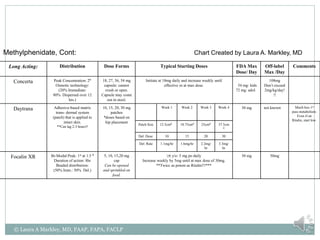
Long Acting: Distribution Dose Forms Typical Starting Doses FDA Max
Dose/ Day
Off-label
Max /Day
Comments
Concerta Peak Concentration: 2º
Osmotic technology:
(20% Immediate:
80% Dispersed over 12
hrs.)
18, 27, 36, 54 mg
capsule: cannot
crush or open.
Capsule may come
out in stool.
Initiate at 18mg daily and increase weekly until
effective or at max dose. 54 mg: kids
72 mg: adol.
108mg
Don’t exceed
2mg/kg/day!
!!
Daytrana Adhesive-based matrix
trans- dermal system
(patch) that is applied to
intact skin.
**Can lag 2-3 hours!!
10, 15, 20, 30 mg
patches
*doses based on
hip placement
Week 1 Week 2 Week 3 Week 4 30 mg not known Much less 1st
pass metabolism.
Even if on
Ritalin, start low.
Patch Size 12.5cm² 18.75cm² 25cm² 37.5cm
²
Del. Dose 10 15 20 30
Del. Rate 1.1mg/hr 1.6mg/hr 2.2mg/
hr
3.3mg/
hr
Focalin XR Bi-Modal Peak: 1st at 1.5 º
Duration of action: 8hr
Beaded distribution:
(50% Imm.: 50% Del.)
5, 10, 15,20 mg
cap
Can be opened
and sprinkled on
food.
≥6 y/o: 5 mg po daily
Increase weekly by 5mg until at max dose of 30mg.
**Twice as potent as Ritalin!!!***
30 mg 50mg
Methylphenidate, Cont: Chart Created by Laura A. Markley, MD
© Laura A Markley, MD, FAAP, FAPA, FACLP
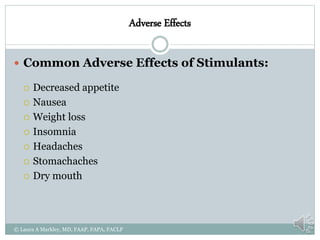
Adverse Effects
 Common Adverse Effects of Stimulants:
 Decreased appetite
 Nausea
 Weight loss
 Insomnia
 Headaches
 Stomachaches
 Dry mouth
© Laura A Markley, MD, FAAP, FAPA, FACLP
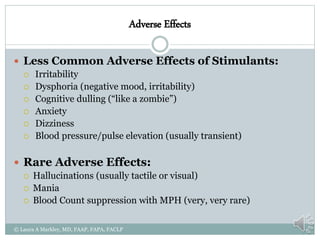
Adverse Effects
 Less Common Adverse Effects of Stimulants:
 Irritability
 Dysphoria (negative mood, irritability)
 Cognitive dulling (“like a zombie”)
 Anxiety
 Dizziness
 Blood pressure/pulse elevation (usually transient)
 Rare Adverse Effects:
 Hallucinations (usually tactile or visual)
 Mania
 Blood Count suppression with MPH (very, very rare)
© Laura A Markley, MD, FAAP, FAPA, FACLP
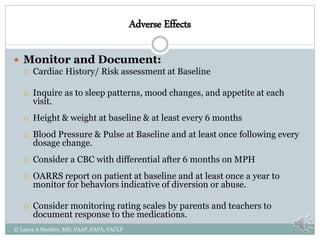
Adverse Effects
 Monitor and Document:
 Cardiac History/ Risk assessment at Baseline
 Inquire as to sleep patterns, mood changes, and appetite at each
visit.
 Height & weight at baseline & at least every 6 months
 Blood Pressure & Pulse at Baseline and at least once following every
dosage change.
 Consider a CBC with differential after 6 months on MPH
 OARRS report on patient at baseline and at least once a year to
monitor for behaviors indicative of diversion or abuse.
 Consider monitoring rating scales by parents and teachers to
document response to the medications.
© Laura A Markley, MD, FAAP, FAPA, FACLP
Adverse Effects
 Stimulants, continued:
 Appetite decrease/ decreased growth.
 Monitor height & weight. If patient crosses two percentile lines, consider a
medication “holiday” during school breaks.
 Loss of adult height potential is controversial
 Cyproheptadine may improve appetite.
 Insomnia
 Consider trying another stimulant- remember distribution!!
 Melatonin 3mg, trazodone, clonidine, or antihistamine.
 Tics
 Controversial. Current stand is that stimulants have no effect. If on
a stimulant and tics arise, consider adding an α2- agonist if child is
negatively affected.
© Laura A Markley, MD, FAAP, FAPA, FACLP
Adverse Effects
 Stimulants, continued:
 Sudden Cardiac Death
 Despite FDA warning, actually LESS instances of sudden death than the general
pediatric population.
 Current Recommendation: Take a thorough individual and family cardiac
history and perform a thorough physical exam. If concerns arise- refer to a
cardiologist for consultation. No EKG.
© Laura A Markley, MD, FAAP, FAPA, FACLP
Other ADHD Medications
 Non-Stimulants:
 Atomoxetine:
 Selective norepinephrine reuptake inhibitor.
 Superior to placebo in studies of children, adolescents, and adults with
ADHD.
 Recent study in Germany showed improvement in co-morbid ADHD and
ODD symptoms.
 Less effects on appetite and sleep, but can cause more nausea and sedation.
 Requires up to THREE MONTHS for effect
 Consider as an alternative to Stimulant + SSRI in patients with ADHD and
anxiety.
 Can be an alternative to stimulants in Substance-Abuse Disorders.
© Laura A Markley, MD, FAAP, FAPA, FACLP
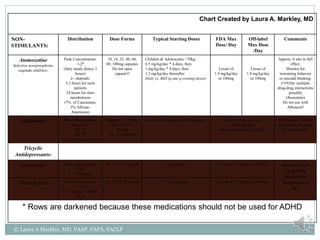
Chart Created by Laura A. Markley, MD
NON-
STIMULANTS:
Distribution Dose Forms Typical Starting Doses FDA Max
Dose/ Day
Off-label
Max Dose
/Day
Comments
Atomoxetine
Selective norepinephrine
reuptake inhibitor.
Peak Concentration:
1-2º
(fatty meals delays 3
hours)
λ= depends:
5.2 hours for most
patients
24 hours for slow
metabolizers
(7% of Caucasians,
2% African-
Americans)
10, 18, 25, 40, 60,
80, 100mg capsules
Do not open
capsule!!
Children & Adolescents <70kg:
0.5 mg/kg/day * 4 days, then
1 mg/kg/day * 4 days, then
1.2 mg/kg/day thereafter
Daily vs. BID (q am/ q evening doses)
Lesser of
1.4 mg/kg/day
or 100mg
Lesser of
1.8 mg/kg/day
or 100mg
Approx. 6 wks to full
effect.
Monitor for
worsening behavior
or suicidal thinking.
CYP2D6: multiple
drug-drug interactions
possible
(fluoxetine)
Do not use with
Albuterol!
Wellbutrin Peak Concentration:
Regular:2º
SR: 3º
XL: 5º
λ= 21 ± 9 hours (elim)
Regular: 75, 100mg
SR: 100, 150,
200mg
XL 150, 300mg
Lesser of 3mg/kg/day or 150mg/day. Lesser of 6mg /kg/ day
or 300mg/ day,
with no single dose > 150mg
BID for kids, TID for
adolescents for safety
& effectiveness
Tricyclic
Antidepressants:
Imipramine Peak Concentration:
2-5º
λ= 9-20 hours
10, 25, 50, 75mg tab 1 mg/kg/day Lesser of 4 mg/day or 200mg Baseline EKG
Drug-drug
interactions.
Dangerous in
OD.
Nortriptyline Peak Concentration:
7- 8.5º
λ= “between 16 & 90”
hours
10, 25, 50, 75mg tab 0.5 mg/kg/day Lesser of 2 mg/day or 100mg
* Rows are darkened because these medications should not be used for ADHD
© Laura A Markley, MD, FAAP, FAPA, FACLP
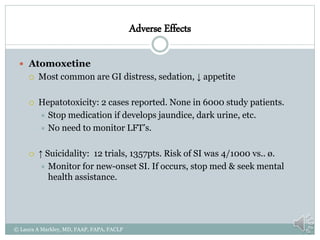
Adverse Effects
 Atomoxetine
 Most common are GI distress, sedation, ↓ appetite
 Hepatotoxicity: 2 cases reported. None in 6000 study patients.
 Stop medication if develops jaundice, dark urine, etc.
 No need to monitor LFT’s.
 ↑ Suicidality: 12 trials, 1357pts. Risk of SI was 4/1000 vs.. ø.
 Monitor for new-onset SI. If occurs, stop med & seek mental
health assistance.
© Laura A Markley, MD, FAAP, FAPA, FACLP
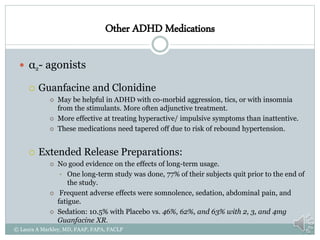
Other ADHD Medications
 α2- agonists
 Guanfacine and Clonidine
 May be helpful in ADHD with co-morbid aggression, tics, or with insomnia
from the stimulants. More often adjunctive treatment.
 More effective at treating hyperactive/ impulsive symptoms than inattentive.
 These medications need tapered off due to risk of rebound hypertension.
 Extended Release Preparations:
 No good evidence on the effects of long-term usage.
• One long-term study was done, 77% of their subjects quit prior to the end of
the study.
 Frequent adverse effects were somnolence, sedation, abdominal pain, and
fatigue.
 Sedation: 10.5% with Placebo vs. 46%, 62%, and 63% with 2, 3, and 4mg
Guanfacine XR.
© Laura A Markley, MD, FAAP, FAPA, FACLP
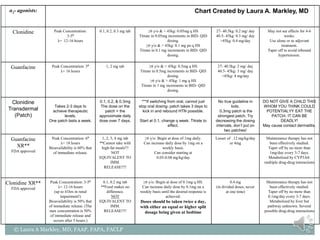
α2- agonists: Chart Created by Laura A. Markley, MD
Clonidine Peak Concentration:
3-5º
λ= 12-16 hours
0.1, 0.2, 0.3 mg tab ≥6 y/o & < 45kg: 0.05mg q HS
Titrate in 0.05mg increments in BID- QID
dosing.
≥6 y/o & > 45kg: 0.1 mg po q HS
Titrate in 0.1 mg increments in BID- QID
dosing.
27- 40.5kg: 0.2 mg/ day
40.5- 45kg: 0.3 mg/ day
>45kg: 0.4 mg/day
May not see effects for 4-6
weeks.
Use alone or as adjuvant
treatment.
Taper off to avoid rebound
hypertension.
Guanfacine Peak Concentration: 3º
λ= 16 hours
1, 2 mg tab ≥6 y/o & < 45kg: 0.5mg q HS
Titrate in 0.5mg increments in BID- QID
dosing.
≥6 y/o & > 45kg: 1 mg q HS
Titrate in 1 mg increments in BID- QID
dosing.
27- 40.5kg: 2 mg/ day
40.5- 45kg: 3 mg/ day
>45kg: 4 mg/day
Clonidine
Transdermal
(Patch)
Takes 2-3 days to
achieve therapeutic
levels.
One patch lasts a week.
0.1, 0.2, & 0.3mg
The dose on the
patch = the
approximate daily
dose over 7 days.
***If switching from oral, cannot just
stop oral dosing- patch takes 3 days to
kick in and rebound HTN possible.
Start at 0.1, change q week. Titrate to
effect.
No true guideline in
kids.
0.3mg patch is the
strongest patch. Try
decreasing the dosing
intervals, don’t put on
two patches!
DO NOT GIVE A CHILD THIS
WHOM YOU THINK COULD
POTENTIALYY EAT THE
PATCH- IT CAN BE
DEADLY!
May cause contact dermatitis.
Guanfacine
XR**
FDA approved
Peak Concentration: 6º
λ= 18 hours
Bioavailability is 60% that
of immediate release.
1, 2, 3, 4 mg tab
**Cannot take with
high-fat meals!!!
NOT
EQUIVALENT TO
IMM.
RELEASE!!!!
≥6 y/o: Begin at dose of 1mg daily.
Can increase daily dose by 1mg on a
weekly basis.
Can consider starting at
0.05-0.08 mg/kg/day
Lesser of .12 mg/kg/day
or 4mg
Maintenance therapy has not
been effectively studied.
Taper off by no more than
1mg/day every 3-7 days.
Metabolized by CYP3A4:
multiple drug-drug interactions
Clonidine XR**
FDA approved
Peak Concentration: 3-5º
λ= 12-16 hours
(up to 41hrs in renal
impairment!)
Bioavailability is 50% that
of immediate release. (The
max concentration is 50%
of immediate release and
occurs after 5 hours.)
0.1, 0.2 mg tab
**Food makes no
difference.
NOT
EQUIVALENT TO
IMM.
RELEASE!!!!
≥6 y/o: Begin at dose of 0.1mg q HS.
Can increase daily dose by 0.1mg on a
weekly basis until the desired response is
achieved.
Doses should be taken twice a day,
with either an equal or higher split
dosage being given at bedtime
0.4 mg
(in divided doses, never
at one time)
Maintenance therapy has not
been effectively studied.
Taper off by no more than
0.1mg/day every 3-7 days.
Metabolized by liver but
pathway unknown. Several
possible drug-drug interactions
© Laura A Markley, MD, FAAP, FAPA, FACLP
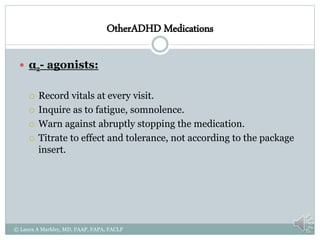
OtherADHD Medications
 α2- agonists:
 Record vitals at every visit.
 Inquire as to fatigue, somnolence.
 Warn against abruptly stopping the medication.
 Titrate to effect and tolerance, not according to the package
insert.
© Laura A Markley, MD, FAAP, FAPA, FACLP
T H A N K Y O U F O R Y O U R A T T E N T I O N !
Any Questions?
© Laura A Markley, MD, FAAP, FAPA, FACLP
Sources:
 American Academy of Child and Adolescent Psychiatry. “Practice Parameter for the Assessment and Treatment of Children and Adolescents with Attention-Deficit/Hyperactivity
Disorder. “Journal of the American Academy of Child and Adolescent Psychiatry. 2007; 46(7): 894-921.

 American Academy of Child and Adolescent Psychiatry. Practice parameter for the assessment and treatment of children and adolescents with depressive disorders. Journal of the
American Academy of Child and Adolescent Psychiatry. 2007;46(11):1503-1526.

 American Academy of Child and Adolescent Psychiatry. “Practice Parameter for the Use of Psychotropic Medication in Children and Adolescents.” Journal of the American Academy of
Child and Adolescent Psychiatry. 2009; 48(9): 961-973.

 American Psychiatric Association. Diagnostic and Statistical Manual of Mental Disorders, 4th edition, Text Revision (DSM-IV-TR). Washington, DC: American Psychiatric Association;
2000.

 [An update on depression in children and adolescents]. Journal of Clinical Psychiatry. 2008;66(11):1818-1828.

 Baer, Daniel. “Psychopharmacology Update.” 4th Ann. Development, Behavior and Emotions: Enhancing Care in the Medical Home. 4/8/10

 Bloch, Michael H., M.D., et. al., “Meta-Analysis: Treatment of Attention-Deficit/ Hyperactivity Disorder in Children with Comorbid Tic Disorders.” Journal of the American Academy of
Child and Adolescent Psychiatry. 2009; 48(9): 884-893.

 Boyer, et al. “Anticholinergic prophylaxis of acute haloperidol-induced acute dystonic reactions.” J Clin Psychopharmacol. 1987 Jun;7(3):164-6.

 Caccia, Silvio. “Safety and Pharmacokinetics of Atypical Antipsychotics in Children and Adolescents” Pediatr Drugs (2013) 15:217–233

 Callor, WB1, et al. “Preliminary findings of noncompliance with psychotropic medication and prevalence of methamphetamine intoxication associated with suicide completion.” Crisis.
2005;26(2):78-84.

 Clonidine hydrochloride [Highlights of Prescribing Information]. Boehringer Ingelheim Pharmaceuticals, Inc., Ridgefield, CT; October 2009.

 Daytrana™ (methylphenidate transdermal system) [Highlights of Prescribing Information]. Shire US Inc., Wayne, PA; December 2009.

 Dittman, et al. “Atomoxetine versus placebo in children and adolescents with attention-deficit/hyperactivity disorder and co-morbid oppositional defiant disorder: a double-blind,
randomized, multicenter trial in Germany. J Child Adolesc Psychopharmacol. 2011 Apr;21(2):97-110. Epub 2011 Apr 13.

 Emslie G, Kratochvil C, Vitiello B, Silva S, Mayes T, McNulty S, Weller E, Waslick B, Casat C, Walkup J, Pathak S, Rohde P, Posner K, March J. Treatment of adolescents with depression
study (TADS): Safety results. Journal of the American Academy of Child and Adolescent Psychiatry. 2006;45(12):1440-1455.

 Emslie GJ, Rush AJ, Weinberg WA, Kowatch RA, Hughes CW, Carmody T, Rintelmann J. A double-blind, randomized, placebo-controlled study of fluoxetine in depressed children and
adolescents. Archives of General Psychiatry. 1997;54:1031-1037.

 Emslie GJ, Ryan ND, Wagner KD. Journal of Clinical Psychiatry. 2005;66(Suppl 7):14-20.
© Laura A Markley, MD, FAAP, FAPA, FACLP
Sources:
 Gibbons RD, Hur K, Bhaumik DK, Mann JJ. The relationship between antidepressant medication use and rate of suicide. Archives of General Psychiatry. 2005;62:165-172.

 Faraone, Stephen, PhD; Biederman, Joseph, M.D, et. al. “Effects of Stimulants on Height and Weight: A Review of the Literature.” Journal of the American Academy of Child and Adolescent
Psychiatry. 2008; 47(9): 994-1009.

 Fluoxetine [FULL PRESCRIBING INFORMATION]. Edgemont Pharmaceuticals, LLC Austin, TX 78731; October 2011.

 FOCALIN XR (dexmethylphenidate hydrochloride) [Highlights of Prescribing Information]. Novartis Pharmaceuticals Corporation, East Hanover, New Jersey; October 2009.

 Gleason, Mary Margaret, M.D., et. al. “Psychopharmacological Treatment for Very Young Children: Contexts and Guidelines.” Journal of the American Academy of Child and Adolescent
Psychiatry. 2007; 46(12): 1532-1546.

 Green, Wayne Hugo. Child & Adolescent Clinical Psychopharmacology, 4th Ed. Philadelphia, Lippincott Williams & Wilkins, 2007.

 Hammad TA, Laughren, T, Racoosin, J. Suicidality in pediatric patients treated with antidepressant drugs. Archives of General Psychiatry. 2006;63:332-339.

 Hilt, RJ. “Monitoring psychiatric medications in children” Pediatric Ann. 2012 Apr;41(4):157-63

 Imipramine HCl Oral [Highlights of Prescribing Information]. Mallinckrodt Inc. Hazelwood, MO; August 2007.

 INTUNIV™ (guanfacine) [Highlights of Prescribing Information]. Shire US Inc., Wayne, PA; August 2009.

 Jain, R., et al, Clonidine extended-release tablets for pediatric patients with attention-deficit/hyperactivity disorder. Am Acad Child Adolesc Psychiatry. 2011 Feb;50(2):171-9

 Jain, R., et al. “Clonidine Extended-Release Tablets as Add-on Therapy to Psychostimulants in Children and Adolescents With ADHD.” PEDIATRICS Volume 127, Number 6, June 2011

 Kapvay® (clonidine hydrochloride) [Highlights of Prescribing Information] Shionogi Pharma, Inc., Atlanta, GA 30328; September, 2010.

 Kratochchvil, Christopher J., M.D. “ADHD: Evidence-Based Treatments and Clinical Challenges.” AACAP 2009 Annual Meeting.
 Kratochvil C, Emslie G, Silva S, McNulty S, Walkup J, Curry J, Reinecke M, Vitiello B, Rohde P, Feeny N, Casat C, Pathak S, Weller E, May D, Mayes T, Robins M, March J. Acute time to
response in the Treatment for Adolescents With Depression Study (TADS). Journal of the American Academy of Child and Adolescent Psychiatry. 2006;45:1412-1418.
 Libby AM, Brent DA, Morrato EH, Orton HD, Allen R, Valuck RJ. Decline in treatment of pediatric depression after FDA advisory on risk of suicidality with SSRIs. American Journal of
Psychiatry. 2007;164(6):884-91.
 Libby AM, Orton HD, Valuck RJ. Persisting decline in depression treatment after FDA warnings. Archives of General Psychiatry. 2009;66(6):633-9.
 Marwick, et al. “Antipsychotics and abnormal liver function tests: systematic review.” Clin Neuropharmacol. 2012 Sep-Oct; 35(5):244-53.
© Laura A Markley, MD, FAAP, FAPA, FACLP
Sources:
 Metadate CD® (methylphenidate HCl, USP) [Highlights of Prescribing Information]. UCB, Inc., Smyrna, GA; February, 2007.
 Olfson M, Shaffer D, Marcus SC, Greenberg T. Relationship between antidepressant medication treatment and suicide in adolescents. Archives of General Psychiatry. 2003;60:978-982.
 Pamelor® (nortriptyline HCl) [Highlights of Prescribing Information]. Novartis Consumer Health, Inc., Lincoln, Nebraska; July 2006.
 Perrin, J.M.; Friedman, Richard A.; Knilans, Timothy K., the Black Box Warning Group, and the Section on Cardiology and Cardiac Surgery. “Cardiovascular Monitoring and Stimulant Drugs
for Attention-Deficit/Hyperactivity Disorder.” Pediatrics. 2008; 122 (2): 451-453.
 Pliszka, Stephen, M.D., and the CMAP (Children’s Medication Algorithm Project. “CMAP: Attention-Deficit/Hyperactivity DisorderAlgorithms.”
http://www.dshs.state.tx.us/mhprograms/adhdpage.shtm. Last updated 2006
 Research Units on Pediatric Psychopharmacology (RUPP) Autism Network. “Randomized, Controlled, Crossover Trial of Methylphenidate in Pervasive Developmental disorders with
hyperactivity.” Arch Gen Psychiatry. 2005; 62: 1266-1274.
 Ritalin LA® (methylphenidate hydrochloride) [Highlights of Prescribing Information]. Novartis Pharmaceuticals Corporation, East Hanover, New Jersey; April 2009.
 Ryan ND. Treatment of depression in children and adolescents. Lancet. 2005;366:933-940.
 Sallee, Floyd R., M.D., et. al., “Long Term Safety and Efficacy of Guanfacine Extended Release in Children and Adolescents with Attention-Deficit/ Hyperactivity Disorder.” Journal of Child
and Adolescent Psychopharmacology. 2009; 19(3): 215-226.
 Strattera [Highlights of Prescribing Information]. Shire US Inc., Wayne, PA; August 2009.
 TADS. Fluoxetine, cognitive-behavioral therapy, and their combination for adolescents with depression: Treatment for Adolescents With Depression Study (TADS) randomized controlled
trial. JAMA 2004;292:807-820
 Tsapakis, EM, Soldani, F, Tondo, L, Baldessarini, RJ. Efficacy of antidepressants in juvenile depression: meta-analysis. The British Journal of Psychiatry. 2008;193:10-17.
 Vyvanse® (lisdexamfetamine dimesylate) [Highlights of Prescribing Information]. Shire US Inc., Wayne, PA; December 2009.
 Waknine,Yael. “FDA Approves Extended-Release Clonidine for Pediatric ADHD.” Medscape Medical News © 2010 WebMD, LLC
 Wellbutrin [Highlights of Prescribing Information]. GlaxoSmithKline, Research Triangle Park, NC; July 2009.
 Wellbutrin SR [Highlights of Prescribing Information]. GlaxoSmithKline, Research Triangle Park, NC; July 2009.
 Wellbutrin XL [Highlights of Prescribing Information]. GlaxoSmithKline, Research Triangle Park, NC; December 2008.
 Wiet, Susan, et. al.. Psychopharmacology Reference Table. Property of University of Utah Behavioral Health Clinic. Updated August 2008.
© Laura A Markley, MD, FAAP, FAPA, FACLP

ADHD - Presenter:  Michael Redovian, MD

  • 1.
    LAURA A. MARKLEY,MD T R I P L E B O A R D - C E R T I F I E D : P E D I A T R I C S / G E N E R A L P S Y C H I A T R Y / C H I L D & A D O L E S C E N T P S Y C H I A T R Y ; M E D I C A L D I R E C T O R O F C / L P S Y C H I A T R Y , A K R O N C H I L D R E N ’ S H O S P I T A L ; A S S O C I A T E C L I N I C A L P R O F E S S O R O F P E D I A T R I C S & A S S O C I A T E P R O F E S S O R O F P S Y C H I A T R Y , N E O M E D M I C H A E L G . R E D O V I A N , M D B O A R D - C E R T I F I E D C H I L D & A D O L E S C E N T P S Y C H I A T R I S T O U T P A T I E N T / P H P P S Y C H I A T R I S T , A K R O N C H I L D R E N ’ S H O S P I T A L A S S O C I A T E C L I N I C A L P R O F E S S O R O F P S Y C H I A T R Y , N E O M E D ADHD © Laura A Markley, MD, FAAP, FAPA, FACLP
  • 2.
    ADHD: DSMV: © LauraA Markley, MD, FAAP, FAPA, FACLP
  • 3.
    ADHD: DSMV:  Inattention:Six or more symptoms of inattention for children up to age 16, or five or more for adolescents 17 and older and adults; symptoms of inattention have been present for at least 6 months, and they are inappropriate for developmental level:  Often fails to give close attention to details or makes careless mistakes in schoolwork, at work, or with other activities.  Often has trouble holding attention on tasks or play activities.  Often does not seem to listen when spoken to directly.  Often does not follow through on instructions and fails to finish schoolwork, chores, or duties in the workplace (e.g., loses focus, side- tracked).  Often has trouble organizing tasks and activities.  Often avoids, dislikes, or is reluctant to do tasks that require mental effort over a long period of time (such as schoolwork or homework).  Often loses things necessary for tasks and activities (e.g. school materials, pencils, books, tools, wallets, keys, paperwork, eyeglasses, mobile telephones).  Is often easily distracted  Is often forgetful in daily activities.  Hyperactivity and Impulsivity: Six or more symptoms of hyperactivity-impulsivity for children up to age 16, or five or more for adolescents 17 and older and adults; symptoms of hyperactivity-impulsivity have been present for at least 6 months to an extent that is disruptive and inappropriate for the person’s developmental level:  Often fidgets with or taps hands or feet, or squirms in seat.  Often leaves seat in situations when remaining seated is expected.  Often runs about or climbs in situations where it is not appropriate (adolescents or adults may be limited to feeling restless).  Often unable to play or take part in leisure activities quietly.  Is often "on the go" acting as if "driven by a motor".  Often talks excessively.  Often blurts out an answer before a question has been completed.  Often has trouble waiting his/her turn.  Often interrupts or intrudes on others (e.g., butts into conversations or games) © Laura A Markley, MD, FAAP, FAPA, FACLP
  • 4.
    ADHD: DSMV:  Inaddition, the following conditions must be met:  Several inattentive or hyperactive-impulsive symptoms were present before age 12 years.  Several symptoms are present in two or more settings, (e.g., at home, school or work; with friends or relatives; in other activities).  There is clear evidence that the symptoms interfere with, or reduce the quality of, social, school, or work functioning.  The symptoms do not happen only during the course of schizophrenia or another psychotic disorder. The symptoms are not better explained by another mental disorder (e.g. Mood Disorder, Anxiety Disorder, Dissociative Disorder, or a Personality Disorder).  Based on the types of symptoms, three kinds (presentations) of ADHD can occur:  Combined Presentation: if enough symptoms of both criteria inattention and hyperactivity-impulsivity were present for the past 6 months  Predominantly Inattentive Presentation: if enough symptoms of inattention, but not hyperactivity-impulsivity, were present for the past six months  Predominantly Hyperactive-Impulsive Presentation: if enough symptoms of hyperactivity-impulsivity but not inattention were present for the past six months.  Because symptoms can change over time, the presentation may change over time as well. © Laura A Markley, MD, FAAP, FAPA, FACLP
  • 5.
    ADHD:  7.5% LifetimeDiagnosis  Only 55% received treatment.  60-85% children diagnosed continue to meet criteria during teenage years  May be less outwardly apparent  Adults with h/o ADHD “in childhood” have increased rates of:  Antisocial Personality Disorder & Criminal Behavior  Injuries, Accidents (MVA’s), and Health problems  Employment difficulties  Teen pregnancies and children out of wedlock  Substance Use Disorders © Laura A Markley, MD, FAAP, FAPA, FACLP
  • 6.
    ADHD Medications  Stimulantshave consistently shown superiority over non-drug treatments in “uncomplicated” ADHD.  “Non-drug Treatments” studied have included:  Intensive Behavioral Therapy  Cognitive Behavioral Therapy  Dietary Modifications  Even combining Behavioral Therapy + Meds does not increase treatment response past Meds alone.  Behavioral interventions may be helpful in ADHD with co-morbidities. © Laura A Markley, MD, FAAP, FAPA, FACLP
  • 7.
    ADHD Medications  Stimulantsare highly efficacious.  65-75% study subjects w/ ADHD have been shown to be responders to stimulants  Comp. 14-30% Placebo  PLEASE note that this means 25-35% NON-responders  If subjects exposed to APH and MPH compounds, 85% respond (15% still don’t!!)  Methylphenidate has been efficacious in treating hyperactivity associated with cognitive disability and pervasive developmental disorders, but the magnitude of response is less than that seen in typically developing children. Adverse effects are more frequent. *** Start on LOW doses (0.3mg/ kg) © Laura A Markley, MD, FAAP, FAPA, FACLP
  • 8.
    ADHD Medications  FDAApproval:  3-6 years: Immediate release AMPHETAMINES  No controlled clinical studies to support.  METHYLPHENIDATE NOT approved, but has several small studies demonstrating positive response  Lower effect size  Preschoolers seem to metabolize slower.  Current Algorithm Calls for: STAGE 0: Parent Management Training or other Behavioral Intervention * at LEAST 6 weeks. ***** If ADHD still causes impairment→ STAGE 1: Methylphenidate. ***** If ADHD still causes impairment→ STAGE 2: Amphetamines. ***** If ADHD still causes impairment→ STAGE 3: atomoxetine or α-agonist ***** If ADHD still causes impairment→ Refer to a Specialist for an Evaluation! © Laura A Markley, MD, FAAP, FAPA, FACLP
  • 9.
    ADHD Medications  FDAApproval:  ≥6 years:  Stimulants:  Methylphenidate and Amphetamine Compounds  Non-stimulants:  Atomoxetine (Selective Norepinephrine Re-Uptake Inhibitor)  Guanfacine XR (α2- agonist)  Clonidine XR (α2- agonist)  Off-label Use:  ≥6 years:  Bupropion  Tri-cyclic Antidepressants  α2- agonists: guanfacine and clonidine © Laura A Markley, MD, FAAP, FAPA, FACLP
  • 10.
    ADHD Medications  Stimulants:Picking the Right One  In a large review:  41% responders responded to either-or (MPH vs. AMP)  44% responded to one or the other  No evidence that “heroic dosing” does any good, and it can do harm.  Current algorithm suggests that if one doesn’t work, try the other one.  No longer have to start a short-acting and transition to a long-acting. Just start the long- acting.  BE AWARE: The distribution system effects when the child receives the stimulant in their system. There is a large difference between the different long-acting forms!!! © Laura A Markley, MD, FAAP, FAPA, FACLP
  • 11.
    Amphetamines: Chart Createdby Laura A. Markley, MD Short Acting: Distribution Dose Forms Typical Starting Doses FDA Max Dose/ Day Off-label Max Dose /Day Comments Adderall (Mixed Isomers) Peak Concentration: 3º λ= 7-8 hours 5, 7.5, 10, 12.5, 15, 20, 30 mg tabs 3-5 y/o: 2.5mg daily Inc. by 2.5 mg increments weekly or twice weekly. Titrate to effect. ≥6 y/o: 5mg daily- bid Inc. by 5 mg increments weekly or twice weekly. Titrate to effect. 40mg daily (Target dose is usually 0.3- 1.0mg/kg/day) >50 kg: 60mg Often used as initial treatment in small children ( <16kg) but have BID-TID dosing. Dexedrine (Dextro Isomer) Peak Concentration: º λ= 6-8 hours 5 mg capsules Dextro Stat (Dextro Isomer) Peak Concentration: º λ= 6-8 hours 5, 10 mg capsules Long Acting: Dexedrine Spansule Peak Concentration: 8º λ= 12 hours Waxy Matrix 5, 10, 15 mg capsules ≥6 y/o: 5-10mg daily- bid 40mg daily >50 kg: 60mg Greater convenience, confidentiality, and compliance. May suppress appetite longer and effect sleep. Adderall XR Peak Concentration: 7º Beaded distribution: (50% Imm.: 50% Del.) 5, 10, 15, 20, 25, 30mg capsules: Can be opened and sprinkled on food. ≥6 y/o: 10mg daily XR dose = total daily dose of short- acting Adderall Adderall XR 2.5mg BID = 5mg daily 30mg daily >50 kg: 60mg Lisdexamphetamine Peak Concentration: of dextroamphetamine was approx 3.5º after dose of lisdexamfetamine. Duration of action: 8- 12º PRO-DRUG of dextroamphetamine. It is rapidly absorbed from the GI tract & converted to dextroamphetamine 20, 30, 40, 50, 60, 70mg capsules **with or without food. ***may be taken whole, or the capsule may be opened and contents dissolved in a glass of water. The solution should be consumed immediately & shouldn’t be stored. The dose of a single capsule should not be divided. 30mg po daily Increase weekly by 10mg until effective or at max dose 70mg daily unknown, but doses > 70mg not rec’d by manufacturer . Effects of long-term use have not been studied. © Laura A Markley, MD, FAAP, FAPA, FACLP
  • 12.
    Methylphenidate: Chart Createdby Laura A. Markley, MD Short Acting: Distribution Dose Forms Typical Starting Doses FDA Max Dose/ Day Off-label Max Dose /Day Comments Focalin δ-enantiomer (pharmacologically active part) of methylphenidate Peak Concentration: 1-1.5º (twice as long w/ high fat breakfast) Duration of action: 2-3 hours 2.5, 5, 10 mg capsules ≥6 y/o: 2.5 mg BID Increase weekly by 2.5 to 5mg until at max dose of 20mg. **Twice as potent as Ritalin!!!*** 20mg daily 50mg Often used as initial treatment in small children ( <16kg) but have BID-TID dosing. Methylin Peak Concentration: 1- 2.5º Duration of action: 2.5 hours No variance with meals. 5, 10, 20mg tabs Methylin also comes in: Chewable: 2.5, 5, 10mg Liquid: 5mg/5ml, 10mg/5ml ≥6 y/o: 5mg daily- bid Increase weekly by 5 to 10mg until effective or at max dose (Target dose is 0.3- 2.0 mg/kg/day) 60 mg >50 kg: 100mg Ritalin Intermediate: ≥6 y/o: 10-20 mg po daily Increase weekly by 5 to 10mg until effective or at max dose. If pt is on immediate release methylphenidate, then: total daily dose of short- acting = extended/ sustained release dose Ritalin Ritalin LA 2.5mg BID = 5mg daily Greater convenience, confidentiality , and compliance. May suppress appetite longer and effect sleep. Ritalin SR (= Metadate ER) “Extended Release” Peak Concentration: 4-5º Duration of action: 8hr Waxy Matrix Ritalin SR: 10mg caps Metadate ER: 10, 20 mg caps 60 mg >50 kg: 100mg Methylin ER “Extended Release” Peak Concentration: 4-5 º Duration of action: 8hr Waxy Matrix 10, 20 mg capsules 60 mg >50 kg: 100mg Metadate CD “Sustained Release” Bi-Modal Peak: 1st at 1.5 º Duration of action: 8hr Beaded distribution: (30% Imm.: 70% Del.) 10, 20, 30, 40, 50, 60 mg capsules: Can be opened and sprinkled on food. 60 mg >50 kg: 100mg Ritalin LA “Sustained Release” Bi-Modal Peak: 1st at 1-3 º Duration of action: 8hr Beaded distribution: (50% Imm.: 50% Del.) 10, 20, 30, 40 mg capsules: Can be opened and sprinkled on food. 60 mg >50 kg: 100mg © Laura A Markley, MD, FAAP, FAPA, FACLP
  • 13.
    Long Acting: DistributionDose Forms Typical Starting Doses FDA Max Dose/ Day Off-label Max /Day Comments Concerta Peak Concentration: 2º Osmotic technology: (20% Immediate: 80% Dispersed over 12 hrs.) 18, 27, 36, 54 mg capsule: cannot crush or open. Capsule may come out in stool. Initiate at 18mg daily and increase weekly until effective or at max dose. 54 mg: kids 72 mg: adol. 108mg Don’t exceed 2mg/kg/day! !! Daytrana Adhesive-based matrix trans- dermal system (patch) that is applied to intact skin. **Can lag 2-3 hours!! 10, 15, 20, 30 mg patches *doses based on hip placement Week 1 Week 2 Week 3 Week 4 30 mg not known Much less 1st pass metabolism. Even if on Ritalin, start low. Patch Size 12.5cm² 18.75cm² 25cm² 37.5cm ² Del. Dose 10 15 20 30 Del. Rate 1.1mg/hr 1.6mg/hr 2.2mg/ hr 3.3mg/ hr Focalin XR Bi-Modal Peak: 1st at 1.5 º Duration of action: 8hr Beaded distribution: (50% Imm.: 50% Del.) 5, 10, 15,20 mg cap Can be opened and sprinkled on food. ≥6 y/o: 5 mg po daily Increase weekly by 5mg until at max dose of 30mg. **Twice as potent as Ritalin!!!*** 30 mg 50mg Methylphenidate, Cont: Chart Created by Laura A. Markley, MD © Laura A Markley, MD, FAAP, FAPA, FACLP
  • 14.
    Adverse Effects  CommonAdverse Effects of Stimulants:  Decreased appetite  Nausea  Weight loss  Insomnia  Headaches  Stomachaches  Dry mouth © Laura A Markley, MD, FAAP, FAPA, FACLP
  • 15.
    Adverse Effects  LessCommon Adverse Effects of Stimulants:  Irritability  Dysphoria (negative mood, irritability)  Cognitive dulling (“like a zombie”)  Anxiety  Dizziness  Blood pressure/pulse elevation (usually transient)  Rare Adverse Effects:  Hallucinations (usually tactile or visual)  Mania  Blood Count suppression with MPH (very, very rare) © Laura A Markley, MD, FAAP, FAPA, FACLP
  • 16.
    Adverse Effects  Monitorand Document:  Cardiac History/ Risk assessment at Baseline  Inquire as to sleep patterns, mood changes, and appetite at each visit.  Height & weight at baseline & at least every 6 months  Blood Pressure & Pulse at Baseline and at least once following every dosage change.  Consider a CBC with differential after 6 months on MPH  OARRS report on patient at baseline and at least once a year to monitor for behaviors indicative of diversion or abuse.  Consider monitoring rating scales by parents and teachers to document response to the medications. © Laura A Markley, MD, FAAP, FAPA, FACLP
  • 17.
    Adverse Effects  Stimulants,continued:  Appetite decrease/ decreased growth.  Monitor height & weight. If patient crosses two percentile lines, consider a medication “holiday” during school breaks.  Loss of adult height potential is controversial  Cyproheptadine may improve appetite.  Insomnia  Consider trying another stimulant- remember distribution!!  Melatonin 3mg, trazodone, clonidine, or antihistamine.  Tics  Controversial. Current stand is that stimulants have no effect. If on a stimulant and tics arise, consider adding an α2- agonist if child is negatively affected. © Laura A Markley, MD, FAAP, FAPA, FACLP
  • 18.
    Adverse Effects  Stimulants,continued:  Sudden Cardiac Death  Despite FDA warning, actually LESS instances of sudden death than the general pediatric population.  Current Recommendation: Take a thorough individual and family cardiac history and perform a thorough physical exam. If concerns arise- refer to a cardiologist for consultation. No EKG. © Laura A Markley, MD, FAAP, FAPA, FACLP
  • 19.
    Other ADHD Medications Non-Stimulants:  Atomoxetine:  Selective norepinephrine reuptake inhibitor.  Superior to placebo in studies of children, adolescents, and adults with ADHD.  Recent study in Germany showed improvement in co-morbid ADHD and ODD symptoms.  Less effects on appetite and sleep, but can cause more nausea and sedation.  Requires up to THREE MONTHS for effect  Consider as an alternative to Stimulant + SSRI in patients with ADHD and anxiety.  Can be an alternative to stimulants in Substance-Abuse Disorders. © Laura A Markley, MD, FAAP, FAPA, FACLP
  • 20.
    Chart Created byLaura A. Markley, MD NON- STIMULANTS: Distribution Dose Forms Typical Starting Doses FDA Max Dose/ Day Off-label Max Dose /Day Comments Atomoxetine Selective norepinephrine reuptake inhibitor. Peak Concentration: 1-2º (fatty meals delays 3 hours) λ= depends: 5.2 hours for most patients 24 hours for slow metabolizers (7% of Caucasians, 2% African- Americans) 10, 18, 25, 40, 60, 80, 100mg capsules Do not open capsule!! Children & Adolescents <70kg: 0.5 mg/kg/day * 4 days, then 1 mg/kg/day * 4 days, then 1.2 mg/kg/day thereafter Daily vs. BID (q am/ q evening doses) Lesser of 1.4 mg/kg/day or 100mg Lesser of 1.8 mg/kg/day or 100mg Approx. 6 wks to full effect. Monitor for worsening behavior or suicidal thinking. CYP2D6: multiple drug-drug interactions possible (fluoxetine) Do not use with Albuterol! Wellbutrin Peak Concentration: Regular:2º SR: 3º XL: 5º λ= 21 ± 9 hours (elim) Regular: 75, 100mg SR: 100, 150, 200mg XL 150, 300mg Lesser of 3mg/kg/day or 150mg/day. Lesser of 6mg /kg/ day or 300mg/ day, with no single dose > 150mg BID for kids, TID for adolescents for safety & effectiveness Tricyclic Antidepressants: Imipramine Peak Concentration: 2-5º λ= 9-20 hours 10, 25, 50, 75mg tab 1 mg/kg/day Lesser of 4 mg/day or 200mg Baseline EKG Drug-drug interactions. Dangerous in OD. Nortriptyline Peak Concentration: 7- 8.5º λ= “between 16 & 90” hours 10, 25, 50, 75mg tab 0.5 mg/kg/day Lesser of 2 mg/day or 100mg * Rows are darkened because these medications should not be used for ADHD © Laura A Markley, MD, FAAP, FAPA, FACLP
  • 21.
    Adverse Effects  Atomoxetine Most common are GI distress, sedation, ↓ appetite  Hepatotoxicity: 2 cases reported. None in 6000 study patients.  Stop medication if develops jaundice, dark urine, etc.  No need to monitor LFT’s.  ↑ Suicidality: 12 trials, 1357pts. Risk of SI was 4/1000 vs.. ø.  Monitor for new-onset SI. If occurs, stop med & seek mental health assistance. © Laura A Markley, MD, FAAP, FAPA, FACLP
  • 22.
    Other ADHD Medications α2- agonists  Guanfacine and Clonidine  May be helpful in ADHD with co-morbid aggression, tics, or with insomnia from the stimulants. More often adjunctive treatment.  More effective at treating hyperactive/ impulsive symptoms than inattentive.  These medications need tapered off due to risk of rebound hypertension.  Extended Release Preparations:  No good evidence on the effects of long-term usage. • One long-term study was done, 77% of their subjects quit prior to the end of the study.  Frequent adverse effects were somnolence, sedation, abdominal pain, and fatigue.  Sedation: 10.5% with Placebo vs. 46%, 62%, and 63% with 2, 3, and 4mg Guanfacine XR. © Laura A Markley, MD, FAAP, FAPA, FACLP
  • 23.
    α2- agonists: ChartCreated by Laura A. Markley, MD Clonidine Peak Concentration: 3-5º λ= 12-16 hours 0.1, 0.2, 0.3 mg tab ≥6 y/o & < 45kg: 0.05mg q HS Titrate in 0.05mg increments in BID- QID dosing. ≥6 y/o & > 45kg: 0.1 mg po q HS Titrate in 0.1 mg increments in BID- QID dosing. 27- 40.5kg: 0.2 mg/ day 40.5- 45kg: 0.3 mg/ day >45kg: 0.4 mg/day May not see effects for 4-6 weeks. Use alone or as adjuvant treatment. Taper off to avoid rebound hypertension. Guanfacine Peak Concentration: 3º λ= 16 hours 1, 2 mg tab ≥6 y/o & < 45kg: 0.5mg q HS Titrate in 0.5mg increments in BID- QID dosing. ≥6 y/o & > 45kg: 1 mg q HS Titrate in 1 mg increments in BID- QID dosing. 27- 40.5kg: 2 mg/ day 40.5- 45kg: 3 mg/ day >45kg: 4 mg/day Clonidine Transdermal (Patch) Takes 2-3 days to achieve therapeutic levels. One patch lasts a week. 0.1, 0.2, & 0.3mg The dose on the patch = the approximate daily dose over 7 days. ***If switching from oral, cannot just stop oral dosing- patch takes 3 days to kick in and rebound HTN possible. Start at 0.1, change q week. Titrate to effect. No true guideline in kids. 0.3mg patch is the strongest patch. Try decreasing the dosing intervals, don’t put on two patches! DO NOT GIVE A CHILD THIS WHOM YOU THINK COULD POTENTIALYY EAT THE PATCH- IT CAN BE DEADLY! May cause contact dermatitis. Guanfacine XR** FDA approved Peak Concentration: 6º λ= 18 hours Bioavailability is 60% that of immediate release. 1, 2, 3, 4 mg tab **Cannot take with high-fat meals!!! NOT EQUIVALENT TO IMM. RELEASE!!!! ≥6 y/o: Begin at dose of 1mg daily. Can increase daily dose by 1mg on a weekly basis. Can consider starting at 0.05-0.08 mg/kg/day Lesser of .12 mg/kg/day or 4mg Maintenance therapy has not been effectively studied. Taper off by no more than 1mg/day every 3-7 days. Metabolized by CYP3A4: multiple drug-drug interactions Clonidine XR** FDA approved Peak Concentration: 3-5º λ= 12-16 hours (up to 41hrs in renal impairment!) Bioavailability is 50% that of immediate release. (The max concentration is 50% of immediate release and occurs after 5 hours.) 0.1, 0.2 mg tab **Food makes no difference. NOT EQUIVALENT TO IMM. RELEASE!!!! ≥6 y/o: Begin at dose of 0.1mg q HS. Can increase daily dose by 0.1mg on a weekly basis until the desired response is achieved. Doses should be taken twice a day, with either an equal or higher split dosage being given at bedtime 0.4 mg (in divided doses, never at one time) Maintenance therapy has not been effectively studied. Taper off by no more than 0.1mg/day every 3-7 days. Metabolized by liver but pathway unknown. Several possible drug-drug interactions © Laura A Markley, MD, FAAP, FAPA, FACLP
  • 24.
    OtherADHD Medications  α2-agonists:  Record vitals at every visit.  Inquire as to fatigue, somnolence.  Warn against abruptly stopping the medication.  Titrate to effect and tolerance, not according to the package insert. © Laura A Markley, MD, FAAP, FAPA, FACLP
  • 25.
    T H AN K Y O U F O R Y O U R A T T E N T I O N ! Any Questions? © Laura A Markley, MD, FAAP, FAPA, FACLP
  • 26.
    Sources:  American Academyof Child and Adolescent Psychiatry. “Practice Parameter for the Assessment and Treatment of Children and Adolescents with Attention-Deficit/Hyperactivity Disorder. “Journal of the American Academy of Child and Adolescent Psychiatry. 2007; 46(7): 894-921.   American Academy of Child and Adolescent Psychiatry. Practice parameter for the assessment and treatment of children and adolescents with depressive disorders. Journal of the American Academy of Child and Adolescent Psychiatry. 2007;46(11):1503-1526.   American Academy of Child and Adolescent Psychiatry. “Practice Parameter for the Use of Psychotropic Medication in Children and Adolescents.” Journal of the American Academy of Child and Adolescent Psychiatry. 2009; 48(9): 961-973.   American Psychiatric Association. Diagnostic and Statistical Manual of Mental Disorders, 4th edition, Text Revision (DSM-IV-TR). Washington, DC: American Psychiatric Association; 2000.   [An update on depression in children and adolescents]. Journal of Clinical Psychiatry. 2008;66(11):1818-1828.   Baer, Daniel. “Psychopharmacology Update.” 4th Ann. Development, Behavior and Emotions: Enhancing Care in the Medical Home. 4/8/10   Bloch, Michael H., M.D., et. al., “Meta-Analysis: Treatment of Attention-Deficit/ Hyperactivity Disorder in Children with Comorbid Tic Disorders.” Journal of the American Academy of Child and Adolescent Psychiatry. 2009; 48(9): 884-893.   Boyer, et al. “Anticholinergic prophylaxis of acute haloperidol-induced acute dystonic reactions.” J Clin Psychopharmacol. 1987 Jun;7(3):164-6.   Caccia, Silvio. “Safety and Pharmacokinetics of Atypical Antipsychotics in Children and Adolescents” Pediatr Drugs (2013) 15:217–233   Callor, WB1, et al. “Preliminary findings of noncompliance with psychotropic medication and prevalence of methamphetamine intoxication associated with suicide completion.” Crisis. 2005;26(2):78-84.   Clonidine hydrochloride [Highlights of Prescribing Information]. Boehringer Ingelheim Pharmaceuticals, Inc., Ridgefield, CT; October 2009.   Daytrana™ (methylphenidate transdermal system) [Highlights of Prescribing Information]. Shire US Inc., Wayne, PA; December 2009.   Dittman, et al. “Atomoxetine versus placebo in children and adolescents with attention-deficit/hyperactivity disorder and co-morbid oppositional defiant disorder: a double-blind, randomized, multicenter trial in Germany. J Child Adolesc Psychopharmacol. 2011 Apr;21(2):97-110. Epub 2011 Apr 13.   Emslie G, Kratochvil C, Vitiello B, Silva S, Mayes T, McNulty S, Weller E, Waslick B, Casat C, Walkup J, Pathak S, Rohde P, Posner K, March J. Treatment of adolescents with depression study (TADS): Safety results. Journal of the American Academy of Child and Adolescent Psychiatry. 2006;45(12):1440-1455.   Emslie GJ, Rush AJ, Weinberg WA, Kowatch RA, Hughes CW, Carmody T, Rintelmann J. A double-blind, randomized, placebo-controlled study of fluoxetine in depressed children and adolescents. Archives of General Psychiatry. 1997;54:1031-1037.   Emslie GJ, Ryan ND, Wagner KD. Journal of Clinical Psychiatry. 2005;66(Suppl 7):14-20. © Laura A Markley, MD, FAAP, FAPA, FACLP
  • 27.
    Sources:  Gibbons RD,Hur K, Bhaumik DK, Mann JJ. The relationship between antidepressant medication use and rate of suicide. Archives of General Psychiatry. 2005;62:165-172.   Faraone, Stephen, PhD; Biederman, Joseph, M.D, et. al. “Effects of Stimulants on Height and Weight: A Review of the Literature.” Journal of the American Academy of Child and Adolescent Psychiatry. 2008; 47(9): 994-1009.   Fluoxetine [FULL PRESCRIBING INFORMATION]. Edgemont Pharmaceuticals, LLC Austin, TX 78731; October 2011.   FOCALIN XR (dexmethylphenidate hydrochloride) [Highlights of Prescribing Information]. Novartis Pharmaceuticals Corporation, East Hanover, New Jersey; October 2009.   Gleason, Mary Margaret, M.D., et. al. “Psychopharmacological Treatment for Very Young Children: Contexts and Guidelines.” Journal of the American Academy of Child and Adolescent Psychiatry. 2007; 46(12): 1532-1546.   Green, Wayne Hugo. Child & Adolescent Clinical Psychopharmacology, 4th Ed. Philadelphia, Lippincott Williams & Wilkins, 2007.   Hammad TA, Laughren, T, Racoosin, J. Suicidality in pediatric patients treated with antidepressant drugs. Archives of General Psychiatry. 2006;63:332-339.   Hilt, RJ. “Monitoring psychiatric medications in children” Pediatric Ann. 2012 Apr;41(4):157-63   Imipramine HCl Oral [Highlights of Prescribing Information]. Mallinckrodt Inc. Hazelwood, MO; August 2007.   INTUNIV™ (guanfacine) [Highlights of Prescribing Information]. Shire US Inc., Wayne, PA; August 2009.   Jain, R., et al, Clonidine extended-release tablets for pediatric patients with attention-deficit/hyperactivity disorder. Am Acad Child Adolesc Psychiatry. 2011 Feb;50(2):171-9   Jain, R., et al. “Clonidine Extended-Release Tablets as Add-on Therapy to Psychostimulants in Children and Adolescents With ADHD.” PEDIATRICS Volume 127, Number 6, June 2011   Kapvay® (clonidine hydrochloride) [Highlights of Prescribing Information] Shionogi Pharma, Inc., Atlanta, GA 30328; September, 2010.   Kratochchvil, Christopher J., M.D. “ADHD: Evidence-Based Treatments and Clinical Challenges.” AACAP 2009 Annual Meeting.  Kratochvil C, Emslie G, Silva S, McNulty S, Walkup J, Curry J, Reinecke M, Vitiello B, Rohde P, Feeny N, Casat C, Pathak S, Weller E, May D, Mayes T, Robins M, March J. Acute time to response in the Treatment for Adolescents With Depression Study (TADS). Journal of the American Academy of Child and Adolescent Psychiatry. 2006;45:1412-1418.  Libby AM, Brent DA, Morrato EH, Orton HD, Allen R, Valuck RJ. Decline in treatment of pediatric depression after FDA advisory on risk of suicidality with SSRIs. American Journal of Psychiatry. 2007;164(6):884-91.  Libby AM, Orton HD, Valuck RJ. Persisting decline in depression treatment after FDA warnings. Archives of General Psychiatry. 2009;66(6):633-9.  Marwick, et al. “Antipsychotics and abnormal liver function tests: systematic review.” Clin Neuropharmacol. 2012 Sep-Oct; 35(5):244-53. © Laura A Markley, MD, FAAP, FAPA, FACLP
  • 28.
    Sources:  Metadate CD®(methylphenidate HCl, USP) [Highlights of Prescribing Information]. UCB, Inc., Smyrna, GA; February, 2007.  Olfson M, Shaffer D, Marcus SC, Greenberg T. Relationship between antidepressant medication treatment and suicide in adolescents. Archives of General Psychiatry. 2003;60:978-982.  Pamelor® (nortriptyline HCl) [Highlights of Prescribing Information]. Novartis Consumer Health, Inc., Lincoln, Nebraska; July 2006.  Perrin, J.M.; Friedman, Richard A.; Knilans, Timothy K., the Black Box Warning Group, and the Section on Cardiology and Cardiac Surgery. “Cardiovascular Monitoring and Stimulant Drugs for Attention-Deficit/Hyperactivity Disorder.” Pediatrics. 2008; 122 (2): 451-453.  Pliszka, Stephen, M.D., and the CMAP (Children’s Medication Algorithm Project. “CMAP: Attention-Deficit/Hyperactivity DisorderAlgorithms.” http://www.dshs.state.tx.us/mhprograms/adhdpage.shtm. Last updated 2006  Research Units on Pediatric Psychopharmacology (RUPP) Autism Network. “Randomized, Controlled, Crossover Trial of Methylphenidate in Pervasive Developmental disorders with hyperactivity.” Arch Gen Psychiatry. 2005; 62: 1266-1274.  Ritalin LA® (methylphenidate hydrochloride) [Highlights of Prescribing Information]. Novartis Pharmaceuticals Corporation, East Hanover, New Jersey; April 2009.  Ryan ND. Treatment of depression in children and adolescents. Lancet. 2005;366:933-940.  Sallee, Floyd R., M.D., et. al., “Long Term Safety and Efficacy of Guanfacine Extended Release in Children and Adolescents with Attention-Deficit/ Hyperactivity Disorder.” Journal of Child and Adolescent Psychopharmacology. 2009; 19(3): 215-226.  Strattera [Highlights of Prescribing Information]. Shire US Inc., Wayne, PA; August 2009.  TADS. Fluoxetine, cognitive-behavioral therapy, and their combination for adolescents with depression: Treatment for Adolescents With Depression Study (TADS) randomized controlled trial. JAMA 2004;292:807-820  Tsapakis, EM, Soldani, F, Tondo, L, Baldessarini, RJ. Efficacy of antidepressants in juvenile depression: meta-analysis. The British Journal of Psychiatry. 2008;193:10-17.  Vyvanse® (lisdexamfetamine dimesylate) [Highlights of Prescribing Information]. Shire US Inc., Wayne, PA; December 2009.  Waknine,Yael. “FDA Approves Extended-Release Clonidine for Pediatric ADHD.” Medscape Medical News © 2010 WebMD, LLC  Wellbutrin [Highlights of Prescribing Information]. GlaxoSmithKline, Research Triangle Park, NC; July 2009.  Wellbutrin SR [Highlights of Prescribing Information]. GlaxoSmithKline, Research Triangle Park, NC; July 2009.  Wellbutrin XL [Highlights of Prescribing Information]. GlaxoSmithKline, Research Triangle Park, NC; December 2008.  Wiet, Susan, et. al.. Psychopharmacology Reference Table. Property of University of Utah Behavioral Health Clinic. Updated August 2008. © Laura A Markley, MD, FAAP, FAPA, FACLP