Welcome to Doggie Brigade™
Informational Session
Akron Children’s Hospital
3 Promises
1. Treat each child as our own
2. Treat others as you would want
to be treated
3. Turn no child away regardless of
ability to pay
A “Dog’s Eye” View
Doggie Brigade™
Mission
Doggie Brigade’s™ Mission is to promote positive
human and animal interaction and improve the
physical, emotional and psychological health of
the patients we serve. Interaction with dogs has
proved to ease tension and occupies patients
during procedures to be distracted from the pain
of their condition and promotes healing!
Doggie Brigade History
 The idea started in 1990; the first visit was in 1992.
 There were 8 teams and each visited one floor one time
per week.
 After 6 months, the Toddler Unit was opened to the
Doggie Brigade™.
 After first year, the entire Hospital was approved for
team visits, except in Oncology, Emergency and PICU.
Today ~ 2019
 General patient
population
 Oncology
 Burn Unit
 PICU
 Emergency
 Outpatient surgery
waiting area
Currently we have 60 dog teams. We are
permitted everywhere in the hospital except in
surgery, food preparation areas and bone marrow
transplant rooms on Oncology.
Trading Cards
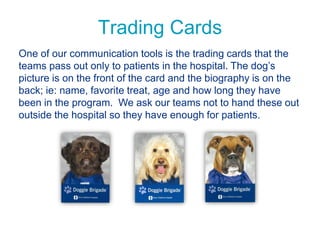
One of our communication tools is the trading cards that the
teams pass out only to patients in the hospital. The dog’s
picture is on the front of the card and the biography is on the
back; ie: name, favorite treat, age and how long they have
been in the program. We ask our teams not to hand these out
outside the hospital so they have enough for patients.
Volunteer Benefits
• You make a difference
– “We’ve seen a patient that’s not wanted to
eat take a bite, a patient in the Burn Center
smile and take a few steps – all because a
Doggie Brigade dog was there for support
and encouragement. The stories are
endless and the impact they have every
day is monumental.” –Whitney R.
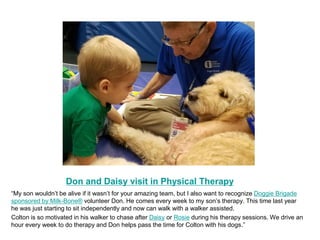
Don and Daisy visit in Physical Therapy
“My son wouldn’t be alive if it wasn’t for your amazing team, but I also want to recognize Doggie Brigade
sponsored by Milk-Bone® volunteer Don. He comes every week to my son’s therapy. This time last year
he was just starting to sit independently and now can walk with a walker assisted.
Colton is so motivated in his walker to chase after Daisy or Rosie during his therapy sessions. We drive an
hour every week to do therapy and Don helps pass the time for Colton with his dogs.”
Volunteer Benefits
• 10 pictures that prove therapy dogs are the
best medicine
– https://www.buzzfeed.com/akronchildrenshospital/
pictures-that-prove-therapy-dogs-are-the-best-
medicine
• Dogs with special needs help heal in physical
therapy
– https://www.today.com/health/inspiration-dogs-
special-needs-help-kids-heal-physical-therapy-
t100530
VOLUNTEER AND
DOG
REQUIREMENTS
Doggie Brigade™
Akron Children’s Hospital
Akron, Ohio
Commitment
to the Program
 Visit the Hospital a minimum of 26 visits per year
 Commit to a fixed, regular schedule
 Attend 2 special/community events per year
 Submit a yearly vet check
 Re-evaluate your dog every 2 years
Commitment
to the Program
 Each visit to the hospital may take approximately
3-5 hours. This timeframe includes:
 Bathing/drying your dog within 24 hours of the visit
 Grooming your dog prior to visit
 Drive time
 The visit itself (no more than 2 hours)
Infection Control Requirements
 Submit a yearly vet check
 Call off when you or your dog are ill or injured
 Offer hand sanitizer (provided by the Hospital) to
anyone before and after petting the dog
 Apply hand sanitizer when entering and exiting patient
rooms
 Bathe your dog within 24 hours of every visit and keep
dog clean with no discernable odor or fragrance
 Dog should not eliminate inside the hospital
 If dog eliminates inside hospital, waste must be cleaned up
immediately. Volunteer Services is notified and housekeeping is
contacted to sterilize the area
Handler Requirements
 At least 18 years old and graduated from high school
 Adaptive to a busy, changing environment
 Proactive, redirect your dog’s behavior when needed
 Advocate for your dog’s needs, know his/her stress
signs and be ready to alter or end an interaction
 Interact with your dog in a friendly, cheerful manner:
 Give cues to your dog in a happy voice
 Do not use force or leash pressure to control your dog
 Do not force your dog to participate in an interaction he or she
does not want to participate in or actively avoids
 Stop and excuse yourself from the visit if at any point your dog
appears to be unwell or uncomfortable, give him/her a break or
go home if needed
Handler Requirements
 Follow the Akron Children’s Hospital policies &
procedures
 Able to work with patients with various types of
behavioral or physical ailments, injuries or disabilities
 Interact appropriately with children including those
terminally or chronically ill
 Respect the privacy and confidentiality of patients, staff
and visitors – do not share any Protected Health
Information outside the hospital or on social media
 Obtain a flu shot annually
 Complete annual hospital safety training
Dog Requirements
 Is at least 1 year old
 Lived with handler for at least 6 months
 House trained
 Enjoys and seeks out interactions with people, friendly
 Remains calm while approaching or being approached
by people, does not exhibit uncontrolled exuberance
(i.e. jumping on people)
 Responds to handler cues quickly with confidence
 Does not avoid interactions or demonstrate aggressive
behavior towards animals and people
Any Size, Any Breed
Evaluation criteria are based on
skills and aptitude only!
EVALUATION
PROCEDURE
Doggie Brigade™
Akron Children’s Hospital
Akron, Ohio
All Doggie Brigade™ teams are tested and
registered through Pet Partners® program. The
Hospital pays for registration and insurance
through this organization. Pet Partners® is our
resource for information. We follow their
ordinances and those of Safety and Infectious
Disease at Akron Children’s Hospital.
Pet Partners Registration Steps
1. Create an account at www.petpartners.org.
2. Take the Pet Partners ® handler course (online).
Fee is $70.
3. Start a new registration and follow the steps on-
screen. Complete as many as you are able.
4. Make vet appointment & bring vet form.
5. Enroll in a Team Evaluation. Evaluations are
available at ACH.
Pet Partners Test
Tips for the Screening
1. Be prepared to provide proof of rabies vaccine at the time of screening
(Animal Health Screening Form completed by your Vet will suffice). If you do
not have it, your dog cannot be screened.
2. Items you are not allowed to have at the testing include:
– Unacceptable Dog Equipment (see next slides section)
– Retractable leashes
– Throw chains, clickers or any other “training device” (your dog needs to be already trained at this
testing).
3. Try to predict your dog’s behavior and help him or her through any situations that
might occur. It is permissible to give a verbal or visual cue to help your dog.
4. You will not be allowed to “jerk” on your dog’s collar or “model” a behavior by
physically pushing or pulling the dog (for example: pushing on the dog’s rump to
get him/her to sit).
5. You are welcome and encouraged to ask your evaluator questions of clarification!
Pet Partners Test
At the screening the dogs must be able to do the following:
1. Demonstrate that the Handler is in control at all times of the following behaviors
on cue:
– Sit
– Down (lay prone)
– Walk on leash without pulling
– Stay (Sit or Down)
– Come (from 10 feet)
2. Demonstrate the animal’s ability to accept and enjoy handling and restraint in a
variety of manners and by a variety of individuals and groups of people (i.e.,
petting, hugging, touching, examining, squeezing, holding, etc.)
– There can be NO body part of the dog that our evaluators cannot touch and hold, including feet and
muzzle (no exceptions). Not allowing contact with any body part is an automatic failure.
Pet Partners Test
At the screening the dogs must be able to do the following:
1. Demonstrate the animal’s confidence around Hospital equipment (i.e.
wheelchairs, IV poles, carts, walkers, etc,). There must be NO aggressive,
fearful or avoidance behaviors from the dog.
2. Demonstrate the animal’s calmness around people who look, sound, walk, and
behave differently.
3. Demonstrate animal’s confidence and calmness around other dogs. There must
be no aggressive, fearful or exuberant behavior when approached or in the
presence of other dogs.
4. The Handler must be able to control the candidate dog in the presence of other
animals.
5. Demonstrate that the animal is people oriented. Animal should politely seek out
interactions with tester and/or testing assistants.
Pet Partners Test
Evaluation Results
• If you feel your dog is not ready for this screening, we suggest working with a
competent trainer or training program and you are welcome to attend the New
Team Evaluation the following year.
• Not passing the screening means the dog is not ready. It does not indicate that
the dog is “bad,” “not good with kids,” or anything else. We are going to take a
snapshot picture of your dog’s behavior. In order to get into this program, your
dog has to take a very good picture.
• Please note that if your dog passes the screening you, the Handler, must
also meet the hospital requirements to become a Volunteer.
• We thank you for your interest and participation. Good Luck!
Acceptable &
Unacceptable Dog
Equipment
Doggie Brigade™
Akron Children’s Hospital
Akron, Ohio
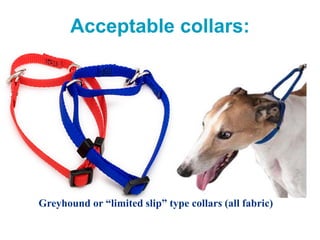
Acceptable collars:
Greyhound or “limited slip” type collars (all fabric)
Acceptable collars:
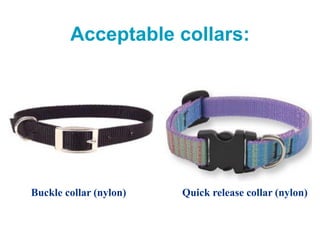
Buckle collar (nylon) Quick release collar (nylon)
Acceptable collars:
Rolled leather buckle collar
Acceptable harnesses:
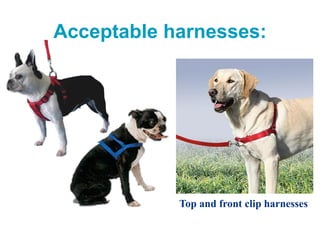
Top and front clip harnesses
Unacceptable collars:
Chains collars of any kind
Unacceptable collars:
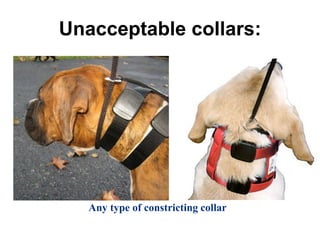
Any type of constricting collar
Unacceptable collars:
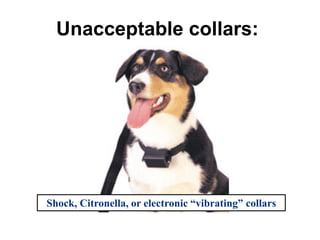
Shock, Citronella, or electronic “vibrating” collars
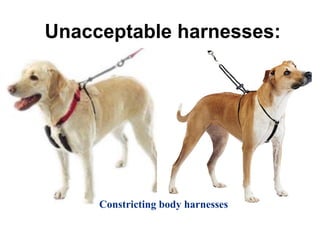
Unacceptable harnesses:
Constricting body harnesses
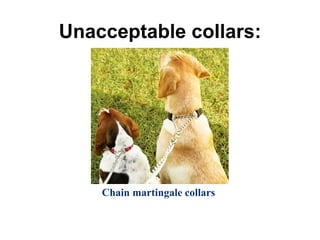
Unacceptable collars:
Chain martingale collars
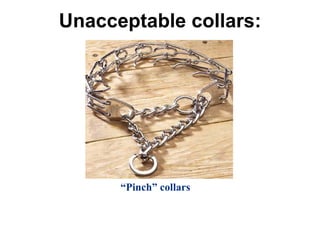
Unacceptable collars:
“Pinch” collars
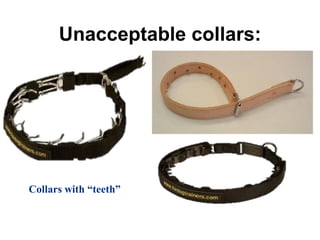
Unacceptable collars:
Collars with “teeth”
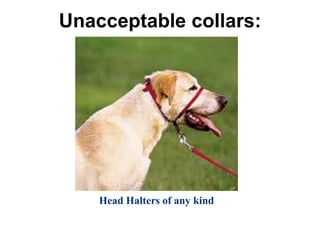
Unacceptable collars:
Head Halters of any kind
Unacceptable collars:
Spiked or jewelled collars of any kind
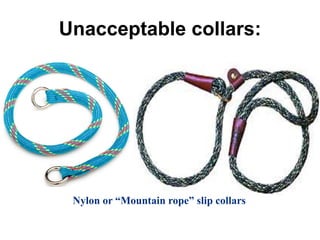
Unacceptable collars:
Nylon or “Mountain rope” slip collars
Thank You for Your Interest!
Questions?
Call Volunteer Services
330-543-8424.

Doggie Brigade Information Session

  • 1.
    Welcome to DoggieBrigade™ Informational Session
  • 2.
    Akron Children’s Hospital 3Promises 1. Treat each child as our own 2. Treat others as you would want to be treated 3. Turn no child away regardless of ability to pay
  • 3.
  • 4.
    Doggie Brigade™ Mission Doggie Brigade’s™Mission is to promote positive human and animal interaction and improve the physical, emotional and psychological health of the patients we serve. Interaction with dogs has proved to ease tension and occupies patients during procedures to be distracted from the pain of their condition and promotes healing!
  • 5.
    Doggie Brigade History The idea started in 1990; the first visit was in 1992.  There were 8 teams and each visited one floor one time per week.  After 6 months, the Toddler Unit was opened to the Doggie Brigade™.  After first year, the entire Hospital was approved for team visits, except in Oncology, Emergency and PICU.
  • 6.
    Today ~ 2019 General patient population  Oncology  Burn Unit  PICU  Emergency  Outpatient surgery waiting area Currently we have 60 dog teams. We are permitted everywhere in the hospital except in surgery, food preparation areas and bone marrow transplant rooms on Oncology.
  • 7.
    Trading Cards One ofour communication tools is the trading cards that the teams pass out only to patients in the hospital. The dog’s picture is on the front of the card and the biography is on the back; ie: name, favorite treat, age and how long they have been in the program. We ask our teams not to hand these out outside the hospital so they have enough for patients.
  • 8.
    Volunteer Benefits • Youmake a difference – “We’ve seen a patient that’s not wanted to eat take a bite, a patient in the Burn Center smile and take a few steps – all because a Doggie Brigade dog was there for support and encouragement. The stories are endless and the impact they have every day is monumental.” –Whitney R.
  • 9.
    Don and Daisyvisit in Physical Therapy “My son wouldn’t be alive if it wasn’t for your amazing team, but I also want to recognize Doggie Brigade sponsored by Milk-Bone® volunteer Don. He comes every week to my son’s therapy. This time last year he was just starting to sit independently and now can walk with a walker assisted. Colton is so motivated in his walker to chase after Daisy or Rosie during his therapy sessions. We drive an hour every week to do therapy and Don helps pass the time for Colton with his dogs.”
  • 10.
    Volunteer Benefits • 10pictures that prove therapy dogs are the best medicine – https://www.buzzfeed.com/akronchildrenshospital/ pictures-that-prove-therapy-dogs-are-the-best- medicine • Dogs with special needs help heal in physical therapy – https://www.today.com/health/inspiration-dogs- special-needs-help-kids-heal-physical-therapy- t100530
  • 11.
  • 12.
    Commitment to the Program Visit the Hospital a minimum of 26 visits per year  Commit to a fixed, regular schedule  Attend 2 special/community events per year  Submit a yearly vet check  Re-evaluate your dog every 2 years
  • 13.
    Commitment to the Program Each visit to the hospital may take approximately 3-5 hours. This timeframe includes:  Bathing/drying your dog within 24 hours of the visit  Grooming your dog prior to visit  Drive time  The visit itself (no more than 2 hours)
  • 14.
    Infection Control Requirements Submit a yearly vet check  Call off when you or your dog are ill or injured  Offer hand sanitizer (provided by the Hospital) to anyone before and after petting the dog  Apply hand sanitizer when entering and exiting patient rooms  Bathe your dog within 24 hours of every visit and keep dog clean with no discernable odor or fragrance  Dog should not eliminate inside the hospital  If dog eliminates inside hospital, waste must be cleaned up immediately. Volunteer Services is notified and housekeeping is contacted to sterilize the area
  • 15.
    Handler Requirements  Atleast 18 years old and graduated from high school  Adaptive to a busy, changing environment  Proactive, redirect your dog’s behavior when needed  Advocate for your dog’s needs, know his/her stress signs and be ready to alter or end an interaction  Interact with your dog in a friendly, cheerful manner:  Give cues to your dog in a happy voice  Do not use force or leash pressure to control your dog  Do not force your dog to participate in an interaction he or she does not want to participate in or actively avoids  Stop and excuse yourself from the visit if at any point your dog appears to be unwell or uncomfortable, give him/her a break or go home if needed
  • 16.
    Handler Requirements  Followthe Akron Children’s Hospital policies & procedures  Able to work with patients with various types of behavioral or physical ailments, injuries or disabilities  Interact appropriately with children including those terminally or chronically ill  Respect the privacy and confidentiality of patients, staff and visitors – do not share any Protected Health Information outside the hospital or on social media  Obtain a flu shot annually  Complete annual hospital safety training
  • 17.
    Dog Requirements  Isat least 1 year old  Lived with handler for at least 6 months  House trained  Enjoys and seeks out interactions with people, friendly  Remains calm while approaching or being approached by people, does not exhibit uncontrolled exuberance (i.e. jumping on people)  Responds to handler cues quickly with confidence  Does not avoid interactions or demonstrate aggressive behavior towards animals and people
  • 18.
    Any Size, AnyBreed Evaluation criteria are based on skills and aptitude only!
  • 19.
  • 20.
    All Doggie Brigade™teams are tested and registered through Pet Partners® program. The Hospital pays for registration and insurance through this organization. Pet Partners® is our resource for information. We follow their ordinances and those of Safety and Infectious Disease at Akron Children’s Hospital.
  • 21.
    Pet Partners RegistrationSteps 1. Create an account at www.petpartners.org. 2. Take the Pet Partners ® handler course (online). Fee is $70. 3. Start a new registration and follow the steps on- screen. Complete as many as you are able. 4. Make vet appointment & bring vet form. 5. Enroll in a Team Evaluation. Evaluations are available at ACH.
  • 22.
    Pet Partners Test Tipsfor the Screening 1. Be prepared to provide proof of rabies vaccine at the time of screening (Animal Health Screening Form completed by your Vet will suffice). If you do not have it, your dog cannot be screened. 2. Items you are not allowed to have at the testing include: – Unacceptable Dog Equipment (see next slides section) – Retractable leashes – Throw chains, clickers or any other “training device” (your dog needs to be already trained at this testing). 3. Try to predict your dog’s behavior and help him or her through any situations that might occur. It is permissible to give a verbal or visual cue to help your dog. 4. You will not be allowed to “jerk” on your dog’s collar or “model” a behavior by physically pushing or pulling the dog (for example: pushing on the dog’s rump to get him/her to sit). 5. You are welcome and encouraged to ask your evaluator questions of clarification!
  • 23.
    Pet Partners Test Atthe screening the dogs must be able to do the following: 1. Demonstrate that the Handler is in control at all times of the following behaviors on cue: – Sit – Down (lay prone) – Walk on leash without pulling – Stay (Sit or Down) – Come (from 10 feet) 2. Demonstrate the animal’s ability to accept and enjoy handling and restraint in a variety of manners and by a variety of individuals and groups of people (i.e., petting, hugging, touching, examining, squeezing, holding, etc.) – There can be NO body part of the dog that our evaluators cannot touch and hold, including feet and muzzle (no exceptions). Not allowing contact with any body part is an automatic failure.
  • 24.
    Pet Partners Test Atthe screening the dogs must be able to do the following: 1. Demonstrate the animal’s confidence around Hospital equipment (i.e. wheelchairs, IV poles, carts, walkers, etc,). There must be NO aggressive, fearful or avoidance behaviors from the dog. 2. Demonstrate the animal’s calmness around people who look, sound, walk, and behave differently. 3. Demonstrate animal’s confidence and calmness around other dogs. There must be no aggressive, fearful or exuberant behavior when approached or in the presence of other dogs. 4. The Handler must be able to control the candidate dog in the presence of other animals. 5. Demonstrate that the animal is people oriented. Animal should politely seek out interactions with tester and/or testing assistants.
  • 25.
    Pet Partners Test EvaluationResults • If you feel your dog is not ready for this screening, we suggest working with a competent trainer or training program and you are welcome to attend the New Team Evaluation the following year. • Not passing the screening means the dog is not ready. It does not indicate that the dog is “bad,” “not good with kids,” or anything else. We are going to take a snapshot picture of your dog’s behavior. In order to get into this program, your dog has to take a very good picture. • Please note that if your dog passes the screening you, the Handler, must also meet the hospital requirements to become a Volunteer. • We thank you for your interest and participation. Good Luck!
  • 26.
    Acceptable & Unacceptable Dog Equipment DoggieBrigade™ Akron Children’s Hospital Akron, Ohio
  • 27.
    Acceptable collars: Greyhound or“limited slip” type collars (all fabric)
  • 28.
    Acceptable collars: Buckle collar(nylon) Quick release collar (nylon)
  • 29.
  • 30.
    Acceptable harnesses: Top andfront clip harnesses
  • 31.
  • 32.
    Unacceptable collars: Any typeof constricting collar
  • 33.
    Unacceptable collars: Shock, Citronella,or electronic “vibrating” collars
  • 34.
  • 35.
  • 36.
  • 37.
  • 38.
  • 39.
    Unacceptable collars: Spiked orjewelled collars of any kind
  • 40.
    Unacceptable collars: Nylon or“Mountain rope” slip collars
  • 41.
    Thank You forYour Interest! Questions? Call Volunteer Services 330-543-8424.