Physician Assistants as Advanced
Practice Providers in Neonatology
Rheadon Remy, PA-C & Erin Keels, DNP, NNP-BC
Neonatal Services, Nationwide Children’s Hospital
Columbus, OH
abstract discussion
Providing care for neonates requires highly specialized skill and
expertise. Neonatal Nurse Practitioners (NNPs) have been used
throughout the United States to help provide high quality care, but
the number of graduates is insufficient to meet the demand. The
purpose of this poster is to describe the role of Physicians
Assistants (PAs) in meeting this need and to describe a Neonatal
PA Fellowship program.
Neonatal Physician Assistant Program
(nationwidechildrens.org)
Using a structured orientation and training fellowship, participants in
the program have been able to practice in NICUs. On completion of
a 12-month fellowship, the PA will be ready to start a career in
neonatology at the level of a novice NNP graduate. With additional
clinical experience and training,
PAs can serve as key team members to help overcome the APP
shortage while providing the highest level of care to healthy
newborns to fragile infants.
background
Neonatal PA fellowship outline
references
There is a growing need for professionals with expertise,
experience, and passion for caring for premature infants. Neonatal
Nurse Practitioners have served as important members of the
interdisciplinary team providing care for these complex patients, but
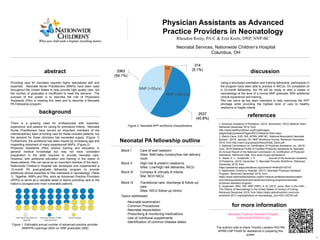
the demand for these clinicians has exceeded supply. (Figure 1)
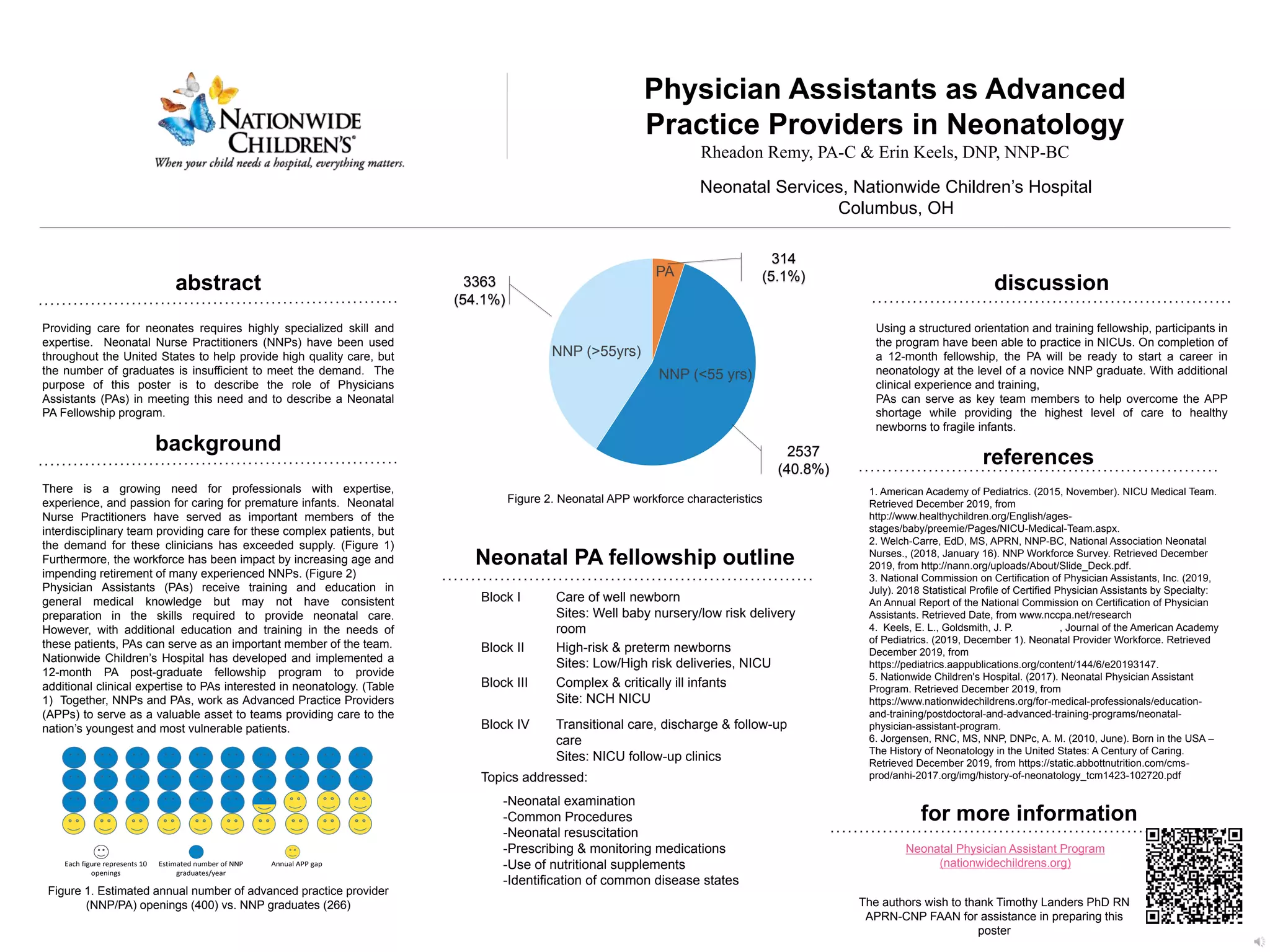
Furthermore, the workforce has been impact by increasing age and
impending retirement of many experienced NNPs. (Figure 2)
Physician Assistants (PAs) receive training and education in
general medical knowledge but may not have consistent
preparation in the skills required to provide neonatal care.
However, with additional education and training in the needs of
these patients, PAs can serve as an important member of the team.
Nationwide Children’s Hospital has developed and implemented a
12-month PA post-graduate fellowship program to provide
additional clinical expertise to PAs interested in neonatology. (Table
1) Together, NNPs and PAs, work as Advanced Practice Providers
(APPs) to serve as a valuable asset to teams providing care to the
nation’s youngest and most vulnerable patients.
1. American Academy of Pediatrics. (2015, November). NICU Medical Team.
Retrieved December 2019, from
http://www.healthychildren.org/English/ages-
stages/baby/preemie/Pages/NICU-Medical-Team.aspx.
2. Welch-Carre, EdD, MS, APRN, NNP-BC, National Association Neonatal
Nurses., (2018, January 16). NNP Workforce Survey. Retrieved December
2019, from http://nann.org/uploads/About/Slide_Deck.pdf.
3. National Commission on Certification of Physician Assistants, Inc. (2019,
July). 2018 Statistical Profile of Certified Physician Assistants by Specialty:
An Annual Report of the National Commission on Certification of Physician
Assistants. Retrieved Date, from www.nccpa.net/research
4. Keels, E. L., Goldsmith, J. P. , Journal of the American Academy
of Pediatrics. (2019, December 1). Neonatal Provider Workforce. Retrieved
December 2019, from
https://pediatrics.aappublications.org/content/144/6/e20193147.
5. Nationwide Children's Hospital. (2017). Neonatal Physician Assistant
Program. Retrieved December 2019, from
https://www.nationwidechildrens.org/for-medical-professionals/education-
and-training/postdoctoral-and-advanced-training-programs/neonatal-
physician-assistant-program.
6. Jorgensen, RNC, MS, NNP, DNPc, A. M. (2010, June). Born in the USA –
The History of Neonatology in the United States: A Century of Caring.
Retrieved December 2019, from https://static.abbottnutrition.com/cms-
prod/anhi-2017.org/img/history-of-neonatology_tcm1423-102720.pdf
for more information
The authors wish to thank Timothy Landers PhD RN
APRN-CNP FAAN for assistance in preparing this
poster
Each figure represents 10
openings
Estimated number of NNP
graduates/year
Annual APP gap
Figure 1. Estimated annual number of advanced practice provider
(NNP/PA) openings (400) vs. NNP graduates (266)
Figure 2. Neonatal APP workforce characteristics
PA
NNP (<55 yrs)
NNP (>55yrs)
2537
(40.8%)
3363
(54.1%)
314
(5.1%)
Block I Care of well newborn
Sites: Well baby nursery/low risk delivery
room
Block II High-risk & preterm newborns
Sites: Low/High risk deliveries, NICU
Block III Complex & critically ill infants
Site: NCH NICU
Block IV Transitional care, discharge & follow-up
care
Sites: NICU follow-up clinics
Topics addressed:
-Neonatal examination
-Common Procedures
-Neonatal resuscitation
-Prescribing & monitoring medications
-Use of nutritional supplements
-Identification of common disease states

Poster remy pa nicu practice

  • 1.
    Physician Assistants asAdvanced Practice Providers in Neonatology Rheadon Remy, PA-C & Erin Keels, DNP, NNP-BC Neonatal Services, Nationwide Children’s Hospital Columbus, OH abstract discussion Providing care for neonates requires highly specialized skill and expertise. Neonatal Nurse Practitioners (NNPs) have been used throughout the United States to help provide high quality care, but the number of graduates is insufficient to meet the demand. The purpose of this poster is to describe the role of Physicians Assistants (PAs) in meeting this need and to describe a Neonatal PA Fellowship program. Neonatal Physician Assistant Program (nationwidechildrens.org) Using a structured orientation and training fellowship, participants in the program have been able to practice in NICUs. On completion of a 12-month fellowship, the PA will be ready to start a career in neonatology at the level of a novice NNP graduate. With additional clinical experience and training, PAs can serve as key team members to help overcome the APP shortage while providing the highest level of care to healthy newborns to fragile infants. background Neonatal PA fellowship outline references There is a growing need for professionals with expertise, experience, and passion for caring for premature infants. Neonatal Nurse Practitioners have served as important members of the interdisciplinary team providing care for these complex patients, but the demand for these clinicians has exceeded supply. (Figure 1) Furthermore, the workforce has been impact by increasing age and impending retirement of many experienced NNPs. (Figure 2) Physician Assistants (PAs) receive training and education in general medical knowledge but may not have consistent preparation in the skills required to provide neonatal care. However, with additional education and training in the needs of these patients, PAs can serve as an important member of the team. Nationwide Children’s Hospital has developed and implemented a 12-month PA post-graduate fellowship program to provide additional clinical expertise to PAs interested in neonatology. (Table 1) Together, NNPs and PAs, work as Advanced Practice Providers (APPs) to serve as a valuable asset to teams providing care to the nation’s youngest and most vulnerable patients. 1. American Academy of Pediatrics. (2015, November). NICU Medical Team. Retrieved December 2019, from http://www.healthychildren.org/English/ages- stages/baby/preemie/Pages/NICU-Medical-Team.aspx. 2. Welch-Carre, EdD, MS, APRN, NNP-BC, National Association Neonatal Nurses., (2018, January 16). NNP Workforce Survey. Retrieved December 2019, from http://nann.org/uploads/About/Slide_Deck.pdf. 3. National Commission on Certification of Physician Assistants, Inc. (2019, July). 2018 Statistical Profile of Certified Physician Assistants by Specialty: An Annual Report of the National Commission on Certification of Physician Assistants. Retrieved Date, from www.nccpa.net/research 4. Keels, E. L., Goldsmith, J. P. , Journal of the American Academy of Pediatrics. (2019, December 1). Neonatal Provider Workforce. Retrieved December 2019, from https://pediatrics.aappublications.org/content/144/6/e20193147. 5. Nationwide Children's Hospital. (2017). Neonatal Physician Assistant Program. Retrieved December 2019, from https://www.nationwidechildrens.org/for-medical-professionals/education- and-training/postdoctoral-and-advanced-training-programs/neonatal- physician-assistant-program. 6. Jorgensen, RNC, MS, NNP, DNPc, A. M. (2010, June). Born in the USA – The History of Neonatology in the United States: A Century of Caring. Retrieved December 2019, from https://static.abbottnutrition.com/cms- prod/anhi-2017.org/img/history-of-neonatology_tcm1423-102720.pdf for more information The authors wish to thank Timothy Landers PhD RN APRN-CNP FAAN for assistance in preparing this poster Each figure represents 10 openings Estimated number of NNP graduates/year Annual APP gap Figure 1. Estimated annual number of advanced practice provider (NNP/PA) openings (400) vs. NNP graduates (266) Figure 2. Neonatal APP workforce characteristics PA NNP (<55 yrs) NNP (>55yrs) 2537 (40.8%) 3363 (54.1%) 314 (5.1%) Block I Care of well newborn Sites: Well baby nursery/low risk delivery room Block II High-risk & preterm newborns Sites: Low/High risk deliveries, NICU Block III Complex & critically ill infants Site: NCH NICU Block IV Transitional care, discharge & follow-up care Sites: NICU follow-up clinics Topics addressed: -Neonatal examination -Common Procedures -Neonatal resuscitation -Prescribing & monitoring medications -Use of nutritional supplements -Identification of common disease states