"I had a terrible education. I attended a school for emotionally disturbed teachers."
— Woody Allen (ADHD)
ADD/ADHD
Kathryn Webb – SEND Department
What is ADHD?
What is ADHD?
Attention Deficit Hyperactivity Disorder (ADHD) is a clearly defined clinical condition and not just a label for naughty or badly
brought up children.
ADHD is diagnosed when a child exhibits abnormally high levels of:
- Inattention (short attention span, easily distracted, doesn’t finish things, disorgansied, forgetful etc).
AND/OR:
- Hyperactivity and impulsiveness (fidgets, can’t sit still, always on the go, talks too much, interrupts, can’t wait their turn
etc).
To qualify as true ADHD these problems:
- Must be long-term – present for at least 6 months.
- Must be abnormal for the age and stage of development of the child (what’s normal in a 2 year old is not normal in a 10 year
old).
- Must have been present before the age of 7 and are nearly always seen before the age of 5 years. ADHD is a developmental
disorder and doesn’t appear suddenly.
- Must be genuinely disruptive to the child’s everyday performance and wellbeing – mere naughtiness at home or not doing well
at school is not enough.
- Must occur in more than one place, for example both at home and at school. Problems, which are present just at home or
just at school, are likely to have other causes.
ADHD is more common in boys than in girls
with a ration of approximately 4 boys to 1 girl.
ADHD effects 3-5% of school-age children. This means that the average UK classroom will
include at least one child with ADHD.
CAMHS
Symptoms in adults and children:
Some symptoms or indicator that can suggest ADD are:
Frequently losing or misplacing things
Perfectionist tendencies
Strong need to control or have things your way
A sense of failure; not living up to one's potential
A sense of being different, unconventional
A sense of internal restlessness; constantly active
Difficulty with falling asleep or waking up alert
Easily distracted; forgetful; daydreaming
Procrastination; inability to complete things
Disorganisation; messiness; clutter
Behavioural or verbal impulsiveness
Difficulty with expressing thoughts in speech or in writing
Significant periods of depression; low self-esteem
A sense of failure; not living up to one's potential
A sense of being different, unconventional
A sense of internal restlessness; constantly active
Very impatient; low frustration tolerance
Emotionally sensitive; easily upset, depressed, hurt or angered
Difficulty with personal or work relationships
Frequently late or rushed
Difficulty in estimating how much time something will take
Impulsive spending and money management problems
Personal or family history of substance abuse, depression or anxiety
Very sensitive to being told to do something, teasing, criticism, rejection or anger
A sense that your mind is always active; thoughts jumping from one topic to the next
Easily bored; intense need for excitement
Difficulty with following rules
Difficulty with reading comprehension or retention
Frequently changing jobs, interests or activities
Attention Deficit Disorder Symptoms
Joss
Mbwata
being
investigated
for ADD
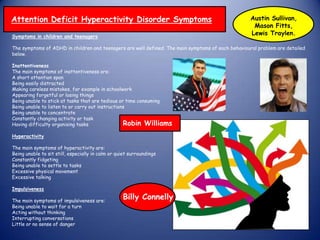
Symptoms in children and teenagers
The symptoms of ADHD in children and teenagers are well defined. The main symptoms of each behavioural problem are detailed
below.
Inattentiveness
The main symptoms of inattentiveness are:
A short attention span
Being easily distracted
Making careless mistakes, for example in schoolwork
Appearing forgetful or losing things
Being unable to stick at tasks that are tedious or time consuming
Being unable to listen to or carry out instructions
Being unable to concentrate
Constantly changing activity or task
Having difficulty organising tasks
Hyperactivity
The main symptoms of hyperactivity are:
Being unable to sit still, especially in calm or quiet surroundings
Constantly fidgeting
Being unable to settle to tasks
Excessive physical movement
Excessive talking
Impulsiveness
The main symptoms of impulsiveness are:
Being unable to wait for a turn
Acting without thinking
Interrupting conversations
Little or no sense of danger
Billy Connelly
Attention Deficit Hyperactivity Disorder Symptoms
Robin Williams
Austin Sullivan,
Mason Fitts,
Lewis Traylen.
Practical teachers for teachers
DON’T TAKE IT PERSONALLY – there is a medical reason for much of the child’s behaviour.
A REASON IS NOT AN EXCUSE – ADHD is the reason for unacceptable behaviour, but not an excuse for it. With your help,
children with ADHD can learn to control their behaviour better.
KEEP IN CONTACT WITH THE PARENTS – So that you know each other’s problems and share the same approach.
SIT THE CHILD CLOSE TO YOU – Ideally put them between two calm and well-behaved pupils, and away from doors, windows
and other potential distractions.
PROVIDE LEGITIMATE OPPORTUNITIES TO BE PHYSICALLY ACTIVE - Let them be the one to go and fetch something or
wipe the board.
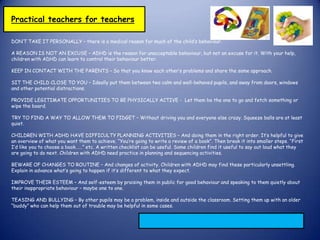
TRY TO FIND A WAY TO ALLOW THEM TO FIDGET – Without driving you and everyone else crazy. Squeeze balls are at least
quiet.
CHILDREN WITH ADHD HAVE DIFFICULTY PLANNING ACTIVITIES – And doing them in the right order. It’s helpful to give
an overview of what you want them to achieve. ―You’re going to write a review of a book‖. Then break it into smaller steps. ―First
I’d like you to choose a book……‖ etc. A written checklist can be useful. Some children find it useful to say out loud what they
are going to do next. Children with ADHD need practice in planning and sequencing activities.
BEWARE OF CHANGES TO ROUTINE – And changes of activity. Children with ADHD may find these particularly unsettling.
Explain in advance what’s going to happen if it’s different to what they expect.
IMPROVE THEIR ESTEEM – And self-esteem by praising them in public for good behaviour and speaking to them quietly about
their inappropriate behaviour – maybe one to one.
TEASING AND BULLYING – By other pupils may be a problem, inside and outside the classroom. Setting them up with an older
―buddy‖ who can help them out of trouble may be helpful in some cases.
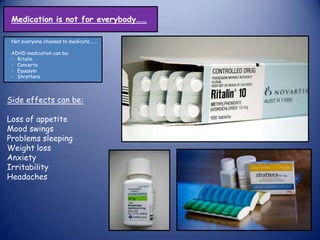
Medication is not for everybody……
Not everyone chooses to medicate…….
ADHD medication can be:
- Ritalin
- Concerta
- Equasym
- Strattera
Side effects can be:
Loss of appetite
Mood swings
Problems sleeping
Weight loss
Anxiety
Irritability
Headaches

ADD ADHD Presentation

  • 1.
    "I had aterrible education. I attended a school for emotionally disturbed teachers." — Woody Allen (ADHD) ADD/ADHD Kathryn Webb – SEND Department
  • 2.
    What is ADHD? Whatis ADHD? Attention Deficit Hyperactivity Disorder (ADHD) is a clearly defined clinical condition and not just a label for naughty or badly brought up children. ADHD is diagnosed when a child exhibits abnormally high levels of: - Inattention (short attention span, easily distracted, doesn’t finish things, disorgansied, forgetful etc). AND/OR: - Hyperactivity and impulsiveness (fidgets, can’t sit still, always on the go, talks too much, interrupts, can’t wait their turn etc). To qualify as true ADHD these problems: - Must be long-term – present for at least 6 months. - Must be abnormal for the age and stage of development of the child (what’s normal in a 2 year old is not normal in a 10 year old). - Must have been present before the age of 7 and are nearly always seen before the age of 5 years. ADHD is a developmental disorder and doesn’t appear suddenly. - Must be genuinely disruptive to the child’s everyday performance and wellbeing – mere naughtiness at home or not doing well at school is not enough. - Must occur in more than one place, for example both at home and at school. Problems, which are present just at home or just at school, are likely to have other causes. ADHD is more common in boys than in girls with a ration of approximately 4 boys to 1 girl. ADHD effects 3-5% of school-age children. This means that the average UK classroom will include at least one child with ADHD. CAMHS
  • 3.
    Symptoms in adultsand children: Some symptoms or indicator that can suggest ADD are: Frequently losing or misplacing things Perfectionist tendencies Strong need to control or have things your way A sense of failure; not living up to one's potential A sense of being different, unconventional A sense of internal restlessness; constantly active Difficulty with falling asleep or waking up alert Easily distracted; forgetful; daydreaming Procrastination; inability to complete things Disorganisation; messiness; clutter Behavioural or verbal impulsiveness Difficulty with expressing thoughts in speech or in writing Significant periods of depression; low self-esteem A sense of failure; not living up to one's potential A sense of being different, unconventional A sense of internal restlessness; constantly active Very impatient; low frustration tolerance Emotionally sensitive; easily upset, depressed, hurt or angered Difficulty with personal or work relationships Frequently late or rushed Difficulty in estimating how much time something will take Impulsive spending and money management problems Personal or family history of substance abuse, depression or anxiety Very sensitive to being told to do something, teasing, criticism, rejection or anger A sense that your mind is always active; thoughts jumping from one topic to the next Easily bored; intense need for excitement Difficulty with following rules Difficulty with reading comprehension or retention Frequently changing jobs, interests or activities Attention Deficit Disorder Symptoms Joss Mbwata being investigated for ADD
  • 4.
    Symptoms in childrenand teenagers The symptoms of ADHD in children and teenagers are well defined. The main symptoms of each behavioural problem are detailed below. Inattentiveness The main symptoms of inattentiveness are: A short attention span Being easily distracted Making careless mistakes, for example in schoolwork Appearing forgetful or losing things Being unable to stick at tasks that are tedious or time consuming Being unable to listen to or carry out instructions Being unable to concentrate Constantly changing activity or task Having difficulty organising tasks Hyperactivity The main symptoms of hyperactivity are: Being unable to sit still, especially in calm or quiet surroundings Constantly fidgeting Being unable to settle to tasks Excessive physical movement Excessive talking Impulsiveness The main symptoms of impulsiveness are: Being unable to wait for a turn Acting without thinking Interrupting conversations Little or no sense of danger Billy Connelly Attention Deficit Hyperactivity Disorder Symptoms Robin Williams Austin Sullivan, Mason Fitts, Lewis Traylen.
  • 5.
    Practical teachers forteachers DON’T TAKE IT PERSONALLY – there is a medical reason for much of the child’s behaviour. A REASON IS NOT AN EXCUSE – ADHD is the reason for unacceptable behaviour, but not an excuse for it. With your help, children with ADHD can learn to control their behaviour better. KEEP IN CONTACT WITH THE PARENTS – So that you know each other’s problems and share the same approach. SIT THE CHILD CLOSE TO YOU – Ideally put them between two calm and well-behaved pupils, and away from doors, windows and other potential distractions. PROVIDE LEGITIMATE OPPORTUNITIES TO BE PHYSICALLY ACTIVE - Let them be the one to go and fetch something or wipe the board. TRY TO FIND A WAY TO ALLOW THEM TO FIDGET – Without driving you and everyone else crazy. Squeeze balls are at least quiet. CHILDREN WITH ADHD HAVE DIFFICULTY PLANNING ACTIVITIES – And doing them in the right order. It’s helpful to give an overview of what you want them to achieve. ―You’re going to write a review of a book‖. Then break it into smaller steps. ―First I’d like you to choose a book……‖ etc. A written checklist can be useful. Some children find it useful to say out loud what they are going to do next. Children with ADHD need practice in planning and sequencing activities. BEWARE OF CHANGES TO ROUTINE – And changes of activity. Children with ADHD may find these particularly unsettling. Explain in advance what’s going to happen if it’s different to what they expect. IMPROVE THEIR ESTEEM – And self-esteem by praising them in public for good behaviour and speaking to them quietly about their inappropriate behaviour – maybe one to one. TEASING AND BULLYING – By other pupils may be a problem, inside and outside the classroom. Setting them up with an older ―buddy‖ who can help them out of trouble may be helpful in some cases.
  • 7.
    Medication is notfor everybody…… Not everyone chooses to medicate……. ADHD medication can be: - Ritalin - Concerta - Equasym - Strattera Side effects can be: Loss of appetite Mood swings Problems sleeping Weight loss Anxiety Irritability Headaches