Adaptive / Responsive Content vs,
Adaptive / Responsive Design
(term disambiguation)
Noz Urbina
Content Strategist,Author
noz.urbina@urbinaconsutling.com unify your content flows
Image: CC lic, Ksionic bit.ly/1RS6b
@nozurbinaObjective
Disambiguate:
• Research and consolidate key industry terms (see resources slide for links)
• Compare and contextualise
• Highlight areas of common confusion and other pitfalls
• Create a compact and useful matrix as a tool to aid collaboration in the industry
Note: this is not attempt at creation/redefinition of terms, but a collection of available knowledge to
help understand the relationships between terms. Some is my own work but seeks to integrate and
respect the input of other thought-leaders/the general community.
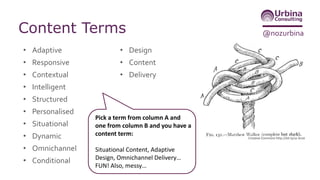
@nozurbinaContent Terms
• Adaptive
• Responsive
• Contextual
• Intelligent
• Structured
• Personalised
• Situational
• Dynamic
• Omnichannel
• Conditional
• Design
• Content
• Delivery
Creative Commons http://bit.ly/uc-knot
Sometimes it seems the content
community just picks a term from
column A and one from column B:
Situational Content, Adaptive
Design, Omnichannel Delivery…
FUN! Also, messy…
Content
12
3
6
9
_____ Content = Refers to the nature of the
source content itself – as opposed to referring to
the (visual) design or other parts of the overall
process or delivery system. NOTE: Confusingly,
some people do use “content” to refer to the
delivery or delivered content experience...
e.g.Adaptive Content
Intelligent Content
Structured Content
Semantic Content
Conditional Content
DesignContent
_____ Design = Refers to interface
and visual presentation aspects.
Does not imply anything about the
content being fed into the design.
Mobile layout Print layout
e.g. Adaptive Design
Responsive Design
Design DeliveryContent (Processing)
The application of rules, filters & layouts
to content. Not really referred to
directly, but usually as a stage between
other terms.
Design DeliveryContent (Processing)
_____ Delivery = Refers to act of actually getting
the content and putting it where it needs to be in
front of the user.
NOTE: Confusingly, “content” is sometimes used
as a synonym for “delivery” or the experience that
is delivered (personalised content, contextual
content)… I try to avoid this…
e.g. Dynamic Delivery
Contextual Delivery
Personalised Delivery
Desktop layout
Design Delivery
Mobile layout
Content
12
3
6
9
(application of rules,
filters & layouts to
content)
Print layout
(Processing)
All together
Desktop layout
Design Delivery
Mobile layout
Content
12
3
6
9
(application of rules,
filters & layouts to
content)
Print layout
(Processing)
Adaptive = definition of rules and processing
happen on the server before sending to device
Desktop layout
Design Delivery
Mobile layout
Content
12
3
6
9
(application of rules,
filters & layouts to
content)
Print layout
(Processing)
Responsive = rules are applied
after content reaches the device
Adaptive = definition of rules and processing
happen on the server before sending to device
Desktop layout
Design Delivery
Mobile layout
Content
12
3
6
9
Adaptive = definition of rules and processing
happen on the server before sending to device
Responsive = rules are applied
after content reaches the device
Dynamic = content is processed or created on
request from a specific user / machine
(application of rules,
filters & layouts to
content)
Print layout
(Processing)
Desktop layout
Design Delivery
Mobile layout
Content
12
3
6
9
General terms: content personalisation, omnichannel content =
the overall process, not individual phases
(application of rules,
filters & layouts to
content)
Print layout
(Processing)
Design Content
Responsive
“After the fact” – Singular
design that goes to the
device and responds to
whatever it finds.
Responsive Design = definition of
presentation rules that can reflow visual
layouts according to display device (or
window) size.
Changes happen on the device so the server
doesn’t need to know what device it is
sending to.
Not a thing. Content can’t “respond” or do
things like to adapt to device or user
constraints without metadata already in
server-stored source material (which would
make it adaptive content).
Anything done to content on the device
must be done by the design.
Adaptive
“Predefined targets” –
For design: various
predefined designs
specialised for specific
devices or device profiles.
For content: various
predefined people,
personas, place
situations, are
represented in the
metadata.
Adaptive Design = definition of
presentation rules and interfaces that are
set on the server – before sending content
and layouts to the device.
The server must know/detect the device
type before sending to it, so that it knows
what to send and how. Often the grid layout
is fixed to a specific size, which has its
disadvantages, but can be combined with
responsive design for more fluid layouts.
Adaptive Content has metadata in the
source material it that defines when, where,
and for whom it should be displayed (how is
in the design). Can be delivered into
responsive and/or adaptive designs in a
personalised and/or contextual way.
A piece of could be for “millennial USB
gadget buyers” and display “on very cold
snowy days near Christmas after 9pm” and
will be delivered dynamically.
Summary Part 1
Design Content
Responsive
“After the fact” – Singular
design that goes to the
device and responds to
whatever it finds.
Responsive Design = definition of
presentation rules that can reflow visual
layouts according to display device (or
window) size.
Changes happen on the device so the server
doesn’t need to know what device it is
sending to.
Not a thing. Content can’t “respond” or do
things like to adapt to device or user
constraints without metadata already in
server-stored source material (which would
make it adaptive content).
Anything done to content on the device
must be done by the design.
Adaptive
“Predefined targets” –
For design: various
predefined designs
specialised for specific
devices or device profiles.
For content: various
predefined people,
personas, place
situations, are
represented in the
metadata.
Adaptive Design = definition of
presentation rules and interfaces that are
set on the server – before sending content
and layouts to the device.
The server must know/detect the device
type before sending to it, so that it knows
what to send and how. Often the grid layout
is fixed to a specific size, which has its
disadvantages, but can be combined with
responsive design for more fluid layouts.
Adaptive Content has metadata in the
source material it that defines when, where,
and for whom it should be displayed (how is
in the design). Can be delivered into
responsive and/or adaptive designs in a
personalised and/or contextual way.
A piece of could be for “millennial USB
gadget buyers” and display “on very cold
snowy days near Christmas after 9pm” and
will be delivered dynamically.
Summary Part 1
Note: As adaptive / responsive
design overlap and are often used
in combination, many (a great
majority, from my research) favour
just using responsive as the term
for both.
Delivery Content
Dynamic
“On-demand”
Dynamic Delivery = processing and sending
of content on-demand / on-request (by a
human or a machine), as opposed to pre-
processing content and storing it.
Adaptive design & adaptive content require
a dynamic delivery system to be in place.
Dynamic Content = content that doesn’t
exist until a request is made. For example,
real-time weather, sport, or geo-positioning
data tables or a user-defined extract of a
larger body of adaptive content.
Adaptive content = dynamic content once
you actually deliver it.
Contextual
“For the moment”
Contextual Delivery = sending specific
content or layouts according to a
combination of time, place and user
situation factors.
Delivery can be personalised (Zoe’s vegan,
she gets all vegan content) or contextual
(someone walking around at dinner time
gets local restaurant content) or both (Zoe
gets local vegan restaurant content when
walking around at dinner time)
Contextual content = adaptive content that
emphasizes metadata about user’s possible
contexts. Adaptive content can adapt on a
number of factors, it’s contextual when
situational factors feature prominently in the
mix.
NOTE: Not a common term!
Summary Part 2
@nozurbinaSummary Part 3 - TBD
• Intelligent content vs Structured content vs Adaptive content
vs Semantic content
• AdaptiveContent vs Content Personalisation vs Personalised
Content
@nozurbinaMy Recommendations
Use
• Responsive Design
• Adaptive Content
• Contextual Delivery
• Personalised Delivery
• Dynamic Delivery
Avoid/Less important
• Adaptive Design (Responsive covers it)
• Responsive Content
• Dynamic Content (so common these
days it’s almost not worth mentioning
it explicitly)
@nozurbinaResources
• Fixed/Fluid Adaptive & Responsive –TeamTreeHouse.com
• Adaptive or Responsive Design - which is better? – Matthew Harris
• Adaptive Content:The OmnichannelTechniqueYou Need to Implement – Noz
Urbina
• What’s the Difference Between Responsive and Adaptiev Web Design – Ryan
Bourdreaux
• Adapting Ourselves to Adaptive Content – Karen McGrane
• Responsive Web Design – Ethan Marcotte
• Switchy McLayout: An Adaptive LayoutTechnique – Marc van den Dobblesteen
@nozurbinaNoz Urbina, Urbina Consulting
Content strategist & modeller
Consultant/trainer in H2H (B2B/B2C)
Author
urbinaconsulting.com/events
89 3929 31 x88
24g
UC.com 2055
@nozurbinaYou might also like

Adaptive / Reponsive Content vs Adaptive / Responsive Design - Term Disamguation

  • 1.
    Adaptive / ResponsiveContent vs, Adaptive / Responsive Design (term disambiguation) Noz Urbina Content Strategist,Author noz.urbina@urbinaconsutling.com unify your content flows Image: CC lic, Ksionic bit.ly/1RS6b
  • 2.
    @nozurbinaObjective Disambiguate: • Research andconsolidate key industry terms (see resources slide for links) • Compare and contextualise • Highlight areas of common confusion and other pitfalls • Create a compact and useful matrix as a tool to aid collaboration in the industry Note: this is not attempt at creation/redefinition of terms, but a collection of available knowledge to help understand the relationships between terms. Some is my own work but seeks to integrate and respect the input of other thought-leaders/the general community.
  • 3.
    @nozurbinaContent Terms • Adaptive •Responsive • Contextual • Intelligent • Structured • Personalised • Situational • Dynamic • Omnichannel • Conditional • Design • Content • Delivery Creative Commons http://bit.ly/uc-knot Sometimes it seems the content community just picks a term from column A and one from column B: Situational Content, Adaptive Design, Omnichannel Delivery… FUN! Also, messy…
  • 4.
    Content 12 3 6 9 _____ Content =Refers to the nature of the source content itself – as opposed to referring to the (visual) design or other parts of the overall process or delivery system. NOTE: Confusingly, some people do use “content” to refer to the delivery or delivered content experience... e.g.Adaptive Content Intelligent Content Structured Content Semantic Content Conditional Content
  • 5.
    DesignContent _____ Design =Refers to interface and visual presentation aspects. Does not imply anything about the content being fed into the design. Mobile layout Print layout e.g. Adaptive Design Responsive Design
  • 6.
    Design DeliveryContent (Processing) Theapplication of rules, filters & layouts to content. Not really referred to directly, but usually as a stage between other terms.
  • 7.
    Design DeliveryContent (Processing) _____Delivery = Refers to act of actually getting the content and putting it where it needs to be in front of the user. NOTE: Confusingly, “content” is sometimes used as a synonym for “delivery” or the experience that is delivered (personalised content, contextual content)… I try to avoid this… e.g. Dynamic Delivery Contextual Delivery Personalised Delivery
  • 8.
    Desktop layout Design Delivery Mobilelayout Content 12 3 6 9 (application of rules, filters & layouts to content) Print layout (Processing) All together
  • 9.
    Desktop layout Design Delivery Mobilelayout Content 12 3 6 9 (application of rules, filters & layouts to content) Print layout (Processing) Adaptive = definition of rules and processing happen on the server before sending to device
  • 10.
    Desktop layout Design Delivery Mobilelayout Content 12 3 6 9 (application of rules, filters & layouts to content) Print layout (Processing) Responsive = rules are applied after content reaches the device Adaptive = definition of rules and processing happen on the server before sending to device
  • 11.
    Desktop layout Design Delivery Mobilelayout Content 12 3 6 9 Adaptive = definition of rules and processing happen on the server before sending to device Responsive = rules are applied after content reaches the device Dynamic = content is processed or created on request from a specific user / machine (application of rules, filters & layouts to content) Print layout (Processing)
  • 12.
    Desktop layout Design Delivery Mobilelayout Content 12 3 6 9 General terms: content personalisation, omnichannel content = the overall process, not individual phases (application of rules, filters & layouts to content) Print layout (Processing)
  • 13.
    Design Content Responsive “After thefact” – Singular design that goes to the device and responds to whatever it finds. Responsive Design = definition of presentation rules that can reflow visual layouts according to display device (or window) size. Changes happen on the device so the server doesn’t need to know what device it is sending to. Not a thing. Content can’t “respond” or do things like to adapt to device or user constraints without metadata already in server-stored source material (which would make it adaptive content). Anything done to content on the device must be done by the design. Adaptive “Predefined targets” – For design: various predefined designs specialised for specific devices or device profiles. For content: various predefined people, personas, place situations, are represented in the metadata. Adaptive Design = definition of presentation rules and interfaces that are set on the server – before sending content and layouts to the device. The server must know/detect the device type before sending to it, so that it knows what to send and how. Often the grid layout is fixed to a specific size, which has its disadvantages, but can be combined with responsive design for more fluid layouts. Adaptive Content has metadata in the source material it that defines when, where, and for whom it should be displayed (how is in the design). Can be delivered into responsive and/or adaptive designs in a personalised and/or contextual way. A piece of could be for “millennial USB gadget buyers” and display “on very cold snowy days near Christmas after 9pm” and will be delivered dynamically. Summary Part 1
  • 14.
    Design Content Responsive “After thefact” – Singular design that goes to the device and responds to whatever it finds. Responsive Design = definition of presentation rules that can reflow visual layouts according to display device (or window) size. Changes happen on the device so the server doesn’t need to know what device it is sending to. Not a thing. Content can’t “respond” or do things like to adapt to device or user constraints without metadata already in server-stored source material (which would make it adaptive content). Anything done to content on the device must be done by the design. Adaptive “Predefined targets” – For design: various predefined designs specialised for specific devices or device profiles. For content: various predefined people, personas, place situations, are represented in the metadata. Adaptive Design = definition of presentation rules and interfaces that are set on the server – before sending content and layouts to the device. The server must know/detect the device type before sending to it, so that it knows what to send and how. Often the grid layout is fixed to a specific size, which has its disadvantages, but can be combined with responsive design for more fluid layouts. Adaptive Content has metadata in the source material it that defines when, where, and for whom it should be displayed (how is in the design). Can be delivered into responsive and/or adaptive designs in a personalised and/or contextual way. A piece of could be for “millennial USB gadget buyers” and display “on very cold snowy days near Christmas after 9pm” and will be delivered dynamically. Summary Part 1 Note: As adaptive / responsive design overlap and are often used in combination, many (a great majority, from my research) favour just using responsive as the term for both.
  • 15.
    Delivery Content Dynamic “On-demand” Dynamic Delivery= processing and sending of content on-demand / on-request (by a human or a machine), as opposed to pre- processing content and storing it. Adaptive design & adaptive content require a dynamic delivery system to be in place. Dynamic Content = content that doesn’t exist until a request is made. For example, real-time weather, sport, or geo-positioning data tables or a user-defined extract of a larger body of adaptive content. Adaptive content = dynamic content once you actually deliver it. Contextual “For the moment” Contextual Delivery = sending specific content or layouts according to a combination of time, place and user situation factors. Delivery can be personalised (Zoe’s vegan, she gets all vegan content) or contextual (someone walking around at dinner time gets local restaurant content) or both (Zoe gets local vegan restaurant content when walking around at dinner time) Contextual content = adaptive content that emphasizes metadata about user’s possible contexts. Adaptive content can adapt on a number of factors, it’s contextual when situational factors feature prominently in the mix. NOTE: Not a common term! Summary Part 2
  • 16.
    @nozurbinaSummary Part 3- TBD • Intelligent content vs Structured content vs Adaptive content vs Semantic content • AdaptiveContent vs Content Personalisation vs Personalised Content
  • 17.
    @nozurbinaMy Recommendations Use • ResponsiveDesign • Adaptive Content • Contextual Delivery • Personalised Delivery • Dynamic Delivery Avoid/Less important • Adaptive Design (Responsive covers it) • Responsive Content • Dynamic Content (so common these days it’s almost not worth mentioning it explicitly)
  • 18.
    @nozurbinaResources • Fixed/Fluid Adaptive& Responsive –TeamTreeHouse.com • Adaptive or Responsive Design - which is better? – Matthew Harris • Adaptive Content:The OmnichannelTechniqueYou Need to Implement – Noz Urbina • What’s the Difference Between Responsive and Adaptiev Web Design – Ryan Bourdreaux • Adapting Ourselves to Adaptive Content – Karen McGrane • Responsive Web Design – Ethan Marcotte • Switchy McLayout: An Adaptive LayoutTechnique – Marc van den Dobblesteen
  • 19.
    @nozurbinaNoz Urbina, UrbinaConsulting Content strategist & modeller Consultant/trainer in H2H (B2B/B2C) Author urbinaconsulting.com/events 89 3929 31 x88 24g UC.com 2055
  • 20.