IBM User Technologies


Growing DITA across the Enterprise: XML
content collaboration for “The Crowd ”

                  by Don Day
                  Architect, Lightweight DITA Publishing
                  User Technologies, IBM Corp.


XML-In-Practice 2008 Conference, Arlington VA              December, 2008   © 2008 IBM Corporation
IBM User Technologies


Agenda
   Introduction
      •   Background on DITA and Wikis
      •   What is DITA, and why?
      •   What makes DITA unique?
      •   Then what is a DITA Wiki?
      •   Role of Enterprise Wikis
      •   What, then, is the IBM DITA Wiki?
          –   DITA Wiki “home page”
   Project Background
      •   Conception and socialization of idea
      •   Project Goals
      •   Basic architecture
          –   The taterWiki editor plugin
   Live demo
   Benefits and realizations
      •   Value of collaboration
          –   Community building
      •   DITA Wiki patterns
      •   Lessons learned
      •   Future prospects
   Resources


    XML-In-Practice 2008 Conference, Arlington VA   December 2008   © 2008 IBM Corporation
IBM User Technologies


Background on DITA and Wikis

    DITA's topic architecture was designed around the natural
    units of content on the web:
    – a well-written web page is conceptually a topic;
    – a topic may be published to a web page.
    Formal suggestion presented by Paul Prescod at XTech
    2005:
    – Structured Authoring in Wikis: The Convergence of Structure
      and Chaos"
    Key ideas socialized by Anne Gentle and Eric Armstrong
    In all, an idea finally coming to its time!


    XML-In-Practice 2008 Conference, Arlington VA   December 2008   © 2008 IBM Corporation
IBM User Technologies


What is DITA, and why?

    XML starter set for technical documentation
    – Business appeal for implementation – allows you to start really simple
      with XML
    – Rich personalization through common metadata enables information
      development and delivery targeted to specific customer sets
    – Clearly defined extensibility through specialization allows your use to
      become complex as you gain experience
    – Core tag set based on common HTML tags and rich semantics which
      allows users to come up to speed quickly (tested)
    Addresses interoperability and sharing of content within and
    across corporations with specialization and fallback - allows DITA
    to be a platform for collaboration
    Open standard backed by IBM and others
    Dave Schell, founding corporate sponsor for DITA:
    – “DITA is a foundation for collaboration.”

    XML-In-Practice 2008 Conference, Arlington VA   December 2008    © 2008 IBM Corporation
IBM User Technologies


What makes DITA unique?

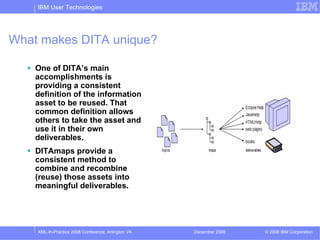
    One of DITA’s main
    accomplishments is
    providing a consistent
    definition of the information
    asset to be reused. That
    common definition allows
    others to take the asset and
    use it in their own
    deliverables.
    DITAmaps provide a
    consistent method to
    combine and recombine
    (reuse) those assets into
    meaningful deliverables.


    XML-In-Practice 2008 Conference, Arlington VA   December 2008   © 2008 IBM Corporation
IBM User Technologies


What makes DITA unique?

    Darwin: DITA utilizes principles
    of inheritance for specialization
    similar to OO programming
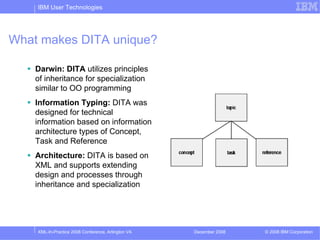
    Information Typing: DITA was
    designed for technical
    information based on information
    architecture types of Concept,
    Task and Reference
    Architecture: DITA is based on
    XML and supports extending
    design and processes through
    inheritance and specialization


    XML-In-Practice 2008 Conference, Arlington VA   December 2008   © 2008 IBM Corporation
IBM User Technologies


Then what is a DITA Wiki?

    Using a Wiki paradigm to provide a cohesive collection of
    core Web services:
    – DITA content authoring
    – collaboration community environment (with a familiar Wiki feel)
    – Dynamic content rendering and navigation
    An application comprised of a set of services
    – Features unique to Wikis
    – Features uniquely related to support of DITA
    – Common core services (server framework, back end,
      interfaces, etc.)


    XML-In-Practice 2008 Conference, Arlington VA   December 2008   © 2008 IBM Corporation
IBM User Technologies


Role of Enterprise wikis

   I think there are fundamental reasons why there is a demand
      or market for what are called “Enterprise wikis. ”
    Encourage deep contribution of knowledge as collateral
    across the company
    Enable collaboration for teams whose members are widely
    separated geographically
    Good for readers too: a wiki is as much a reading platform
    as an authoring platform
    Wide accessibility of this collected information across the
    enterprise.


     XML-In-Practice 2008 Conference, Arlington VA   December 2008   © 2008 IBM Corporation
IBM User Technologies


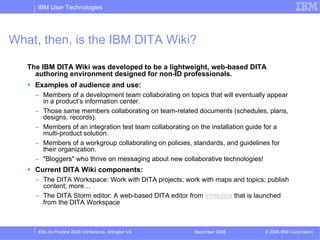
What, then, is the IBM DITA Wiki?

   The IBM DITA Wiki was developed to be a lightweight, web-based DITA
     authoring environment designed for non-ID professionals.
     Examples of audience and use:
     – Members of a development team collaborating on topics that will eventually appear
       in a product’s information center.
     – Those same members collaborating on team-related documents (schedules, plans,
       designs, records).
     – Members of an integration test team collaborating on the installation guide for a
       multi-product solution.
     – Members of a workgroup collaborating on policies, standards, and guidelines for
       their organization.
     – "Bloggers" who thrive on messaging about new collaborative technologies!
     Current DITA Wiki components:
     – The DITA Workspace: Work with DITA projects; work with maps and topics; publish
       content; more…
     – The DITA Storm editor: A web-based DITA editor from Inmedius that is launched
       from the DITA Workspace


     XML-In-Practice 2008 Conference, Arlington VA       December 2008          © 2008 IBM Corporation
IBM User Technologies


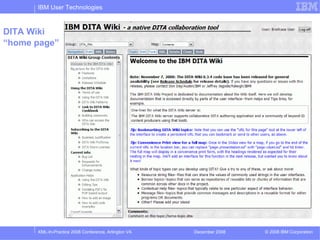
DITA Wiki
“home page”


      XML-In-Practice 2008 Conference, Arlington VA   December 2008   © 2008 IBM Corporation
IBM User Technologies


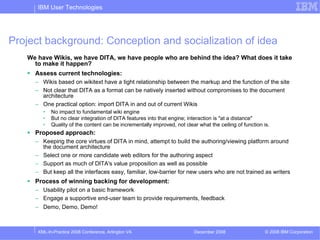
Project background: Conception and socialization of idea
   We have Wikis, we have DITA, we have people who are behind the idea? What does it take
     to make it happen?
     Assess current technologies:
     – Wikis based on wikitext have a tight relationship between the markup and the function of the site
     – Not clear that DITA as a format can be natively inserted without compromises to the document
       architecture
     – One practical option: import DITA in and out of current Wikis
        •   No impact to fundamental wiki engine
        •   But no clear integration of DITA features into that engine; interaction is "at a distance"
        •   Quality of the content can be incrementally improved, not clear what the ceiling of function is.
     Proposed approach:
     – Keeping the core virtues of DITA in mind, attempt to build the authoring/viewing platform around
       the document architecture
     – Select one or more candidate web editors for the authoring aspect
     – Support as much of DITA's value proposition as well as possible
     – But keep all the interfaces easy, familiar, low-barrier for new users who are not trained as writers
     Process of winning backing for development:
     – Usability pilot on a basic framework
     – Engage a supportive end-user team to provide requirements, feedback
     – Demo, Demo, Demo!


      XML-In-Practice 2008 Conference, Arlington VA                       December 2008                   © 2008 IBM Corporation
IBM User Technologies


Project goals

    Unify content plugin API and expectations
    – Share IBM DITA Wiki content with other collaborative services
    Enable output services for users
    – Make use of the ubiquitous DITA Open Toolkit
    – Remote server based to manage performance of the Wiki itself
    Enable packaging for:
    – Download to user's system
    – Sending to translation vendor
    – Sharing content with OEM


     XML-In-Practice 2008 Conference, Arlington VA   December 2008   © 2008 IBM Corporation
IBM User Technologies


Basic architecture

    PHP application framework (easy, agile for the prototype
    programmers)
    Layout based on popular Wiki/Web conventions (left nav and
    tools, right reading)
    Plugin architecture to enable better modularity, independent
    testing of new modules, easier unit test, etc..
    LDAP-based login to support corporate and license admin
    concerns
    Separate user groups, hosted on central server
    Briefcase mode allows unplugging and working away from
    the cloud


     XML-In-Practice 2008 Conference, Arlington VA   December 2008   © 2008 IBM Corporation
IBM User Technologies


The taterWiki editor plugin
  Bob Flavin, IBM Research, who has demonstrated an editor component in the
    DITA Wiki:
    – IBM has hosted several editors successfully on this platform. taterWiki is IBM's
      internal technology. The plugin interface allows clean separation and choice of
      appropriate tools for future goals. Bob Flavin, architect for taterWiki, provided these
      comments about the editor:
    – Documents used to be flat -- office documents today are just strings or letters, the
      software has very little concept of the relationships between parts of the document.
    – By representing the documents as heirarchical, semi-structured, semantically-
      tagged, formatting-free objects, aka DITA. The computer can start to assist us in
      searching the contents of the document and making them more useful.
    – taterWiki is a tool that allows these DITA documents to be shared and edited
      collaboratively in real-time or asynchronously, with fine-grained control over who can
      change what and what side effects these changes can have.
    – By maintaining the documents in an 'abstract' format -- free of the formating
      information that HTML, word and PDF documents are -- taterWiki can 'render' the
      documents in different manners depending on user's needs, preferences and
      privileges.
    – For example, you could be looking at a car repair manual for a 2005 Mustang with a
      6 cylinder engine as a mechanic while I'm looking at, and annotating the same
      document in a view appropriate an owner of a convertible, 2006 Mustang with the 4
      cylinder engine. Some parts of the manual will appear the same to both of us, some
      will be customed for our interests. Our ability to change or annotate the document
      depend on our roles and privileges.

     XML-In-Practice 2008 Conference, Arlington VA         December 2008            © 2008 IBM Corporation
IBM User Technologies


Live demo

    We will look at several demo content types and a
    sample interaction session.
    – Specifications
    – Collaborative "books"
    – Help sets
    – How to documentation


    XML-In-Practice 2008 Conference, Arlington VA   December 2008   © 2008 IBM Corporation
IBM User Technologies


Benefits and realizations

    Value of collaboration
    – content collaboration,
    – information harvesting/authoring
    Community building
    – Users of shared collaboration sites are implicitly part of
      whatever community roosts there. Care and feeding of
      the customer is never as important as when rolling out a
      new service! We learned some things about how to
      improve relationships all around.


     XML-In-Practice 2008 Conference, Arlington VA   December 2008   © 2008 IBM Corporation
IBM User Technologies


Benefits and realizations

    A sense of trust has a healthy infectious effect on users who
    come into the program with skeptical attitudes.
    – Don't overpromise on capabilities of the tool.
    – Be responsive and show leadership in dealing with whatever
      issues the new user has.
    Provide a support forum and community through which
    users and seekers can connect with each other and have a
    healthy dialog about change.
    – IBM has a DITA Advocates internal workgroup that provided
      both Q&A and presentation oriented telecons every month.
      Very active members of this group also help out with reviewing
      site content and mentoring new users of the DITA authoring
      tools in use across IBM.


     XML-In-Practice 2008 Conference, Arlington VA   December 2008   © 2008 IBM Corporation
IBM User Technologies


DITA Wiki Patterns
   The popular web site, wikipatterns.com, is a resource for ways to construct
     (or avoid) particular content or behaviors on a wiki site. You might think of
     a pattern as a convention, good or bad, that people can follow to achieve
     particular ends in a wiki.
   While standard wiki patterns (or anti-patterns) might apply in the DITA Wiki,
    the nature of having structured information in an enterprise environment
    necessarily invents new ways of looking at some behaviors or techniques.
    We've spotted these uniquely-DITA patterns so far on the site:
     People Patterns
     – DITA Guru
     (like the traditional Champion pattern but with skill in helping with DITA)
     People Anti-patterns
     – Fear of Breaking Something
     Adoption Patterns
     – DITA Linking
     – Templates and forks
     – Create new map from dir/query listings
     Adoption Anti-patterns
     – Access policies

      XML-In-Practice 2008 Conference, Arlington VA   December 2008        © 2008 IBM Corporation
IBM User Technologies


Lessons learned
    Templates rock!
    – Authors like having structure to start from
    – Template boilerplate ensures at least a starting consistency in
      an environment that would otherwise be anarchic
    – Any current topic is basically a template for some new use:
      "save as" = "fork" = "start with fairly ready-to-go existing
      boilerplate"
    Documentation Projects are not the only paradigm for using
    a Wiki
    Users need to be continually reminded to think outside their
    preconceptions
    Battle of the bulge (keeping the experience light in the
    presence of demand for more function)
    For viability, visibility counts!

    XML-In-Practice 2008 Conference, Arlington VA   December 2008   © 2008 IBM Corporation
IBM User Technologies


Future prospects

    The IBM DITA Wiki began as a rapid prototype that quickly
    proved its value and is on its way to becoming a dependable
    tool. Some of the clear things still to explore include:
    – Finish off remaining Wiki feature enablement.
    – Extend the plugin interfaces to make all aspects of the
      application "hot swappable" insofar as we can: new output
      transforms, alternate editors, alternate group UI schemes,
      choice of back end from file system to code versioning system
      to full CMS, and so forth.
    – Utilize web services to enable other tools to use our content or
      capabilities as policies allow.
    – Review the code for modularity and clean function.
    – Encourage a plugin building community to expand the tool to
      do amazing new things with DITA as content!


     XML-In-Practice 2008 Conference, Arlington VA   December 2008   © 2008 IBM Corporation
IBM User Technologies


Thanks!

  Any questions?


    Contact: Don Day (dond@us.ibm.com


    XML-In-Practice 2008 Conference, Arlington VA   December 2008   © 2008 IBM Corporation

Growing DITA across the enterprise

  • 1.
    IBM User Technologies GrowingDITA across the Enterprise: XML content collaboration for “The Crowd ” by Don Day Architect, Lightweight DITA Publishing User Technologies, IBM Corp. XML-In-Practice 2008 Conference, Arlington VA December, 2008 © 2008 IBM Corporation
  • 2.
    IBM User Technologies Agenda Introduction • Background on DITA and Wikis • What is DITA, and why? • What makes DITA unique? • Then what is a DITA Wiki? • Role of Enterprise Wikis • What, then, is the IBM DITA Wiki? – DITA Wiki “home page” Project Background • Conception and socialization of idea • Project Goals • Basic architecture – The taterWiki editor plugin Live demo Benefits and realizations • Value of collaboration – Community building • DITA Wiki patterns • Lessons learned • Future prospects Resources XML-In-Practice 2008 Conference, Arlington VA December 2008 © 2008 IBM Corporation
  • 3.
    IBM User Technologies Backgroundon DITA and Wikis DITA's topic architecture was designed around the natural units of content on the web: – a well-written web page is conceptually a topic; – a topic may be published to a web page. Formal suggestion presented by Paul Prescod at XTech 2005: – Structured Authoring in Wikis: The Convergence of Structure and Chaos" Key ideas socialized by Anne Gentle and Eric Armstrong In all, an idea finally coming to its time! XML-In-Practice 2008 Conference, Arlington VA December 2008 © 2008 IBM Corporation
  • 4.
    IBM User Technologies Whatis DITA, and why? XML starter set for technical documentation – Business appeal for implementation – allows you to start really simple with XML – Rich personalization through common metadata enables information development and delivery targeted to specific customer sets – Clearly defined extensibility through specialization allows your use to become complex as you gain experience – Core tag set based on common HTML tags and rich semantics which allows users to come up to speed quickly (tested) Addresses interoperability and sharing of content within and across corporations with specialization and fallback - allows DITA to be a platform for collaboration Open standard backed by IBM and others Dave Schell, founding corporate sponsor for DITA: – “DITA is a foundation for collaboration.” XML-In-Practice 2008 Conference, Arlington VA December 2008 © 2008 IBM Corporation
  • 5.
    IBM User Technologies Whatmakes DITA unique? One of DITA’s main accomplishments is providing a consistent definition of the information asset to be reused. That common definition allows others to take the asset and use it in their own deliverables. DITAmaps provide a consistent method to combine and recombine (reuse) those assets into meaningful deliverables. XML-In-Practice 2008 Conference, Arlington VA December 2008 © 2008 IBM Corporation
  • 6.
    IBM User Technologies Whatmakes DITA unique? Darwin: DITA utilizes principles of inheritance for specialization similar to OO programming Information Typing: DITA was designed for technical information based on information architecture types of Concept, Task and Reference Architecture: DITA is based on XML and supports extending design and processes through inheritance and specialization XML-In-Practice 2008 Conference, Arlington VA December 2008 © 2008 IBM Corporation
  • 7.
    IBM User Technologies Thenwhat is a DITA Wiki? Using a Wiki paradigm to provide a cohesive collection of core Web services: – DITA content authoring – collaboration community environment (with a familiar Wiki feel) – Dynamic content rendering and navigation An application comprised of a set of services – Features unique to Wikis – Features uniquely related to support of DITA – Common core services (server framework, back end, interfaces, etc.) XML-In-Practice 2008 Conference, Arlington VA December 2008 © 2008 IBM Corporation
  • 8.
    IBM User Technologies Roleof Enterprise wikis I think there are fundamental reasons why there is a demand or market for what are called “Enterprise wikis. ” Encourage deep contribution of knowledge as collateral across the company Enable collaboration for teams whose members are widely separated geographically Good for readers too: a wiki is as much a reading platform as an authoring platform Wide accessibility of this collected information across the enterprise. XML-In-Practice 2008 Conference, Arlington VA December 2008 © 2008 IBM Corporation
  • 9.
    IBM User Technologies What,then, is the IBM DITA Wiki? The IBM DITA Wiki was developed to be a lightweight, web-based DITA authoring environment designed for non-ID professionals. Examples of audience and use: – Members of a development team collaborating on topics that will eventually appear in a product’s information center. – Those same members collaborating on team-related documents (schedules, plans, designs, records). – Members of an integration test team collaborating on the installation guide for a multi-product solution. – Members of a workgroup collaborating on policies, standards, and guidelines for their organization. – "Bloggers" who thrive on messaging about new collaborative technologies! Current DITA Wiki components: – The DITA Workspace: Work with DITA projects; work with maps and topics; publish content; more… – The DITA Storm editor: A web-based DITA editor from Inmedius that is launched from the DITA Workspace XML-In-Practice 2008 Conference, Arlington VA December 2008 © 2008 IBM Corporation
  • 10.
    IBM User Technologies DITAWiki “home page” XML-In-Practice 2008 Conference, Arlington VA December 2008 © 2008 IBM Corporation
  • 11.
    IBM User Technologies Projectbackground: Conception and socialization of idea We have Wikis, we have DITA, we have people who are behind the idea? What does it take to make it happen? Assess current technologies: – Wikis based on wikitext have a tight relationship between the markup and the function of the site – Not clear that DITA as a format can be natively inserted without compromises to the document architecture – One practical option: import DITA in and out of current Wikis • No impact to fundamental wiki engine • But no clear integration of DITA features into that engine; interaction is "at a distance" • Quality of the content can be incrementally improved, not clear what the ceiling of function is. Proposed approach: – Keeping the core virtues of DITA in mind, attempt to build the authoring/viewing platform around the document architecture – Select one or more candidate web editors for the authoring aspect – Support as much of DITA's value proposition as well as possible – But keep all the interfaces easy, familiar, low-barrier for new users who are not trained as writers Process of winning backing for development: – Usability pilot on a basic framework – Engage a supportive end-user team to provide requirements, feedback – Demo, Demo, Demo! XML-In-Practice 2008 Conference, Arlington VA December 2008 © 2008 IBM Corporation
  • 12.
    IBM User Technologies Projectgoals Unify content plugin API and expectations – Share IBM DITA Wiki content with other collaborative services Enable output services for users – Make use of the ubiquitous DITA Open Toolkit – Remote server based to manage performance of the Wiki itself Enable packaging for: – Download to user's system – Sending to translation vendor – Sharing content with OEM XML-In-Practice 2008 Conference, Arlington VA December 2008 © 2008 IBM Corporation
  • 13.
    IBM User Technologies Basicarchitecture PHP application framework (easy, agile for the prototype programmers) Layout based on popular Wiki/Web conventions (left nav and tools, right reading) Plugin architecture to enable better modularity, independent testing of new modules, easier unit test, etc.. LDAP-based login to support corporate and license admin concerns Separate user groups, hosted on central server Briefcase mode allows unplugging and working away from the cloud XML-In-Practice 2008 Conference, Arlington VA December 2008 © 2008 IBM Corporation
  • 14.
    IBM User Technologies ThetaterWiki editor plugin Bob Flavin, IBM Research, who has demonstrated an editor component in the DITA Wiki: – IBM has hosted several editors successfully on this platform. taterWiki is IBM's internal technology. The plugin interface allows clean separation and choice of appropriate tools for future goals. Bob Flavin, architect for taterWiki, provided these comments about the editor: – Documents used to be flat -- office documents today are just strings or letters, the software has very little concept of the relationships between parts of the document. – By representing the documents as heirarchical, semi-structured, semantically- tagged, formatting-free objects, aka DITA. The computer can start to assist us in searching the contents of the document and making them more useful. – taterWiki is a tool that allows these DITA documents to be shared and edited collaboratively in real-time or asynchronously, with fine-grained control over who can change what and what side effects these changes can have. – By maintaining the documents in an 'abstract' format -- free of the formating information that HTML, word and PDF documents are -- taterWiki can 'render' the documents in different manners depending on user's needs, preferences and privileges. – For example, you could be looking at a car repair manual for a 2005 Mustang with a 6 cylinder engine as a mechanic while I'm looking at, and annotating the same document in a view appropriate an owner of a convertible, 2006 Mustang with the 4 cylinder engine. Some parts of the manual will appear the same to both of us, some will be customed for our interests. Our ability to change or annotate the document depend on our roles and privileges. XML-In-Practice 2008 Conference, Arlington VA December 2008 © 2008 IBM Corporation
  • 15.
    IBM User Technologies Livedemo We will look at several demo content types and a sample interaction session. – Specifications – Collaborative "books" – Help sets – How to documentation XML-In-Practice 2008 Conference, Arlington VA December 2008 © 2008 IBM Corporation
  • 16.
    IBM User Technologies Benefitsand realizations Value of collaboration – content collaboration, – information harvesting/authoring Community building – Users of shared collaboration sites are implicitly part of whatever community roosts there. Care and feeding of the customer is never as important as when rolling out a new service! We learned some things about how to improve relationships all around. XML-In-Practice 2008 Conference, Arlington VA December 2008 © 2008 IBM Corporation
  • 17.
    IBM User Technologies Benefitsand realizations A sense of trust has a healthy infectious effect on users who come into the program with skeptical attitudes. – Don't overpromise on capabilities of the tool. – Be responsive and show leadership in dealing with whatever issues the new user has. Provide a support forum and community through which users and seekers can connect with each other and have a healthy dialog about change. – IBM has a DITA Advocates internal workgroup that provided both Q&A and presentation oriented telecons every month. Very active members of this group also help out with reviewing site content and mentoring new users of the DITA authoring tools in use across IBM. XML-In-Practice 2008 Conference, Arlington VA December 2008 © 2008 IBM Corporation
  • 18.
    IBM User Technologies DITAWiki Patterns The popular web site, wikipatterns.com, is a resource for ways to construct (or avoid) particular content or behaviors on a wiki site. You might think of a pattern as a convention, good or bad, that people can follow to achieve particular ends in a wiki. While standard wiki patterns (or anti-patterns) might apply in the DITA Wiki, the nature of having structured information in an enterprise environment necessarily invents new ways of looking at some behaviors or techniques. We've spotted these uniquely-DITA patterns so far on the site: People Patterns – DITA Guru (like the traditional Champion pattern but with skill in helping with DITA) People Anti-patterns – Fear of Breaking Something Adoption Patterns – DITA Linking – Templates and forks – Create new map from dir/query listings Adoption Anti-patterns – Access policies XML-In-Practice 2008 Conference, Arlington VA December 2008 © 2008 IBM Corporation
  • 19.
    IBM User Technologies Lessonslearned Templates rock! – Authors like having structure to start from – Template boilerplate ensures at least a starting consistency in an environment that would otherwise be anarchic – Any current topic is basically a template for some new use: "save as" = "fork" = "start with fairly ready-to-go existing boilerplate" Documentation Projects are not the only paradigm for using a Wiki Users need to be continually reminded to think outside their preconceptions Battle of the bulge (keeping the experience light in the presence of demand for more function) For viability, visibility counts! XML-In-Practice 2008 Conference, Arlington VA December 2008 © 2008 IBM Corporation
  • 20.
    IBM User Technologies Futureprospects The IBM DITA Wiki began as a rapid prototype that quickly proved its value and is on its way to becoming a dependable tool. Some of the clear things still to explore include: – Finish off remaining Wiki feature enablement. – Extend the plugin interfaces to make all aspects of the application "hot swappable" insofar as we can: new output transforms, alternate editors, alternate group UI schemes, choice of back end from file system to code versioning system to full CMS, and so forth. – Utilize web services to enable other tools to use our content or capabilities as policies allow. – Review the code for modularity and clean function. – Encourage a plugin building community to expand the tool to do amazing new things with DITA as content! XML-In-Practice 2008 Conference, Arlington VA December 2008 © 2008 IBM Corporation
  • 21.
    IBM User Technologies Thanks! Any questions? Contact: Don Day (dond@us.ibm.com XML-In-Practice 2008 Conference, Arlington VA December 2008 © 2008 IBM Corporation