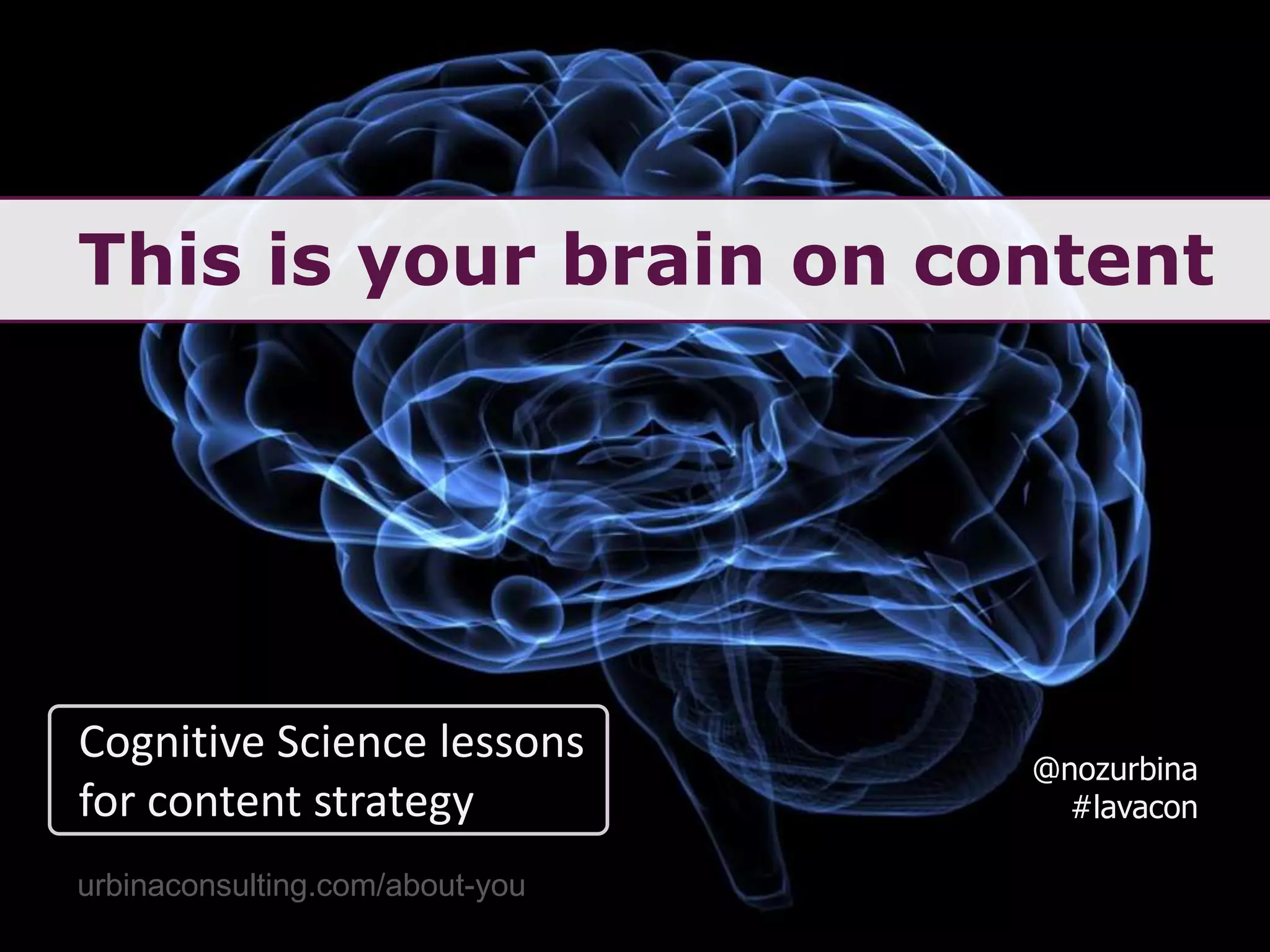







This is your brain on content
@nozurbina
#lavacon
urbinaconsulting.com/about-you
Cognitive Science lessons
for content strategy
@nozurbina #LavaCon
This is your brain on content:
Cognitive Science lessons for content
strategy
Noz Urbina
Founder and Content Strategist
Urbina Consulting
urbinaconsulting.com/about-you
@nozurbinaMe (Noz Urbina)
Content strategist & modeller
Consultant/trainer
Author
Futurist
H2H (Human-Human/B2B/B2C)
urbinaconsulting.com/events
89 3929 31 x88
24g
UC.com 2015
thecontentstrategybook.com
The problem
4
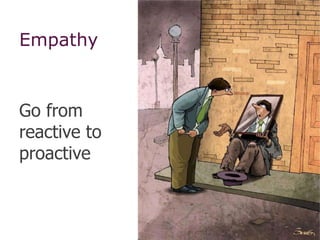
@nozurbinaEmpathy
5
Go from
reactive to
proactive
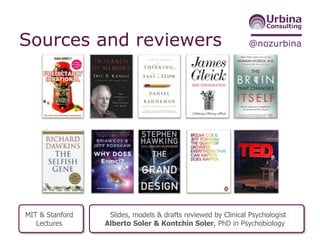
@nozurbinaSources and reviewers
@nozurbina - 6
MIT & Stanford
Lectures
Slides, models & drafts reviewed by Clinical Psychologist
Alberto Soler & Kontchín Soler, PhD in Psychobiology
To influence behaviour…
…we must understand
behaviour
Behaviour starts and
ends in the mind
http://bit.ly/brainneb
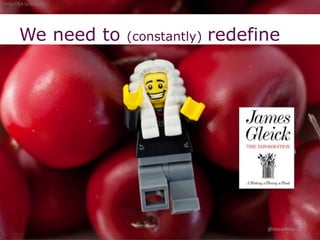
We need to (constantly) redefine
@nozurbina - 8
http://bit.ly/1cqjUbv
Communication
and the mind
http://bit.ly/brainneb
The topic
Intelligent Content
supports our biological,
mental processes better
than traditional content
http://bit.ly/brainneb
The thesis
WE ARE SENSE MAKING
MACHINES
We’ll make it up if we have to
11
@nozurbinaBABY
12
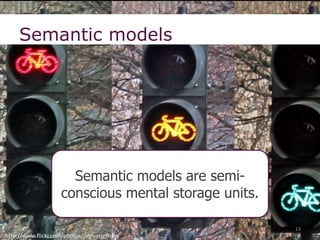
Semantic models
13
http://www.flickr.com/photos/denverjeffrey/
Semantic models are semi-
conscious mental storage units.
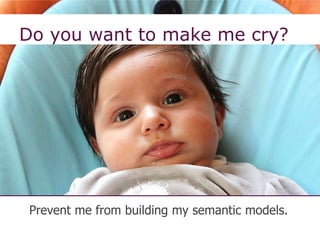
Do you want to make me cry?
14
Prevent me from building my semantic models.
QUALITY CHECK
How good are our models?
15
16
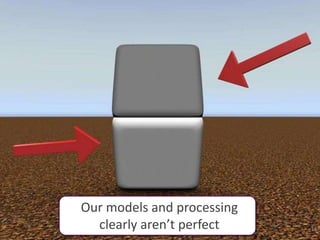
Our models and processing
clearly aren’t perfect
Thinking Systems 2 and 1
17
Brain economics and the
cost/benefit of cognition
@nozurbinaThinking System 2
• Plays poker and chess (unless
you’re a master, and can use System 1)
• Contains our conscious
experience
• Analyses, reflects on and digests
content
• Taxed when learning new skills
• Delegates to System 1
whenever possible 18
S l o o o w
“Expensive”
Tiring
@nozurbinaThinking System 1
• “The zone”, “the gut”, “the heart”,
“lateral thinking” and inspiration
• Drives, plays violin (any embedded skill)
• Picks up on body language, style,
mood, metaphor, symbolism, etc.
(using associative memory)
• Uses compression & semantic models
• Skims content (using keywords, colour,
shapes and other fast cues)
19
Fast!
“Cheap”
(Nearly)
Effortless
FEEL THE DIFFERENCE
Answer these questions
(in your head)
20
FEEL THE DIFFERENCE
What’s your first name?
21
FEEL THE DIFFERENCE
What month were you born?
22
FEEL THE DIFFERENCE
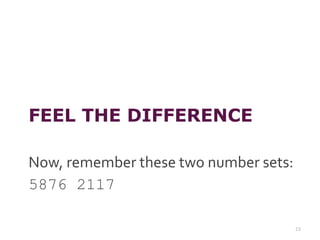
Now, remember these two number sets:
5876 2117
23
FEEL THE DIFFERENCE
Increment each digit of each set UP by
one
24
FEEL THE DIFFERENCE
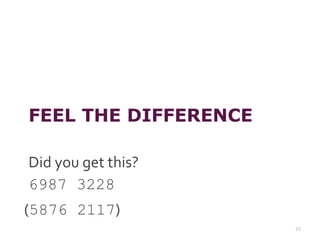
Did you get this?
6987 3228
25
(5876 2117)
WATCH THEM FIGHT
A different kind of illusion
26
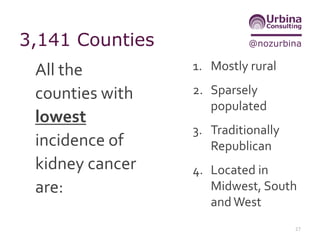
@nozurbina3,141 Counties
All the
counties with
lowest
incidence of
kidney cancer
are:
27
1. Mostly rural
2. Sparsely
populated
3. Traditionally
Republican
4. Located in
Midwest, South
and West
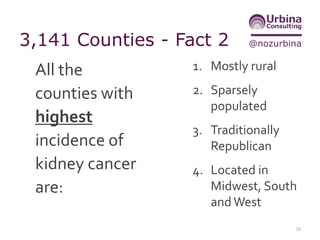
@nozurbina3,141 Counties - Fact 2
All the
counties with
highest
incidence of
kidney cancer
are:
28
1. Mostly rural
2. Sparsely
populated
3. Traditionally
Republican
4. Located in
Midwest, South
and West
@nozurbina
WTF?
29
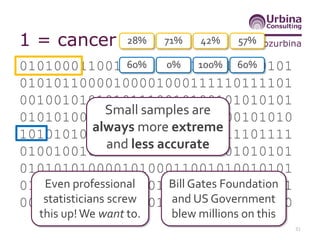
@nozurbina1 = cancer
01010001100101001010101111010101
01010110000100001000111110111101
00100101010101110010100101010101
01010100001010101110010100101010
10101010100001000010001111101111
01001001010101011100101001010101
01010101000010100011001010010101
01111010101010101010101011100101
00101010101010101010101010111110
31
Even professional
statisticians screw
this up!We want to.
Small samples are
always more extreme
and less accurate
Bill Gates Foundation
and US Government
blew millions on this
28%
60%
71%
0%
42%
100%
57%
60%
@nozurbina
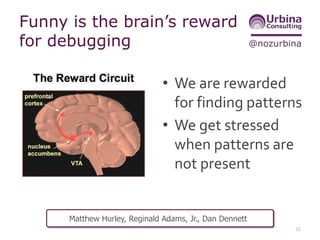
Funny is the brain’s reward
for debugging
• We are rewarded
for finding patterns
• We get stressed
when patterns are
not present
32
Matthew Hurley, Reginald Adams, Jr., Dan Dennett
@nozurbina
33
34
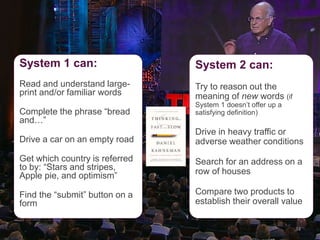
System 1 can:
Read and understand large-
print and/or familiar words
Complete the phrase “bread
and…”
Drive a car on an empty road
Get which country is referred
to by: “Stars and stripes,
Apple pie, and optimism”
Find the “submit” button on a
form
System 2 can:
Try to reason out the
meaning of new words (if
System 1 doesn’t offer up a
satisfying definition)
Drive in heavy traffic or
adverse weather conditions
Search for an address on a
row of houses
Compare two products to
establish their overall value
@nozurbina
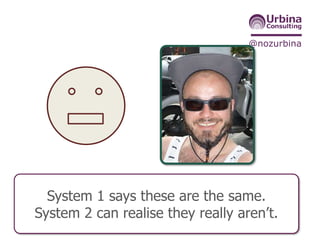
System 1 says these are the same.
System 2 can realise they really aren’t.
@nozurbina
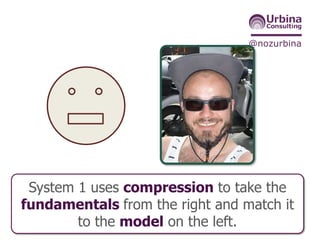
System 1 uses compression to take the
fundamentals from the right and match it
to the model on the left.
@nozurbina
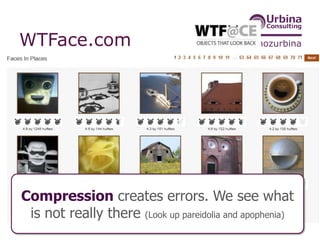
http://wtface.com/
WTFace.com
Compression creates errors. We see what
is not really there (Look up pareidolia and apophenia)
COMPRESSION ERROR
ILLUSIONS
Experience vs. Memory
38
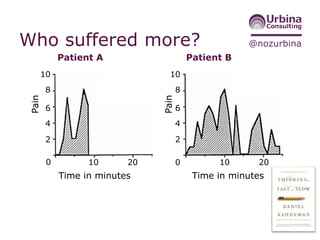
@nozurbinaWho suffered more?
Time in minutes
Pain
0 10 20
2
4
6
8
10
Patient A
Time in minutes
Pain
0 10 20
2
4
6
8
10
Patient B
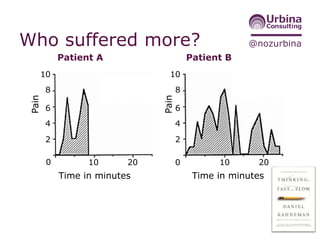
@nozurbinaWho suffered more?
Time in minutes
Pain
0 10 20
2
4
6
8
10
Patient A
Time in minutes
Pain
0 10 20
2
4
6
8
10
Patient B
Memory trumps experience
…what we get to keep from
our experiences is a story.
What defines a story are
changes, significant
moments and endings.
Endings are very, very
important.
The remembering
self is a storyteller
41
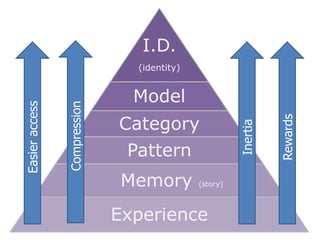
THE EXPERIENCE TO
IDENTITY PYRAMID
The semantic ladder for anything with interactivity
43
44
I.D.
(identity)
Model
Category
Pattern
Memory (story)
Experience
Easieraccess
Compression
Rewards
Inertia
@nozurbina
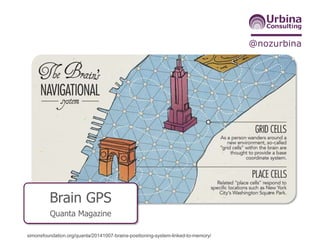
Brain GPS
Quanta Magazine
simonsfoundation.org/quanta/20141007-brains-positioning-system-linked-to-memory/
@nozurbina
Brain GPS
Quanta Magazine
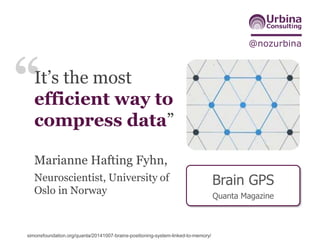
It’s the most
efficient way to
compress data”
Marianne Hafting Fyhn,
Neuroscientist, University of
Oslo in Norway
simonsfoundation.org/quanta/20141007-brains-positioning-system-linked-to-memory/
Our brains reward the
creation of new models
and IDs
But it’s always
“cheaper” to relate new
ones to old ones
http://bit.ly/brainneb
48
http://en.wikipedia.org/wiki/File:Dopamineseratonin.png
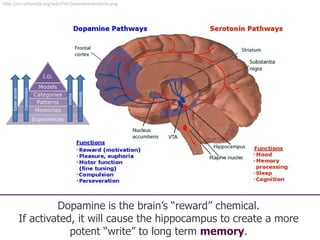
Dopamine is the brain’s “reward” chemical.
If activated, it will cause the hippocampus to create a more
potent “write” to long term memory.
I.D.
Models
Categories
Patterns
Memories
Experiences
Easieraccess
Compression
Rewards
Inertia
49
http://en.wikipedia.org/wiki/File:Dopamineseratonin.png
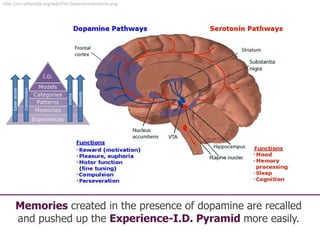
Memories created in the presence of dopamine are recalled
and pushed up the Experience-I.D. Pyramid more easily.
I.D.
Models
Categories
Patterns
Memories
Experiences
Easieraccess
Compression
Rewards
Inertia
@nozurbina
50
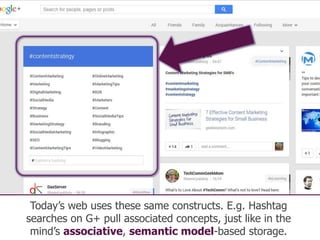
Today’s web uses these same constructs. E.g. Hashtag
searches on G+ pull associated concepts, just like in the
mind’s associative, semantic model-based storage.
HOW WILL YOUR BRAND
STAND UP TO
COMPRESSION?
51
@nozurbina
52
http://3rdbillion.net/2014/01/apple-logo-2/
INTELLIGENT CONTENT
Intelligent content enables agility from experience to identity
53
@nozurbina
54
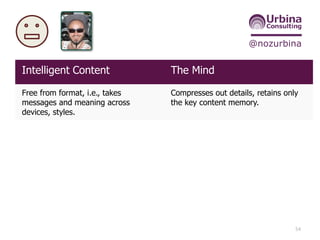
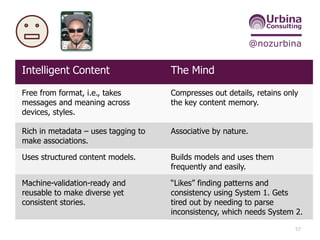
Intelligent Content The Mind
Free from format, i.e., takes
messages and meaning across
devices, styles.
Compresses out details, retains only
the key content memory.
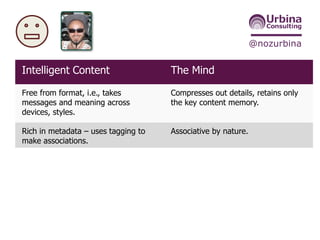
Rich in metadata – uses tagging to
make associations.
Associative by nature.
Uses structured content models. Builds models and uses them
frequently and easily.
Machine-validation-ready and
reusable to make diverse yet
consistent stories.
“Likes” finding patterns and
consistency using System 1. Gets
tired out by needing to parse
inconsistency, which needs System 2.
@nozurbina
55
Intelligent Content The Mind
Free from format, i.e., takes
messages and meaning across
devices, styles.
Compresses out details, retains only
the key content memory.
Rich in metadata – uses tagging to
make associations.
Associative by nature.
Uses structured content models. Builds models and uses them
frequently and easily.
Machine-validation-ready and
reusable to make diverse yet
consistent stories.
“Likes” finding patterns and
consistency using System 1. Gets
tired out by needing to parse
inconsistency, which needs System 2.
@nozurbina
56
Intelligent Content The Mind
Free from format, i.e., takes
messages and meaning across
devices, styles.
Compresses out details, retains only
the key content memory.
Rich in metadata – uses tagging to
make associations.
Associative by nature.
Uses structured content models. Builds models and uses them
frequently and easily.
Machine-validation-ready and
reusable to make diverse yet
consistent stories.
“Likes” finding patterns and
consistency using System 1. Gets
tired out by needing to parse
inconsistency, which needs System 2.
@nozurbina
57
Intelligent Content The Mind
Free from format, i.e., takes
messages and meaning across
devices, styles.
Compresses out details, retains only
the key content memory.
Rich in metadata – uses tagging to
make associations.
Associative by nature.
Uses structured content models. Builds models and uses them
frequently and easily.
Machine-validation-ready and
reusable to make diverse yet
consistent stories.
“Likes” finding patterns and
consistency using System 1. Gets
tired out by needing to parse
inconsistency, which needs System 2.
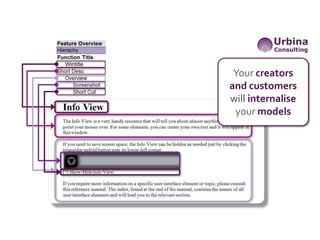
Your creators
and customers
will internalise
your models
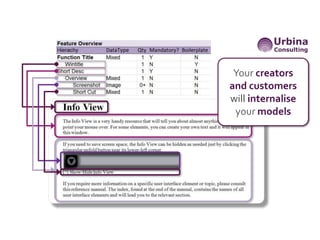
Your creators
and customers
will internalise
your models
@nozurbina
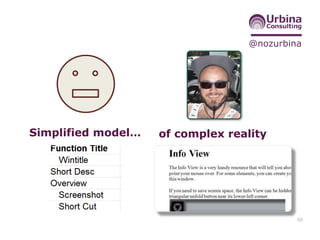
Simplified model…
60
of complex reality
@nozurbina
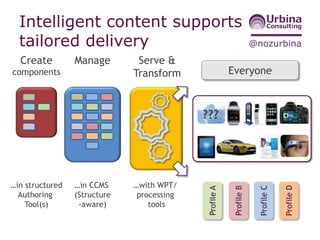
Intelligent content supports
tailored delivery
Manage Serve &
Transform
Create
components
ProfileA
ProfileB
ProfileC
ProfileD
Same content
Everyone
…with WPT/
processing
tools
…in CCMS
(Structure
-aware)
…in structured
Authoring
Tool(s)
???
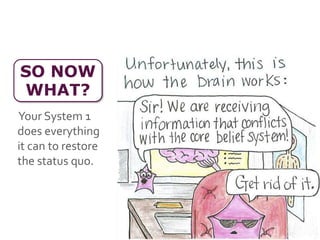
Your System 1
does everything
it can to restore
the status quo.
SO NOW
WHAT?
SOME PARTING
THOUGHTS
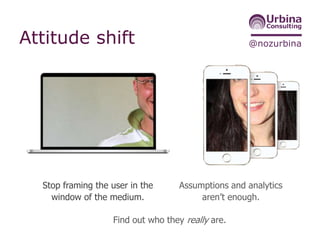
@nozurbinaAttitude shift
Stop framing the user in the
window of the medium.
Assumptions and analytics
aren’t enough.
Find out who they really are.
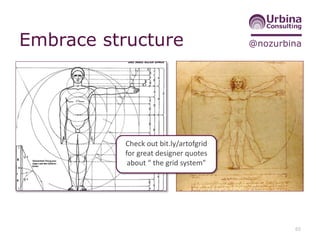
@nozurbinaEmbrace structure
65
Check out bit.ly/artofgrid
for great designer quotes
about “ the grid system”
HOMEWORK
Specific lessons and terms to take home
66
(some of which are in
our book. Nudge
nudge, wink wink)
@nozurbinaEmbrace Intelligent Content
• Write for system 1 and system 2
• Explicitly define the semantic models implicit in
your content
– Map out the different perspectives and contexts in
which content will be used
• Give creators clear tools to create and visualise
their work across contexts
• Store semantic content so machines validate it
and can help you deliver tailored experiences
67
@nozurbinaEmbrace Intelligent Content
• Measure user memory of whole journeys
– UX is just a means to an end
– Digital alone CANNOT SHOW a customer’s full
journey
• Set up your team properly
– “Chief content officer” and “chief experience officers” are
becoming real things
– Get content creators, strategists, engineers (and the rest)
who understand the value-add of each other’s work
• Start bashing your boss’s System 1 and 2
68

This is Your Brain on Content: Cognitive Science Lessons for Content Strategy

Editor's Notes

  • #2 A communicator’s life involves continual justification. Everyone can write, right? Some people might need a fancier editing tool or a copy of Photoshop if they’re ‘Special writers’, but structured tools? Management systems? A myriad of training courses? Consultancy and systems integration? Isn’t that all just extravagant? All we need is a manual, right? Wrong. But how can you get that clear to those who are not so closely engaged in content? You need to convey the message that content issues can’t wait, but in a compelling attractive way. Tip #1: don’t say, “Content is king”. You can win support, get long-term mind-share, not get left out of product management and budget decisions and avoid being a tick-in-the-box afterthought in the corporate strategy, if you know how. Based on a career of winning budget and mindshare in a wide array of audiences, this session enumerates some key tips to get you started, no matter the size of your budget or situation.
  • #5 We are in a world of continuously accelerating change, and we are living longer and longer Every generation is facing more change than every other that has ever lived There is nothing new in the world, but things are very nearly new Every time this happens we have a shock to the system that has the same requirements Newton had to redefine mass, force, time, motion Motion used to just mean change, like a peach ripening P.7 The Information
  • #6 This whole session could be considered an in-depth focus on empathy Go deep into the fundamentals understand all people so that we can better support and persuade the behaviour of our audiences And ourselves find the clarity and justification required to take the necessary steps Keep seeing all these times where we get sideswiped when if we had been looking at the BIGGER PICTURE. We could have anticipated. i am going to talk about the brain, how it functions and how the lessons of cognitive science can lead us to better user empathy i am going to present my own theories and models that i have developed over nearly 3 years of research regarding how we can and must rethink content for the new millenium i am doing this in hopes that we as industry can be more proactive, and less reactive, and those that chose to will be able to stay if not ahead of the curve, then ahead at least keep their heads above water as the tidal wave of change continues to batter us. The biological mechanisms of the brain offer many valuable insights into the new millennia content problems Those same mechanisms create the challenges for us in improving our content The thing we are trying to address in our audience is exactly what is holding us back.
  • #7 Dr Psychobiology PhD Clinical Psychology MS
  • #8 http://bit.ly/brainneb The brain is a sense maker virtual reality machine reward system
  • #9 To invent physics, Newton had to redefine various words like “mass”, “force”, “time”, and “motion”. He was trying to describe things never before described. Digital technology is putting the same pressure on communicators. People have never communicated this way before. Our biology is not designed for paradigm shifts Newton had to redefine mass, force, time, motion Motion used to just mean change, like a peach ripening P.7 The Information We must build the new conceptual vocabulary required, so we can discuss the issues and work out solutions. http://bit.ly/1cqjUbv
  • #10 Semantically rich and tagged Structured Validation-ready We need to think of language at the level of “systems”, not words or pages. Intelligent content is free from format, rich in semantic and structural metadata, and automation-system-ready.
  • #11 Semantically rich and tagged Structured Validation-ready
  • #14 We can call up a semantic model instantly and know how to react or interact.
  • #17 www.funonthenet.in
  • #19 Handles categorisation and retrieval Does “heuristic assessment” of complex questions Holds our racism, sexism, nationalism, and other “isms”
  • #20 Handles categorisation and retrieval Does “heuristic assessment” of complex questions Holds our racism, sexism, nationalism, and other “isms”
  • #32 This is thought illusion.
  • #33 Ergo Need to carefully control how attention is spent, avoiding low-value spend and focusing on high-value spend Matthew Hurley, Reginald Adams, Jr., Dan Dennett Putting together a book which will look at "Funny as debugging". Cognitive rewards for doing semantic adjustment
  • #36 Alvin Toffler is an American writer and futurist, known for his works discussing the digital revolution, communication revolution, corporate revolution and technological singularity. 
  • #37 Alvin Toffler is an American writer and futurist, known for his works discussing the digital revolution, communication revolution, corporate revolution and technological singularity. 
  • #38 Alvin Toffler is an American writer and futurist, known for his works discussing the digital revolution, communication revolution, corporate revolution and technological singularity. 
  • #39 So we have met system 1 and 2 and understood how compression and load balancing work at a basic level. Now let’s see some more complex examples that relate to user’s content experiences.
  • #45 Jerry story… Anything with interactivity goes through this cycle. It creates inertia. It takes lots of experiences to change one of these. We are discouraged from initially changing them, but we get a reward for getting to the top. Our brain is rewarding us for making new IDs. t’s always cheaper to make new ones based on existing models.
  • #48 If you will allow me to geek out for a second the limbic system manages our basic stimulus responses coordinates recoding memory Contains Amygdala (emotions) wand the Hippocampus (Memory administrator) Get Amygdala giving dopamine and get an easier “write” Get past the hard parts of the pyramid to the top automatically get dopamine release. Also get one if you relate two existing models. This creates emotional and semantic ‘halo effects’, which stand up really well to compression. Simple: Mnemonic devices slogans that rhyme Complex: taxonomies GEEK FEST OVER – LET’S SEE AN EXAMPLE
  • #53 http://3rdbillion.net/2014/01/apple-logo-2/
  • #59 45 IN / 5 LEFT Variant and configuration management
  • #60 45 IN / 5 LEFT Variant and configuration management
  • #61 This model explicitly maps out the various semantic components of a feature overview. All content of the type “feature overview” should match the model. (computers can quality check content structures for you if you create semantic, structured content)
  • #62 http://www.markboulton.co.uk/journal/wysiwtfftwomg http://thecontentwrangler.com/2011/01/17/what-is-intelligent-content/ Interactive Kioskwww.omnimediaworld.co.id - Manufacturing | Datasheets | Templates & Design Exampleswww.stocklayouts.com - 500 × 310 - Search by image 2768391365_9d870914cf_o.jpgwww.flickr.com - 2816 × 2112 - Search by image www.flickr.com/photos/mnsc/2768391365/
  • #63 New ideas are “brain-expensive”, so they are naturally dropped during compression, or we try to mould and fold them into existing ones. Some of you will join the party, and you’ll tell your bosses all about this. NO! You’ll just tell them that the game has fundamentally changed. You’ll show them some examples of other websites and talk about how we need to picture customers as real, complete people living their lives and see what their realities with the brand and industry are like, so you can leapfrog the competition, or maintain your leadership by a mile, not have them nipping at your ankles
  • #64 Some of you will join the party, and you’ll tell your bosses all about this. NO! You’ll just tell them that the game has fundamentally changed. You’ll show them some examples of other websites and talk about how we need to picture customers as real, complete people living their lives and see what their realities with the brand and industry are like, so you can leapfrog the competition, or maintain your leadership by a mile, not have them nipping at your ankles
  • #65 content example – Roomba and Scooba Users Sales person in a retail store (extranet) Prospective customer shopping online Scenarios Content models RS Components – “This is what we know about how our customers buy” Huddle – “The Brand is this pantonne color and this Font”
  • #66 http://graphicdesign.stackexchange.com/questions/25143/what-is-this-circle-technique-called/25151#25151 Randomness is never found in anything that is intended for any use
  • #69 Cleve said, Marketing has too much muscle and own the customer. He is also predicting new roles coming out.