DITA Collaboration for ContentBy Don R. DayLearningbyWrote.com1/17/20111
DITA Collaboration for ContentAbstract: Subject matter experts in your company create many types of valuable content; the problem is in converting that content into reuseable business assets. You can turn Lost Content into Intelligent Content using structured collaboration.1/17/20112
The Knowledge Conundrum:"Where is the wisdom we have lost in knowledge?Where is the knowledge we have lost in information?"--T.S. EliotEnd of 2010: 205.8 million registered domains50 to 120 billion indexed pages ** http://thenextweb.com/shareables/2011/01/11/infographic-how-big-is-the-internet/1/17/20113
What is Knowledge Management?"Information economy" goals:Gathering and processing data competitivelyApplying information for economic advantage"Knowledge economy" goals:Tacit knowledge (intuitive, mentored) vs Explicit knowledge (documented)Connecting people to enhance knowledge poolingTreating knowledge as a business product (such as consulting)1/17/20114
Types of knowledge assets:Customer knowledgeCRM systems--often "who knows who" networkingCompetitor knowledgeMarket strategyProduct knowledgeHow your product works, how well your product is described to customers (fail searches or failed "drag" opportunities)Process knowledgePractices, trends, experienceFinancial knowledgeOperations and resource managementPeople knowledgeIdentifying skills and expertise, making connections1/17/20115
Knowledge is easily lost:TurnoverHard-to-use tools impede the writing processObscure or non-standard formatsNot up-to-dateNot well described or indexedNot team reviewed and approvedContext may be missing for understanding the data1/17/20116
Pain Points informal survey on LinkedIn:Inadequate time for writers to curate their own work, ensuring good use of semantics, grammar, markup usage, etc..Quantity is rewarded more than quality.Plethora of tools and formats with no organizing methodologyInadequate CMS integration around semantics that ARE available in disparate data setsInadequate awareness of how to use semantics effectively (ie, keyword tagging and appropriate markup selection.Inadequate social support (coaching dynamics, assistive interfaces, training and docs)1/17/20117
Managing content in a collaboration spaceWhat is a typical content lifecycle?Preparation (analysis and design)Initial document creationFeedback and modification (test)Approval (publication/build implementation)Subsequent updates and modification (support, enhancements)1/17/20118
Managing content, cont.Content curation is a new term. What is it?Selection & OrganizationWhat is significant?What needs explanation and synthesis?What needs corrected?Authentication (review and agreement on quality)Indexing/tagging and enriching semantically1/17/20119
Managing content, cont.Options for turning original/curated content into reusable resources:Rule-driven, heuristic tools (for example, using LegalZoom to create online wills, other DIY advice)Specialist-vetted FAQs and How-To topicsCommercial eBooks (which typically lack synthesis or correction in their curation)Misconception: We'll let engineers write the end user docs for us on a wiki!1/17/201110
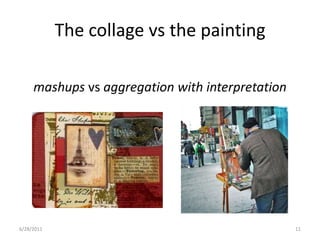
The collage vs the paintingmashupsvsaggregation with interpretation1/17/201111
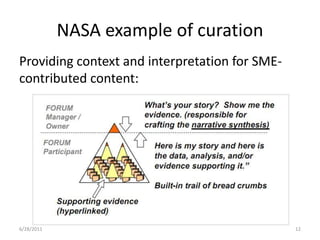
NASA example of curationProviding context and interpretation for SME-contributed content:1/17/201112
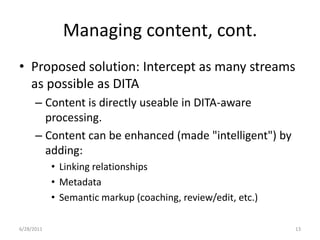
Managing content, cont.Proposed solution: Intercept as many streams as possible as DITAContent is directly useable in DITA-aware processing.Content can be enhanced (made "intelligent") by adding:Linking relationshipsMetadataSemantic markup (coaching, review/edit, etc.)1/17/201113
How does DITA fit into KM strategies?Ann Rockley defines Intelligent Content as:“content which is structurally rich and semantically aware, thereforeautomatically discoverable, reusable, reconfigurable, and adaptable.”Collaboration is a product of writers, consumers, and mediators working together on a body of knowledgeCollaborative discourse tends to provide context for knowledge. Topics are Good!XML technologies help by:Enabling content interchange with organizations across the companyEnabling content interchange with partners, contractors, OEMsEnabling dialog between companies and customersFacilitating process definition and execution within the companyDITA (Darwin Information Typing Architecture) is an XML application designed to provide many of these benefits.1/17/201114
What can you capture?Ideas (one to many, blogs)How-to contributions (eliciting deep product knowledge and best practices)Examples (programs, recipes, crafts, etc.)"Tags" for retrieval--user perception of what things or ideas are called (ontology, folksonomy)Comments -- conventional "user generated content"Annotations directly to content locations (effectively becoming footnotes rather than comments)Literate programming: "The sea is in the bottle; the bottle is in the sea."Conversations (IM sessions, email quotes)Goodies to share (links, colleague profiles, comments from books and classes)Field observations (debriefings, solutions)Research (abstracts and links to published materials)Announcements (presentations, patents, awards)1/17/201115
Getting content into DITAIntegrate DITA conversion or direct DITA authoring into collaborative interfaces:Wikis & blogsForumsTwitter feeds"Data mining" for potentially useful content in files, call center logs, chat logs, etc..Use familiar desktop tools that are DITA-aware (Quark Xpress Author, Author-It, FrameMaker)1/17/201116
Fostering contributionEmpower and encourage atmosphere of sharingReward/acknowledge mastery of markup goalsProvide wizards and other assistance for inserting metadata and markupDevise "shell" templates to guide general flow of well-structured topicsLook to ease policies that impede spontaneous participationCreate and support communities around knowledge domainsInternal workgroups or meetupsLocal DITA user groupsWorldwide DITA resources and forumsTraining and reading resourcesMake it easier to reuse knowledge (dita maps and conrefs)1/17/201117
Content Makeover using DITA collaborationTraditional setup:Wiki for collaboration, but cut/paste into Word for publicationsNo capture strategy for Twitter or other social media conversationsNo coordinated tracking of user comments1/17/201118
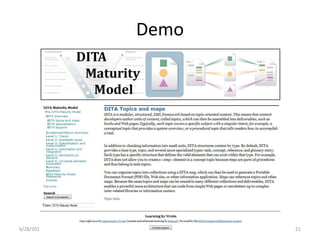
Makeover, cont.Workflows of the prototype expeDITA collaboration toolConfigurable modes:Wiki: multiple authorsProject documents (home page, news, schedules, specs)End user documents (FAQs, How Tos)Blog: single author contributorsForum: conversational modePublished Web site modeProposed: chat and Twitter aggregation into curated topics1/17/201119
Makeover, cont.Configurable layouts:Branding for the company look and feelThree-column blogTwo-column wikiOne-column reading/print mode1/17/201120
Demo1/17/201121
ChallengesCollaboration should stimulate new ideas, solve problems, enhance teamwork, and distribute expertise. *Get the right messages in place: Social Media and collaborative tools are elective, not mandated. Users must be drawn by value.Collaboration tools do not replace e-mail or bulletin boards--use the appropriate tool!Be wary about how data modeling can limit you:top-down analysis tends to formalize Business Todaybottom-up allows in-the-trenches input on trends in motion*Why Some People ‘Dread’ Collaboration, InfoWeek-Sept 6 2010 p401/17/201122
ResourcesDITA Focus Area, http://dita.xml.org/book/dita-wiki-knowledgebaseSemantic Computing at AIST, by HasidaKoti, http://www-tsujii.is.s.u-tokyo.ac.jp/jgws2006/koiti.pdfThe Evolution of Web-Based Collaboration at NASA & The Wiki-way Forward, http://pmchallenge.gsfc.nasa.gov/docs/2009/presentations/Newman.Steve.pdfCollage image provided by http://wikiHow.com, a wiki building the world's largest, highest quality how-to manual. Please edit these articles and find author credits at the original wikiHow articles on http://www.wikihow.com/Make-a-Collage and http://www.wikihow.com/Oil-Paint. Content on wikiHow can be shared under a Creative Commons License.expeDITAContent Collaboration project, http://expedita-cct.com/1/17/201123
Questions and Discussion1/17/201124
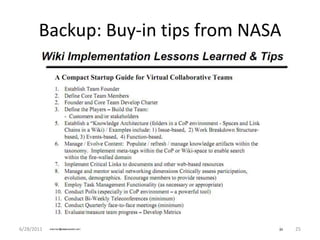
Backup: Buy-in tips from NASA1/17/201125

DITA Collaboration for Content

  • 1.
    DITA Collaboration forContentBy Don R. DayLearningbyWrote.com1/17/20111
  • 2.
    DITA Collaboration forContentAbstract: Subject matter experts in your company create many types of valuable content; the problem is in converting that content into reuseable business assets. You can turn Lost Content into Intelligent Content using structured collaboration.1/17/20112
  • 3.
    The Knowledge Conundrum:"Whereis the wisdom we have lost in knowledge?Where is the knowledge we have lost in information?"--T.S. EliotEnd of 2010: 205.8 million registered domains50 to 120 billion indexed pages ** http://thenextweb.com/shareables/2011/01/11/infographic-how-big-is-the-internet/1/17/20113
  • 4.
    What is KnowledgeManagement?"Information economy" goals:Gathering and processing data competitivelyApplying information for economic advantage"Knowledge economy" goals:Tacit knowledge (intuitive, mentored) vs Explicit knowledge (documented)Connecting people to enhance knowledge poolingTreating knowledge as a business product (such as consulting)1/17/20114
  • 5.
    Types of knowledgeassets:Customer knowledgeCRM systems--often "who knows who" networkingCompetitor knowledgeMarket strategyProduct knowledgeHow your product works, how well your product is described to customers (fail searches or failed "drag" opportunities)Process knowledgePractices, trends, experienceFinancial knowledgeOperations and resource managementPeople knowledgeIdentifying skills and expertise, making connections1/17/20115
  • 6.
    Knowledge is easilylost:TurnoverHard-to-use tools impede the writing processObscure or non-standard formatsNot up-to-dateNot well described or indexedNot team reviewed and approvedContext may be missing for understanding the data1/17/20116
  • 7.
    Pain Points informalsurvey on LinkedIn:Inadequate time for writers to curate their own work, ensuring good use of semantics, grammar, markup usage, etc..Quantity is rewarded more than quality.Plethora of tools and formats with no organizing methodologyInadequate CMS integration around semantics that ARE available in disparate data setsInadequate awareness of how to use semantics effectively (ie, keyword tagging and appropriate markup selection.Inadequate social support (coaching dynamics, assistive interfaces, training and docs)1/17/20117
  • 8.
    Managing content ina collaboration spaceWhat is a typical content lifecycle?Preparation (analysis and design)Initial document creationFeedback and modification (test)Approval (publication/build implementation)Subsequent updates and modification (support, enhancements)1/17/20118
  • 9.
    Managing content, cont.Contentcuration is a new term. What is it?Selection & OrganizationWhat is significant?What needs explanation and synthesis?What needs corrected?Authentication (review and agreement on quality)Indexing/tagging and enriching semantically1/17/20119
  • 10.
    Managing content, cont.Optionsfor turning original/curated content into reusable resources:Rule-driven, heuristic tools (for example, using LegalZoom to create online wills, other DIY advice)Specialist-vetted FAQs and How-To topicsCommercial eBooks (which typically lack synthesis or correction in their curation)Misconception: We'll let engineers write the end user docs for us on a wiki!1/17/201110
  • 11.
    The collage vsthe paintingmashupsvsaggregation with interpretation1/17/201111
  • 12.
    NASA example ofcurationProviding context and interpretation for SME-contributed content:1/17/201112
  • 13.
    Managing content, cont.Proposedsolution: Intercept as many streams as possible as DITAContent is directly useable in DITA-aware processing.Content can be enhanced (made "intelligent") by adding:Linking relationshipsMetadataSemantic markup (coaching, review/edit, etc.)1/17/201113
  • 14.
    How does DITAfit into KM strategies?Ann Rockley defines Intelligent Content as:“content which is structurally rich and semantically aware, thereforeautomatically discoverable, reusable, reconfigurable, and adaptable.”Collaboration is a product of writers, consumers, and mediators working together on a body of knowledgeCollaborative discourse tends to provide context for knowledge. Topics are Good!XML technologies help by:Enabling content interchange with organizations across the companyEnabling content interchange with partners, contractors, OEMsEnabling dialog between companies and customersFacilitating process definition and execution within the companyDITA (Darwin Information Typing Architecture) is an XML application designed to provide many of these benefits.1/17/201114
  • 15.
    What can youcapture?Ideas (one to many, blogs)How-to contributions (eliciting deep product knowledge and best practices)Examples (programs, recipes, crafts, etc.)"Tags" for retrieval--user perception of what things or ideas are called (ontology, folksonomy)Comments -- conventional "user generated content"Annotations directly to content locations (effectively becoming footnotes rather than comments)Literate programming: "The sea is in the bottle; the bottle is in the sea."Conversations (IM sessions, email quotes)Goodies to share (links, colleague profiles, comments from books and classes)Field observations (debriefings, solutions)Research (abstracts and links to published materials)Announcements (presentations, patents, awards)1/17/201115
  • 16.
    Getting content intoDITAIntegrate DITA conversion or direct DITA authoring into collaborative interfaces:Wikis & blogsForumsTwitter feeds"Data mining" for potentially useful content in files, call center logs, chat logs, etc..Use familiar desktop tools that are DITA-aware (Quark Xpress Author, Author-It, FrameMaker)1/17/201116
  • 17.
    Fostering contributionEmpower andencourage atmosphere of sharingReward/acknowledge mastery of markup goalsProvide wizards and other assistance for inserting metadata and markupDevise "shell" templates to guide general flow of well-structured topicsLook to ease policies that impede spontaneous participationCreate and support communities around knowledge domainsInternal workgroups or meetupsLocal DITA user groupsWorldwide DITA resources and forumsTraining and reading resourcesMake it easier to reuse knowledge (dita maps and conrefs)1/17/201117
  • 18.
    Content Makeover usingDITA collaborationTraditional setup:Wiki for collaboration, but cut/paste into Word for publicationsNo capture strategy for Twitter or other social media conversationsNo coordinated tracking of user comments1/17/201118
  • 19.
    Makeover, cont.Workflows ofthe prototype expeDITA collaboration toolConfigurable modes:Wiki: multiple authorsProject documents (home page, news, schedules, specs)End user documents (FAQs, How Tos)Blog: single author contributorsForum: conversational modePublished Web site modeProposed: chat and Twitter aggregation into curated topics1/17/201119
  • 20.
    Makeover, cont.Configurable layouts:Brandingfor the company look and feelThree-column blogTwo-column wikiOne-column reading/print mode1/17/201120
  • 21.
  • 22.
    ChallengesCollaboration should stimulatenew ideas, solve problems, enhance teamwork, and distribute expertise. *Get the right messages in place: Social Media and collaborative tools are elective, not mandated. Users must be drawn by value.Collaboration tools do not replace e-mail or bulletin boards--use the appropriate tool!Be wary about how data modeling can limit you:top-down analysis tends to formalize Business Todaybottom-up allows in-the-trenches input on trends in motion*Why Some People ‘Dread’ Collaboration, InfoWeek-Sept 6 2010 p401/17/201122
  • 23.
    ResourcesDITA Focus Area,http://dita.xml.org/book/dita-wiki-knowledgebaseSemantic Computing at AIST, by HasidaKoti, http://www-tsujii.is.s.u-tokyo.ac.jp/jgws2006/koiti.pdfThe Evolution of Web-Based Collaboration at NASA & The Wiki-way Forward, http://pmchallenge.gsfc.nasa.gov/docs/2009/presentations/Newman.Steve.pdfCollage image provided by http://wikiHow.com, a wiki building the world's largest, highest quality how-to manual. Please edit these articles and find author credits at the original wikiHow articles on http://www.wikihow.com/Make-a-Collage and http://www.wikihow.com/Oil-Paint. Content on wikiHow can be shared under a Creative Commons License.expeDITAContent Collaboration project, http://expedita-cct.com/1/17/201123
  • 24.
  • 25.
    Backup: Buy-in tipsfrom NASA1/17/201125