Adaptive Radiotherapy at
GenesisCare UK
Amanda Jones and Jacqui Dorney Nov 2016
Page 2
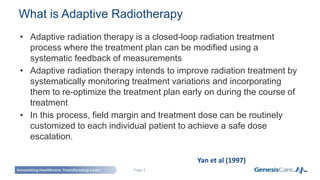
• Adaptive radiation therapy is a closed-loop radiation treatment
process where the treatment plan can be modified using a
systematic feedback of measurements
• Adaptive radiation therapy intends to improve radiation treatment by
systematically monitoring treatment variations and incorporating
them to re-optimize the treatment plan early on during the course of
treatment
• In this process, field margin and treatment dose can be routinely
customized to each individual patient to achieve a safe dose
escalation.
Yan et al (1997)
What is Adaptive Radiotherapy
Page 3
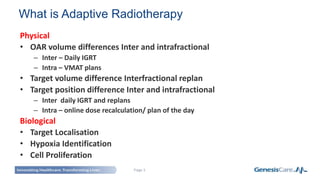
Physical
• OAR volume differences Inter and intrafractional
– Inter – Daily IGRT
– Intra – VMAT plans
• Target volume difference Interfractional replan
• Target position difference Inter and intrafractional
– Inter daily IGRT and replans
– Intra – online dose recalculation/ plan of the day
Biological
• Target Localisation
• Hypoxia Identification
• Cell Proliferation
What is Adaptive Radiotherapy
Page 4
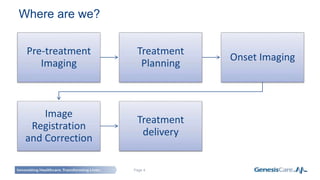
Pre-treatment
Imaging
Treatment
Planning
Onset Imaging
Image
Registration
and Correction
Treatment
delivery
Where are we?
Page 5
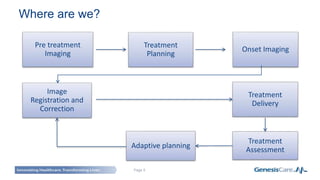
Where are we?
Pre treatment
Imaging
Treatment
Planning
Onset Imaging
Treatment
Delivery
Image
Registration and
Correction
Treatment
Assessment
Adaptive planning
Page 6
Where are we?
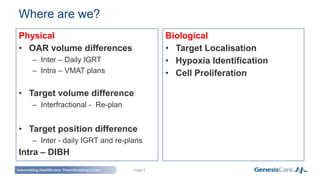
Physical
• OAR volume differences
– Inter – Daily IGRT
– Intra – VMAT plans
• Target volume difference
– Interfractional - Re-plan
• Target position difference
– Inter - daily IGRT and re-plans
Intra – DIBH
Biological
• Target Localisation
• Hypoxia Identification
• Cell Proliferation
Page 7
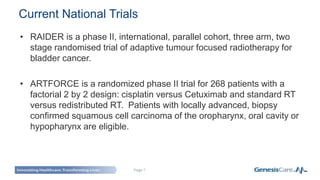
• RAIDER is a phase II, international, parallel cohort, three arm, two
stage randomised trial of adaptive tumour focused radiotherapy for
bladder cancer.
• ARTFORCE is a randomized phase II trial for 268 patients with a
factorial 2 by 2 design: cisplatin versus Cetuximab and standard RT
versus redistributed RT. Patients with locally advanced, biopsy
confirmed squamous cell carcinoma of the oropharynx, oral cavity or
hypopharynx are eligible.
Current National Trials
Page 8
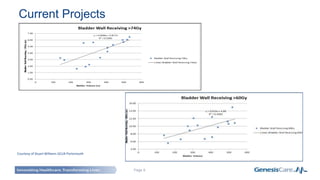
Current Projects
Courtesy of Stuart Williams GCUK Portsmouth
Page 9
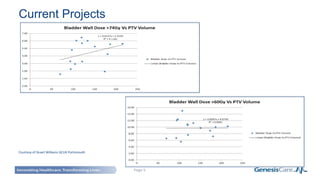
Current Projects
Courtesy of Stuart Williams GCUK Portsmouth
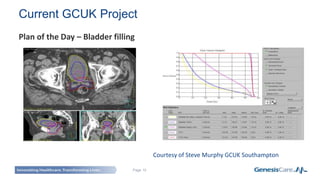
Plan of the Day – Bladder filling
Page 10
Current GCUK Project
Courtesy of Steve Murphy GCUK Southampton
Page 11
Physical
• OAR volume/position difference
– Daily IGRT with plan of the day options
• Target volume difference
Interfractional re-plan
– Daily IGRT with plan of the day options
• Target position difference Inter
and intrafractional
– Inter - Daily IGRT and offline re-plans
– Online dosimetry with re-plan
Intra – Intrafractional IGRT wit online
compensation
What next?
Biological
• Target Localisation
• Hypoxia Identification
• Cell Proliferation
Thank-you
References
Yan D1, Vicini F, Wong J, Martinez A, (1997), Adaptive radiation therapy, Phys Med Biol. 1997 Jan;42(1):123-32.

Adaptive Radiotherapy at GenesisCare UK

  • 1.
    Adaptive Radiotherapy at GenesisCareUK Amanda Jones and Jacqui Dorney Nov 2016
  • 2.
    Page 2 • Adaptiveradiation therapy is a closed-loop radiation treatment process where the treatment plan can be modified using a systematic feedback of measurements • Adaptive radiation therapy intends to improve radiation treatment by systematically monitoring treatment variations and incorporating them to re-optimize the treatment plan early on during the course of treatment • In this process, field margin and treatment dose can be routinely customized to each individual patient to achieve a safe dose escalation. Yan et al (1997) What is Adaptive Radiotherapy
  • 3.
    Page 3 Physical • OARvolume differences Inter and intrafractional – Inter – Daily IGRT – Intra – VMAT plans • Target volume difference Interfractional replan • Target position difference Inter and intrafractional – Inter daily IGRT and replans – Intra – online dose recalculation/ plan of the day Biological • Target Localisation • Hypoxia Identification • Cell Proliferation What is Adaptive Radiotherapy
  • 4.
  • 5.
    Page 5 Where arewe? Pre treatment Imaging Treatment Planning Onset Imaging Treatment Delivery Image Registration and Correction Treatment Assessment Adaptive planning
  • 6.
    Page 6 Where arewe? Physical • OAR volume differences – Inter – Daily IGRT – Intra – VMAT plans • Target volume difference – Interfractional - Re-plan • Target position difference – Inter - daily IGRT and re-plans Intra – DIBH Biological • Target Localisation • Hypoxia Identification • Cell Proliferation
  • 7.
    Page 7 • RAIDERis a phase II, international, parallel cohort, three arm, two stage randomised trial of adaptive tumour focused radiotherapy for bladder cancer. • ARTFORCE is a randomized phase II trial for 268 patients with a factorial 2 by 2 design: cisplatin versus Cetuximab and standard RT versus redistributed RT. Patients with locally advanced, biopsy confirmed squamous cell carcinoma of the oropharynx, oral cavity or hypopharynx are eligible. Current National Trials
  • 8.
    Page 8 Current Projects Courtesyof Stuart Williams GCUK Portsmouth
  • 9.
    Page 9 Current Projects Courtesyof Stuart Williams GCUK Portsmouth
  • 10.
    Plan of theDay – Bladder filling Page 10 Current GCUK Project Courtesy of Steve Murphy GCUK Southampton
  • 11.
    Page 11 Physical • OARvolume/position difference – Daily IGRT with plan of the day options • Target volume difference Interfractional re-plan – Daily IGRT with plan of the day options • Target position difference Inter and intrafractional – Inter - Daily IGRT and offline re-plans – Online dosimetry with re-plan Intra – Intrafractional IGRT wit online compensation What next? Biological • Target Localisation • Hypoxia Identification • Cell Proliferation
  • 12.
    Thank-you References Yan D1, ViciniF, Wong J, Martinez A, (1997), Adaptive radiation therapy, Phys Med Biol. 1997 Jan;42(1):123-32.

Editor's Notes

  • #3 Not a new concept Multiple definitions as to what is regarded as ‘Adaptive Radiotherapy’ Need to pitch our flag as to what we interpret it to be, where we are, what we want it to mean and how to get there……
  • #4 Physical OAR volume differences Inter and intrafractional Inter – plan of the day working on Intra – VMAT plans – create treatment times as short as possible to reduce this movement Target volume difference Interfractional replan organs – may have rapid treatment response or conversely rapid disease progression – requiring total dosimetric replan – Target position difference Inter and intrafractional Inter daily IGRT and replans Biological Decide what the purpose of the imaging is as different agents used to demonstrate each… Target Localisation – currently using for H&N and Lung. But just initially, not repeated during treatment. Decide at what point appropriate Hypoxia Identification Cell Proliferation
  • #7 Physical OAR volume differences Inter – Daily IGRT Intra – VMAT plans Target volume difference Interfractional - Replan Target position difference Inter - daily IGRT and replans Intra - DIBH
  • #8 RAIDER is a phase II, international, parallel cohort, three arm, two stage randomised trial of adaptive tumour focused radiotherapy for bladder cancer.  Stage 1 will investigate the feasibility of dose escalated tumour boost radiotherapy delivery at multiple centres and Stage II will assess long term side effects.   240 participants with muscle invasive bladder cancer will be randomised to one of three treatment groups, standard dose tumour focused adaptive radiotherapy, dose escalated tumour boost adaptive radiotherapy and standard radiotherapy. Minimum follow up 5 years.   Arm 1 2 planning scans.  3 treatment plans (small, medium and large) created.  XVI prior to treatment to find out which bladder size is most appropriate for that day of treatment.  Standard dose of RT to the tumour and a lower dose of RT to the remainder of the bladder.  Adaptive tumour focused RT   Arm 2 2 planning scans.  3 treatment plans (small, medium and large) created.  XVi prior to treatment to find out which bladder size is most appropriate for that day of treatment.  Dose escalated to the tumour and lower than normal dose to the remainder of the bladder.  Adaptive tumour boost RT   Arm 3 1 planning scan.   Standard bladder protocol, planning, dose and fractionation and delivery Review ARTFORCE   The objective of the ARTFORCE Head and Neck trial is to determine the predictive value of biological markers and 89Zr-Cetuximab uptake, as it is unknown how to select patients for the appropriate concurrent agent. Also  will determine if adaptive RT and dose redistribution improve locoregional control without increasing toxicity. Cisplatin is dosed weekly 40 mg/m2 for 6 weeks. Cetuximab is dosed 250mg/m2 weekly (loading dose 400 mg/m2) for 6 weeks. The standard RT regimen consists of elective RT up to 54.25 Gy with a simultaneous integrated boost (SIB) to 70 Gy in 35 fractions in 6 weeks. Redistributed adaptive RT consists of elective RT up to 54.25 Gy with a SIB between 64-80 Gy in 35 fractions in 6 weeks with redistributed dose to the gross tumour volume (GTV) and clinical target volume (CTV), and adaptation of treatment for anatomical changes in the third week of treatment.       Pre-treatment 89Zr-Cetuximab scan A week before the start of treatment a loading dose of Cetuximab 400mg/m2 will be administered and immediately followed by the intravenous (i.v.) administration of Zirconium labelled Cetuximab (89Zr-Cetuximab) (60mBq). The first 30 patients will be scanned twice to determine the optimal scanning moment to determine Cetuximab uptake in the tumour. (Figure 3 and Figure 4). These (89Zr-Cetuximab-PET) scans will be made 4 and 7 days after 89Zr-Cetuximab administration. For the rest of the study population we will select only one time moment for the 89Zr-Cetuximab-PET. The aortic arch will also be scanned and will serve as a reference point for 89Zr-Cetuximab uptake.       4 different treatment arms;;   Arm 1 is considered the standard treatment: conventional radiotherapy with concomitant cisplatin. Arm 2 entails dose redistributed adaptive radiotherapy with concomitant cisplatin. In the dose-painted redistriburtion radiotherapy regimen, the GTV-FDG-PET is defined by an automatic iso-contour at 50% of the maximum uptake in the primary tumour. This is expanded by 3mm to form the PTV-FDG-PET. The GTV-primary should at least encompass the GTV-FDG-PET and is expanded by 10mm to form the PTV-primary. Arm 3 Cetuximab regimen combined with standard radiotherapy Arm 4 Cetuximab regimen combined with redistributed adaptive radiotherapy. The PTV-FDG-PET will receive 35 fractions to a maximum total dose of 84 Gy to 2% of the volume (PTV-FDG-PET), a minimum dose of 70 Gy and a mean dose of approximately 77 Gy. The PTV-primary outside the PTV-FDG-PET will receive 35 fractions to a total mean dose of 67 Gy (ranging from 64-70 Gy). To assure accurate delivery of the redistributed radiation plan in arm 2 and 4, a repeat CT is made in week 2 of treatment. After recalculation and adaptation of the treatment plan on this CT, the patient starts with the new plan in week 3 of treatment.
  • #12 Physical OAR volume/position difference Daily IGRT with plan of the day options Target volume difference Interfractional replan Daily IGRT with plan of the day options Target position difference Inter and intrafractional Inter - Daily IGRT and offline replans Online dosimetry with replan Intra – Intrafractional IGRT wit online compensation