Elie Richa
Gem: Integrated Unit Testing
for a Trusted Code Generator
QGen Developer and QA Coordinator
Model-driven Development of
Critical Software
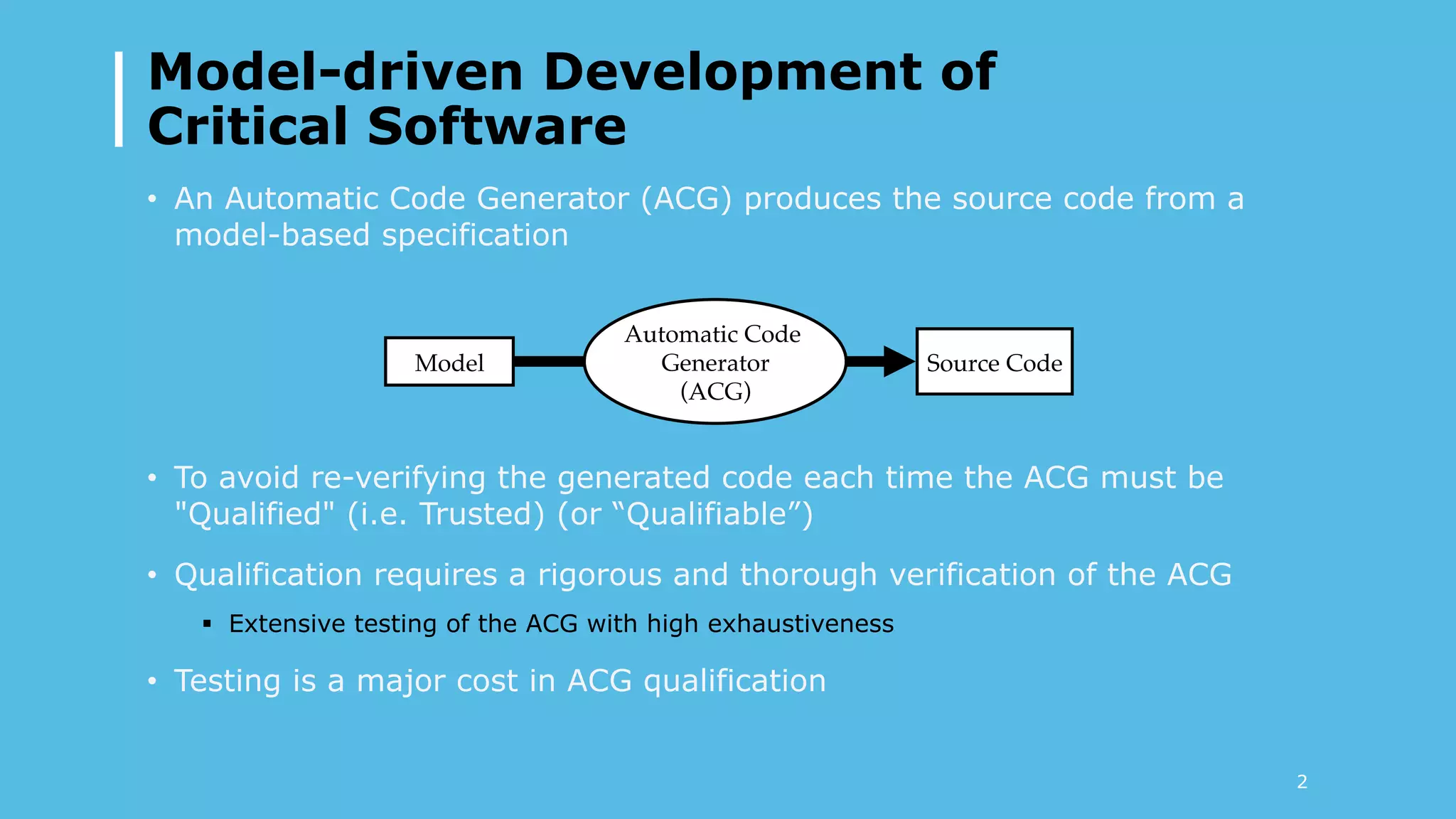
•  An Automatic Code Generator (ACG) produces the source code from a
model-based specification
•  To avoid re-verifying the generated code each time the ACG must be
"Qualified" (i.e. Trusted) (or “Qualifiable”)
•  Qualification requires a rigorous and thorough verification of the ACG
§  Extensive testing of the ACG with high exhaustiveness
•  Testing is a major cost in ACG qualification
Model
Automatic Code
Generator!
(ACG)
Source Code
2
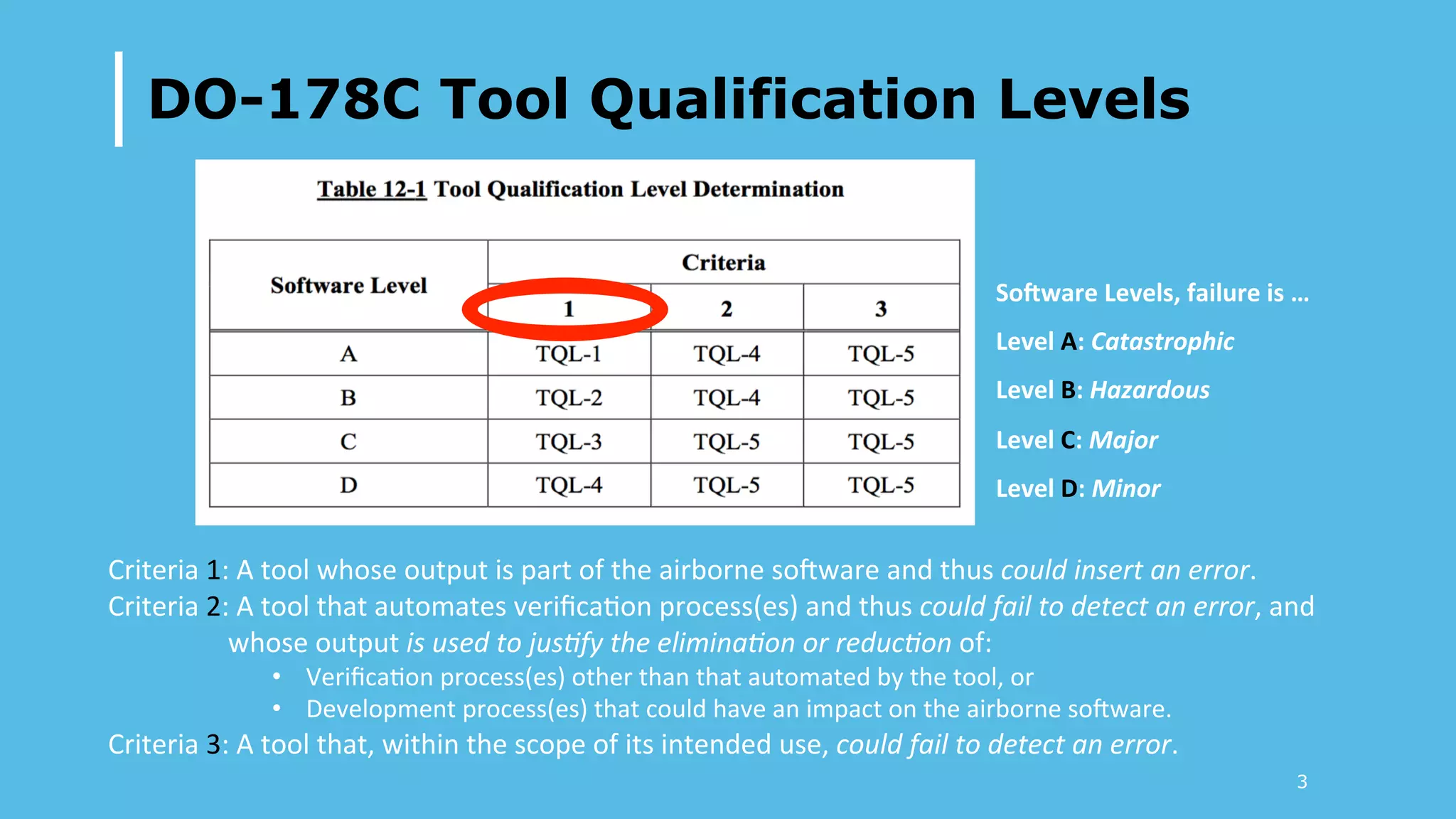
DO-178C Tool Qualification Levels
Criteria	1:	A	tool	whose	output	is	part	of	the	airborne	so5ware	and	thus	could	insert	an	error.		
Criteria	2:	A	tool	that	automates	verifica=on	process(es)	and	thus	could	fail	to	detect	an	error,	and	
whose	output	is	used	to	jus0fy	the	elimina0on	or	reduc0on	of:		
•  Verifica=on	process(es)	other	than	that	automated	by	the	tool,	or		
•  Development	process(es)	that	could	have	an	impact	on	the	airborne	so5ware.		
Criteria	3:	A	tool	that,	within	the	scope	of	its	intended	use,	could	fail	to	detect	an	error.		
	
So$ware	Levels,	failure	is	…	
Level	A:	Catastrophic	
Level	B:	Hazardous	
Level	C:	Major	
Level	D:	Minor		
3
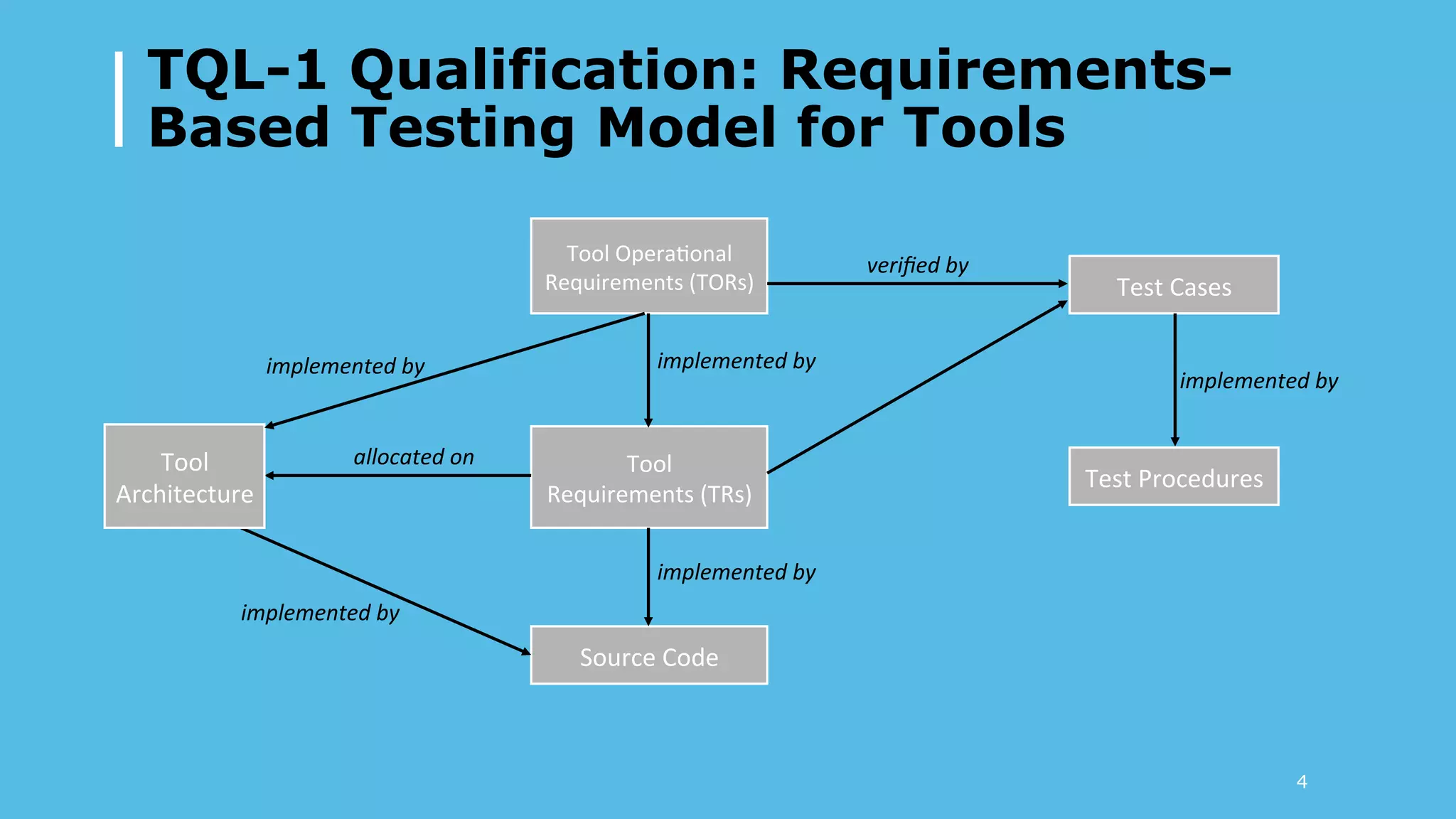
TQL-1 Qualification: Requirements-
Based Testing Model for Tools
Tool	Opera=onal	
Requirements	(TORs)	
Tool	
Requirements	(TRs)	
Test	Cases	
Test	Procedures	
Source	Code	
implemented	by	
allocated	on	Tool	
Architecture	
implemented	by	
implemented	by	
verified	by	
implemented	by	
implemented	by	
4
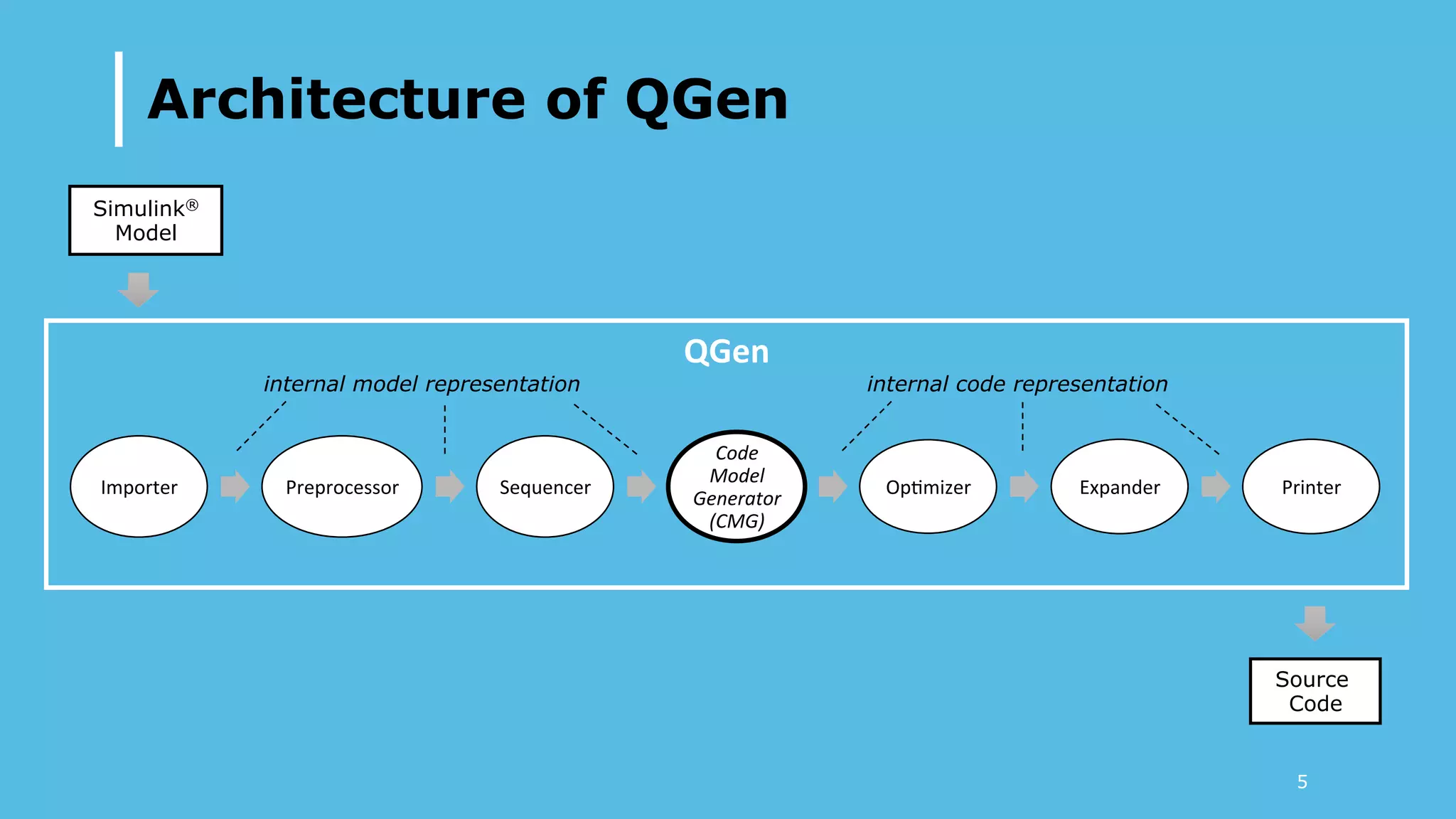
QGen	
Architecture of QGen
5
Importer	 Preprocessor	 Sequencer	
Code	
Model	
Generator	
(CMG)	
Op=mizer	 Expander	 Printer	
Simulink®
Model
Source
Code
internal model representation internal code representation
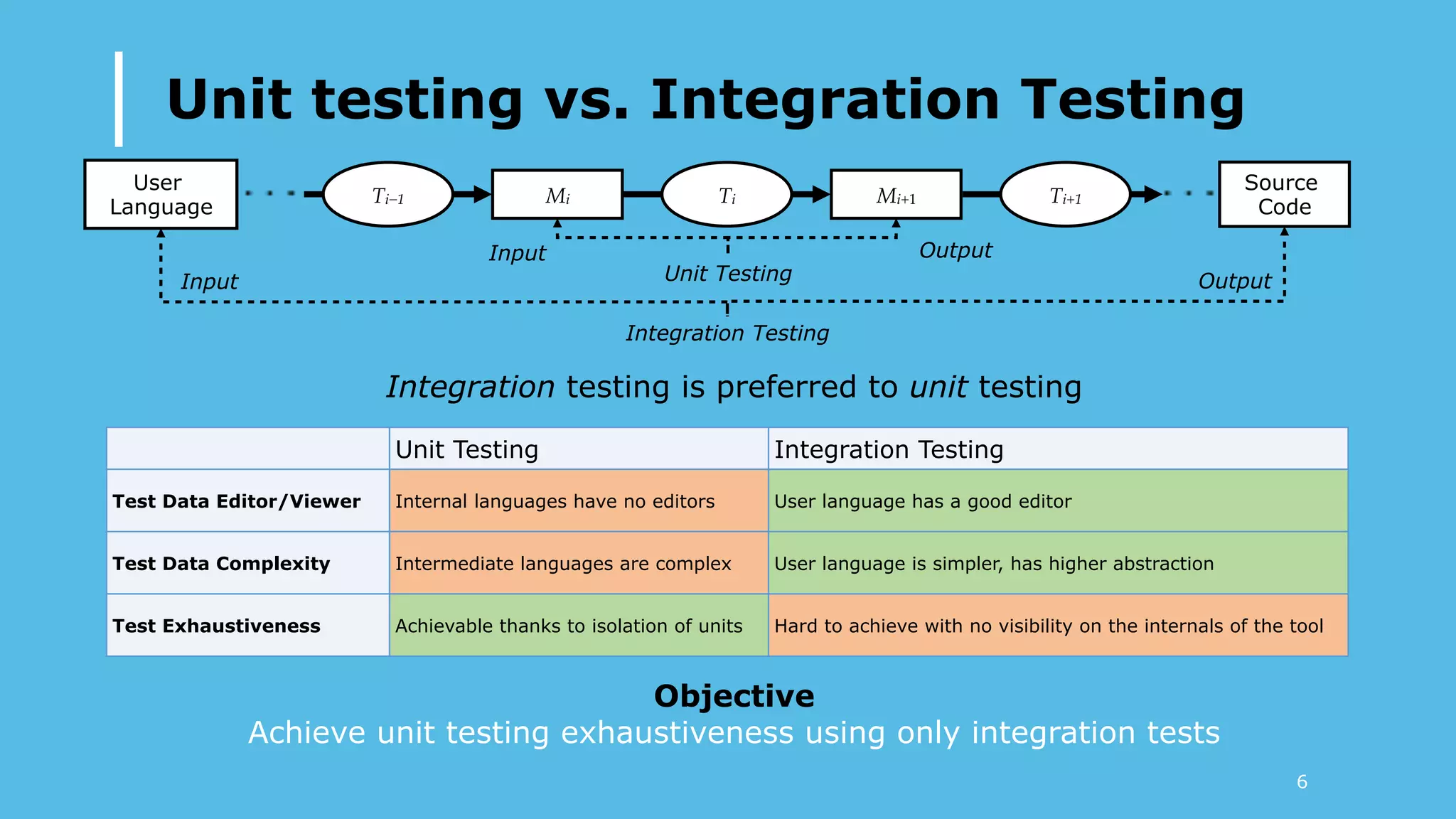
Unit Testing
Input Output
Integration Testing
Input Output
User
Language
Ti−1 TiMi
Source
Code
Ti+1
Unit testing vs. Integration Testing
Integration testing is preferred to unit testing
Objective
Achieve unit testing exhaustiveness using only integration tests
Unit Testing Integration Testing
Test Data Editor/Viewer Internal languages have no editors User language has a good editor
Test Data Complexity Intermediate languages are complex User language is simpler, has higher abstraction
Test Exhaustiveness Achievable thanks to isolation of units Hard to achieve with no visibility on the internals of the tool
Mi+1
6
Executable Unit Test Cases
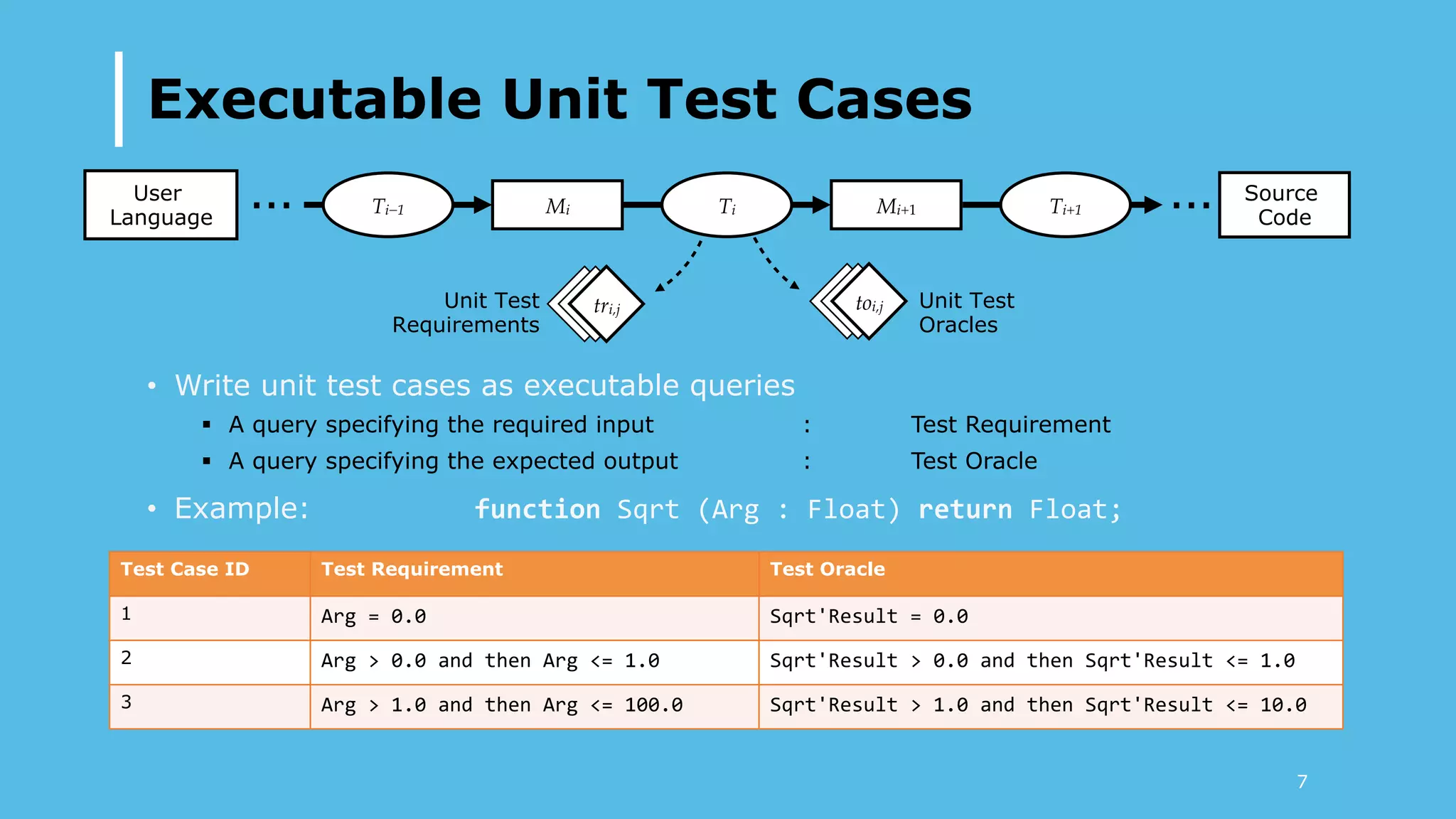
•  Write unit test cases as executable queries
§  A query specifying the required input : Test Requirement
§  A query specifying the expected output : Test Oracle
•  Example: function	Sqrt	(Arg	:	Float)	return	Float;	
7
User
Language
Ti−1 TiMi
Source
Code
Ti+1Mi+1
Unit Test
Requirements
tri,jtri,jtri,j tri,jtri,jtoi,j Unit Test
Oracles
… …
Test Case ID Test Requirement Test Oracle
1 Arg	=	0.0	 Sqrt'Result	=	0.0	
2 Arg	>	0.0	and	then	Arg	<=	1.0	 Sqrt'Result	>	0.0	and	then	Sqrt'Result	<=	1.0	
3 Arg	>	1.0	and	then	Arg	<=	100.0	 Sqrt'Result	>	1.0	and	then	Sqrt'Result	<=	10.0
Instrumentation for Test Case
Evaluation and Logging
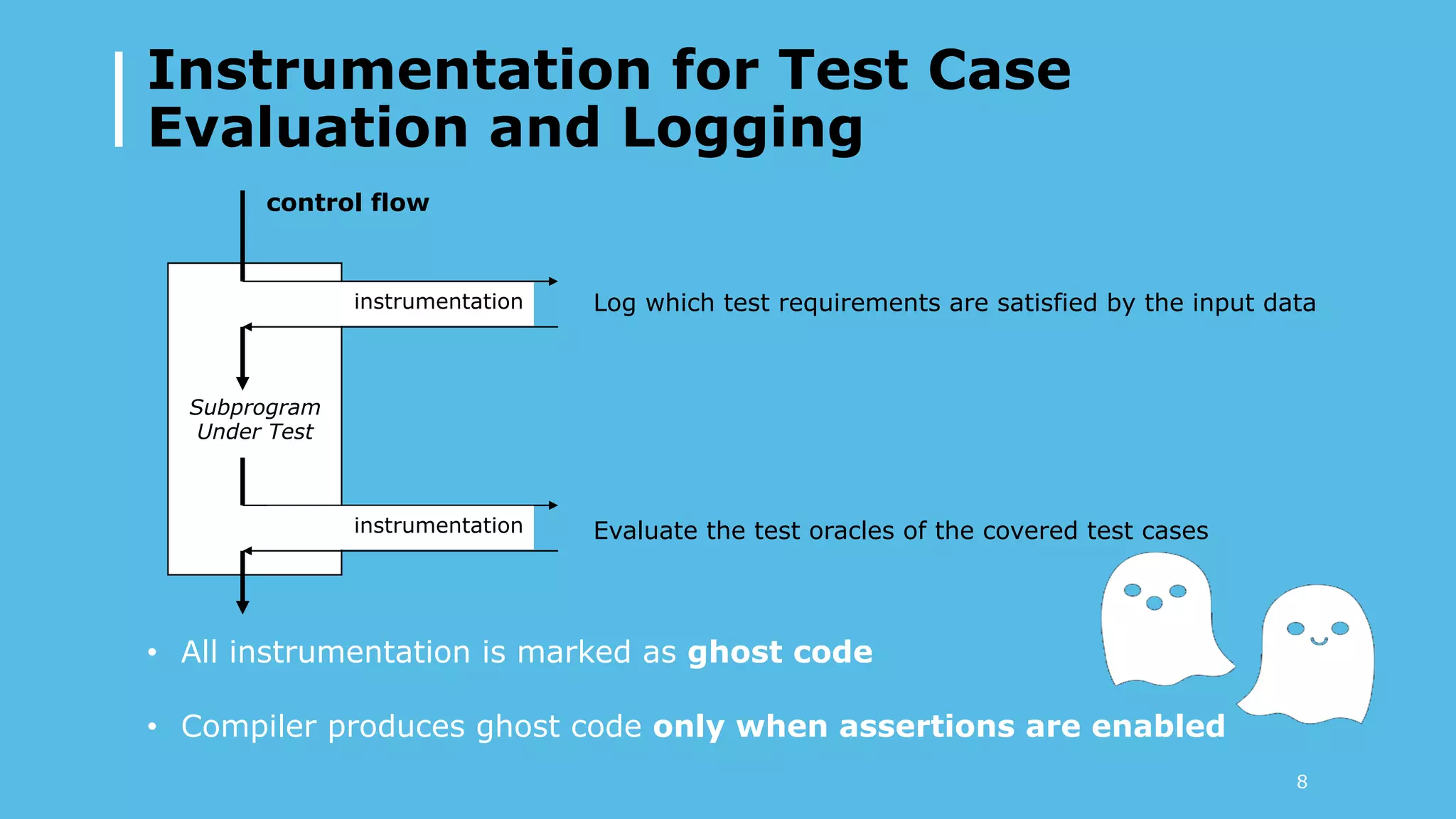
•  All instrumentation is marked as ghost code
•  Compiler produces ghost code only when assertions are enabled
Log which test requirements are satisfied by the input data
Evaluate the test oracles of the covered test cases
Subprogram
Under Test
control flow
instrumentation
instrumentation
8
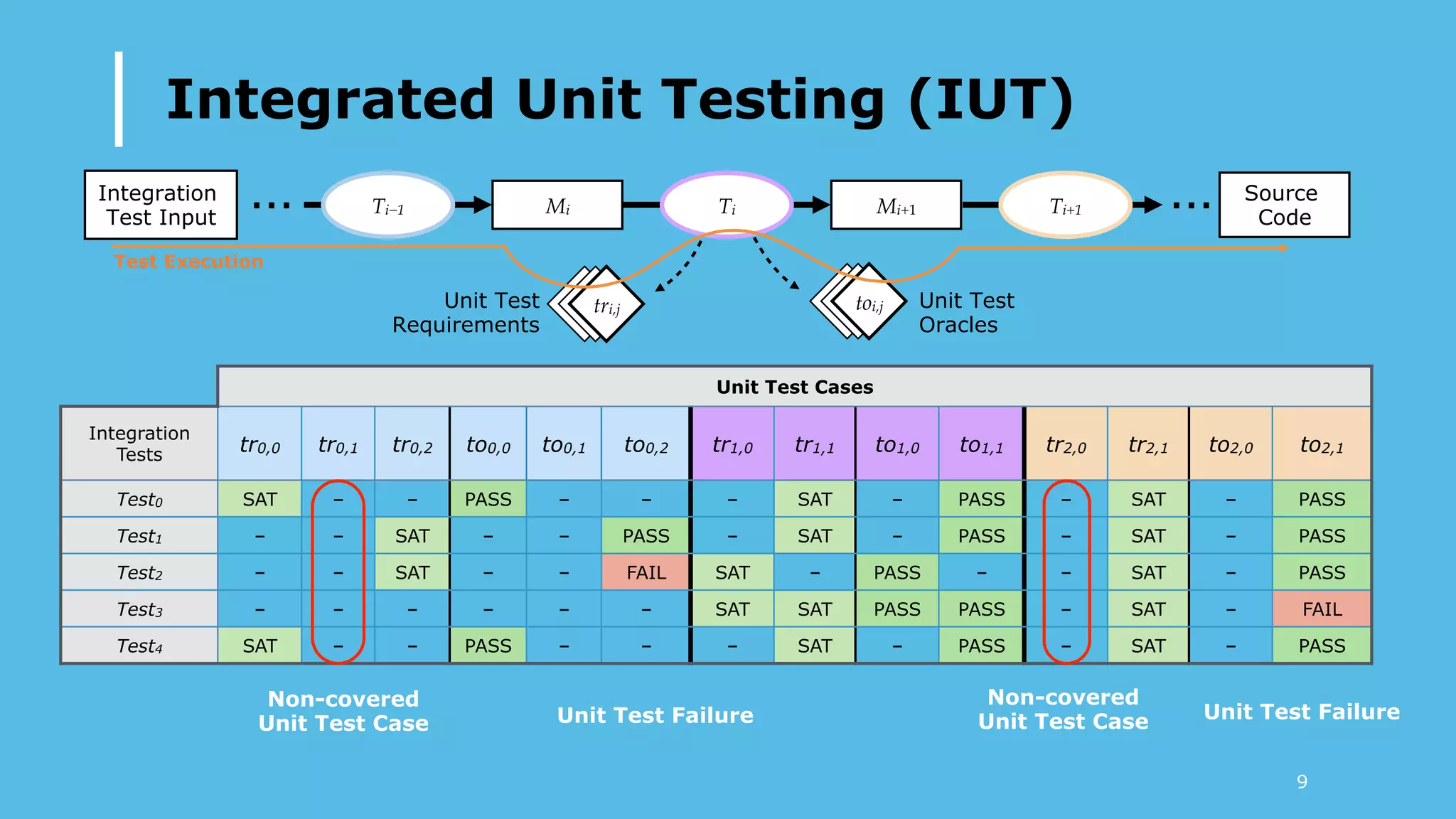
Unit Test Cases
Integration
Tests
tr0,0 tr0,1 tr0,2 to0,0 to0,1 to0,2 tr1,0 tr1,1 to1,0 to1,1 tr2,0 tr2,1 to2,0 to2,1
Test0 SAT – – PASS – – – SAT – PASS – SAT – PASS
Test1 – – SAT – – PASS – SAT – PASS – SAT – PASS
Test2 – – SAT – – FAIL SAT – PASS – – SAT – PASS
Test3 – – – – – – SAT SAT PASS PASS – SAT – FAIL
Test4 SAT – – PASS – – – SAT – PASS – SAT – PASS
Non-covered
Unit Test Case
Non-covered
Unit Test CaseUnit Test Failure Unit Test Failure
Integrated Unit Testing (IUT)
Integration
Test Input
Ti−1 TiMi
Source
Code
Ti+1Mi+1
Unit Test
Requirements
tri,jtri,jtri,j tri,jtri,jtoi,j Unit Test
Oracles
… …
Test Execution
9
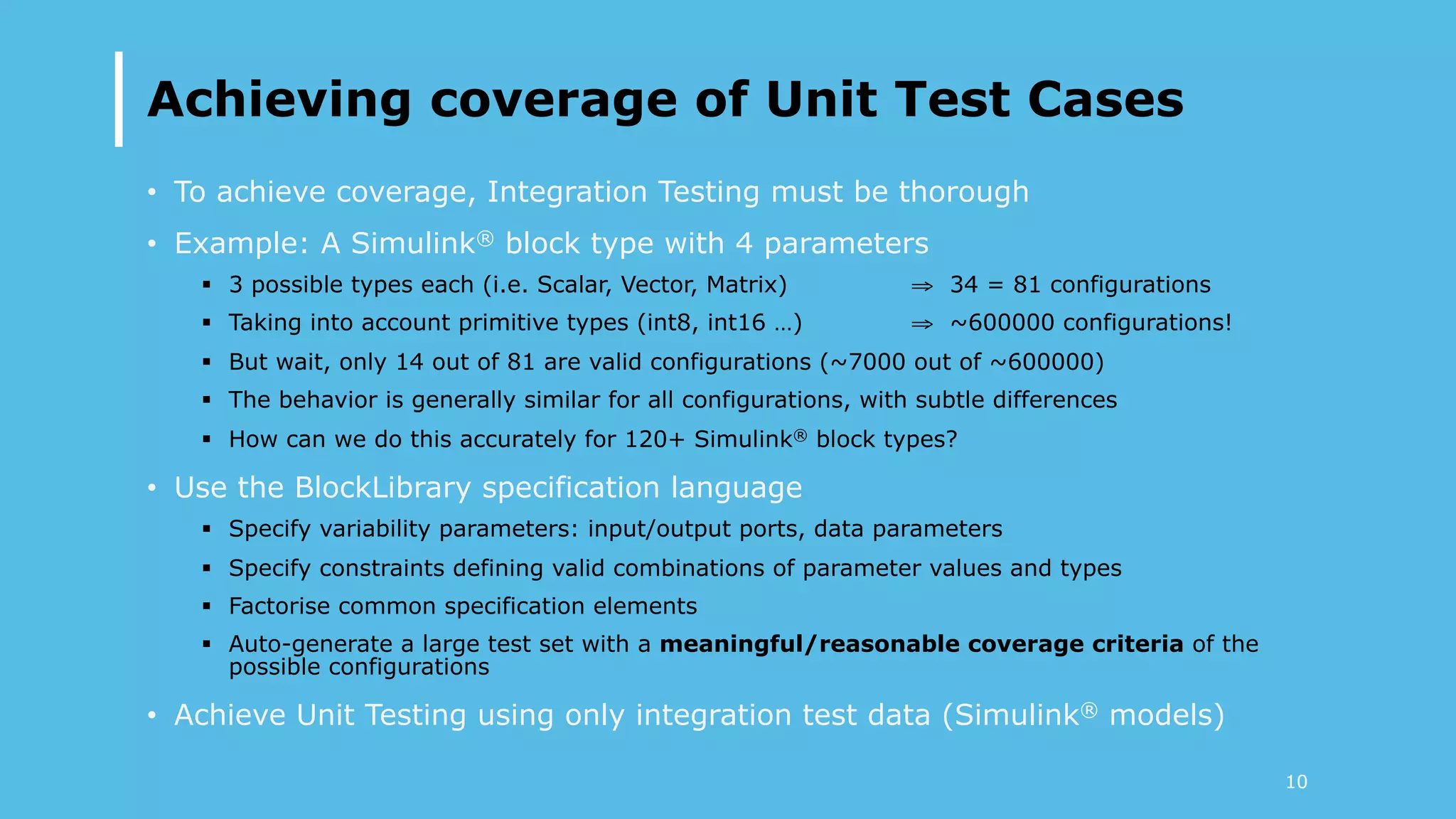
Achieving coverage of Unit Test Cases
•  To achieve coverage, Integration Testing must be thorough
•  Example: A Simulink® block type with 4 parameters
§  3 possible types each (i.e. Scalar, Vector, Matrix) ⇒ 34 = 81 configurations
§  Taking into account primitive types (int8, int16 …) ⇒ ~600000 configurations!
§  But wait, only 14 out of 81 are valid configurations (~7000 out of ~600000)
§  The behavior is generally similar for all configurations, with subtle differences
§  How can we do this accurately for 120+ Simulink® block types?
•  Use the BlockLibrary specification language
§  Specify variability parameters: input/output ports, data parameters
§  Specify constraints defining valid combinations of parameter values and types
§  Factorise common specification elements
§  Auto-generate a large test set with a meaningful/reasonable coverage criteria of the
possible configurations
•  Achieve Unit Testing using only integration test data (Simulink® models)
10
Integrated Unit Testing Framework
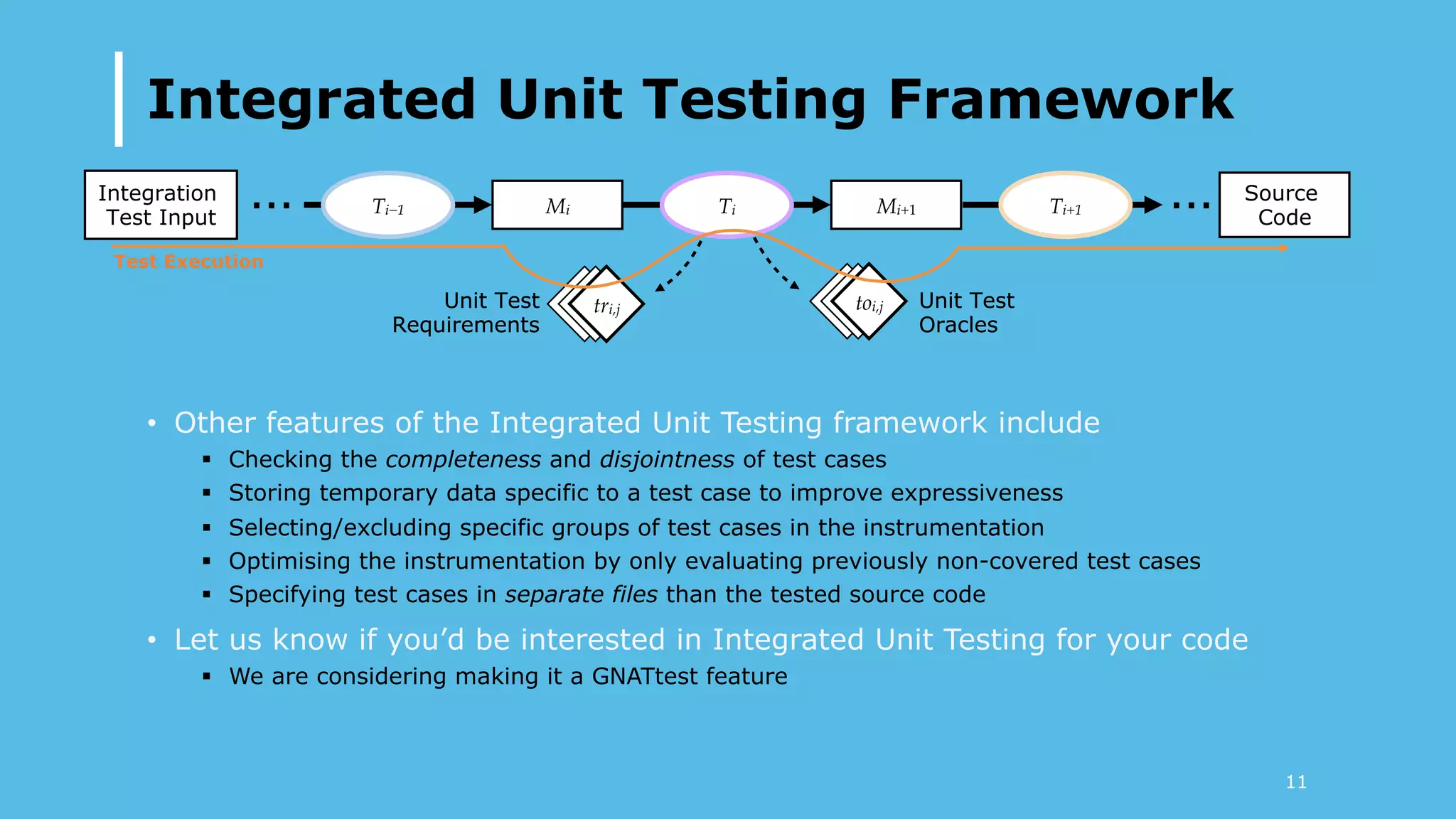
•  Other features of the Integrated Unit Testing framework include
§  Checking the completeness and disjointness of test cases
§  Storing temporary data specific to a test case to improve expressiveness
§  Selecting/excluding specific groups of test cases in the instrumentation
§  Optimising the instrumentation by only evaluating previously non-covered test cases
§  Specifying test cases in separate files than the tested source code
•  Let us know if you’d be interested in Integrated Unit Testing for your code
§  We are considering making it a GNATtest feature
11
Unit Test
Requirements
Unit Test
Oracles
Integration
Test Input
Ti−1 TiMi
Source
Code
Ti+1Mi+1
Unit Test
Requirements
tri,jtri,jtri,j tri,jtri,jtoi,j Unit Test
Oracles
Test Execution
… …
Conclusion: Integrated Unit Testing
•  Conventional Unit Testing of multi-pass code generators is painful
§  Difficult to create inputs and check outputs of individual passes
•  Integration Testing is generally easier
§  Can use normal Models as input; generated Source Code as output
•  Integrated Unit Testing: accomplish Unit Testing using Integration Testing
§  Instrument the tested tool with ghost code
§  Monitor internal data during Integration Testing
§  Log evidence of the coverage and passing of Unit Test Cases
•  The approach is applicable to other software
§  Let us know if Integrated Unit Testing is interesting in your context
12
AdaCore Paris Tech Day 2016: Elie Richa - Integrated Unit Testing for a Trusted Code Generator

AdaCore Paris Tech Day 2016: Elie Richa - Integrated Unit Testing for a Trusted Code Generator

  • 1.
    Elie Richa Gem: IntegratedUnit Testing for a Trusted Code Generator QGen Developer and QA Coordinator
  • 2.
    Model-driven Development of CriticalSoftware •  An Automatic Code Generator (ACG) produces the source code from a model-based specification •  To avoid re-verifying the generated code each time the ACG must be "Qualified" (i.e. Trusted) (or “Qualifiable”) •  Qualification requires a rigorous and thorough verification of the ACG §  Extensive testing of the ACG with high exhaustiveness •  Testing is a major cost in ACG qualification Model Automatic Code Generator! (ACG) Source Code 2
  • 3.
    DO-178C Tool QualificationLevels Criteria 1: A tool whose output is part of the airborne so5ware and thus could insert an error. Criteria 2: A tool that automates verifica=on process(es) and thus could fail to detect an error, and whose output is used to jus0fy the elimina0on or reduc0on of: •  Verifica=on process(es) other than that automated by the tool, or •  Development process(es) that could have an impact on the airborne so5ware. Criteria 3: A tool that, within the scope of its intended use, could fail to detect an error. So$ware Levels, failure is … Level A: Catastrophic Level B: Hazardous Level C: Major Level D: Minor 3
  • 4.
    TQL-1 Qualification: Requirements- BasedTesting Model for Tools Tool Opera=onal Requirements (TORs) Tool Requirements (TRs) Test Cases Test Procedures Source Code implemented by allocated on Tool Architecture implemented by implemented by verified by implemented by implemented by 4
  • 5.
    QGen Architecture of QGen 5 Importer Preprocessor Sequencer Code Model Generator (CMG) Op=mizer Expander Printer Simulink® Model Source Code internal model representation internal code representation
  • 6.
    Unit Testing Input Output IntegrationTesting Input Output User Language Ti−1 TiMi Source Code Ti+1 Unit testing vs. Integration Testing Integration testing is preferred to unit testing Objective Achieve unit testing exhaustiveness using only integration tests Unit Testing Integration Testing Test Data Editor/Viewer Internal languages have no editors User language has a good editor Test Data Complexity Intermediate languages are complex User language is simpler, has higher abstraction Test Exhaustiveness Achievable thanks to isolation of units Hard to achieve with no visibility on the internals of the tool Mi+1 6
  • 7.
    Executable Unit TestCases •  Write unit test cases as executable queries §  A query specifying the required input : Test Requirement §  A query specifying the expected output : Test Oracle •  Example: function Sqrt (Arg : Float) return Float; 7 User Language Ti−1 TiMi Source Code Ti+1Mi+1 Unit Test Requirements tri,jtri,jtri,j tri,jtri,jtoi,j Unit Test Oracles … … Test Case ID Test Requirement Test Oracle 1 Arg = 0.0 Sqrt'Result = 0.0 2 Arg > 0.0 and then Arg <= 1.0 Sqrt'Result > 0.0 and then Sqrt'Result <= 1.0 3 Arg > 1.0 and then Arg <= 100.0 Sqrt'Result > 1.0 and then Sqrt'Result <= 10.0
  • 8.
    Instrumentation for TestCase Evaluation and Logging •  All instrumentation is marked as ghost code •  Compiler produces ghost code only when assertions are enabled Log which test requirements are satisfied by the input data Evaluate the test oracles of the covered test cases Subprogram Under Test control flow instrumentation instrumentation 8
  • 9.
    Unit Test Cases Integration Tests tr0,0tr0,1 tr0,2 to0,0 to0,1 to0,2 tr1,0 tr1,1 to1,0 to1,1 tr2,0 tr2,1 to2,0 to2,1 Test0 SAT – – PASS – – – SAT – PASS – SAT – PASS Test1 – – SAT – – PASS – SAT – PASS – SAT – PASS Test2 – – SAT – – FAIL SAT – PASS – – SAT – PASS Test3 – – – – – – SAT SAT PASS PASS – SAT – FAIL Test4 SAT – – PASS – – – SAT – PASS – SAT – PASS Non-covered Unit Test Case Non-covered Unit Test CaseUnit Test Failure Unit Test Failure Integrated Unit Testing (IUT) Integration Test Input Ti−1 TiMi Source Code Ti+1Mi+1 Unit Test Requirements tri,jtri,jtri,j tri,jtri,jtoi,j Unit Test Oracles … … Test Execution 9
  • 10.
    Achieving coverage ofUnit Test Cases •  To achieve coverage, Integration Testing must be thorough •  Example: A Simulink® block type with 4 parameters §  3 possible types each (i.e. Scalar, Vector, Matrix) ⇒ 34 = 81 configurations §  Taking into account primitive types (int8, int16 …) ⇒ ~600000 configurations! §  But wait, only 14 out of 81 are valid configurations (~7000 out of ~600000) §  The behavior is generally similar for all configurations, with subtle differences §  How can we do this accurately for 120+ Simulink® block types? •  Use the BlockLibrary specification language §  Specify variability parameters: input/output ports, data parameters §  Specify constraints defining valid combinations of parameter values and types §  Factorise common specification elements §  Auto-generate a large test set with a meaningful/reasonable coverage criteria of the possible configurations •  Achieve Unit Testing using only integration test data (Simulink® models) 10
  • 11.
    Integrated Unit TestingFramework •  Other features of the Integrated Unit Testing framework include §  Checking the completeness and disjointness of test cases §  Storing temporary data specific to a test case to improve expressiveness §  Selecting/excluding specific groups of test cases in the instrumentation §  Optimising the instrumentation by only evaluating previously non-covered test cases §  Specifying test cases in separate files than the tested source code •  Let us know if you’d be interested in Integrated Unit Testing for your code §  We are considering making it a GNATtest feature 11 Unit Test Requirements Unit Test Oracles Integration Test Input Ti−1 TiMi Source Code Ti+1Mi+1 Unit Test Requirements tri,jtri,jtri,j tri,jtri,jtoi,j Unit Test Oracles Test Execution … …
  • 12.
    Conclusion: Integrated UnitTesting •  Conventional Unit Testing of multi-pass code generators is painful §  Difficult to create inputs and check outputs of individual passes •  Integration Testing is generally easier §  Can use normal Models as input; generated Source Code as output •  Integrated Unit Testing: accomplish Unit Testing using Integration Testing §  Instrument the tested tool with ghost code §  Monitor internal data during Integration Testing §  Log evidence of the coverage and passing of Unit Test Cases •  The approach is applicable to other software §  Let us know if Integrated Unit Testing is interesting in your context 12