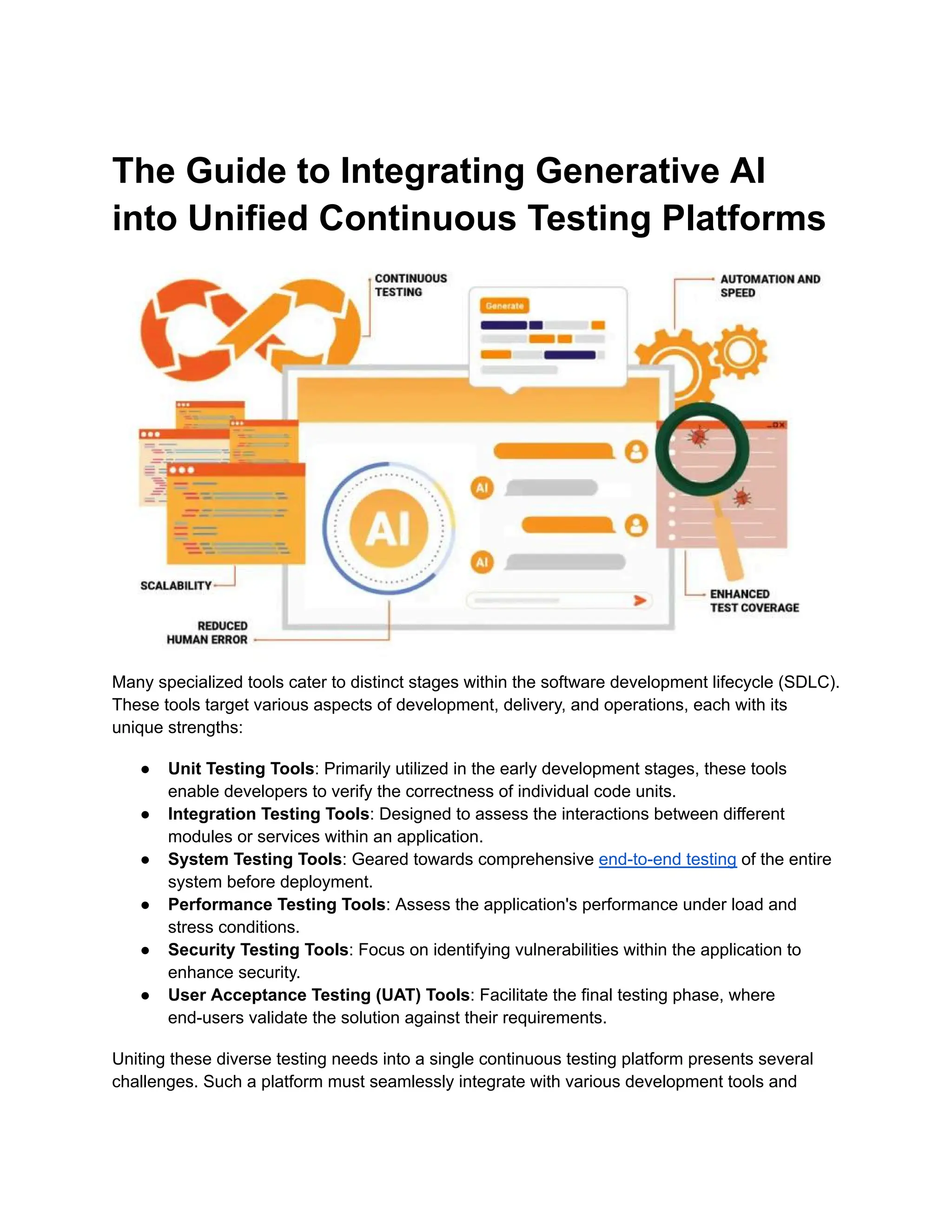
The Guide to Integrating Generative AI
into Unified Continuous Testing Platforms
Many specialized tools cater to distinct stages within the software development lifecycle (SDLC).
These tools target various aspects of development, delivery, and operations, each with its
unique strengths:
● Unit Testing Tools: Primarily utilized in the early development stages, these tools
enable developers to verify the correctness of individual code units.
● Integration Testing Tools: Designed to assess the interactions between different
modules or services within an application.
● System Testing Tools: Geared towards comprehensive end-to-end testing of the entire
system before deployment.
● Performance Testing Tools: Assess the application's performance under load and
stress conditions.
● Security Testing Tools: Focus on identifying vulnerabilities within the application to
enhance security.
● User Acceptance Testing (UAT) Tools: Facilitate the final testing phase, where
end-users validate the solution against their requirements.
Uniting these diverse testing needs into a single continuous testing platform presents several
challenges. Such a platform must seamlessly integrate with various development tools and
environments, accommodate different testing methodologies, and remain flexible to adapt to
organizational processes and quality standards.
Some CI/CD tools integrate multiple testing stages using specialized tools rather than offering a
unified solution. They orchestrate testing activities rather than consolidating them into a single
platform.
Yet, a fully unified continuous testing platform covering requirements for deployment and
in-production testing presents a significant opportunity for innovation. Leveraging advancements
like generative AI in continuous testing could create adaptable, intelligent testing processes
spanning the entire spectrum of needs.
Understanding Generative Artificial Intelligence (Gen AI)
Generative AI has emerged prominently with innovations like Chat GPT and Dall-E. Essentially,
it functions as a contemporary genie, capable of creating diverse content types such as text,
images, and audio. While the concept may appear novel, its roots trace back to the 1960s,
notably with Joseph Weizenbaum's creation, ELIZA. This intelligent program simulated human
conversation, foreshadowing the development of modern-day chatbots. With his visionary
foresight, Alan Turing anticipated such technological advancements long before their realization
in today's sophisticated tech landscape.
Exploring Generative AI's Functionality
Generative AI operates at the forefront of technology, utilizing machine learning and neural
networks to create data autonomously. It learns from extensive datasets, employing this
knowledge to produce new content.
In software testing, Generative AI automates quality assurance processes by analyzing user
flows and usage logs of an application under test (AUT). It then generates test scripts and
synthetic data to simulate user interactions, excelling in defect detection by identifying
anomalies or deviations from expected outcomes.
What sets Generative AI apart is its adaptability. It continually updates and refines test cases as
the AUT evolves, reducing manual effort, accelerating testing, and enhancing defect detection.
This transformative technology combines the strengths of artificial intelligence with the demands
of modern software development, revolutionizing software testing practices.
Benefits of Using Generative AI in Software Testing
Generative AI revolutionizes software testing, enhancing efficiency and effectiveness with
numerous benefits:
1. Automation and Speed: By automating test script generation, Generative AI
accelerates test case creation and execution, leading to faster releases and shorter
time-to-market.
2. Enhanced Test Coverage: It generates diverse test scenarios, including edge cases
and rarely encountered conditions, uncovering hidden defects and vulnerabilities often
missed in manual testing.
3. Continuous Testing: Generative AI enables adaptive testing, automatically generating
updated test cases as the application under test (AUT) evolves, ensuring alignment with
agile development methodologies.
4. Reduced Human Error: Its consistency and accuracy in executing test cases minimize
human errors, improving the reliability of defect detection.
5. Cost Efficiency: By automating testing processes, Generative AI significantly reduces
labor costs, enabling QA teams to meet testing demands previously unattainable,
transforming the economics of software quality assurance.
6. Scalability: Generative AI seamlessly scales to accommodate the testing needs of
complex, large-scale software projects, handling an ever-expanding set of test cases
without requiring additional resources.
In conclusion, Generative AI revolutionizes software testing by offering speed, accuracy,
adaptability, and cost efficiency. It empowers organizations to deliver high-quality software
faster, reduce costs, and ensure comprehensive test coverage.
How Generative AI is Transforming Software Testing
Generative AI holds promise in reshaping the testing landscape, offering potential
enhancements to app quality assurance. As artificial intelligence progresses, generative AI
techniques are poised to drive innovations in app testing. Here are key areas where generative
AI can make significant strides:
1. Test Data Generation: Overcoming the challenge of obtaining diverse and realistic
datasets, generative AI creates synthetic test data, facilitating thorough testing under
various conditions.
2. Automated Test Case Generation: Generative AI swiftly generates comprehensive test
cases, saving time and effort by automating test case creation based on app
specifications and requirements.
3. Exploratory Testing: Employed for exploring apps autonomously, generative AI
uncovers new issues and edge cases, ensuring comprehensive testing beyond
traditional approaches.
4. Regression Testing: Automating regression testing, generative AI generates new test
cases covering app changes, reducing the risk of introducing new bugs with updates.
5. Performance Testing: Generating load and stress tests, generative AI assesses app
performance under different user traffic scenarios, identifying potential bottlenecks early.
6. Usability Testing: Simulating user interactions, generative AI evaluates app usability,
helping identify potential issues and ensuring a smoother user experience
7. Consumer Behavior: Enhancing accuracy and understanding user journeys, generative
AI generates synthetic user profiles, aiding in comprehensive testing and insight into
consumer behaviors.
8. Visual Testing: Leveraging image recognition, generative AI automates visual testing to
ensure UI and website appearance align with design requirements, enhancing
correctness and efficiency.
Generative AI presents opportunities for transformative advancements in testing methodologies,
promising improved efficiency, accuracy, and depth in assessing app quality and performance.
The Advantages of a Unified Continuous Testing Platform
● Enhanced Efficiency and Speed: Integrating testing throughout the software
development lifecycle streamlines processes, enabling automated feedback loops for
quick defect identification and resolution. This accelerates feature releases, enhances
market responsiveness, and boosts customer satisfaction.
● Improved Quality and Reliability: A unified platform ensures consistent and
comprehensive testing, facilitating early issue detection and mitigation. This sustains
high software quality and reliability, fostering user trust and satisfaction.
● Cost Savings and Reduced Maintenance: Automation reduces manual testing costs
and late-stage defect remediation expenses. Early defect identification minimizes fix
costs and shortens time-to-market. Moreover, dependable software requires less
maintenance, reducing long-term expenses and freeing resources for innovation.
● Enhanced Collaboration Across Teams: By providing a shared framework and tools, a
unified platform promotes collaboration among development, testing, and operations
teams. Breaking down silos enhances communication and problem-solving efficiency,
leading to better outcomes aligned with project goals.
These benefits illustrate how a unified continuous testing platform optimizes software
development, fostering efficiency, cost-effectiveness, collaboration, and the delivery of
high-quality products. While existing tools address specific testing lifecycle stages, the vision of
a seamlessly unified platform from requirements to in-production testing remains a challenge
and an opportunity for future development.
Navigating Challenges in Unified Continuous Testing
Platforms
Embarking on the journey to create a unified continuous testing platform that harmonizes test
activities across the entire value stream poses intricate challenges. Here's a breakdown of the
critical hurdles:
1. Diverse Technology Landscape: Modern software environments span many
languages, frameworks, and technologies, necessitating a platform seamlessly
integrating with this diversity.
2. Complex Integration Points: Continuous testing interfaces with various stages in the
development pipeline, each potentially employing different tools and processes,
complicating creating a universally compatible solution.
3. Varied Quality Metrics: Teams and projects may have distinct definitions of quality and
success criteria, demanding a highly customizable testing platform.
4. Change Management: Embracing a new platform entails organizational processes and
workflow adjustments, often met with resistance and inertia.
5. Scalability and Performance: Ensuring the platform scales to meet the testing
demands of large organizations while maintaining performance efficiency presents a
technical challenge.
6. Security and Compliance: Integrating testing across all development stages raises
security and compliance concerns, necessitating data protection and regulatory
adherence.
7. Cost and Resource Constraints: Developing and maintaining a unified testing platform
requires substantial investment, prompting cautious resource allocation without assured
returns.
8. Evolution of Practices: Adapting to evolving software development practices and tools
mandates ongoing innovation and effort to keep the platform current.
Despite these obstacles, there's a growing acknowledgment of the value of continuous testing
throughout the development lifecycle. Some organizations and communities are advancing
integrated testing solutions, though achieving a fully unified platform remains an ongoing
endeavor and a significant opportunity for industry innovation.
Overcoming Challenges with Generative AI in Unified
Continuous Testing Platforms
Generative AI in continuous testing emerges as a potent tool in overcoming the hurdles of
crafting a unified continuous testing platform that harmonizes test activities throughout the value
stream. Here's how generative AI in continuous testing can address each challenge:
1. Addressing Technology Diversity: Generative AI's adaptability allows it to comprehend
and generate code or testing scripts across various programming languages,
frameworks, and technologies, ensuring compatibility with diverse environments.
2. Navigating Complex Integration Points: By analyzing development pipeline
workflows, AI can suggest optimal testing integration points, drawing insights from
different CI/CD configurations to embed testing into existing workflows seamlessly.
3. Customizing Quality Metrics: Tailored generative AI models can apply project-specific
quality metrics and success criteria, adapting to diverse definitions of quality through
training on versatile datasets.
4. Assisting Change Management: AI aids in change management by simulating new
testing platform adoption outcomes, offering evidence-based benefits, and mitigating
resistance. AI-driven analytics highlight efficiency gains and quality improvements,
supporting transition.
5. Ensuring Scalability and Performance: Generative AI optimizes testing processes,
identifies redundancies, and dynamically allocates resources based on testing needs,
ensuring scalability without compromising efficiency.
6. Ensuring Security and Compliance: Trained AI models can identify and flag potential
security and compliance issues, remaining abreast of the latest standards and
regulations to ensure testing practices align with requirements.
7. Addressing Cost and Resource Constraints: Automating test case generation and
optimization reduces manual effort, lowering costs. AI prioritizes testing efforts based on
risk assessment, ensuring resource focus where most needed.
8. Adapting to Evolving Practices: Generative AI continuously learns from new
development practices, tools, and technologies, ensuring the testing platform remains
aligned with software development advancements.
Generative AI in continuous testing holds promise in revolutionizing continuous testing, offering
adaptive, efficient, and intelligent solutions to unify test activities across the value stream.
Realizing these potentials demands meticulous design, extensive AI model training, and
ongoing management to ensure alignment with evolving testing needs.
The Advantages of HeadSpin's AI-Driven Approach in
Continuous Testing
HeadSpin stands out with its commitment to continuous automation, integration, and delivery in
enterprise continuous testing. Its Testing Platform seamlessly aligns with these principles,
offering a comprehensive testing environment spanning mobile, web, IoT, and 5G technologies.
1. AI-Driven Insights: Harnessing AI-driven insights, HeadSpin enables teams to identify
and address issues swiftly, enhancing overall application quality and performance.
2. Swift Feedback Loops: HeadSpin enables rapid feedback loops, providing real-time
insights into application performance across diverse environments and facilitating agile
decision-making.
3. Global Testing Environments: Leveraging a global device infrastructure, HeadSpin
creates diverse real-world testing scenarios, ensuring thorough and accurate testing
under various conditions.
4. Integration with CI Pipelines: HeadSpin seamlessly integrates with Continuous
Integration (CI) pipelines, automating testing at each integration point for consistent
evaluation of application changes.
5. Efficiency in Maintenance: With a centralized testing infrastructure, HeadSpin
automates routine tasks, optimizes resource allocation, and minimizes manual
intervention, reducing maintenance efforts.
6. Test Prioritization: HeadSpin facilitates intelligent test prioritization based on critical
business requirements and user scenarios, ensuring impactful tests are executed first to
optimize testing efforts.
7. Seamless Test Automation: Facilitating continuous test automation across diverse
devices and platforms, HeadSpin ensures consistent and reliable testing outcomes,
enhancing software quality and reliability.
By leveraging these capabilities, HeadSpin empowers organizations to strike a harmonious
balance between speed, quality, and agility in their software development processes, efficiently
delivering superior products to market.
Key Takeaway
Generative AI offers a promising avenue for tackling the intricate challenges of consolidating
test activities. By leveraging its capabilities, the industry can navigate the diversity of tools,
integrate complex testing stages, adapt to varying quality metrics, manage organizational
change, scale efficiently, and ensure security and compliance. This transformative journey
demands concerted efforts, but investments in AI-driven testing innovations are crucial to
realizing a comprehensive, unified, continuous testing platform. It's not merely an opportunity for
enhancement; it's a clarion call for the industry to redefine engineering platforms for the future.
At the forefront of this transformation lies HeadSpin, providing a cornerstone product
indispensable for enterprises across diverse sectors. The HeadSpin Platform offers a versatile
solution addressing a spectrum of testing needs, from functional to performance and regression
testing. By embracing HeadSpin's continuous testing model, organizations unlock the potential
to drive cost reductions, expedite time-to-market, and redirect efforts toward delivering
enhanced customer value.
Article Source:
This article was originally published on:
https://www.headspin.io/blog/discover-how-generative-ai-in-continuous-testing-works

The Guide to Integrating Generative AI into Unified Continuous Testing Platforms.pdf

  • 1.
    The Guide toIntegrating Generative AI into Unified Continuous Testing Platforms Many specialized tools cater to distinct stages within the software development lifecycle (SDLC). These tools target various aspects of development, delivery, and operations, each with its unique strengths: ● Unit Testing Tools: Primarily utilized in the early development stages, these tools enable developers to verify the correctness of individual code units. ● Integration Testing Tools: Designed to assess the interactions between different modules or services within an application. ● System Testing Tools: Geared towards comprehensive end-to-end testing of the entire system before deployment. ● Performance Testing Tools: Assess the application's performance under load and stress conditions. ● Security Testing Tools: Focus on identifying vulnerabilities within the application to enhance security. ● User Acceptance Testing (UAT) Tools: Facilitate the final testing phase, where end-users validate the solution against their requirements. Uniting these diverse testing needs into a single continuous testing platform presents several challenges. Such a platform must seamlessly integrate with various development tools and
  • 2.
    environments, accommodate differenttesting methodologies, and remain flexible to adapt to organizational processes and quality standards. Some CI/CD tools integrate multiple testing stages using specialized tools rather than offering a unified solution. They orchestrate testing activities rather than consolidating them into a single platform. Yet, a fully unified continuous testing platform covering requirements for deployment and in-production testing presents a significant opportunity for innovation. Leveraging advancements like generative AI in continuous testing could create adaptable, intelligent testing processes spanning the entire spectrum of needs. Understanding Generative Artificial Intelligence (Gen AI) Generative AI has emerged prominently with innovations like Chat GPT and Dall-E. Essentially, it functions as a contemporary genie, capable of creating diverse content types such as text, images, and audio. While the concept may appear novel, its roots trace back to the 1960s, notably with Joseph Weizenbaum's creation, ELIZA. This intelligent program simulated human conversation, foreshadowing the development of modern-day chatbots. With his visionary foresight, Alan Turing anticipated such technological advancements long before their realization in today's sophisticated tech landscape. Exploring Generative AI's Functionality Generative AI operates at the forefront of technology, utilizing machine learning and neural networks to create data autonomously. It learns from extensive datasets, employing this knowledge to produce new content. In software testing, Generative AI automates quality assurance processes by analyzing user flows and usage logs of an application under test (AUT). It then generates test scripts and synthetic data to simulate user interactions, excelling in defect detection by identifying anomalies or deviations from expected outcomes. What sets Generative AI apart is its adaptability. It continually updates and refines test cases as the AUT evolves, reducing manual effort, accelerating testing, and enhancing defect detection. This transformative technology combines the strengths of artificial intelligence with the demands of modern software development, revolutionizing software testing practices. Benefits of Using Generative AI in Software Testing Generative AI revolutionizes software testing, enhancing efficiency and effectiveness with numerous benefits:
  • 3.
    1. Automation andSpeed: By automating test script generation, Generative AI accelerates test case creation and execution, leading to faster releases and shorter time-to-market. 2. Enhanced Test Coverage: It generates diverse test scenarios, including edge cases and rarely encountered conditions, uncovering hidden defects and vulnerabilities often missed in manual testing. 3. Continuous Testing: Generative AI enables adaptive testing, automatically generating updated test cases as the application under test (AUT) evolves, ensuring alignment with agile development methodologies. 4. Reduced Human Error: Its consistency and accuracy in executing test cases minimize human errors, improving the reliability of defect detection. 5. Cost Efficiency: By automating testing processes, Generative AI significantly reduces labor costs, enabling QA teams to meet testing demands previously unattainable, transforming the economics of software quality assurance. 6. Scalability: Generative AI seamlessly scales to accommodate the testing needs of complex, large-scale software projects, handling an ever-expanding set of test cases without requiring additional resources. In conclusion, Generative AI revolutionizes software testing by offering speed, accuracy, adaptability, and cost efficiency. It empowers organizations to deliver high-quality software faster, reduce costs, and ensure comprehensive test coverage. How Generative AI is Transforming Software Testing Generative AI holds promise in reshaping the testing landscape, offering potential enhancements to app quality assurance. As artificial intelligence progresses, generative AI techniques are poised to drive innovations in app testing. Here are key areas where generative AI can make significant strides: 1. Test Data Generation: Overcoming the challenge of obtaining diverse and realistic datasets, generative AI creates synthetic test data, facilitating thorough testing under various conditions. 2. Automated Test Case Generation: Generative AI swiftly generates comprehensive test cases, saving time and effort by automating test case creation based on app specifications and requirements. 3. Exploratory Testing: Employed for exploring apps autonomously, generative AI uncovers new issues and edge cases, ensuring comprehensive testing beyond traditional approaches. 4. Regression Testing: Automating regression testing, generative AI generates new test cases covering app changes, reducing the risk of introducing new bugs with updates. 5. Performance Testing: Generating load and stress tests, generative AI assesses app performance under different user traffic scenarios, identifying potential bottlenecks early. 6. Usability Testing: Simulating user interactions, generative AI evaluates app usability, helping identify potential issues and ensuring a smoother user experience
  • 4.
    7. Consumer Behavior:Enhancing accuracy and understanding user journeys, generative AI generates synthetic user profiles, aiding in comprehensive testing and insight into consumer behaviors. 8. Visual Testing: Leveraging image recognition, generative AI automates visual testing to ensure UI and website appearance align with design requirements, enhancing correctness and efficiency. Generative AI presents opportunities for transformative advancements in testing methodologies, promising improved efficiency, accuracy, and depth in assessing app quality and performance. The Advantages of a Unified Continuous Testing Platform ● Enhanced Efficiency and Speed: Integrating testing throughout the software development lifecycle streamlines processes, enabling automated feedback loops for quick defect identification and resolution. This accelerates feature releases, enhances market responsiveness, and boosts customer satisfaction. ● Improved Quality and Reliability: A unified platform ensures consistent and comprehensive testing, facilitating early issue detection and mitigation. This sustains high software quality and reliability, fostering user trust and satisfaction. ● Cost Savings and Reduced Maintenance: Automation reduces manual testing costs and late-stage defect remediation expenses. Early defect identification minimizes fix costs and shortens time-to-market. Moreover, dependable software requires less maintenance, reducing long-term expenses and freeing resources for innovation. ● Enhanced Collaboration Across Teams: By providing a shared framework and tools, a unified platform promotes collaboration among development, testing, and operations teams. Breaking down silos enhances communication and problem-solving efficiency, leading to better outcomes aligned with project goals. These benefits illustrate how a unified continuous testing platform optimizes software development, fostering efficiency, cost-effectiveness, collaboration, and the delivery of high-quality products. While existing tools address specific testing lifecycle stages, the vision of a seamlessly unified platform from requirements to in-production testing remains a challenge and an opportunity for future development. Navigating Challenges in Unified Continuous Testing Platforms Embarking on the journey to create a unified continuous testing platform that harmonizes test activities across the entire value stream poses intricate challenges. Here's a breakdown of the critical hurdles:
  • 5.
    1. Diverse TechnologyLandscape: Modern software environments span many languages, frameworks, and technologies, necessitating a platform seamlessly integrating with this diversity. 2. Complex Integration Points: Continuous testing interfaces with various stages in the development pipeline, each potentially employing different tools and processes, complicating creating a universally compatible solution. 3. Varied Quality Metrics: Teams and projects may have distinct definitions of quality and success criteria, demanding a highly customizable testing platform. 4. Change Management: Embracing a new platform entails organizational processes and workflow adjustments, often met with resistance and inertia. 5. Scalability and Performance: Ensuring the platform scales to meet the testing demands of large organizations while maintaining performance efficiency presents a technical challenge. 6. Security and Compliance: Integrating testing across all development stages raises security and compliance concerns, necessitating data protection and regulatory adherence. 7. Cost and Resource Constraints: Developing and maintaining a unified testing platform requires substantial investment, prompting cautious resource allocation without assured returns. 8. Evolution of Practices: Adapting to evolving software development practices and tools mandates ongoing innovation and effort to keep the platform current. Despite these obstacles, there's a growing acknowledgment of the value of continuous testing throughout the development lifecycle. Some organizations and communities are advancing integrated testing solutions, though achieving a fully unified platform remains an ongoing endeavor and a significant opportunity for industry innovation. Overcoming Challenges with Generative AI in Unified Continuous Testing Platforms Generative AI in continuous testing emerges as a potent tool in overcoming the hurdles of crafting a unified continuous testing platform that harmonizes test activities throughout the value stream. Here's how generative AI in continuous testing can address each challenge: 1. Addressing Technology Diversity: Generative AI's adaptability allows it to comprehend and generate code or testing scripts across various programming languages, frameworks, and technologies, ensuring compatibility with diverse environments. 2. Navigating Complex Integration Points: By analyzing development pipeline workflows, AI can suggest optimal testing integration points, drawing insights from different CI/CD configurations to embed testing into existing workflows seamlessly. 3. Customizing Quality Metrics: Tailored generative AI models can apply project-specific quality metrics and success criteria, adapting to diverse definitions of quality through training on versatile datasets.
  • 6.
    4. Assisting ChangeManagement: AI aids in change management by simulating new testing platform adoption outcomes, offering evidence-based benefits, and mitigating resistance. AI-driven analytics highlight efficiency gains and quality improvements, supporting transition. 5. Ensuring Scalability and Performance: Generative AI optimizes testing processes, identifies redundancies, and dynamically allocates resources based on testing needs, ensuring scalability without compromising efficiency. 6. Ensuring Security and Compliance: Trained AI models can identify and flag potential security and compliance issues, remaining abreast of the latest standards and regulations to ensure testing practices align with requirements. 7. Addressing Cost and Resource Constraints: Automating test case generation and optimization reduces manual effort, lowering costs. AI prioritizes testing efforts based on risk assessment, ensuring resource focus where most needed. 8. Adapting to Evolving Practices: Generative AI continuously learns from new development practices, tools, and technologies, ensuring the testing platform remains aligned with software development advancements. Generative AI in continuous testing holds promise in revolutionizing continuous testing, offering adaptive, efficient, and intelligent solutions to unify test activities across the value stream. Realizing these potentials demands meticulous design, extensive AI model training, and ongoing management to ensure alignment with evolving testing needs. The Advantages of HeadSpin's AI-Driven Approach in Continuous Testing HeadSpin stands out with its commitment to continuous automation, integration, and delivery in enterprise continuous testing. Its Testing Platform seamlessly aligns with these principles, offering a comprehensive testing environment spanning mobile, web, IoT, and 5G technologies. 1. AI-Driven Insights: Harnessing AI-driven insights, HeadSpin enables teams to identify and address issues swiftly, enhancing overall application quality and performance. 2. Swift Feedback Loops: HeadSpin enables rapid feedback loops, providing real-time insights into application performance across diverse environments and facilitating agile decision-making. 3. Global Testing Environments: Leveraging a global device infrastructure, HeadSpin creates diverse real-world testing scenarios, ensuring thorough and accurate testing under various conditions. 4. Integration with CI Pipelines: HeadSpin seamlessly integrates with Continuous Integration (CI) pipelines, automating testing at each integration point for consistent evaluation of application changes. 5. Efficiency in Maintenance: With a centralized testing infrastructure, HeadSpin automates routine tasks, optimizes resource allocation, and minimizes manual intervention, reducing maintenance efforts.
  • 7.
    6. Test Prioritization:HeadSpin facilitates intelligent test prioritization based on critical business requirements and user scenarios, ensuring impactful tests are executed first to optimize testing efforts. 7. Seamless Test Automation: Facilitating continuous test automation across diverse devices and platforms, HeadSpin ensures consistent and reliable testing outcomes, enhancing software quality and reliability. By leveraging these capabilities, HeadSpin empowers organizations to strike a harmonious balance between speed, quality, and agility in their software development processes, efficiently delivering superior products to market. Key Takeaway Generative AI offers a promising avenue for tackling the intricate challenges of consolidating test activities. By leveraging its capabilities, the industry can navigate the diversity of tools, integrate complex testing stages, adapt to varying quality metrics, manage organizational change, scale efficiently, and ensure security and compliance. This transformative journey demands concerted efforts, but investments in AI-driven testing innovations are crucial to realizing a comprehensive, unified, continuous testing platform. It's not merely an opportunity for enhancement; it's a clarion call for the industry to redefine engineering platforms for the future. At the forefront of this transformation lies HeadSpin, providing a cornerstone product indispensable for enterprises across diverse sectors. The HeadSpin Platform offers a versatile solution addressing a spectrum of testing needs, from functional to performance and regression testing. By embracing HeadSpin's continuous testing model, organizations unlock the potential to drive cost reductions, expedite time-to-market, and redirect efforts toward delivering enhanced customer value. Article Source: This article was originally published on: https://www.headspin.io/blog/discover-how-generative-ai-in-continuous-testing-works