Latest Advances in 
AdaCore Static Analysis 
Tools 
Presented by 
Arnaud Charlet
What is Static Analysis? 
• Basic Static Analysis: coding standard checking, metrics, compiler 
warnings and style checks 
• Advanced Static Analysis: symbolic execution/interpretation of source 
code, whole program analysis to perform software verification 
• Formal Verification: verify high level or abstract properties on your 
application, give strong guarantees
Why Use Static Analysis? 
• Make software more reliable at reasonable cost 
• Full coverage of your code 
• No missing check (no “false negatives”) 
• Anticipate problems (get results before testing) 
• Automate part of code review 
• Express and verify your requirements and architecture
CodePeer Overview 
• Advanced static analysis tool for Ada 
• Includes also basic static analysis (gnatcheck, gnatmetric) 
• Detects runtime and logic errors 
• Buffer overflow, division by zero, dead code, … 
• Analyzes complete or partial programs (full Ada) 
• Generates human readable annotations
Why Use CodePeer? 
• Early testing (detect errors earlier on code modifications/new code) 
• Find bugs (on existing code) 
• Impact analysis 
• Code review: help focusing on potential problems/complex code
Why Use CodePeer? 
• Race conditions 
• Provide evidence for program verification
SPARK Overview 
• Formal verification tool and language 
developed by AdaCore and Altran 
• Subset of Ada 2012: no pointers, no exceptions 
• New aspects, pragmas, attributes 
• Can add (executable) contracts for more precise analysis 
• Can combine test and proof at subprogram level 
• Allows 100% automatic proof
Why Use SPARK? 
• Guarantee no runtime errors, no uninitialized variables 
• Functional verification 
• Check data flows (data coupling) 
• Express and verify high level properties
Why Use SPARK? 
When starting from existing code: 
• You can start by adding incrementally annotations (pre/post) 
• Get immediate benefit from tests 
• Incrementally get additional benefits from the SPARK toolset
Why Use SPARK? 
When (re)writing (new) code: 
• Express your requirements in a way that can be reviewed by humans, 
checked by testing, and verified by SPARK 
• Express your software architecture, and verify it automatically
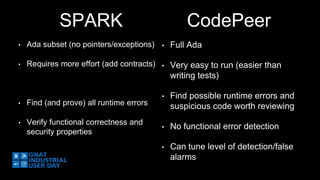
SPARK CodePeer 
• Ada subset (no pointers/exceptions) 
• Requires more effort (add contracts) 
• Find (and prove) all runtime errors 
• Verify functional correctness and 
security properties 
• Full Ada 
• Very easy to run (easier than 
writing tests) 
• Find possible runtime errors and 
suspicious code worth reviewing 
• No functional error detection 
• Can tune level of detection/false 
alarms
Next Release 
SPARK 15.0 and CodePeer 3.0
What’s New in SPARK 15.0 
• Improved proof capability 
• Improved user interface 
• New language features
Improved Proof Capability 
• Local subprograms can be used without contracts 
• Improved parallelism 
• Use of Ada functions in contracts 
• Improved handling of arrays, integers, floating-point
Improved User Interface 
• Improved handling of error and warning messages 
• More precise generation of contracts (Globals/Depends) 
• Support for manual provers (e.g. Coq, Isabelle) 
• Computation and display of remaining assumptions 
• Improved documentation (examples, tutorials, …)
New Language Features 
• Support for tagged types and dynamic dispatching 
• Library of (un)bounded indefinite containers 
• Support for dynamic constants/types 
• Improved usability of volatile objects 
• Support for simple raise statements 
• Support for proof-only (“ghost”) code
What’s New in CodePeer 3.0 
• DO178B and EN50128 qualification 
• Support for IEEE 754 floating point semantics 
• Symbolic debugger 
• Enhanced project file support 
• Improved support for non GNAT compilers 
• Enhanced Messages
DO178B Qualification 
• CodePeer can be used to automate part of DO178B 6.3.4.f 
The objective is to determine the correctness and consistency of the Source Code 
• Qualified as a verification tool (TQL 5 in DO178C) 
• Most checks have been qualified: overflow, range, index, division by 
zero, uninitialized variables 
• Generation of a detailed report file (date of run, switches, messages, 
limitations, …)
EN50128 Qualification 
• Qualified as a tool class T2 
• Boundary value analysis 
• Null dereference, buffer overflow, numeric overflow, … 
• Control flow analysis 
• Unreachable code, redundant conditionals, … 
• Data flow analysis 
• Uninitialized variables, redundant assignments, …
IEEE 754 Floating Point 
• CodePeer used to approximate floating point using infinite precision 
values (mathematical results) 
• This could lead to missing potential errors, or false alarms 
• IEEE 754 rounding and loss of precision now taken into account 
• Reliable detection of possible overflows, division by zero 
• Understand properties of mathematical functions (cos, sin, sqrt, …)
Symbolic Debugger 
• Display of Backtraces on precondition messages 
• Display of possible values for any variable
Enhanced Project File Support 
• Aggregate projects 
• Specifying main files on command line 
• Analyzing closure of project 
• Excluding some files from analysis 
• Improved documentation on getting started with project files
Support for Other Compilers 
• Compiler specific libraries 
• Support for a target configuration file 
• Ability to generate a target configuration file using target compiler 
• Support for Ada 83 non portable or invalid code
Enhanced Messages 
• New message: check on possible parameter aliasing 
• New filter on security related vulnerabilities 
• Support for CWE (Common Weakness Enumeration) cwe.mitre.org 
• Compiler-like behavior: file by file quick incremental analysis 
• More accurate messages, fewer false positives
Future Plans 
SPARK 16.0 and CodePeer 3.1
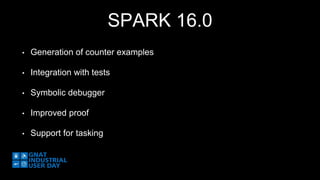
SPARK 16.0 
• Generation of counter examples 
• Integration with tests 
• Symbolic debugger 
• Improved proof 
• Support for tasking
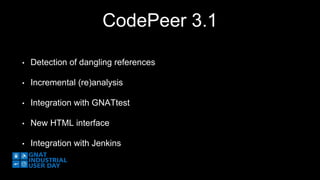
CodePeer 3.1 
• Detection of dangling references 
• Incremental (re)analysis 
• Integration with GNATtest 
• New HTML interface 
• Integration with Jenkins
Questions?

GNAT Pro User Day: Latest Advances in AdaCore Static Analysis Tools

  • 1.
    Latest Advances in AdaCore Static Analysis Tools Presented by Arnaud Charlet
  • 2.
    What is StaticAnalysis? • Basic Static Analysis: coding standard checking, metrics, compiler warnings and style checks • Advanced Static Analysis: symbolic execution/interpretation of source code, whole program analysis to perform software verification • Formal Verification: verify high level or abstract properties on your application, give strong guarantees
  • 3.
    Why Use StaticAnalysis? • Make software more reliable at reasonable cost • Full coverage of your code • No missing check (no “false negatives”) • Anticipate problems (get results before testing) • Automate part of code review • Express and verify your requirements and architecture
  • 4.
    CodePeer Overview •Advanced static analysis tool for Ada • Includes also basic static analysis (gnatcheck, gnatmetric) • Detects runtime and logic errors • Buffer overflow, division by zero, dead code, … • Analyzes complete or partial programs (full Ada) • Generates human readable annotations
  • 5.
    Why Use CodePeer? • Early testing (detect errors earlier on code modifications/new code) • Find bugs (on existing code) • Impact analysis • Code review: help focusing on potential problems/complex code
  • 6.
    Why Use CodePeer? • Race conditions • Provide evidence for program verification
  • 7.
    SPARK Overview •Formal verification tool and language developed by AdaCore and Altran • Subset of Ada 2012: no pointers, no exceptions • New aspects, pragmas, attributes • Can add (executable) contracts for more precise analysis • Can combine test and proof at subprogram level • Allows 100% automatic proof
  • 8.
    Why Use SPARK? • Guarantee no runtime errors, no uninitialized variables • Functional verification • Check data flows (data coupling) • Express and verify high level properties
  • 9.
    Why Use SPARK? When starting from existing code: • You can start by adding incrementally annotations (pre/post) • Get immediate benefit from tests • Incrementally get additional benefits from the SPARK toolset
  • 10.
    Why Use SPARK? When (re)writing (new) code: • Express your requirements in a way that can be reviewed by humans, checked by testing, and verified by SPARK • Express your software architecture, and verify it automatically
  • 11.
    SPARK CodePeer •Ada subset (no pointers/exceptions) • Requires more effort (add contracts) • Find (and prove) all runtime errors • Verify functional correctness and security properties • Full Ada • Very easy to run (easier than writing tests) • Find possible runtime errors and suspicious code worth reviewing • No functional error detection • Can tune level of detection/false alarms
  • 12.
    Next Release SPARK15.0 and CodePeer 3.0
  • 13.
    What’s New inSPARK 15.0 • Improved proof capability • Improved user interface • New language features
  • 14.
    Improved Proof Capability • Local subprograms can be used without contracts • Improved parallelism • Use of Ada functions in contracts • Improved handling of arrays, integers, floating-point
  • 15.
    Improved User Interface • Improved handling of error and warning messages • More precise generation of contracts (Globals/Depends) • Support for manual provers (e.g. Coq, Isabelle) • Computation and display of remaining assumptions • Improved documentation (examples, tutorials, …)
  • 16.
    New Language Features • Support for tagged types and dynamic dispatching • Library of (un)bounded indefinite containers • Support for dynamic constants/types • Improved usability of volatile objects • Support for simple raise statements • Support for proof-only (“ghost”) code
  • 17.
    What’s New inCodePeer 3.0 • DO178B and EN50128 qualification • Support for IEEE 754 floating point semantics • Symbolic debugger • Enhanced project file support • Improved support for non GNAT compilers • Enhanced Messages
  • 18.
    DO178B Qualification •CodePeer can be used to automate part of DO178B 6.3.4.f The objective is to determine the correctness and consistency of the Source Code • Qualified as a verification tool (TQL 5 in DO178C) • Most checks have been qualified: overflow, range, index, division by zero, uninitialized variables • Generation of a detailed report file (date of run, switches, messages, limitations, …)
  • 19.
    EN50128 Qualification •Qualified as a tool class T2 • Boundary value analysis • Null dereference, buffer overflow, numeric overflow, … • Control flow analysis • Unreachable code, redundant conditionals, … • Data flow analysis • Uninitialized variables, redundant assignments, …
  • 20.
    IEEE 754 FloatingPoint • CodePeer used to approximate floating point using infinite precision values (mathematical results) • This could lead to missing potential errors, or false alarms • IEEE 754 rounding and loss of precision now taken into account • Reliable detection of possible overflows, division by zero • Understand properties of mathematical functions (cos, sin, sqrt, …)
  • 21.
    Symbolic Debugger •Display of Backtraces on precondition messages • Display of possible values for any variable
  • 22.
    Enhanced Project FileSupport • Aggregate projects • Specifying main files on command line • Analyzing closure of project • Excluding some files from analysis • Improved documentation on getting started with project files
  • 23.
    Support for OtherCompilers • Compiler specific libraries • Support for a target configuration file • Ability to generate a target configuration file using target compiler • Support for Ada 83 non portable or invalid code
  • 24.
    Enhanced Messages •New message: check on possible parameter aliasing • New filter on security related vulnerabilities • Support for CWE (Common Weakness Enumeration) cwe.mitre.org • Compiler-like behavior: file by file quick incremental analysis • More accurate messages, fewer false positives
  • 25.
    Future Plans SPARK16.0 and CodePeer 3.1
  • 26.
    SPARK 16.0 •Generation of counter examples • Integration with tests • Symbolic debugger • Improved proof • Support for tasking
  • 27.
    CodePeer 3.1 •Detection of dangling references • Incremental (re)analysis • Integration with GNATtest • New HTML interface • Integration with Jenkins
  • 28.