Acute pancreatitis
• Acute pancreatitis is a reversible inflammatory disorder that
varies in severity, from focal edema and fat necrosis to
widespread hemorrhagic necrosis.
Causes:
• Alcohol abuse and gallstones are the major causes.
Causes:
• Idiopathic, Gallstones, Ethanol, Trauma, Steroids, Mumps,
Autoimmune disease, Scorpion sting,
Hypercalcemia/Hypertriglyceridemia (> 1000 mg/dL), ERCP,
Drugs (eg, sulfa drugs, NRTis, protease inhibitors).
“I GET SMASHED”
Note:
• Endoscopic retrograde cholangio-pancreatography (ERCP)
• Nucleoside Reverse Transcriptase Inhibitor (NRTI): E.g. zidovudine (Retrovir), lamivudine (Epivir)
Pathogenesis
Acute pancreatitis appears to be caused by autodigestion
of the pancreas by inappropriately activated pancreatic
enzymes.
Pathogenesis
Acute pancreatitis
Pathogenesis
Mechanisms of activation of proenzymes
(1)Obstruction of the main pancreatic duct or terminal CBD
(2)Chemical injury of acinar cells
(3)Infectious injury of acinar cells
(4)Mechanical injury of acinar cells
(5) Metabolic activation of proenzymes (e.g., hypercalcemia,
ischemia, shock)
Leads to stimulation of Trypsin- activates various proenzymes -
resulting in Acute pancreatitis
Acute pancreatitis
Pathogenesis
(1) Obstruction of the main pancreatic duct or terminal CBD
(a) Gallstones
(b) Alcohol thickens ductal secretions.
• Also increases duct permeability to the enzymes
Acute pancreatitis
Pathogenesis
(2) Chemical injury of acinar cells
• Examples—thiazides, alcohol, triglycerides (>1000 mg/dL)
(3) Infectious injury of acinar cells
• Examples—CMV, mumps, coxsackievirus
(4) Mechanical injury of acinar cells
• Examples—seat belt trauma, posterior penetration of duodenal
ulcer
Acute pancreatitis
Pathogenesis
(5) Metabolic activation of proenzymes (e.g., hypercalcemia,
ischemia, shock)
Acute pancreatitis
Pathogenesis
RESULTS IN –
Trypsin is important in the activation of proenzymes.
(1) Proteases damage acinar cell structure.
(2) Lipases and phospholipases produce enzymatic fat necrosis.
(3) Elastases damage vessel walls and induce hemorrhage (see
(4) Activated enzymes also circulate in the blood.
Morphology of Acute Pancreatitis
The basic alterations in acute pancreatitis are:
(1) Microvascular leakage causing edema,
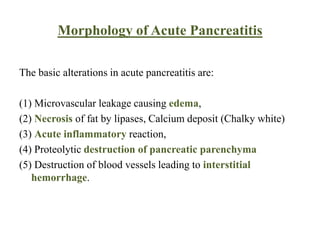
(2) Necrosis of fat by lipases, Calcium deposit (Chalky white)
(3) Acute inflammatory reaction,
(4) Proteolytic destruction of pancreatic parenchyma
(5) Destruction of blood vessels leading to interstitial
hemorrhage.
Complications
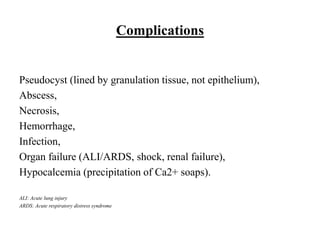
Pseudocyst (lined by granulation tissue, not epithelium),
Abscess,
Necrosis,
Hemorrhage,
Infection,
Organ failure (ALI/ARDS, shock, renal failure),
Hypocalcemia (precipitation of Ca2+ soaps).
ALI: Acute lung injury
ARDS: Acute respiratory distress syndrome
Further reading….
Clinical findings
a. Fever, nausea, and vomiting
b. Severe, boring (knife-like) midepigastric pain with radiation into the back
• Radiation to the back is due to its retroperitoneal location.
c. Hypovolemic shock (Third space fluid loss)
d. Hypoxemia
(1) Circulating pancreatic phospholipase destroys surfactant.
• Loss of surfactant induces atelectasis and intrapulmonary shunting.
(2) Acute respiratory distress syndrome (ARDS) may occur.
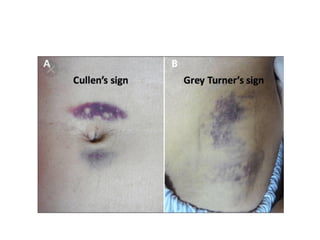
e. Grey-Turner sign (flank hemorrhage)
f. Cullen sign (periumbilical hemorrhage)
g. Disseminated intravascular coagulation
• Due to activation of prothrombin by trypsin
h. Tetany
(1) Hypocalcemia is caused by enzymatic fat necrosis.
(2) Calcium binds to fatty acids, which decreases ionized calcium.
• Diagnosis by 2 of 3 criteria:
- Acute epigastric pain often radiating to the
back
- Increased serum amylase or lipase (more
specific) to 3x upper limit of normal
- Or, characteristic imaging findings.

Acute pancreatitis

  • 1.
  • 3.
    • Acute pancreatitisis a reversible inflammatory disorder that varies in severity, from focal edema and fat necrosis to widespread hemorrhagic necrosis.
  • 4.
    Causes: • Alcohol abuseand gallstones are the major causes.
  • 5.
    Causes: • Idiopathic, Gallstones,Ethanol, Trauma, Steroids, Mumps, Autoimmune disease, Scorpion sting, Hypercalcemia/Hypertriglyceridemia (> 1000 mg/dL), ERCP, Drugs (eg, sulfa drugs, NRTis, protease inhibitors). “I GET SMASHED” Note: • Endoscopic retrograde cholangio-pancreatography (ERCP) • Nucleoside Reverse Transcriptase Inhibitor (NRTI): E.g. zidovudine (Retrovir), lamivudine (Epivir)
  • 6.
    Pathogenesis Acute pancreatitis appearsto be caused by autodigestion of the pancreas by inappropriately activated pancreatic enzymes.
  • 7.
  • 8.
    Acute pancreatitis Pathogenesis Mechanisms ofactivation of proenzymes (1)Obstruction of the main pancreatic duct or terminal CBD (2)Chemical injury of acinar cells (3)Infectious injury of acinar cells (4)Mechanical injury of acinar cells (5) Metabolic activation of proenzymes (e.g., hypercalcemia, ischemia, shock) Leads to stimulation of Trypsin- activates various proenzymes - resulting in Acute pancreatitis
  • 9.
    Acute pancreatitis Pathogenesis (1) Obstructionof the main pancreatic duct or terminal CBD (a) Gallstones (b) Alcohol thickens ductal secretions. • Also increases duct permeability to the enzymes
  • 10.
    Acute pancreatitis Pathogenesis (2) Chemicalinjury of acinar cells • Examples—thiazides, alcohol, triglycerides (>1000 mg/dL) (3) Infectious injury of acinar cells • Examples—CMV, mumps, coxsackievirus (4) Mechanical injury of acinar cells • Examples—seat belt trauma, posterior penetration of duodenal ulcer
  • 11.
    Acute pancreatitis Pathogenesis (5) Metabolicactivation of proenzymes (e.g., hypercalcemia, ischemia, shock)
  • 12.
    Acute pancreatitis Pathogenesis RESULTS IN– Trypsin is important in the activation of proenzymes. (1) Proteases damage acinar cell structure. (2) Lipases and phospholipases produce enzymatic fat necrosis. (3) Elastases damage vessel walls and induce hemorrhage (see (4) Activated enzymes also circulate in the blood.
  • 13.
    Morphology of AcutePancreatitis The basic alterations in acute pancreatitis are: (1) Microvascular leakage causing edema, (2) Necrosis of fat by lipases, Calcium deposit (Chalky white) (3) Acute inflammatory reaction, (4) Proteolytic destruction of pancreatic parenchyma (5) Destruction of blood vessels leading to interstitial hemorrhage.
  • 14.
    Complications Pseudocyst (lined bygranulation tissue, not epithelium), Abscess, Necrosis, Hemorrhage, Infection, Organ failure (ALI/ARDS, shock, renal failure), Hypocalcemia (precipitation of Ca2+ soaps). ALI: Acute lung injury ARDS: Acute respiratory distress syndrome
  • 15.
  • 16.
    Clinical findings a. Fever,nausea, and vomiting b. Severe, boring (knife-like) midepigastric pain with radiation into the back • Radiation to the back is due to its retroperitoneal location. c. Hypovolemic shock (Third space fluid loss) d. Hypoxemia (1) Circulating pancreatic phospholipase destroys surfactant. • Loss of surfactant induces atelectasis and intrapulmonary shunting. (2) Acute respiratory distress syndrome (ARDS) may occur. e. Grey-Turner sign (flank hemorrhage) f. Cullen sign (periumbilical hemorrhage) g. Disseminated intravascular coagulation • Due to activation of prothrombin by trypsin h. Tetany (1) Hypocalcemia is caused by enzymatic fat necrosis. (2) Calcium binds to fatty acids, which decreases ionized calcium.
  • 18.
    • Diagnosis by2 of 3 criteria: - Acute epigastric pain often radiating to the back - Increased serum amylase or lipase (more specific) to 3x upper limit of normal - Or, characteristic imaging findings.