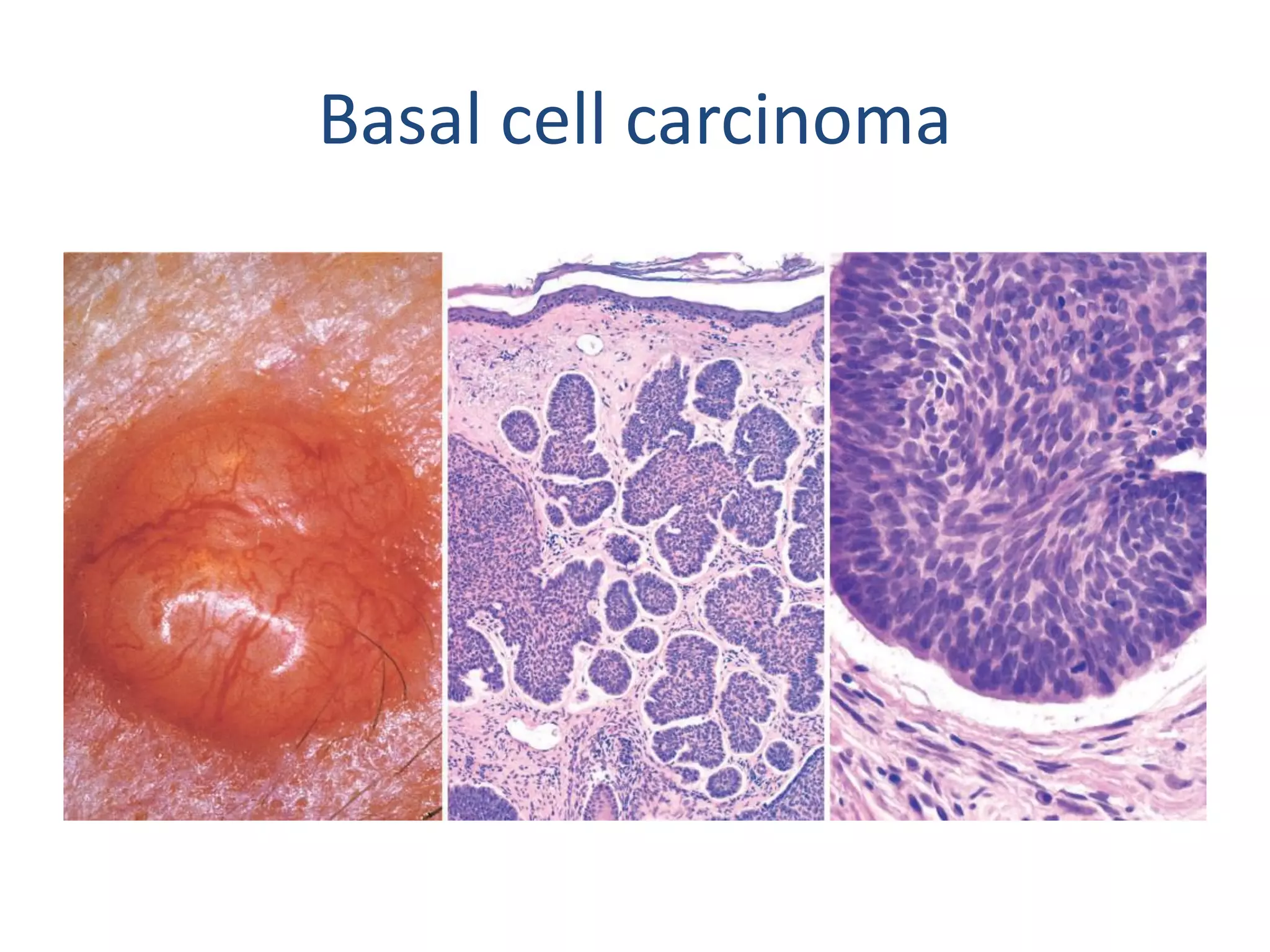
Basal cell carcinoma
❑Slow growing tumors
❑Rarely metastasize
❑Locally aggressive (Rodent ulcer)
Basal cell carcinoma
Arises from the basal cell layers of the epidermis
or, from the follicular epithelium
(Resembles cells in the basal layer of the
epidermis)
Basal cell carcinoma
Predisposing factors
➢ Chronic exposure to ultraviolet light
➢ Lightly pigmented people
➢ Xeroderma pigmentosum (DNA repair defect)
➢ X-ray exposure
➢ Tattoos
➢ Skin injury
Xeroderma Pigmentosum
Pathogenesis
• Mutations in PTCH1 (Tumor suppressor gene)
• Excessive activation of Hedgehog signalling
pathway
PTCH1 (Protein patched homolog 1)
C/F
• Pearly papules often containing prominent, dilated
subepidermal blood vessels (telengiectasias)
• May appear as nodules with central crater
-Sides of the crater are surfaced by telengiectactic vessels.
• Occurs in sun-exposed areas (Sites):
a) Inner canthus of the eye, upper lip
b) Very general rule of thumb is that BBCs favor upper lip
and higher.
Basal cell carcinoma
Pearly papule showing
telengiectasia Nodule with central crater
Morphology
Two patterns are seen.
A) Nodular lesion: Cords and islands of basophilic cells with
hyperchromatic nuclei.
The cells forming the periphery of the tumor
cell islands tend to be arranged radially with their long axes
in approximately parallel alignment (palisading)
The stroma shrinks away from the
epithelial tumor nests creating clefts or retraction artifacts
Basal cell carcinoma
Morphology
B) Multifocal superficial growths: Originating from the epidermis
and extending over several square centimeters (This makes it
difficult to get free margins after surgery)

Basal cell carcinoma

  • 1.
    Basal cell carcinoma ❑Slowgrowing tumors ❑Rarely metastasize ❑Locally aggressive (Rodent ulcer)
  • 2.
    Basal cell carcinoma Arisesfrom the basal cell layers of the epidermis or, from the follicular epithelium (Resembles cells in the basal layer of the epidermis)
  • 3.
    Basal cell carcinoma Predisposingfactors ➢ Chronic exposure to ultraviolet light ➢ Lightly pigmented people ➢ Xeroderma pigmentosum (DNA repair defect) ➢ X-ray exposure ➢ Tattoos ➢ Skin injury
  • 4.
  • 5.
    Pathogenesis • Mutations inPTCH1 (Tumor suppressor gene) • Excessive activation of Hedgehog signalling pathway PTCH1 (Protein patched homolog 1)
  • 6.
    C/F • Pearly papulesoften containing prominent, dilated subepidermal blood vessels (telengiectasias) • May appear as nodules with central crater -Sides of the crater are surfaced by telengiectactic vessels. • Occurs in sun-exposed areas (Sites): a) Inner canthus of the eye, upper lip b) Very general rule of thumb is that BBCs favor upper lip and higher.
  • 7.
    Basal cell carcinoma Pearlypapule showing telengiectasia Nodule with central crater
  • 8.
    Morphology Two patterns areseen. A) Nodular lesion: Cords and islands of basophilic cells with hyperchromatic nuclei. The cells forming the periphery of the tumor cell islands tend to be arranged radially with their long axes in approximately parallel alignment (palisading) The stroma shrinks away from the epithelial tumor nests creating clefts or retraction artifacts
  • 9.
  • 10.
    Morphology B) Multifocal superficialgrowths: Originating from the epidermis and extending over several square centimeters (This makes it difficult to get free margins after surgery)