Acute heart failure AIMS
Common emergency presentation High mortality & morbidity in survivors Diagnosis not always straightforward Classic examination findings not sensitive or specific Prompt recognition & stabilization of patient- priority
At 40 yrs age- lifetime risk: 21% Increasing prevalence In extremis + rapid deterioration Often respond very rapidly to treatment Very satisfying condition to treat Outlook poor despite initial clinical improvement
Presentations Acute SOB, frothy sputum Collapse Shock Cardiac arrest
Acute pulmonary oedema SPOTTER Extreme SOB, puffing, unable to speak Profuse sweating, cold clammy extremities Tachycardia irregularity BP fall  ± Basal creps Rarely wheeze predominant !!! ( asthma)
Collapse/ cardiac arrest Severe HF of any cause:- prone for malignant arrythmias, PE   Present as collapse Very poor outcomes Survival to discharge  ???
Aetiology CAD Hypertensive heart disease Fluid overload Acute valvular regurgitations Arrythmias Pulmonary embolism Acute hepatic venous thrombosis IWMI+RVMI Tamponade
CAD Most common cause Can be the 1 st  manifestation SOB >>> chest pain RVMI common  in the setting of IWMI LV > 40% infarct size
HHD 1 st  presentation  Accelerated hypertension Onset of HF lowers previously high BP Diastolic dysfunction is the basis Age
Pulmonary oedema Mechanisms pulm capillary pressure Capillary permeability Oncotic pressure
pulm capillary pressure LA pressure MV disease Arrythmias Aortic valve disease Ischemia cardiomyopathy LVEDP Accelerated HBP Pericardial constriction Fluid overload Reno-vascular disease High-output states Neurogenic IC bleed Cerebral oedema Post-ictal high altitude
Capillary permeability ARDS Oncotic pressure fall Loss:- NS, Cirrhosis Production:- cirrhosis, sepsis Dilution:- crystalloids
 
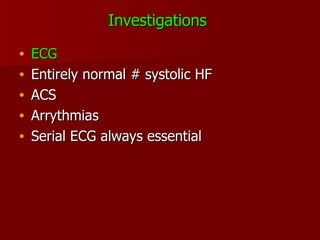
Investigations  ECG Entirely normal # systolic HF ACS Arrythmias  Serial ECG always essential
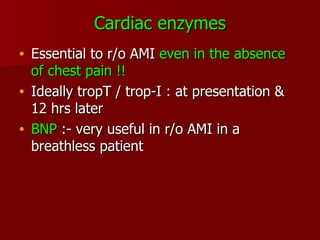
Cardiac enzymes Essential to r/o AMI  even in the absence of chest pain !! Ideally tropT / trop-I : at presentation & 12 hrs later BNP  :- very useful in r/o AMI in a breathless patient
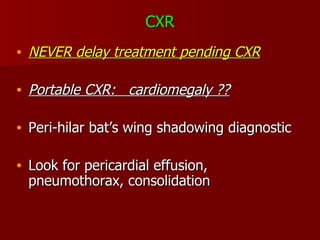
CXR NEVER delay treatment pending CXR Portable CXR:  cardiomegaly ?? Peri-hilar bat’s wing shadowing diagnostic Look for pericardial effusion, pneumothorax, consolidation
ECHO:-  preferably as early as possible To identify cause Assess LV function,  Diastolic dysfunction Cardiac tamponade
STABILIZATION
Actions in order Propped up position IV Morphine 100% Oxygen IV Lasix Monitor ECG Venous access Ensure optimal BP Emergency blood samples ABG SpO2
Assess respiratory function Wheeze: interstitial oedema Aminophylline helpful- bolus  Indications for further support Exhaustion Persistent low paO2 < 8kPa Rising pCO2 Worsening acidosis
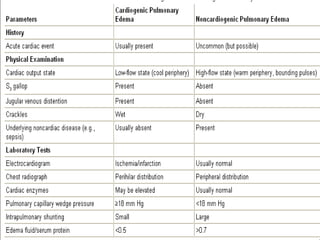
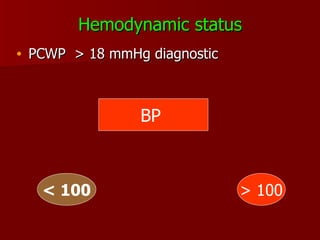
Hemodynamic status PCWP  > 18 mmHg diagnostic BP  < 100 > 100
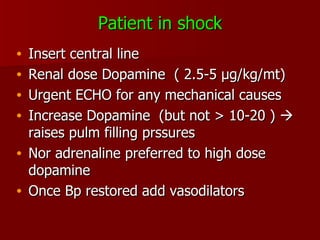
Patient in shock Insert central line Renal dose Dopamine  ( 2.5-5  µg/kg/mt) Urgent ECHO for any mechanical causes Increase Dopamine  (but not > 10-20 )    raises pulm filling prssures Nor adrenaline preferred to high dose dopamine Once Bp restored add vasodilators
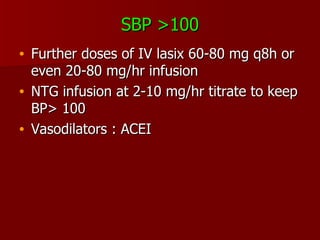
SBP >100 Further doses of IV lasix 60-80 mg q8h or even 20-80 mg/hr infusion NTG infusion at 2-10 mg/hr titrate to keep BP> 100 Vasodilators : ACEI
THANK YOU

Acute Heart Failure

  • 1.
  • 2.
    Common emergency presentationHigh mortality & morbidity in survivors Diagnosis not always straightforward Classic examination findings not sensitive or specific Prompt recognition & stabilization of patient- priority
  • 3.
    At 40 yrsage- lifetime risk: 21% Increasing prevalence In extremis + rapid deterioration Often respond very rapidly to treatment Very satisfying condition to treat Outlook poor despite initial clinical improvement
  • 4.
    Presentations Acute SOB,frothy sputum Collapse Shock Cardiac arrest
  • 5.
    Acute pulmonary oedemaSPOTTER Extreme SOB, puffing, unable to speak Profuse sweating, cold clammy extremities Tachycardia irregularity BP fall ± Basal creps Rarely wheeze predominant !!! ( asthma)
  • 6.
    Collapse/ cardiac arrestSevere HF of any cause:- prone for malignant arrythmias, PE  Present as collapse Very poor outcomes Survival to discharge ???
  • 7.
    Aetiology CAD Hypertensiveheart disease Fluid overload Acute valvular regurgitations Arrythmias Pulmonary embolism Acute hepatic venous thrombosis IWMI+RVMI Tamponade
  • 8.
    CAD Most commoncause Can be the 1 st manifestation SOB >>> chest pain RVMI common in the setting of IWMI LV > 40% infarct size
  • 9.
    HHD 1 st presentation Accelerated hypertension Onset of HF lowers previously high BP Diastolic dysfunction is the basis Age
  • 10.
    Pulmonary oedema Mechanismspulm capillary pressure Capillary permeability Oncotic pressure
  • 11.
    pulm capillary pressureLA pressure MV disease Arrythmias Aortic valve disease Ischemia cardiomyopathy LVEDP Accelerated HBP Pericardial constriction Fluid overload Reno-vascular disease High-output states Neurogenic IC bleed Cerebral oedema Post-ictal high altitude
  • 12.
    Capillary permeability ARDSOncotic pressure fall Loss:- NS, Cirrhosis Production:- cirrhosis, sepsis Dilution:- crystalloids
  • 13.
  • 14.
    Investigations ECGEntirely normal # systolic HF ACS Arrythmias Serial ECG always essential
  • 15.
    Cardiac enzymes Essentialto r/o AMI even in the absence of chest pain !! Ideally tropT / trop-I : at presentation & 12 hrs later BNP :- very useful in r/o AMI in a breathless patient
  • 16.
    CXR NEVER delaytreatment pending CXR Portable CXR: cardiomegaly ?? Peri-hilar bat’s wing shadowing diagnostic Look for pericardial effusion, pneumothorax, consolidation
  • 17.
    ECHO:- preferablyas early as possible To identify cause Assess LV function, Diastolic dysfunction Cardiac tamponade
  • 18.
  • 19.
    Actions in orderPropped up position IV Morphine 100% Oxygen IV Lasix Monitor ECG Venous access Ensure optimal BP Emergency blood samples ABG SpO2
  • 20.
    Assess respiratory functionWheeze: interstitial oedema Aminophylline helpful- bolus Indications for further support Exhaustion Persistent low paO2 < 8kPa Rising pCO2 Worsening acidosis
  • 21.
    Hemodynamic status PCWP > 18 mmHg diagnostic BP < 100 > 100
  • 22.
    Patient in shockInsert central line Renal dose Dopamine ( 2.5-5 µg/kg/mt) Urgent ECHO for any mechanical causes Increase Dopamine (but not > 10-20 )  raises pulm filling prssures Nor adrenaline preferred to high dose dopamine Once Bp restored add vasodilators
  • 23.
    SBP >100 Furtherdoses of IV lasix 60-80 mg q8h or even 20-80 mg/hr infusion NTG infusion at 2-10 mg/hr titrate to keep BP> 100 Vasodilators : ACEI
  • 24.