

ACUTE FLACCID PARALYSIS
DR. SWAPNIL C. MIRAJKAR
M.D. (PAEDS)
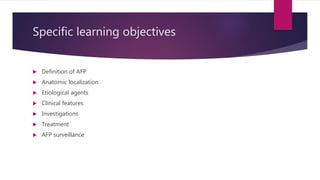
Specific learning objectives
 Definition of AFP
 Anatomic localization
 Etiological agents
 Clinical features
 Investigations
 Treatment
 AFP surveillance
Definition
 Sudden onset of weakness or paralysis in a previously normal limb in a patient
aged less than 15 years age.
 AFP is a lower motor neuron lesion.
 LMN : lesion of the nerve fibres travelling from the anterior horn of the spinal cord
to the associated muscle(s)
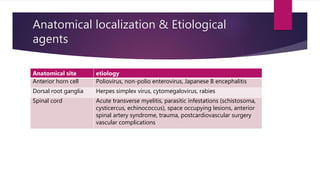
Anatomical localization & Etiological
agents
Anatomical site etiology
Anterior horn cell Poliovirus, non-polio enterovirus, Japanese B encephalitis
Dorsal root ganglia Herpes simplex virus, cytomegalovirus, rabies
Spinal cord Acute transverse myelitis, parasitic infestations (schistosoma,
cysticercus, echinococcus), space occupying lesions, anterior
spinal artery syndrome, trauma, postcardiovascular surgery
vascular complications
Anatomical localization & Etiological
agents (continued)
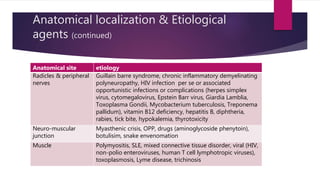
Anatomical site etiology
Radicles & peripheral
nerves
Guillain barre syndrome, chronic inflammatory demyelinating
polyneuropathy, HIV infection per se or associated
opportunistic infections or complications (herpes simplex
virus, cytomegalovirus, Epstein Barr virus, Giardia Lamblia,
Toxoplasma Gondii, Mycobacterium tuberculosis, Treponema
pallidum), vitamin B12 deficiency, hepatitis B, diphtheria,
rabies, tick bite, hypokalemia, thyrotoxicity
Neuro-muscular
junction
Myasthenic crisis, OPP, drugs (aminoglycoside phenytoin),
botulisim, snake envenomation
Muscle Polymyositis, SLE, mixed connective tissue disorder, viral (HIV,
non-polio enteroviruses, human T cell lymphotropic viruses),
toxoplasmosis, Lyme disease, trichinosis
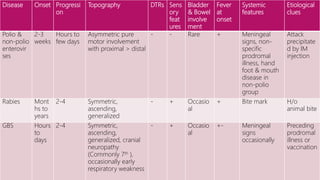
 Clinical features in a child presenting with acute flaccid paralysis.
Disease Onset Progressi
on
Topography DTRs Sens
ory
feat
ures
Bladder
& Bowel
involve
ment
Fever
at
onset
Systemic
features
Etiological
clues
Polio &
non-polio
enterovir
ses
2-3
weeks
Hours to
few days
Asymmetric pure
motor involvement
with proximal > distal
- - Rare + Meningeal
signs, non-
specific
prodromal
illness, hand
foot & mouth
disease in
non-polio
group
Attack
precipitate
d by IM
injection
Rabies Mont
hs to
years
2-4 Symmetric,
ascending,
generalized
- + Occasio
al
+ Bite mark H/o
animal bite
GBS Hours
to
days
2-4 Symmetric,
ascending,
generalized, cranial
neuropathy
(Commonly 7th ),
occasionally early
respiratory weakness
- + Occasio
al
+- Meningeal
signs
occasionally
Preceding
prodromal
illness or
vaccination
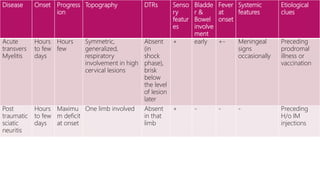
Disease Onset Progress
ion
Topography DTRs Senso
ry
featur
es
Bladde
r &
Bowel
involve
ment
Fever
at
onset
Systemic
features
Etiological
clues
Acute
transvers
Myelitis
Hours
to few
days
Hours
few
Symmetric,
generalized,
respiratory
involvement in high
cervical lesions
Absent
(in
shock
phase),
brisk
below
the level
of lesion
later
+ early +- Meningeal
signs
occasionally
Preceding
prodromal
illness or
vaccination
Post
traumatic
sciatic
neuritis
Hours
to few
days
Maximu
m deficit
at onset
One limb involved Absent
in that
limb
+ - - - Preceding
H/o IM
injections
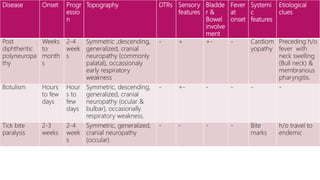
Disease Onset Progr
essio
n
Topography DTRs Sensory
features
Bladde
r &
Bowel
involve
ment
Fever
at
onset
Systemi
c
features
Etiological
clues
Post
diphtheritic
polyneuropa
thy
Weeks
to
month
s
2-4
week
s
Symmetric ,descending,
generalized, cranial
neuropathy (commonly
palatal), occassionaly
early respiratory
weakness
- + +- - Cardiom
yopathy
Preceding h/o
fever with
neck swelling
(Bull neck) &
membranous
pharyngitis.
Botulism Hours
to few
days
Hour
s to
few
days
Symmetric, descending,
generalized, cranial
neuropathy (ocular &
bulbar), occasionally
respiratory weakness.
- +- - - - -
Tick bite
paralysis
2-3
weeks
2-4
week
s
Symmetric, generalized,
cranial neuropathy
(occular)
- - - - Bite
marks
h/o travel to
endemic
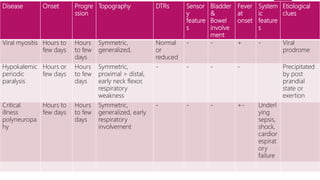
Disease Onset Progre
ssion
Topography DTRs Sensor
y
feature
s
Bladder
&
Bowel
involve
ment
Fever
at
onset
System
ic
feature
s
Etiological
clues
Viral myositis Hours to
few days
Hours
to few
days
Symmetric,
generalized,
Normal
or
reduced
- - + - Viral
prodrome
Hypokalemic
periodic
paralysis
Hours or
few days
Hours
to few
days
Symmetric,
proximal > distal,
early neck flexor,
respiratory
weakness
- - - - Precipitated
by post
prandial
state or
exertion
Critical
illness
polyneuropa
hy
Hours to
few days
Hours
to few
days
Symmetric,
generalized, early
respiratory
involvement
- - - +- Underl
ying
sepsis,
shock,
cardior
espirat
ory
failure
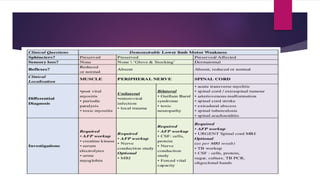
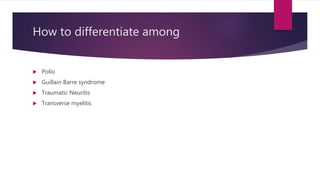
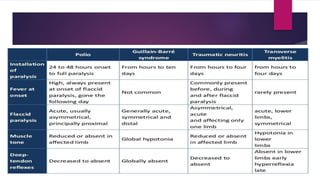
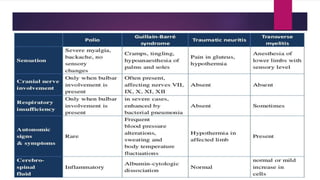
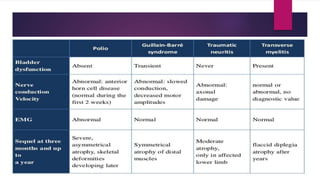
How to differentiate among
 Polio
 Guillain Barre syndrome
 Traumatic Neuritis
 Transverse myelitis
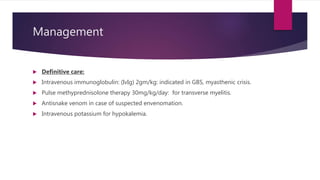
Management
 Definitive care:
 Intravenous immunoglobulin: (IvIg) 2gm/kg: indicated in GBS, myasthenic crisis.
 Pulse methyprednisolone therapy 30mg/kg/day: for transverse myelitis.
 Antisnake venom in case of suspected envenomation.
 Intravenous potassium for hypokalemia.
Management
 Supportive care:
 Prevention of bedsores
 Bladder & bowel care
 Nutrition
 Physical & occupational theraphy
AFP SURVEILLENCE
 AFP surveillance identifies new cases & detects importation of wild poliovirus.
 The four steps of surveillance are:
1. Finding & reporting children with AFP.
2. Transporting stool samples for analysis.
3. Isolating & identifying poliovirus in the laboratory.
4. Mapping the virus to determine the origin of the virus strain.
AFP SURVEILLENCE
Finding & reporting children with AFP
 The first link are staff in all health facilities: from district health centres to large
hospitals
 They must promptly report every case of AFP in any child < 15 years of age.
 The number of AFP cases reported each year is used as an indicator of country’s
ability to detect polio even in countries where disease no longer occurs.
 A country’s surveillance system needs to be sensitive enough to detect at least
one case of AFP for every 1,00,000 children < 15 years of age even in absence of
polio.
AFP SURVEILLENCE
Transporting stool samples for analysis:
 Two stool samples should be collected at an interval of 24-48 hours apart & within
14 days of onset of paralysis.
 However, when AFP cases are seen late(i.e. greater than 2 weeks after paralysis),
stool specimen may be collected up to 60 days after onset of paralysis.
 At least “one thumb sized” 8 gm of stool is required.
AFP SURVEILLENCE
Isolating poliovirus:
 If poliovirus is isolated the next step is to distinguish between wild & vaccine
related.
 If wild poliovirus is isolated then identify which of the two surviving types of wild
virus is involved.
AFP SURVEILLENCE
Mapping of the virus:
 Once the wild poliovirus is identified, further tests are carried out to determine
from where the strain may have originated.
 By determining the genetic makeup of virus, wild virus can be compared to others
& classified into genetic families which cluster in defined geographic areas.
 When the poliovirus has been pinpointed to precise geographical area, it is
possible to identify the source of importation of poliovirus- both long range &
cross border.
Thank you

Acute flaccid paralysis

  • 1.
    ACUTE FLACCID PARALYSIS DR.SWAPNIL C. MIRAJKAR M.D. (PAEDS)
  • 2.
    Specific learning objectives Definition of AFP  Anatomic localization  Etiological agents  Clinical features  Investigations  Treatment  AFP surveillance
  • 3.
    Definition  Sudden onsetof weakness or paralysis in a previously normal limb in a patient aged less than 15 years age.
  • 4.
     AFP isa lower motor neuron lesion.  LMN : lesion of the nerve fibres travelling from the anterior horn of the spinal cord to the associated muscle(s)
  • 5.
    Anatomical localization &Etiological agents Anatomical site etiology Anterior horn cell Poliovirus, non-polio enterovirus, Japanese B encephalitis Dorsal root ganglia Herpes simplex virus, cytomegalovirus, rabies Spinal cord Acute transverse myelitis, parasitic infestations (schistosoma, cysticercus, echinococcus), space occupying lesions, anterior spinal artery syndrome, trauma, postcardiovascular surgery vascular complications
  • 6.
    Anatomical localization &Etiological agents (continued) Anatomical site etiology Radicles & peripheral nerves Guillain barre syndrome, chronic inflammatory demyelinating polyneuropathy, HIV infection per se or associated opportunistic infections or complications (herpes simplex virus, cytomegalovirus, Epstein Barr virus, Giardia Lamblia, Toxoplasma Gondii, Mycobacterium tuberculosis, Treponema pallidum), vitamin B12 deficiency, hepatitis B, diphtheria, rabies, tick bite, hypokalemia, thyrotoxicity Neuro-muscular junction Myasthenic crisis, OPP, drugs (aminoglycoside phenytoin), botulisim, snake envenomation Muscle Polymyositis, SLE, mixed connective tissue disorder, viral (HIV, non-polio enteroviruses, human T cell lymphotropic viruses), toxoplasmosis, Lyme disease, trichinosis
  • 7.
     Clinical featuresin a child presenting with acute flaccid paralysis.
  • 8.
    Disease Onset Progressi on TopographyDTRs Sens ory feat ures Bladder & Bowel involve ment Fever at onset Systemic features Etiological clues Polio & non-polio enterovir ses 2-3 weeks Hours to few days Asymmetric pure motor involvement with proximal > distal - - Rare + Meningeal signs, non- specific prodromal illness, hand foot & mouth disease in non-polio group Attack precipitate d by IM injection Rabies Mont hs to years 2-4 Symmetric, ascending, generalized - + Occasio al + Bite mark H/o animal bite GBS Hours to days 2-4 Symmetric, ascending, generalized, cranial neuropathy (Commonly 7th ), occasionally early respiratory weakness - + Occasio al +- Meningeal signs occasionally Preceding prodromal illness or vaccination
  • 9.
    Disease Onset Progress ion TopographyDTRs Senso ry featur es Bladde r & Bowel involve ment Fever at onset Systemic features Etiological clues Acute transvers Myelitis Hours to few days Hours few Symmetric, generalized, respiratory involvement in high cervical lesions Absent (in shock phase), brisk below the level of lesion later + early +- Meningeal signs occasionally Preceding prodromal illness or vaccination Post traumatic sciatic neuritis Hours to few days Maximu m deficit at onset One limb involved Absent in that limb + - - - Preceding H/o IM injections
  • 10.
    Disease Onset Progr essio n TopographyDTRs Sensory features Bladde r & Bowel involve ment Fever at onset Systemi c features Etiological clues Post diphtheritic polyneuropa thy Weeks to month s 2-4 week s Symmetric ,descending, generalized, cranial neuropathy (commonly palatal), occassionaly early respiratory weakness - + +- - Cardiom yopathy Preceding h/o fever with neck swelling (Bull neck) & membranous pharyngitis. Botulism Hours to few days Hour s to few days Symmetric, descending, generalized, cranial neuropathy (ocular & bulbar), occasionally respiratory weakness. - +- - - - - Tick bite paralysis 2-3 weeks 2-4 week s Symmetric, generalized, cranial neuropathy (occular) - - - - Bite marks h/o travel to endemic
  • 11.
    Disease Onset Progre ssion TopographyDTRs Sensor y feature s Bladder & Bowel involve ment Fever at onset System ic feature s Etiological clues Viral myositis Hours to few days Hours to few days Symmetric, generalized, Normal or reduced - - + - Viral prodrome Hypokalemic periodic paralysis Hours or few days Hours to few days Symmetric, proximal > distal, early neck flexor, respiratory weakness - - - - Precipitated by post prandial state or exertion Critical illness polyneuropa hy Hours to few days Hours to few days Symmetric, generalized, early respiratory involvement - - - +- Underl ying sepsis, shock, cardior espirat ory failure
  • 13.
    How to differentiateamong  Polio  Guillain Barre syndrome  Traumatic Neuritis  Transverse myelitis
  • 17.
    Management  Definitive care: Intravenous immunoglobulin: (IvIg) 2gm/kg: indicated in GBS, myasthenic crisis.  Pulse methyprednisolone therapy 30mg/kg/day: for transverse myelitis.  Antisnake venom in case of suspected envenomation.  Intravenous potassium for hypokalemia.
  • 18.
    Management  Supportive care: Prevention of bedsores  Bladder & bowel care  Nutrition  Physical & occupational theraphy
  • 19.
    AFP SURVEILLENCE  AFPsurveillance identifies new cases & detects importation of wild poliovirus.  The four steps of surveillance are: 1. Finding & reporting children with AFP. 2. Transporting stool samples for analysis. 3. Isolating & identifying poliovirus in the laboratory. 4. Mapping the virus to determine the origin of the virus strain.
  • 20.
    AFP SURVEILLENCE Finding &reporting children with AFP  The first link are staff in all health facilities: from district health centres to large hospitals  They must promptly report every case of AFP in any child < 15 years of age.  The number of AFP cases reported each year is used as an indicator of country’s ability to detect polio even in countries where disease no longer occurs.  A country’s surveillance system needs to be sensitive enough to detect at least one case of AFP for every 1,00,000 children < 15 years of age even in absence of polio.
  • 21.
    AFP SURVEILLENCE Transporting stoolsamples for analysis:  Two stool samples should be collected at an interval of 24-48 hours apart & within 14 days of onset of paralysis.  However, when AFP cases are seen late(i.e. greater than 2 weeks after paralysis), stool specimen may be collected up to 60 days after onset of paralysis.  At least “one thumb sized” 8 gm of stool is required.
  • 22.
    AFP SURVEILLENCE Isolating poliovirus: If poliovirus is isolated the next step is to distinguish between wild & vaccine related.  If wild poliovirus is isolated then identify which of the two surviving types of wild virus is involved.
  • 23.
    AFP SURVEILLENCE Mapping ofthe virus:  Once the wild poliovirus is identified, further tests are carried out to determine from where the strain may have originated.  By determining the genetic makeup of virus, wild virus can be compared to others & classified into genetic families which cluster in defined geographic areas.  When the poliovirus has been pinpointed to precise geographical area, it is possible to identify the source of importation of poliovirus- both long range & cross border.
  • 24.