EXCITABILITY
• Is aphysiochemical change that occurs in a tissue
when stimulus is applied.
• Stimulus is an external agent, which produces
excitability in the tissues.
• Nerve fibers have a low threshold for excitation
than the other cells.
3.
Response Due toStimulation of Nerve
Fiber
• When a nerve fiber is stimulated, based on the
strength of stimulus, two types of response
develop;
1. Action potential or nerve impulse:
2. Electrotonic potential or local potential
4.
1. Action potentialor nerve impulse
• Action potential develops in a nerve fiber when it is
stimulated by a stimulus with adequate strength.
• Adequate strength of stimulus, necessary for
producing the action potential in a nerve fiber is
known as threshold or minimal stimulus.
• Action potential is propagated.
5.
• When thestimulus with subliminal strength is
applied,only electrotonic potential develops and the
action potential does not develop.
• Electrotonic potential is non-propagated.
2. Electrotonic potential or local
potential
6.
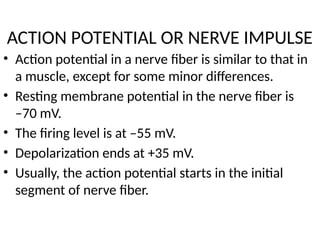
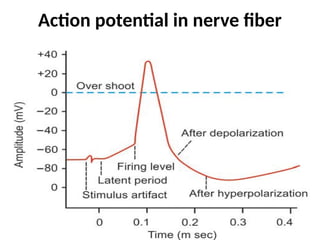
ACTION POTENTIAL ORNERVE IMPULSE
• Action potential in a nerve fiber is similar to that in
a muscle, except for some minor differences.
• Resting membrane potential in the nerve fiber is
–70 mV.
• The firing level is at –55 mV.
• Depolarization ends at +35 mV.
• Usually, the action potential starts in the initial
segment of nerve fiber.
7.
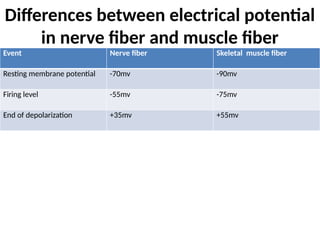
Differences between electricalpotential
in nerve fiber and muscle fiber
Event Nerve fiber Skeletal muscle fiber
Resting membrane potential -70mv -90mv
Firing level -55mv -75mv
End of depolarization +35mv +55mv
ELECTROTONIC POTENTIAL OR
LOCALPOTENTIAL
• Electrotonic potential or local potential is a non-propagated
local response that develops in the nerve fiber when a
subliminal stimulus is applied.
• Subliminal or subthreshold stimulus does not produce action
potential.
• But, it alters the resting membrane potential and produces
slight depolarization for about 7 mV.
• This slight depolarized state is called electrotonic potential.
• Firing level is reached only if depolarization occurs up to 15
mV.
• Then only action potential can develop.
• Electrotonic potential is a graded potential
10.
Properties of nervefibers
• Excitability-
• Conductivity-ability of nerve fibers to transmit impulse
• Summation-when subliminal stimulus is applied no response is
produced. when two subliminal is applied within a short interval
response is produced.
• adaptation-a phenomenon by which excitability of nerve fibers
decreases slowly to a point of no response
• Infatigability-nerve cant be fatigued even if is stimulated for a long time.
• All or one -law-when a nerve is stimulated
• by a stimulus it gives maximum response or does not
• give response at all.
• Refractory period-is period at which the nerve does not give any
response to a stimulus