The Gremlin Graph Traversal
Machine and Language
Dr. Marko A. Rodriguez
Director of Engineering at DataStax, Inc.
Project Management Committee, Apache TinkerPop
http://tinkerpop.incubator.apache.org
Database Programming Languages
Rodriguez, M.A., “The Gremlin Graph Traversal Machine and Language,” Proceedings of the ACM Database Programming
Languages Conference, doi:10.1145/2815072.2815073, ACM, Pittsburg, Pennsylvania, October 2015.
Java is a virtual machine.
Java is a programming language.
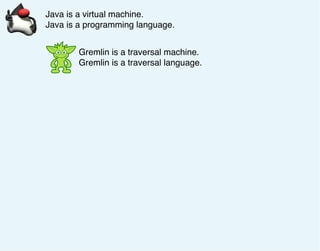
Java is a virtual machine.
Java is a programming language.
Gremlin is a traversal machine.
Gremlin is a traversal language.
Java is a virtual machine.
Java is a programming language.
Gremlin is a traversal machine.
Gremlin is a traversal language.
Java is operating system agnostic.
MacOSX, Linux, Windows, etc.
Java is a virtual machine.
Java is a programming language.
Gremlin is a traversal machine.
Gremlin is a traversal language.
Java is operating system agnostic.
MacOSX, Linux, Windows, etc.
Gremlin is graph system agnostic.
Titan, Neo4j, Stardog, Giraph, Spark, Hadoop, etc.
Java is a virtual machine.
Java is a programming language.
Gremlin is a traversal machine.
Gremlin is a traversal language.
Other languages compile to the Java virtual machine.
Groovy, Scala, Clojure, JavaScript Nashorn, etc.
Java is operating system agnostic.
MacOSX, Linux, Windows, etc.
Gremlin is graph system agnostic.
Titan, Neo4j, Stardog, Giraph, Spark, Hadoop, etc.
Java is a virtual machine.
Java is a programming language.
Gremlin is a traversal machine.
Gremlin is a traversal language.
Other languages compile to the Java virtual machine.
Groovy, Scala, Clojure, JavaScript Nashorn, etc.
Other languages compile to the Gremlin traversal machine.
Gremlin-Groovy, Gremlin-Scala, SPARQL, etc.
Java is operating system agnostic.
MacOSX, Linux, Windows, etc.
Gremlin is graph system agnostic.
Titan, Neo4j, Stardog, Giraph, Spark, Hadoop, etc.
Rodriguez, M.A., Kuppitz, D., “The Benefits of the Gremlin Graph Traversal Machine," DataStax Engineering Blog, 2015.
http://www.datastax.com/dev/blog/the-benefits-of-the-gremlin-graph-traversal-machine
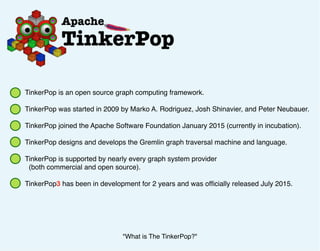
TinkerPop is an open source graph computing framework.
TinkerPop was started in 2009 by Marko A. Rodriguez, Josh Shinavier, and Peter Neubauer.
TinkerPop joined the Apache Software Foundation January 2015 (currently in incubation).
TinkerPop designs and develops the Gremlin graph traversal machine and language.
TinkerPop is supported by nearly every graph system provider
(both commercial and open source).
TinkerPop3 has been in development for 2 years and was officially released July 2015.
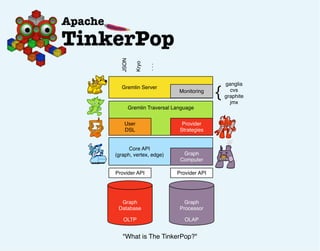
"What is The TinkerPop?"
Graph
Database
Graph
Processor
Provider API Provider API
Provider
Strategies
Gremlin Traversal Language
Graph
Computer
Core API
(graph, vertex, edge)
Monitoring
Gremlin Server
JSON
Kryo
...
ganglia
cvs
graphite
jmx
{
User
DSL
OLTP OLAP
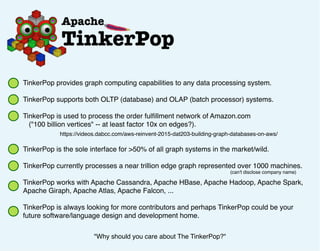
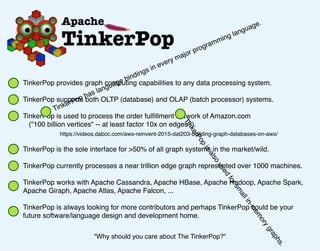
TinkerPop provides graph computing capabilities to any data processing system.
TinkerPop supports both OLTP (database) and OLAP (batch processor) systems.
TinkerPop is used to process the order fulfillment network of Amazon.com
("100 billion vertices" -- at least factor 10x on edges?).
TinkerPop is the sole interface for >50% of all graph systems in the market/wild.
TinkerPop currently processes a near trillion edge graph represented over 1000 machines.
TinkerPop works with Apache Cassandra, Apache HBase, Apache Hadoop, Apache Spark,
Apache Giraph, Apache Atlas, Apache Falcon, ...
TinkerPop is always looking for more contributors and perhaps TinkerPop could be your
future software/language design and development home.
"Why should you care about The TinkerPop?"
https://videos.dabcc.com/aws-reinvent-2015-dat203-building-graph-databases-on-aws/
(can't disclose company name)
TinkerPop provides graph computing capabilities to any data processing system.
TinkerPop supports both OLTP (database) and OLAP (batch processor) systems.
TinkerPop is used to process the order fulfillment network of Amazon.com
("100 billion vertices" -- at least factor 10x on edges?).
TinkerPop is the sole interface for >50% of all graph systems in the market/wild.
TinkerPop currently processes a near trillion edge graph represented over 1000 machines.
TinkerPop works with Apache Cassandra, Apache HBase, Apache Hadoop, Apache Spark,
Apache Giraph, Apache Atlas, Apache Falcon, ...
TinkerPop is always looking for more contributors and perhaps TinkerPop could be your
future software/language design and development home.
"Why should you care about The TinkerPop?"
https://videos.dabcc.com/aws-reinvent-2015-dat203-building-graph-databases-on-aws/
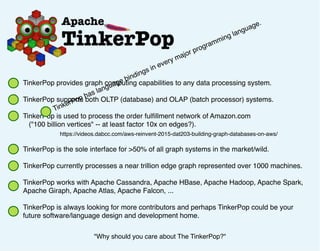
TinkerPop has language bindings in every major programming language.
TinkerPop provides graph computing capabilities to any data processing system.
TinkerPop supports both OLTP (database) and OLAP (batch processor) systems.
TinkerPop is used to process the order fulfillment network of Amazon.com
("100 billion vertices" -- at least factor 10x on edges?).
TinkerPop is the sole interface for >50% of all graph systems in the market/wild.
TinkerPop currently processes a near trillion edge graph represented over 1000 machines.
TinkerPop works with Apache Cassandra, Apache HBase, Apache Hadoop, Apache Spark,
Apache Giraph, Apache Atlas, Apache Falcon, ...
TinkerPop is always looking for more contributors and perhaps TinkerPop could be your
future software/language design and development home.
"Why should you care about The TinkerPop?"
https://videos.dabcc.com/aws-reinvent-2015-dat203-building-graph-databases-on-aws/
TinkerPop has language bindings in every major programming language.
TinkerPop
isalso
used
forsm
allin-m
em
orygraphs.
Part 1: The Gremlin Traversal Machine
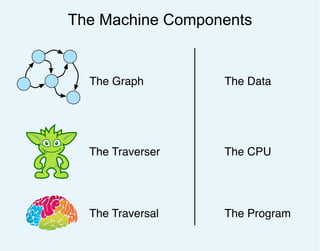
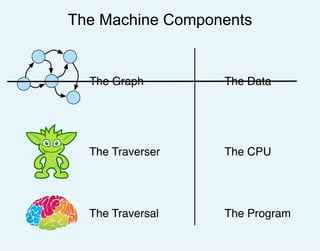
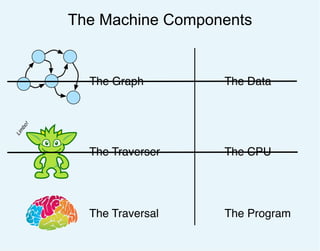
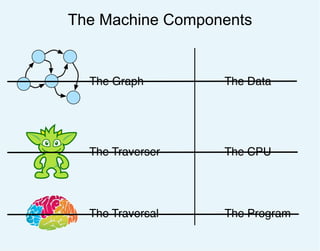
The Machine Components
The Graph
The Traverser
The Traversal
The Data
The CPU
The Program
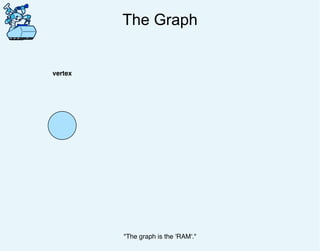
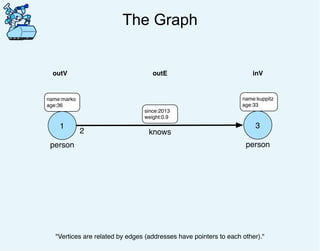
The Graph
vertex
"The graph is the 'RAM'."
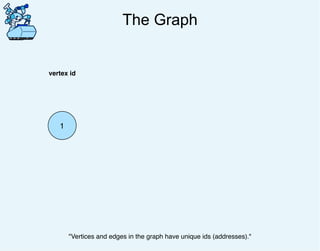
The Graph
1
vertex id
"Vertices and edges in the graph have unique ids (addresses)."
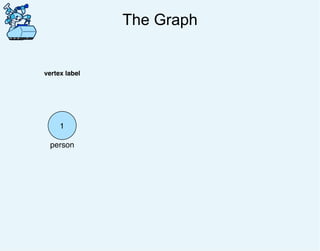
The Graph
1
vertex label
person
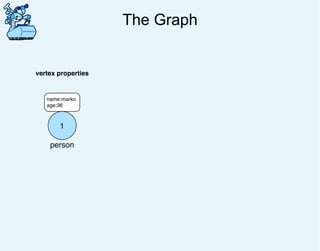
The Graph
1
vertex properties
person
name:marko
age:36
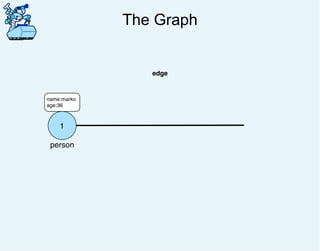
The Graph
1
person
name:marko
age:36
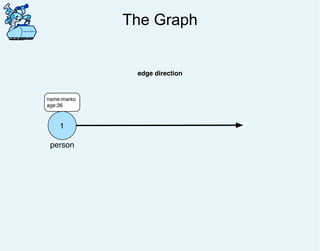
edge
The Graph
1
person
name:marko
age:36
edge direction
The Graph
1
person
name:marko
age:36
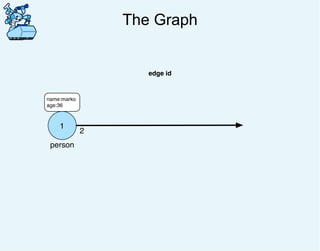
edge id
2
The Graph
1
person
name:marko
age:36
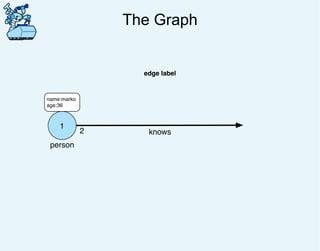
edge label
2 knows
The Graph
1
person
name:marko
age:36
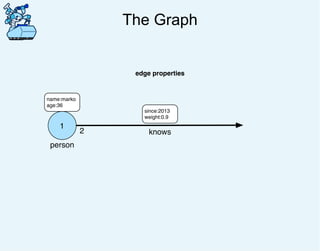
edge properties
2 knows
since:2013
weight:0.9
The Graph
1
person
name:marko
age:36
outE
2 knows
since:2013
weight:0.9
3
person
name:kuppitz
age:33
inVoutV
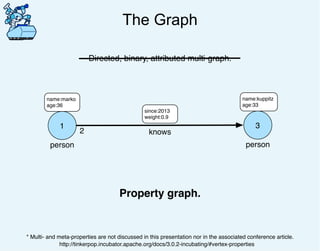
"Vertices are related by edges (addresses have pointers to each other)."
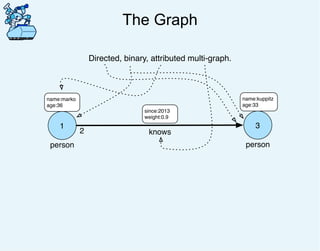
The Graph
1
person
name:marko
age:36
2 knows
since:2013
weight:0.9
3
person
name:kuppitz
age:33
Directed, binary, attributed multi-graph.
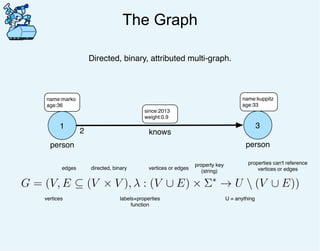
The Graph
1
person
name:marko
age:36
2 knows
since:2013
weight:0.9
3
person
name:kuppitz
age:33
Directed, binary, attributed multi-graph.
G = (V, E ⊆ (V × V ), λ : (V ∪ E) × Σ∗
→ U  (V ∪ E))
vertices
edges directed, binary
labels+properties
function
properties can't reference
vertices or edges
property key
(string)
vertices or edges
U = anything
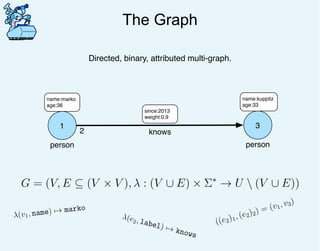
The Graph
1
person
name:marko
age:36
2 knows
since:2013
weight:0.9
3
person
name:kuppitz
age:33
Directed, binary, attributed multi-graph.
G = (V, E ⊆ (V × V ), λ : (V ∪ E) × Σ∗
→ U  (V ∪ E))
λ(v1, name) → marko
λ(e2, label) → knows
((e2)1, (e2)2) = (v1, v3)
The Graph
1
person
name:marko
age:36
2 knows
since:2013
weight:0.9
3
person
name:kuppitz
age:33
Directed, binary, attributed multi-graph.
Property graph.
* Multi- and meta-properties are not discussed in this presentation nor in the associated conference article.
http://tinkerpop.incubator.apache.org/docs/3.0.2-incubating/#vertex-properties
~/tinkerpop3$ bin/gremlin.sh
gremlin>
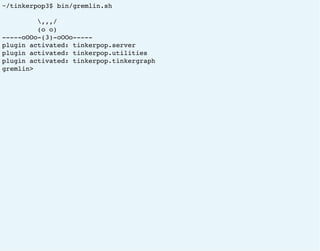
~/tinkerpop3$ bin/gremlin.sh
,,,/
(o o)
-----oOOo-(3)-oOOo-----
plugin activated: tinkerpop.server
plugin activated: tinkerpop.utilities
plugin activated: tinkerpop.tinkergraph
gremlin>
~/tinkerpop3$ bin/gremlin.sh
,,,/
(o o)
-----oOOo-(3)-oOOo-----
plugin activated: tinkerpop.server
plugin activated: tinkerpop.utilities
plugin activated: tinkerpop.tinkergraph
gremlin> graph = TinkerGraph.open()
==>tinkergraph[vertices:0 edges:0]
gremlin>
"TinkerGraph is an in-memory graph system provided by TinkerPop."
~/tinkerpop3$ bin/gremlin.sh
,,,/
(o o)
-----oOOo-(3)-oOOo-----
plugin activated: tinkerpop.server
plugin activated: tinkerpop.utilities
plugin activated: tinkerpop.tinkergraph
gremlin> graph = TinkerGraph.open()
==>tinkergraph[vertices:0 edges:0]
gremlin>
TitanGraph.open(…)
Neo4jGraph.open(…)
OrientGraph.open(…)
HadoopGraph.open(…)
HadoopGraph.
compute(GiraphGraphComputer)
HadoopGraph.
compute(SparkGraphComputer)
"Gremlin is agnostic to the underlying graph system."
StardogGraph.open(…)
etc...
DSEGraph.open(…)
~/tinkerpop3$ bin/gremlin.sh
,,,/
(o o)
-----oOOo-(3)-oOOo-----
plugin activated: tinkerpop.server
plugin activated: tinkerpop.utilities
plugin activated: tinkerpop.tinkergraph
gremlin> graph = TinkerGraph.open()
==>tinkergraph[vertices:0 edges:0]
gremlin> v1 = graph.addVertex(id,1,label,'person')
==>v[1]
gremlin>
"A graph system provider is Gremlin-enabled if they implement the gremlin.structure API suite."
1
person
~/tinkerpop3$ bin/gremlin.sh
,,,/
(o o)
-----oOOo-(3)-oOOo-----
plugin activated: tinkerpop.server
plugin activated: tinkerpop.utilities
plugin activated: tinkerpop.tinkergraph
gremlin> graph = TinkerGraph.open()
==>tinkergraph[vertices:0 edges:0]
gremlin> v1 = graph.addVertex(id,1,label,'person')
==>v[1]
gremlin> v1.property('name','marko')
==>vp[name->marko]
gremlin>
"The APIs have to do with CRUD operations on a graph structure."
1
person
name:marko
~/tinkerpop3$ bin/gremlin.sh
,,,/
(o o)
-----oOOo-(3)-oOOo-----
plugin activated: tinkerpop.server
plugin activated: tinkerpop.utilities
plugin activated: tinkerpop.tinkergraph
gremlin> graph = TinkerGraph.open()
==>tinkergraph[vertices:0 edges:0]
gremlin> v1 = graph.addVertex(id,1,label,'person')
==>v[1]
gremlin> v1.property('name','marko')
==>vp[name->marko]
gremlin> v1.property('age',36)
==>vp[age->36]
gremlin>
1
person
name:marko
age:36
~/tinkerpop3$ bin/gremlin.sh
,,,/
(o o)
-----oOOo-(3)-oOOo-----
plugin activated: tinkerpop.server
plugin activated: tinkerpop.utilities
plugin activated: tinkerpop.tinkergraph
gremlin> graph = TinkerGraph.open()
==>tinkergraph[vertices:0 edges:0]
gremlin> v1 = graph.addVertex(id,1,label,'person')
==>v[1]
gremlin> v1.property('name','marko')
==>vp[name->marko]
gremlin> v1.property('age',36)
==>vp[age->36]
gremlin> v3 = graph.addVertex(id,3,label,'person','name','kuppitz','age',33)
==>v[3]
gremlin>
3
person
name:kuppitz
age:33
~/tinkerpop3$ bin/gremlin.sh
,,,/
(o o)
-----oOOo-(3)-oOOo-----
plugin activated: tinkerpop.server
plugin activated: tinkerpop.utilities
plugin activated: tinkerpop.tinkergraph
gremlin> graph = TinkerGraph.open()
==>tinkergraph[vertices:0 edges:0]
gremlin> v1 = graph.addVertex(id,1,label,'person')
==>v[1]
gremlin> v1.property('name','marko')
==>vp[name->marko]
gremlin> v1.property('age',36)
==>vp[age->36]
gremlin> v3 = graph.addVertex(id,3,label,'person','name','kuppitz','age',33)
==>v[3]
gremlin> v1.addEdge('knows',v3,id,2,'since',2013,'weight',0.9)
==>e[2][1-knows->3]
gremlin>
1
person
name:marko
age:36
2 knows
since:2013
weight:0.9
3
person
name:kuppitz
age:33
The Machine Components
The Graph
The Traverser
The Traversal
The Data
The CPU
The Program
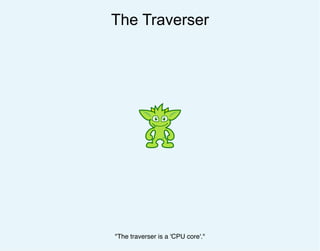
The Traverser
"The traverser is a 'CPU core'."
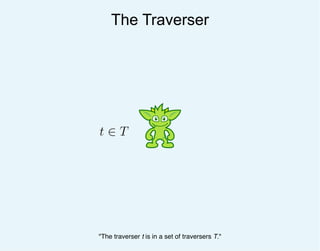
The Traverser
t ∈ T
"The traverser t is in a set of traversers T."
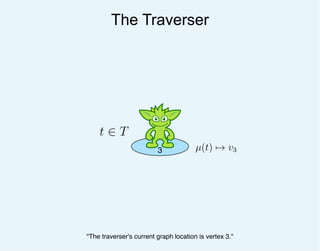
The Traverser
t ∈ T
3
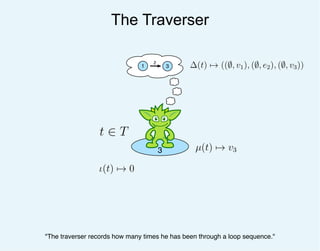
"The traverser's current graph location is vertex 3."
µ(t) → v3
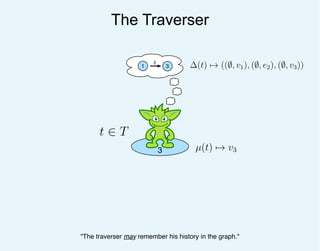
The Traverser
t ∈ T
3
"The traverser may remember his history in the graph."
1 3
2
µ(t) → v3
∆(t) → ((∅, v1), (∅, e2), (∅, v3))
The Traverser
t ∈ T
3
"The traverser records how many times he has been through a loop sequence."
1 3
2
µ(t) → v3
∆(t) → ((∅, v1), (∅, e2), (∅, v3))
ι(t) → 0
The Traverser
t ∈ T
3
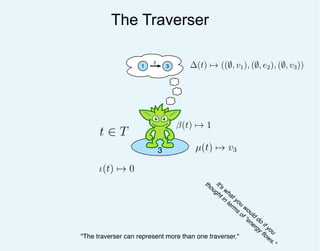
"The traverser can represent more than one traverser."
1 3
2
µ(t) → v3
∆(t) → ((∅, v1), (∅, e2), (∅, v3))
ι(t) → 0
It's
what you
would
do
if you
thought in
term
s
of "energy
flows."
β(t) → 1
The Traverser
t ∈ T
3
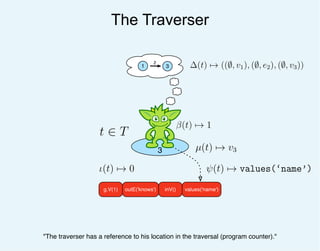
"The traverser has a reference to his location in the traversal (program counter)."
1 3
2
µ(t) → v3
∆(t) → ((∅, v1), (∅, e2), (∅, v3))
ι(t) → 0
β(t) → 1
outE('knows') inV() values('name')g.V(1)
ψ(t) → values(‘name’)
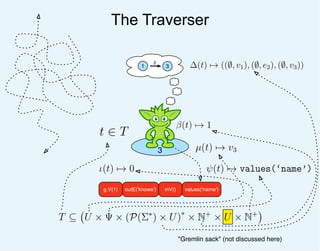
T ⊆ U × Ψ × (P(Σ∗
) × U)∗
× N+
× U × N+
The Traverser
t ∈ T
3
"Gremlin sack" (not discussed here)
1 3
2
µ(t) → v3
∆(t) → ((∅, v1), (∅, e2), (∅, v3))
ι(t) → 0
β(t) → 1
outE('knows') inV() values('name')g.V(1)
ψ(t) → values(‘name’)
The Traverser
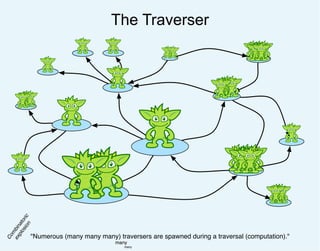
"Numerous (many many many) traversers are spawned during a traversal (computation)."
many
many
Com
binatoric
explosion
The Traverser
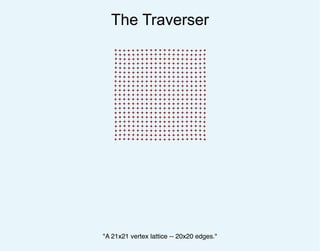
"A 21x21 vertex lattice -- 20x20 edges."
The Traverser
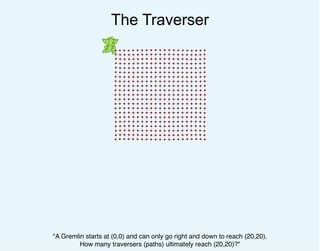
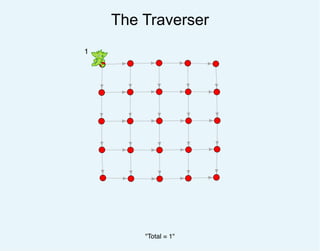
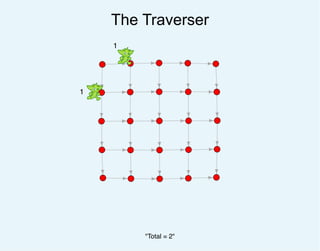
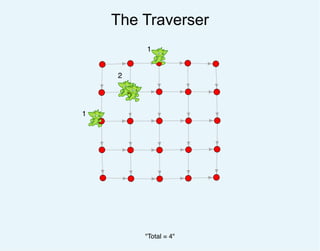
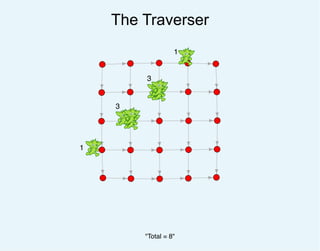
"A Gremlin starts at (0,0) and can only go right and down to reach (20,20).
How many traversers (paths) ultimately reach (20,20)?"
The Traverser
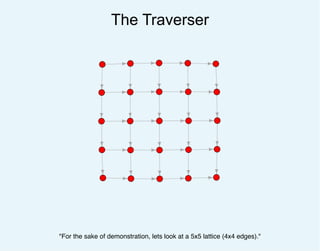
"For the sake of demonstration, lets look at a 5x5 lattice (4x4 edges)."
The Traverser
1
"Total = 1"
The Traverser
1
1
"Total = 2"
The Traverser
"Total = 4"
1
1
2
The Traverser
"Total = 8"
1
1
3
3
The Traverser
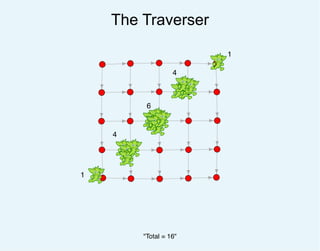
"Total = 16"
1
1
4
4
6
The Traverser
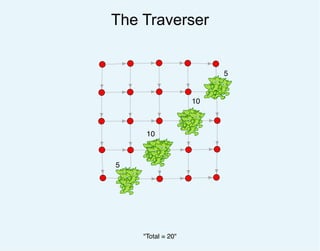
"Total = 20"
5
5
10
10
The Traverser
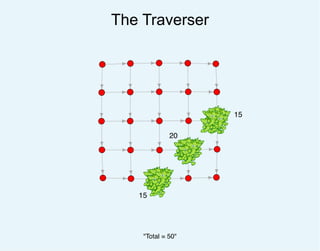
"Total = 50"
15
15
20
The Traverser
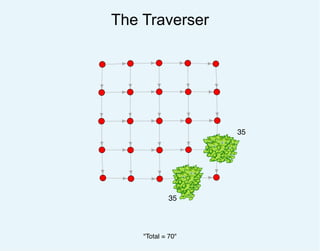
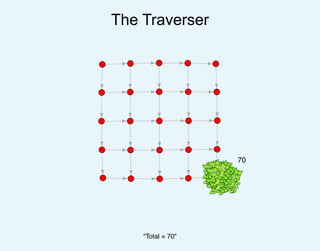
"Total = 70"
35
35
The Traverser
"Total = 70"
70
The Traverser
70
✓
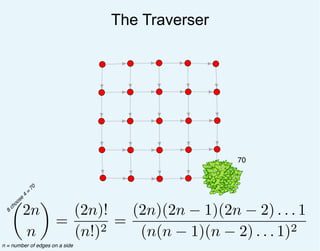
2n
n
◆
=
(2n)!
(n!)2
=
(2n)(2n 1)(2n 2) . . . 1
(n(n 1)(n 2) . . . 1)2
8
choose
4
=
70
n = number of edges on a side
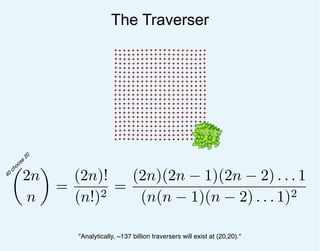
"Analytically, ~137 billion traversers will exist at (20,20)."
The Traverser
✓
2n
n
◆
=
(2n)!
(n!)2
=
(2n)(2n 1)(2n 2) . . . 1
(n(n 1)(n 2) . . . 1)2
40
choose
20
The Traverser
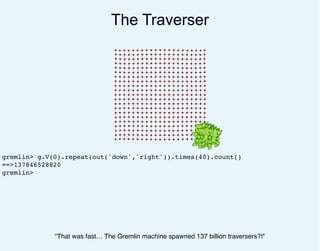
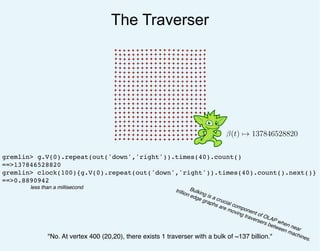
gremlin> g.V(0).repeat(out('down','right')).times(40).count()
==>137846528820
gremlin>
"That was fast… The Gremlin machine spawned 137 billion traversers?!"
"No. At vertex 400 (20,20), there exists 1 traverser with a bulk of ~137 billion."
The Traverser
gremlin> g.V(0).repeat(out('down','right')).times(40).count()
==>137846528820
gremlin> clock(100){g.V(0).repeat(out('down','right')).times(40).count().next()}
==>0.8890942
less than a millisecond
β(t) → 137846528820
Bulking is a crucial component of OLAP when near
trillion edge graphs are moving traversers between machines.
The Traverser
"If 2 traversers (each with bulk 1) are at the same location in the graph and have similar other properties,
make 1 traverser with a bulk of 2."
Traverser Equivalence Class
graph location
traversal location
path history
same loop counter
[t] = {t ∈ T | µ(t) = µ(t ) ∧
ψ(t) = ψ(t ) ∧
∆(t) = ∆(t ) ∧
ι(t) = ι(t ) }.
data location
program counter
MAY NOT BE REQUIRED
recursion of program counter
β(t1) → 1
β(t2) → 3
β(t3) → 4
β(t4) → 8
Don't enumerate, bulk!
The Traverser
User Machine
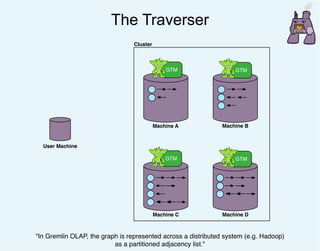
"In Gremlin OLAP, the graph is represented across a distributed system (e.g. Hadoop)
as a partitioned adjacency list."
GTM GTM
GTM GTM
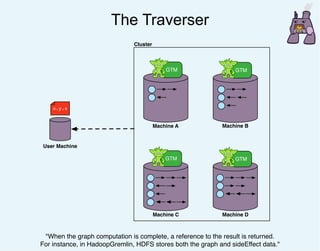
Machine C
Machine A Machine B
Machine D
Cluster
The Traverser
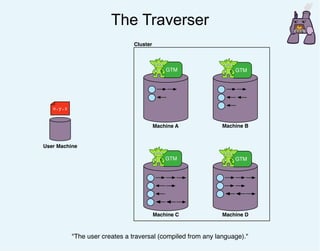
User Machine
x.y.z
"The user creates a traversal (compiled from any language)."
GTM GTM
GTM GTM
Machine C
Machine A Machine B
Machine D
Cluster
The Traverser
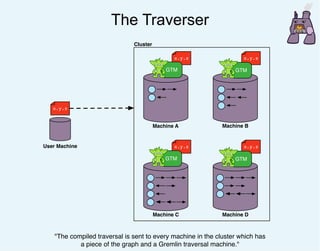
x.y.z x.y.z
x.y.zx.y.z
GTM GTM
GTM GTM
Machine C
Machine A Machine B
Machine D
Cluster
User Machine
x.y.z
"The compiled traversal is sent to every machine in the cluster which has
a piece of the graph and a Gremlin traversal machine."
The Traverser
GTM GTM
GTM GTM
Machine C
Machine A Machine B
Machine D
Cluster
User Machine
x.y.z
"When the graph computation is complete, a reference to the result is returned.
For instance, in HadoopGremlin, HDFS stores both the graph and sideEffect data."
The Traverser
x.y.z
GTM
x.y.z
GTM
Machine A Machine B
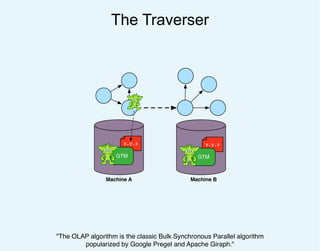
"The OLAP algorithm is the classic Bulk Synchronous Parallel algorithm
popularized by Google Pregel and Apache Giraph."
x.y.z
GTM
x.y.z
GTM
The Traverser
Machine A Machine B
"The messages are traversers. Given the traverser equivalence class [t], they can be bulked."
"Its just "complex energy."
The Machine Components
The Graph
The Traverser
The Traversal
The Data
The CPU
The Program
Lim
bo!
The Traversal
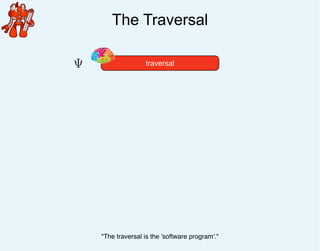
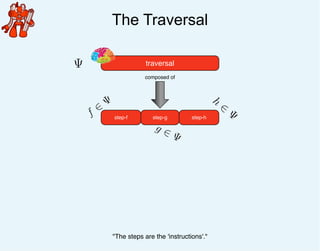
Ψ traversal
"The traversal is the 'software program'."
The Traversal
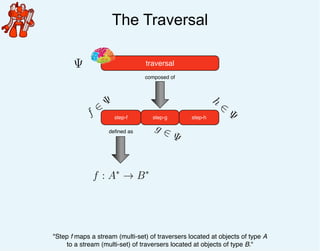
traversalΨ
step-g step-hstep-f
composed of
f
∈
Ψ
g ∈ Ψ
h
∈
Ψ
"The steps are the 'instructions'."
The Traversal
traversalΨ
step-g step-hstep-f
composed of
f
∈
Ψ
defined as
g ∈ Ψ
h
∈
Ψ
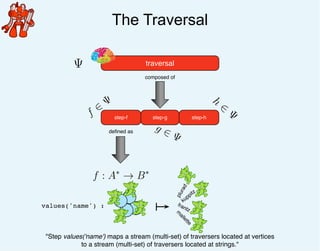
f : A∗
→ B∗
"Step f maps a stream (multi-set) of traversers located at objects of type A
to a stream (multi-set) of traversers located at objects of type B."
The Traversal
traversalΨ
step-g step-hstep-f
composed of
f
∈
Ψ
defined as
g ∈ Ψ
h
∈
Ψ
f : A∗
→ B∗
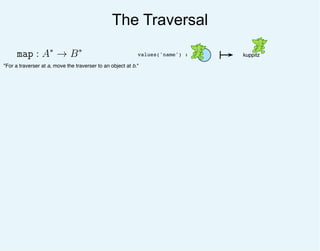
"Step values('name') maps a stream (multi-set) of traversers located at vertices
to a stream (multi-set) of traversers located at strings."
kuppitz
m
allette
frantz
plurad
values('name') :
The Traversal
map : A∗
→ B∗
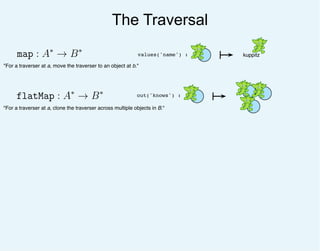
"For a traverser at a, move the traverser to an object at b."
kuppitzvalues('name') :
The Traversal
map : A∗
→ B∗
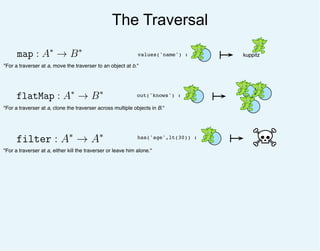
"For a traverser at a, move the traverser to an object at b."
flatMap : A∗
→ B∗
"For a traverser at a, clone the traverser across multiple objects in B."
kuppitzvalues('name') :
out('knows') :
The Traversal
map : A∗
→ B∗
"For a traverser at a, move the traverser to an object at b."
flatMap : A∗
→ B∗
"For a traverser at a, clone the traverser across multiple objects in B."
"For a traverser at a, either kill the traverser or leave him alone."
filter : A∗
→ A∗
kuppitzvalues('name') :
out('knows') :
has('age',lt(30)) :
The Traversal
map : A∗
→ B∗
"For a traverser at a, move the traverser to an object at b."
flatMap : A∗
→ B∗
"For a traverser at a, clone the traverser across multiple objects in B."
"For a traverser at a, either kill the traverser or leave him alone."
filter : A∗
→ A∗
"For a traverser at a, leave him alone though manipulate some data structure x."
sideEffect : A∗
→x A∗
kuppitzvalues('name') :
out('knows') :
has('age',lt(30)) :
groupCount('m') : m
v[1]:1
v[2]:34
The Traversal
map : A∗
→ B∗
"For a traverser at a, move the traverser to an object at b."
flatMap : A∗
→ B∗
"For a traverser at a, clone the traverser across multiple objects in B."
"For a traverser at a, either kill the traverser or leave him alone."
filter : A∗
→ A∗
"For a traverser at a, leave him alone though manipulate some data structure x."
sideEffect : A∗
→x A∗
branch : A∗
→b
B∗
"For a traverser at a, choose some internal branch b to ultimately yield traversers at objects of type B."
kuppitzvalues('name') :
out('knows') :
has('age',lt(30)) :
groupCount('m') : m
v[1]:1
v[2]:34
repeat(out('knows')).times(5) :
The Traversal
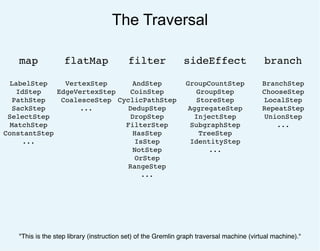
map flatMap filter sideEffect branch
BranchStep
ChooseStep
LocalStep
RepeatStep
UnionStep
...
AndStep
CoinStep
CyclicPathStep
DedupStep
DropStep
FilterStep
HasStep
IsStep
NotStep
OrStep
RangeStep
...
VertexStep
EdgeVertexStep
CoalesceStep
...
LabelStep
IdStep
PathStep
SackStep
SelectStep
MatchStep
ConstantStep
...
GroupCountStep
GroupStep
StoreStep
AggregateStep
InjectStep
SubgraphStep
TreeStep
IdentityStep
...
"This is the step library (instruction set) of the Gremlin graph traversal machine (virtual machine)."
The Traversal
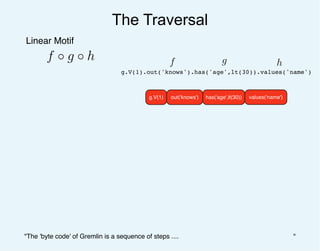
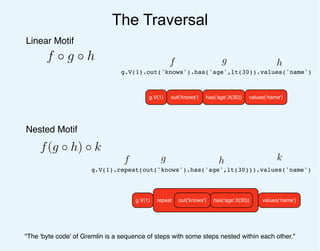
f ◦ g ◦ h
Linear Motif
g.V(1).out('knows').has('age',lt(30)).values('name')
f g h
repeatout('knows') has('age',lt(30)) values('name')g.V(1)
"The 'byte code' of Gremlin is a sequence of steps .... "
The Traversal
f ◦ g ◦ h
Linear Motif
f(g ◦ h) ◦ k
Nested Motif
g.V(1).out('knows').has('age',lt(30)).values('name')
f g h
g.V(1).repeat(out('knows').has('age',lt(30))).values('name')
f g h k
repeat out('knows') has('age',lt(30)) values('name')g.V(1)
repeatout('knows') has('age',lt(30)) values('name')g.V(1)
"The 'byte code' of Gremlin is a sequence of steps with some steps nested within each other."
gremlin> graph
==>tinkergraph[vertices:2 edges:1]
gremlin>
1
person
name:marko
age:36
2 knows
since:2013
weight:0.9
3
person
name:kuppitz
age:33
"Back to our super baby toy graph."
gremlin> graph
==>tinkergraph[vertices:2 edges:1]
gremlin> g = graph.traversal()
==>graphtraversalsource[tinkergraph[vertices:2 edges:1], standard]
gremlin>
1
person
name:marko
age:36
2 knows
since:2013
weight:0.9
3
person
name:kuppitz
age:33
O
LTP
vs. O
LAP
graph
database
vs. processor
Neo4j vs. G
iraph
gremlin> graph
==>tinkergraph[vertices:2 edges:1]
gremlin> g = graph.traversal()
==>graphtraversalsource[tinkergraph[vertices:2 edges:1], standard]
gremlin> g.V(1)
==>v[1]
gremlin>
1
person
name:marko
age:36
2 knows
since:2013
weight:0.9
3
person
name:kuppitz
age:33
gremlin> graph
==>tinkergraph[vertices:2 edges:1]
gremlin> g = graph.traversal()
==>graphtraversalsource[tinkergraph[vertices:2 edges:1], standard]
gremlin> g.V(1)
==>v[1]
gremlin> g.V(1).label()
==>person
gremlin>
1
person
name:marko
age:36
2 knows
since:2013
weight:0.9
3
person
name:kuppitz
age:33
gremlin> graph
==>tinkergraph[vertices:2 edges:1]
gremlin> g = graph.traversal()
==>graphtraversalsource[tinkergraph[vertices:2 edges:1], standard]
gremlin> g.V(1)
==>v[1]
gremlin> g.V(1).label()
==>person
gremlin> g.V(1).outE()
==>e[2][1-knows->3]
gremlin>
1
person
name:marko
age:36
2 knows
since:2013
weight:0.9
3
person
name:kuppitz
age:33
gremlin> graph
==>tinkergraph[vertices:2 edges:1]
gremlin> g = graph.traversal()
==>graphtraversalsource[tinkergraph[vertices:2 edges:1], standard]
gremlin> g.V(1)
==>v[1]
gremlin> g.V(1).label()
==>person
gremlin> g.V(1).outE()
==>e[2][1-knows->3]
gremlin> g.V(1).outE().valueMap()
==>[weight:0.9, since:2013]
gremlin>
1
person
name:marko
age:36
2 knows
since:2013
weight:0.9
3
person
name:kuppitz
age:33
gremlin> graph
==>tinkergraph[vertices:2 edges:1]
gremlin> g = graph.traversal()
==>graphtraversalsource[tinkergraph[vertices:2 edges:1], standard]
gremlin> g.V(1)
==>v[1]
gremlin> g.V(1).label()
==>person
gremlin> g.V(1).outE()
==>e[2][1-knows->3]
gremlin> g.V(1).outE().valueMap()
==>[weight:0.9, since:2013]
gremlin> g.V(1).out()
==>v[3]
gremlin>
1
person
name:marko
age:36
2 knows
since:2013
weight:0.9
3
person
name:kuppitz
age:33
gremlin> graph
==>tinkergraph[vertices:2 edges:1]
gremlin> g = graph.traversal()
==>graphtraversalsource[tinkergraph[vertices:2 edges:1], standard]
gremlin> g.V(1)
==>v[1]
gremlin> g.V(1).label()
==>person
gremlin> g.V(1).outE()
==>e[2][1-knows->3]
gremlin> g.V(1).outE().valueMap()
==>[weight:0.9, since:2013]
gremlin> g.V(1).out()
==>v[3]
gremlin> g.V(1).out().values('age')
==>33
gremlin>
1
person
name:marko
age:36
2 knows
since:2013
weight:0.9
3
person
name:kuppitz
age:33
The Machine Components
The Graph
The Traverser
The Traversal
The Data
The CPU
The Program
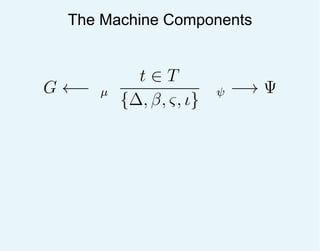
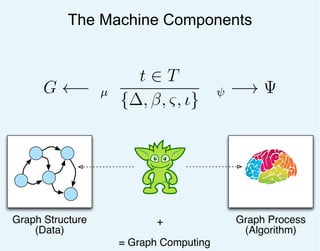
G ←− µ
t ∈ T
{∆, β, ς, ι}
ψ −→ Ψ
The Machine Components
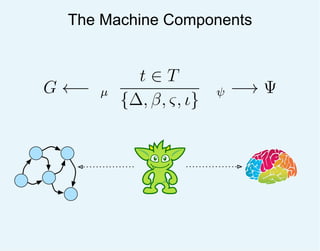
G ←− µ
t ∈ T
{∆, β, ς, ι}
ψ −→ Ψ
The Machine Components
G ←− µ
t ∈ T
{∆, β, ς, ι}
ψ −→ Ψ
Graph Structure Graph Process+
= Graph Computing
(Data) (Algorithm)
The Machine Components
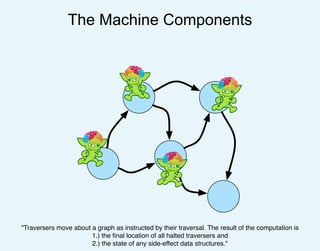
"Traversers move about a graph as instructed by their traversal. The result of the computation is
1.) the final location of all halted traversers and
2.) the state of any side-effect data structures."
The Machine Components
Part 2: The Gremlin Traversal Language
Ψ
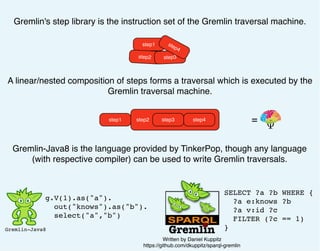
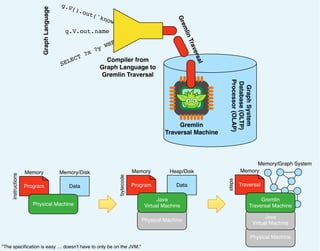
Gremlin's step library is the instruction set of the Gremlin traversal machine.
A linear/nested composition of steps forms a traversal which is executed by the
Gremlin traversal machine.
step1
step2 step3
step4
step1 step3 step4step2
Gremlin-Java8 is the language provided by TinkerPop, though any language
(with respective compiler) can be used to write Gremlin traversals.
g.V(1).as("a").
out("knows").as("b").
select("a","b")
SELECT ?a ?b WHERE {
?a e:knows ?b
?a v:id ?c
FILTER (?c == 1)
}Gremlin-Java8
Written by Daniel Kuppitz
https://github.com/dkuppitz/sparql-gremlin
=
g.V().out('knows')
SELECT ?x ?y WHERE
g.V.out.name
GraphLanguage
Compiler from
Graph Language to
Gremlin Traversal
Gremlin
Traversal Machine
GraphSystem
Database(OLTP)
Processor(OLAP)
GremlinTraversal
Physical Machine
DataProgram Traversal
Heap/DiskMemory Memory
Memory/Graph System
Physical Machine
Java
Virtual Machine
bytecode
steps
DataProgram
Memory/DiskMemory
Physical Machine
instructions
Java
Virtual Machine
Gremlin
Traversal Machine
"The specification is easy … doesn't have to only be on the JVM."
~/tinkerpop3$ bin/gremlin.sh
gremlin>
"Gremlin-Groovy can be executed in the Gremlin Console REPL and thus, is good for demonstrations."
~/tinkerpop3$ bin/gremlin.sh
,,,/
(o o)
-----oOOo-(3)-oOOo-----
plugin activated: tinkerpop.server
plugin activated: tinkerpop.utilities
plugin activated: tinkerpop.tinkergraph
gremlin>
~/tinkerpop3$ bin/gremlin.sh
,,,/
(o o)
-----oOOo-(3)-oOOo-----
plugin activated: tinkerpop.server
plugin activated: tinkerpop.utilities
plugin activated: tinkerpop.tinkergraph
gremlin> graph = TinkerGraph.open()
==>tinkergraph[vertices:0 edges:0]
gremlin>
~/tinkerpop3$ bin/gremlin.sh
,,,/
(o o)
-----oOOo-(3)-oOOo-----
plugin activated: tinkerpop.server
plugin activated: tinkerpop.utilities
plugin activated: tinkerpop.tinkergraph
gremlin> graph = TinkerGraph.open()
==>tinkergraph[vertices:0 edges:0]
gremlin> graph.io(graphml()).readGraph('data/grateful-dead.xml')
==>null
gremlin>
~/tinkerpop3$ bin/gremlin.sh
,,,/
(o o)
-----oOOo-(3)-oOOo-----
plugin activated: tinkerpop.server
plugin activated: tinkerpop.utilities
plugin activated: tinkerpop.tinkergraph
gremlin> graph = TinkerGraph.open()
==>tinkergraph[vertices:0 edges:0]
gremlin> graph.io(graphml()).readGraph('data/grateful-dead.xml')
==>null
gremlin>
GraphML
Gryo
GraphSON
"TinkerPop supports three I/O graph formats. Though the user can add their own format/parser."
~/tinkerpop3$ bin/gremlin.sh
,,,/
(o o)
-----oOOo-(3)-oOOo-----
plugin activated: tinkerpop.server
plugin activated: tinkerpop.utilities
plugin activated: tinkerpop.tinkergraph
gremlin> graph = TinkerGraph.open()
==>tinkergraph[vertices:0 edges:0]
gremlin> graph.io(graphml()).readGraph('data/grateful-dead.xml')
==>null
gremlin>
name:<String>
Artist Song
name:<String>
songType:<String>
performances:<Integer>sungBy
writtenBy followedBy
weight:<Long>
gremlin> :plugin use tinkerpop.gephi
==>tinkerpop.gephi activated
gremlin> :remote connect tinkerpop.gephi
==>Connection to Gephi - http://localhost:8080/workspace0 with stepDelay:1000,
startRGBColor:[0.0, 1.0, 0.5], colorToFade:g, colorFadeRate:0.7
gremlin> :> graph
==>tinkergraph[vertices:808 edges:8049]
gremlin>
http://gephi.org
Generated by Daniel Kuppitz
Rodriguez, M.A., Kuppitz, D., Yim, K., “Tales From the TinkerPop," DataStax Engineering Blog, 2015.
http://www.datastax.com/dev/blog/tales-from-the-tinkerpop
This is an actual Gremlin/R session I performed for this presentation.
I was interested in understanding why Grateful Dead concerts continue to fascinate me.
SPOILER ALERT: No local correlations -- correlations exist in the stationary distribution. EigenDead..the long run."
gremlin> graph = TinkerGraph.open()
==>tinkergraph[vertices:0 edges:0]
gremlin> graph.io(graphml()).readGraph('data/grateful-dead.xml')
==>null
gremlin> g = graph.traversal()
==>graphtraversalsource[tinkergraph[vertices:808 edges:8049], standard]
gremlin>
gremlin> graph = TinkerGraph.open()
==>tinkergraph[vertices:0 edges:0]
gremlin> graph.io(graphml()).readGraph('data/grateful-dead.xml')
==>null
gremlin> g = graph.traversal()
==>graphtraversalsource[tinkergraph[vertices:808 edges:8049], standard]
gremlin> g.V().has('name','DARK STAR')
==>v[89]
gremlin>
Vertex
filter
has(...)
"one-to-[one-or-none]"
Vertex
89
"Get the vertex named Dark Star."
gremlin> graph = TinkerGraph.open()
==>tinkergraph[vertices:0 edges:0]
gremlin> graph.io(graphml()).readGraph('data/grateful-dead.xml')
==>null
gremlin> g = graph.traversal()
==>graphtraversalsource[tinkergraph[vertices:808 edges:8049], standard]
gremlin> g.V().has('name','DARK STAR')
==>v[89]
gremlin>
}
ProviderOptimizationStrategy
* OLTP graph system providers turn this into an index-lookup.
Vertex
filter
has(...)
"one-to-[one-or-none]"
Vertex
89
"TraversalStrategies are an important part of Gremlin (discussed at length in the conference article)."
gremlin> graph = TinkerGraph.open()
==>tinkergraph[vertices:0 edges:0]
gremlin> graph.io(graphml()).readGraph('data/grateful-dead.xml')
==>null
gremlin> g = graph.traversal()
==>graphtraversalsource[tinkergraph[vertices:808 edges:8049], standard]
gremlin> g.V().has('name','DARK STAR')
==>v[89]
gremlin> g.V().has('name','DARK STAR').out('followedBy').values('name')
==>TRUCKING
==>EYES OF THE WORLD
==>HES GONE
==>SING ME BACK HOME
==>SPANISH JAM
==>CHINA DOLL
==>MORNING DEW
==>WHARF RAT
==>THE OTHER ONE
==>MIND LEFT BODY JAM
...
gremlin>
Vertex
filter
has(...)
"one-to-[one-or-none]"
Vertex
89 flatMap
out('followedBy')
"one-to-many"
Vertex
"one-to-one"
map
values('name')
String
TRUCKING
EYES OF THE WORLD
HES GONE
SING ME BACK HOME
SPANISH JAM
...
"What are the names of the songs that have followed Dark Star in concert?"
gremlin> g.V().outE().groupCount().by(label)
==>[followedBy:7047, sungBy:501, writtenBy:501]
gremlin>
Vertex Map<String,Long>
flatMap
[
followedBy:7074
sungBy:501
writtenBy:501
]
outE() {"one-to-many"
Edge
map
groupCount()
"many-to-one"
reducing
barrier
"What is the distribution of edge labels in the graph?"
gremlin> g.V().outE().groupCount().by(label)
==>[followedBy:7047, sungBy:501, writtenBy:501]
gremlin>
Vertex Map<String,Long>
flatMap
[
followedBy:7074
sungBy:501
writtenBy:501
]
outE() {"one-to-many"
Edge
map
groupCount()
"many-to-one"
reducing
barrier
"What is the distribution of edge labels in the graph?"
groupCount()isa
TraversalParent(nestingstep):label()
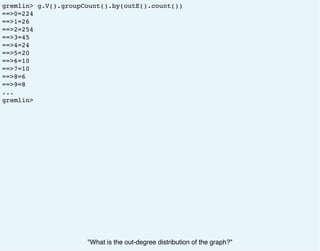
gremlin> g.V().groupCount().by(outE().count())
==>0=224
==>1=26
==>2=254
==>3=45
==>4=24
==>5=20
==>6=10
==>7=10
==>8=6
==>9=8
...
gremlin>
"What is the out-degree distribution of the graph?"
gremlin> g.V().groupCount().by(outE().count())
==>0=224
==>1=26
==>2=254
==>3=45
==>4=24
==>5=20
==>6=10
==>7=10
==>8=6
==>9=8
...
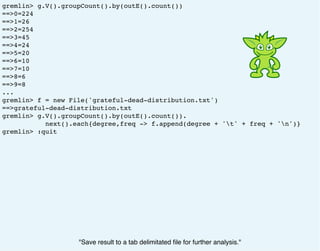
gremlin> f = new File('grateful-dead-distribution.txt')
==>grateful-dead-distribution.txt
gremlin> g.V().groupCount().by(outE().count()).
next().each{degree,freq -> f.append(degree + 't' + freq + 'n')}
gremlin> :quit
"Save result to a tab delimitated file for further analysis."
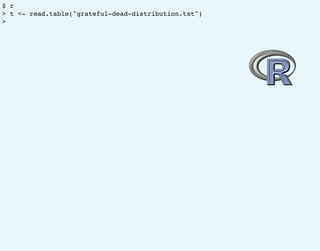
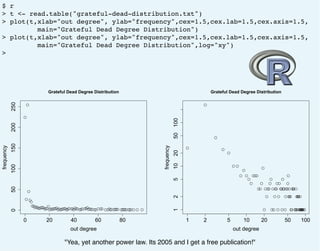
$ r
> t <- read.table("grateful-dead-distribution.txt")
>
0 20 40 60 80
050100150200250
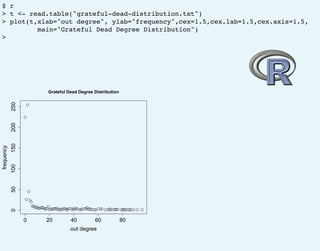
Grateful Dead Degree Distribution
out degree
frequency$ r
> t <- read.table("grateful-dead-distribution.txt")
> plot(t,xlab="out degree", ylab="frequency",cex=1.5,cex.lab=1.5,cex.axis=1.5,
main="Grateful Dead Degree Distribution")
>
$ r
> t <- read.table("grateful-dead-distribution.txt")
> plot(t,xlab="out degree", ylab="frequency",cex=1.5,cex.lab=1.5,cex.axis=1.5,
main="Grateful Dead Degree Distribution")
> plot(t,xlab="out degree", ylab="frequency",cex=1.5,cex.lab=1.5,cex.axis=1.5,
main="Grateful Dead Degree Distribution",log="xy")
>
0 20 40 60 80
050100150200250
Grateful Dead Degree Distribution
out degree
frequency
1 2 5 10 20 50 100
125102050100
Grateful Dead Degree Distribution
out degree
frequency
"Yea, yet another power law. Its 2005 and I get a free publication!"
gremlin> g.V().as('a').out('followedBy').as('b').
select('a','b').by('performances')
==>[a:5, b:1]
==>[a:5, b:531]
==>[a:5, b:394]
==>[a:5, b:293]
==>[a:5, b:1]
==>[a:1, b:473]
==>[a:1, b:24]
==>[a:531, b:87]
==>[a:531, b:41]
==>[a:531, b:254]
...
gremlin> f = new File('performance-assortativity.txt')
==>performance-assortativity.txt
gremlin> g.V().as('a').out('followedBy').as('b').
select('a','b').by('performances').
each{f.append(it.a + 't' + it.b + 'n')}
"Are songs that follow each other assortative by the number of times they are played in concert?"
https://en.wikipedia.org/wiki/Assortativity
"Gremlins of a green, bulk together."
gremlin> g.V().as('a').out('followedBy').as('b').
select('a','b').by('performances')
==>[a:5, b:1]
==>[a:5, b:531]
==>[a:5, b:394]
==>[a:5, b:293]
==>[a:5, b:1]
==>[a:1, b:473]
==>[a:1, b:24]
==>[a:531, b:87]
==>[a:531, b:41]
==>[a:531, b:254]
...
gremlin> f = new File('performance-assortativity.txt')
==>performance-assortativity.txt
gremlin> g.V().as('a').out('followedBy').as('b').
select('a','b').by('performances').
each{f.append(it.a + 't' + it.b + 'n')}
> cor.test(t[,1],t[,2], test='pearson')
Pearson's product-moment correlation
data: t[, 1] and t[, 2]
t = -3.9525, df = 7045, p-value = 7.809e-05
alternative hypothesis: true correlation is not equal to 0
95 percent confidence interval:
-0.07030966 -0.02371587
sample estimates:
cor
-0.04703835
No
correlation
betw
een
songs
by
perform
ance.
"…you know: birds and feathers and flocking togethers."
gremlin> g.V().as('a').out('followedBy').as('b').
select('a','b').by('songType')
==>[a:cover, b:cover]
==>[a:cover, b:original]
==>[a:cover, b:cover]
==>[a:cover, b:original]
==>[a:cover, b:cover]
...
gremlin> f = new File('songType-assortativity.txt')
==>songType-assortativity.txt
gremlin> g.V().as('a').out('followedBy').as('b').
select('a','b').by('songType').
each{f.append((it.a == 'cover' ? 0 : 1) + 't' +
(it.b == 'cover' ? 0 : 1) + 'n')}
"Are songs that follow each other assortative by either being a cover or an original song?"
"Hmmm.. need numbers -- ah! only two song types."
gremlin> g.V().as('a').out('followedBy').as('b').
select('a','b').by('songType')
==>[a:cover, b:cover]
==>[a:cover, b:original]
==>[a:cover, b:cover]
==>[a:cover, b:original]
==>[a:cover, b:cover]
...
gremlin> f = new File('songType-assortativity.txt')
==>songType-assortativity.txt
gremlin> g.V().as('a').out('followedBy').as('b').
select('a','b').by('songType').
each{f.append((it.a == 'cover' ? 0 : 1) + 't' +
(it.b == 'cover' ? 0 : 1) + 'n')}
> cramersV(chisq.test(t[,1],t[,2])$observed)
[1] 0.0093161 No
correlation
betw
een
songs
by
song
type
(original or cover).
"Cramer's V is for nominal data correlations."
gremlin> g.V().as('a').out('followedBy').as('b').
select('a','b').by(out('sungBy').values('name'))
==>[a:Garcia, b:Spencer_Davis]
==>[a:Garcia, b:Weir]
==>[a:Garcia, b:Garcia]
==>[a:Garcia, b:Weir]
==>[a:Spencer_Davis, b:Weir]
==>[a:Spencer_Davis, b:Grateful_Dead]
==>[a:Weir, b:Garcia]
==>[a:Weir, b:All]
==>[a:Weir, b:Garcia]
...
gremlin> f = new File('singer-assortativity.txt')
==>singer-assortativity.txt
gremlin> g.V().as('a').out('followedBy').as('b').
select('a','b').by(out('sungBy').values('name')).
each{f.append(it.a.hashCode() + 't' + it.b.hashCode() + 'n')}
"Are songs that follow each other assortative by their singer?"
"Dah! Now
I need an algorithm
to turn a String to a unique integer.
Duh -- hashCode()."
gremlin> g.V().as('a').out('followedBy').as('b').
select('a','b').by(out('sungBy').values('name'))
==>[a:Garcia, b:Spencer_Davis]
==>[a:Garcia, b:Weir]
==>[a:Garcia, b:Garcia]
==>[a:Garcia, b:Weir]
==>[a:Spencer_Davis, b:Weir]
==>[a:Spencer_Davis, b:Grateful_Dead]
==>[a:Weir, b:Garcia]
==>[a:Weir, b:All]
==>[a:Weir, b:Garcia]
...
gremlin> f = new File('singer-assortativity.txt')
==>singer-assortativity.txt
gremlin> g.V().as('a').out('followedBy').as('b').
select('a','b').by(out('sungBy').values('name')).
each{f.append(it.a.hashCode() + 't' + it.b.hashCode() + 'n')}
> cramersV(chisq.test(t[,1],t[,2])$observed)
[1] 0.2354349 Songs
are
w
eakly
correlated
by
singers.
"However, its typically just Jerry and Bobby trading off in ones or twos…"
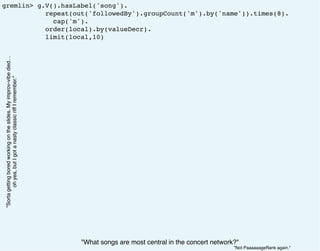
gremlin> g.V().hasLabel('song').
repeat(out('followedBy').groupCount('m').by('name')).times(8).
cap('m').
order(local).by(valueDecr).
limit(local,10)
"What songs are most central in the concert network?"
"Sortagettingboredworkingontheslides.Myimprov-vibedied…
ohyea,butIgotanastyclassicriffIremember."
"Not PaaaaaageRank again."
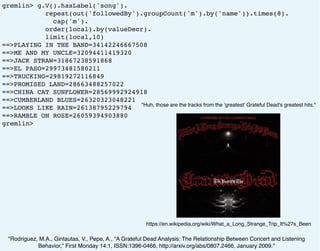
gremlin> g.V().hasLabel('song').
repeat(out('followedBy').groupCount('m').by('name')).times(8).
cap('m').
order(local).by(valueDecr).
limit(local,10)
==>PLAYING IN THE BAND=34142246667508
==>ME AND MY UNCLE=32094411419320
==>JACK STRAW=31867238591868
==>EL PASO=29973481580211
==>TRUCKING=29819272116849
==>PROMISED LAND=28663488257022
==>CHINA CAT SUNFLOWER=28569992924918
==>CUMBERLAND BLUES=26320323048221
==>LOOKS LIKE RAIN=26138795229794
==>RAMBLE ON ROSE=26059394903880
gremlin>
"Rodriguez, M.A., Gintautas, V., Pepe, A., “A Grateful Dead Analysis: The Relationship Between Concert and Listening
Behavior,” First Monday 14:1, ISSN:1396-0466, http://arxiv.org/abs/0807.2466, January 2009."
"Huh, those are the tracks from the 'greatest' Grateful Dead's greatest hits."
https://en.wikipedia.org/wiki/What_a_Long_Strange_Trip_It%27s_Been
gremlin> g.V().hasLabel('song').
repeat(out('followedBy').groupCount('m').by('name')).times(8).
cap('m').
order(local).by(valueDecr).
limit(local,10)
==>PLAYING IN THE BAND=34142246667508
==>ME AND MY UNCLE=32094411419320
==>JACK STRAW=31867238591868
==>EL PASO=29973481580211
==>TRUCKING=29819272116849
==>PROMISED LAND=28663488257022
==>CHINA CAT SUNFLOWER=28569992924918
==>CUMBERLAND BLUES=26320323048221
==>LOOKS LIKE RAIN=26138795229794
==>RAMBLE ON ROSE=26059394903880
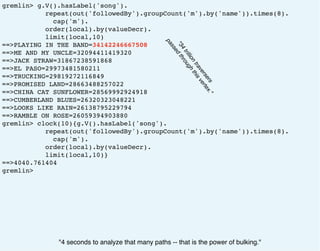
gremlin> clock(10){g.V().hasLabel('song').
repeat(out('followedBy').groupCount('m').by('name')).times(8).
cap('m').
order(local).by(valueDecr).
limit(local,10)}
==>4040.761404
gremlin>
"4 seconds to analyze that many paths -- that is the power of bulking."
"34
trillion
traversers
passed
through
thisvertex."
gremlin> graph = HadoopGraph.open('hadoop-grateful-gryo.properties')
==>hadoopgraph[gryoinputformat->gryooutputformat]
gremlin>
"And now note how the same Gremlin queries you've seen thus far can execute across a cluster."
gremlin> graph = HadoopGraph.open('hadoop-grateful-gryo.properties')
==>hadoopgraph[gryoinputformat->gryooutputformat]
gremlin> g = graph.traversal(computer(SparkGraphComputer))
==>graphtraversalsource[hadoopgraph[gryoinputformat->gryooutputformat],
sparkgraphcomputer]
gremlin>
G
raphCom
puter's
are
O
LAP
system
s
"Lets use Apache Spark via TinkerPop's SparkGraphComputer."
gremlin> graph = HadoopGraph.open('hadoop-grateful-gryo.properties')
==>hadoopgraph[gryoinputformat->gryooutputformat]
gremlin> g = graph.traversal(computer(SparkGraphComputer))
==>graphtraversalsource[hadoopgraph[gryoinputformat->gryooutputformat],
sparkgraphcomputer]
gremlin> g.V().match(
__.as('a').out('sungBy').as('b'),
__.as('a').out('writtenBy').as('b'),
__.as('a').values('name').as('c'),
__.as('b').values('name').as('d')).
select('c','d')
"Which songs were written and sung by the same person?"
"__" is
required
by
G
rem
lin-G
roovy
as
"as" is
a
keyword
in
G
roovy.
gremlin> graph = HadoopGraph.open('hadoop-grateful-gryo.properties')
==>hadoopgraph[gryoinputformat->gryooutputformat]
gremlin> g = graph.traversal(computer(SparkGraphComputer))
==>graphtraversalsource[hadoopgraph[gryoinputformat->gryooutputformat],
sparkgraphcomputer]
gremlin> g.V().match(
__.as('a').out('sungBy').as('b'),
__.as('a').out('writtenBy').as('b'),
__.as('a').values('name').as('c'),
__.as('b').values('name').as('d')).
select('c','d')
==>[c:ANY WONDER, d:Unknown]
==>[c:WALK DOWN THE STREET, d:Unknown]
==>[c:LEAVE YOUR LOVE AT HOME, d:Unknown]
==>[c:COWBOY SONG, d:Unknown]
==>[c:NEIGHBORHOOD GIRLS, d:Suzanne_Vega]
==>[c:MINDBENDER, d:Garcia_Lesh]
==>[c:EQUINOX, d:Lesh]
==>[c:NO LEFT TURN UNSTONED (CARDBOARD COWBOY), d:Lesh]
==>[c:CHILDHOODS END, d:Lesh]
==>[c:NEVER TRUST A WOMAN, d:Mydland]
...
gremlin>
"That was a distributed, declarative graph pattern match query.
This could have been over a 1000 node cluster."
g.V().match(
__.as('a').out('sungBy').as('b'),
__.as('a').out('writtenBy').as('b'),
__.as('a').values('name').as('c'),
__.as('b').values('name').as('d')).
select('c','d')
SELECT ?c ?d WHERE {
?a e:writtenBy ?b .
?a e:sungBy ?b .
?a v:name ?c .
?b v:name ?d
}
Gremlin-Groovy
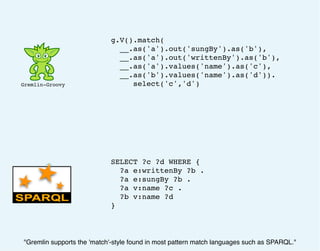
"Gremlin supports the 'match'-style found in most pattern match languages such as SPARQL."
g.V().match(
__.as('a').out('sungBy').as('b'),
__.as('a').out('writtenBy').as('b'),
__.as('a').values('name').as('c'),
__.as('b').values('name').as('d')).
select('c','d')
SELECT ?c ?d WHERE {
?a e:writtenBy ?b .
?a e:sungBy ?b .
?a v:name ?c .
?b v:name ?d
}
Gremlin-Groovy
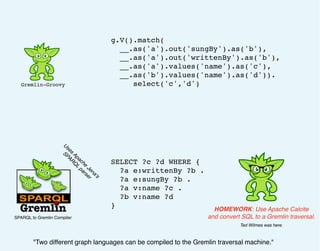
"Two different graph languages can be compiled to the Gremlin traversal machine."
Uses Apache
Jena's
SPARQ
L
parser
HOMEWORK: Use Apache Calcite
and convert SQL to a Gremlin traversal.SPARQL to Gremlin Compiler
Ted Wilmes was here.
gremlin> :install com.datastax sparql-gremlin 0.1
==>Loaded: [com.datastax, sparql-gremlin, 0.1]
gremlin> :plugin use datastax.sparql
==>datastax.sparql activated
gremlin>
"Install the SPARQL-Gremlin compiler developed by Daniel Kuppitz of DataStax."
gremlin> :install com.datastax sparql-gremlin 0.1
==>Loaded: [com.datastax, sparql-gremlin, 0.1]
gremlin> :plugin use datastax.sparql
==>datastax.sparql activated
gremlin> :remote connect datastax.sparql g
==>SPARQL[graphtraversalsource[hadoopgraph[gryoinputformat->gryooutputformat],
sparkgraphcomputer]]
gremlin>
"Given that SPARQL is NOT Groovy, it is passed to the cluster as a remote String."
gremlin> :install com.datastax sparql-gremlin 0.1
==>Loaded: [com.datastax, sparql-gremlin, 0.1]
gremlin> :plugin use datastax.sparql
==>datastax.sparql activated
gremlin> :remote connect datastax.sparql g
==>SPARQL[graphtraversalsource[hadoopgraph[gryoinputformat->gryooutputformat],
sparkgraphcomputer]]
gremlin> :> SELECT ?c ?d WHERE {
?a e:writtenBy ?b .
?a e:sungBy ?b .
?a v:name ?c .
?b v:name ?d }
==>[c:ANY WONDER, d:Unknown]
==>[c:WALK DOWN THE STREET, d:Unknown]
==>[c:LEAVE YOUR LOVE AT HOME, d:Unknown]
==>[c:COWBOY SONG, d:Unknown]
==>[c:NEIGHBORHOOD GIRLS, d:Suzanne_Vega]
==>[c:MINDBENDER, d:Garcia_Lesh]
==>[c:EQUINOX, d:Lesh]
==>[c:NO LEFT TURN UNSTONED (CARDBOARD COWBOY), d:Lesh]
==>[c:CHILDHOODS END, d:Lesh]
==>[c:NEVER TRUST A WOMAN, d:Mydland]
...
gremlin>
"SPARQL was just executed over Apache Spark by way of the Gremlin traversal machine."
gremlin> g = graph.traversal(computer(GiraphGraphComputer))
==>graphtraversalsource[hadoopgraph[gryoinputformat->gryooutputformat],
giraphgraphcomputer]
gremlin>
"Use a different GraphComputer."
gremlin> g = graph.traversal(computer(GiraphGraphComputer))
==>graphtraversalsource[hadoopgraph[gryoinputformat->gryooutputformat],
giraphgraphcomputer]
gremlin> g.V().match(
__.as('a').out('sungBy').as('b'),
__.as('a').out('writtenBy').as('b'),
__.as('a').values('name').as('c'),
__.as('b').values('name').as('d')).
select('c','d')
INFO org.apache.hadoop.mapreduce.Job - Running job: job_1445539638801_0011
INFO org.apache.hadoop.mapreduce.Job - map 50% reduce 0%
INFO org.apache.hadoop.mapreduce.Job - map 100% reduce 0%
INFO org.apache.hadoop.mapreduce.Job - Counters: 55
...
Giraph Stats
Superstep 1 GiraphComputation (ms)=2022
Superstep 2 GiraphComputation (ms)=1994
Superstep 3 GiraphComputation (ms)=999
Superstep 4 GiraphComputation (ms)=1001
Superstep 5 GiraphComputation (ms)=1254
Total (ms)=21425
...
==>[c:IT MUST HAVE BEEN THE ROSES, d:Hunter]
==>[c:EASY WIND, d:Hunter]
==>[c:WHATLL YOU RAISE, d:Hunter]
==>[c:CRYPTICAL ENVELOPMENT, d:Garcia]
==>[c:CREAM PUFF WAR, d:Garcia]
==>[c:DRUMS, d:Grateful_Dead]
...
gremlin>
"Gremlin-Groovy just executed over Apache Giraph by way of the Gremlin traversal machine."
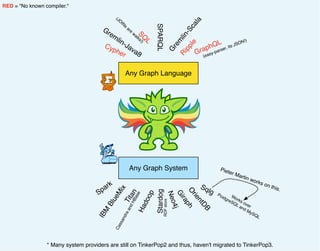
"I'm a Gingerbremlin."
Gremlin-Java8
SPARQL
Cypher GraphQL
G
rem
lin-Scala
O
rientDB
Neo4j
Titan
Spark
Giraph
Hadoop
Sqlg
IBM
BlueMix
Any Graph System
Any Graph Language
Stardog
Ripple
SQ
L
* Many system providers are still on TinkerPop2 and thus, haven't migrated to TinkerPop3.
(JO
INs
are
walks!)
(easy-parser, its JSON!)
Works over
PostgreSQL and MySQL
Pieter Martin works on this.
CassandraandHBase
RED = "No known compiler."
RDFstore
Thank you….
Rodriguez, M.A., Kuppitz, D., Yim, K., “Tales From the TinkerPop," DataStax Engineering Blog, 2015.
http://www.datastax.com/dev/blog/tales-from-the-tinkerpop

ACM DBPL Keynote: The Graph Traversal Machine and Language

  • 1.
    The Gremlin GraphTraversal Machine and Language Dr. Marko A. Rodriguez Director of Engineering at DataStax, Inc. Project Management Committee, Apache TinkerPop http://tinkerpop.incubator.apache.org Database Programming Languages Rodriguez, M.A., “The Gremlin Graph Traversal Machine and Language,” Proceedings of the ACM Database Programming Languages Conference, doi:10.1145/2815072.2815073, ACM, Pittsburg, Pennsylvania, October 2015.
  • 2.
    Java is avirtual machine. Java is a programming language.
  • 3.
    Java is avirtual machine. Java is a programming language. Gremlin is a traversal machine. Gremlin is a traversal language.
  • 4.
    Java is avirtual machine. Java is a programming language. Gremlin is a traversal machine. Gremlin is a traversal language. Java is operating system agnostic. MacOSX, Linux, Windows, etc.
  • 5.
    Java is avirtual machine. Java is a programming language. Gremlin is a traversal machine. Gremlin is a traversal language. Java is operating system agnostic. MacOSX, Linux, Windows, etc. Gremlin is graph system agnostic. Titan, Neo4j, Stardog, Giraph, Spark, Hadoop, etc.
  • 6.
    Java is avirtual machine. Java is a programming language. Gremlin is a traversal machine. Gremlin is a traversal language. Other languages compile to the Java virtual machine. Groovy, Scala, Clojure, JavaScript Nashorn, etc. Java is operating system agnostic. MacOSX, Linux, Windows, etc. Gremlin is graph system agnostic. Titan, Neo4j, Stardog, Giraph, Spark, Hadoop, etc.
  • 7.
    Java is avirtual machine. Java is a programming language. Gremlin is a traversal machine. Gremlin is a traversal language. Other languages compile to the Java virtual machine. Groovy, Scala, Clojure, JavaScript Nashorn, etc. Other languages compile to the Gremlin traversal machine. Gremlin-Groovy, Gremlin-Scala, SPARQL, etc. Java is operating system agnostic. MacOSX, Linux, Windows, etc. Gremlin is graph system agnostic. Titan, Neo4j, Stardog, Giraph, Spark, Hadoop, etc. Rodriguez, M.A., Kuppitz, D., “The Benefits of the Gremlin Graph Traversal Machine," DataStax Engineering Blog, 2015. http://www.datastax.com/dev/blog/the-benefits-of-the-gremlin-graph-traversal-machine
  • 8.
    TinkerPop is anopen source graph computing framework. TinkerPop was started in 2009 by Marko A. Rodriguez, Josh Shinavier, and Peter Neubauer. TinkerPop joined the Apache Software Foundation January 2015 (currently in incubation). TinkerPop designs and develops the Gremlin graph traversal machine and language. TinkerPop is supported by nearly every graph system provider (both commercial and open source). TinkerPop3 has been in development for 2 years and was officially released July 2015. "What is The TinkerPop?"
  • 9.
    "What is TheTinkerPop?" Graph Database Graph Processor Provider API Provider API Provider Strategies Gremlin Traversal Language Graph Computer Core API (graph, vertex, edge) Monitoring Gremlin Server JSON Kryo ... ganglia cvs graphite jmx { User DSL OLTP OLAP
  • 10.
    TinkerPop provides graphcomputing capabilities to any data processing system. TinkerPop supports both OLTP (database) and OLAP (batch processor) systems. TinkerPop is used to process the order fulfillment network of Amazon.com ("100 billion vertices" -- at least factor 10x on edges?). TinkerPop is the sole interface for >50% of all graph systems in the market/wild. TinkerPop currently processes a near trillion edge graph represented over 1000 machines. TinkerPop works with Apache Cassandra, Apache HBase, Apache Hadoop, Apache Spark, Apache Giraph, Apache Atlas, Apache Falcon, ... TinkerPop is always looking for more contributors and perhaps TinkerPop could be your future software/language design and development home. "Why should you care about The TinkerPop?" https://videos.dabcc.com/aws-reinvent-2015-dat203-building-graph-databases-on-aws/ (can't disclose company name)
  • 11.
    TinkerPop provides graphcomputing capabilities to any data processing system. TinkerPop supports both OLTP (database) and OLAP (batch processor) systems. TinkerPop is used to process the order fulfillment network of Amazon.com ("100 billion vertices" -- at least factor 10x on edges?). TinkerPop is the sole interface for >50% of all graph systems in the market/wild. TinkerPop currently processes a near trillion edge graph represented over 1000 machines. TinkerPop works with Apache Cassandra, Apache HBase, Apache Hadoop, Apache Spark, Apache Giraph, Apache Atlas, Apache Falcon, ... TinkerPop is always looking for more contributors and perhaps TinkerPop could be your future software/language design and development home. "Why should you care about The TinkerPop?" https://videos.dabcc.com/aws-reinvent-2015-dat203-building-graph-databases-on-aws/ TinkerPop has language bindings in every major programming language.
  • 12.
    TinkerPop provides graphcomputing capabilities to any data processing system. TinkerPop supports both OLTP (database) and OLAP (batch processor) systems. TinkerPop is used to process the order fulfillment network of Amazon.com ("100 billion vertices" -- at least factor 10x on edges?). TinkerPop is the sole interface for >50% of all graph systems in the market/wild. TinkerPop currently processes a near trillion edge graph represented over 1000 machines. TinkerPop works with Apache Cassandra, Apache HBase, Apache Hadoop, Apache Spark, Apache Giraph, Apache Atlas, Apache Falcon, ... TinkerPop is always looking for more contributors and perhaps TinkerPop could be your future software/language design and development home. "Why should you care about The TinkerPop?" https://videos.dabcc.com/aws-reinvent-2015-dat203-building-graph-databases-on-aws/ TinkerPop has language bindings in every major programming language. TinkerPop isalso used forsm allin-m em orygraphs.
  • 13.
    Part 1: TheGremlin Traversal Machine
  • 14.
    The Machine Components TheGraph The Traverser The Traversal The Data The CPU The Program
  • 15.
  • 16.
    The Graph 1 vertex id "Verticesand edges in the graph have unique ids (addresses)."
  • 17.
  • 18.
  • 19.
  • 20.
  • 21.
  • 22.
  • 23.
  • 24.
  • 25.
  • 26.
    The Graph 1 person name:marko age:36 2 knows since:2013 weight:0.9 3 person name:kuppitz age:33 Directed,binary, attributed multi-graph. G = (V, E ⊆ (V × V ), λ : (V ∪ E) × Σ∗ → U (V ∪ E)) vertices edges directed, binary labels+properties function properties can't reference vertices or edges property key (string) vertices or edges U = anything
  • 27.
    The Graph 1 person name:marko age:36 2 knows since:2013 weight:0.9 3 person name:kuppitz age:33 Directed,binary, attributed multi-graph. G = (V, E ⊆ (V × V ), λ : (V ∪ E) × Σ∗ → U (V ∪ E)) λ(v1, name) → marko λ(e2, label) → knows ((e2)1, (e2)2) = (v1, v3)
  • 28.
    The Graph 1 person name:marko age:36 2 knows since:2013 weight:0.9 3 person name:kuppitz age:33 Directed,binary, attributed multi-graph. Property graph. * Multi- and meta-properties are not discussed in this presentation nor in the associated conference article. http://tinkerpop.incubator.apache.org/docs/3.0.2-incubating/#vertex-properties
  • 29.
  • 30.
    ~/tinkerpop3$ bin/gremlin.sh ,,,/ (o o) -----oOOo-(3)-oOOo----- pluginactivated: tinkerpop.server plugin activated: tinkerpop.utilities plugin activated: tinkerpop.tinkergraph gremlin>
  • 31.
    ~/tinkerpop3$ bin/gremlin.sh ,,,/ (o o) -----oOOo-(3)-oOOo----- pluginactivated: tinkerpop.server plugin activated: tinkerpop.utilities plugin activated: tinkerpop.tinkergraph gremlin> graph = TinkerGraph.open() ==>tinkergraph[vertices:0 edges:0] gremlin> "TinkerGraph is an in-memory graph system provided by TinkerPop."
  • 32.
    ~/tinkerpop3$ bin/gremlin.sh ,,,/ (o o) -----oOOo-(3)-oOOo----- pluginactivated: tinkerpop.server plugin activated: tinkerpop.utilities plugin activated: tinkerpop.tinkergraph gremlin> graph = TinkerGraph.open() ==>tinkergraph[vertices:0 edges:0] gremlin> TitanGraph.open(…) Neo4jGraph.open(…) OrientGraph.open(…) HadoopGraph.open(…) HadoopGraph. compute(GiraphGraphComputer) HadoopGraph. compute(SparkGraphComputer) "Gremlin is agnostic to the underlying graph system." StardogGraph.open(…) etc... DSEGraph.open(…)
  • 33.
    ~/tinkerpop3$ bin/gremlin.sh ,,,/ (o o) -----oOOo-(3)-oOOo----- pluginactivated: tinkerpop.server plugin activated: tinkerpop.utilities plugin activated: tinkerpop.tinkergraph gremlin> graph = TinkerGraph.open() ==>tinkergraph[vertices:0 edges:0] gremlin> v1 = graph.addVertex(id,1,label,'person') ==>v[1] gremlin> "A graph system provider is Gremlin-enabled if they implement the gremlin.structure API suite." 1 person
  • 34.
    ~/tinkerpop3$ bin/gremlin.sh ,,,/ (o o) -----oOOo-(3)-oOOo----- pluginactivated: tinkerpop.server plugin activated: tinkerpop.utilities plugin activated: tinkerpop.tinkergraph gremlin> graph = TinkerGraph.open() ==>tinkergraph[vertices:0 edges:0] gremlin> v1 = graph.addVertex(id,1,label,'person') ==>v[1] gremlin> v1.property('name','marko') ==>vp[name->marko] gremlin> "The APIs have to do with CRUD operations on a graph structure." 1 person name:marko
  • 35.
    ~/tinkerpop3$ bin/gremlin.sh ,,,/ (o o) -----oOOo-(3)-oOOo----- pluginactivated: tinkerpop.server plugin activated: tinkerpop.utilities plugin activated: tinkerpop.tinkergraph gremlin> graph = TinkerGraph.open() ==>tinkergraph[vertices:0 edges:0] gremlin> v1 = graph.addVertex(id,1,label,'person') ==>v[1] gremlin> v1.property('name','marko') ==>vp[name->marko] gremlin> v1.property('age',36) ==>vp[age->36] gremlin> 1 person name:marko age:36
  • 36.
    ~/tinkerpop3$ bin/gremlin.sh ,,,/ (o o) -----oOOo-(3)-oOOo----- pluginactivated: tinkerpop.server plugin activated: tinkerpop.utilities plugin activated: tinkerpop.tinkergraph gremlin> graph = TinkerGraph.open() ==>tinkergraph[vertices:0 edges:0] gremlin> v1 = graph.addVertex(id,1,label,'person') ==>v[1] gremlin> v1.property('name','marko') ==>vp[name->marko] gremlin> v1.property('age',36) ==>vp[age->36] gremlin> v3 = graph.addVertex(id,3,label,'person','name','kuppitz','age',33) ==>v[3] gremlin> 3 person name:kuppitz age:33
  • 37.
    ~/tinkerpop3$ bin/gremlin.sh ,,,/ (o o) -----oOOo-(3)-oOOo----- pluginactivated: tinkerpop.server plugin activated: tinkerpop.utilities plugin activated: tinkerpop.tinkergraph gremlin> graph = TinkerGraph.open() ==>tinkergraph[vertices:0 edges:0] gremlin> v1 = graph.addVertex(id,1,label,'person') ==>v[1] gremlin> v1.property('name','marko') ==>vp[name->marko] gremlin> v1.property('age',36) ==>vp[age->36] gremlin> v3 = graph.addVertex(id,3,label,'person','name','kuppitz','age',33) ==>v[3] gremlin> v1.addEdge('knows',v3,id,2,'since',2013,'weight',0.9) ==>e[2][1-knows->3] gremlin> 1 person name:marko age:36 2 knows since:2013 weight:0.9 3 person name:kuppitz age:33
  • 38.
    The Machine Components TheGraph The Traverser The Traversal The Data The CPU The Program
  • 39.
  • 40.
    The Traverser t ∈T "The traverser t is in a set of traversers T."
  • 41.
    The Traverser t ∈T 3 "The traverser's current graph location is vertex 3." µ(t) → v3
  • 42.
    The Traverser t ∈T 3 "The traverser may remember his history in the graph." 1 3 2 µ(t) → v3 ∆(t) → ((∅, v1), (∅, e2), (∅, v3))
  • 43.
    The Traverser t ∈T 3 "The traverser records how many times he has been through a loop sequence." 1 3 2 µ(t) → v3 ∆(t) → ((∅, v1), (∅, e2), (∅, v3)) ι(t) → 0
  • 44.
    The Traverser t ∈T 3 "The traverser can represent more than one traverser." 1 3 2 µ(t) → v3 ∆(t) → ((∅, v1), (∅, e2), (∅, v3)) ι(t) → 0 It's what you would do if you thought in term s of "energy flows." β(t) → 1
  • 45.
    The Traverser t ∈T 3 "The traverser has a reference to his location in the traversal (program counter)." 1 3 2 µ(t) → v3 ∆(t) → ((∅, v1), (∅, e2), (∅, v3)) ι(t) → 0 β(t) → 1 outE('knows') inV() values('name')g.V(1) ψ(t) → values(‘name’)
  • 46.
    T ⊆ U× Ψ × (P(Σ∗ ) × U)∗ × N+ × U × N+ The Traverser t ∈ T 3 "Gremlin sack" (not discussed here) 1 3 2 µ(t) → v3 ∆(t) → ((∅, v1), (∅, e2), (∅, v3)) ι(t) → 0 β(t) → 1 outE('knows') inV() values('name')g.V(1) ψ(t) → values(‘name’)
  • 47.
    The Traverser "Numerous (manymany many) traversers are spawned during a traversal (computation)." many many Com binatoric explosion
  • 48.
    The Traverser "A 21x21vertex lattice -- 20x20 edges."
  • 49.
    The Traverser "A Gremlinstarts at (0,0) and can only go right and down to reach (20,20). How many traversers (paths) ultimately reach (20,20)?"
  • 50.
    The Traverser "For thesake of demonstration, lets look at a 5x5 lattice (4x4 edges)."
  • 51.
  • 52.
  • 53.
  • 54.
  • 55.
  • 56.
  • 57.
  • 58.
  • 59.
  • 60.
    The Traverser 70 ✓ 2n n ◆ = (2n)! (n!)2 = (2n)(2n 1)(2n2) . . . 1 (n(n 1)(n 2) . . . 1)2 8 choose 4 = 70 n = number of edges on a side
  • 61.
    "Analytically, ~137 billiontraversers will exist at (20,20)." The Traverser ✓ 2n n ◆ = (2n)! (n!)2 = (2n)(2n 1)(2n 2) . . . 1 (n(n 1)(n 2) . . . 1)2 40 choose 20
  • 62.
  • 63.
    "No. At vertex400 (20,20), there exists 1 traverser with a bulk of ~137 billion." The Traverser gremlin> g.V(0).repeat(out('down','right')).times(40).count() ==>137846528820 gremlin> clock(100){g.V(0).repeat(out('down','right')).times(40).count().next()} ==>0.8890942 less than a millisecond β(t) → 137846528820 Bulking is a crucial component of OLAP when near trillion edge graphs are moving traversers between machines.
  • 64.
    The Traverser "If 2traversers (each with bulk 1) are at the same location in the graph and have similar other properties, make 1 traverser with a bulk of 2." Traverser Equivalence Class graph location traversal location path history same loop counter [t] = {t ∈ T | µ(t) = µ(t ) ∧ ψ(t) = ψ(t ) ∧ ∆(t) = ∆(t ) ∧ ι(t) = ι(t ) }. data location program counter MAY NOT BE REQUIRED recursion of program counter β(t1) → 1 β(t2) → 3 β(t3) → 4 β(t4) → 8 Don't enumerate, bulk!
  • 65.
    The Traverser User Machine "InGremlin OLAP, the graph is represented across a distributed system (e.g. Hadoop) as a partitioned adjacency list." GTM GTM GTM GTM Machine C Machine A Machine B Machine D Cluster
  • 66.
    The Traverser User Machine x.y.z "Theuser creates a traversal (compiled from any language)." GTM GTM GTM GTM Machine C Machine A Machine B Machine D Cluster
  • 67.
    The Traverser x.y.z x.y.z x.y.zx.y.z GTMGTM GTM GTM Machine C Machine A Machine B Machine D Cluster User Machine x.y.z "The compiled traversal is sent to every machine in the cluster which has a piece of the graph and a Gremlin traversal machine."
  • 68.
    The Traverser GTM GTM GTMGTM Machine C Machine A Machine B Machine D Cluster User Machine x.y.z "When the graph computation is complete, a reference to the result is returned. For instance, in HadoopGremlin, HDFS stores both the graph and sideEffect data."
  • 69.
    The Traverser x.y.z GTM x.y.z GTM Machine AMachine B "The OLAP algorithm is the classic Bulk Synchronous Parallel algorithm popularized by Google Pregel and Apache Giraph."
  • 70.
    x.y.z GTM x.y.z GTM The Traverser Machine AMachine B "The messages are traversers. Given the traverser equivalence class [t], they can be bulked." "Its just "complex energy."
  • 71.
    The Machine Components TheGraph The Traverser The Traversal The Data The CPU The Program Lim bo!
  • 72.
    The Traversal Ψ traversal "Thetraversal is the 'software program'."
  • 73.
    The Traversal traversalΨ step-g step-hstep-f composedof f ∈ Ψ g ∈ Ψ h ∈ Ψ "The steps are the 'instructions'."
  • 74.
    The Traversal traversalΨ step-g step-hstep-f composedof f ∈ Ψ defined as g ∈ Ψ h ∈ Ψ f : A∗ → B∗ "Step f maps a stream (multi-set) of traversers located at objects of type A to a stream (multi-set) of traversers located at objects of type B."
  • 75.
    The Traversal traversalΨ step-g step-hstep-f composedof f ∈ Ψ defined as g ∈ Ψ h ∈ Ψ f : A∗ → B∗ "Step values('name') maps a stream (multi-set) of traversers located at vertices to a stream (multi-set) of traversers located at strings." kuppitz m allette frantz plurad values('name') :
  • 76.
    The Traversal map :A∗ → B∗ "For a traverser at a, move the traverser to an object at b." kuppitzvalues('name') :
  • 77.
    The Traversal map :A∗ → B∗ "For a traverser at a, move the traverser to an object at b." flatMap : A∗ → B∗ "For a traverser at a, clone the traverser across multiple objects in B." kuppitzvalues('name') : out('knows') :
  • 78.
    The Traversal map :A∗ → B∗ "For a traverser at a, move the traverser to an object at b." flatMap : A∗ → B∗ "For a traverser at a, clone the traverser across multiple objects in B." "For a traverser at a, either kill the traverser or leave him alone." filter : A∗ → A∗ kuppitzvalues('name') : out('knows') : has('age',lt(30)) :
  • 79.
    The Traversal map :A∗ → B∗ "For a traverser at a, move the traverser to an object at b." flatMap : A∗ → B∗ "For a traverser at a, clone the traverser across multiple objects in B." "For a traverser at a, either kill the traverser or leave him alone." filter : A∗ → A∗ "For a traverser at a, leave him alone though manipulate some data structure x." sideEffect : A∗ →x A∗ kuppitzvalues('name') : out('knows') : has('age',lt(30)) : groupCount('m') : m v[1]:1 v[2]:34
  • 80.
    The Traversal map :A∗ → B∗ "For a traverser at a, move the traverser to an object at b." flatMap : A∗ → B∗ "For a traverser at a, clone the traverser across multiple objects in B." "For a traverser at a, either kill the traverser or leave him alone." filter : A∗ → A∗ "For a traverser at a, leave him alone though manipulate some data structure x." sideEffect : A∗ →x A∗ branch : A∗ →b B∗ "For a traverser at a, choose some internal branch b to ultimately yield traversers at objects of type B." kuppitzvalues('name') : out('knows') : has('age',lt(30)) : groupCount('m') : m v[1]:1 v[2]:34 repeat(out('knows')).times(5) :
  • 81.
    The Traversal map flatMapfilter sideEffect branch BranchStep ChooseStep LocalStep RepeatStep UnionStep ... AndStep CoinStep CyclicPathStep DedupStep DropStep FilterStep HasStep IsStep NotStep OrStep RangeStep ... VertexStep EdgeVertexStep CoalesceStep ... LabelStep IdStep PathStep SackStep SelectStep MatchStep ConstantStep ... GroupCountStep GroupStep StoreStep AggregateStep InjectStep SubgraphStep TreeStep IdentityStep ... "This is the step library (instruction set) of the Gremlin graph traversal machine (virtual machine)."
  • 82.
    The Traversal f ◦g ◦ h Linear Motif g.V(1).out('knows').has('age',lt(30)).values('name') f g h repeatout('knows') has('age',lt(30)) values('name')g.V(1) "The 'byte code' of Gremlin is a sequence of steps .... "
  • 83.
    The Traversal f ◦g ◦ h Linear Motif f(g ◦ h) ◦ k Nested Motif g.V(1).out('knows').has('age',lt(30)).values('name') f g h g.V(1).repeat(out('knows').has('age',lt(30))).values('name') f g h k repeat out('knows') has('age',lt(30)) values('name')g.V(1) repeatout('knows') has('age',lt(30)) values('name')g.V(1) "The 'byte code' of Gremlin is a sequence of steps with some steps nested within each other."
  • 84.
    gremlin> graph ==>tinkergraph[vertices:2 edges:1] gremlin> 1 person name:marko age:36 2knows since:2013 weight:0.9 3 person name:kuppitz age:33 "Back to our super baby toy graph."
  • 85.
    gremlin> graph ==>tinkergraph[vertices:2 edges:1] gremlin>g = graph.traversal() ==>graphtraversalsource[tinkergraph[vertices:2 edges:1], standard] gremlin> 1 person name:marko age:36 2 knows since:2013 weight:0.9 3 person name:kuppitz age:33 O LTP vs. O LAP graph database vs. processor Neo4j vs. G iraph
  • 86.
    gremlin> graph ==>tinkergraph[vertices:2 edges:1] gremlin>g = graph.traversal() ==>graphtraversalsource[tinkergraph[vertices:2 edges:1], standard] gremlin> g.V(1) ==>v[1] gremlin> 1 person name:marko age:36 2 knows since:2013 weight:0.9 3 person name:kuppitz age:33
  • 87.
    gremlin> graph ==>tinkergraph[vertices:2 edges:1] gremlin>g = graph.traversal() ==>graphtraversalsource[tinkergraph[vertices:2 edges:1], standard] gremlin> g.V(1) ==>v[1] gremlin> g.V(1).label() ==>person gremlin> 1 person name:marko age:36 2 knows since:2013 weight:0.9 3 person name:kuppitz age:33
  • 88.
    gremlin> graph ==>tinkergraph[vertices:2 edges:1] gremlin>g = graph.traversal() ==>graphtraversalsource[tinkergraph[vertices:2 edges:1], standard] gremlin> g.V(1) ==>v[1] gremlin> g.V(1).label() ==>person gremlin> g.V(1).outE() ==>e[2][1-knows->3] gremlin> 1 person name:marko age:36 2 knows since:2013 weight:0.9 3 person name:kuppitz age:33
  • 89.
    gremlin> graph ==>tinkergraph[vertices:2 edges:1] gremlin>g = graph.traversal() ==>graphtraversalsource[tinkergraph[vertices:2 edges:1], standard] gremlin> g.V(1) ==>v[1] gremlin> g.V(1).label() ==>person gremlin> g.V(1).outE() ==>e[2][1-knows->3] gremlin> g.V(1).outE().valueMap() ==>[weight:0.9, since:2013] gremlin> 1 person name:marko age:36 2 knows since:2013 weight:0.9 3 person name:kuppitz age:33
  • 90.
    gremlin> graph ==>tinkergraph[vertices:2 edges:1] gremlin>g = graph.traversal() ==>graphtraversalsource[tinkergraph[vertices:2 edges:1], standard] gremlin> g.V(1) ==>v[1] gremlin> g.V(1).label() ==>person gremlin> g.V(1).outE() ==>e[2][1-knows->3] gremlin> g.V(1).outE().valueMap() ==>[weight:0.9, since:2013] gremlin> g.V(1).out() ==>v[3] gremlin> 1 person name:marko age:36 2 knows since:2013 weight:0.9 3 person name:kuppitz age:33
  • 91.
    gremlin> graph ==>tinkergraph[vertices:2 edges:1] gremlin>g = graph.traversal() ==>graphtraversalsource[tinkergraph[vertices:2 edges:1], standard] gremlin> g.V(1) ==>v[1] gremlin> g.V(1).label() ==>person gremlin> g.V(1).outE() ==>e[2][1-knows->3] gremlin> g.V(1).outE().valueMap() ==>[weight:0.9, since:2013] gremlin> g.V(1).out() ==>v[3] gremlin> g.V(1).out().values('age') ==>33 gremlin> 1 person name:marko age:36 2 knows since:2013 weight:0.9 3 person name:kuppitz age:33
  • 92.
    The Machine Components TheGraph The Traverser The Traversal The Data The CPU The Program
  • 93.
    G ←− µ t∈ T {∆, β, ς, ι} ψ −→ Ψ The Machine Components
  • 94.
    G ←− µ t∈ T {∆, β, ς, ι} ψ −→ Ψ The Machine Components
  • 95.
    G ←− µ t∈ T {∆, β, ς, ι} ψ −→ Ψ Graph Structure Graph Process+ = Graph Computing (Data) (Algorithm) The Machine Components
  • 96.
    "Traversers move abouta graph as instructed by their traversal. The result of the computation is 1.) the final location of all halted traversers and 2.) the state of any side-effect data structures." The Machine Components
  • 97.
    Part 2: TheGremlin Traversal Language
  • 98.
    Ψ Gremlin's step libraryis the instruction set of the Gremlin traversal machine. A linear/nested composition of steps forms a traversal which is executed by the Gremlin traversal machine. step1 step2 step3 step4 step1 step3 step4step2 Gremlin-Java8 is the language provided by TinkerPop, though any language (with respective compiler) can be used to write Gremlin traversals. g.V(1).as("a"). out("knows").as("b"). select("a","b") SELECT ?a ?b WHERE { ?a e:knows ?b ?a v:id ?c FILTER (?c == 1) }Gremlin-Java8 Written by Daniel Kuppitz https://github.com/dkuppitz/sparql-gremlin =
  • 99.
    g.V().out('knows') SELECT ?x ?yWHERE g.V.out.name GraphLanguage Compiler from Graph Language to Gremlin Traversal Gremlin Traversal Machine GraphSystem Database(OLTP) Processor(OLAP) GremlinTraversal Physical Machine DataProgram Traversal Heap/DiskMemory Memory Memory/Graph System Physical Machine Java Virtual Machine bytecode steps DataProgram Memory/DiskMemory Physical Machine instructions Java Virtual Machine Gremlin Traversal Machine "The specification is easy … doesn't have to only be on the JVM."
  • 100.
    ~/tinkerpop3$ bin/gremlin.sh gremlin> "Gremlin-Groovy canbe executed in the Gremlin Console REPL and thus, is good for demonstrations."
  • 101.
    ~/tinkerpop3$ bin/gremlin.sh ,,,/ (o o) -----oOOo-(3)-oOOo----- pluginactivated: tinkerpop.server plugin activated: tinkerpop.utilities plugin activated: tinkerpop.tinkergraph gremlin>
  • 102.
    ~/tinkerpop3$ bin/gremlin.sh ,,,/ (o o) -----oOOo-(3)-oOOo----- pluginactivated: tinkerpop.server plugin activated: tinkerpop.utilities plugin activated: tinkerpop.tinkergraph gremlin> graph = TinkerGraph.open() ==>tinkergraph[vertices:0 edges:0] gremlin>
  • 103.
    ~/tinkerpop3$ bin/gremlin.sh ,,,/ (o o) -----oOOo-(3)-oOOo----- pluginactivated: tinkerpop.server plugin activated: tinkerpop.utilities plugin activated: tinkerpop.tinkergraph gremlin> graph = TinkerGraph.open() ==>tinkergraph[vertices:0 edges:0] gremlin> graph.io(graphml()).readGraph('data/grateful-dead.xml') ==>null gremlin>
  • 104.
    ~/tinkerpop3$ bin/gremlin.sh ,,,/ (o o) -----oOOo-(3)-oOOo----- pluginactivated: tinkerpop.server plugin activated: tinkerpop.utilities plugin activated: tinkerpop.tinkergraph gremlin> graph = TinkerGraph.open() ==>tinkergraph[vertices:0 edges:0] gremlin> graph.io(graphml()).readGraph('data/grateful-dead.xml') ==>null gremlin> GraphML Gryo GraphSON "TinkerPop supports three I/O graph formats. Though the user can add their own format/parser."
  • 105.
    ~/tinkerpop3$ bin/gremlin.sh ,,,/ (o o) -----oOOo-(3)-oOOo----- pluginactivated: tinkerpop.server plugin activated: tinkerpop.utilities plugin activated: tinkerpop.tinkergraph gremlin> graph = TinkerGraph.open() ==>tinkergraph[vertices:0 edges:0] gremlin> graph.io(graphml()).readGraph('data/grateful-dead.xml') ==>null gremlin> name:<String> Artist Song name:<String> songType:<String> performances:<Integer>sungBy writtenBy followedBy weight:<Long>
  • 106.
    gremlin> :plugin usetinkerpop.gephi ==>tinkerpop.gephi activated gremlin> :remote connect tinkerpop.gephi ==>Connection to Gephi - http://localhost:8080/workspace0 with stepDelay:1000, startRGBColor:[0.0, 1.0, 0.5], colorToFade:g, colorFadeRate:0.7 gremlin> :> graph ==>tinkergraph[vertices:808 edges:8049] gremlin> http://gephi.org Generated by Daniel Kuppitz Rodriguez, M.A., Kuppitz, D., Yim, K., “Tales From the TinkerPop," DataStax Engineering Blog, 2015. http://www.datastax.com/dev/blog/tales-from-the-tinkerpop
  • 107.
    This is anactual Gremlin/R session I performed for this presentation. I was interested in understanding why Grateful Dead concerts continue to fascinate me. SPOILER ALERT: No local correlations -- correlations exist in the stationary distribution. EigenDead..the long run."
  • 108.
    gremlin> graph =TinkerGraph.open() ==>tinkergraph[vertices:0 edges:0] gremlin> graph.io(graphml()).readGraph('data/grateful-dead.xml') ==>null gremlin> g = graph.traversal() ==>graphtraversalsource[tinkergraph[vertices:808 edges:8049], standard] gremlin>
  • 109.
    gremlin> graph =TinkerGraph.open() ==>tinkergraph[vertices:0 edges:0] gremlin> graph.io(graphml()).readGraph('data/grateful-dead.xml') ==>null gremlin> g = graph.traversal() ==>graphtraversalsource[tinkergraph[vertices:808 edges:8049], standard] gremlin> g.V().has('name','DARK STAR') ==>v[89] gremlin> Vertex filter has(...) "one-to-[one-or-none]" Vertex 89 "Get the vertex named Dark Star."
  • 110.
    gremlin> graph =TinkerGraph.open() ==>tinkergraph[vertices:0 edges:0] gremlin> graph.io(graphml()).readGraph('data/grateful-dead.xml') ==>null gremlin> g = graph.traversal() ==>graphtraversalsource[tinkergraph[vertices:808 edges:8049], standard] gremlin> g.V().has('name','DARK STAR') ==>v[89] gremlin> } ProviderOptimizationStrategy * OLTP graph system providers turn this into an index-lookup. Vertex filter has(...) "one-to-[one-or-none]" Vertex 89 "TraversalStrategies are an important part of Gremlin (discussed at length in the conference article)."
  • 111.
    gremlin> graph =TinkerGraph.open() ==>tinkergraph[vertices:0 edges:0] gremlin> graph.io(graphml()).readGraph('data/grateful-dead.xml') ==>null gremlin> g = graph.traversal() ==>graphtraversalsource[tinkergraph[vertices:808 edges:8049], standard] gremlin> g.V().has('name','DARK STAR') ==>v[89] gremlin> g.V().has('name','DARK STAR').out('followedBy').values('name') ==>TRUCKING ==>EYES OF THE WORLD ==>HES GONE ==>SING ME BACK HOME ==>SPANISH JAM ==>CHINA DOLL ==>MORNING DEW ==>WHARF RAT ==>THE OTHER ONE ==>MIND LEFT BODY JAM ... gremlin> Vertex filter has(...) "one-to-[one-or-none]" Vertex 89 flatMap out('followedBy') "one-to-many" Vertex "one-to-one" map values('name') String TRUCKING EYES OF THE WORLD HES GONE SING ME BACK HOME SPANISH JAM ... "What are the names of the songs that have followed Dark Star in concert?"
  • 112.
    gremlin> g.V().outE().groupCount().by(label) ==>[followedBy:7047, sungBy:501,writtenBy:501] gremlin> Vertex Map<String,Long> flatMap [ followedBy:7074 sungBy:501 writtenBy:501 ] outE() {"one-to-many" Edge map groupCount() "many-to-one" reducing barrier "What is the distribution of edge labels in the graph?"
  • 113.
    gremlin> g.V().outE().groupCount().by(label) ==>[followedBy:7047, sungBy:501,writtenBy:501] gremlin> Vertex Map<String,Long> flatMap [ followedBy:7074 sungBy:501 writtenBy:501 ] outE() {"one-to-many" Edge map groupCount() "many-to-one" reducing barrier "What is the distribution of edge labels in the graph?" groupCount()isa TraversalParent(nestingstep):label()
  • 114.
  • 115.
    gremlin> g.V().groupCount().by(outE().count()) ==>0=224 ==>1=26 ==>2=254 ==>3=45 ==>4=24 ==>5=20 ==>6=10 ==>7=10 ==>8=6 ==>9=8 ... gremlin> f= new File('grateful-dead-distribution.txt') ==>grateful-dead-distribution.txt gremlin> g.V().groupCount().by(outE().count()). next().each{degree,freq -> f.append(degree + 't' + freq + 'n')} gremlin> :quit "Save result to a tab delimitated file for further analysis."
  • 116.
    $ r > t<- read.table("grateful-dead-distribution.txt") >
  • 117.
    0 20 4060 80 050100150200250 Grateful Dead Degree Distribution out degree frequency$ r > t <- read.table("grateful-dead-distribution.txt") > plot(t,xlab="out degree", ylab="frequency",cex=1.5,cex.lab=1.5,cex.axis=1.5, main="Grateful Dead Degree Distribution") >
  • 118.
    $ r > t<- read.table("grateful-dead-distribution.txt") > plot(t,xlab="out degree", ylab="frequency",cex=1.5,cex.lab=1.5,cex.axis=1.5, main="Grateful Dead Degree Distribution") > plot(t,xlab="out degree", ylab="frequency",cex=1.5,cex.lab=1.5,cex.axis=1.5, main="Grateful Dead Degree Distribution",log="xy") > 0 20 40 60 80 050100150200250 Grateful Dead Degree Distribution out degree frequency 1 2 5 10 20 50 100 125102050100 Grateful Dead Degree Distribution out degree frequency "Yea, yet another power law. Its 2005 and I get a free publication!"
  • 119.
    gremlin> g.V().as('a').out('followedBy').as('b'). select('a','b').by('performances') ==>[a:5, b:1] ==>[a:5,b:531] ==>[a:5, b:394] ==>[a:5, b:293] ==>[a:5, b:1] ==>[a:1, b:473] ==>[a:1, b:24] ==>[a:531, b:87] ==>[a:531, b:41] ==>[a:531, b:254] ... gremlin> f = new File('performance-assortativity.txt') ==>performance-assortativity.txt gremlin> g.V().as('a').out('followedBy').as('b'). select('a','b').by('performances'). each{f.append(it.a + 't' + it.b + 'n')} "Are songs that follow each other assortative by the number of times they are played in concert?" https://en.wikipedia.org/wiki/Assortativity "Gremlins of a green, bulk together."
  • 120.
    gremlin> g.V().as('a').out('followedBy').as('b'). select('a','b').by('performances') ==>[a:5, b:1] ==>[a:5,b:531] ==>[a:5, b:394] ==>[a:5, b:293] ==>[a:5, b:1] ==>[a:1, b:473] ==>[a:1, b:24] ==>[a:531, b:87] ==>[a:531, b:41] ==>[a:531, b:254] ... gremlin> f = new File('performance-assortativity.txt') ==>performance-assortativity.txt gremlin> g.V().as('a').out('followedBy').as('b'). select('a','b').by('performances'). each{f.append(it.a + 't' + it.b + 'n')} > cor.test(t[,1],t[,2], test='pearson') Pearson's product-moment correlation data: t[, 1] and t[, 2] t = -3.9525, df = 7045, p-value = 7.809e-05 alternative hypothesis: true correlation is not equal to 0 95 percent confidence interval: -0.07030966 -0.02371587 sample estimates: cor -0.04703835 No correlation betw een songs by perform ance. "…you know: birds and feathers and flocking togethers."
  • 121.
    gremlin> g.V().as('a').out('followedBy').as('b'). select('a','b').by('songType') ==>[a:cover, b:cover] ==>[a:cover,b:cover] ==>[a:cover, b:original] ==>[a:cover, b:cover] ==>[a:cover, b:cover] ==>[a:cover, b:original] ==>[a:cover, b:original] ==>[a:cover, b:original] ==>[a:cover, b:cover] ==>[a:cover, b:cover] ... gremlin> f = new File('songType-assortativity.txt') ==>songType-assortativity.txt gremlin> g.V().as('a').out('followedBy').as('b'). select('a','b').by('songType'). each{f.append((it.a == 'cover' ? 0 : 1) + 't' + (it.b == 'cover' ? 0 : 1) + 'n')} "Are songs that follow each other assortative by either being a cover or an original song?" "Hmmm.. need numbers -- ah! only two song types."
  • 122.
    gremlin> g.V().as('a').out('followedBy').as('b'). select('a','b').by('songType') ==>[a:cover, b:cover] ==>[a:cover,b:cover] ==>[a:cover, b:original] ==>[a:cover, b:cover] ==>[a:cover, b:cover] ==>[a:cover, b:original] ==>[a:cover, b:original] ==>[a:cover, b:original] ==>[a:cover, b:cover] ==>[a:cover, b:cover] ... gremlin> f = new File('songType-assortativity.txt') ==>songType-assortativity.txt gremlin> g.V().as('a').out('followedBy').as('b'). select('a','b').by('songType'). each{f.append((it.a == 'cover' ? 0 : 1) + 't' + (it.b == 'cover' ? 0 : 1) + 'n')} > cramersV(chisq.test(t[,1],t[,2])$observed) [1] 0.0093161 No correlation betw een songs by song type (original or cover). "Cramer's V is for nominal data correlations."
  • 123.
    gremlin> g.V().as('a').out('followedBy').as('b'). select('a','b').by(out('sungBy').values('name')) ==>[a:Garcia, b:Spencer_Davis] ==>[a:Garcia,b:Weir] ==>[a:Garcia, b:Garcia] ==>[a:Garcia, b:Garcia] ==>[a:Garcia, b:Weir] ==>[a:Spencer_Davis, b:Weir] ==>[a:Spencer_Davis, b:Grateful_Dead] ==>[a:Weir, b:Garcia] ==>[a:Weir, b:All] ==>[a:Weir, b:Garcia] ... gremlin> f = new File('singer-assortativity.txt') ==>singer-assortativity.txt gremlin> g.V().as('a').out('followedBy').as('b'). select('a','b').by(out('sungBy').values('name')). each{f.append(it.a.hashCode() + 't' + it.b.hashCode() + 'n')} "Are songs that follow each other assortative by their singer?" "Dah! Now I need an algorithm to turn a String to a unique integer. Duh -- hashCode()."
  • 124.
    gremlin> g.V().as('a').out('followedBy').as('b'). select('a','b').by(out('sungBy').values('name')) ==>[a:Garcia, b:Spencer_Davis] ==>[a:Garcia,b:Weir] ==>[a:Garcia, b:Garcia] ==>[a:Garcia, b:Garcia] ==>[a:Garcia, b:Weir] ==>[a:Spencer_Davis, b:Weir] ==>[a:Spencer_Davis, b:Grateful_Dead] ==>[a:Weir, b:Garcia] ==>[a:Weir, b:All] ==>[a:Weir, b:Garcia] ... gremlin> f = new File('singer-assortativity.txt') ==>singer-assortativity.txt gremlin> g.V().as('a').out('followedBy').as('b'). select('a','b').by(out('sungBy').values('name')). each{f.append(it.a.hashCode() + 't' + it.b.hashCode() + 'n')} > cramersV(chisq.test(t[,1],t[,2])$observed) [1] 0.2354349 Songs are w eakly correlated by singers. "However, its typically just Jerry and Bobby trading off in ones or twos…"
  • 125.
    gremlin> g.V().hasLabel('song'). repeat(out('followedBy').groupCount('m').by('name')).times(8). cap('m'). order(local).by(valueDecr). limit(local,10) "What songsare most central in the concert network?" "Sortagettingboredworkingontheslides.Myimprov-vibedied… ohyea,butIgotanastyclassicriffIremember." "Not PaaaaaageRank again."
  • 126.
    gremlin> g.V().hasLabel('song'). repeat(out('followedBy').groupCount('m').by('name')).times(8). cap('m'). order(local).by(valueDecr). limit(local,10) ==>PLAYING INTHE BAND=34142246667508 ==>ME AND MY UNCLE=32094411419320 ==>JACK STRAW=31867238591868 ==>EL PASO=29973481580211 ==>TRUCKING=29819272116849 ==>PROMISED LAND=28663488257022 ==>CHINA CAT SUNFLOWER=28569992924918 ==>CUMBERLAND BLUES=26320323048221 ==>LOOKS LIKE RAIN=26138795229794 ==>RAMBLE ON ROSE=26059394903880 gremlin> "Rodriguez, M.A., Gintautas, V., Pepe, A., “A Grateful Dead Analysis: The Relationship Between Concert and Listening Behavior,” First Monday 14:1, ISSN:1396-0466, http://arxiv.org/abs/0807.2466, January 2009." "Huh, those are the tracks from the 'greatest' Grateful Dead's greatest hits." https://en.wikipedia.org/wiki/What_a_Long_Strange_Trip_It%27s_Been
  • 127.
    gremlin> g.V().hasLabel('song'). repeat(out('followedBy').groupCount('m').by('name')).times(8). cap('m'). order(local).by(valueDecr). limit(local,10) ==>PLAYING INTHE BAND=34142246667508 ==>ME AND MY UNCLE=32094411419320 ==>JACK STRAW=31867238591868 ==>EL PASO=29973481580211 ==>TRUCKING=29819272116849 ==>PROMISED LAND=28663488257022 ==>CHINA CAT SUNFLOWER=28569992924918 ==>CUMBERLAND BLUES=26320323048221 ==>LOOKS LIKE RAIN=26138795229794 ==>RAMBLE ON ROSE=26059394903880 gremlin> clock(10){g.V().hasLabel('song'). repeat(out('followedBy').groupCount('m').by('name')).times(8). cap('m'). order(local).by(valueDecr). limit(local,10)} ==>4040.761404 gremlin> "4 seconds to analyze that many paths -- that is the power of bulking." "34 trillion traversers passed through thisvertex."
  • 128.
    gremlin> graph =HadoopGraph.open('hadoop-grateful-gryo.properties') ==>hadoopgraph[gryoinputformat->gryooutputformat] gremlin> "And now note how the same Gremlin queries you've seen thus far can execute across a cluster."
  • 129.
    gremlin> graph =HadoopGraph.open('hadoop-grateful-gryo.properties') ==>hadoopgraph[gryoinputformat->gryooutputformat] gremlin> g = graph.traversal(computer(SparkGraphComputer)) ==>graphtraversalsource[hadoopgraph[gryoinputformat->gryooutputformat], sparkgraphcomputer] gremlin> G raphCom puter's are O LAP system s "Lets use Apache Spark via TinkerPop's SparkGraphComputer."
  • 130.
    gremlin> graph =HadoopGraph.open('hadoop-grateful-gryo.properties') ==>hadoopgraph[gryoinputformat->gryooutputformat] gremlin> g = graph.traversal(computer(SparkGraphComputer)) ==>graphtraversalsource[hadoopgraph[gryoinputformat->gryooutputformat], sparkgraphcomputer] gremlin> g.V().match( __.as('a').out('sungBy').as('b'), __.as('a').out('writtenBy').as('b'), __.as('a').values('name').as('c'), __.as('b').values('name').as('d')). select('c','d') "Which songs were written and sung by the same person?" "__" is required by G rem lin-G roovy as "as" is a keyword in G roovy.
  • 131.
    gremlin> graph =HadoopGraph.open('hadoop-grateful-gryo.properties') ==>hadoopgraph[gryoinputformat->gryooutputformat] gremlin> g = graph.traversal(computer(SparkGraphComputer)) ==>graphtraversalsource[hadoopgraph[gryoinputformat->gryooutputformat], sparkgraphcomputer] gremlin> g.V().match( __.as('a').out('sungBy').as('b'), __.as('a').out('writtenBy').as('b'), __.as('a').values('name').as('c'), __.as('b').values('name').as('d')). select('c','d') ==>[c:ANY WONDER, d:Unknown] ==>[c:WALK DOWN THE STREET, d:Unknown] ==>[c:LEAVE YOUR LOVE AT HOME, d:Unknown] ==>[c:COWBOY SONG, d:Unknown] ==>[c:NEIGHBORHOOD GIRLS, d:Suzanne_Vega] ==>[c:MINDBENDER, d:Garcia_Lesh] ==>[c:EQUINOX, d:Lesh] ==>[c:NO LEFT TURN UNSTONED (CARDBOARD COWBOY), d:Lesh] ==>[c:CHILDHOODS END, d:Lesh] ==>[c:NEVER TRUST A WOMAN, d:Mydland] ... gremlin> "That was a distributed, declarative graph pattern match query. This could have been over a 1000 node cluster."
  • 132.
    g.V().match( __.as('a').out('sungBy').as('b'), __.as('a').out('writtenBy').as('b'), __.as('a').values('name').as('c'), __.as('b').values('name').as('d')). select('c','d') SELECT ?c ?dWHERE { ?a e:writtenBy ?b . ?a e:sungBy ?b . ?a v:name ?c . ?b v:name ?d } Gremlin-Groovy "Gremlin supports the 'match'-style found in most pattern match languages such as SPARQL."
  • 133.
    g.V().match( __.as('a').out('sungBy').as('b'), __.as('a').out('writtenBy').as('b'), __.as('a').values('name').as('c'), __.as('b').values('name').as('d')). select('c','d') SELECT ?c ?dWHERE { ?a e:writtenBy ?b . ?a e:sungBy ?b . ?a v:name ?c . ?b v:name ?d } Gremlin-Groovy "Two different graph languages can be compiled to the Gremlin traversal machine." Uses Apache Jena's SPARQ L parser HOMEWORK: Use Apache Calcite and convert SQL to a Gremlin traversal.SPARQL to Gremlin Compiler Ted Wilmes was here.
  • 134.
    gremlin> :install com.datastaxsparql-gremlin 0.1 ==>Loaded: [com.datastax, sparql-gremlin, 0.1] gremlin> :plugin use datastax.sparql ==>datastax.sparql activated gremlin> "Install the SPARQL-Gremlin compiler developed by Daniel Kuppitz of DataStax."
  • 135.
    gremlin> :install com.datastaxsparql-gremlin 0.1 ==>Loaded: [com.datastax, sparql-gremlin, 0.1] gremlin> :plugin use datastax.sparql ==>datastax.sparql activated gremlin> :remote connect datastax.sparql g ==>SPARQL[graphtraversalsource[hadoopgraph[gryoinputformat->gryooutputformat], sparkgraphcomputer]] gremlin> "Given that SPARQL is NOT Groovy, it is passed to the cluster as a remote String."
  • 136.
    gremlin> :install com.datastaxsparql-gremlin 0.1 ==>Loaded: [com.datastax, sparql-gremlin, 0.1] gremlin> :plugin use datastax.sparql ==>datastax.sparql activated gremlin> :remote connect datastax.sparql g ==>SPARQL[graphtraversalsource[hadoopgraph[gryoinputformat->gryooutputformat], sparkgraphcomputer]] gremlin> :> SELECT ?c ?d WHERE { ?a e:writtenBy ?b . ?a e:sungBy ?b . ?a v:name ?c . ?b v:name ?d } ==>[c:ANY WONDER, d:Unknown] ==>[c:WALK DOWN THE STREET, d:Unknown] ==>[c:LEAVE YOUR LOVE AT HOME, d:Unknown] ==>[c:COWBOY SONG, d:Unknown] ==>[c:NEIGHBORHOOD GIRLS, d:Suzanne_Vega] ==>[c:MINDBENDER, d:Garcia_Lesh] ==>[c:EQUINOX, d:Lesh] ==>[c:NO LEFT TURN UNSTONED (CARDBOARD COWBOY), d:Lesh] ==>[c:CHILDHOODS END, d:Lesh] ==>[c:NEVER TRUST A WOMAN, d:Mydland] ... gremlin> "SPARQL was just executed over Apache Spark by way of the Gremlin traversal machine."
  • 137.
    gremlin> g =graph.traversal(computer(GiraphGraphComputer)) ==>graphtraversalsource[hadoopgraph[gryoinputformat->gryooutputformat], giraphgraphcomputer] gremlin> "Use a different GraphComputer."
  • 138.
    gremlin> g =graph.traversal(computer(GiraphGraphComputer)) ==>graphtraversalsource[hadoopgraph[gryoinputformat->gryooutputformat], giraphgraphcomputer] gremlin> g.V().match( __.as('a').out('sungBy').as('b'), __.as('a').out('writtenBy').as('b'), __.as('a').values('name').as('c'), __.as('b').values('name').as('d')). select('c','d') INFO org.apache.hadoop.mapreduce.Job - Running job: job_1445539638801_0011 INFO org.apache.hadoop.mapreduce.Job - map 50% reduce 0% INFO org.apache.hadoop.mapreduce.Job - map 100% reduce 0% INFO org.apache.hadoop.mapreduce.Job - Counters: 55 ... Giraph Stats Superstep 1 GiraphComputation (ms)=2022 Superstep 2 GiraphComputation (ms)=1994 Superstep 3 GiraphComputation (ms)=999 Superstep 4 GiraphComputation (ms)=1001 Superstep 5 GiraphComputation (ms)=1254 Total (ms)=21425 ... ==>[c:IT MUST HAVE BEEN THE ROSES, d:Hunter] ==>[c:EASY WIND, d:Hunter] ==>[c:WHATLL YOU RAISE, d:Hunter] ==>[c:CRYPTICAL ENVELOPMENT, d:Garcia] ==>[c:CREAM PUFF WAR, d:Garcia] ==>[c:DRUMS, d:Grateful_Dead] ... gremlin> "Gremlin-Groovy just executed over Apache Giraph by way of the Gremlin traversal machine." "I'm a Gingerbremlin."
  • 139.
    Gremlin-Java8 SPARQL Cypher GraphQL G rem lin-Scala O rientDB Neo4j Titan Spark Giraph Hadoop Sqlg IBM BlueMix Any GraphSystem Any Graph Language Stardog Ripple SQ L * Many system providers are still on TinkerPop2 and thus, haven't migrated to TinkerPop3. (JO INs are walks!) (easy-parser, its JSON!) Works over PostgreSQL and MySQL Pieter Martin works on this. CassandraandHBase RED = "No known compiler." RDFstore
  • 140.
    Thank you…. Rodriguez, M.A.,Kuppitz, D., Yim, K., “Tales From the TinkerPop," DataStax Engineering Blog, 2015. http://www.datastax.com/dev/blog/tales-from-the-tinkerpop