
Distributed Machine Learning and
Graph Processing with Sparse
Matrices
Speaker: LIN Qian
http://www.comp.nus.edu.sg/~linqian/
Big Data, Complex Algorithms
PageRank
(Dominant eigenvector)
Recommendations
(Matrix factorization)
Anomaly detection
(Top-K eigenvalues)
User Importance
(Vertex Centrality)
Machine learning + Graph algorithms
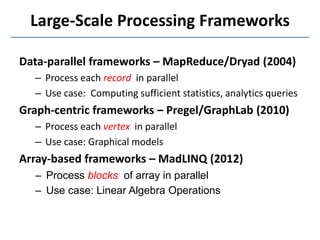
Large-Scale Processing Frameworks
Data-parallel frameworks – MapReduce/Dryad (2004)
– Process each record in parallel
– Use case: Computing sufficient statistics, analytics queries
Graph-centric frameworks – Pregel/GraphLab (2010)
– Process each vertex in parallel
– Use case: Graphical models
Array-based frameworks – MadLINQ (2012)
– Process blocks of array in parallel
– Use case: Linear Algebra Operations
PageRank using Matrices
Power Method
Dominant
eigenvector
Mp
M = web graph matrix
p = PageRank vector
Simplified algorithm repeat { p = M*p }
Linear Algebra Operations on Sparse Matrices
p
Statistical software
moderately-sized datasets
single server, entirely in memory
Work-around
for massive dataset
Vertical scalability
Sampling
MapReduce
Limited to aggregation processing
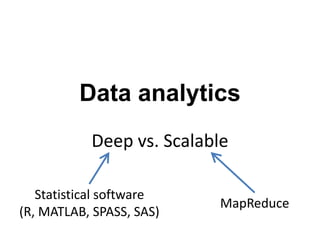
Data analytics
Deep vs. Scalable
Statistical software
(R, MATLAB, SPASS, SAS)
MapReduce
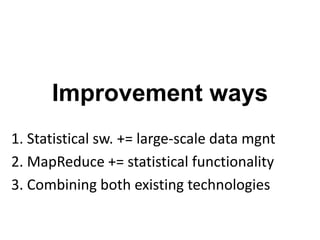
Improvement ways
1. Statistical sw. += large-scale data mgnt
2. MapReduce += statistical functionality
3. Combining both existing technologies
Parallel MATLAB, pR
HAMA, SciHadoop
MadLINQ [EuroSys’12]
Linear algebra platform on Dryad
Not efficient for sparse matrix comp.
Ricardo [SIGMOD’10]
But ends up inheriting the
inefficiencies of the MapReduce
interface
R Hadoop
aggregation-processing queries
aggregated data
Array-based
Single-threaded
Limited support for scaling
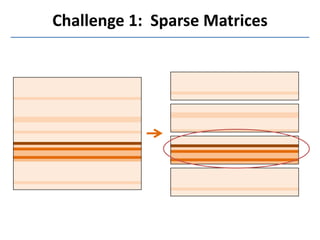
Challenge 1: Sparse Matrices
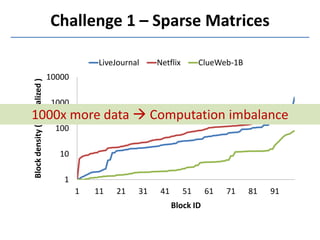
Challenge 1 – Sparse Matrices
1
10
100
1000
10000
1 11 21 31 41 51 61 71 81 91
Blockdensity(normalized)
Block ID
LiveJournal Netflix ClueWeb-1B
1000x more data  Computation imbalance
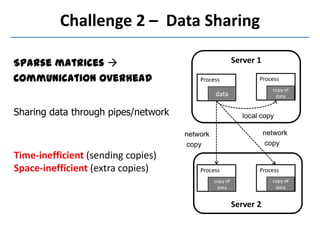
Challenge 2 – Data Sharing
Sharing data through pipes/network
Time-inefficient (sending copies)
Space-inefficient (extra copies)
Process
copy of
data
local copy
Process
data
Process
copy of
data
Process
copy of
data
Server 1
network
copy
network
copy
Server 2
Sparse matrices 
Communication overhead
Extend R – make it scalable, distributed
Large-scale machine learning and graph
processing on sparse matrices
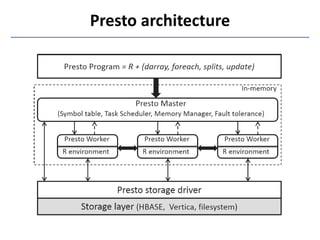
Presto architecture
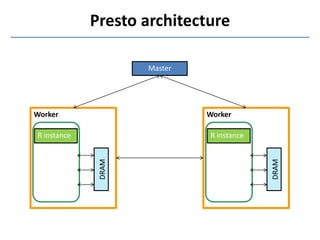
Presto architecture
WorkerWorker
Master
R instanceR instance
DRAM
R instance R instanceR instance
DRAM
R instance
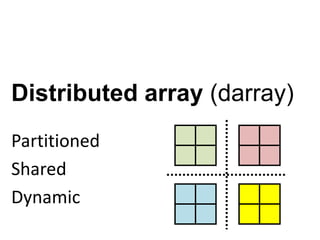
Distributed array (darray)
Partitioned
Shared
Dynamic
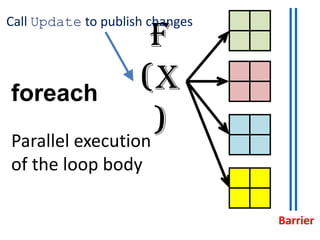
foreach
Parallel execution
of the loop body
f
(x
)
Barrier
Call Update to publish changes
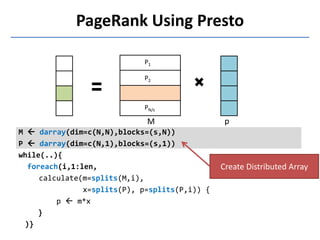
PageRank Using Presto
M  darray(dim=c(N,N),blocks=(s,N))
P  darray(dim=c(N,1),blocks=(s,1))
while(..){
foreach(i,1:len,
calculate(m=splits(M,i),
x=splits(P), p=splits(P,i)) {
p  m*x
}
)}
Create Distributed Array
M p
P1
P2
PN/s
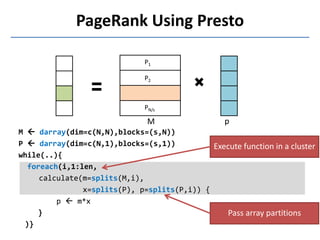
PageRank Using Presto
M  darray(dim=c(N,N),blocks=(s,N))
P  darray(dim=c(N,1),blocks=(s,1))
while(..){
foreach(i,1:len,
calculate(m=splits(M,i),
x=splits(P), p=splits(P,i)) {
p  m*x
}
)}
Execute function in a cluster
Pass array partitions
p
P1
P2
PN/s
M
Dynamic repartitioning
To address load imbalance
Correctness
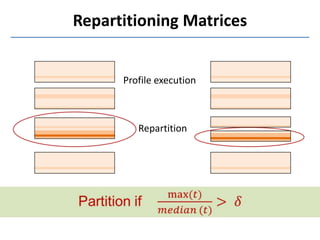
Repartitioning Matrices
Profile execution
Repartition
Invariants
compatibility in array sizes
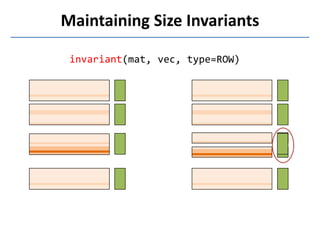
Maintaining Size Invariants
invariant(mat, vec, type=ROW)
Data sharing
for multi-core
Zero-copy sharing across cores
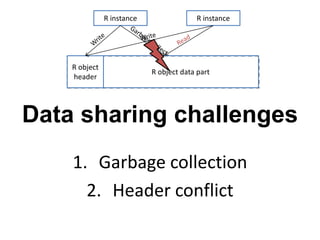
Data sharing challenges
1. Garbage collection
2. Header conflict
R object data part
R object
header
R instance R instance
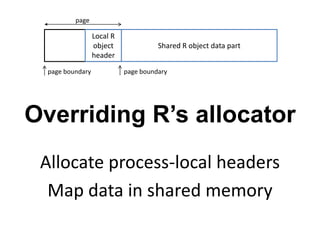
Overriding R’s allocator
Allocate process-local headers
Map data in shared memory
page
Shared R object data part
Local R
object
header
page boundary page boundary
Immutable partitions
 Safe sharing
Only share read-only data
Versioning arrays
To ensure correctness when arrays
are shared across machines
Fault tolerance
Master: primary-backup replication
Worker: heartbeat-based failure detection
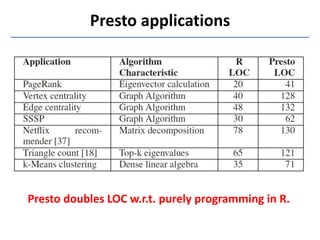
Presto applications
Presto doubles LOC w.r.t. purely programming in R.
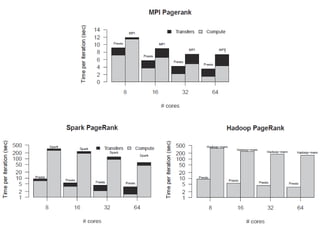
Evaluation
Faster than Spark and Hadoop
using in-memory data
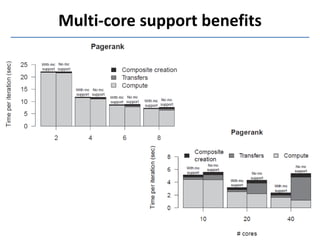
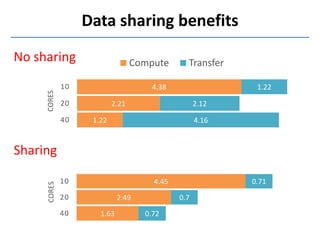
Multi-core support benefits
Data sharing benefits
4.45
2.49
1.63
0.71
0.7
0.72
10
20
40
CORES
4.38
2.21
1.22
1.22
2.12
4.16
10
20
40
CORES
Compute TransferNo sharing
Sharing
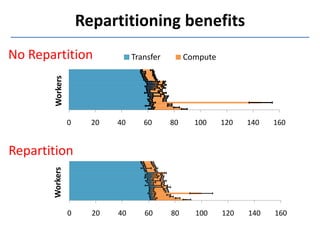
Repartitioning benefits
0 20 40 60 80 100 120 140 160
Workers Transfer Compute
0 20 40 60 80 100 120 140 160
WorkersNo Repartition
Repartition
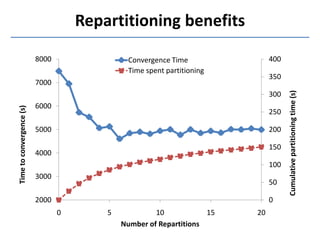
Repartitioning benefits
0
50
100
150
200
250
300
350
400
2000
3000
4000
5000
6000
7000
8000
0 5 10 15 20
Cumulativepartitioningtime(s)
Timetoconvergence(s)
Number of Repartitions
Convergence Time
Time spent partitioning
Limitations
1. In-memory computation
2. One writer per partition
3. Array-based programming
• Presto: Large scale array-based
framework extends R
• Challenges with Sparse matrices
• Repartitioning, sharing versioned arrays
Conclusion
IMDb Rating: 8.5
Release Date: 27 June 2008
Director: Doug Sweetland
Studio: Pixar
Runtime: 5 min
Brief:
A stage magician’s rabbit
gets into a magical onstage
brawl against his neglectful
guardian with two magic
hats.

Presto: Distributed Machine Learning and Graph Processing with Sparse Matrices

Editor's Notes

  • #2 MapReduce excels in massively parallel processing, scalability, and fault tolerance.In terms of analytics, however, such systems have been limited primarily to aggregation processing, i.e., computation of simple aggregates such as SUM, COUNT, and AVERAGE, after using filtering, joining, and grouping operations to prepare the data for the aggregation step. Although most DMSs provide hooks for user-defined functions and procedures, they do not deliver the rich analytic functionality found in statistical packages.
  • #3 Virtually all prior work attempts to get along with only one type of system, either adding large-scale data management capability to statistical packages or adding statistical functionality to DMSs. This approach leads to solutions that are often cumbersome, unfriendly to analysts, or wasteful in that a great deal of well established technology is needlessly re-invented or re-implemented.
  • #4 Convert matrix operations to MapReduce functions.
  • #5 R sending aggregation-processing queries to Hadoop (written in the high-level Jaql query language), and Hadoop sending aggregated data to R for advanced statistical processing or visualization.
  • #6 R has serious limitations when applied to very large datasets: limited support for distributed processing, no strategy for load balancing, no fault tolerance, and is constrained by a server’s DRAM capacity.
  • #8 Large-scale machine learning and graph processing on sparse matrices
  • #9 Distributed array (darray) provides a shared, in-memory view of multi-dimensional data stored across multiple servers.
  • #10 Repartitioning can be used to subdivide an array into a specified number of parts. Repartitioning is an optional performance optimization which helps when there is load imbalance in the system.
  • #11 Note that for programs with general data structures (e.g., trees) writing invariants is difficult. However, for matrix computation, arrays are the only data structure and the relevant invariant is the compatibility in array sizes.
  • #12 Qian’s comment: same concept as the snapshot isolation.