Acid Rain
Causes, Effects, and “Cures”.
Acid Rain


•   What is acid rain?
•   The main effects of acid rain
•   Damages & the areas affected most
•   The effects on life & commerce
•   Reversal & prevention of damage
•   Bibliography & reference
What Is Acid Rain?
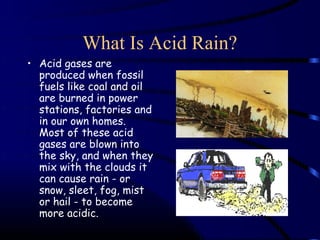
• Acid gases are
  produced when fossil
  fuels like coal and oil
  are burned in power
  stations, factories and
  in our own homes.
  Most of these acid
  gases are blown into
  the sky, and when they
  mix with the clouds it
  can cause rain - or
  snow, sleet, fog, mist
  or hail - to become
  more acidic.
Air Pollution
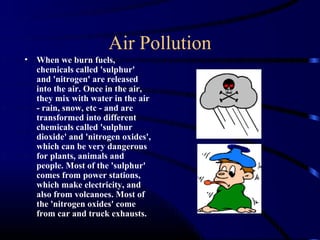
•   When we burn fuels,
    chemicals called 'sulphur'
    and 'nitrogen' are released
    into the air. Once in the air,
    they mix with water in the air
    - rain, snow, etc - and are
    transformed into different
    chemicals called 'sulphur
    dioxide' and 'nitrogen oxides',
    which can be very dangerous
    for plants, animals and
    people. Most of the 'sulphur'
    comes from power stations,
    which make electricity, and
    also from volcanoes. Most of
    the 'nitrogen oxides' come
    from car and truck exhausts.
Acid Rain


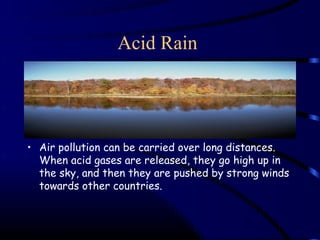
• Air pollution can be carried over long distances.
  When acid gases are released, they go high up in
  the sky, and then they are pushed by strong winds
  towards other countries.
The Causes


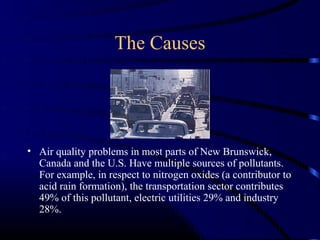
• Air quality problems in most parts of New Brunswick,
  Canada and the U.S. Have multiple sources of pollutants.
  For example, in respect to nitrogen oxides (a contributor to
  acid rain formation), the transportation sector contributes
  49% of this pollutant, electric utilities 29% and industry
  28%.
Where It Comes From


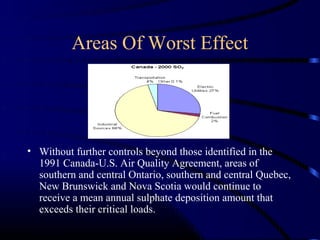
• Sulphur dioxide emissions by contrast are electric utilities
  66%, industry 28% and transportation 3%. When it comes
  to carbon dioxide (one of the major greenhouse gases
  contributing to climate change), the transportation sector
  makes up 30%, industry 22% and electric utilities 36%.
  Source: Canada/U.S. air quality agreement progress report.
Effects On Forests


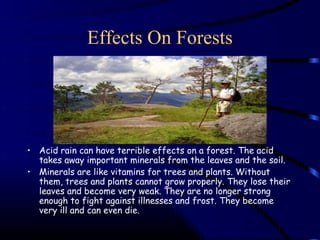
• Acid rain can have terrible effects on a forest. The acid
  takes away important minerals from the leaves and the soil.
• Minerals are like vitamins for trees and plants. Without
  them, trees and plants cannot grow properly. They lose their
  leaves and become very weak. They are no longer strong
  enough to fight against illnesses and frost. They become
  very ill and can even die.
Effects On Water Life


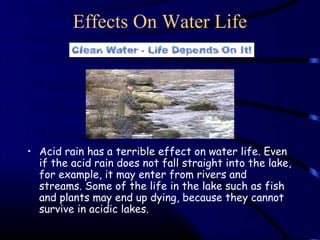
• Acid rain has a terrible effect on water life. Even
  if the acid rain does not fall straight into the lake,
  for example, it may enter from rivers and
  streams. Some of the life in the lake such as fish
  and plants may end up dying, because they cannot
  survive in acidic lakes.
Effects On Fish


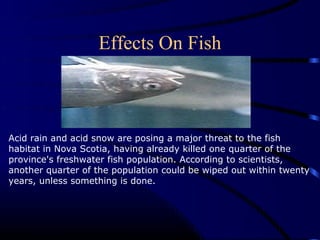
Acid rain and acid snow are posing a major threat to the fish
habitat in Nova Scotia, having already killed one quarter of the
province's freshwater fish population. According to scientists,
another quarter of the population could be wiped out within twenty
years, unless something is done.
Effects On Lakes & Rivers


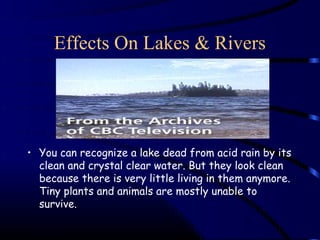
• You can recognize a lake dead from acid rain by its
  clean and crystal clear water. But they look clean
  because there is very little living in them anymore.
  Tiny plants and animals are mostly unable to
  survive.
Effects On
     Humans


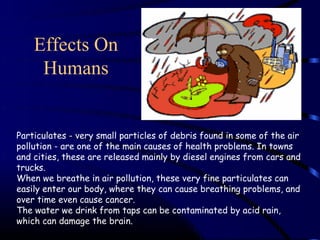
Particulates - very small particles of debris found in some of the air
pollution - are one of the main causes of health problems. In towns
and cities, these are released mainly by diesel engines from cars and
trucks.
When we breathe in air pollution, these very fine particulates can
easily enter our body, where they can cause breathing problems, and
over time even cause cancer.
The water we drink from taps can be contaminated by acid rain,
which can damage the brain.
Effects On
                          Buildings


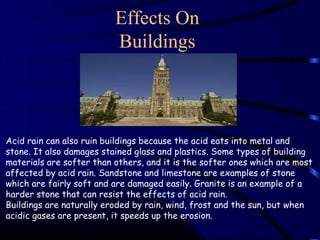
Acid rain can also ruin buildings because the acid eats into metal and
stone. It also damages stained glass and plastics. Some types of building
materials are softer than others, and it is the softer ones which are most
affected by acid rain. Sandstone and limestone are examples of stone
which are fairly soft and are damaged easily. Granite is an example of a
harder stone that can resist the effects of acid rain.
Buildings are naturally eroded by rain, wind, frost and the sun, but when
acidic gases are present, it speeds up the erosion.
Effects On Commerce


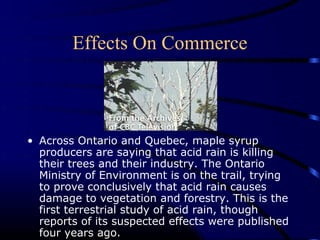
• Across Ontario and Quebec, maple syrup
  producers are saying that acid rain is killing
  their trees and their industry. The Ontario
  Ministry of Environment is on the trail, trying
  to prove conclusively that acid rain causes
  damage to vegetation and forestry. This is the
  first terrestrial study of acid rain, though
  reports of its suspected effects were published
  four years ago.
Areas Of Worst Effect


• Without further controls beyond those identified in the
  1991 Canada-U.S. Air Quality Agreement, areas of
  southern and central Ontario, southern and central Quebec,
  New Brunswick and Nova Scotia would continue to
  receive a mean annual sulphate deposition amount that
  exceeds their critical loads.
THE END
•         THANK YOU


•   Submitted by: chasper jade padrigo

Acid.rain(ok)ppt

  • 1.
  • 2.
    Acid Rain • What is acid rain? • The main effects of acid rain • Damages & the areas affected most • The effects on life & commerce • Reversal & prevention of damage • Bibliography & reference
  • 3.
    What Is AcidRain? • Acid gases are produced when fossil fuels like coal and oil are burned in power stations, factories and in our own homes. Most of these acid gases are blown into the sky, and when they mix with the clouds it can cause rain - or snow, sleet, fog, mist or hail - to become more acidic.
  • 4.
    Air Pollution • When we burn fuels, chemicals called 'sulphur' and 'nitrogen' are released into the air. Once in the air, they mix with water in the air - rain, snow, etc - and are transformed into different chemicals called 'sulphur dioxide' and 'nitrogen oxides', which can be very dangerous for plants, animals and people. Most of the 'sulphur' comes from power stations, which make electricity, and also from volcanoes. Most of the 'nitrogen oxides' come from car and truck exhausts.
  • 5.
    Acid Rain • Airpollution can be carried over long distances. When acid gases are released, they go high up in the sky, and then they are pushed by strong winds towards other countries.
  • 6.
    The Causes • Airquality problems in most parts of New Brunswick, Canada and the U.S. Have multiple sources of pollutants. For example, in respect to nitrogen oxides (a contributor to acid rain formation), the transportation sector contributes 49% of this pollutant, electric utilities 29% and industry 28%.
  • 7.
    Where It ComesFrom • Sulphur dioxide emissions by contrast are electric utilities 66%, industry 28% and transportation 3%. When it comes to carbon dioxide (one of the major greenhouse gases contributing to climate change), the transportation sector makes up 30%, industry 22% and electric utilities 36%. Source: Canada/U.S. air quality agreement progress report.
  • 8.
    Effects On Forests •Acid rain can have terrible effects on a forest. The acid takes away important minerals from the leaves and the soil. • Minerals are like vitamins for trees and plants. Without them, trees and plants cannot grow properly. They lose their leaves and become very weak. They are no longer strong enough to fight against illnesses and frost. They become very ill and can even die.
  • 9.
    Effects On WaterLife • Acid rain has a terrible effect on water life. Even if the acid rain does not fall straight into the lake, for example, it may enter from rivers and streams. Some of the life in the lake such as fish and plants may end up dying, because they cannot survive in acidic lakes.
  • 10.
    Effects On Fish Acidrain and acid snow are posing a major threat to the fish habitat in Nova Scotia, having already killed one quarter of the province's freshwater fish population. According to scientists, another quarter of the population could be wiped out within twenty years, unless something is done.
  • 11.
    Effects On Lakes& Rivers • You can recognize a lake dead from acid rain by its clean and crystal clear water. But they look clean because there is very little living in them anymore. Tiny plants and animals are mostly unable to survive.
  • 12.
    Effects On Humans Particulates - very small particles of debris found in some of the air pollution - are one of the main causes of health problems. In towns and cities, these are released mainly by diesel engines from cars and trucks. When we breathe in air pollution, these very fine particulates can easily enter our body, where they can cause breathing problems, and over time even cause cancer. The water we drink from taps can be contaminated by acid rain, which can damage the brain.
  • 13.
    Effects On Buildings Acid rain can also ruin buildings because the acid eats into metal and stone. It also damages stained glass and plastics. Some types of building materials are softer than others, and it is the softer ones which are most affected by acid rain. Sandstone and limestone are examples of stone which are fairly soft and are damaged easily. Granite is an example of a harder stone that can resist the effects of acid rain. Buildings are naturally eroded by rain, wind, frost and the sun, but when acidic gases are present, it speeds up the erosion.
  • 14.
    Effects On Commerce •Across Ontario and Quebec, maple syrup producers are saying that acid rain is killing their trees and their industry. The Ontario Ministry of Environment is on the trail, trying to prove conclusively that acid rain causes damage to vegetation and forestry. This is the first terrestrial study of acid rain, though reports of its suspected effects were published four years ago.
  • 15.
    Areas Of WorstEffect • Without further controls beyond those identified in the 1991 Canada-U.S. Air Quality Agreement, areas of southern and central Ontario, southern and central Quebec, New Brunswick and Nova Scotia would continue to receive a mean annual sulphate deposition amount that exceeds their critical loads.
  • 16.
    THE END • THANK YOU • Submitted by: chasper jade padrigo