English 2015 onwards
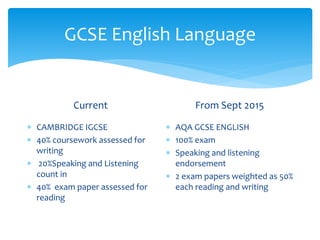
GCSE English Language
Current
 CAMBRIDGE IGCSE
 40% coursework assessed for
writing
 20%Speaking and Listening
count in
 40% exam paper assessed for
reading
From Sept 2015
 AQA GCSE ENGLISH
 100% exam
 Speaking and listening
endorsement
 2 exam papers weighted as 50%
each reading and writing
AO1 Identify and interpret explicit and implicit information and ideas.
Select and synthesise evidence from different texts.
AO2 Explain, comment on and analyse how writers use language and structure
to achieve effects and influence readers, using relevant subject terminology to
support their views.
AO3 Compare writers’ ideas and perspectives, as well as how these are
conveyed, across two or more texts.
AO4 Evaluate texts critically and support this with appropriate textual
references.
AO 5 Communicate clearly, effectively and imaginatively, selecting and adapting
tone, style and register for different forms, purposes and audiences. Organise
information and ideas, using structural and grammatical features to support
coherence and cohesion of texts.
AO 6 Use a range of vocabulary and sentence structures for clarity, purpose and
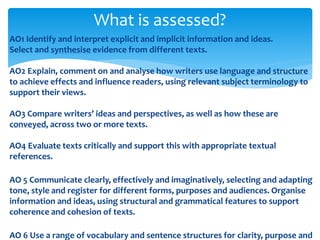
What is assessed?
AO1 Identify and interpret explicit and implicit information and ideas.
Select and synthesise evidence from different texts.
AO2 Explain, comment on and analyse how writers use language and structure
to achieve effects and influence readers, using relevant subject terminology to
support their views.
AO3 Compare writers’ ideas and perspectives, as well as how these are
conveyed, across two or more texts.
AO4 Evaluate texts critically and support this with appropriate textual
references.
AO 5 Communicate clearly, effectively and imaginatively, selecting and adapting
tone, style and register for different forms, purposes and audiences. Organise
information and ideas, using structural and grammatical features to support
coherence and cohesion of texts.
AO 6 Use a range of vocabulary and sentence structures for clarity, purpose and
What is assessed?
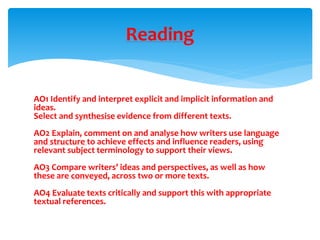
AO1 Identify and interpret explicit and implicit information and
ideas.
Select and synthesise evidence from different texts.
AO2 Explain, comment on and analyse how writers use language
and structure to achieve effects and influence readers, using
relevant subject terminology to support their views.
AO3 Compare writers’ ideas and perspectives, as well as how
these are conveyed, across two or more texts.
AO4 Evaluate texts critically and support this with appropriate
textual references.
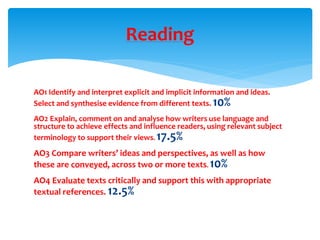
Reading
AO1 Identify and interpret explicit and implicit information and ideas.
Select and synthesise evidence from different texts. 10%
AO2 Explain, comment on and analyse how writers use language and
structure to achieve effects and influence readers, using relevant subject
terminology to support their views. 17.5%
AO3 Compare writers’ ideas and perspectives, as well as how
these are conveyed, across two or more texts. 10%
AO4 Evaluate texts critically and support this with appropriate
textual references. 12.5%
Reading
AO 5 Communicate clearly, effectively and
imaginatively, selecting and adapting tone, style and
register for different forms, purposes and audiences.
Organise information and ideas, using structural and
grammatical features to support coherence and
cohesion of texts.
AO 6 Use a range of vocabulary and sentence
structures for clarity, purpose and effect, with accurate
spelling and punctuation.
Writing
AO 5 Communicate clearly, effectively and imaginatively,
selecting and adapting tone, style and register for different
forms, purposes and audiences. Organise information and
ideas, using structural and grammatical features to support
coherence and cohesion of texts. 30%
AO 6 Use a range of vocabulary and sentence structures for
clarity, purpose and effect, with accurate spelling and
punctuation. 20%
Writing
Paper 1 Section A: Sample question 1
Read again the first part of the source, lines 1 to 7.
List four things from this part of the text about the weather.
a
b
c
d
[4 marks]
Slide 21 Copyright © AQA and its licensors. All rights reserved.
Paper 1 Section A: Sample question 4
Focus this part of your answer on the second half of the source, from line 18 to
the end.
A student, having read this section of the text said: “The writer brings the very
different characters to life for the reader. It is as if you are inside the coach with
them.”
To what extent do you agree?
In your response, you could:
• write about your own impressions of the characters
• evaluate how the writer has created these impressions
• support your opinions with quotations from the text.
[20 marks]
Slide 24 Copyright © AQA and its licensors. All rights reserved.
Paper 1 Section B: Sample question 5
You are going to enter a creative writing competition. Your entry will be judged
by a panel of people of your own age.
Either: Write a description suggested by this picture:
Or: Write the opening part of a story about a place that is severely affected by
the weather.
[24 marks for content and organisation
16 marks for technical accuracy]
[40 marks]
Slide 30 Copyright © AQA and its licensors. All rights reserved.
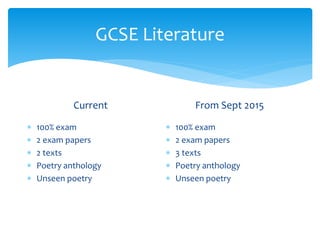
GCSE Literature
Current
 100% exam
 2 exam papers
 2 texts
 Poetry anthology
 Unseen poetry
From Sept 2015
 100% exam
 2 exam papers
 3 texts
 Poetry anthology
 Unseen poetry
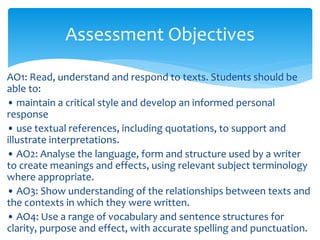
AO1: Read, understand and respond to texts. Students should be
able to:
• maintain a critical style and develop an informed personal
response
• use textual references, including quotations, to support and
illustrate interpretations.
• AO2: Analyse the language, form and structure used by a writer
to create meanings and effects, using relevant subject terminology
where appropriate.
• AO3: Show understanding of the relationships between texts and
the contexts in which they were written.
• AO4: Use a range of vocabulary and sentence structures for
clarity, purpose and effect, with accurate spelling and punctuation.
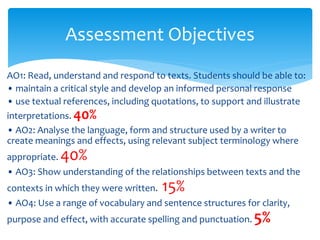
Assessment Objectives
AO1: Read, understand and respond to texts. Students should be able to:
• maintain a critical style and develop an informed personal response
• use textual references, including quotations, to support and illustrate
interpretations. 40%
• AO2: Analyse the language, form and structure used by a writer to
create meanings and effects, using relevant subject terminology where
appropriate. 40%
• AO3: Show understanding of the relationships between texts and the
contexts in which they were written. 15%
• AO4: Use a range of vocabulary and sentence structures for clarity,
purpose and effect, with accurate spelling and punctuation. 5%
Assessment Objectives
Choose 1 from Choose 1 from Choose 1 from Poetry- Poems
Past and
Present
The Strange
Case of Dr Jekyll
and Mr Hyde
Macbeth An Inspector
Calls
Lord of the Flies There is a choice
of :
A Christmas
Carol
Romeo and
Juliet
Blood Brothers AQA Anthology
Telling Tales
Love and
relationships
Great
Expectations
The Tempest The History
Boys
Animal Farm Power and
conflict.
Jane Eyre The Merchant of
Venice
DNA Never Let Me Go +
Frankenstein Much Ado
About Nothing
The Curious
Incident of the
Dog in the
Night-
Time (play
script)
Anita and Me Unseen Poetry
Pride and
Prejudice
Julius Caesar A Taste of
Honey
Pigeon English
The Sign of Four
Content
Choose 1 from Choose 1 from Choose 1 from Poetry- Poems
Past and
Present
The Strange
Case of Dr Jekyll
and Mr Hyde
Macbeth An Inspector
Calls
Lord of the Flies There is a choice
of :
A Christmas
Carol
Romeo and
Juliet
Blood Brothers AQA Anthology
Telling Tales
Love and
relationships
Great
Expectations
The Tempest The History
Boys
Animal Farm Power and conflict.
Jane Eyre The Merchant of
Venice
DNA Never Let Me Go +
Frankenstein Much Ado
About Nothing
The Curious
Incident of the
Dog in the
Night-
Time (play
script)
Anita and Me Unseen Poetry
Pride and
Prejudice
Julius Caesar A Taste of
Honey
Pigeon English
The Sign of Four
The boundary for
the new grade five
will be set at about
half to two thirds
of a GCSE grade
higher than the
current
requirement for a
grade C.
The bottom of a new grade
four will correspond to the
bottom of a current grade C
The same proportion of
candidates will achieve a
grade four or above as
currently achieve a grade C
or above. However, under
the changes those
candidates will be spread
among six different grades
(four up to nine), and not
four (C up to A*) as at
present, helping to
distinguish between middle
and top performers and
giving pupils heading for
grade C a higher goal to aim
for.
CURRENT KS3
Curriculum
2014 CURRICULUM
• Currently structured
around: Key concepts; Key
processes; range and
content and curriculum
opportunities.
• Always been phrased as
‘Pupils should be able
to…’
• Currently have ‘Speaking
and Listening as a topic.
• New curriculum is more knowledge based,
particularly based on knowledge of grammar
and vocabulary.
• Now phrased as ‘Pupils should be taught to…’
• Will now be called ‘Spoken English’ (no
comments on listening!)
• No reference to assessment yet!
• Repetition of ‘challenging’
• Greater focus on Literature based learning
• Greater emphasis on planning, drafting,
editing and proofreading writing.
• GRAMMAR and VOCABULARY focus – similar
to KS2 SPAG (This is equal to reading and
writing)
Some differences:
New KS3
Curriculum from
September 2014
READING
1. develop an appreciation and
love of reading, and read
increasingly challenging
material independently
2. understand increasingly
challenging texts
3. read critically
GRAMMAR AND VOCABULARY
1. consolidate and build on
their knowledge of
grammar and vocabulary
2 plan, draft, edit and proof-
read
SPOKEN ENGLISH.
speak confidently and
effectively
WRITING
1. write accurately, fluently,
effectively and at length for
pleasure and information
2. plan, draft, edit and proof-
read
New KS3
Curriculum from
September 2014
READING
1. develop an appreciation and
love of reading, and read
increasingly challenging
material independently
2. understand increasingly
challenging texts
3. read critically
GRAMMAR AND VOCABULARY
1. consolidate and build on
their knowledge of
grammar and vocabulary
2 plan, draft, edit and proof-
read
SPOKEN ENGLISH.
speak confidently and
effectively
WRITING
1. write accurately, fluently,
effectively and at length for
pleasure and information
2. plan, draft, edit and proof-
read
Rigour at KS3
Choice of texts far more demanding
Regular formal exam style assessments
Informal assessment regular SPaG tests
Accelerated Reader
Structured schemes of learning ensure that all
Assessments are focused on assessment criteria
Regular review of groupings
How have we prepared for these
changes at KS3?

English 2015 onwards presentation

  • 1.
  • 2.
    GCSE English Language Current CAMBRIDGE IGCSE  40% coursework assessed for writing  20%Speaking and Listening count in  40% exam paper assessed for reading From Sept 2015  AQA GCSE ENGLISH  100% exam  Speaking and listening endorsement  2 exam papers weighted as 50% each reading and writing
  • 3.
    AO1 Identify andinterpret explicit and implicit information and ideas. Select and synthesise evidence from different texts. AO2 Explain, comment on and analyse how writers use language and structure to achieve effects and influence readers, using relevant subject terminology to support their views. AO3 Compare writers’ ideas and perspectives, as well as how these are conveyed, across two or more texts. AO4 Evaluate texts critically and support this with appropriate textual references. AO 5 Communicate clearly, effectively and imaginatively, selecting and adapting tone, style and register for different forms, purposes and audiences. Organise information and ideas, using structural and grammatical features to support coherence and cohesion of texts. AO 6 Use a range of vocabulary and sentence structures for clarity, purpose and What is assessed?
  • 4.
    AO1 Identify andinterpret explicit and implicit information and ideas. Select and synthesise evidence from different texts. AO2 Explain, comment on and analyse how writers use language and structure to achieve effects and influence readers, using relevant subject terminology to support their views. AO3 Compare writers’ ideas and perspectives, as well as how these are conveyed, across two or more texts. AO4 Evaluate texts critically and support this with appropriate textual references. AO 5 Communicate clearly, effectively and imaginatively, selecting and adapting tone, style and register for different forms, purposes and audiences. Organise information and ideas, using structural and grammatical features to support coherence and cohesion of texts. AO 6 Use a range of vocabulary and sentence structures for clarity, purpose and What is assessed?
  • 5.
    AO1 Identify andinterpret explicit and implicit information and ideas. Select and synthesise evidence from different texts. AO2 Explain, comment on and analyse how writers use language and structure to achieve effects and influence readers, using relevant subject terminology to support their views. AO3 Compare writers’ ideas and perspectives, as well as how these are conveyed, across two or more texts. AO4 Evaluate texts critically and support this with appropriate textual references. Reading
  • 6.
    AO1 Identify andinterpret explicit and implicit information and ideas. Select and synthesise evidence from different texts. 10% AO2 Explain, comment on and analyse how writers use language and structure to achieve effects and influence readers, using relevant subject terminology to support their views. 17.5% AO3 Compare writers’ ideas and perspectives, as well as how these are conveyed, across two or more texts. 10% AO4 Evaluate texts critically and support this with appropriate textual references. 12.5% Reading
  • 7.
    AO 5 Communicateclearly, effectively and imaginatively, selecting and adapting tone, style and register for different forms, purposes and audiences. Organise information and ideas, using structural and grammatical features to support coherence and cohesion of texts. AO 6 Use a range of vocabulary and sentence structures for clarity, purpose and effect, with accurate spelling and punctuation. Writing
  • 8.
    AO 5 Communicateclearly, effectively and imaginatively, selecting and adapting tone, style and register for different forms, purposes and audiences. Organise information and ideas, using structural and grammatical features to support coherence and cohesion of texts. 30% AO 6 Use a range of vocabulary and sentence structures for clarity, purpose and effect, with accurate spelling and punctuation. 20% Writing
  • 9.
    Paper 1 SectionA: Sample question 1 Read again the first part of the source, lines 1 to 7. List four things from this part of the text about the weather. a b c d [4 marks] Slide 21 Copyright © AQA and its licensors. All rights reserved.
  • 10.
    Paper 1 SectionA: Sample question 4 Focus this part of your answer on the second half of the source, from line 18 to the end. A student, having read this section of the text said: “The writer brings the very different characters to life for the reader. It is as if you are inside the coach with them.” To what extent do you agree? In your response, you could: • write about your own impressions of the characters • evaluate how the writer has created these impressions • support your opinions with quotations from the text. [20 marks] Slide 24 Copyright © AQA and its licensors. All rights reserved.
  • 11.
    Paper 1 SectionB: Sample question 5 You are going to enter a creative writing competition. Your entry will be judged by a panel of people of your own age. Either: Write a description suggested by this picture: Or: Write the opening part of a story about a place that is severely affected by the weather. [24 marks for content and organisation 16 marks for technical accuracy] [40 marks] Slide 30 Copyright © AQA and its licensors. All rights reserved.
  • 12.
    GCSE Literature Current  100%exam  2 exam papers  2 texts  Poetry anthology  Unseen poetry From Sept 2015  100% exam  2 exam papers  3 texts  Poetry anthology  Unseen poetry
  • 13.
    AO1: Read, understandand respond to texts. Students should be able to: • maintain a critical style and develop an informed personal response • use textual references, including quotations, to support and illustrate interpretations. • AO2: Analyse the language, form and structure used by a writer to create meanings and effects, using relevant subject terminology where appropriate. • AO3: Show understanding of the relationships between texts and the contexts in which they were written. • AO4: Use a range of vocabulary and sentence structures for clarity, purpose and effect, with accurate spelling and punctuation. Assessment Objectives
  • 14.
    AO1: Read, understandand respond to texts. Students should be able to: • maintain a critical style and develop an informed personal response • use textual references, including quotations, to support and illustrate interpretations. 40% • AO2: Analyse the language, form and structure used by a writer to create meanings and effects, using relevant subject terminology where appropriate. 40% • AO3: Show understanding of the relationships between texts and the contexts in which they were written. 15% • AO4: Use a range of vocabulary and sentence structures for clarity, purpose and effect, with accurate spelling and punctuation. 5% Assessment Objectives
  • 15.
    Choose 1 fromChoose 1 from Choose 1 from Poetry- Poems Past and Present The Strange Case of Dr Jekyll and Mr Hyde Macbeth An Inspector Calls Lord of the Flies There is a choice of : A Christmas Carol Romeo and Juliet Blood Brothers AQA Anthology Telling Tales Love and relationships Great Expectations The Tempest The History Boys Animal Farm Power and conflict. Jane Eyre The Merchant of Venice DNA Never Let Me Go + Frankenstein Much Ado About Nothing The Curious Incident of the Dog in the Night- Time (play script) Anita and Me Unseen Poetry Pride and Prejudice Julius Caesar A Taste of Honey Pigeon English The Sign of Four Content
  • 16.
    Choose 1 fromChoose 1 from Choose 1 from Poetry- Poems Past and Present The Strange Case of Dr Jekyll and Mr Hyde Macbeth An Inspector Calls Lord of the Flies There is a choice of : A Christmas Carol Romeo and Juliet Blood Brothers AQA Anthology Telling Tales Love and relationships Great Expectations The Tempest The History Boys Animal Farm Power and conflict. Jane Eyre The Merchant of Venice DNA Never Let Me Go + Frankenstein Much Ado About Nothing The Curious Incident of the Dog in the Night- Time (play script) Anita and Me Unseen Poetry Pride and Prejudice Julius Caesar A Taste of Honey Pigeon English The Sign of Four
  • 17.
    The boundary for thenew grade five will be set at about half to two thirds of a GCSE grade higher than the current requirement for a grade C. The bottom of a new grade four will correspond to the bottom of a current grade C The same proportion of candidates will achieve a grade four or above as currently achieve a grade C or above. However, under the changes those candidates will be spread among six different grades (four up to nine), and not four (C up to A*) as at present, helping to distinguish between middle and top performers and giving pupils heading for grade C a higher goal to aim for.
  • 18.
    CURRENT KS3 Curriculum 2014 CURRICULUM •Currently structured around: Key concepts; Key processes; range and content and curriculum opportunities. • Always been phrased as ‘Pupils should be able to…’ • Currently have ‘Speaking and Listening as a topic. • New curriculum is more knowledge based, particularly based on knowledge of grammar and vocabulary. • Now phrased as ‘Pupils should be taught to…’ • Will now be called ‘Spoken English’ (no comments on listening!) • No reference to assessment yet! • Repetition of ‘challenging’ • Greater focus on Literature based learning • Greater emphasis on planning, drafting, editing and proofreading writing. • GRAMMAR and VOCABULARY focus – similar to KS2 SPAG (This is equal to reading and writing) Some differences:
  • 19.
    New KS3 Curriculum from September2014 READING 1. develop an appreciation and love of reading, and read increasingly challenging material independently 2. understand increasingly challenging texts 3. read critically GRAMMAR AND VOCABULARY 1. consolidate and build on their knowledge of grammar and vocabulary 2 plan, draft, edit and proof- read SPOKEN ENGLISH. speak confidently and effectively WRITING 1. write accurately, fluently, effectively and at length for pleasure and information 2. plan, draft, edit and proof- read
  • 20.
    New KS3 Curriculum from September2014 READING 1. develop an appreciation and love of reading, and read increasingly challenging material independently 2. understand increasingly challenging texts 3. read critically GRAMMAR AND VOCABULARY 1. consolidate and build on their knowledge of grammar and vocabulary 2 plan, draft, edit and proof- read SPOKEN ENGLISH. speak confidently and effectively WRITING 1. write accurately, fluently, effectively and at length for pleasure and information 2. plan, draft, edit and proof- read
  • 21.
    Rigour at KS3 Choiceof texts far more demanding Regular formal exam style assessments Informal assessment regular SPaG tests Accelerated Reader Structured schemes of learning ensure that all Assessments are focused on assessment criteria Regular review of groupings How have we prepared for these changes at KS3?

Editor's Notes

  • #10 As a lead in to the first paper, this question seeks to reassure students at the start of the examination with a low tariff, short response question It requires students to list 4 points from the text, and refers them to numbered lines that will be from the start of the extract The layout of the student answer booklet supports this response by setting out four lines (a,b,c,d) for students to complete Students can quote directly from the source, paraphrase in their own words or use a mixture of both The mark scheme enumerates the possible answers which the examiner then correlates with the student’s list There will be one mark for each relevant response in the list to a total of 4 marks The designated lines will always contain more than 4 aspects of information or ideas for students to be able to identify and gain full marks.
  • #11 This question requires students to critically evaluate the extent to which the writer has been successful in creating a specified effect on the reader within a particular section of the text It requires a judgement to be made by the student as a reader and requires them to support their ideas through textual references The statement prompts the reader to take a view about the writer’s intended impact and influence on them, and in doing so requires consideration of form and purpose – in particular, the extent to which the writer successfully draws the reader into the world of the text As the final reading question on the first paper, this requires the student to make an extended response It seeks to help the student in two ways – by focusing on a specific section of text towards the end of the extract, and by providing a statement for them to consider We feel that by providing a statement for them to make a judgement about, and to what extent they may agree, partially agree, or not agree at all, that we are more helpfully pointing them towards critical evaluation in a way that goes beyond just analysis The bullet points provide further clarity, reminding students to consider their own impression, evaluate the statement and how it relates to the effect the descriptions have on them, whilst also reminding them about the importance of making their judgement evidence based.
  • #12 As a task, either the description or narrative task provides scope for the student to develop content and organisation into their writing in a way that will create impact on the specified audience – in this case, a judging panel and the spur of a competition entry In addition, as set out in the Section B rubric, students are instructed to ‘write in full sentences’ This points students towards writing in Standard English and the importance of maintaining control of their writing We appreciate that producing an extended piece of writing under examination conditions can be challenging and needs a degree of stimulus for each student to have enough content and ideas to write about We didn’t want to introduce more reading material to do this and instead, have designed the paper so that the reading source that has to be studied, acts as a bridge or stimulus for the writing task We believe that this follows good writing practice - as part of our stakeholder engagement, NFER, on reviewing the specification state: “The AQA specification for English Language is innovative, combining reading and writing in each of the two papers. This is effective as the reading texts serve a double purpose: as the basis for comprehension questions and as supporting text for the writing tasks. Those set in the AQA English Language papers are in line with the assessment of writing in the high performing jurisdictions studied.”