Accounting Basics
Special Report

Accounting
Basics

EasyPC Training
Unit 4B, 333 Queensport Road
Murarrie QLD 4172
Tel: 1300 63 10 40
Accounting Basics

For additional support and information regarding this or any other EasyPC Training course, visit
our website at www.easypctraining.com.au or contact us at:

Tel: 1300 63 10 40
E-mail: info@easypctraining.com.au
Mail to: PO Box 154, Northgate, QLD 4013

Disclaimer
Information supplied by EasyPC Training (whether in user documentation and other literature, training
courses, websites, advice, or other means) is intended only to illustrate general principles, and may not be
complete, accurate or free of error.

© Copyright EasyPC Training 2010. All rights reserved.
Copyright Notice
No part of this publication may be reproduced, utilised, transmitted or distributed in any form by
any means – including photocopying, recording, mechanical, electronic or otherwise – by any other
party, without written permission from the publisher, EasyPC Training.
Copying without authorisation is illegal.

Accounting Basics
Accounting Basics

Contents
Bookkeeping basics ..................................................................................................................... 1
The Accounting Equation ......................................................................................................... 1
Assets ..................................................................................................................................... 1
Liabilities ................................................................................................................................. 1
Owner‟s Equity ........................................................................................................................ 2
The Balance Sheet .................................................................................................................... 3
Balance Sheet example .......................................................................................................... 3
Profit and Loss account ........................................................................................................... 4
Profit and Loss account example ............................................................................................ 4
Sales ....................................................................................................................................... 4
Cost of Sales ........................................................................................................................... 4
Expenses ................................................................................................................................ 5
Double Entry Bookkeeping....................................................................................................... 6
Ledger Accounts ....................................................................................................................... 6
Trial Balance.............................................................................................................................. 7
Trial Balance example ............................................................................................................. 7
Cash v Credit transactions ....................................................................................................... 8
Debtors ................................................................................................................................... 8
Creditors ................................................................................................................................. 8

Accounting Basics
Accounting Basics

Bookkeeping basics
The Accounting Equation
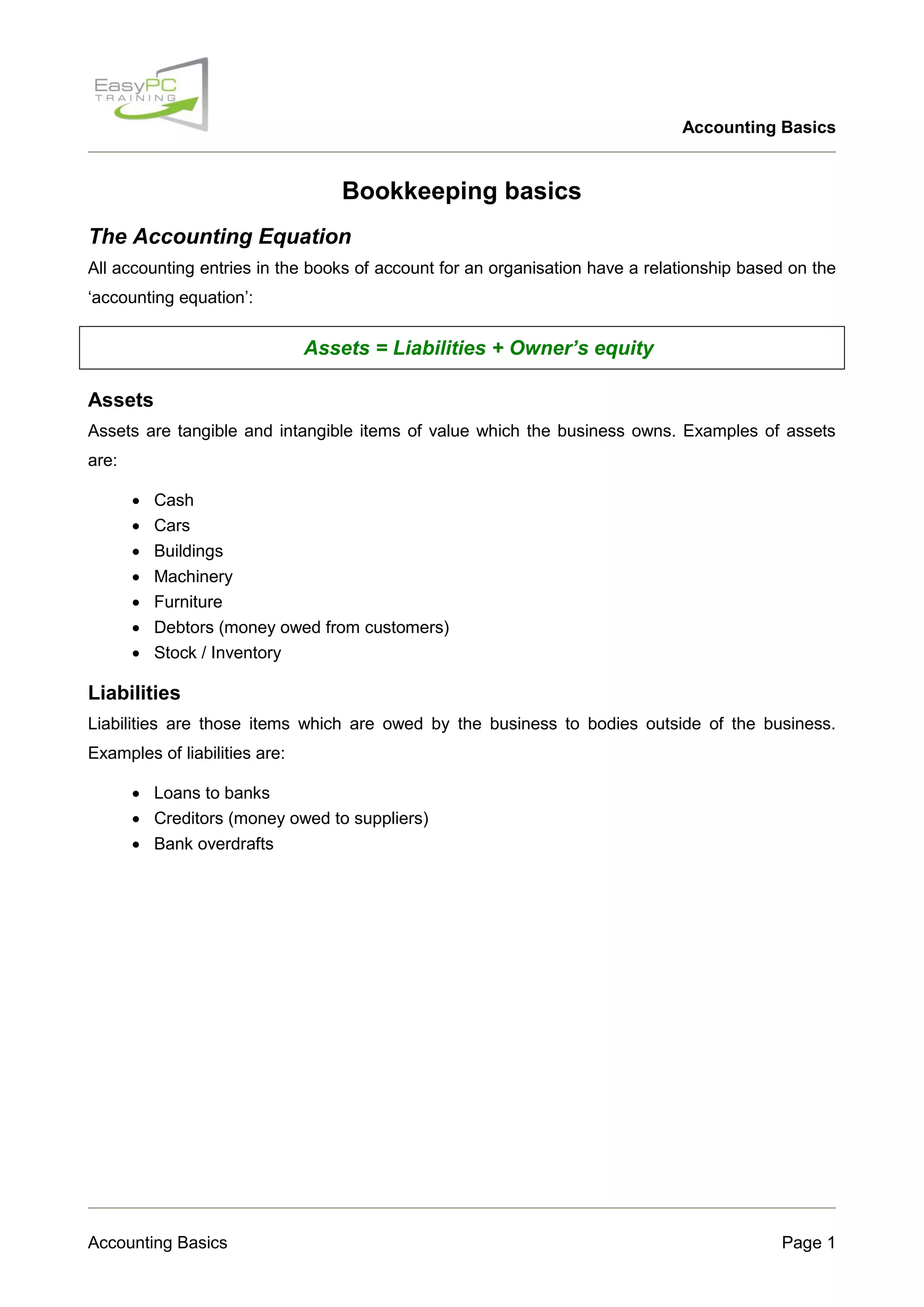
All accounting entries in the books of account for an organisation have a relationship based on the
„accounting equation‟:

Assets = Liabilities + Owner’s equity
Assets
Assets are tangible and intangible items of value which the business owns. Examples of assets
are:








Cash
Cars
Buildings
Machinery
Furniture
Debtors (money owed from customers)
Stock / Inventory

Liabilities
Liabilities are those items which are owed by the business to bodies outside of the business.
Examples of liabilities are:
 Loans to banks
 Creditors (money owed to suppliers)
 Bank overdrafts

Accounting Basics

Page 1
Accounting Basics

Owner’s Equity
The simplest way to understand the accounting equation is to understand what makes up „owner‟s
equity‟.
By rearranging the accounting equation you can see that Owner‟s Equity is made up of Assets and
Liabilities.

Owner’s Equity = Total Assets less Total Liabilities
Owner‟s Equity can also be expressed as:

Owner’s Equity = Capital invested by owner + Profits (Losses) to date
(also known as ‘Retained Earnings’)
Rearranging the equation again, therefore:

Total Assets - Total Liabilities = Capital + Retained Earnings

Accounting Basics

Page 2
Accounting Basics

The Balance Sheet
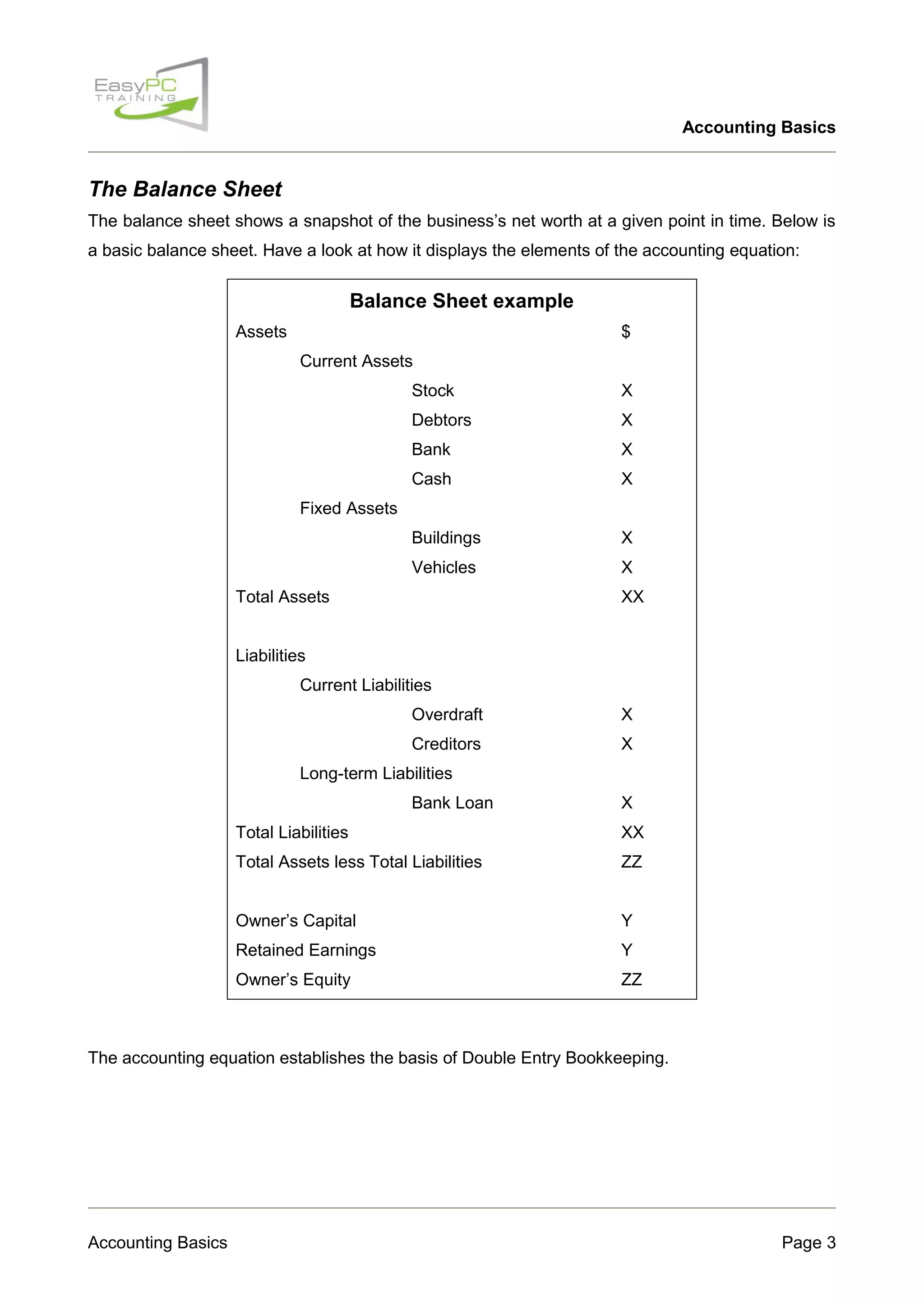
The balance sheet shows a snapshot of the business‟s net worth at a given point in time. Below is
a basic balance sheet. Have a look at how it displays the elements of the accounting equation:

Balance Sheet example
Assets

$
Current Assets
Stock

X

Debtors

X

Bank

X

Cash

X

Buildings

X

Vehicles

X

Fixed Assets

Total Assets

XX

Liabilities
Current Liabilities
Overdraft

X

Creditors

X

Long-term Liabilities
Bank Loan

X

Total Liabilities

XX

Total Assets less Total Liabilities

ZZ

Owner‟s Capital

Y

Retained Earnings

Y

Owner‟s Equity

ZZ

The accounting equation establishes the basis of Double Entry Bookkeeping.

Accounting Basics

Page 3
Accounting Basics

Profit and Loss account
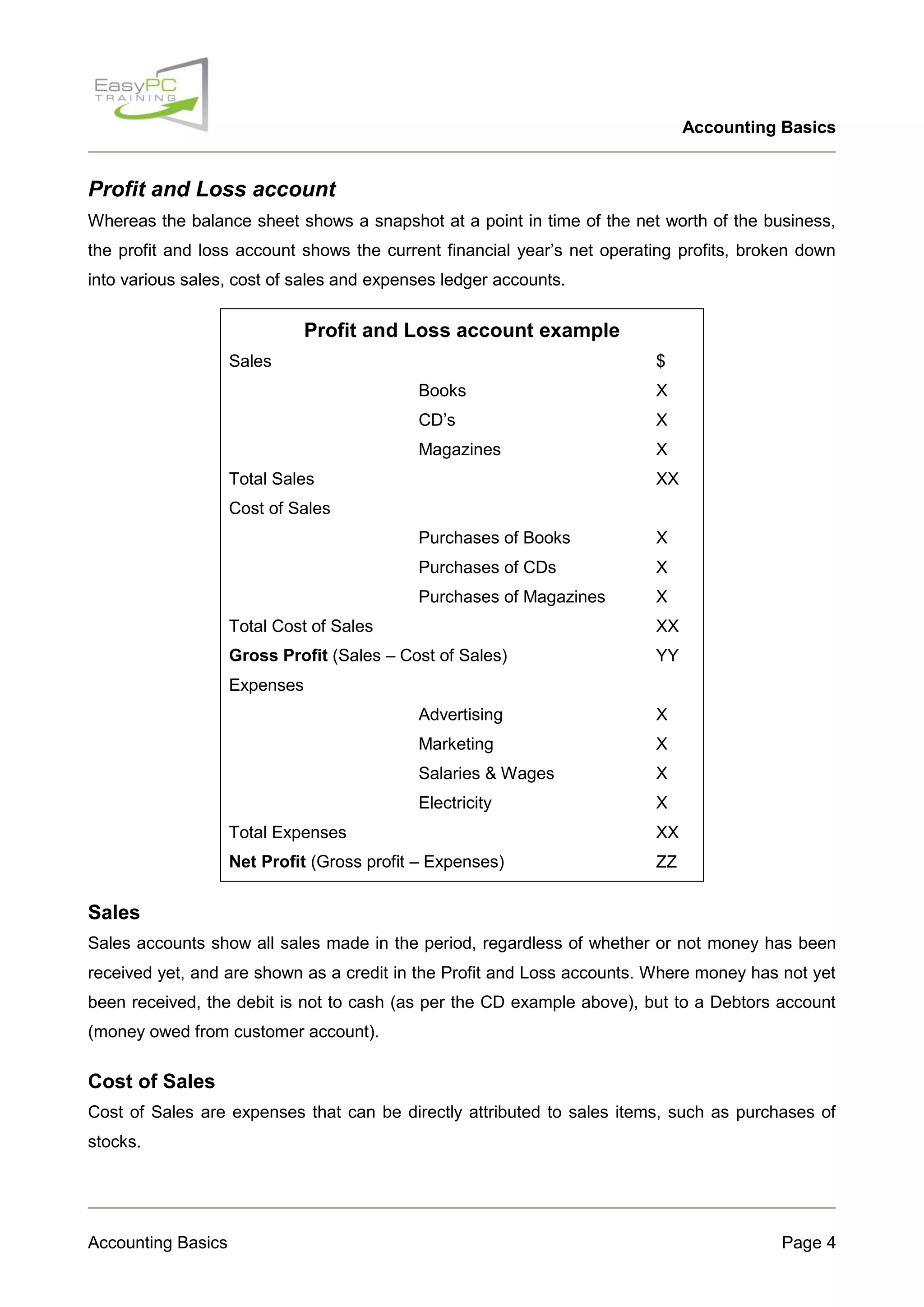
Whereas the balance sheet shows a snapshot at a point in time of the net worth of the business,
the profit and loss account shows the current financial year‟s net operating profits, broken down
into various sales, cost of sales and expenses ledger accounts.

Profit and Loss account example
Sales

$
Books

X

CD‟s

X

Magazines

X

Total Sales

XX

Cost of Sales
Purchases of Books

X

Purchases of CDs

X

Purchases of Magazines

X

Total Cost of Sales

XX

Gross Profit (Sales – Cost of Sales)

YY

Expenses
Advertising

X

Marketing

X

Salaries & Wages

X

Electricity

X

Total Expenses

XX

Net Profit (Gross profit – Expenses)

ZZ

Sales
Sales accounts show all sales made in the period, regardless of whether or not money has been
received yet, and are shown as a credit in the Profit and Loss accounts. Where money has not yet
been received, the debit is not to cash (as per the CD example above), but to a Debtors account
(money owed from customer account).

Cost of Sales
Cost of Sales are expenses that can be directly attributed to sales items, such as purchases of
stocks.

Accounting Basics

Page 4
Accounting Basics

Expenses
These are all other expenses (other than purchases of assets) which cannot be attributed directly
to sales items, such as rent, electricity or advertising.

Accounting Basics

Page 5
Accounting Basics

Double Entry Bookkeeping
All accounting transactions are made up of 2 entries in the accounts: a debit and a credit.
For example, if you purchased a book, your value of books would increase, but your value of cash
would decrease by the same value, at the same time. This is double entry bookkeeping.

Ledger Accounts
A ledger account is an item in either the Profit & Loss account (which we‟ll discuss shortly) or the
balance sheet. A Ledger account is either a:






Asset
Liability
Equity
Income
Expense

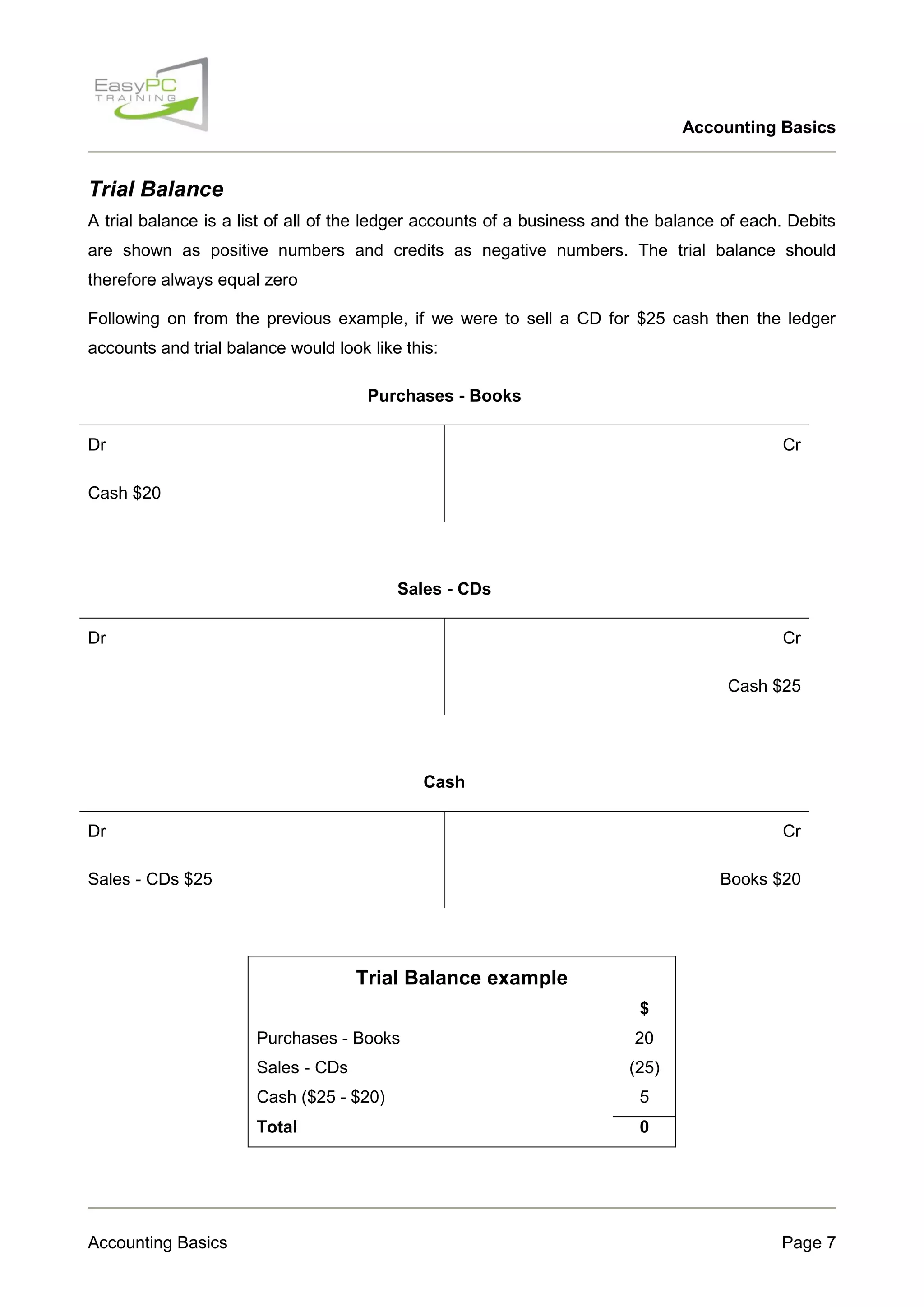
The example of purchasing a book, mentioned above, can be shown in the form of ledger “T”
accounts as follows:
“Dr” is short for Debit

“Cr” is short for Credit

Purchases - Books
Dr

Cr

Cash $20

Cash
Dr

Cr
Books $20

If all transactions are entered into the books in this way, then the sum of all of the debits would
equal the sum of all of the credits.

Accounting Basics

Page 6
Accounting Basics

Trial Balance
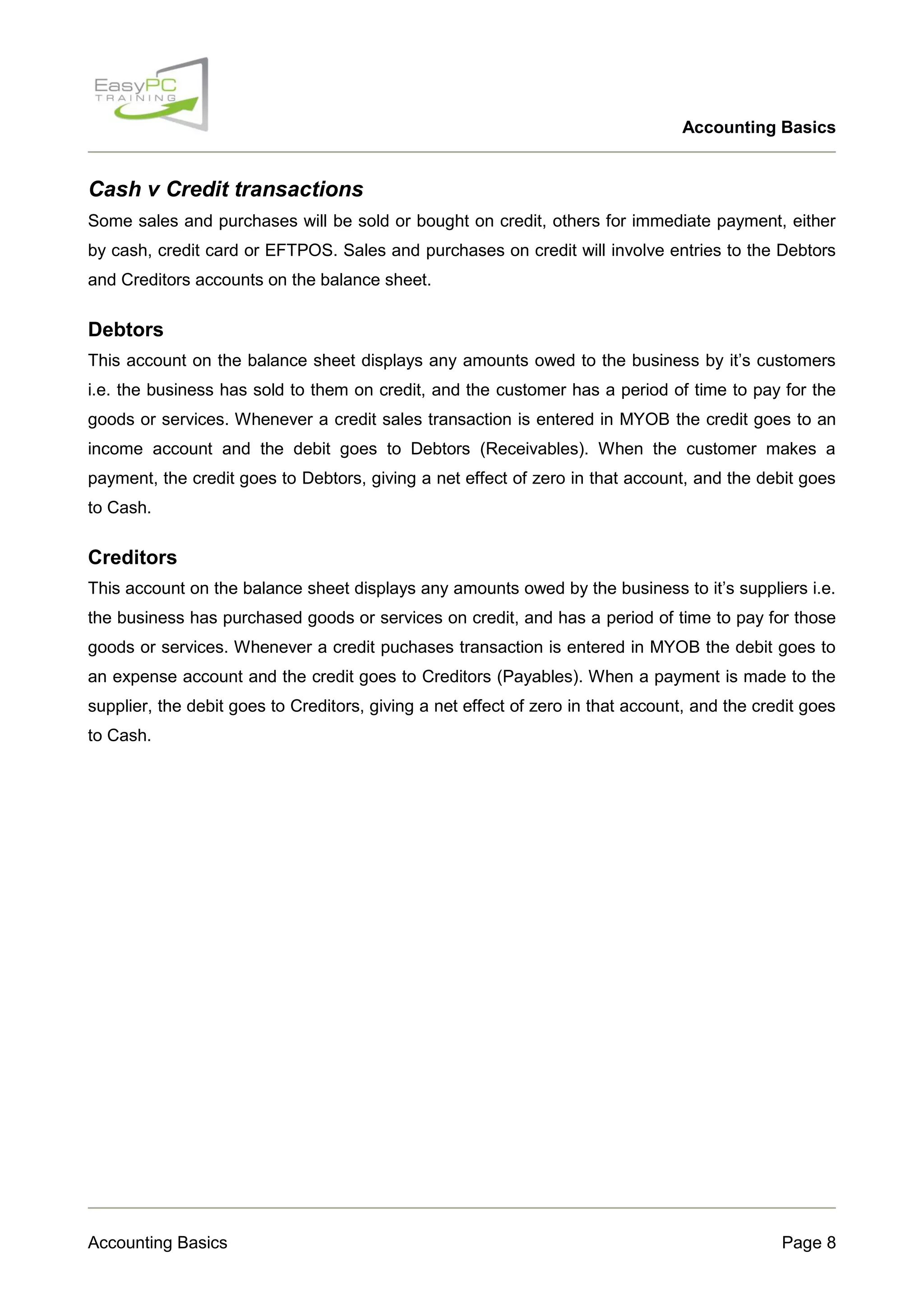
A trial balance is a list of all of the ledger accounts of a business and the balance of each. Debits
are shown as positive numbers and credits as negative numbers. The trial balance should
therefore always equal zero
Following on from the previous example, if we were to sell a CD for $25 cash then the ledger
accounts and trial balance would look like this:
Purchases - Books
Dr

Cr

Cash $20

Sales - CDs
Dr

Cr
Cash $25

Cash
Dr

Cr

Sales - CDs $25

Books $20

Trial Balance example
$
Purchases - Books
Sales - CDs

20
(25)

Cash ($25 - $20)
Total

Accounting Basics

5
0

Page 7
Accounting Basics

Cash v Credit transactions
Some sales and purchases will be sold or bought on credit, others for immediate payment, either
by cash, credit card or EFTPOS. Sales and purchases on credit will involve entries to the Debtors
and Creditors accounts on the balance sheet.

Debtors
This account on the balance sheet displays any amounts owed to the business by it‟s customers
i.e. the business has sold to them on credit, and the customer has a period of time to pay for the
goods or services. Whenever a credit sales transaction is entered in MYOB the credit goes to an
income account and the debit goes to Debtors (Receivables). When the customer makes a
payment, the credit goes to Debtors, giving a net effect of zero in that account, and the debit goes
to Cash.

Creditors
This account on the balance sheet displays any amounts owed by the business to it‟s suppliers i.e.
the business has purchased goods or services on credit, and has a period of time to pay for those
goods or services. Whenever a credit puchases transaction is entered in MYOB the debit goes to
an expense account and the credit goes to Creditors (Payables). When a payment is made to the
supplier, the debit goes to Creditors, giving a net effect of zero in that account, and the credit goes
to Cash.

Accounting Basics

Page 8

Accounting basics2

  • 1.
    Accounting Basics Special Report Accounting Basics EasyPCTraining Unit 4B, 333 Queensport Road Murarrie QLD 4172 Tel: 1300 63 10 40
  • 2.
    Accounting Basics For additionalsupport and information regarding this or any other EasyPC Training course, visit our website at www.easypctraining.com.au or contact us at: Tel: 1300 63 10 40 E-mail: info@easypctraining.com.au Mail to: PO Box 154, Northgate, QLD 4013 Disclaimer Information supplied by EasyPC Training (whether in user documentation and other literature, training courses, websites, advice, or other means) is intended only to illustrate general principles, and may not be complete, accurate or free of error. © Copyright EasyPC Training 2010. All rights reserved. Copyright Notice No part of this publication may be reproduced, utilised, transmitted or distributed in any form by any means – including photocopying, recording, mechanical, electronic or otherwise – by any other party, without written permission from the publisher, EasyPC Training. Copying without authorisation is illegal. Accounting Basics
  • 3.
    Accounting Basics Contents Bookkeeping basics..................................................................................................................... 1 The Accounting Equation ......................................................................................................... 1 Assets ..................................................................................................................................... 1 Liabilities ................................................................................................................................. 1 Owner‟s Equity ........................................................................................................................ 2 The Balance Sheet .................................................................................................................... 3 Balance Sheet example .......................................................................................................... 3 Profit and Loss account ........................................................................................................... 4 Profit and Loss account example ............................................................................................ 4 Sales ....................................................................................................................................... 4 Cost of Sales ........................................................................................................................... 4 Expenses ................................................................................................................................ 5 Double Entry Bookkeeping....................................................................................................... 6 Ledger Accounts ....................................................................................................................... 6 Trial Balance.............................................................................................................................. 7 Trial Balance example ............................................................................................................. 7 Cash v Credit transactions ....................................................................................................... 8 Debtors ................................................................................................................................... 8 Creditors ................................................................................................................................. 8 Accounting Basics
  • 4.
    Accounting Basics Bookkeeping basics TheAccounting Equation All accounting entries in the books of account for an organisation have a relationship based on the „accounting equation‟: Assets = Liabilities + Owner’s equity Assets Assets are tangible and intangible items of value which the business owns. Examples of assets are:        Cash Cars Buildings Machinery Furniture Debtors (money owed from customers) Stock / Inventory Liabilities Liabilities are those items which are owed by the business to bodies outside of the business. Examples of liabilities are:  Loans to banks  Creditors (money owed to suppliers)  Bank overdrafts Accounting Basics Page 1
  • 5.
    Accounting Basics Owner’s Equity Thesimplest way to understand the accounting equation is to understand what makes up „owner‟s equity‟. By rearranging the accounting equation you can see that Owner‟s Equity is made up of Assets and Liabilities. Owner’s Equity = Total Assets less Total Liabilities Owner‟s Equity can also be expressed as: Owner’s Equity = Capital invested by owner + Profits (Losses) to date (also known as ‘Retained Earnings’) Rearranging the equation again, therefore: Total Assets - Total Liabilities = Capital + Retained Earnings Accounting Basics Page 2
  • 6.
    Accounting Basics The BalanceSheet The balance sheet shows a snapshot of the business‟s net worth at a given point in time. Below is a basic balance sheet. Have a look at how it displays the elements of the accounting equation: Balance Sheet example Assets $ Current Assets Stock X Debtors X Bank X Cash X Buildings X Vehicles X Fixed Assets Total Assets XX Liabilities Current Liabilities Overdraft X Creditors X Long-term Liabilities Bank Loan X Total Liabilities XX Total Assets less Total Liabilities ZZ Owner‟s Capital Y Retained Earnings Y Owner‟s Equity ZZ The accounting equation establishes the basis of Double Entry Bookkeeping. Accounting Basics Page 3
  • 7.
    Accounting Basics Profit andLoss account Whereas the balance sheet shows a snapshot at a point in time of the net worth of the business, the profit and loss account shows the current financial year‟s net operating profits, broken down into various sales, cost of sales and expenses ledger accounts. Profit and Loss account example Sales $ Books X CD‟s X Magazines X Total Sales XX Cost of Sales Purchases of Books X Purchases of CDs X Purchases of Magazines X Total Cost of Sales XX Gross Profit (Sales – Cost of Sales) YY Expenses Advertising X Marketing X Salaries & Wages X Electricity X Total Expenses XX Net Profit (Gross profit – Expenses) ZZ Sales Sales accounts show all sales made in the period, regardless of whether or not money has been received yet, and are shown as a credit in the Profit and Loss accounts. Where money has not yet been received, the debit is not to cash (as per the CD example above), but to a Debtors account (money owed from customer account). Cost of Sales Cost of Sales are expenses that can be directly attributed to sales items, such as purchases of stocks. Accounting Basics Page 4
  • 8.
    Accounting Basics Expenses These areall other expenses (other than purchases of assets) which cannot be attributed directly to sales items, such as rent, electricity or advertising. Accounting Basics Page 5
  • 9.
    Accounting Basics Double EntryBookkeeping All accounting transactions are made up of 2 entries in the accounts: a debit and a credit. For example, if you purchased a book, your value of books would increase, but your value of cash would decrease by the same value, at the same time. This is double entry bookkeeping. Ledger Accounts A ledger account is an item in either the Profit & Loss account (which we‟ll discuss shortly) or the balance sheet. A Ledger account is either a:      Asset Liability Equity Income Expense The example of purchasing a book, mentioned above, can be shown in the form of ledger “T” accounts as follows: “Dr” is short for Debit “Cr” is short for Credit Purchases - Books Dr Cr Cash $20 Cash Dr Cr Books $20 If all transactions are entered into the books in this way, then the sum of all of the debits would equal the sum of all of the credits. Accounting Basics Page 6
  • 10.
    Accounting Basics Trial Balance Atrial balance is a list of all of the ledger accounts of a business and the balance of each. Debits are shown as positive numbers and credits as negative numbers. The trial balance should therefore always equal zero Following on from the previous example, if we were to sell a CD for $25 cash then the ledger accounts and trial balance would look like this: Purchases - Books Dr Cr Cash $20 Sales - CDs Dr Cr Cash $25 Cash Dr Cr Sales - CDs $25 Books $20 Trial Balance example $ Purchases - Books Sales - CDs 20 (25) Cash ($25 - $20) Total Accounting Basics 5 0 Page 7
  • 11.
    Accounting Basics Cash vCredit transactions Some sales and purchases will be sold or bought on credit, others for immediate payment, either by cash, credit card or EFTPOS. Sales and purchases on credit will involve entries to the Debtors and Creditors accounts on the balance sheet. Debtors This account on the balance sheet displays any amounts owed to the business by it‟s customers i.e. the business has sold to them on credit, and the customer has a period of time to pay for the goods or services. Whenever a credit sales transaction is entered in MYOB the credit goes to an income account and the debit goes to Debtors (Receivables). When the customer makes a payment, the credit goes to Debtors, giving a net effect of zero in that account, and the debit goes to Cash. Creditors This account on the balance sheet displays any amounts owed by the business to it‟s suppliers i.e. the business has purchased goods or services on credit, and has a period of time to pay for those goods or services. Whenever a credit puchases transaction is entered in MYOB the debit goes to an expense account and the credit goes to Creditors (Payables). When a payment is made to the supplier, the debit goes to Creditors, giving a net effect of zero in that account, and the credit goes to Cash. Accounting Basics Page 8