




John McCarthy Department of Applied Psychology University College Cork Ireland
 
Founded in 1845 "Where Finbarr Taught, Let Munster Learn". 14,500 students 3,000 staff 800 faculty


Department of Applied Psychology began late 1960s ‘ Applied’ Psychology!! 20 staff 150 Psychology students 250 FTE others (nursing, arts, etc.)
areas of interest / activity children at risk aging and wellbeing counselling and therapy forensic psychology people and technology (PAT)
PAT group loose coalition of people with overlapping interests in ‘people and technology’. three lecturers.  about 10 research staff and students.
Research Areas usability (Human Factors Research Group). use of the internet for criminal purposes e.g. paedophilia and terrorism (Copine).  user experience and interaction design.
User Experience and IxD understanding people’s experiences of technology through exploring the socio-cultural contexts of technology use theory and practice of the design of interactive technologies aesthetic interest
some projects experience of technologies in work settings such as hospitals and air traffic control use of ICT to support intimate relationships role of technologies in evoking experiences such as enchantment social networking - communities of artists on the net developing conceptual foundations for experience design
user experience   “ designers … have tried to understand products from the inside -   not physically inside, but inside the experience of human beings that make and use them in situated social and cultural environments. … new understanding through an investigation of what makes a product useful, usable, and desirable"  (Buchanan, 1999). “ Designing for the full range of human experience may well be the theme for the next generation of discourse about software design”  (Winograd, 1996, p. xix).
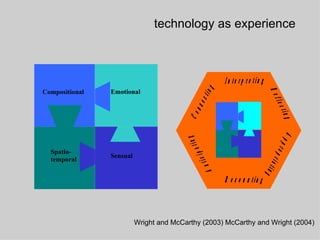
technology as experience Wright and McCarthy (2003) McCarthy and Wright (2004) Connecting Interpreting Reflecting Appropriating Recounting Anticipating
technology as experience A holistic approach to experience wherein the intellectual, sensual and  emotional stand as equal partners Continuous engagement and sense making the self is the centre of experience and brings to a situation a history of meanings and anticipated futures Sense making as a dialogical process in which the meaning of an artefact is not finalised by the designer but actively constructed through experience as multiple centres   of value
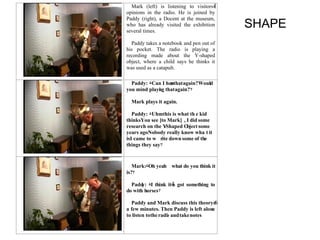
SHAPE
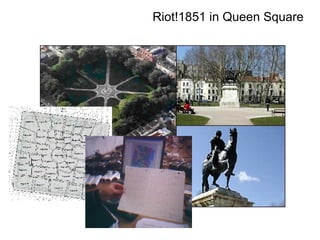
Riot!1851 in Queen Square
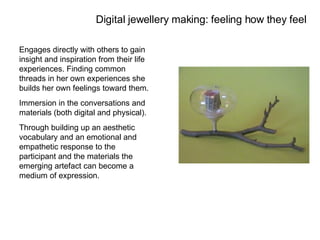
Engages directly with others to gain insight and inspiration from their life experiences. Finding common threads in her own experiences she builds her own feelings toward them. Immersion in the conversations and materials (both digital and physical). Through building up an aesthetic vocabulary and an emotional and empathetic response to the participant and the materials the emerging artefact can become a medium of expression. Digital jewellery making: feeling how they feel
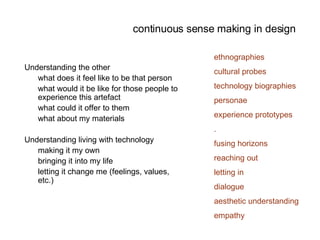
continuous sense making in design Understanding the other  what does it feel like to be that person what would it be like for those people to experience this artefact what could it offer to them what about my materials Understanding living with technology making it my own bringing it into my life letting it change me (feelings, values, etc.) ethnographies cultural probes technology biographies personae experience prototypes . fusing horizons reaching out letting in dialogue aesthetic understanding empathy

Hci Presentation

  • 1.
    John McCarthy Departmentof Applied Psychology University College Cork Ireland
  • 2.
  • 3.
    Founded in 1845"Where Finbarr Taught, Let Munster Learn". 14,500 students 3,000 staff 800 faculty
  • 4.
  • 5.
  • 6.
  • 7.
  • 8.
    Department of AppliedPsychology began late 1960s ‘ Applied’ Psychology!! 20 staff 150 Psychology students 250 FTE others (nursing, arts, etc.)
  • 9.
    areas of interest/ activity children at risk aging and wellbeing counselling and therapy forensic psychology people and technology (PAT)
  • 10.
    PAT group loosecoalition of people with overlapping interests in ‘people and technology’. three lecturers. about 10 research staff and students.
  • 11.
    Research Areas usability(Human Factors Research Group). use of the internet for criminal purposes e.g. paedophilia and terrorism (Copine). user experience and interaction design.
  • 12.
    User Experience andIxD understanding people’s experiences of technology through exploring the socio-cultural contexts of technology use theory and practice of the design of interactive technologies aesthetic interest
  • 13.
    some projects experienceof technologies in work settings such as hospitals and air traffic control use of ICT to support intimate relationships role of technologies in evoking experiences such as enchantment social networking - communities of artists on the net developing conceptual foundations for experience design
  • 14.
    user experience “ designers … have tried to understand products from the inside - not physically inside, but inside the experience of human beings that make and use them in situated social and cultural environments. … new understanding through an investigation of what makes a product useful, usable, and desirable" (Buchanan, 1999). “ Designing for the full range of human experience may well be the theme for the next generation of discourse about software design” (Winograd, 1996, p. xix).
  • 15.
    technology as experienceWright and McCarthy (2003) McCarthy and Wright (2004) Connecting Interpreting Reflecting Appropriating Recounting Anticipating
  • 16.
    technology as experienceA holistic approach to experience wherein the intellectual, sensual and emotional stand as equal partners Continuous engagement and sense making the self is the centre of experience and brings to a situation a history of meanings and anticipated futures Sense making as a dialogical process in which the meaning of an artefact is not finalised by the designer but actively constructed through experience as multiple centres of value
  • 17.
  • 18.
  • 19.
    Engages directly withothers to gain insight and inspiration from their life experiences. Finding common threads in her own experiences she builds her own feelings toward them. Immersion in the conversations and materials (both digital and physical). Through building up an aesthetic vocabulary and an emotional and empathetic response to the participant and the materials the emerging artefact can become a medium of expression. Digital jewellery making: feeling how they feel
  • 20.
    continuous sense makingin design Understanding the other what does it feel like to be that person what would it be like for those people to experience this artefact what could it offer to them what about my materials Understanding living with technology making it my own bringing it into my life letting it change me (feelings, values, etc.) ethnographies cultural probes technology biographies personae experience prototypes . fusing horizons reaching out letting in dialogue aesthetic understanding empathy