Presentation topic:
Inclusive & Health Education
PRESENTED BY:
Shahid Nawaz
Education Officer
Inclusive & Health Education
When every child is welcomed
and valued regardless of ability or
disability.
Inclusive Education is an attitude
 It means the doors to schools,
classrooms and school activities are
open to every child and they are
afforded every opportunity to be
included with their non-disabled peers.
 The focus is on giving every child the
help s/he needs to learn.
Inclusive education is NOT:
 Dumping kids with disabilities into general
classrooms without the supports and services they
need to be successful.
 Cutting back special education services as a
“trade off” for being in the general education
classroom.
 Sacrificing the education of kids without disabilities
so kids with disabilities can be included.
Special Education. . .
is NOT a place
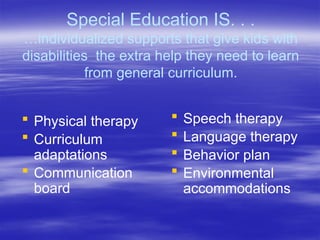
Special Education IS. . .
…individualized supports that give kids with
disabilities the extra help they need to learn
from general curriculum.
 Physical therapy
 Curriculum
adaptations
 Communication
board
 Speech therapy
 Language therapy
 Behavior plan
 Environmental
accommodations
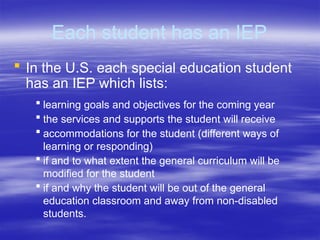
Each student has an IEP
 In the U.S. each special education student
has an IEP which lists:
 learning goals and objectives for the coming year
 the services and supports the student will receive
 accommodations for the student (different ways of
learning or responding)
 if and to what extent the general curriculum will be
modified for the student
 if and why the student will be out of the general
education classroom and away from non-disabled
students.
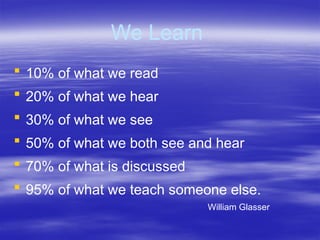
We Learn
 10% of what we read
 20% of what we hear
 30% of what we see
 50% of what we both see and hear
 70% of what is discussed
 95% of what we teach someone else.
William Glasser
Students can’t learn general
curriculum unless they are in the
room where it is being taught.
General Curriculum
IEPs must have:
“ A statement of measurable annual goals,
including benchmarks or short-term
objectives, related to meeting the child’s
needs that result from the child’s disability to
enable the child to be involved in and
progress in the general curriculum (i.e., the
same curriculum as for non-disabled
children), or for preschool children, as
appropriate, to participate in appropriate
activities.”
Individuals with Disabilities Education Improvement
Act, 20U.S.C.1414(d)(1)(A) and (d)(6)
Tied to General Curriculum
 There must be a connection between the general
curriculum objectives and this student’s IEP goals
and objectives.
 The Team must decide what the student will learn
about each subject the class is studying.
 The Team must decide which and how many
general curriculum objectives are to be taught.
 The Team must make general curriculum
objectives functional and meaningful for this
student.
What is the class learning?
 How do the IEP goals fit into the
general curriculum?
 Goals may be different but need to
be related (like learning to
recognize a triangle when others
are learning the angles in a triangle)
 The student may need to be taught
in a different way (like doing hands
on activities instead of listening to a
lecture)
 The student may need to work in a
different way (like using a computer
instead of pencil and paper)
It’s not about the place!!!
 All students must have access to general
curriculum.
 This is true no matter what class they are in.
 Even students in the most segregated
classes MUST have access to the general
curriculum for their age and grade.
Least restrictive environment (LRE)
Describes where a child will get services
It should put the fewest possible restrictions on
how much time is spent with kids without
disabilities.
What the law says about LRE
Each public agency shall ensure
that to the maximum extent
appropriate, children with
disabilities…are educated with
children who are non-disabled
and that special classes,
separate schooling or other
removal of children with
disabilities from the regular
educational environment occurs
only if the nature or severity of
the disability is such that
education in the regular classes
with the use of supplementary
aids and services cannot be
achieved satisfactorily.
LRE
 Starts with the assumption the student will
be in the general classroom, with supports
as needed.
 If that won’t work full time, pull the child out
of the general classroom for part of the day
for therapies or resources. This should be
done as seldom as possible.
 Only if all other options fail should the child
be separated from the general classroom.
Ideas for disability awareness
 Deafness - have students watch their favorite TV show with the volume
off.
 Teach students some sign language or Braille.
 Not able to understand - give students a paragraph in German and
then test them on it.
 Not able to communicate – give students a puzzle to do together but
don’t allow them to talk.
 Have students use a wheelchair or crutches for a day.
 Have students communicate using only body language or gestures.
 Dyslexia – give students a paragraph to read with the letters switched
around.
 Sensitivity to noise – have students take a test while there is a lot of
unexpected noise in the background.
Accommodation or Modification?
 Accommodations are used when
the student is expected to learn the
same curricular content. But the
student may be taught in a different
way or need changes in the
environment.
 Modification are used when the
student is expected to learn less or
different curricular content. This
could require the modification of
assignments, tests, worksheets and
other materials in the classroom.
What are accommodations?
Accommodations are
changes in teaching
methods. It can
include changes in:
– where you teach,
– who teaches
– how you teach
– how the student can
respond
– materials you use.
Know the Curriculum!
 You have to know what
you are trying to teach
(curriculum) before you
can change how you
teach it.
 If you make the wrong
changes, you can end
up teaching a different
concept than the one
you wanted the
student to learn.
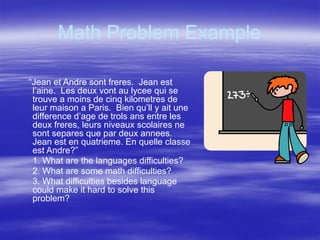
Math Problem Example
“Jean et Andre sont freres. Jean est
l’aine. Les deux vont au lycee qui se
trouve a moins de cinq kilometres de
leur maison a Paris. Bien qu’ll y ait une
difference d’age de trols ans entre les
deux freres, leurs niveaux scolaires ne
sont separes que par deux annees.
Jean est en quatrieme. En quelle classe
est Andre?”
1. What are the languages difficulties?
2. What are some math difficulties?
3. What difficulties besides language
could make it hard to solve this
problem?
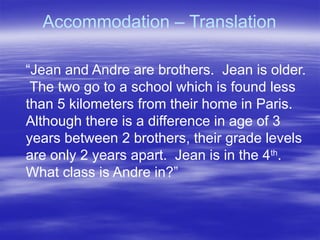
Accommodation – Translation
“Jean and Andre are brothers. Jean is older.
The two go to a school which is found less
than 5 kilometers from their home in Paris.
Although there is a difference in age of 3
years between 2 brothers, their grade levels
are only 2 years apart. Jean is in the 4th
.
What class is Andre in?”
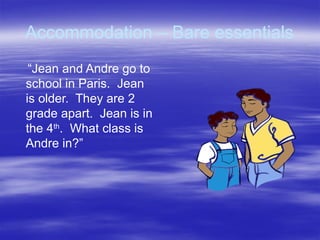
Accommodation – Bare essentials
“Jean and Andre go to
school in Paris. Jean
is older. They are 2
grade apart. Jean is in
the 4th
. What class is
Andre in?”
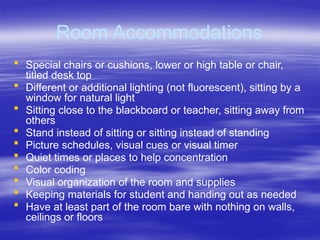
Room Accommodations
 Special chairs or cushions, lower or high table or chair,
titled desk top
 Different or additional lighting (not fluorescent), sitting by a
window for natural light
 Sitting close to the blackboard or teacher, sitting away from
others
 Stand instead of sitting or sitting instead of standing
 Picture schedules, visual cues or visual timer
 Quiet times or places to help concentration
 Color coding
 Visual organization of the room and supplies
 Keeping materials for student and handing out as needed
 Have at least part of the room bare with nothing on walls,
ceilings or floors
Teacher Accommodations
 Don’t wear cologne (hard on allergies)
 Don’t wear a lot of jewelry (distracts kids with
ADHD)
 Count to 10 before letting anyone answer
questions (processing time)
 Vary teaching methods
 Projects for extra credit or in place of timed tests
 Giving instructions one step at a time instead of
all at once
 Ask questions to get repeat of information
 Divide the class (small groups, peer partners,
peer tutors)
 Set up lessons (community instruction, role
playing activities)
 Change the learning goals (more time, cooperate,
share)
 Create alternative activity (learning center,
research teams)
Individual Accommodations
 Fewer problems on a page, large print or dark print
 Read things to students and give verbal tests
 Use a tape recorder (taking notes and giving reports)
 Sensory breaks
 Communication device or sign language
 Use a touch screen, voice activated computer, switch controls or
adapted keyboard, mouse, calculator
 Peer tutoring or peer taking notes
 Small group work instead or individual assignments
 Assistance with organizing
 More time to transition to next activity
 Change the materials (counting actual objects, tape recorder)
 Change how much or what kind of personal assistance a student gets
(prompts, verbal cues, gestures, physical assistance)
Modifying Grades
 Use a grading system to show the
combination of what they learned
and how hard they tried.
 Give extra credit for consistent
effort and completing assignments.
 Give extra points for positive
behaviors or extra assignments.
 Base assignments and grades on
meeting IEP goals
 Reduce the amount of writing by
using T/F, multiple choice or fill in
the blanks, or oral tests
 Give child less to learn at a time
 Allow students to take classes as
pass/fail
If adaptations aren’t enough
 Schools often add an adult educational assistant
to work with the student 1-to-1
 Or they may take a student out of class (called pull
out ) for pre-teaching, skill building or one-on-one
instruction.
 Use of education assistants and pull out
instruction should be carefully planned. Is it too
much isolation from other students? Does it make
the student miss too much class time?
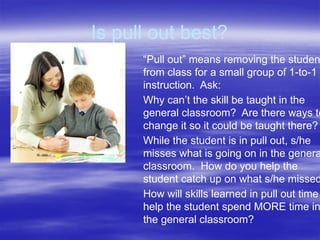
Is pull out best?
“Pull out” means removing the studen
from class for a small group of 1-to-1
instruction. Ask:
Why can’t the skill be taught in the
general classroom? Are there ways to
change it so it could be taught there?
While the student is in pull out, s/he
misses what is going on in the genera
classroom. How do you help the
student catch up on what s/he missed
How will skills learned in pull out time
help the student spend MORE time in
the general classroom?
Me and My Shadow
 Is having an adult with him/her all day
making the students MORE dependent?
 Does the educational assistant take
away the student’s need to
communicate and make choices?
 Does having an educational assistant
there make peers less likely to interact
with the student? Is the student ever
alone with peers?
 Is the student at least arm’s length away
from the educational assistant when
possible?
 Would the student be better off having
help from several different people rather
than always the same assistant?
 Don’t glue an adult to the student every
minute.
Accommodations work!
Before
 Refused to do work
 Behavior outburst
 Unable to stay seated
 Yelled and hit other kids
 No friends
 Refused many class activities
After
 Does class work; learned difficult terms like life span,
germinate and organism
 Almost no behavior problems
 Sits appropriately
 Loads of friends
 Participates in all class activities
HEALTH EDUCATION
Definition:
“Health education is the process
by which individuals and group
of people learn to “:
 Promote
 Maintain
 Restore health.
“Education for health begins with
people as they are, with
whatever interests they may
have in improving their living
conditions”.
Health education or Health Promotion?
 Health education is defined as:
“Any combination of learning experiences designed to facilitate
voluntary adaptation of behavior conducive to health”.
This definition imply:
- All possible channels of influence on health are appropriately combined and
designed to support adaptation of behavior.
- The word “voluntary” is significant for ethical reasons.
(Educators should not force people to do what they don’t want to do )
i.e. All efforts should be done to help people make decisions and have their own
choices.
- The word “designed” refers to planned, integral, intended activities rather
than casual, incident, trivial experiences.
Health education or Health Promotion?
 With rising criticism that traditional H.E. was too narrow,
focused on individual’s lifestyle and could become “victim
blaming”, more work was done about wider issues eg.
social policy, environmental safety measures
( EMERGENCE of HEALTH PROMOTION )
Health Promotion:
“ Is any combination of educational, organizational, economic and
environmental support for behaviors and conditions of living
conducive to health .”
Health Promotion is a widely used term to encompass various
activities eg. :
 Behavior & lifestyle,
 Preventive health services,
 Health protection directed at environment,
 Health related public policy,
 Economic & regulatory measures.
(Health Education is the primary and dominant measure in Health
Promotion ).
AIMS OF HEALTH EDUCATION:
1. To develop a sense of responsibility for health conditions,
as individuals, as members of families & communities.
(Promotion ,prevention of disease & early diagnosis
and management ).
2. To promote and wisely use the available health services.
3. To be part of all education, and to continue throughout
whole span of life.
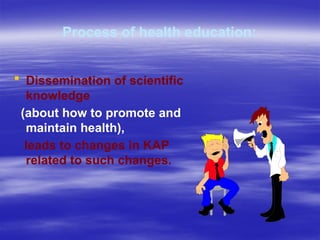
Process of health education:
 Dissemination of scientific
knowledge
(about how to promote and
maintain health),
leads to changes in KAP
related to such changes.
Steps for adopting new ideas & practices :
 AWARENESS (Know about new ideas)
 INTEREST (Seeks more details )
 EVALUATION
(Advantages versus disadvant.+ testing usefulness )
 TRIAL (Decision put into practice)
 ADOPTION (person feels new idea is good
and adopts it)
CONTENTS OF HEALTH EDUCATION:
 Nutrition
 Health habits
 Personal hygiene
 Safety rules
 Basic (K) of disease & preventive
measures
 Mental health
 Proper use of health services
 Sex education
 Special education for groups( fd handlers,
occupations, mothers, school health
etc. )
 Principles of healthy life style e.g. sleep,
exercise
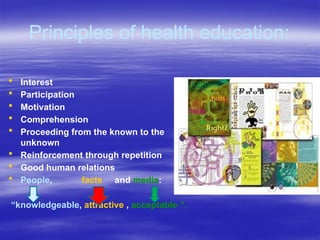
Principles of health education:
 Interest
 Participation
 Motivation
 Comprehension
 Proceeding from the known to the
unknown
 Reinforcement through repetition
 Good human relations
 People, facts and media:
“knowledgeable, attractive , acceptable “.
Principles of health education:
 Learning by doing:
“ If I hear, I forget
If I see, I remember
If I do, I know”.
 Motivation,
i.e. awakening the desire to know and learn:
- Primary motives, e.g. inborn desires , hunger, sex.
- Secondary motives,
i.e. desires created by incentives such as praise, love, recognition,
competition.
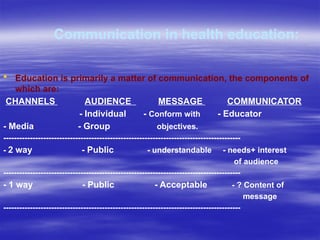
Communication in health education:
 Education is primarily a matter of communication, the components of
which are:
CHANNELS AUDIENCE MESSAGE COMMUNICATOR
- Individual - Conform with - Educator
- Media - Group objectives.
-----------------------------------------------------------------------------------------
- 2 way - Public - understandable - needs+ interest
of audience
-----------------------------------------------------------------------------------------
- 1 way - Public - Acceptable - ? Content of
message
-----------------------------------------------------------------------------------------
Evaluation of health education programs:
There should be continuous
evaluation.
 Evaluation should not be left
to the end but should be
done from time to time for
purpose of making
modifications to achieve
better results.
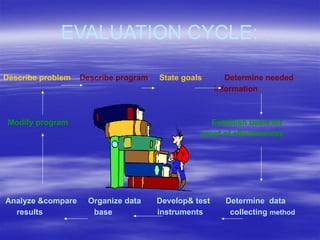
EVALUATION CYCLE:
Describe problem Describe program State goals Determine needed
information
Modify program Establish basis for
proof of effectiveness
Analyze &compare Organize data Develop& test Determine data
results base instruments collecting method
Thank You… so
much
For your
attention..!!

Inclusive Education&healtheducation.pptx

  • 2.
    Presentation topic: Inclusive &Health Education PRESENTED BY: Shahid Nawaz Education Officer
  • 3.
    Inclusive & HealthEducation When every child is welcomed and valued regardless of ability or disability.
  • 4.
    Inclusive Education isan attitude  It means the doors to schools, classrooms and school activities are open to every child and they are afforded every opportunity to be included with their non-disabled peers.  The focus is on giving every child the help s/he needs to learn.
  • 5.
    Inclusive education isNOT:  Dumping kids with disabilities into general classrooms without the supports and services they need to be successful.  Cutting back special education services as a “trade off” for being in the general education classroom.  Sacrificing the education of kids without disabilities so kids with disabilities can be included.
  • 6.
    Special Education. .. is NOT a place
  • 7.
    Special Education IS.. . …individualized supports that give kids with disabilities the extra help they need to learn from general curriculum.  Physical therapy  Curriculum adaptations  Communication board  Speech therapy  Language therapy  Behavior plan  Environmental accommodations
  • 8.
    Each student hasan IEP  In the U.S. each special education student has an IEP which lists:  learning goals and objectives for the coming year  the services and supports the student will receive  accommodations for the student (different ways of learning or responding)  if and to what extent the general curriculum will be modified for the student  if and why the student will be out of the general education classroom and away from non-disabled students.
  • 9.
    We Learn  10%of what we read  20% of what we hear  30% of what we see  50% of what we both see and hear  70% of what is discussed  95% of what we teach someone else. William Glasser
  • 10.
    Students can’t learngeneral curriculum unless they are in the room where it is being taught.
  • 11.
    General Curriculum IEPs musthave: “ A statement of measurable annual goals, including benchmarks or short-term objectives, related to meeting the child’s needs that result from the child’s disability to enable the child to be involved in and progress in the general curriculum (i.e., the same curriculum as for non-disabled children), or for preschool children, as appropriate, to participate in appropriate activities.” Individuals with Disabilities Education Improvement Act, 20U.S.C.1414(d)(1)(A) and (d)(6)
  • 12.
    Tied to GeneralCurriculum  There must be a connection between the general curriculum objectives and this student’s IEP goals and objectives.  The Team must decide what the student will learn about each subject the class is studying.  The Team must decide which and how many general curriculum objectives are to be taught.  The Team must make general curriculum objectives functional and meaningful for this student.
  • 13.
    What is theclass learning?  How do the IEP goals fit into the general curriculum?  Goals may be different but need to be related (like learning to recognize a triangle when others are learning the angles in a triangle)  The student may need to be taught in a different way (like doing hands on activities instead of listening to a lecture)  The student may need to work in a different way (like using a computer instead of pencil and paper)
  • 14.
    It’s not aboutthe place!!!  All students must have access to general curriculum.  This is true no matter what class they are in.  Even students in the most segregated classes MUST have access to the general curriculum for their age and grade.
  • 15.
    Least restrictive environment(LRE) Describes where a child will get services It should put the fewest possible restrictions on how much time is spent with kids without disabilities.
  • 16.
    What the lawsays about LRE Each public agency shall ensure that to the maximum extent appropriate, children with disabilities…are educated with children who are non-disabled and that special classes, separate schooling or other removal of children with disabilities from the regular educational environment occurs only if the nature or severity of the disability is such that education in the regular classes with the use of supplementary aids and services cannot be achieved satisfactorily.
  • 17.
    LRE  Starts withthe assumption the student will be in the general classroom, with supports as needed.  If that won’t work full time, pull the child out of the general classroom for part of the day for therapies or resources. This should be done as seldom as possible.  Only if all other options fail should the child be separated from the general classroom.
  • 18.
    Ideas for disabilityawareness  Deafness - have students watch their favorite TV show with the volume off.  Teach students some sign language or Braille.  Not able to understand - give students a paragraph in German and then test them on it.  Not able to communicate – give students a puzzle to do together but don’t allow them to talk.  Have students use a wheelchair or crutches for a day.  Have students communicate using only body language or gestures.  Dyslexia – give students a paragraph to read with the letters switched around.  Sensitivity to noise – have students take a test while there is a lot of unexpected noise in the background.
  • 19.
    Accommodation or Modification? Accommodations are used when the student is expected to learn the same curricular content. But the student may be taught in a different way or need changes in the environment.  Modification are used when the student is expected to learn less or different curricular content. This could require the modification of assignments, tests, worksheets and other materials in the classroom.
  • 20.
    What are accommodations? Accommodationsare changes in teaching methods. It can include changes in: – where you teach, – who teaches – how you teach – how the student can respond – materials you use.
  • 21.
    Know the Curriculum! You have to know what you are trying to teach (curriculum) before you can change how you teach it.  If you make the wrong changes, you can end up teaching a different concept than the one you wanted the student to learn.
  • 22.
    Math Problem Example “Jeanet Andre sont freres. Jean est l’aine. Les deux vont au lycee qui se trouve a moins de cinq kilometres de leur maison a Paris. Bien qu’ll y ait une difference d’age de trols ans entre les deux freres, leurs niveaux scolaires ne sont separes que par deux annees. Jean est en quatrieme. En quelle classe est Andre?” 1. What are the languages difficulties? 2. What are some math difficulties? 3. What difficulties besides language could make it hard to solve this problem?
  • 23.
    Accommodation – Translation “Jeanand Andre are brothers. Jean is older. The two go to a school which is found less than 5 kilometers from their home in Paris. Although there is a difference in age of 3 years between 2 brothers, their grade levels are only 2 years apart. Jean is in the 4th . What class is Andre in?”
  • 24.
    Accommodation – Bareessentials “Jean and Andre go to school in Paris. Jean is older. They are 2 grade apart. Jean is in the 4th . What class is Andre in?”
  • 25.
    Room Accommodations  Specialchairs or cushions, lower or high table or chair, titled desk top  Different or additional lighting (not fluorescent), sitting by a window for natural light  Sitting close to the blackboard or teacher, sitting away from others  Stand instead of sitting or sitting instead of standing  Picture schedules, visual cues or visual timer  Quiet times or places to help concentration  Color coding  Visual organization of the room and supplies  Keeping materials for student and handing out as needed  Have at least part of the room bare with nothing on walls, ceilings or floors
  • 26.
    Teacher Accommodations  Don’twear cologne (hard on allergies)  Don’t wear a lot of jewelry (distracts kids with ADHD)  Count to 10 before letting anyone answer questions (processing time)  Vary teaching methods  Projects for extra credit or in place of timed tests  Giving instructions one step at a time instead of all at once  Ask questions to get repeat of information  Divide the class (small groups, peer partners, peer tutors)  Set up lessons (community instruction, role playing activities)  Change the learning goals (more time, cooperate, share)  Create alternative activity (learning center, research teams)
  • 27.
    Individual Accommodations  Fewerproblems on a page, large print or dark print  Read things to students and give verbal tests  Use a tape recorder (taking notes and giving reports)  Sensory breaks  Communication device or sign language  Use a touch screen, voice activated computer, switch controls or adapted keyboard, mouse, calculator  Peer tutoring or peer taking notes  Small group work instead or individual assignments  Assistance with organizing  More time to transition to next activity  Change the materials (counting actual objects, tape recorder)  Change how much or what kind of personal assistance a student gets (prompts, verbal cues, gestures, physical assistance)
  • 28.
    Modifying Grades  Usea grading system to show the combination of what they learned and how hard they tried.  Give extra credit for consistent effort and completing assignments.  Give extra points for positive behaviors or extra assignments.  Base assignments and grades on meeting IEP goals  Reduce the amount of writing by using T/F, multiple choice or fill in the blanks, or oral tests  Give child less to learn at a time  Allow students to take classes as pass/fail
  • 29.
    If adaptations aren’tenough  Schools often add an adult educational assistant to work with the student 1-to-1  Or they may take a student out of class (called pull out ) for pre-teaching, skill building or one-on-one instruction.  Use of education assistants and pull out instruction should be carefully planned. Is it too much isolation from other students? Does it make the student miss too much class time?
  • 30.
    Is pull outbest? “Pull out” means removing the studen from class for a small group of 1-to-1 instruction. Ask: Why can’t the skill be taught in the general classroom? Are there ways to change it so it could be taught there? While the student is in pull out, s/he misses what is going on in the genera classroom. How do you help the student catch up on what s/he missed How will skills learned in pull out time help the student spend MORE time in the general classroom?
  • 31.
    Me and MyShadow  Is having an adult with him/her all day making the students MORE dependent?  Does the educational assistant take away the student’s need to communicate and make choices?  Does having an educational assistant there make peers less likely to interact with the student? Is the student ever alone with peers?  Is the student at least arm’s length away from the educational assistant when possible?  Would the student be better off having help from several different people rather than always the same assistant?  Don’t glue an adult to the student every minute.
  • 32.
    Accommodations work! Before  Refusedto do work  Behavior outburst  Unable to stay seated  Yelled and hit other kids  No friends  Refused many class activities After  Does class work; learned difficult terms like life span, germinate and organism  Almost no behavior problems  Sits appropriately  Loads of friends  Participates in all class activities
  • 33.
  • 34.
    Definition: “Health education isthe process by which individuals and group of people learn to “:  Promote  Maintain  Restore health. “Education for health begins with people as they are, with whatever interests they may have in improving their living conditions”.
  • 35.
    Health education orHealth Promotion?  Health education is defined as: “Any combination of learning experiences designed to facilitate voluntary adaptation of behavior conducive to health”. This definition imply: - All possible channels of influence on health are appropriately combined and designed to support adaptation of behavior. - The word “voluntary” is significant for ethical reasons. (Educators should not force people to do what they don’t want to do ) i.e. All efforts should be done to help people make decisions and have their own choices. - The word “designed” refers to planned, integral, intended activities rather than casual, incident, trivial experiences.
  • 36.
    Health education orHealth Promotion?  With rising criticism that traditional H.E. was too narrow, focused on individual’s lifestyle and could become “victim blaming”, more work was done about wider issues eg. social policy, environmental safety measures ( EMERGENCE of HEALTH PROMOTION )
  • 37.
    Health Promotion: “ Isany combination of educational, organizational, economic and environmental support for behaviors and conditions of living conducive to health .” Health Promotion is a widely used term to encompass various activities eg. :  Behavior & lifestyle,  Preventive health services,  Health protection directed at environment,  Health related public policy,  Economic & regulatory measures. (Health Education is the primary and dominant measure in Health Promotion ).
  • 38.
    AIMS OF HEALTHEDUCATION: 1. To develop a sense of responsibility for health conditions, as individuals, as members of families & communities. (Promotion ,prevention of disease & early diagnosis and management ). 2. To promote and wisely use the available health services. 3. To be part of all education, and to continue throughout whole span of life.
  • 39.
    Process of healtheducation:  Dissemination of scientific knowledge (about how to promote and maintain health), leads to changes in KAP related to such changes.
  • 40.
    Steps for adoptingnew ideas & practices :  AWARENESS (Know about new ideas)  INTEREST (Seeks more details )  EVALUATION (Advantages versus disadvant.+ testing usefulness )  TRIAL (Decision put into practice)  ADOPTION (person feels new idea is good and adopts it)
  • 41.
    CONTENTS OF HEALTHEDUCATION:  Nutrition  Health habits  Personal hygiene  Safety rules  Basic (K) of disease & preventive measures  Mental health  Proper use of health services  Sex education  Special education for groups( fd handlers, occupations, mothers, school health etc. )  Principles of healthy life style e.g. sleep, exercise
  • 42.
    Principles of healtheducation:  Interest  Participation  Motivation  Comprehension  Proceeding from the known to the unknown  Reinforcement through repetition  Good human relations  People, facts and media: “knowledgeable, attractive , acceptable “.
  • 43.
    Principles of healtheducation:  Learning by doing: “ If I hear, I forget If I see, I remember If I do, I know”.  Motivation, i.e. awakening the desire to know and learn: - Primary motives, e.g. inborn desires , hunger, sex. - Secondary motives, i.e. desires created by incentives such as praise, love, recognition, competition.
  • 44.
    Communication in healtheducation:  Education is primarily a matter of communication, the components of which are: CHANNELS AUDIENCE MESSAGE COMMUNICATOR - Individual - Conform with - Educator - Media - Group objectives. ----------------------------------------------------------------------------------------- - 2 way - Public - understandable - needs+ interest of audience ----------------------------------------------------------------------------------------- - 1 way - Public - Acceptable - ? Content of message -----------------------------------------------------------------------------------------
  • 45.
    Evaluation of healtheducation programs: There should be continuous evaluation.  Evaluation should not be left to the end but should be done from time to time for purpose of making modifications to achieve better results.
  • 46.
    EVALUATION CYCLE: Describe problemDescribe program State goals Determine needed information Modify program Establish basis for proof of effectiveness Analyze &compare Organize data Develop& test Determine data results base instruments collecting method

  • 48.
    Thank You… so much Foryour attention..!!