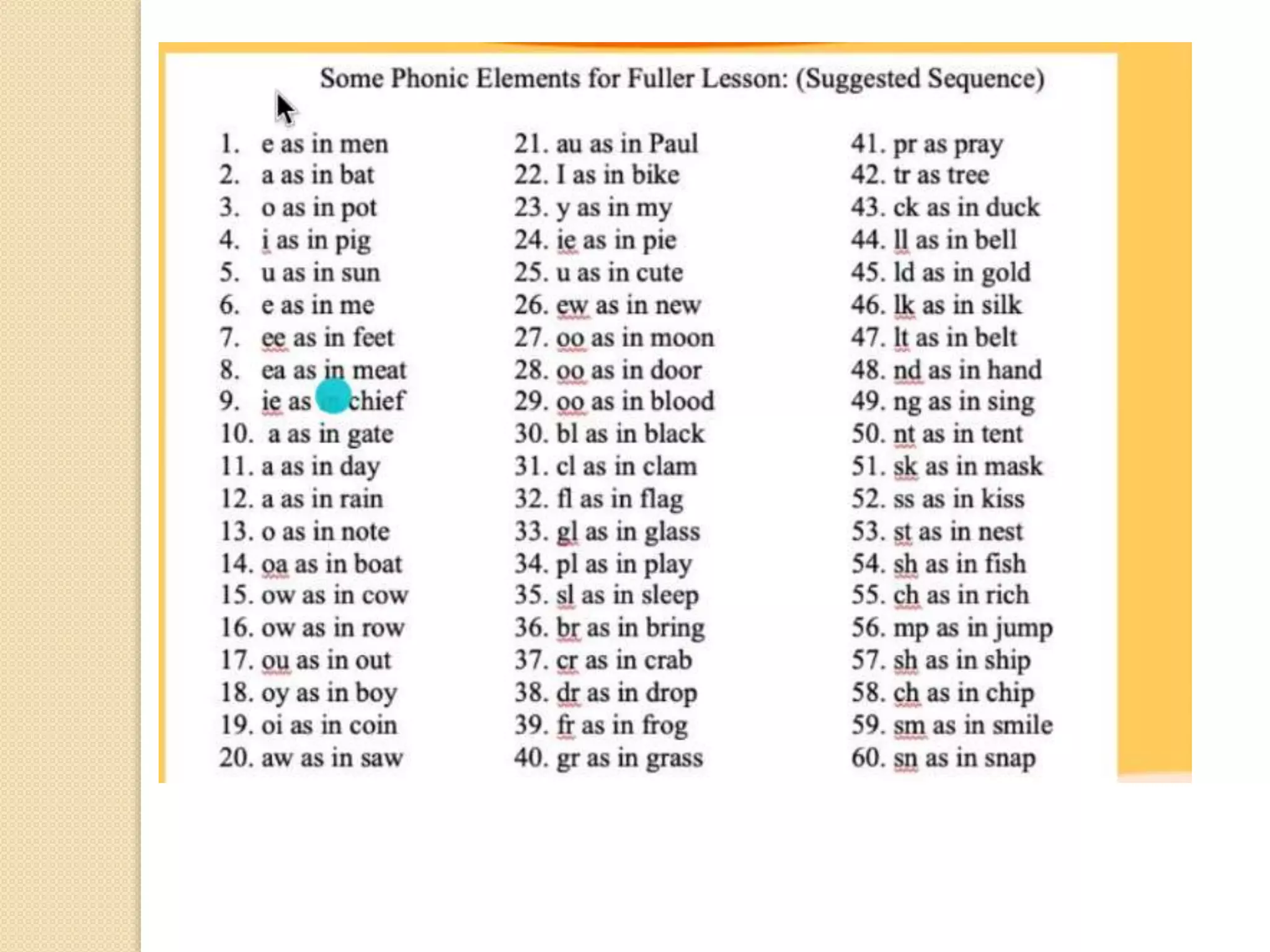
Fuller and Fuller Approach
The Fuller is a combination of the
alphabet, phonics, and whole methods
of teaching word recognition.
What is Fuller Approach?
Pre-Requisites Before Teaching
the Fuller Technique
Before using the Fuller Technique, the
child must show the following skills:
1) The child has mastery of the name
and form of each alphabet. The child
can identify which letters are vowels
and which letters are consonants.
2) The child has mastery of the regular
sounds of the consonants.
How to Use the Fuller
Lessons?
1. Teach the name and form of each
letter in English alphabet. It is not
necessary for the learners to know
which are the vowels and which are
consonants.
2. Teach the regular sounds of the
consonants.
The following sequence is recommended in
teaching the consonant sounds.
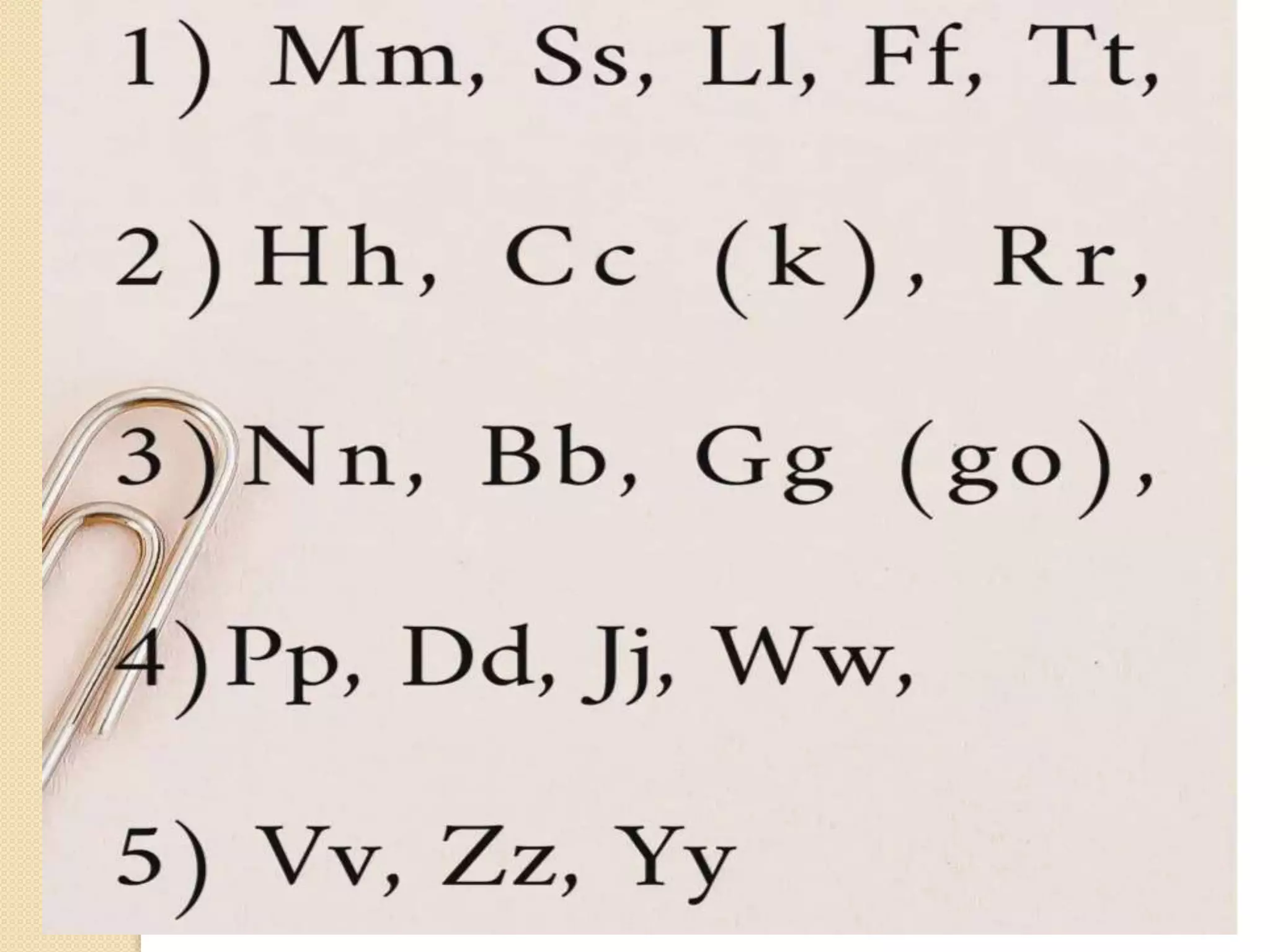
The first letter that we teach is letter Mm
followed by Ss, Ll, Ff, Tt and so on. When introduce a
letter, we show first words that begin with the target
letter. And then, we sound out the target letter. Next is
that we show how the target letter is formed. We
demonstrate how to write the target letter in different
multi-sensory ways. Last is we give exercises to
reinforce the target letter.
Here are some things we need to remember:
Consonants C and G have two sounds, only the hard
sound of these consonants are introduced to the
beginning reader (e.g c as in cat, g as in gate).
Consonants X, K, Q are not in the above list. X is a
final sound in all beginning reading words (e.g mix,
fix, six, ax); the sound of x is taught when these
words are introduced.
A Sample Target Lesson
Letter Mm
Step 1:
First important important step is
vocabulary development. Show names
that start with the letter Mm e.g man,
mug, mat, mom, etc.
Name what is in the picture!
Step 2:
 Introduce the letter sound. Our target
letter is Mm.
 Sound it out! The sound of letter Mm
is “mmm”.
 Show the pictures and let’s name the
pictures again.
 Step 3:
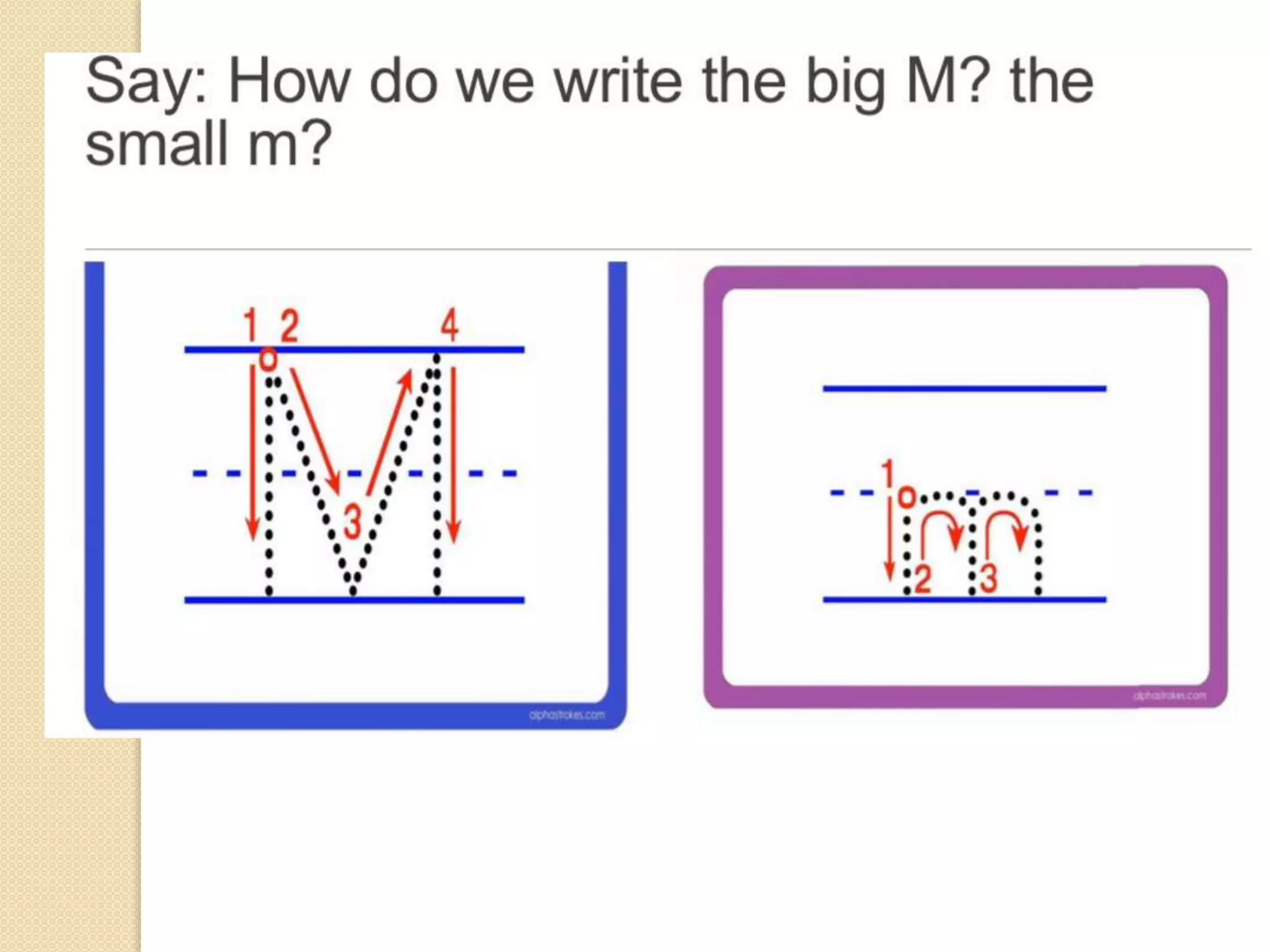
 Introduce/ review the letter form-
Demonstrate how to write the Big M
and the small m. Show how to write
the capital M and the small m properly.
Using his imagination, start by asking
your child to write the letter on Mm air
(use big movements), on the floor, on
his palm. Ask him to write on mommy’s
back. Then write on the board and next
on paper (notice: gross motor skills to
fine motor skills).
 Step 4:
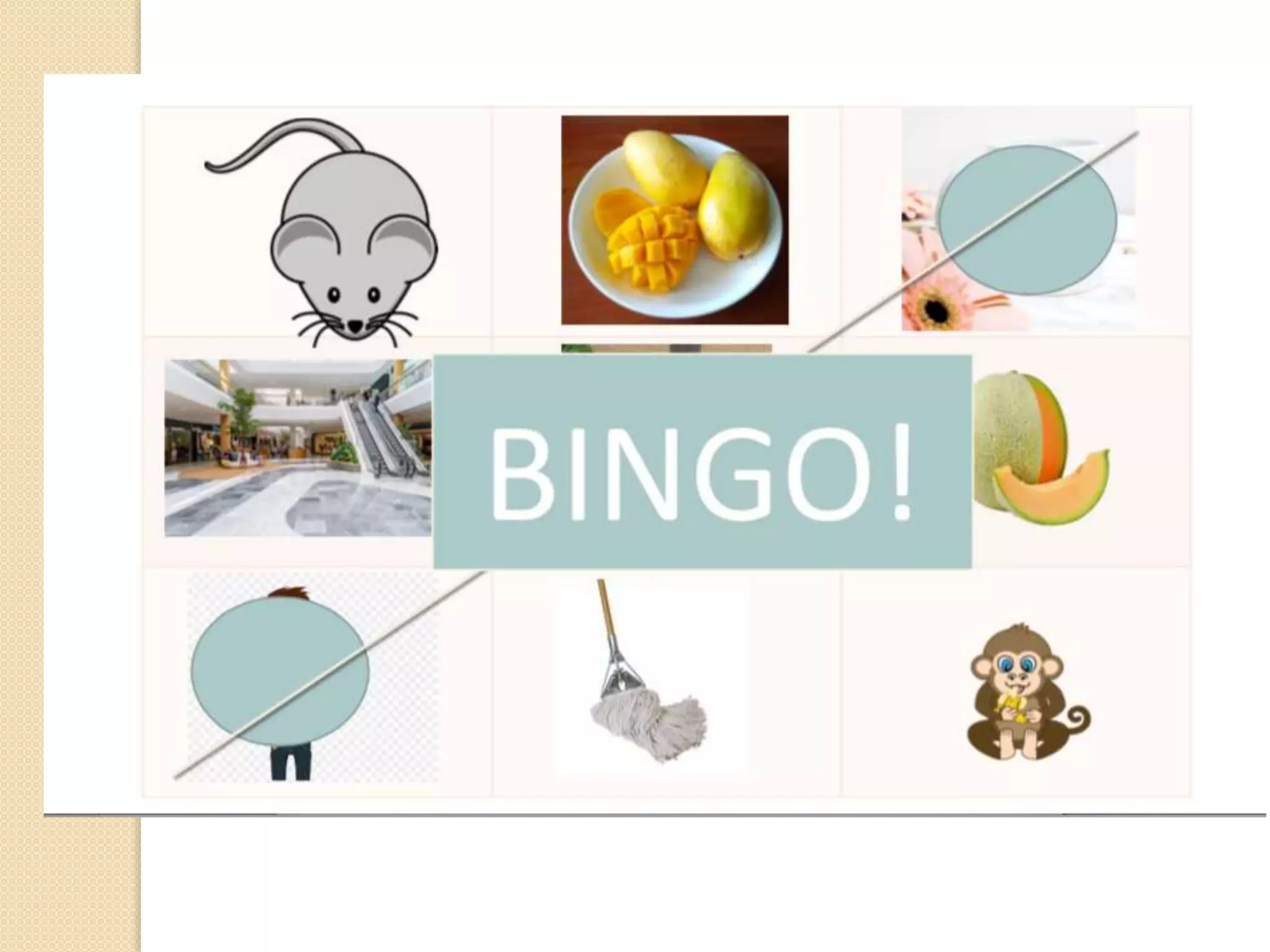
 Exercises/ games/ contests: For
example, show a Bingo Card with
pictures that all start with the sound of
Mm. Show a target pattern. Say the
word with emphasis on the beginning
sound. Ask the child to identify the
pictures. If he completes the given
pattern, he can say “Bingo!”
What do we need to
remember?
1.Start each lesson with a review of the
previous consonant learned.
2.The difficulty increases with each lesson.
3.Mastery of new words must be done
through a fun way–games, exercises,
contests will surely interest a young
child.
4.The child must be exposed to lots of
kinds of books before working with
letters and words.
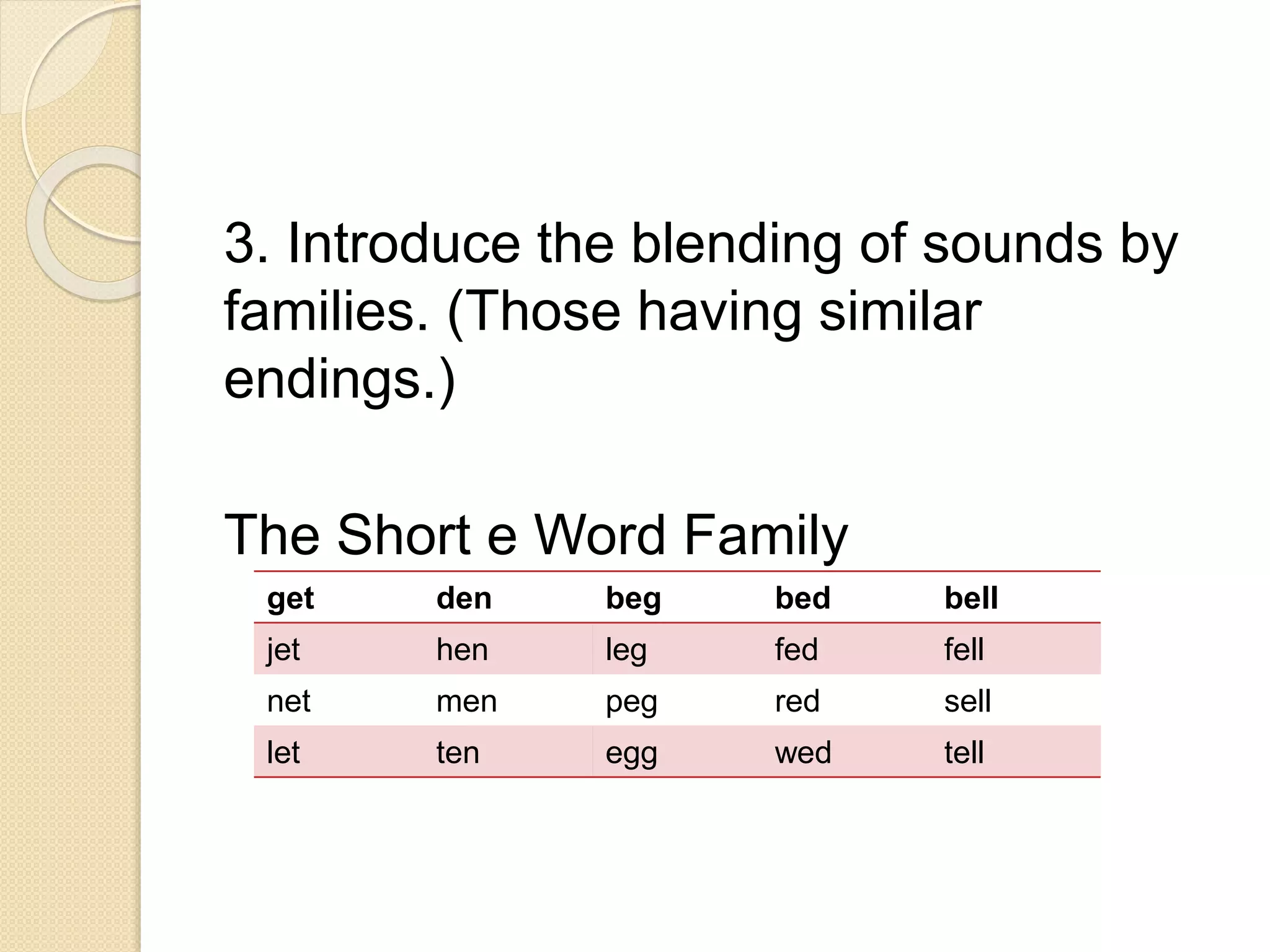
3. Introduce the blending of sounds by
families. (Those having similar
endings.)
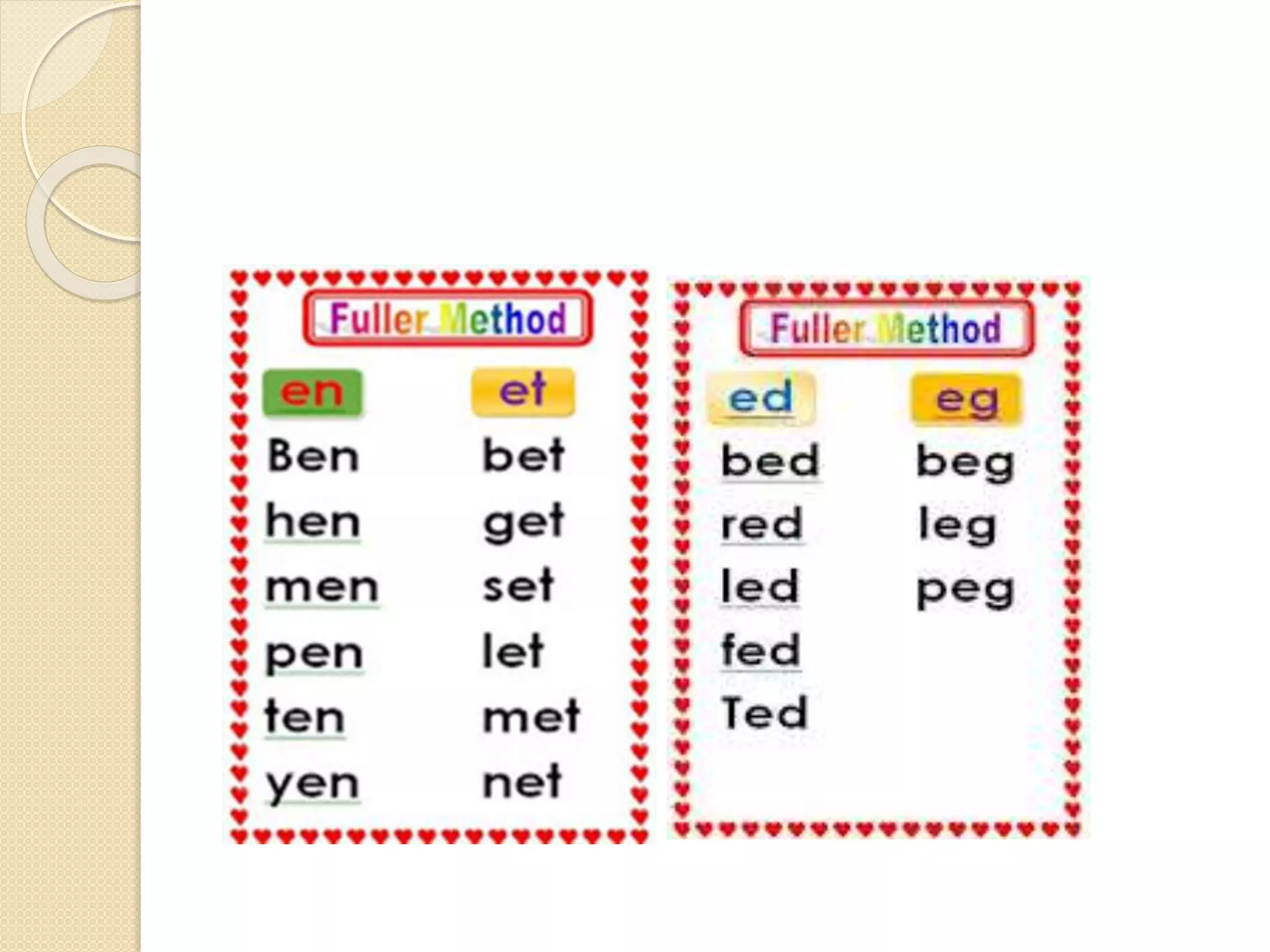
The Short e Word Family
get den beg bed bell
jet hen leg fed fell
net men peg red sell
let ten egg wed tell
4. Present the words in each lesson in a
column. With the help of a
pointer/marker, say the first word.
Move the pointer/marker to the next
word and let the learners read it aloud.
Point out the similar endings of the
words to the learners. The rhymed
endings help them read the words down
the column.
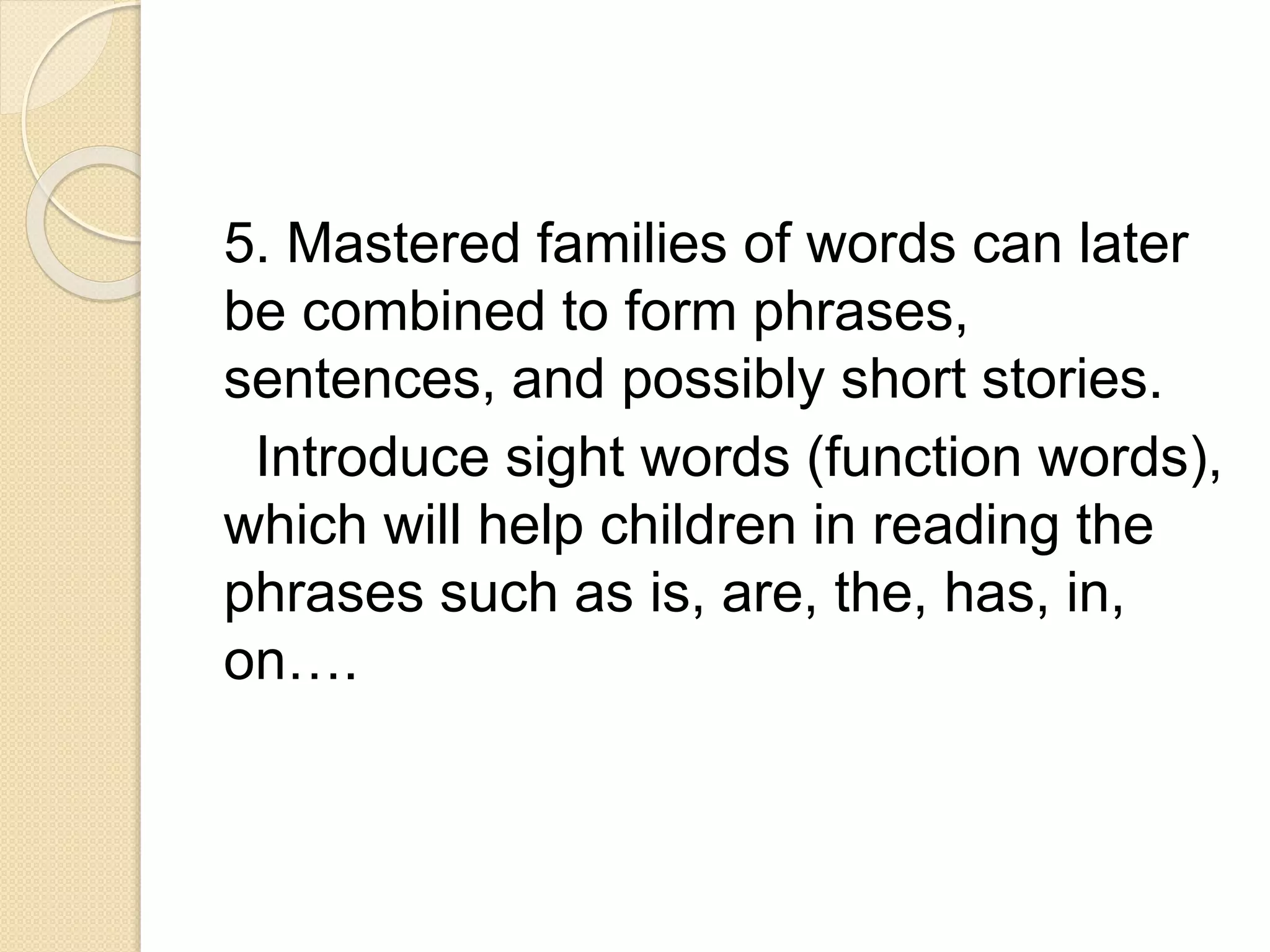
5. Mastered families of words can later
be combined to form phrases,
sentences, and possibly short stories.
Introduce sight words (function words),
which will help children in reading the
phrases such as is, are, the, has, in,
on….
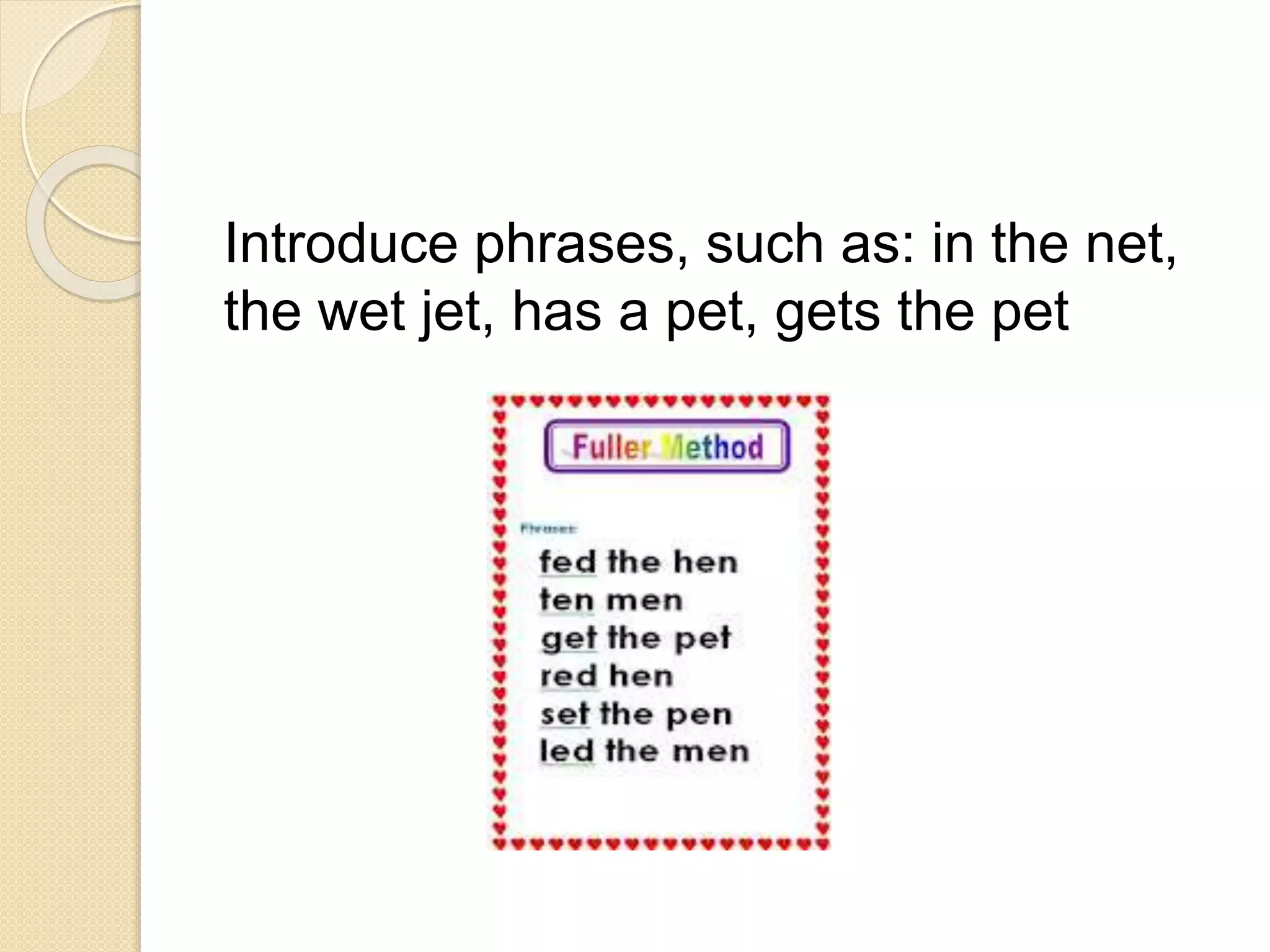
Introduce phrases, such as: in the net,
the wet jet, has a pet, gets the pet
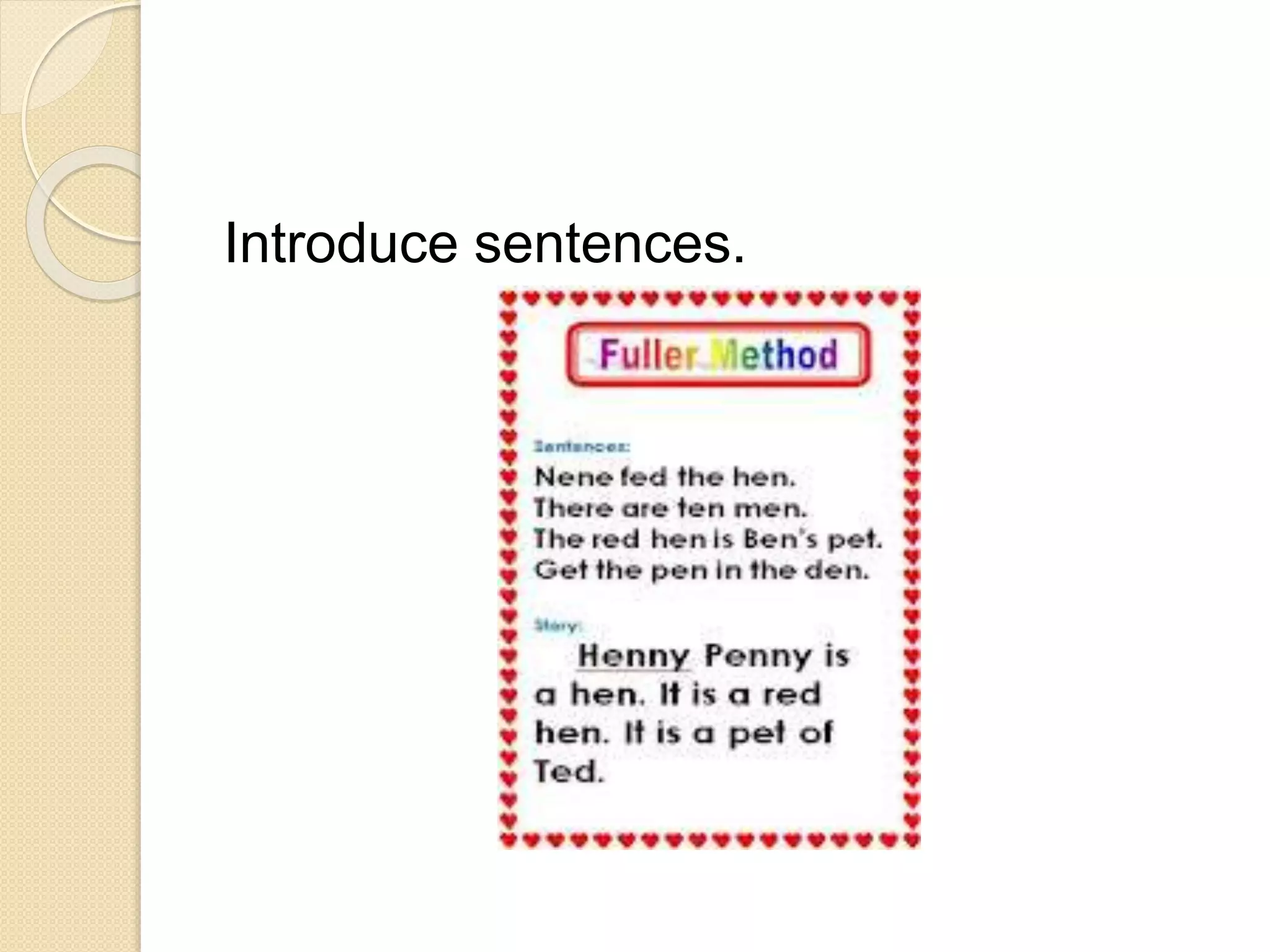
Introduce sentences.
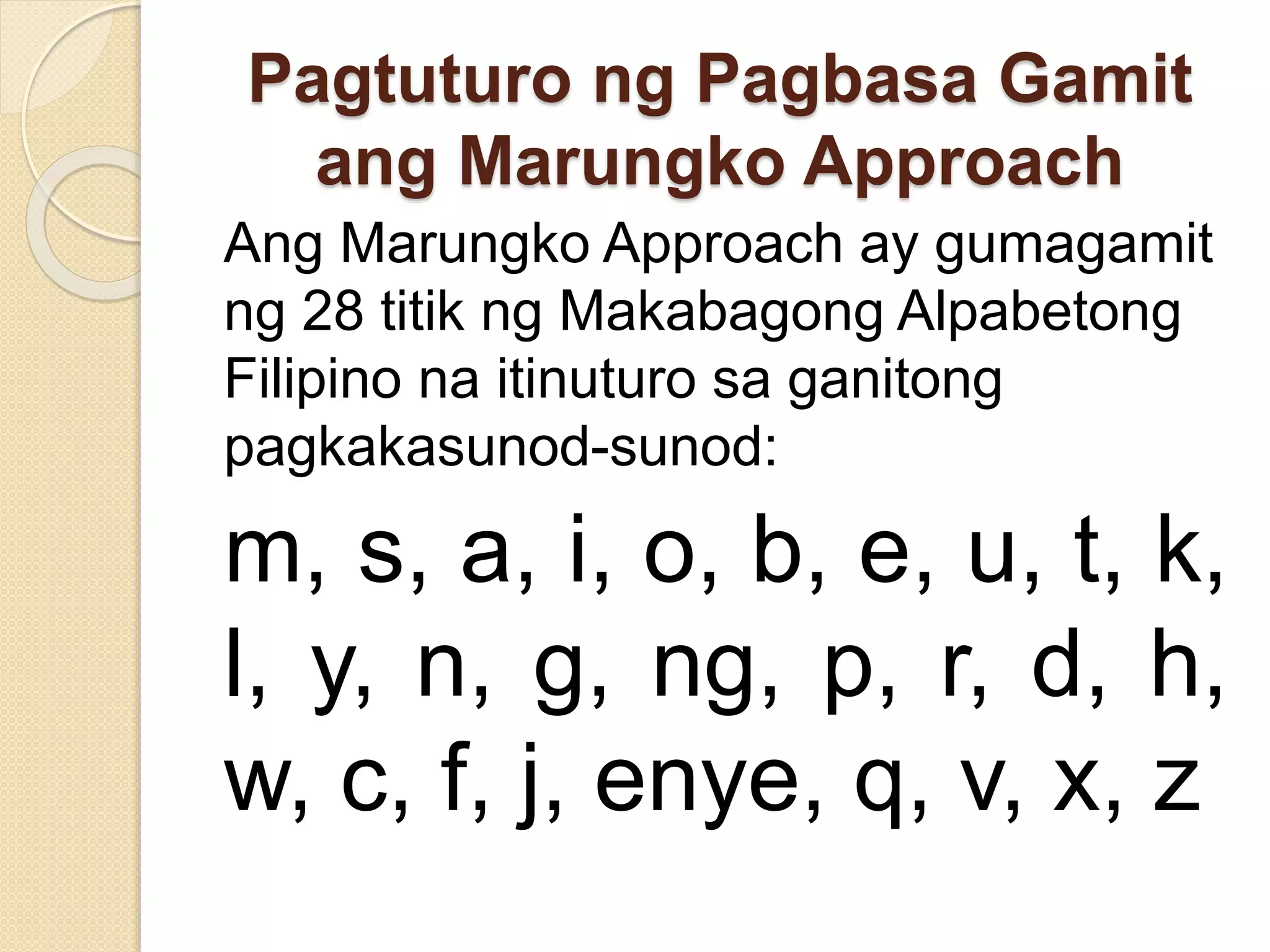
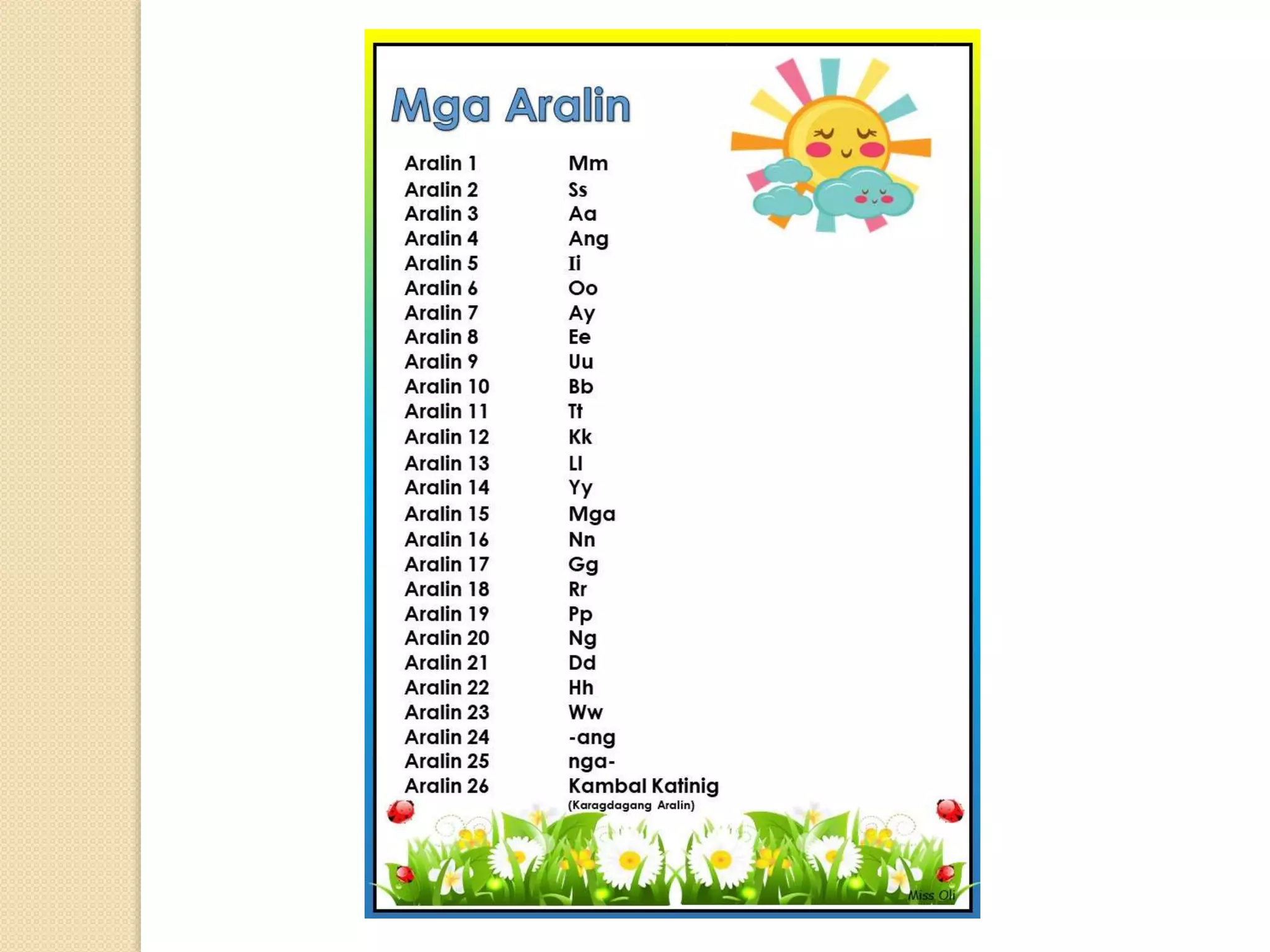
MARUNGKO APPROACH
Pagtuturo ng Pagbasa Gamit
ang Marungko Approach
Ang Marungko Approach ay gumagamit
ng 28 titik ng Makabagong Alpabetong
Filipino na itinuturo sa ganitong
pagkakasunod-sunod:
m, s, a, i, o, b, e, u, t, k,
l, y, n, g, ng, p, r, d, h,
w, c, f, j, enye, q, v, x, z
Unang Antas ng Pagbasa
 pagpapakilala ng mga larawan ng
mga bagay na nagsisimula sa tunog
na pinag-aralan
 pagpapakilala ng tunog
 pagpapakilala ng hugis ng tunog
 pagpapakilala ng titik
 pagsulat ng hugis sa hangin, sa sahig,
sa palad, etc.
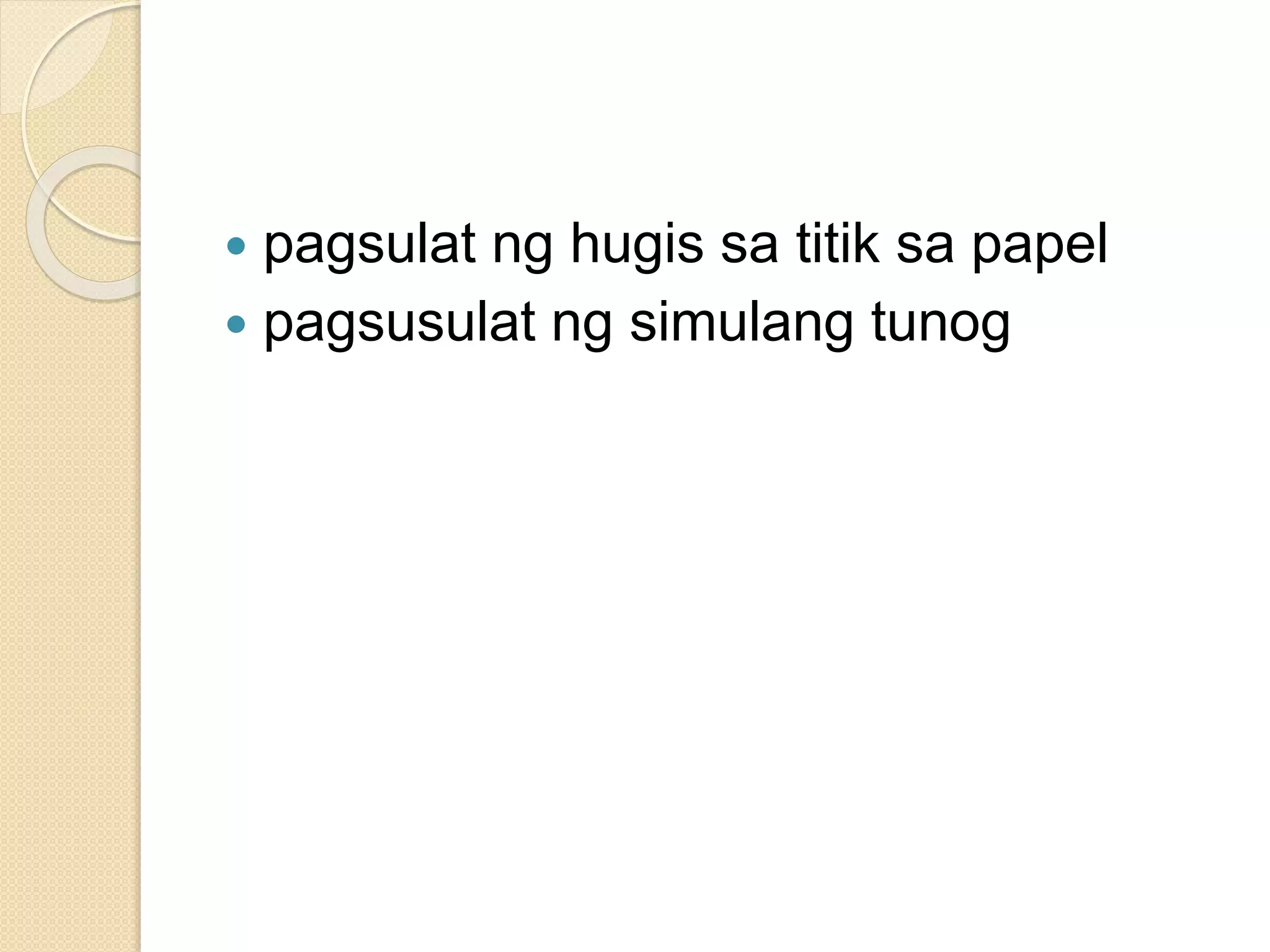
 pagsulat ng hugis sa titik sa papel
 pagsusulat ng simulang tunog
Ikalawang Antas ng Pagbasa
 Pagsasama ng mga tunog upang
makalikha ng isang makabuluhang
salita
 m, s, a…
Ikatlong Antas ng Pagbasa
 Pagpapakilala ng mga pantulong na
kataga
ang, mga, si, ay, ng,
kay
Ikaapat na Antas ng Pagbasa
 Pagbubuo ng mga parirala at
pangungusap
 Pagbasa ng mga salita, parirala at
pangungusap.
 Pagsagot sa mga tanong na may:
Sino, Ano, Saan, Kanino
Halimbawa: Sino ang sasama sa
masa?
 Pagbasa ng maikling kuwento
 Pagsagot ng mga tanong tungkol sa
kuwento

Fuller-and-Fuller-Approach.pptx

  • 1.
  • 2.
    The Fuller isa combination of the alphabet, phonics, and whole methods of teaching word recognition. What is Fuller Approach?
  • 3.
    Pre-Requisites Before Teaching theFuller Technique Before using the Fuller Technique, the child must show the following skills: 1) The child has mastery of the name and form of each alphabet. The child can identify which letters are vowels and which letters are consonants. 2) The child has mastery of the regular sounds of the consonants.
  • 4.
    How to Usethe Fuller Lessons? 1. Teach the name and form of each letter in English alphabet. It is not necessary for the learners to know which are the vowels and which are consonants. 2. Teach the regular sounds of the consonants.
  • 5.
    The following sequenceis recommended in teaching the consonant sounds. The first letter that we teach is letter Mm followed by Ss, Ll, Ff, Tt and so on. When introduce a letter, we show first words that begin with the target letter. And then, we sound out the target letter. Next is that we show how the target letter is formed. We demonstrate how to write the target letter in different multi-sensory ways. Last is we give exercises to reinforce the target letter.
  • 7.
    Here are somethings we need to remember: Consonants C and G have two sounds, only the hard sound of these consonants are introduced to the beginning reader (e.g c as in cat, g as in gate). Consonants X, K, Q are not in the above list. X is a final sound in all beginning reading words (e.g mix, fix, six, ax); the sound of x is taught when these words are introduced.
  • 8.
    A Sample TargetLesson Letter Mm Step 1: First important important step is vocabulary development. Show names that start with the letter Mm e.g man, mug, mat, mom, etc.
  • 9.
    Name what isin the picture!
  • 10.
    Step 2:  Introducethe letter sound. Our target letter is Mm.  Sound it out! The sound of letter Mm is “mmm”.  Show the pictures and let’s name the pictures again.
  • 11.
     Step 3: Introduce/ review the letter form- Demonstrate how to write the Big M and the small m. Show how to write the capital M and the small m properly.
  • 13.
    Using his imagination,start by asking your child to write the letter on Mm air (use big movements), on the floor, on his palm. Ask him to write on mommy’s back. Then write on the board and next on paper (notice: gross motor skills to fine motor skills).
  • 14.
     Step 4: Exercises/ games/ contests: For example, show a Bingo Card with pictures that all start with the sound of Mm. Show a target pattern. Say the word with emphasis on the beginning sound. Ask the child to identify the pictures. If he completes the given pattern, he can say “Bingo!”
  • 16.
    What do weneed to remember? 1.Start each lesson with a review of the previous consonant learned. 2.The difficulty increases with each lesson. 3.Mastery of new words must be done through a fun way–games, exercises, contests will surely interest a young child. 4.The child must be exposed to lots of kinds of books before working with letters and words.
  • 17.
    3. Introduce theblending of sounds by families. (Those having similar endings.) The Short e Word Family get den beg bed bell jet hen leg fed fell net men peg red sell let ten egg wed tell
  • 18.
    4. Present thewords in each lesson in a column. With the help of a pointer/marker, say the first word. Move the pointer/marker to the next word and let the learners read it aloud. Point out the similar endings of the words to the learners. The rhymed endings help them read the words down the column.
  • 20.
    5. Mastered familiesof words can later be combined to form phrases, sentences, and possibly short stories. Introduce sight words (function words), which will help children in reading the phrases such as is, are, the, has, in, on….
  • 21.
    Introduce phrases, suchas: in the net, the wet jet, has a pet, gets the pet
  • 22.
  • 24.
  • 25.
    Pagtuturo ng PagbasaGamit ang Marungko Approach Ang Marungko Approach ay gumagamit ng 28 titik ng Makabagong Alpabetong Filipino na itinuturo sa ganitong pagkakasunod-sunod: m, s, a, i, o, b, e, u, t, k, l, y, n, g, ng, p, r, d, h, w, c, f, j, enye, q, v, x, z
  • 27.
    Unang Antas ngPagbasa  pagpapakilala ng mga larawan ng mga bagay na nagsisimula sa tunog na pinag-aralan  pagpapakilala ng tunog  pagpapakilala ng hugis ng tunog  pagpapakilala ng titik  pagsulat ng hugis sa hangin, sa sahig, sa palad, etc.
  • 28.
     pagsulat nghugis sa titik sa papel  pagsusulat ng simulang tunog
  • 29.
    Ikalawang Antas ngPagbasa  Pagsasama ng mga tunog upang makalikha ng isang makabuluhang salita  m, s, a…
  • 32.
    Ikatlong Antas ngPagbasa  Pagpapakilala ng mga pantulong na kataga ang, mga, si, ay, ng, kay
  • 33.
    Ikaapat na Antasng Pagbasa  Pagbubuo ng mga parirala at pangungusap
  • 34.
     Pagbasa ngmga salita, parirala at pangungusap.
  • 35.
     Pagsagot samga tanong na may: Sino, Ano, Saan, Kanino Halimbawa: Sino ang sasama sa masa?  Pagbasa ng maikling kuwento  Pagsagot ng mga tanong tungkol sa kuwento