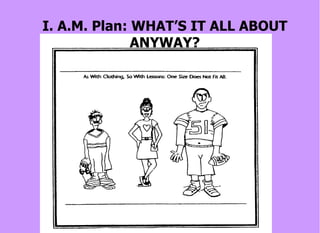
I. A.M. Plan: WHAT’S IT ALL ABOUT ANYWAY?
Daily Warm Up Activity “ The Tragic Story of the Right Family” Materials Needed: Marker Note Card (“right” your name on the front)
Objectives Participants will be able to: CONTENT : explain the purpose of an I AM PLAN explain the difference between accommodations and modifications apply appropriate accommodations or modifications to specific student needs Relevance: How does this apply to your classroom?
I AM Plan I Implementation A  Accommodations M Modifications Implementation  of  accommodations  and  modifications  to help provide better support for students in your classroom with an IEP
accommodations An  accommodation  is an adjustment to an activity or setting that removes a barrier presented by a disability so students may have equal access to the same opportunities available to a student without a disability.
modifications A  modification  is an alteration of content expectations being assessed in the activities, assignments, and/or assessments itself. In other words, either the content of the above or the way it is administered is altered.
Most-Effective Teachers J.W. Lloyd, E.J. Kameanui, and D. Chard (Eds.) (1997) Issues in educating students with disabilities.
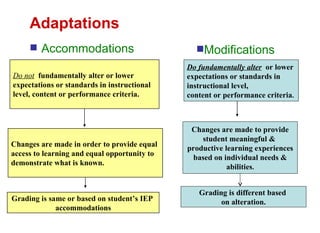
Adaptations Accommodations Grading is same or based on student’s IEP  accommodations Grading is different based  on alteration. Do not   fundamentally alter or lower  expectations or standards in instructional  level, content or performance criteria. Changes are made in order to provide equal  access to learning and equal opportunity to demonstrate what is known. Do fundamentally alter   or lower  expectations or standards in  instructional level,  content or performance criteria . Changes are made to provide student meaningful &  productive learning experiences based on individual needs & abilities . Modifications
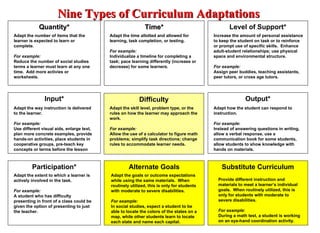
Quantity* Time* Level of Support* Input* Alternate Goals Difficulty Participation* Output* Substitute Curriculum Adapt the way instruction is delivered to the learner. For example: Use different visual aids, enlarge text, plan more concrete examples, provide hands-on activities, place students in cooperative groups, pre-teach key concepts or terms before the lesson Adapt the number of items that the learner is expected to learn or complete. For example: Reduce the number of social studies terms a learner must learn at any one time.  Add more activies or worksheets. Adapt the time allotted and allowed for learning, task completion, or testing. For example: Individualize a timeline for completing a task; pace learning differently (increase or decrease) for some learners. Increase the amount of personal assistance to keep the student on task or to reinforce or prompt use of specific skills.  Enhance adult-student relationships; use physical space and environmental structure. For example: Assign peer buddies, teaching assistants, peer tutors, or cross age tutors. Adapt the skill level, problem type, or the rules on how the learner may approach the work. For example: Allow the use of a calculator to figure math problems; simplify task directions; change rules to accommodate learner needs. Adapt how the student can respond to instruction. For example : Instead of answering questions in writing, allow a verbal response, use a communication book for some students, allow students to show knowledge with hands on materials. Adapt the extent to which a learner is actively involved in the task. For example: A student who has difficulty presenting in front of a class could be given the option of presenting to just the teacher.  Adapt the goals or outcome expectations while using the same materials.  When routinely utilized, this is only for students with moderate to severe disabilities. For example: In social studies, expect a student to be able to locate the colors of the states on a map, while other students learn to locate each state and name each capital. Provide different instruction and materials to meet a learner’s individual goals.  When routinely utilized, this is only for students with moderate to severe disabilities. For example : During a math test, a student is working on an eye-hand coordination activity.  Nine Types of Curriculum Adaptations
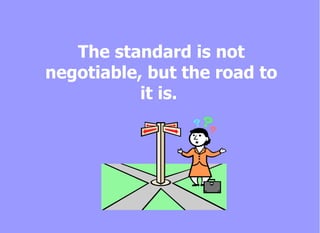
The standard is not negotiable, but the road to it is.
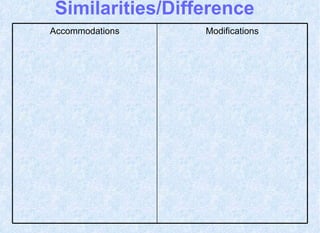
Similarities/Difference Accommodations Modifications
Small Group Activity “IEP Scenario” Now, in this next exercise discuss in your group using the given scenario and IEP at a glance the possible accommodation and/or modifications that will be needed to help provide support for your student(s) to be successful.
Small Group Activity “IEP Scenario” After discussion, use the provided chart paper and markers to identify the needed accommodation and/or modifications for your scenario.
Putting it all Together Goal: To remove barriers to learning the material and to demonstrate mastery. Accommodations will keep standards substantially the same for all; outcomes may vary. Modifications will fundamentally change the way standards are mastered.
Individual Education Plan Every special education student has an IEP.  The IEP defines the program that is to be followed to help the student achieve academic success. IEP IEPs are legally binding documents.
Ticket out the Door On your  Name  note card, please respond on the back to the following: What challenges, questions, and/or training do you have/need to help you provide better support for your students with an IEP?  If you would like a copy of today’s presentation, please write your email address down and we will email it to you.

Sped presentation 2011

  • 1.
    I. A.M. Plan:WHAT’S IT ALL ABOUT ANYWAY?
  • 2.
    Daily Warm UpActivity “ The Tragic Story of the Right Family” Materials Needed: Marker Note Card (“right” your name on the front)
  • 3.
    Objectives Participants willbe able to: CONTENT : explain the purpose of an I AM PLAN explain the difference between accommodations and modifications apply appropriate accommodations or modifications to specific student needs Relevance: How does this apply to your classroom?
  • 4.
    I AM PlanI Implementation A Accommodations M Modifications Implementation of accommodations and modifications to help provide better support for students in your classroom with an IEP
  • 5.
    accommodations An accommodation is an adjustment to an activity or setting that removes a barrier presented by a disability so students may have equal access to the same opportunities available to a student without a disability.
  • 6.
    modifications A modification is an alteration of content expectations being assessed in the activities, assignments, and/or assessments itself. In other words, either the content of the above or the way it is administered is altered.
  • 7.
    Most-Effective Teachers J.W.Lloyd, E.J. Kameanui, and D. Chard (Eds.) (1997) Issues in educating students with disabilities.
  • 8.
    Adaptations Accommodations Gradingis same or based on student’s IEP accommodations Grading is different based on alteration. Do not fundamentally alter or lower expectations or standards in instructional level, content or performance criteria. Changes are made in order to provide equal access to learning and equal opportunity to demonstrate what is known. Do fundamentally alter or lower expectations or standards in instructional level, content or performance criteria . Changes are made to provide student meaningful & productive learning experiences based on individual needs & abilities . Modifications
  • 9.
    Quantity* Time* Levelof Support* Input* Alternate Goals Difficulty Participation* Output* Substitute Curriculum Adapt the way instruction is delivered to the learner. For example: Use different visual aids, enlarge text, plan more concrete examples, provide hands-on activities, place students in cooperative groups, pre-teach key concepts or terms before the lesson Adapt the number of items that the learner is expected to learn or complete. For example: Reduce the number of social studies terms a learner must learn at any one time. Add more activies or worksheets. Adapt the time allotted and allowed for learning, task completion, or testing. For example: Individualize a timeline for completing a task; pace learning differently (increase or decrease) for some learners. Increase the amount of personal assistance to keep the student on task or to reinforce or prompt use of specific skills. Enhance adult-student relationships; use physical space and environmental structure. For example: Assign peer buddies, teaching assistants, peer tutors, or cross age tutors. Adapt the skill level, problem type, or the rules on how the learner may approach the work. For example: Allow the use of a calculator to figure math problems; simplify task directions; change rules to accommodate learner needs. Adapt how the student can respond to instruction. For example : Instead of answering questions in writing, allow a verbal response, use a communication book for some students, allow students to show knowledge with hands on materials. Adapt the extent to which a learner is actively involved in the task. For example: A student who has difficulty presenting in front of a class could be given the option of presenting to just the teacher. Adapt the goals or outcome expectations while using the same materials. When routinely utilized, this is only for students with moderate to severe disabilities. For example: In social studies, expect a student to be able to locate the colors of the states on a map, while other students learn to locate each state and name each capital. Provide different instruction and materials to meet a learner’s individual goals. When routinely utilized, this is only for students with moderate to severe disabilities. For example : During a math test, a student is working on an eye-hand coordination activity. Nine Types of Curriculum Adaptations
  • 10.
    The standard isnot negotiable, but the road to it is.
  • 11.
  • 12.
    Small Group Activity“IEP Scenario” Now, in this next exercise discuss in your group using the given scenario and IEP at a glance the possible accommodation and/or modifications that will be needed to help provide support for your student(s) to be successful.
  • 13.
    Small Group Activity“IEP Scenario” After discussion, use the provided chart paper and markers to identify the needed accommodation and/or modifications for your scenario.
  • 14.
    Putting it allTogether Goal: To remove barriers to learning the material and to demonstrate mastery. Accommodations will keep standards substantially the same for all; outcomes may vary. Modifications will fundamentally change the way standards are mastered.
  • 15.
    Individual Education PlanEvery special education student has an IEP. The IEP defines the program that is to be followed to help the student achieve academic success. IEP IEPs are legally binding documents.
  • 16.
    Ticket out theDoor On your Name note card, please respond on the back to the following: What challenges, questions, and/or training do you have/need to help you provide better support for your students with an IEP? If you would like a copy of today’s presentation, please write your email address down and we will email it to you.