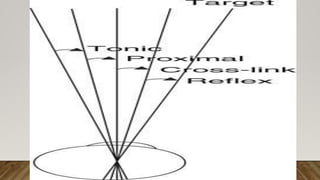
ACCOMMODATIVE AND
PROXIMAL
CONVERGENCE
DR. USAMA
ACCOMMODATIVE CONVERGENCE:
• It is the convergence that occurs when eyes accommodate
or when a nerve impulse to accommodate is discharged to
the eyes.
• Stimulus:
• Blurred retinal images
NEAR REFLEX TRIAD:
• What is the near reflex triad?
• The near reflex is the action of the eye for adjustment to
fixate on a near object. The reflex is a triad which consists
of accommodation, convergence and miosis. Spasm of the
near reflex (SNR) is when this triad persists when the
patient is not fixating on a near object.
AC/A RATIO:
• Accommodative convergence is measured in prism
diopters.
• Myopes have high AC/A ratio.
• Hypermetropes have low AC/A ratio.
• Pupillary distance must also be considered in determining
the AC/A ratio.
ABNORMALITIES OF AC/A RATIO:
• High AC/A ratio cause excessive convergence and
produces convergent squint (esotropia).
• Low AC/A ratio cause divergent squint (exotropia).
PROXIMAL CONVERGENCE:
• It is induced by the proximity of the object of regardor the
awareness of proximity of near object.
Example:
• Haploscope optically set at infinity, proximal convergence
is used.
INVERSE RELATIONSHIP:
• Proximal convergence ×1/ change in fixation distance
• Change in fixation distance is expressed as change in
vergence of light i.e in diopters.
• Each diopter of change of fixation distance ,an
approximate change of 1.5∆ occurs in proximal
convergence.
accommodation and convergence.pptx

accommodation and convergence.pptx

  • 1.
  • 2.
    ACCOMMODATIVE CONVERGENCE: • Itis the convergence that occurs when eyes accommodate or when a nerve impulse to accommodate is discharged to the eyes. • Stimulus: • Blurred retinal images
  • 4.
    NEAR REFLEX TRIAD: •What is the near reflex triad? • The near reflex is the action of the eye for adjustment to fixate on a near object. The reflex is a triad which consists of accommodation, convergence and miosis. Spasm of the near reflex (SNR) is when this triad persists when the patient is not fixating on a near object.
  • 5.
    AC/A RATIO: • Accommodativeconvergence is measured in prism diopters. • Myopes have high AC/A ratio. • Hypermetropes have low AC/A ratio. • Pupillary distance must also be considered in determining the AC/A ratio.
  • 6.
    ABNORMALITIES OF AC/ARATIO: • High AC/A ratio cause excessive convergence and produces convergent squint (esotropia). • Low AC/A ratio cause divergent squint (exotropia).
  • 7.
    PROXIMAL CONVERGENCE: • Itis induced by the proximity of the object of regardor the awareness of proximity of near object. Example: • Haploscope optically set at infinity, proximal convergence is used.
  • 9.
    INVERSE RELATIONSHIP: • Proximalconvergence ×1/ change in fixation distance • Change in fixation distance is expressed as change in vergence of light i.e in diopters. • Each diopter of change of fixation distance ,an approximate change of 1.5∆ occurs in proximal convergence.