
by Blossom
Child Proofing
Solutions
A Presentation on Child
Safety
Radhika Bhalerao
Ashwini Gawde
Experience of Parenthood
Mental
Emotional
Physical
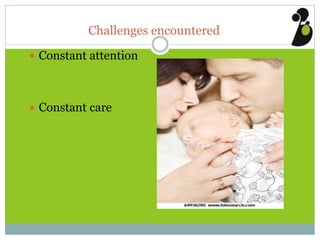
Challenges encountered
 Constant attention
 Constant care
Baby Care
 Baby skin care
 Toys/prams/bassinets/cribs
 Baby food
 Baby toiletries and diapers
 Vaccines
 Clothes and shoes
Expenses done by Parents
 According to the study done by Economic Times:
Almost 54.75 lakhs on an average is being spent on
raising a child in India out of which 2.17 lakhs spent on
child care and also the healthcare costs are highest till the
child is 4 to 6 years old.
 Again when we talk about healthcare it is mostly Vaccines
and minor illness like fever ,cough, cold……..
 Totally ignored part of Child care is UNINTENTIONAL
CHILDHOOD INJURIES which is vital and which causes
almost 2 child deaths every minute of every day.
Study done by WHO and UNICEF
 Every day around 2000 families lose a child due to
an unintentional injury or a so called accident
 Unintentional injuries are also a major cause of
disabilities which can have a long last impact on all
aspects of children’s lives: relationships, learning
and play
Study done by WHO and UNICEF
 Children’s maturity and their interests and needs
differ from adults. Therefore, simply reproducing
injury prevention strategies that are relevant to adults
does not adequately protect children.
 Child injuries have been neglected for many years, and
are largely absent from child survival initiatives
presently on the global agenda. Through the World
report on child injury prevention, the World
Health Organization, the United Nations
Children’s Fund and many partners have set out to
elevate child injury to a priority for the global public
health and development communities.
Statistics about Child Safety in India
 In India, preventable injuries kill more than
60,000 children each year, leaving many more
disabled.
 Pediatrics say after health problems, the second
main reason for medical help is treatment of
household injuries for children
 The major causes of injuries are falls, burns,
accidental poisoning and drowning
 Almost 90%home accidents can be prevented with
the optimum use of childproofing products
What is Childproofing
 Almost all injuries can be prevented
 The act of making an environment or an object
relatively safe for children.
 To reduce risk of injuries to a considerable level
and to offer safety solutions suiting the specific
requirements.
Importance of child proofing
 Safety oriented
 Unknown risks also being covered
 Peace of mind and assurity about child safety
 The number of “NO”s would considerably
decrease
 Convenient to install and de-install
 Easy way of managing a child’s natural
curiosity
LET US EXPLORE THE
HOME THROUGH A
CHILD’S EYE…
Childproofing the Home
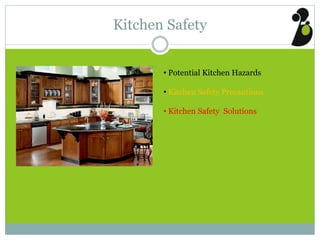
Kitchen Safety
• Potential Kitchen Hazards
• Kitchen Safety Precautions
• Kitchen Safety Solutions
Potential Kitchen Hazards
• Burning Hazard: Stoves, ovens, microwave, pots or
pans full of boiling water or hot food etc.
• Finger pinching: Drawers and cabinet doors
• Cuts or bruises: Sharp knives or other utensils
• Risk of fire/explosion: Unsafe handling of stove knobs
by children
Kitchen Safety Precautions
• Rotate the handles of pots and pans inside
• Keep matches, lighters, sharp objects and utensils out
of reach of children
• Put child proof locks for cabinet doors and drawers
• Don't store heavy objects overhead
• Don't let children climb on kitchen counters, especially
while you are cooking
• Plastic bags and cleaning liquids to be kept in a secure
place
• If a pan fire ignites ,cover the fire with a lid instead of
using water
• Avoid table cloth and / or table mats
• Microwave should not be used for heating milk
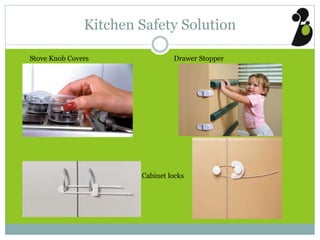
Kitchen Safety Solution
Stove Knob Covers Drawer Stopper
Cabinet locks
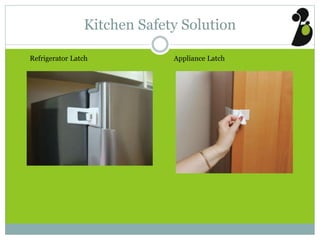
Kitchen Safety Solution
Refrigerator Latch Appliance Latch
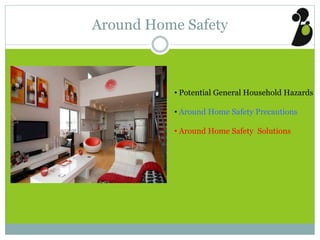
Around Home Safety
• Potential General Household Hazards
• Around Home Safety Precautions
• Around Home Safety Solutions
Potential General Household Hazards
• Falling Hazard: Staircase, window falls, Bed falls etc
• Electrical Burns: open electrical outlet plugs, or unsafe
electric wires
• Strangulation Hazard: cords and strings out within
reach of a child
• Poisoning: Medicines
Around Home Safety Precautions
• Install hardware mounted safety gates at the top and
bottom of stair-case.
• Never leave anything on stairs
• Keep away harmful toxins and poisons, medicines, etc.
• Cover electrical outlets to prevent shock, burns or child
from plugging in an appliance
• All heavy objects like furniture and television securely
bolted to the walls
• Beware of toxic plants
• Post emergency numbers
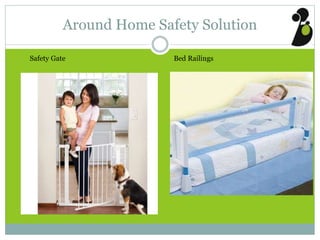
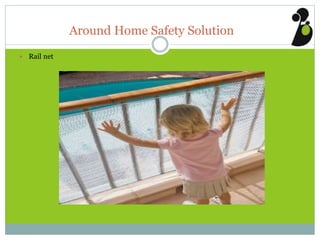
Around Home Safety Solution
Safety Gate Bed Railings
Around Home Safety Solution
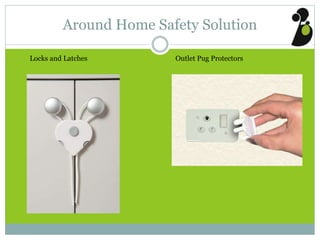
Locks and Latches Outlet Pug Protectors
Around Home Safety Solution
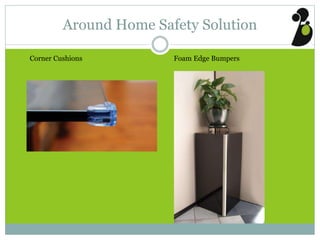
Corner Cushions Foam Edge Bumpers
Around Home Safety Solution
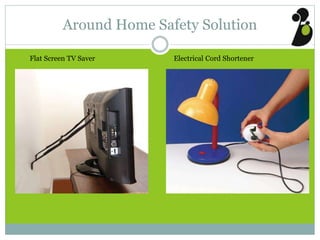
Flat Screen TV Saver Electrical Cord Shortener
Around Home Safety Solution
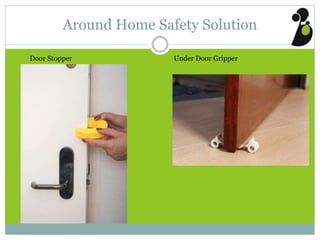
Door Stopper Under Door Gripper
Around Home Safety Solution
 Rail net
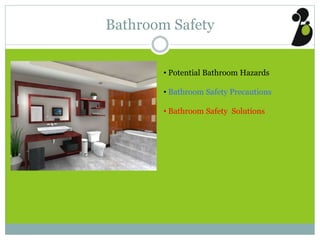
Bathroom Safety
• Potential Bathroom Hazards
• Bathroom Safety Precautions
• Bathroom Safety Solutions
Potential Bathroom Hazards
• Drowning Hazard: Bath Tubs or Buckets
• Burning and Scald: hot water
• Poisoning: Detergents, soaps
Bathroom Safety Precautions
• Check the bath water before placing your child
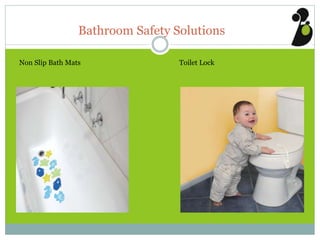
• Keep toilet lids shut and use toilet locks
• Drain the tub immediately once bath is over
• Empty all buckets and containers after use and store
them upside down
• Keep detergents, shampoos and soap out of reach
• Keep detergents and toilet cleaners in their original
packages to avoid confusion
• Prepare yourself before heading into the bathroom
• Keep bathrooms doors closed when not in use
• Never leave electrical appliances plugged in near water
• No child should ever be left alone in the tub
• OUT OF SIGHT;OUT OF MIND
Bathroom Safety Solutions
Non Slip Bath Mats Toilet Lock
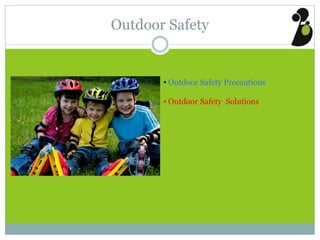
Outdoor Safety
• Outdoor Safety Precautions
• Outdoor Safety Solutions
Outdoor Safety Precautions
• Pouring fuel in open space ,the fumes can be dangerous
• Swimming pools should always be locked
• Deck railings should never be more than 3 inches apart
• If swing set at home, make sure the surface beneath is
well cushioned
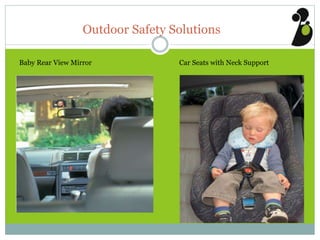
• Car-seat is must
• Teach your children to stay clear of vehicles
• First aid kit in; bulky , heavy items out
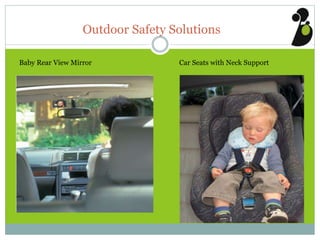
Outdoor Safety Solutions
Baby Rear View Mirror Car Seats with Neck Support
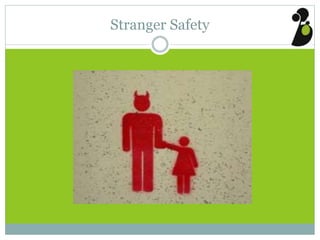
Stranger Safety
Rules for Stranger Safety
• Instead of: Don't talk to strangers
Say: Check with me or your dad or your babysitter
before talking to another grown-up.
• Instead of: If you get lost in a store, ask a trusted adult
to help you find me
Say: If you get lost in a store, stay in the building and
find someone with a name tag to help you.
• Instead of: Don't take candy from a stranger
Say: Don't take anything from anyone except your
parents, babysitter, teacher, or friend's mom or dad on
a play date.
Rules for Stranger Safety
• Instead of: Don't leave my sight
Say: Don't go where you can't see me.
• Instead of: Don't keep secrets
Say: A surprise is the only secret that's okay to keep.
Outdoor Safety Solutions
Baby Rear View Mirror Car Seats with Neck Support
Safety a way of Life….
 Instead of thinking about child safety as a job, or
something that has to be done once in a while,
think of it as something just as important as
providing nourishment to your children.
 Child safety advice, tips, pointers and products
are meant to make parenting kids of all ages a
little easier and keep them healthy and safe in the
process.
 Never be afraid of being overly paranoid as to
your children’s safety, there really is no such
thing.
Basic tips on Burns, Bites and Poisoning
Burns
Three types of Burns:
First-degree burns
1. Location : involve top layer of skin
2. How to identify: skin will be red, painful to touch
and will show mild swelling
3. Treatment: - immerse in cool fresh water
- cover the burn with bandage or
clean cloth
Basic tips on Burns, Bites and Poisoning
 Second degree burns:
1. Location: first two layers of skin
2. How to identify: Skin will be deep red and painful
and may look glossy from leaking fluid,blisters may
appear.
3. Treatment: -immerse in fresh,cool water for 10-15
minutes.
- Dry with clean cloth ,don’t break
blisters and seek medical attention
Basic tips on Burns, Bites and Poisoning
Third –degree burns
1.Location: penetrate the entire thickness of skin
2.How to identify: skin may appear dry, leathery or
charred and may appear white, brown or black
3.Treatment: - Cover burn lightly with clean cloth
- take steps to prevent shock
- seek immediate medical attention.
Basic tips on Burns, Bites and Poisoning
 Things not to be done during burns:
1. Don’t apply medications, ice, oil spray or cream.
2.Don’t breath, blow or cough on he burn
3.Don’t disturb blistered skin.
4.Don’t remove clothing that is suck to the skin.
5.Don’t give anything by mouth if there is a severe
burn.
6.Don’t immerse a severe burn in cold. water
Basic tips on Burns, Bites and Poisoning
Bites
 Teach your child to stay away from unfamiliar
animals
 Supervise children around pets
 Wash a dog or cat bite or scratch immediately
 Use mosquitoes repellent
Basic tips on Burns, Bites and Poisoning
Poisoning
Proper storage is a key to prevent poisoning
Don’t let children play in pesticide-treated areas.
Don’t try to give medicine to get the poison out.
See immediate medical attention.
Basic tips on Burns, Bites and Poisoning
 Some household poisons:
- Alcoholic beverages
- Artificial nail-paint remover
- Automatic dishwater detergents
- Drain openers
- Furniture polish
- Gasoline, kerosene, lamp oil, mouthwash
- Paint thinner
- Pesticides
- Miniature batteries
Child Safety

Child Safety

  • 1.
    by Blossom Child Proofing Solutions APresentation on Child Safety Radhika Bhalerao Ashwini Gawde
  • 2.
  • 3.
    Challenges encountered  Constantattention  Constant care
  • 4.
    Baby Care  Babyskin care  Toys/prams/bassinets/cribs  Baby food  Baby toiletries and diapers  Vaccines  Clothes and shoes
  • 5.
    Expenses done byParents  According to the study done by Economic Times: Almost 54.75 lakhs on an average is being spent on raising a child in India out of which 2.17 lakhs spent on child care and also the healthcare costs are highest till the child is 4 to 6 years old.  Again when we talk about healthcare it is mostly Vaccines and minor illness like fever ,cough, cold……..  Totally ignored part of Child care is UNINTENTIONAL CHILDHOOD INJURIES which is vital and which causes almost 2 child deaths every minute of every day.
  • 6.
    Study done byWHO and UNICEF  Every day around 2000 families lose a child due to an unintentional injury or a so called accident  Unintentional injuries are also a major cause of disabilities which can have a long last impact on all aspects of children’s lives: relationships, learning and play
  • 7.
    Study done byWHO and UNICEF  Children’s maturity and their interests and needs differ from adults. Therefore, simply reproducing injury prevention strategies that are relevant to adults does not adequately protect children.  Child injuries have been neglected for many years, and are largely absent from child survival initiatives presently on the global agenda. Through the World report on child injury prevention, the World Health Organization, the United Nations Children’s Fund and many partners have set out to elevate child injury to a priority for the global public health and development communities.
  • 8.
    Statistics about ChildSafety in India  In India, preventable injuries kill more than 60,000 children each year, leaving many more disabled.  Pediatrics say after health problems, the second main reason for medical help is treatment of household injuries for children  The major causes of injuries are falls, burns, accidental poisoning and drowning  Almost 90%home accidents can be prevented with the optimum use of childproofing products
  • 9.
    What is Childproofing Almost all injuries can be prevented  The act of making an environment or an object relatively safe for children.  To reduce risk of injuries to a considerable level and to offer safety solutions suiting the specific requirements.
  • 10.
    Importance of childproofing  Safety oriented  Unknown risks also being covered  Peace of mind and assurity about child safety  The number of “NO”s would considerably decrease  Convenient to install and de-install  Easy way of managing a child’s natural curiosity
  • 11.
    LET US EXPLORETHE HOME THROUGH A CHILD’S EYE… Childproofing the Home
  • 12.
    Kitchen Safety • PotentialKitchen Hazards • Kitchen Safety Precautions • Kitchen Safety Solutions
  • 13.
    Potential Kitchen Hazards •Burning Hazard: Stoves, ovens, microwave, pots or pans full of boiling water or hot food etc. • Finger pinching: Drawers and cabinet doors • Cuts or bruises: Sharp knives or other utensils • Risk of fire/explosion: Unsafe handling of stove knobs by children
  • 14.
    Kitchen Safety Precautions •Rotate the handles of pots and pans inside • Keep matches, lighters, sharp objects and utensils out of reach of children • Put child proof locks for cabinet doors and drawers • Don't store heavy objects overhead • Don't let children climb on kitchen counters, especially while you are cooking • Plastic bags and cleaning liquids to be kept in a secure place • If a pan fire ignites ,cover the fire with a lid instead of using water • Avoid table cloth and / or table mats • Microwave should not be used for heating milk
  • 15.
    Kitchen Safety Solution StoveKnob Covers Drawer Stopper Cabinet locks
  • 16.
  • 17.
    Around Home Safety •Potential General Household Hazards • Around Home Safety Precautions • Around Home Safety Solutions
  • 18.
    Potential General HouseholdHazards • Falling Hazard: Staircase, window falls, Bed falls etc • Electrical Burns: open electrical outlet plugs, or unsafe electric wires • Strangulation Hazard: cords and strings out within reach of a child • Poisoning: Medicines
  • 19.
    Around Home SafetyPrecautions • Install hardware mounted safety gates at the top and bottom of stair-case. • Never leave anything on stairs • Keep away harmful toxins and poisons, medicines, etc. • Cover electrical outlets to prevent shock, burns or child from plugging in an appliance • All heavy objects like furniture and television securely bolted to the walls • Beware of toxic plants • Post emergency numbers
  • 20.
    Around Home SafetySolution Safety Gate Bed Railings
  • 21.
    Around Home SafetySolution Locks and Latches Outlet Pug Protectors
  • 22.
    Around Home SafetySolution Corner Cushions Foam Edge Bumpers
  • 23.
    Around Home SafetySolution Flat Screen TV Saver Electrical Cord Shortener
  • 24.
    Around Home SafetySolution Door Stopper Under Door Gripper
  • 25.
    Around Home SafetySolution  Rail net
  • 26.
    Bathroom Safety • PotentialBathroom Hazards • Bathroom Safety Precautions • Bathroom Safety Solutions
  • 27.
    Potential Bathroom Hazards •Drowning Hazard: Bath Tubs or Buckets • Burning and Scald: hot water • Poisoning: Detergents, soaps
  • 28.
    Bathroom Safety Precautions •Check the bath water before placing your child • Keep toilet lids shut and use toilet locks • Drain the tub immediately once bath is over • Empty all buckets and containers after use and store them upside down • Keep detergents, shampoos and soap out of reach • Keep detergents and toilet cleaners in their original packages to avoid confusion • Prepare yourself before heading into the bathroom • Keep bathrooms doors closed when not in use • Never leave electrical appliances plugged in near water • No child should ever be left alone in the tub • OUT OF SIGHT;OUT OF MIND
  • 29.
    Bathroom Safety Solutions NonSlip Bath Mats Toilet Lock
  • 30.
    Outdoor Safety • OutdoorSafety Precautions • Outdoor Safety Solutions
  • 31.
    Outdoor Safety Precautions •Pouring fuel in open space ,the fumes can be dangerous • Swimming pools should always be locked • Deck railings should never be more than 3 inches apart • If swing set at home, make sure the surface beneath is well cushioned • Car-seat is must • Teach your children to stay clear of vehicles • First aid kit in; bulky , heavy items out
  • 32.
    Outdoor Safety Solutions BabyRear View Mirror Car Seats with Neck Support
  • 33.
  • 34.
    Rules for StrangerSafety • Instead of: Don't talk to strangers Say: Check with me or your dad or your babysitter before talking to another grown-up. • Instead of: If you get lost in a store, ask a trusted adult to help you find me Say: If you get lost in a store, stay in the building and find someone with a name tag to help you. • Instead of: Don't take candy from a stranger Say: Don't take anything from anyone except your parents, babysitter, teacher, or friend's mom or dad on a play date.
  • 35.
    Rules for StrangerSafety • Instead of: Don't leave my sight Say: Don't go where you can't see me. • Instead of: Don't keep secrets Say: A surprise is the only secret that's okay to keep.
  • 36.
    Outdoor Safety Solutions BabyRear View Mirror Car Seats with Neck Support
  • 37.
    Safety a wayof Life….  Instead of thinking about child safety as a job, or something that has to be done once in a while, think of it as something just as important as providing nourishment to your children.  Child safety advice, tips, pointers and products are meant to make parenting kids of all ages a little easier and keep them healthy and safe in the process.  Never be afraid of being overly paranoid as to your children’s safety, there really is no such thing.
  • 38.
    Basic tips onBurns, Bites and Poisoning Burns Three types of Burns: First-degree burns 1. Location : involve top layer of skin 2. How to identify: skin will be red, painful to touch and will show mild swelling 3. Treatment: - immerse in cool fresh water - cover the burn with bandage or clean cloth
  • 39.
    Basic tips onBurns, Bites and Poisoning  Second degree burns: 1. Location: first two layers of skin 2. How to identify: Skin will be deep red and painful and may look glossy from leaking fluid,blisters may appear. 3. Treatment: -immerse in fresh,cool water for 10-15 minutes. - Dry with clean cloth ,don’t break blisters and seek medical attention
  • 40.
    Basic tips onBurns, Bites and Poisoning Third –degree burns 1.Location: penetrate the entire thickness of skin 2.How to identify: skin may appear dry, leathery or charred and may appear white, brown or black 3.Treatment: - Cover burn lightly with clean cloth - take steps to prevent shock - seek immediate medical attention.
  • 41.
    Basic tips onBurns, Bites and Poisoning  Things not to be done during burns: 1. Don’t apply medications, ice, oil spray or cream. 2.Don’t breath, blow or cough on he burn 3.Don’t disturb blistered skin. 4.Don’t remove clothing that is suck to the skin. 5.Don’t give anything by mouth if there is a severe burn. 6.Don’t immerse a severe burn in cold. water
  • 42.
    Basic tips onBurns, Bites and Poisoning Bites  Teach your child to stay away from unfamiliar animals  Supervise children around pets  Wash a dog or cat bite or scratch immediately  Use mosquitoes repellent
  • 43.
    Basic tips onBurns, Bites and Poisoning Poisoning Proper storage is a key to prevent poisoning Don’t let children play in pesticide-treated areas. Don’t try to give medicine to get the poison out. See immediate medical attention.
  • 44.
    Basic tips onBurns, Bites and Poisoning  Some household poisons: - Alcoholic beverages - Artificial nail-paint remover - Automatic dishwater detergents - Drain openers - Furniture polish - Gasoline, kerosene, lamp oil, mouthwash - Paint thinner - Pesticides - Miniature batteries

Editor's Notes

  • #14 Common Hazards Kitchens are full of potentially dangerous objects, some of which you may not even consider to be dangerous at first glance: Microwaves, stoves, and toasters and anything heated on or in them can be very hot and pose a burn risk. Drawers and cabinet doors can easily trap or smash little fingers that are in the way when they close. Sharp knives or other utensils could accidentally cut or poke a child who doesn't know how to handle them properly. Pots and pans full of boiling water or hot food could spill onto the floor if bumped or knocked over, splashing hot water on anyone nearby. Chemicals under the sink also pose a risk to children because they are often manufactured to be bright colored liquids which may bear a striking resemblance to juice or sport drinks.
  • #15 All of the above hazards can result in injury or illness for children. If you have young kids around the kitchen while you are busy cooking, you may not always be able to keep an eye on them. The following safety precautions can help keep your children safe in the kitchen: Put child proof locks on all cabinet doors and drawers. This can prevent kids from accessing chemicals or utensils that could harm them. It can also help minimize the risk of smashed fingers. Don't let children climb on kitchen counters, especially while you are preparing food or cooking. Keep sharp objects and utensils out of reach of children. Rotate the handles of pots and pans so that they do not hang over the edge of the stove. This can help decrease the risk of spilling hot food or water. Don't store heavy objects overhead where they could fall if bumped and injure you or your children. These precautions can help to keep your kitchen a safe place for your children.
  • #19 Common Hazards Kitchens are full of potentially dangerous objects, some of which you may not even consider to be dangerous at first glance: Microwaves, stoves, and toasters and anything heated on or in them can be very hot and pose a burn risk. Drawers and cabinet doors can easily trap or smash little fingers that are in the way when they close. Sharp knives or other utensils could accidentally cut or poke a child who doesn't know how to handle them properly. Pots and pans full of boiling water or hot food could spill onto the floor if bumped or knocked over, splashing hot water on anyone nearby. Chemicals under the sink also pose a risk to children because they are often manufactured to be bright colored liquids which may bear a striking resemblance to juice or sport drinks.
  • #28 Common Hazards Kitchens are full of potentially dangerous objects, some of which you may not even consider to be dangerous at first glance: Microwaves, stoves, and toasters and anything heated on or in them can be very hot and pose a burn risk. Drawers and cabinet doors can easily trap or smash little fingers that are in the way when they close. Sharp knives or other utensils could accidentally cut or poke a child who doesn't know how to handle them properly. Pots and pans full of boiling water or hot food could spill onto the floor if bumped or knocked over, splashing hot water on anyone nearby. Chemicals under the sink also pose a risk to children because they are often manufactured to be bright colored liquids which may bear a striking resemblance to juice or sport drinks.
  • #29 All of the above hazards can result in injury or illness for children. If you have young kids around the kitchen while you are busy cooking, you may not always be able to keep an eye on them. The following safety precautions can help keep your children safe in the kitchen: Put child proof locks on all cabinet doors and drawers. This can prevent kids from accessing chemicals or utensils that could harm them. It can also help minimize the risk of smashed fingers. Don't let children climb on kitchen counters, especially while you are preparing food or cooking. Keep sharp objects and utensils out of reach of children. Rotate the handles of pots and pans so that they do not hang over the edge of the stove. This can help decrease the risk of spilling hot food or water. Don't store heavy objects overhead where they could fall if bumped and injure you or your children. These precautions can help to keep your kitchen a safe place for your children.
  • #32 All of the above hazards can result in injury or illness for children. If you have young kids around the kitchen while you are busy cooking, you may not always be able to keep an eye on them. The following safety precautions can help keep your children safe in the kitchen: Put child proof locks on all cabinet doors and drawers. This can prevent kids from accessing chemicals or utensils that could harm them. It can also help minimize the risk of smashed fingers. Don't let children climb on kitchen counters, especially while you are preparing food or cooking. Keep sharp objects and utensils out of reach of children. Rotate the handles of pots and pans so that they do not hang over the edge of the stove. This can help decrease the risk of spilling hot food or water. Don't store heavy objects overhead where they could fall if bumped and injure you or your children. These precautions can help to keep your kitchen a safe place for your children.
  • #35 All of the above hazards can result in injury or illness for children. If you have young kids around the kitchen while you are busy cooking, you may not always be able to keep an eye on them. The following safety precautions can help keep your children safe in the kitchen: Put child proof locks on all cabinet doors and drawers. This can prevent kids from accessing chemicals or utensils that could harm them. It can also help minimize the risk of smashed fingers. Don't let children climb on kitchen counters, especially while you are preparing food or cooking. Keep sharp objects and utensils out of reach of children. Rotate the handles of pots and pans so that they do not hang over the edge of the stove. This can help decrease the risk of spilling hot food or water. Don't store heavy objects overhead where they could fall if bumped and injure you or your children. These precautions can help to keep your kitchen a safe place for your children.
  • #36 All of the above hazards can result in injury or illness for children. If you have young kids around the kitchen while you are busy cooking, you may not always be able to keep an eye on them. The following safety precautions can help keep your children safe in the kitchen: Put child proof locks on all cabinet doors and drawers. This can prevent kids from accessing chemicals or utensils that could harm them. It can also help minimize the risk of smashed fingers. Don't let children climb on kitchen counters, especially while you are preparing food or cooking. Keep sharp objects and utensils out of reach of children. Rotate the handles of pots and pans so that they do not hang over the edge of the stove. This can help decrease the risk of spilling hot food or water. Don't store heavy objects overhead where they could fall if bumped and injure you or your children. These precautions can help to keep your kitchen a safe place for your children.