Access Methods
• Computer stores many files.
• Applications are used to access files.
• Three ways to access files:
- Sequential access method.
- Direct access method.
- Index access method.
Sequential Access Method:
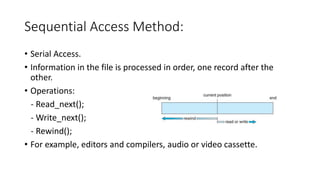
• Serial Access.
• Information in the file is processed in order, one record after the
other.
• Operations:
- Read_next();
- Write_next();
- Rewind();
• For example, editors and compilers, audio or video cassette.
Direct Access Method:
• The file is viewed as a numbered sequence of blocks or records.
• Thus, we may read block 14, then read block 53, and then write block
7.
• Operations:
- Read(n);
- Write(n);
- Goto(n);
• E.g Database System.
Index Access Method:
• We first search the index and then use the pointer to access the file
directly and to find the desired record.
• The primary index file contains the contains the pointer to secondary
index file.
• Secondary index file contains the actual index of the block of the file.
File-System Mounting
• A file must be opened before it is used.
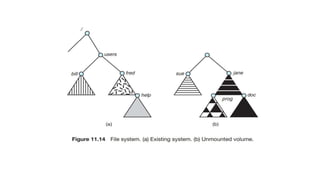
• File system must be mounted before it can be available to processes
on the system.
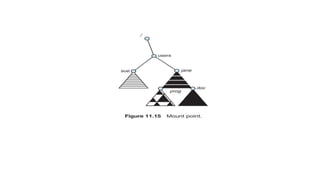
• Mount point—the location within the file structure where the file
system is to be attached.
• Typically, a mount point is an empty directory.
File-System Mounting
• For e.g external storage media (e.g CDROM and Floppy disk) are
usually mounted in subdirectory of the /mnt directory(i.e
/mnt/cdrom and /mnt/floppy).
• The mac OS X operating system searches for a file system on the
device. If it finds one, it automatically mounts the file system under
the /volumes directory, adding a folder icon labeled with the name of
the file system (as stored in the device directory).
• In some systems, like UNIX, the mount commands are explicit. A
system configuration file contains a list of devices and mount points
for automatic mounting at boot time, but other mounts may be
executed manually.

Access Methods and File System Mounting.pptx

  • 1.
    Access Methods • Computerstores many files. • Applications are used to access files. • Three ways to access files: - Sequential access method. - Direct access method. - Index access method.
  • 2.
    Sequential Access Method: •Serial Access. • Information in the file is processed in order, one record after the other. • Operations: - Read_next(); - Write_next(); - Rewind(); • For example, editors and compilers, audio or video cassette.
  • 3.
    Direct Access Method: •The file is viewed as a numbered sequence of blocks or records. • Thus, we may read block 14, then read block 53, and then write block 7. • Operations: - Read(n); - Write(n); - Goto(n); • E.g Database System.
  • 4.
    Index Access Method: •We first search the index and then use the pointer to access the file directly and to find the desired record. • The primary index file contains the contains the pointer to secondary index file. • Secondary index file contains the actual index of the block of the file.
  • 5.
    File-System Mounting • Afile must be opened before it is used. • File system must be mounted before it can be available to processes on the system. • Mount point—the location within the file structure where the file system is to be attached. • Typically, a mount point is an empty directory.
  • 8.
    File-System Mounting • Fore.g external storage media (e.g CDROM and Floppy disk) are usually mounted in subdirectory of the /mnt directory(i.e /mnt/cdrom and /mnt/floppy). • The mac OS X operating system searches for a file system on the device. If it finds one, it automatically mounts the file system under the /volumes directory, adding a folder icon labeled with the name of the file system (as stored in the device directory). • In some systems, like UNIX, the mount commands are explicit. A system configuration file contains a list of devices and mount points for automatic mounting at boot time, but other mounts may be executed manually.