
From insights to action, the path to extraordinary value starts here.
Thought you
knew the Scope 3
issues in your
supply chain?
Think again.
Gaining visibility to hidden
hot spots to move from
targets to actions to value
Thought you knew the Scope 3 issues in your supply chain? Think again. Copyright © 2022 Accenture. All rights reserved. 2
Reducing all-tier Scope 3 emissions is a
top priority for companies committed to
the decarbonization of their extended
supply networks. But it’s not just about
carbon. Eliminating Scope 3 emissions
can bring value beyond emissions.
Companies are linking sustainability outcomes to their
enterprise value creation agenda, including:
• accessing premium customer segments
• expanding market access
• improving talent retention and attraction
• lowering the cost of capital
• mitigating regulatory disruption
• improving resilience
• mitigating risk
Thought you knew the Scope 3 issues in your supply chain? Think again.
Generating these benefits starts with gaining real visibility into Scope
3 emissions. Companies need to truly understand emissions across
every tier of their supplier base to:
Identify the main
drivers of upstream
emissions
Copyright © 2022 Accenture. All rights reserved. 3
Determine what’s
strategically important
to the supply chain
Decide where to
focus their efforts
Based on our research and Accenture-developed Scope 3 data model,
we’ve identified the insights and actions that will help companies
accelerate the decarbonization of their supply chains.
Thought you knew the Scope 3 issues in your supply chain? Think again. Copyright © 2022 Accenture. All rights reserved. 4
Insight #1
Nearly two-thirds of upstream emissions lay beyond Tier 1
suppliers, and in geographically complex networks
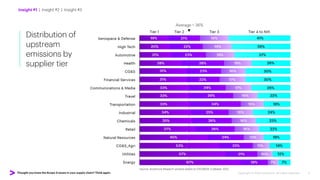
Across all industries, Tier 1 suppliers are responsible only for an average of 36% of total
upstream emissions.
Understanding multi-tier emissions—
going beyond Tier 1—is the only way to
make progress on reducing Scope 3
emissions, in every industry.
In most cases, if upstream emissions are a significant portion of a company’s total emissions,
they tend to occur deeper in the supplier network.
Sectors vary significantly in network and geographic complexity.
Insight #1 | Insight #2 | Insight #3
Thought you knew the Scope 3 issues in your supply chain? Think again. Copyright © 2022 Accenture. All rights reserved. 5
Distribution of
upstream
emissions by
supplier tier
Source: Accenture Research analysis based on EXIOBASE 3 dataset, 2022
Insight #1 | Insight #2 | Insight #3
Thought you knew the Scope 3 issues in your supply chain? Think again. Copyright © 2022 Accenture. All rights reserved. 6
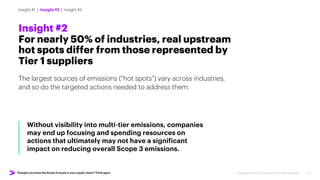
Insight #2
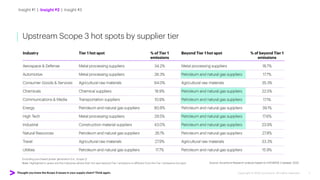
For nearly 50% of industries, real upstream
hot spots differ from those represented by
Tier 1 suppliers
The largest sources of emissions (“hot spots”) vary across industries,
and so do the targeted actions needed to address them.
Without visibility into multi-tier emissions, companies
may end up focusing and spending resources on
actions that ultimately may not have a significant
impact on reducing overall Scope 3 emissions.
Insight #1 | Insight #2 | Insight #3
Thought you knew the Scope 3 issues in your supply chain? Think again. Copyright © 2022 Accenture. All rights reserved. 7
Upstream Scope 3 hot spots by supplier tier
Source: Accenture Research analysis based on EXIOBASE 3 dataset, 2022
Excluding purchased power generation (i.e., Scope 2)
Note: Highlighted in green are the industries where their hot spot beyond Tier 1 emissions is different from the Tier 1 emissions hot spot.
Insight #1 | Insight #2 | Insight #3
Thought you knew the Scope 3 issues in your supply chain? Think again. Copyright © 2022 Accenture. All rights reserved. 8
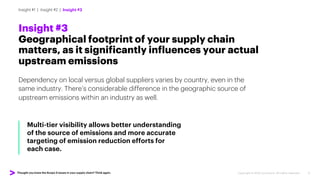
Insight #3
Geographical footprint of your supply chain
matters, as it significantly influences your actual
upstream emissions
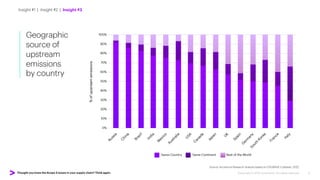
Dependency on local versus global suppliers varies by country, even in the
same industry. There’s considerable difference in the geographic source of
upstream emissions within an industry as well.
Multi-tier visibility allows better understanding
of the source of emissions and more accurate
targeting of emission reduction efforts for
each case.
Insight #1 | Insight #2 | Insight #3
Thought you knew the Scope 3 issues in your supply chain? Think again. Copyright © 2022 Accenture. All rights reserved. 9
Geographic
source of
upstream
emissions
by country
Insight #1 | Insight #2 | Insight #3
Source: Accenture Research analysis based on EXIOBASE 3 dataset, 2022
Thought you knew the Scope 3 issues in your supply chain? Think again.
Start moving faster
Copyright © 2022 Accenture. All rights reserved. 10
Thought you knew the Scope 3 issues in your supply chain? Think again. Copyright © 2022 Accenture. All rights reserved. 11
These three insights show
how transparency and
data on upstream Scope 3
can help companies make
their emissions actionable,
auditable and reportable.
But companies need more than just
visibility. To accelerate their progress
in addressing Scope 3 emissions and
generating greater enterprise value,
they also need to act.
With multi-tier visibility, companies can:
• Identify where they can reduce potential
cost, regulatory, reputation, and other risks
and pressures, across both supplier tiers
and geographies
• Make better, more informed purchasing,
design, manufacturing, planning, after-
sales services, product end-of-life and
other decisions that reduce end-to-end
supply chain emissions
• Focus the efforts of limited resources on
the areas where action can have the
biggest impact
Thought you knew the Scope 3 issues in your supply chain? Think again.
Five key actions
Copyright © 2022 Accenture. All rights reserved. 12
Thought you knew the Scope 3 issues in your supply chain? Think again. Copyright © 2022 Accenture. All rights reserved. 13
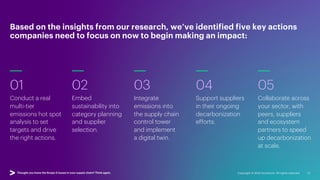
Based on the insights from our research, we’ve identified five key actions
companies need to focus on now to begin making an impact:
01
Conduct a real
multi-tier
emissions hot spot
analysis to set
targets and drive
the right actions.
02
Embed
sustainability into
category planning
and supplier
selection.
03
Integrate
emissions into
the supply chain
control tower
and implement
a digital twin.
04
Support suppliers
in their ongoing
decarbonization
efforts.
05
Collaborate across
your sector, with
peers, suppliers
and ecosystem
partners to speed
up decarbonization
at scale.
Thought you knew the Scope 3 issues in your supply chain? Think again. Copyright © 2022 Accenture. All rights reserved. 14
Action 1
Conduct a real multi-tier emissions
hot spot analysis to set targets and
drive the right actions
Upstream emissions aren’t created equal and
large sources exist hidden from normal view.
To focus on what’s most important, companies
should conduct a detailed analysis of their
supplier base to determine the biggest sources
of emissions and use it as the foundation for an
action plan to address the areas of most
significant impact.
Action 1 | Action 2 | Action 3 | Action 4 | Action 5
Thought you knew the Scope 3 issues in your supply chain? Think again. Copyright © 2022 Accenture. All rights reserved. 15
Action 2
Embed sustainability into category
planning and supplier selection
With hot spots identified, a company can integrate
activities to reduce emissions into spend category
playbooks.
Include environmental, social and governance
(ESG) criteria in every step of the sourcing and
decision-making process, and customize category
plans, including emission-reduction strategies, to
address hot spots as appropriate.
Action 1 | Action 2 | Action 3 | Action 4 | Action 5
Thought you knew the Scope 3 issues in your supply chain? Think again. Copyright © 2022 Accenture. All rights reserved. 16
Action 3
Integrate emissions into the supply chain
control tower and implement a
digital twin
Control towers can help companies reduce Scope
3 emissions by centralizing visibility and decision
making and guiding actions with short- and long-
term benefits.
A powerful complement to a control tower
is a digital twin of the supply chain that generates
the end-to-end visibility necessary to optimize
supply chain networks and simulate the carbon
footprint of the entire network.
Action 1 | Action 2 | Action 3 | Action 4 | Action 5
Thought you knew the Scope 3 issues in your supply chain? Think again. Copyright © 2022 Accenture. All rights reserved. 17
Action 4
Support suppliers in their ongoing
decarbonization efforts
Proactively work with suppliers on an ongoing
basis to help them improve their own
decarbonization performance.
A segmented supplier engagement program with
training, incentives, and improved supplier data
quality and accuracy, is critical to this effort.
Action 1 | Action 2 | Action 3 | Action 4 | Action 5
Thought you knew the Scope 3 issues in your supply chain? Think again. Copyright © 2022 Accenture. All rights reserved. 18
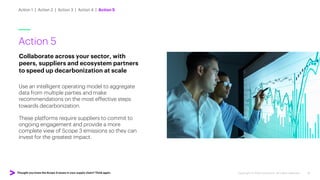
Action 5
Collaborate across your sector, with
peers, suppliers and ecosystem partners
to speed up decarbonization at scale
Use an intelligent operating model to aggregate
data from multiple parties and make
recommendations on the most effective steps
towards decarbonization.
These platforms require suppliers to commit to
ongoing engagement and provide a more
complete view of Scope 3 emissions so they can
invest for the greatest impact.
Action 1 | Action 2 | Action 3 | Action 4 | Action 5
Thought you knew the Scope 3 issues in your supply chain? Think again. Copyright © 2022 Accenture. All rights reserved. 19
It’s time to make meaningful progress
on Scope 3
The scale of the challenge in reducing Scope 3 emissions is massive. The supply chain has a
responsibility to take a leading role and expand the types of value it delivers to the business.
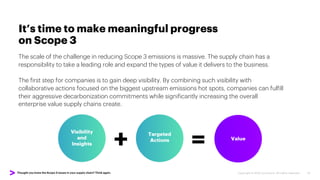
The first step for companies is to gain deep visibility. By combining such visibility with
collaborative actions focused on the biggest upstream emissions hot spots, companies can fulfill
their aggressive decarbonization commitments while significantly increasing the overall
enterprise value supply chains create.
Thought you knew the Scope 3 issues in your supply chain? Think again.
accenture.com/DecarbonizeSupplyChain
Copyright © 2022 Accenture. All rights reserved. 20

Sustainable Value Chain

  • 1.
    From insights toaction, the path to extraordinary value starts here. Thought you knew the Scope 3 issues in your supply chain? Think again. Gaining visibility to hidden hot spots to move from targets to actions to value
  • 2.
    Thought you knewthe Scope 3 issues in your supply chain? Think again. Copyright © 2022 Accenture. All rights reserved. 2 Reducing all-tier Scope 3 emissions is a top priority for companies committed to the decarbonization of their extended supply networks. But it’s not just about carbon. Eliminating Scope 3 emissions can bring value beyond emissions. Companies are linking sustainability outcomes to their enterprise value creation agenda, including: • accessing premium customer segments • expanding market access • improving talent retention and attraction • lowering the cost of capital • mitigating regulatory disruption • improving resilience • mitigating risk
  • 3.
    Thought you knewthe Scope 3 issues in your supply chain? Think again. Thought you knew the Scope 3 issues in your supply chain? Think again. Generating these benefits starts with gaining real visibility into Scope 3 emissions. Companies need to truly understand emissions across every tier of their supplier base to: Identify the main drivers of upstream emissions Copyright © 2022 Accenture. All rights reserved. 3 Determine what’s strategically important to the supply chain Decide where to focus their efforts Based on our research and Accenture-developed Scope 3 data model, we’ve identified the insights and actions that will help companies accelerate the decarbonization of their supply chains.
  • 4.
    Thought you knewthe Scope 3 issues in your supply chain? Think again. Copyright © 2022 Accenture. All rights reserved. 4 Insight #1 Nearly two-thirds of upstream emissions lay beyond Tier 1 suppliers, and in geographically complex networks Across all industries, Tier 1 suppliers are responsible only for an average of 36% of total upstream emissions. Understanding multi-tier emissions— going beyond Tier 1—is the only way to make progress on reducing Scope 3 emissions, in every industry. In most cases, if upstream emissions are a significant portion of a company’s total emissions, they tend to occur deeper in the supplier network. Sectors vary significantly in network and geographic complexity. Insight #1 | Insight #2 | Insight #3
  • 5.
    Thought you knewthe Scope 3 issues in your supply chain? Think again. Copyright © 2022 Accenture. All rights reserved. 5 Distribution of upstream emissions by supplier tier Source: Accenture Research analysis based on EXIOBASE 3 dataset, 2022 Insight #1 | Insight #2 | Insight #3
  • 6.
    Thought you knewthe Scope 3 issues in your supply chain? Think again. Copyright © 2022 Accenture. All rights reserved. 6 Insight #2 For nearly 50% of industries, real upstream hot spots differ from those represented by Tier 1 suppliers The largest sources of emissions (“hot spots”) vary across industries, and so do the targeted actions needed to address them. Without visibility into multi-tier emissions, companies may end up focusing and spending resources on actions that ultimately may not have a significant impact on reducing overall Scope 3 emissions. Insight #1 | Insight #2 | Insight #3
  • 7.
    Thought you knewthe Scope 3 issues in your supply chain? Think again. Copyright © 2022 Accenture. All rights reserved. 7 Upstream Scope 3 hot spots by supplier tier Source: Accenture Research analysis based on EXIOBASE 3 dataset, 2022 Excluding purchased power generation (i.e., Scope 2) Note: Highlighted in green are the industries where their hot spot beyond Tier 1 emissions is different from the Tier 1 emissions hot spot. Insight #1 | Insight #2 | Insight #3
  • 8.
    Thought you knewthe Scope 3 issues in your supply chain? Think again. Copyright © 2022 Accenture. All rights reserved. 8 Insight #3 Geographical footprint of your supply chain matters, as it significantly influences your actual upstream emissions Dependency on local versus global suppliers varies by country, even in the same industry. There’s considerable difference in the geographic source of upstream emissions within an industry as well. Multi-tier visibility allows better understanding of the source of emissions and more accurate targeting of emission reduction efforts for each case. Insight #1 | Insight #2 | Insight #3
  • 9.
    Thought you knewthe Scope 3 issues in your supply chain? Think again. Copyright © 2022 Accenture. All rights reserved. 9 Geographic source of upstream emissions by country Insight #1 | Insight #2 | Insight #3 Source: Accenture Research analysis based on EXIOBASE 3 dataset, 2022
  • 10.
    Thought you knewthe Scope 3 issues in your supply chain? Think again. Start moving faster Copyright © 2022 Accenture. All rights reserved. 10
  • 11.
    Thought you knewthe Scope 3 issues in your supply chain? Think again. Copyright © 2022 Accenture. All rights reserved. 11 These three insights show how transparency and data on upstream Scope 3 can help companies make their emissions actionable, auditable and reportable. But companies need more than just visibility. To accelerate their progress in addressing Scope 3 emissions and generating greater enterprise value, they also need to act. With multi-tier visibility, companies can: • Identify where they can reduce potential cost, regulatory, reputation, and other risks and pressures, across both supplier tiers and geographies • Make better, more informed purchasing, design, manufacturing, planning, after- sales services, product end-of-life and other decisions that reduce end-to-end supply chain emissions • Focus the efforts of limited resources on the areas where action can have the biggest impact
  • 12.
    Thought you knewthe Scope 3 issues in your supply chain? Think again. Five key actions Copyright © 2022 Accenture. All rights reserved. 12
  • 13.
    Thought you knewthe Scope 3 issues in your supply chain? Think again. Copyright © 2022 Accenture. All rights reserved. 13 Based on the insights from our research, we’ve identified five key actions companies need to focus on now to begin making an impact: 01 Conduct a real multi-tier emissions hot spot analysis to set targets and drive the right actions. 02 Embed sustainability into category planning and supplier selection. 03 Integrate emissions into the supply chain control tower and implement a digital twin. 04 Support suppliers in their ongoing decarbonization efforts. 05 Collaborate across your sector, with peers, suppliers and ecosystem partners to speed up decarbonization at scale.
  • 14.
    Thought you knewthe Scope 3 issues in your supply chain? Think again. Copyright © 2022 Accenture. All rights reserved. 14 Action 1 Conduct a real multi-tier emissions hot spot analysis to set targets and drive the right actions Upstream emissions aren’t created equal and large sources exist hidden from normal view. To focus on what’s most important, companies should conduct a detailed analysis of their supplier base to determine the biggest sources of emissions and use it as the foundation for an action plan to address the areas of most significant impact. Action 1 | Action 2 | Action 3 | Action 4 | Action 5
  • 15.
    Thought you knewthe Scope 3 issues in your supply chain? Think again. Copyright © 2022 Accenture. All rights reserved. 15 Action 2 Embed sustainability into category planning and supplier selection With hot spots identified, a company can integrate activities to reduce emissions into spend category playbooks. Include environmental, social and governance (ESG) criteria in every step of the sourcing and decision-making process, and customize category plans, including emission-reduction strategies, to address hot spots as appropriate. Action 1 | Action 2 | Action 3 | Action 4 | Action 5
  • 16.
    Thought you knewthe Scope 3 issues in your supply chain? Think again. Copyright © 2022 Accenture. All rights reserved. 16 Action 3 Integrate emissions into the supply chain control tower and implement a digital twin Control towers can help companies reduce Scope 3 emissions by centralizing visibility and decision making and guiding actions with short- and long- term benefits. A powerful complement to a control tower is a digital twin of the supply chain that generates the end-to-end visibility necessary to optimize supply chain networks and simulate the carbon footprint of the entire network. Action 1 | Action 2 | Action 3 | Action 4 | Action 5
  • 17.
    Thought you knewthe Scope 3 issues in your supply chain? Think again. Copyright © 2022 Accenture. All rights reserved. 17 Action 4 Support suppliers in their ongoing decarbonization efforts Proactively work with suppliers on an ongoing basis to help them improve their own decarbonization performance. A segmented supplier engagement program with training, incentives, and improved supplier data quality and accuracy, is critical to this effort. Action 1 | Action 2 | Action 3 | Action 4 | Action 5
  • 18.
    Thought you knewthe Scope 3 issues in your supply chain? Think again. Copyright © 2022 Accenture. All rights reserved. 18 Action 5 Collaborate across your sector, with peers, suppliers and ecosystem partners to speed up decarbonization at scale Use an intelligent operating model to aggregate data from multiple parties and make recommendations on the most effective steps towards decarbonization. These platforms require suppliers to commit to ongoing engagement and provide a more complete view of Scope 3 emissions so they can invest for the greatest impact. Action 1 | Action 2 | Action 3 | Action 4 | Action 5
  • 19.
    Thought you knewthe Scope 3 issues in your supply chain? Think again. Copyright © 2022 Accenture. All rights reserved. 19 It’s time to make meaningful progress on Scope 3 The scale of the challenge in reducing Scope 3 emissions is massive. The supply chain has a responsibility to take a leading role and expand the types of value it delivers to the business. The first step for companies is to gain deep visibility. By combining such visibility with collaborative actions focused on the biggest upstream emissions hot spots, companies can fulfill their aggressive decarbonization commitments while significantly increasing the overall enterprise value supply chains create.
  • 20.
    Thought you knewthe Scope 3 issues in your supply chain? Think again. accenture.com/DecarbonizeSupplyChain Copyright © 2022 Accenture. All rights reserved. 20