LABOUR COSTS-Aims of the
Session
• To understand the different ways employees
can be rewarded financially
• To understand different incentive schemes
• To understand how to account for labour
costs
LABOUR REMUNERATION
• Time based where output varies, difficult to
measure and quality of output important
Eg Carol is employed by H Limited. She works a
basic week of 30 hours and is paid £8 per
hour. If she works overtime this is paid at a
premium of 50 per cent above her normal
hourly rate (this is known as ‘time-and-a-
half’). During the week ended 4 July she
worked 35 hours.
LABOUR REMUNERATION
• Time based where output varies, difficult to
measure and quality of output important
Eg Carl is employed by W Limited. She works a
basic week of 35 hours and is paid £9 per
hour. If he works overtime this is paid at a
premium of 50 per cent above her normal
hourly rate (this is known as ‘time-and-a-
half’). During the week ended 4 July she
worked 40 hours. What is he paid?
LABOUR REMUNERATION
 Monday 9 hours
 Tuesday 8 hours
 Wednesday 10 hours
 Thursday 10 hours
 Friday 8 hours
 Saturday 8 hours
If standard working week is 35 hours, and any
weekday overtime is time and a half, while it is
double time at the weekend, what is the wage if
standard rate per hour is £8/hour?
LABOUR REMUNERATION
 Monday 12 hours
 Tuesday 9 hours
 Wednesday 10 hours
 Thursday 10 hours
 Friday 10 hours
 Saturday and Sunday 8 hours per day
If standard working week is 40 hours, and any
weekday overtime is time and a half, while it is
double time at the weekend, what is the wage if
standard rate per hour is £9/hour?
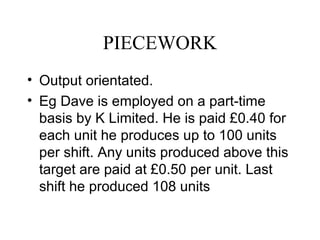
PIECEWORK
• Output orientated.
• Eg Dave is employed on a part-time
basis by K Limited. He is paid £0.40 for
each unit he produces up to 100 units
per shift. Any units produced above this
target are paid at £0.50 per unit. Last
shift he produced 108 units
PIECEWORK
• Output orientated.
• Eg Ron is employed on a part-time
basis by A Limited. He is paid £0.50 for
each unit he produces up to 80 units
per shift. Any units produced above this
target are paid at £0.60 per unit. Last
shift he produced 103 units. What is he
paid?
PIECEWORK
• Number Amount per item
0-19 50p
20-29 60p
30-39 65p
40+ 70p
How much paid if produce 38 units per hour?
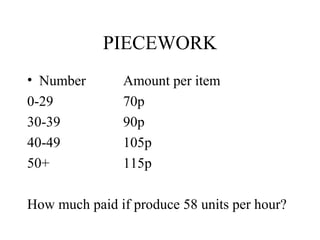
PIECEWORK
• Number Amount per item
0-29 70p
30-39 90p
40-49 105p
50+ 115p
How much paid if produce 58 units per hour?
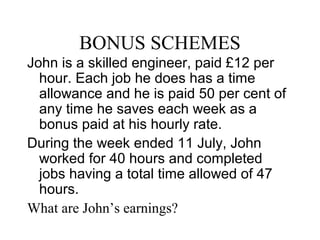
BONUS SCHEMES
John is a skilled engineer, paid £12 per
hour. Each job he does has a time
allowance and he is paid 50 per cent of
any time he saves each week as a
bonus paid at his hourly rate.
During the week ended 11 July, John
worked for 40 hours and completed
jobs having a total time allowed of 47
hours.
What are John’s earnings?
BONUS SCHEMES
Fred is a skilled engineer, paid £15 per
hour. Each job he does has a time
allowance and he is paid 40 per cent of
any time he saves each week as a
bonus paid at his hourly rate.
During the week ended 11 July, Fred
worked for 39 hours and completed
jobs having a total time allowed of 49
hours.
What are Fred’s earnings?
GROUP INCENTIVE
SCHEMES
• Why– not possible to measure individual
performance, work in groups, production
integrated
• Advantages- non-production employees
included, team spirit, reduces admin. Time
• Disadvantages- lazy members, negotiating
terms, may demotivate
MINIMUM WAGE
• May be included when completing
piecework or when making sales (basic+)
• If Dave had only produced 50 units but
was entitled to a guaranteed minimum
wage of £30 per shift, he would receive
£30 even though his piecework
earnings were only 50 x £0.40 = £20.
RECORDING TIME
• Clock cards
• Flexible time workers
• Activity recording devices
• Timesheets
ACCOUNTING FOR LABOUR
• Overtime premium
• Bonus earnings
• Idle time
• Sickness
• Diverted hours
If overtime relates specifically to the
production of a particular unit then deemed
to be a direct cost
SUMMARY
You should now be able to:
Describe different labour costing methods
Calculate the labour cost using a range of
different methods
Explain the benefits and disadvantages of
the different methods
Understand how to account for labour costs

Labour costs

  • 1.
    LABOUR COSTS-Aims ofthe Session • To understand the different ways employees can be rewarded financially • To understand different incentive schemes • To understand how to account for labour costs
  • 2.
    LABOUR REMUNERATION • Timebased where output varies, difficult to measure and quality of output important Eg Carol is employed by H Limited. She works a basic week of 30 hours and is paid £8 per hour. If she works overtime this is paid at a premium of 50 per cent above her normal hourly rate (this is known as ‘time-and-a- half’). During the week ended 4 July she worked 35 hours.
  • 3.
    LABOUR REMUNERATION • Timebased where output varies, difficult to measure and quality of output important Eg Carl is employed by W Limited. She works a basic week of 35 hours and is paid £9 per hour. If he works overtime this is paid at a premium of 50 per cent above her normal hourly rate (this is known as ‘time-and-a- half’). During the week ended 4 July she worked 40 hours. What is he paid?
  • 4.
    LABOUR REMUNERATION  Monday9 hours  Tuesday 8 hours  Wednesday 10 hours  Thursday 10 hours  Friday 8 hours  Saturday 8 hours If standard working week is 35 hours, and any weekday overtime is time and a half, while it is double time at the weekend, what is the wage if standard rate per hour is £8/hour?
  • 5.
    LABOUR REMUNERATION  Monday12 hours  Tuesday 9 hours  Wednesday 10 hours  Thursday 10 hours  Friday 10 hours  Saturday and Sunday 8 hours per day If standard working week is 40 hours, and any weekday overtime is time and a half, while it is double time at the weekend, what is the wage if standard rate per hour is £9/hour?
  • 6.
    PIECEWORK • Output orientated. •Eg Dave is employed on a part-time basis by K Limited. He is paid £0.40 for each unit he produces up to 100 units per shift. Any units produced above this target are paid at £0.50 per unit. Last shift he produced 108 units
  • 7.
    PIECEWORK • Output orientated. •Eg Ron is employed on a part-time basis by A Limited. He is paid £0.50 for each unit he produces up to 80 units per shift. Any units produced above this target are paid at £0.60 per unit. Last shift he produced 103 units. What is he paid?
  • 8.
    PIECEWORK • Number Amountper item 0-19 50p 20-29 60p 30-39 65p 40+ 70p How much paid if produce 38 units per hour?
  • 9.
    PIECEWORK • Number Amountper item 0-29 70p 30-39 90p 40-49 105p 50+ 115p How much paid if produce 58 units per hour?
  • 10.
    BONUS SCHEMES John isa skilled engineer, paid £12 per hour. Each job he does has a time allowance and he is paid 50 per cent of any time he saves each week as a bonus paid at his hourly rate. During the week ended 11 July, John worked for 40 hours and completed jobs having a total time allowed of 47 hours. What are John’s earnings?
  • 11.
    BONUS SCHEMES Fred isa skilled engineer, paid £15 per hour. Each job he does has a time allowance and he is paid 40 per cent of any time he saves each week as a bonus paid at his hourly rate. During the week ended 11 July, Fred worked for 39 hours and completed jobs having a total time allowed of 49 hours. What are Fred’s earnings?
  • 12.
    GROUP INCENTIVE SCHEMES • Why–not possible to measure individual performance, work in groups, production integrated • Advantages- non-production employees included, team spirit, reduces admin. Time • Disadvantages- lazy members, negotiating terms, may demotivate
  • 13.
    MINIMUM WAGE • Maybe included when completing piecework or when making sales (basic+) • If Dave had only produced 50 units but was entitled to a guaranteed minimum wage of £30 per shift, he would receive £30 even though his piecework earnings were only 50 x £0.40 = £20.
  • 14.
    RECORDING TIME • Clockcards • Flexible time workers • Activity recording devices • Timesheets
  • 15.
    ACCOUNTING FOR LABOUR •Overtime premium • Bonus earnings • Idle time • Sickness • Diverted hours If overtime relates specifically to the production of a particular unit then deemed to be a direct cost
  • 16.
    SUMMARY You should nowbe able to: Describe different labour costing methods Calculate the labour cost using a range of different methods Explain the benefits and disadvantages of the different methods Understand how to account for labour costs