
writing
publishing
europe
pat thomson
2017
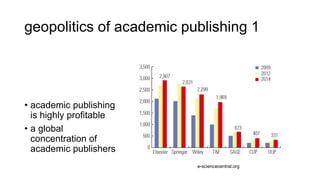
geopolitics of academic publishing 1
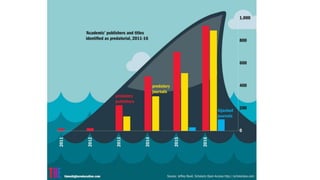
• academic publishing
is highly profitable
• a global
concentration of
academic publishers
e-sciencecentral.org
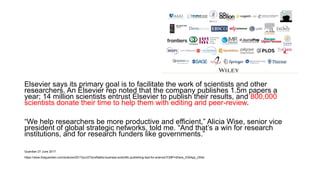
Elsevier says its primary goal is to facilitate the work of scientists and other
researchers. An Elsevier rep noted that the company publishes 1.5m papers a
year; 14 million scientists entrust Elsevier to publish their results, and 800,000
scientists donate their time to help them with editing and peer-review.
“We help researchers be more productive and efficient,” Alicia Wise, senior vice
president of global strategic networks, told me. “And that’s a win for research
institutions, and for research funders like governments.”
Guardian 27 June 2017
https://www.theguardian.com/science/2017/jun/27/profitable-business-scientific-publishing-bad-for-science?CMP=Share_iOSApp_Other
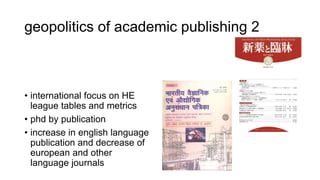
geopolitics of academic publishing 2
• international focus on HE
league tables and metrics
• phd by publication
• increase in english language
publication and decrease of
european and other
language journals
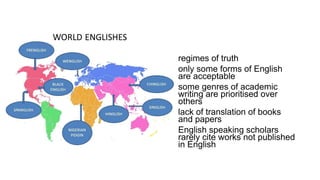
• regimes of truth
• only some forms of English
are acceptable
• some genres of academic
writing are prioritised over
others
• lack of translation of books
and papers
• English speaking scholars
rarely cite works not published
in English
some important concepts are
untranslatable
we are still teaching people to write monographs as phds
but
most academic monographs sell around 350 copies. this is the point at which
they become profitable. some specialised books sell as little as 50 copies.
and global un-evenness
“academic books in africa, despite being produced and available for at least
half a century, are now a rare sight to behold in the continent’s academic
institutions.” dr ola ukulu.
strong continuities
the scriptural economy
The mastery of language guarantees and isolates a new power ,
a “bourgeois’ power, that of making history and fabricating
languages. This power, which is essentially scriptural, challenges
not only the privilege of birth that is, of the aristocracy, but also
defines the code governing socioeconomic promotion and
dominates, regulates, or selects according to its norms all those
who do not possess this mastery of language.
De Certeau 1987 p. 139
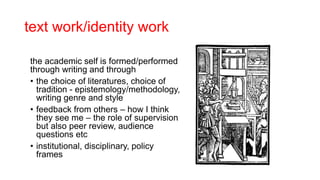
text work/identity work
the academic self is formed/performed
through writing and through
• the choice of literatures, choice of
tradition - epistemology/methodology,
writing genre and style
• feedback from others – how I think
they see me – the role of supervision
but also peer review, audience
questions etc
• institutional, disciplinary, policy
frames
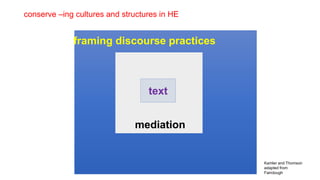
mediaytext
mediation
framing discourse practices
conserve –ing cultures and structures in HE
Kamler and Thomson
adapted from
Fairclough
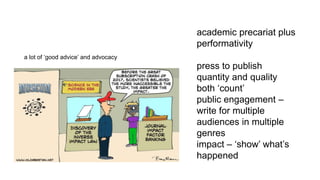
academic precariat plus
performativity
press to publish
quantity and quality
both ‘count’
public engagement –
write for multiple
audiences in multiple
genres
impact – ‘show’ what’s
happened
a lot of ‘good advice’ and advocacy
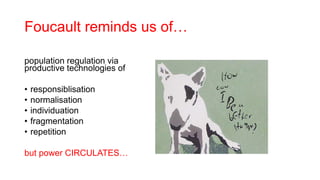
Foucault reminds us of…
population regulation via
productive technologies of
• responsiblisation
• normalisation
• individuation
• fragmentation
• repetition
but power CIRCULATES…
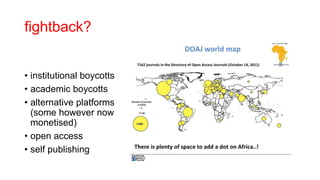
fightback?
• institutional boycotts
• academic boycotts
• alternative platforms
(some however now
monetised)
• open access
• self publishing
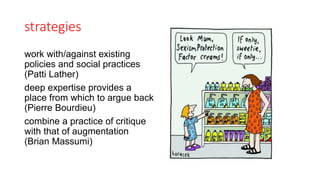
strategies
work with/against existing
policies and social practices
(Patti Lather)
deep expertise provides a
place from which to argue back
(Pierre Bourdieu)
combine a practice of critique
with that of augmentation
(Brian Massumi)
reflexivity - margaret archer
reflexivity: “the regular
exercise of the mental ability,
shared by all (normal)
people, to consider
themselves in relation to
their (social) contexts and
vice versa.”
reflexivity mediates
structural /cultural influences
on the courses of action we
take
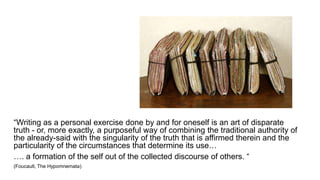
“Writing as a personal exercise done by and for oneself is an art of disparate
truth - or, more exactly, a purposeful way of combining the traditional authority of
the already-said with the singularity of the truth that is affirmed therein and the
particularity of the circumstances that determine its use…
…. a formation of the self out of the collected discourse of others. “
(Foucault, The Hypomnemata)
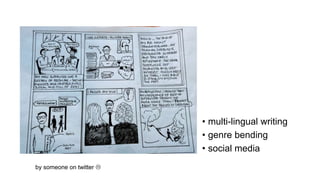
• multi-lingual writing
• genre bending
• social media
by someone on twitter 
collaboration
“It is no accident that both my research and writing partners are also second
wave feminists, generationally disposed to believe that there is strength in
solidarity, joy in the kinds of intimacy that shared experiences can bring, and
power in bringing more than one mind and body to an activity. Working
together is a safety net, a way to get things done, but also an ongoing
source of inspiration and support.
But long term research and writing relationships are more than simply
instrumental. They require trust built on shared values, beliefs and
experiences.
They bring satisfaction in joint achievement, comfort in the face of
institutional unreason, moments of revelry, excitement and mirth. They are,
to be somewhat trite, shelter in the higher education storm.”
( me, in press)

Academic writing publishing: SUSSEES 2017

  • 1.
  • 2.
    geopolitics of academicpublishing 1 • academic publishing is highly profitable • a global concentration of academic publishers e-sciencecentral.org
  • 3.
    Elsevier says itsprimary goal is to facilitate the work of scientists and other researchers. An Elsevier rep noted that the company publishes 1.5m papers a year; 14 million scientists entrust Elsevier to publish their results, and 800,000 scientists donate their time to help them with editing and peer-review. “We help researchers be more productive and efficient,” Alicia Wise, senior vice president of global strategic networks, told me. “And that’s a win for research institutions, and for research funders like governments.” Guardian 27 June 2017 https://www.theguardian.com/science/2017/jun/27/profitable-business-scientific-publishing-bad-for-science?CMP=Share_iOSApp_Other
  • 6.
    geopolitics of academicpublishing 2 • international focus on HE league tables and metrics • phd by publication • increase in english language publication and decrease of european and other language journals
  • 7.
    • regimes oftruth • only some forms of English are acceptable • some genres of academic writing are prioritised over others • lack of translation of books and papers • English speaking scholars rarely cite works not published in English
  • 8.
    some important conceptsare untranslatable
  • 9.
    we are stillteaching people to write monographs as phds but most academic monographs sell around 350 copies. this is the point at which they become profitable. some specialised books sell as little as 50 copies. and global un-evenness “academic books in africa, despite being produced and available for at least half a century, are now a rare sight to behold in the continent’s academic institutions.” dr ola ukulu.
  • 10.
    strong continuities the scripturaleconomy The mastery of language guarantees and isolates a new power , a “bourgeois’ power, that of making history and fabricating languages. This power, which is essentially scriptural, challenges not only the privilege of birth that is, of the aristocracy, but also defines the code governing socioeconomic promotion and dominates, regulates, or selects according to its norms all those who do not possess this mastery of language. De Certeau 1987 p. 139
  • 11.
    text work/identity work theacademic self is formed/performed through writing and through • the choice of literatures, choice of tradition - epistemology/methodology, writing genre and style • feedback from others – how I think they see me – the role of supervision but also peer review, audience questions etc • institutional, disciplinary, policy frames
  • 12.
    mediaytext mediation framing discourse practices conserve–ing cultures and structures in HE Kamler and Thomson adapted from Fairclough
  • 13.
    academic precariat plus performativity pressto publish quantity and quality both ‘count’ public engagement – write for multiple audiences in multiple genres impact – ‘show’ what’s happened a lot of ‘good advice’ and advocacy
  • 14.
    Foucault reminds usof… population regulation via productive technologies of • responsiblisation • normalisation • individuation • fragmentation • repetition but power CIRCULATES…
  • 15.
    fightback? • institutional boycotts •academic boycotts • alternative platforms (some however now monetised) • open access • self publishing
  • 16.
    strategies work with/against existing policiesand social practices (Patti Lather) deep expertise provides a place from which to argue back (Pierre Bourdieu) combine a practice of critique with that of augmentation (Brian Massumi)
  • 17.
    reflexivity - margaretarcher reflexivity: “the regular exercise of the mental ability, shared by all (normal) people, to consider themselves in relation to their (social) contexts and vice versa.” reflexivity mediates structural /cultural influences on the courses of action we take
  • 18.
    “Writing as apersonal exercise done by and for oneself is an art of disparate truth - or, more exactly, a purposeful way of combining the traditional authority of the already-said with the singularity of the truth that is affirmed therein and the particularity of the circumstances that determine its use… …. a formation of the self out of the collected discourse of others. “ (Foucault, The Hypomnemata)
  • 19.
    • multi-lingual writing •genre bending • social media by someone on twitter 
  • 20.
    collaboration “It is noaccident that both my research and writing partners are also second wave feminists, generationally disposed to believe that there is strength in solidarity, joy in the kinds of intimacy that shared experiences can bring, and power in bringing more than one mind and body to an activity. Working together is a safety net, a way to get things done, but also an ongoing source of inspiration and support. But long term research and writing relationships are more than simply instrumental. They require trust built on shared values, beliefs and experiences. They bring satisfaction in joint achievement, comfort in the face of institutional unreason, moments of revelry, excitement and mirth. They are, to be somewhat trite, shelter in the higher education storm.” ( me, in press)