ACADEMIC POOR PERFORMANCE
Understanding the Probable Causes
Picture source-kotomatrix.ru/abyss/22396/
Common perceived causes
 Laziness
 Distractions
 Company of
students(e.g., friends
not academically
inclined)
 Poor teaching
techniques
Rima Sehgal PhD rima.sehgal@fulbrightmail.org
Picture source-Newslocker.com
Evidence Based Causes of Poor
Performance
 PSYCHOLOGICAL
 SOCIAL AND
ENVIRONMENTAL
 NEUROLOGICAL-
COGNITIVE
 PHYSICAL/HEALTH
Rima Sehgal PhD rima.sehgal@fulbrightmail.org
Picture source: punjab.news18.com
Psychological - (individual/ emotional problems)
 Self-concept
 Psychological disorders-Most frequent psychological
disorders include examination phobia, conduct
disorder, adjustment, separation anxiety, anxiety,
anger, fear, and learning disability.
 Personality-Conscientious people are defined as
highly responsible, achievement - oriented and
industrious learners. Such characteristics make them
determined and resolved to gain high academic
attainments. (Bratko et al., 2006)
 Lack of commitment/motivation to study
 Time management.
 Medium of instruction at colleges/ universities is
English.
 Problems with subject content and examinations
Rima Sehgal PhD rima.sehgal@fulbrightmail.org
Factors that intervene with student’s motivation.
 Fear of making mistakes/ failure due to resulting
humiliation
 Lack of challenge- boredom ( inability to understand
or too easy to comprehend for “gifted’)
 Lack of meaning- no connection with own life;
inability to comprehend the experience e.g., a
dysgraphia may find writing irrelevant due to
repeated failures.
 Emotional problems- such as anger or fear.
 Attention seeking behavior- Problem with academics
can gain support and attention. Attention for
children is a powerful motivator.
 SLD
Rima Sehgal PhD rima.sehgal@fulbrightmail.org
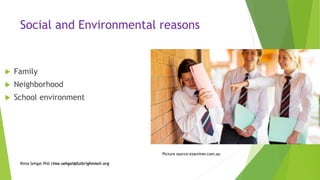
Social and Environmental reasons
 Family
 Neighborhood
 School environment
Rima Sehgal PhD rima.sehgal@fulbrightmail.org
Picture source:examiner.com.au
Familial factors
 A broken home -divorce, separation, death of
one of parent and illegitimacy
 Lack of parental academic involvement, - lower
maternal education and family background
 Authoritative parenting has been shown to be
a significant predictor of self-efficacy and
resilience and positively correlates with
academic achievement.
 Poverty- According to a research, children living
below the poverty threshold are 1.3 times as
likely as nonpoor children to experience learning
disabilities, cognitive and developmental delays.
 Abuse- Physical, Verbal or Sexual
 Drug addiction or Alcoholism.
 Incurable diseases (of one of the parents or
close relatives).
Rima Sehgal PhD rima.sehgal@fulbrightmail.org
Picture source: scoop.it
Neighborhood
 Lack of role models in the low academic
progression areas.
 Teaching work force and learning resources
available in schools in high poverty areas
are not as rigorous as those in posh/urban
schools.
 High risk behaviours such as drug abuse—
marijuana, stealing, participating in group
against group fight has been commonly
found in deprived localities.
Rima Sehgal PhD rima.sehgal@fulbrightmail.org
Picture source: Flickr.com
Neuro-cognitive
• Below average intelligence
• specific learning disorder-such as Dyslexia, Dyscalculia- A disorder that affects
a child's ability to interpret what they see and hear or to link information
from different parts of the brain.
• Attention deficit and hyperactivity disorder- Three main signs, or symptoms,
of ADHD. These are: problems with paying attention, being very active (called
hyperactivity), and acting before thinking (called impulsivity).
• Learning difficulties are more common than you think. Keep in mind that
learning difficulties don’t imply mental retardation.
• These difficulties can affect a child to a greater or lesser degree depending on
the case. It is always necessary to put into practice a sustainable strategy to
solve the problem.
• Unfortunately, due to a lack of information, the term “problem child” is often
used and the condition goes untreated. Detecting and treating the disorder
will help improve the child’s academic performance.
Rima Sehgal PhD rima.sehgal@fulbrightmail.org
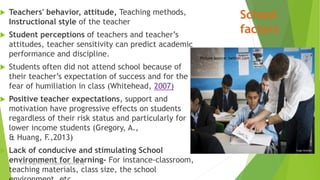
School
factors
 Teachers' behavior, attitude, Teaching methods,
Instructional style of the teacher
 Student perceptions of teachers and teacher’s
attitudes, teacher sensitivity can predict academic
performance and discipline.
 Students often did not attend school because of
their teacher’s expectation of success and for the
fear of humiliation in class (Whitehead, 2007)
 Positive teacher expectations, support and
motivation have progressive effects on students
regardless of their risk status and particularly for
lower income students (Gregory, A.,
& Huang, F.,2013)
 Lack of conducive and stimulating School
environment for learning- For instance-classroom,
teaching materials, class size, the school
Rima Sehgal PhD rima.sehgal@fulbrightmail.org
Picture source: twitter.com
Physiological-Health factors
 Hearing loss
 Visualization impairment
 Allergy-related problems, asthma,
sickle cell anemia and childhood
diabetic.
 Motor impairments or orthopedic
make it difficult to interact with
others and to explore their
environment.
 Neurological and physiological
based learning problems intrusive
with their traits to learn.Rima Sehgal PhD rima.sehgal@fulbrightmail.org
Picture source: Pinterest.com
PREVENTION POSSIBILITIES
 Identify the causes and nature of challenges in academics at an early age with the help of school counsellor,
teachers and parents.
 Plan an Individualized intervention; reinforcing the efforts and improvements.
 Help students with self-determining learning and study skills during the institutional years
 Approaches using individualized profile of students’ study style and providing study skills, peer tutoring are
helpful.
 Recognize Individual Differences. Not everyone can excel in academics similarly.
Rima Sehgal PhD
rima.sehgal@fulbrightmail.org

Academic poor performance

  • 1.
    ACADEMIC POOR PERFORMANCE Understandingthe Probable Causes Picture source-kotomatrix.ru/abyss/22396/
  • 2.
    Common perceived causes Laziness  Distractions  Company of students(e.g., friends not academically inclined)  Poor teaching techniques Rima Sehgal PhD rima.sehgal@fulbrightmail.org Picture source-Newslocker.com
  • 3.
    Evidence Based Causesof Poor Performance  PSYCHOLOGICAL  SOCIAL AND ENVIRONMENTAL  NEUROLOGICAL- COGNITIVE  PHYSICAL/HEALTH Rima Sehgal PhD rima.sehgal@fulbrightmail.org Picture source: punjab.news18.com
  • 4.
    Psychological - (individual/emotional problems)  Self-concept  Psychological disorders-Most frequent psychological disorders include examination phobia, conduct disorder, adjustment, separation anxiety, anxiety, anger, fear, and learning disability.  Personality-Conscientious people are defined as highly responsible, achievement - oriented and industrious learners. Such characteristics make them determined and resolved to gain high academic attainments. (Bratko et al., 2006)  Lack of commitment/motivation to study  Time management.  Medium of instruction at colleges/ universities is English.  Problems with subject content and examinations Rima Sehgal PhD rima.sehgal@fulbrightmail.org
  • 5.
    Factors that intervenewith student’s motivation.  Fear of making mistakes/ failure due to resulting humiliation  Lack of challenge- boredom ( inability to understand or too easy to comprehend for “gifted’)  Lack of meaning- no connection with own life; inability to comprehend the experience e.g., a dysgraphia may find writing irrelevant due to repeated failures.  Emotional problems- such as anger or fear.  Attention seeking behavior- Problem with academics can gain support and attention. Attention for children is a powerful motivator.  SLD Rima Sehgal PhD rima.sehgal@fulbrightmail.org
  • 6.
    Social and Environmentalreasons  Family  Neighborhood  School environment Rima Sehgal PhD rima.sehgal@fulbrightmail.org Picture source:examiner.com.au
  • 7.
    Familial factors  Abroken home -divorce, separation, death of one of parent and illegitimacy  Lack of parental academic involvement, - lower maternal education and family background  Authoritative parenting has been shown to be a significant predictor of self-efficacy and resilience and positively correlates with academic achievement.  Poverty- According to a research, children living below the poverty threshold are 1.3 times as likely as nonpoor children to experience learning disabilities, cognitive and developmental delays.  Abuse- Physical, Verbal or Sexual  Drug addiction or Alcoholism.  Incurable diseases (of one of the parents or close relatives). Rima Sehgal PhD rima.sehgal@fulbrightmail.org Picture source: scoop.it
  • 8.
    Neighborhood  Lack ofrole models in the low academic progression areas.  Teaching work force and learning resources available in schools in high poverty areas are not as rigorous as those in posh/urban schools.  High risk behaviours such as drug abuse— marijuana, stealing, participating in group against group fight has been commonly found in deprived localities. Rima Sehgal PhD rima.sehgal@fulbrightmail.org Picture source: Flickr.com
  • 9.
    Neuro-cognitive • Below averageintelligence • specific learning disorder-such as Dyslexia, Dyscalculia- A disorder that affects a child's ability to interpret what they see and hear or to link information from different parts of the brain. • Attention deficit and hyperactivity disorder- Three main signs, or symptoms, of ADHD. These are: problems with paying attention, being very active (called hyperactivity), and acting before thinking (called impulsivity). • Learning difficulties are more common than you think. Keep in mind that learning difficulties don’t imply mental retardation. • These difficulties can affect a child to a greater or lesser degree depending on the case. It is always necessary to put into practice a sustainable strategy to solve the problem. • Unfortunately, due to a lack of information, the term “problem child” is often used and the condition goes untreated. Detecting and treating the disorder will help improve the child’s academic performance. Rima Sehgal PhD rima.sehgal@fulbrightmail.org
  • 10.
    School factors  Teachers' behavior,attitude, Teaching methods, Instructional style of the teacher  Student perceptions of teachers and teacher’s attitudes, teacher sensitivity can predict academic performance and discipline.  Students often did not attend school because of their teacher’s expectation of success and for the fear of humiliation in class (Whitehead, 2007)  Positive teacher expectations, support and motivation have progressive effects on students regardless of their risk status and particularly for lower income students (Gregory, A., & Huang, F.,2013)  Lack of conducive and stimulating School environment for learning- For instance-classroom, teaching materials, class size, the school Rima Sehgal PhD rima.sehgal@fulbrightmail.org Picture source: twitter.com
  • 11.
    Physiological-Health factors  Hearingloss  Visualization impairment  Allergy-related problems, asthma, sickle cell anemia and childhood diabetic.  Motor impairments or orthopedic make it difficult to interact with others and to explore their environment.  Neurological and physiological based learning problems intrusive with their traits to learn.Rima Sehgal PhD rima.sehgal@fulbrightmail.org Picture source: Pinterest.com
  • 12.
    PREVENTION POSSIBILITIES  Identifythe causes and nature of challenges in academics at an early age with the help of school counsellor, teachers and parents.  Plan an Individualized intervention; reinforcing the efforts and improvements.  Help students with self-determining learning and study skills during the institutional years  Approaches using individualized profile of students’ study style and providing study skills, peer tutoring are helpful.  Recognize Individual Differences. Not everyone can excel in academics similarly. Rima Sehgal PhD rima.sehgal@fulbrightmail.org