Catch a
falling
“STAR”
How to
Helping
Underachievers
In School
Intellectual QuotientKey concepts about a child
•Every person is gifted
•Basic to a person’s psychological well
being is a mindset of: I am loved...
I am capable...
•A child is narcissistic but docile and
malleable.
•He needs to be controlled to develop self-
control.
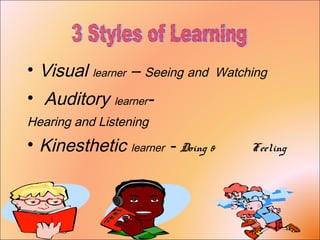
• Visual learner – Seeing and Watching
• Auditory learner-
Hearing and Listening
• Kinesthetic learner - Doing & Feeling
Visual Learners: How To Spot Them
 Likes to look at books and pictures
Can read silently for a long time
They remember details and colors of what they see
They are fond of reading, spelling and proof reading
They remember faces of people he/she meets ( forget names)
remembers names seen in print
They quietly take in surroundings
They create mental photos
They are good at putting clothes together
Having to take action before either seeing or reading about what
needs to be done
Working in an environment with noise or movement
Tuning out sounds (not very responsive to music
Listening to lectures without visual pictures or graphics to illustrate
Working under fluorescent lights ( makes it hard to concentrate)
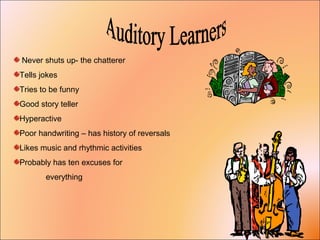
Never shuts up- the chatterer
Tells jokes
Tries to be funny
Good story teller
Hyperactive
Poor handwriting – has history of reversals
Likes music and rhythmic activities
Probably has ten excuses for
everything
Knows all the words to all the songs. Can memorize easily
Motorically awkward
Poor performance on group tests of intelligence
Poor perception of time, space
Difficulties in School
Reading quickly; reads more slowly than a visual learner
Reading silently for prolonged periods of time
Reading directions; unaware of illustrations
Taking tests under time pressure that must be read and written
Living with enforced silence in class when teacher is lecturing.
Can’t wait to talk
Being distracted by sounds
Seeing significant details
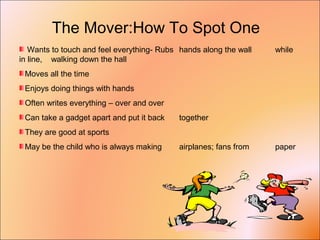
The Mover:How To Spot One
Wants to touch and feel everything- Rubs hands along the wall while
in line, walking down the hall
Moves all the time
Enjoys doing things with hands
Often writes everything – over and over
Can take a gadget apart and put it back together
They are good at sports
May be the child who is always making airplanes; fans from paper
Difficulties in Schools:
Having good interpersonal skills
Having legible cursive handwriting. Better with
printing or keyboarding
Sitting still; tends to fidget and needs to move
Listening to lectures more than four minutes
Spelling
Communicating without getting physically close to
another person
Recalling what is seen or heard- better at recalling
what is done
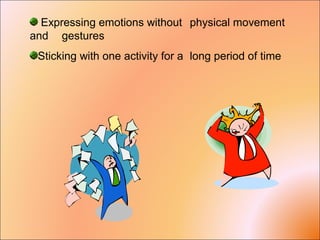
Expressing emotions without physical movement
and gestures
Sticking with one activity for a long period of time
Obstacles to Achievement
• Lacks motivation to achieve
• Not able to complete task
• Fears failures
The Underachievers
• Unmotivated
• Denies by action that what they do now has
impact on their future
• Doesn’t see/accept that their inability to
complete tasks & assume responsibility will
lead tocontinuing failure
Underachievers:
Lack the ability to:
work to completion
function independently
produce within time limit
Underachievers:
Performance falls short of abilities
Doesn’t initiate new projects; doesn’t find new
ideas challenging
Isn’t a self-starter, no
sence of urgency, misses deadlines
Underachiever:
• Doesn’t complete or submit work on time
• Seldom accepts responsibility for personal
failure
• Starts enthusiastically but quickly fades
• Easily distracted
Underachiever:
• Seems unaffected by own deficiencies &
ineffectiveneness
• Fakes happiness
• Hostile towards authority
• Excessively self-critical
• Fluent orally but poor iin written work
Underachiever:
• Doesn’t set own goals
• Lacks concentration
• Daydreams
• Disorganized
• Has poor study habits
Causes of Underachievement:
• Disabilities & Impairments
• Family Dynamics:
low parental expectations
inconsistent parenting techniques
autocratic & permissive parenting style
absence of role models of achievement-oriented behavior
no encouragement for self motivation, environmental
engagement & autonomy
• Negative peer influence
Duration of Underchievement
• Short-term or intermittent
Cause: family discord, etc.
• Long-term
Cause: socio-economic conditions,
family attitude towards school
too low or too high aspirations
What can you do
now
Motivating Your Child To
Achieve
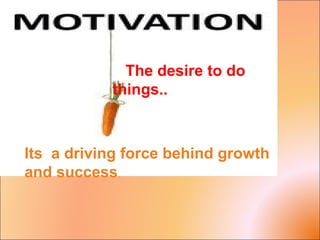
The desire to do
things..
Its a driving force behind growth
and success.
What Dampens motivation?
 Fear of failure
 Frustration with inconsistent performance
 Lack of understanding the school
work
 Emotional problems
 Anger
 Desire for attention– even negative
attention
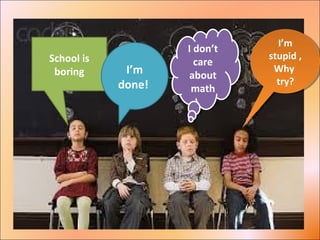
School is
boring I’m
done!
I don’t
care
about
math
I don’t
care
about
math
I’m
stupid ,
Why
try?
I’m
stupid ,
Why
try?
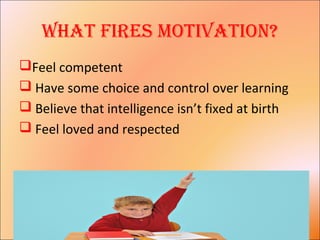
What Fires motivation?
Feel competent
 Have some choice and control over learning
 Believe that intelligence isn’t fixed at birth
 Feel loved and respected
simple Ways to help
your chilD get
motivateD
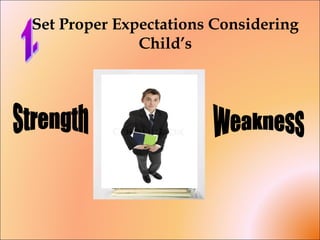
Set Proper Expectations Considering
Child’s
Talk kindly and honestly
to your child about her
interest and abilities.
Talk kindly and honestly
to your child about her
interest and abilities.
Share your OPINION
based on your
OBSERVATION
Share your OPINION
based on your
OBSERVATION
Have
an agreement
Have
an agreement
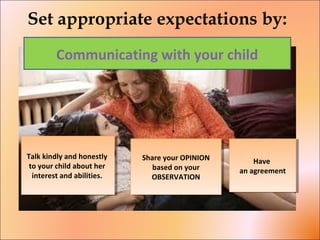
Set appropriate expectations by:
Communicating with your child
Re-evaluate as necessary
Plan to review your expectation with your child.
Talk to your child and make an adjustment. Make
sure that both of you will agree about the
expectations.
Help your child set goals
Write the goals
down.
Make the
goals specific
Make the
goals
measurable
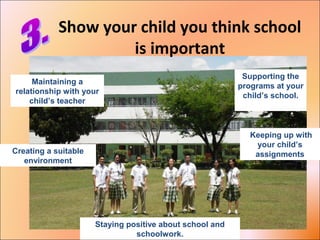
Show your child you think school
is important
Maintaining a
relationship with your
child’s teacher
Supporting the
programs at your
child’s school.
Creating a suitable
environment
Keeping up with
your child’s
assignments
Staying positive about school and
schoolwork.
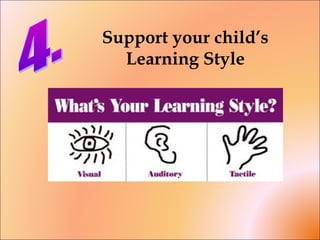
Support your child’s
Learning Style
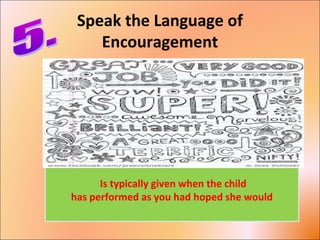
Speak the Language of
Encouragement
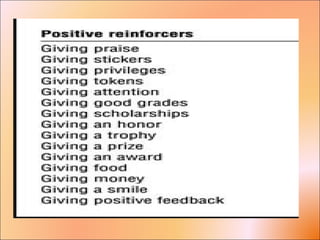
Praise:
• Discusses results.
“Great work on the science quiz! You got an
A!”
• Uses opinion words such as
“good,” “great,” “terrific,” and“wonderful.”
Is typically given when the child
has performed as you had hoped she would
Encouragement:
• Notices effort and progress.
“Look at that paper ! I can tell you've spent a lot
of time on it ! It must feel good to know you
worked so hard!”
• Uses descriptive words.
“You washed the dishes without being asked.
Look at it ! So shiny and clean.
Can be given regardless of the child’s
performance.
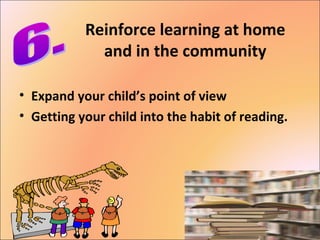
Reinforce learning at home
and in the community
• Expand your child’s point of view
• Getting your child into the habit of reading.
Encourage Your Child to Be
Resilient
Skills Needed to be Developed
• Goal-setting
• Making choices
• Organizational strategies
• Planning & managing tasks
• Time management &
scheduling
• Focus
Skills Needed to be Developed
• Improved study skills
• Giving self-affirmation
• Recognizing negative thought patterns
• Doing positive self-talks
• Self-evaluation
• Celebrating improvements
Catch A Falling Star

Catch A Falling Star

  • 1.
  • 2.
  • 3.
    Intellectual QuotientKey conceptsabout a child •Every person is gifted •Basic to a person’s psychological well being is a mindset of: I am loved... I am capable... •A child is narcissistic but docile and malleable. •He needs to be controlled to develop self- control.
  • 5.
    • Visual learner– Seeing and Watching • Auditory learner- Hearing and Listening • Kinesthetic learner - Doing & Feeling
  • 6.
    Visual Learners: HowTo Spot Them  Likes to look at books and pictures Can read silently for a long time They remember details and colors of what they see They are fond of reading, spelling and proof reading They remember faces of people he/she meets ( forget names) remembers names seen in print They quietly take in surroundings They create mental photos They are good at putting clothes together
  • 7.
    Having to takeaction before either seeing or reading about what needs to be done Working in an environment with noise or movement Tuning out sounds (not very responsive to music Listening to lectures without visual pictures or graphics to illustrate Working under fluorescent lights ( makes it hard to concentrate)
  • 8.
    Never shuts up-the chatterer Tells jokes Tries to be funny Good story teller Hyperactive Poor handwriting – has history of reversals Likes music and rhythmic activities Probably has ten excuses for everything
  • 9.
    Knows all thewords to all the songs. Can memorize easily Motorically awkward Poor performance on group tests of intelligence Poor perception of time, space
  • 10.
    Difficulties in School Readingquickly; reads more slowly than a visual learner Reading silently for prolonged periods of time Reading directions; unaware of illustrations Taking tests under time pressure that must be read and written Living with enforced silence in class when teacher is lecturing. Can’t wait to talk Being distracted by sounds Seeing significant details
  • 11.
    The Mover:How ToSpot One Wants to touch and feel everything- Rubs hands along the wall while in line, walking down the hall Moves all the time Enjoys doing things with hands Often writes everything – over and over Can take a gadget apart and put it back together They are good at sports May be the child who is always making airplanes; fans from paper
  • 12.
    Difficulties in Schools: Havinggood interpersonal skills Having legible cursive handwriting. Better with printing or keyboarding Sitting still; tends to fidget and needs to move Listening to lectures more than four minutes Spelling
  • 13.
    Communicating without gettingphysically close to another person Recalling what is seen or heard- better at recalling what is done
  • 14.
    Expressing emotions withoutphysical movement and gestures Sticking with one activity for a long period of time
  • 15.
    Obstacles to Achievement •Lacks motivation to achieve • Not able to complete task • Fears failures
  • 16.
    The Underachievers • Unmotivated •Denies by action that what they do now has impact on their future • Doesn’t see/accept that their inability to complete tasks & assume responsibility will lead tocontinuing failure
  • 17.
    Underachievers: Lack the abilityto: work to completion function independently produce within time limit
  • 18.
    Underachievers: Performance falls shortof abilities Doesn’t initiate new projects; doesn’t find new ideas challenging Isn’t a self-starter, no sence of urgency, misses deadlines
  • 19.
    Underachiever: • Doesn’t completeor submit work on time • Seldom accepts responsibility for personal failure • Starts enthusiastically but quickly fades • Easily distracted
  • 20.
    Underachiever: • Seems unaffectedby own deficiencies & ineffectiveneness • Fakes happiness • Hostile towards authority • Excessively self-critical • Fluent orally but poor iin written work
  • 21.
    Underachiever: • Doesn’t setown goals • Lacks concentration • Daydreams • Disorganized • Has poor study habits
  • 22.
    Causes of Underachievement: •Disabilities & Impairments • Family Dynamics: low parental expectations inconsistent parenting techniques autocratic & permissive parenting style absence of role models of achievement-oriented behavior no encouragement for self motivation, environmental engagement & autonomy • Negative peer influence
  • 23.
    Duration of Underchievement •Short-term or intermittent Cause: family discord, etc. • Long-term Cause: socio-economic conditions, family attitude towards school too low or too high aspirations
  • 24.
  • 25.
  • 26.
    The desire todo things.. Its a driving force behind growth and success.
  • 27.
    What Dampens motivation? Fear of failure  Frustration with inconsistent performance  Lack of understanding the school work  Emotional problems  Anger  Desire for attention– even negative attention
  • 28.
    School is boring I’m done! Idon’t care about math I don’t care about math I’m stupid , Why try? I’m stupid , Why try?
  • 29.
    What Fires motivation? Feelcompetent  Have some choice and control over learning  Believe that intelligence isn’t fixed at birth  Feel loved and respected
  • 30.
    simple Ways tohelp your chilD get motivateD
  • 31.
    Set Proper ExpectationsConsidering Child’s
  • 32.
    Talk kindly andhonestly to your child about her interest and abilities. Talk kindly and honestly to your child about her interest and abilities. Share your OPINION based on your OBSERVATION Share your OPINION based on your OBSERVATION Have an agreement Have an agreement Set appropriate expectations by: Communicating with your child
  • 33.
    Re-evaluate as necessary Planto review your expectation with your child. Talk to your child and make an adjustment. Make sure that both of you will agree about the expectations.
  • 34.
    Help your childset goals Write the goals down. Make the goals specific Make the goals measurable
  • 35.
    Show your childyou think school is important Maintaining a relationship with your child’s teacher Supporting the programs at your child’s school. Creating a suitable environment Keeping up with your child’s assignments Staying positive about school and schoolwork.
  • 36.
  • 37.
    Speak the Languageof Encouragement Praise: • Discusses results. “Great work on the science quiz! You got an A!” • Uses opinion words such as “good,” “great,” “terrific,” and“wonderful.” Is typically given when the child has performed as you had hoped she would
  • 38.
    Encouragement: • Notices effortand progress. “Look at that paper ! I can tell you've spent a lot of time on it ! It must feel good to know you worked so hard!” • Uses descriptive words. “You washed the dishes without being asked. Look at it ! So shiny and clean. Can be given regardless of the child’s performance.
  • 40.
    Reinforce learning athome and in the community • Expand your child’s point of view • Getting your child into the habit of reading.
  • 41.
    Encourage Your Childto Be Resilient
  • 42.
    Skills Needed tobe Developed • Goal-setting • Making choices • Organizational strategies • Planning & managing tasks • Time management & scheduling • Focus
  • 43.
    Skills Needed tobe Developed • Improved study skills • Giving self-affirmation • Recognizing negative thought patterns • Doing positive self-talks • Self-evaluation • Celebrating improvements