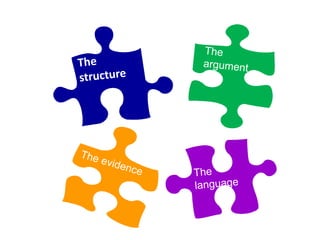
Academic Writing for
Postgraduate Study
Caroline Malthus
Te Puna Ako Learning Centre
© Unitec New Zealand 1
Introductions
• your name?
• What programme are you studying?
• What questions or concerns do you have
about academic writing?
Slides will be available on Te Puna Ako Learning Centre Moodle
This session…
• The expectations of Unitec lecturers
• Some key features of academic writing
• The differences between descriptive
writing and critical analysis
• The processes of paraphrasing, citation
and referencing
© Unitec New Zealand 3
Look at the assignment you’re
given and discuss:
© Unitec New Zealand 4
What seem to be the expectations of lecturers
for postgrad assignments?
What criteria do lecturers have for assessing
assignments?
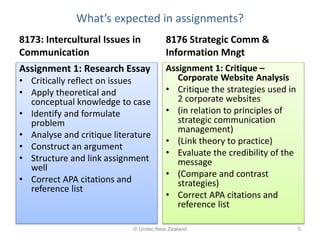
What’s expected in assignments?
8173: Intercultural Issues in
Communication
Assignment 1: Research Essay
• Critically reflect on issues
• Apply theoretical and
conceptual knowledge to case
• Identify and formulate
problem
• Analyse and critique literature
• Construct an argument
• Structure and link assignment
well
• Correct APA citations and
reference list
8176 Strategic Comm &
Information Mngt
Assignment 1: Critique –
Corporate Website Analysis
• Critique the strategies used in
2 corporate websites
• (in relation to principles of
strategic communication
management)
• (Link theory to practice)
• Evaluate the credibility of the
message
• (Compare and contrast
strategies)
• Correct APA citations and
reference list
© Unitec New Zealand 5
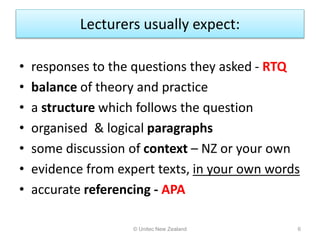
Lecturers usually expect:
• responses to the questions they asked - RTQ
• balance of theory and practice
• a structure which follows the question
• organised & logical paragraphs
• some discussion of context – NZ or your own
• evidence from expert texts, in your own words
• accurate referencing - APA
© Unitec New Zealand 6
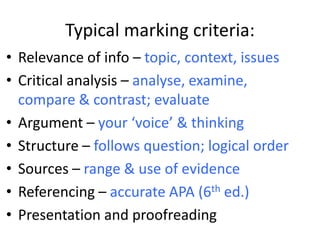
Typical marking criteria:
• Relevance of info – topic, context, issues
• Critical analysis – analyse, examine,
compare & contrast; evaluate
• Argument – your ‘voice’ & thinking
• Structure – follows question; logical order
• Sources – range & use of evidence
• Referencing – accurate APA (6th ed.)
• Presentation and proofreading
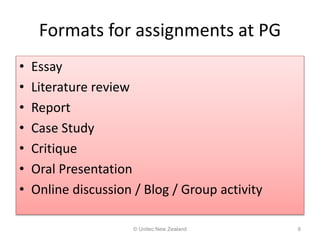
Formats for assignments at PG
• Essay
• Literature review
• Report
• Case Study
• Critique
• Oral Presentation
• Online discussion / Blog / Group activity
© Unitec New Zealand 8
Features of academic writing
emphasised by lecturers
• A structure
– Introduction
– Body
– Conclusion
• In-text references and a reference list
• Ideas which are explained and linked in
paragraphs
• Reader knows where the writer is taking them
(tour guide - signposts)
• Good presentation and proof reading
© Unitec New Zealand 10
Stages in Assignment writing
Analyse the assignment question or topic, e.g.
“Genes and behavior are inextricably linked”.
Discuss this statement, using at least 2 specific
examples in your discussion. Also, refer to the
findings of the Human Genome Project. You
must also use 10 relevant, refereed articles.
Analyse the assessment criteria
…. And then?
© Unitec New Zealand 11
An assignment/thesis is a project
with steps / phases:
Which take up most time?
Literature search
Reading and notemaking
Analysis and thinking
Writing up – as you go
Referencing – as you go
A handy planning tool (see Handout: 10 step
assignment process)
© Unitec New Zealand 12
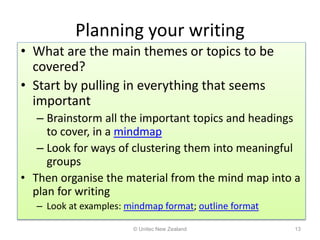
Planning your writing
• What are the main themes or topics to be
covered?
• Start by pulling in everything that seems
important
– Brainstorm all the important topics and headings
to cover, in a mindmap
– Look for ways of clustering them into meaningful
groups
• Then organise the material from the mind map into a
plan for writing
– Look at examples: mindmap format; outline format
© Unitec New Zealand 13
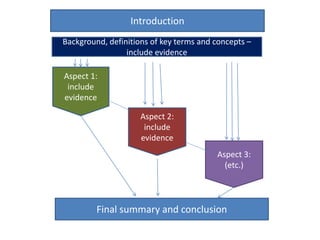
Introduction
Aspect 1:
include
evidence
Aspect 2:
include
evidence
Aspect 3:
(etc.)
Final summary and conclusion
Background, definitions of key terms and concepts –
include evidence
What are the features of good
academic writing?
Task: look at the text (handout: Formal/ Informal writing)
Identify features that make the text academic
Opinions: is this good academic writing?
© Unitec New Zealand 15
Social psychologists, communication scholars, and those working
in the business, information and organisational science areas
were among the first to undertake research on email and other
forms of computer-mediated communication (CMC). More
recently linguists have begun to take an interest in this medium
which may well be the dominant interpersonal communications
medium in this millennium “approaching if not overshadowing
voice” (Negroponte, 1995, p. 191). This paper outlines the
growth of email over the last ten years, reviews research on the
social and psychological effects of email and other forms of CMC,
on the benefits of email in relation to other means of
communication, and on the role of email in workplace politics.
Research on different styles of email communication, including
gender differences in email use is also summarised.
© Unitec New Zealand 16
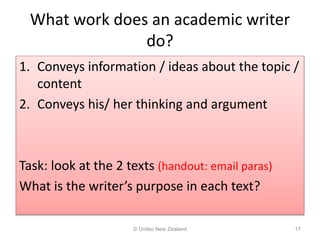
What work does an academic writer
do?
1. Conveys information / ideas about the topic /
content
2. Conveys his/ her thinking and argument
Task: look at the 2 texts (handout: email paras)
What is the writer’s purpose in each text?
© Unitec New Zealand 17
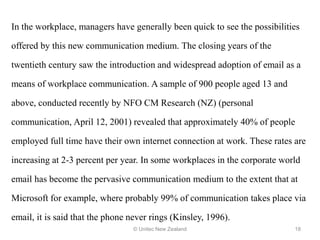
In the workplace, managers have generally been quick to see the possibilities
offered by this new communication medium. The closing years of the
twentieth century saw the introduction and widespread adoption of email as a
means of workplace communication. A sample of 900 people aged 13 and
above, conducted recently by NFO CM Research (NZ) (personal
communication, April 12, 2001) revealed that approximately 40% of people
employed full time have their own internet connection at work. These rates are
increasing at 2-3 percent per year. In some workplaces in the corporate world
email has become the pervasive communication medium to the extent that at
Microsoft for example, where probably 99% of communication takes place via
email, it is said that the phone never rings (Kinsley, 1996).
© Unitec New Zealand 18
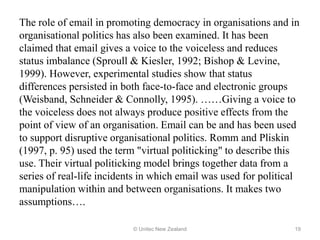
The role of email in promoting democracy in organisations and in
organisational politics has also been examined. It has been
claimed that email gives a voice to the voiceless and reduces
status imbalance (Sproull & Kiesler, 1992; Bishop & Levine,
1999). However, experimental studies show that status
differences persisted in both face-to-face and electronic groups
(Weisband, Schneider & Connolly, 1995). ……Giving a voice to
the voiceless does not always produce positive effects from the
point of view of an organisation. Email can be and has been used
to support disruptive organisational politics. Romm and Pliskin
(1997, p. 95) used the term "virtual politicking" to describe this
use. Their virtual politicking model brings together data from a
series of real-life incidents in which email was used for political
manipulation within and between organisations. It makes two
assumptions….
© Unitec New Zealand 19
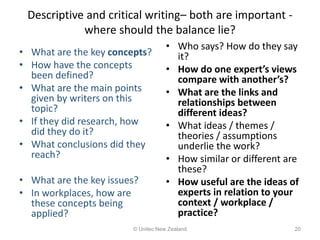
Descriptive and critical writing– both are important -
where should the balance lie?
• What are the key concepts?
• How have the concepts
been defined?
• What are the main points
given by writers on this
topic?
• If they did research, how
did they do it?
• What conclusions did they
reach?
• What are the key issues?
• In workplaces, how are
these concepts being
applied?
• Who says? How do they say
it?
• How do one expert’s views
compare with another’s?
• What are the links and
relationships between
different ideas?
• What ideas / themes /
theories / assumptions
underlie the work?
• How similar or different are
these?
• How useful are the ideas of
experts in relation to your
context / workplace /
practice?
© Unitec New Zealand 20
Critical thinking skills
• Analysing
• Looking for
assumptions
• Comparing and
contrasting
• Justifying
• Evaluating
• Discriminating
• Speculating
“Genes and behavior are
inextricably linked”. Discuss
this statement, using at least
2 specific examples in your
discussion. Also, refer to the
findings of the Human
Genome Project. You must
also use 10 relevant, refereed
articles.
© Unitec New Zealand 21
Write in paragraphs
• Paragraphs are the building blocks of academic writing
• A paragraph deals with one main idea
• This is usually stated at or near the beginning of the
paragraph
• The ideas is developed and discussed in the body of the
paragraph
• The idea is concluded in a way that leads to the next
paragraph
© Unitec New Zealand 22
It is often said that people need to drink 6-8 glasses of
water per day to stay healthy and well-hydrated.
However it is hard to find solid scientific evidence to
support this claim (Valtin, 2002). Valtin points out that
food contains some fluid, and also says it is not clear
whether a range of different beverages can be consumed
in place of water. A study by Le Bellego et al. (2010)
compared a number of surveys aimed at investigating
people’s actual fluid intake. They found it hard to
compare conclusions because of differences in the ways
the surveys were conducted. A later study (European
Food Safety Authority (EFSA), 2010) has concluded that
guidelines on adequate intake of fluid need to consider
factors such as type of fluid, environmental factors,
energy output, age and health status. Clearly the topic is
more complicated than the everyday advice suggests.
Building an argument
3 part structure to a critical argument:
1. Statement of the assertion or claim you are
making
2. Evidence to support that assertion – from
literature
3. The significance of the evidence is explained
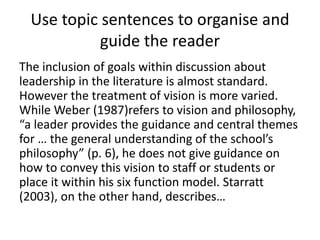
Use topic sentences to organise and
guide the reader
The inclusion of goals within discussion about
leadership in the literature is almost standard.
However the treatment of vision is more varied.
While Weber (1987)refers to vision and philosophy,
“a leader provides the guidance and central themes
for … the general understanding of the school’s
philosophy” (p. 6), he does not give guidance on
how to convey this vision to staff or students or
place it within his six function model. Starratt
(2003), on the other hand, describes…
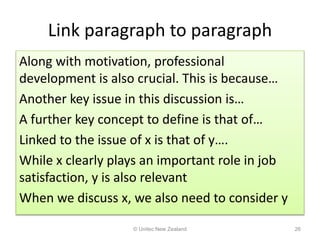
Link paragraph to paragraph
Along with motivation, professional
development is also crucial. This is because…
Another key issue in this discussion is…
A further key concept to define is that of…
Linked to the issue of x is that of y….
While x clearly plays an important role in job
satisfaction, y is also relevant
When we discuss x, we also need to consider y
© Unitec New Zealand 26
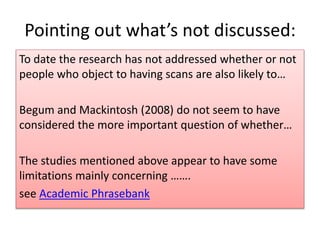
Pointing out what’s not discussed:
To date the research has not addressed whether or not
people who object to having scans are also likely to…
Begum and Mackintosh (2008) do not seem to have
considered the more important question of whether…
The studies mentioned above appear to have some
limitations mainly concerning …….
see Academic Phrasebank
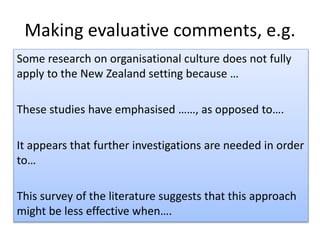
Making evaluative comments, e.g.
Some research on organisational culture does not fully
apply to the New Zealand setting because …
These studies have emphasised ……, as opposed to….
It appears that further investigations are needed in order
to…
This survey of the literature suggests that this approach
might be less effective when….
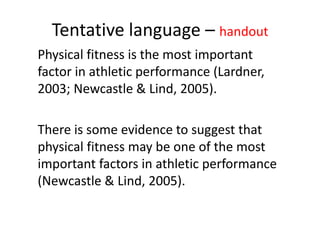
Tentative language – handout
Physical fitness is the most important
factor in athletic performance (Lardner,
2003; Newcastle & Lind, 2005).
There is some evidence to suggest that
physical fitness may be one of the most
important factors in athletic performance
(Newcastle & Lind, 2005).
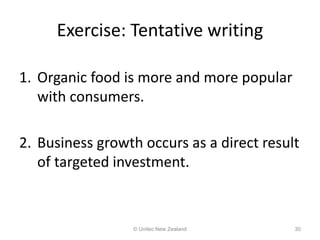
Exercise: Tentative writing
1. Organic food is more and more popular
with consumers.
2. Business growth occurs as a direct result
of targeted investment.
© Unitec New Zealand 30
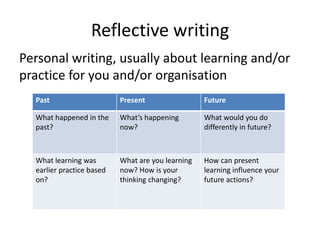
Reflective writing
Personal writing, usually about learning and/or
practice for you and/or organisation
Past Present Future
What happened in the
past?
What’s happening
now?
What would you do
differently in future?
What learning was
earlier practice based
on?
What are you learning
now? How is your
thinking changing?
How can present
learning influence your
future actions?
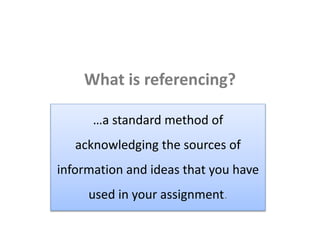
What is referencing?
…a standard method of
acknowledging the sources of
information and ideas that you have
used in your assignment.
APA referencing system
In-text references
• in sentences in the body of the assignment
• shows where you’ve used ideas and words of an
expert
• includes name of author and year
Reference List
• on a separate page at the end of the assignment
• list of materials you have consulted
© Unitec New Zealand 33
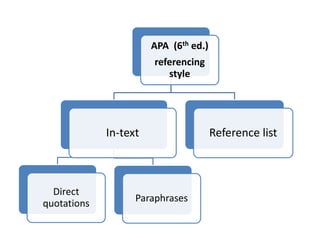
APA (6th ed.)
referencing
style
In-text
Direct
quotations Paraphrases
Reference list
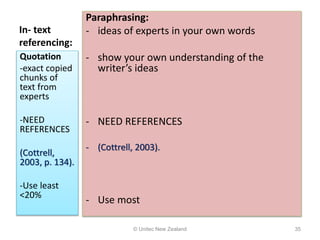
In- text
referencing:
Paraphrasing:
- ideas of experts in your own words
- show your own understanding of the
writer’s ideas
- NEED REFERENCES
- (Cottrell, 2003).
- Use most
Quotation
-exact copied
chunks of
text from
experts
-NEED
REFERENCES
(Cottrell,
2003, p. 134).
-Use least
<20%
© Unitec New Zealand 35
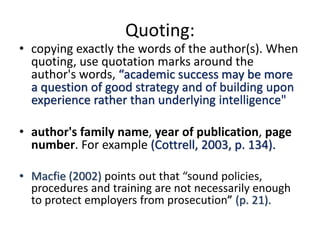
Quoting:
• copying exactly the words of the author(s). When
quoting, use quotation marks around the
author's words, “academic success may be more
a question of good strategy and of building upon
experience rather than underlying intelligence"
• author's family name, year of publication, page
number. For example (Cottrell, 2003, p. 134).
• Macfie (2002) points out that “sound policies,
procedures and training are not necessarily enough
to protect employers from prosecution” (p. 21).
Consider paraphrasing and
quotation
Explaining other people’s ideas, in your own
words
A process of rewriting ideas of expert writers
• Why is paraphrasing desirable?
• When can quotes be useful?
© Unitec New Zealand 37
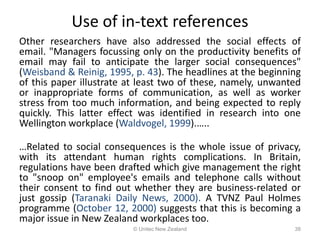
Use of in-text references
Other researchers have also addressed the social effects of
email. "Managers focussing only on the productivity benefits of
email may fail to anticipate the larger social consequences"
(Weisband & Reinig, 1995, p. 43). The headlines at the beginning
of this paper illustrate at least two of these, namely, unwanted
or inappropriate forms of communication, as well as worker
stress from too much information, and being expected to reply
quickly. This latter effect was identified in research into one
Wellington workplace (Waldvogel, 1999).…..
…Related to social consequences is the whole issue of privacy,
with its attendant human rights complications. In Britain,
regulations have been drafted which give management the right
to "snoop on" employee's emails and telephone calls without
their consent to find out whether they are business-related or
just gossip (Taranaki Daily News, 2000). A TVNZ Paul Holmes
programme (October 12, 2000) suggests that this is becoming a
major issue in New Zealand workplaces too.
© Unitec New Zealand 38
“Academic language is no-one’s
mother tongue”
(Bourdieu & Passeron, 1994, p. 8).
We develop this language gradually… notice
how other academic writers express ideas
Start writing early
“Since you are never ready to write, you start
writing before you are ready.”
George Watson
Get into the writing habit
• Don’t wait until you’ve worked out all your
ideas; use writing to work out your ideas
• Accept that your first drafts will be imperfect
• Reading and research to exploratory drafts to
polished writing
© Unitec New Zealand 41
Proofread 2-3x to check for:
is the writing answering the question set?
clear introduction and conclusion
the key or strongest points in response to the
question: are they at the beginnings of
paragraphs?
is referencing accurate – in-text and in list?
Grammar, spelling, punctuation
© Unitec New Zealand 43
• Write with a plan
Have a set of headings or theme areas
• Write regularly and seek feedback
From your lecturer
From a learning advisor (Learning Centre)
•Keep the reader(s) in mind
An educated, non-specialist reader
Is your argument clearly stated?
Have you answered the “so what” question?
References
© Unitec New Zealand 44
Cottrell, S. (2008). The study skills handbook. Basingstoke: Palgrave Macmillan.
Godfrey, J. (2009). How to use your reading in your essays. Basingstoke: Palgrave
Macmillan.
Swales, J., & Feak, C. (2004). Academic writing for graduate students: A course for
nonnative speakers of English (2nd Ed.). Ann Arbor, Michigan: University of
Michigan Press.
Waldevogel, J. (2001). Email and workplace communication: A literature review.
Language in the Workplace Occasional Papers, 3, 1-12. Retrieved March 1,
2008 from http://www.victoria.ac.nz/lals/lwp/resources/occasional-
papers.aspx
Wallace, M., & Wray, A. (2006). Critical reading and writing for postgraduates.
Thousand Oaks, CA: Sage.
Useful links for academic writing:
Study Toolbox
University of Manchester. (2014). Academic
Phrasebank. Retrieved from
http://www.phrasebank.manchester.ac.uk

Acad wrtg for_pg_study_sem1_2016

  • 1.
    Academic Writing for PostgraduateStudy Caroline Malthus Te Puna Ako Learning Centre © Unitec New Zealand 1
  • 2.
    Introductions • your name? •What programme are you studying? • What questions or concerns do you have about academic writing? Slides will be available on Te Puna Ako Learning Centre Moodle
  • 3.
    This session… • Theexpectations of Unitec lecturers • Some key features of academic writing • The differences between descriptive writing and critical analysis • The processes of paraphrasing, citation and referencing © Unitec New Zealand 3
  • 4.
    Look at theassignment you’re given and discuss: © Unitec New Zealand 4 What seem to be the expectations of lecturers for postgrad assignments? What criteria do lecturers have for assessing assignments?
  • 5.
    What’s expected inassignments? 8173: Intercultural Issues in Communication Assignment 1: Research Essay • Critically reflect on issues • Apply theoretical and conceptual knowledge to case • Identify and formulate problem • Analyse and critique literature • Construct an argument • Structure and link assignment well • Correct APA citations and reference list 8176 Strategic Comm & Information Mngt Assignment 1: Critique – Corporate Website Analysis • Critique the strategies used in 2 corporate websites • (in relation to principles of strategic communication management) • (Link theory to practice) • Evaluate the credibility of the message • (Compare and contrast strategies) • Correct APA citations and reference list © Unitec New Zealand 5
  • 6.
    Lecturers usually expect: •responses to the questions they asked - RTQ • balance of theory and practice • a structure which follows the question • organised & logical paragraphs • some discussion of context – NZ or your own • evidence from expert texts, in your own words • accurate referencing - APA © Unitec New Zealand 6
  • 7.
    Typical marking criteria: •Relevance of info – topic, context, issues • Critical analysis – analyse, examine, compare & contrast; evaluate • Argument – your ‘voice’ & thinking • Structure – follows question; logical order • Sources – range & use of evidence • Referencing – accurate APA (6th ed.) • Presentation and proofreading
  • 8.
    Formats for assignmentsat PG • Essay • Literature review • Report • Case Study • Critique • Oral Presentation • Online discussion / Blog / Group activity © Unitec New Zealand 8
  • 10.
    Features of academicwriting emphasised by lecturers • A structure – Introduction – Body – Conclusion • In-text references and a reference list • Ideas which are explained and linked in paragraphs • Reader knows where the writer is taking them (tour guide - signposts) • Good presentation and proof reading © Unitec New Zealand 10
  • 11.
    Stages in Assignmentwriting Analyse the assignment question or topic, e.g. “Genes and behavior are inextricably linked”. Discuss this statement, using at least 2 specific examples in your discussion. Also, refer to the findings of the Human Genome Project. You must also use 10 relevant, refereed articles. Analyse the assessment criteria …. And then? © Unitec New Zealand 11
  • 12.
    An assignment/thesis isa project with steps / phases: Which take up most time? Literature search Reading and notemaking Analysis and thinking Writing up – as you go Referencing – as you go A handy planning tool (see Handout: 10 step assignment process) © Unitec New Zealand 12
  • 13.
    Planning your writing •What are the main themes or topics to be covered? • Start by pulling in everything that seems important – Brainstorm all the important topics and headings to cover, in a mindmap – Look for ways of clustering them into meaningful groups • Then organise the material from the mind map into a plan for writing – Look at examples: mindmap format; outline format © Unitec New Zealand 13
  • 14.
    Introduction Aspect 1: include evidence Aspect 2: include evidence Aspect3: (etc.) Final summary and conclusion Background, definitions of key terms and concepts – include evidence
  • 15.
    What are thefeatures of good academic writing? Task: look at the text (handout: Formal/ Informal writing) Identify features that make the text academic Opinions: is this good academic writing? © Unitec New Zealand 15
  • 16.
    Social psychologists, communicationscholars, and those working in the business, information and organisational science areas were among the first to undertake research on email and other forms of computer-mediated communication (CMC). More recently linguists have begun to take an interest in this medium which may well be the dominant interpersonal communications medium in this millennium “approaching if not overshadowing voice” (Negroponte, 1995, p. 191). This paper outlines the growth of email over the last ten years, reviews research on the social and psychological effects of email and other forms of CMC, on the benefits of email in relation to other means of communication, and on the role of email in workplace politics. Research on different styles of email communication, including gender differences in email use is also summarised. © Unitec New Zealand 16
  • 17.
    What work doesan academic writer do? 1. Conveys information / ideas about the topic / content 2. Conveys his/ her thinking and argument Task: look at the 2 texts (handout: email paras) What is the writer’s purpose in each text? © Unitec New Zealand 17
  • 18.
    In the workplace,managers have generally been quick to see the possibilities offered by this new communication medium. The closing years of the twentieth century saw the introduction and widespread adoption of email as a means of workplace communication. A sample of 900 people aged 13 and above, conducted recently by NFO CM Research (NZ) (personal communication, April 12, 2001) revealed that approximately 40% of people employed full time have their own internet connection at work. These rates are increasing at 2-3 percent per year. In some workplaces in the corporate world email has become the pervasive communication medium to the extent that at Microsoft for example, where probably 99% of communication takes place via email, it is said that the phone never rings (Kinsley, 1996). © Unitec New Zealand 18
  • 19.
    The role ofemail in promoting democracy in organisations and in organisational politics has also been examined. It has been claimed that email gives a voice to the voiceless and reduces status imbalance (Sproull & Kiesler, 1992; Bishop & Levine, 1999). However, experimental studies show that status differences persisted in both face-to-face and electronic groups (Weisband, Schneider & Connolly, 1995). ……Giving a voice to the voiceless does not always produce positive effects from the point of view of an organisation. Email can be and has been used to support disruptive organisational politics. Romm and Pliskin (1997, p. 95) used the term "virtual politicking" to describe this use. Their virtual politicking model brings together data from a series of real-life incidents in which email was used for political manipulation within and between organisations. It makes two assumptions…. © Unitec New Zealand 19
  • 20.
    Descriptive and criticalwriting– both are important - where should the balance lie? • What are the key concepts? • How have the concepts been defined? • What are the main points given by writers on this topic? • If they did research, how did they do it? • What conclusions did they reach? • What are the key issues? • In workplaces, how are these concepts being applied? • Who says? How do they say it? • How do one expert’s views compare with another’s? • What are the links and relationships between different ideas? • What ideas / themes / theories / assumptions underlie the work? • How similar or different are these? • How useful are the ideas of experts in relation to your context / workplace / practice? © Unitec New Zealand 20
  • 21.
    Critical thinking skills •Analysing • Looking for assumptions • Comparing and contrasting • Justifying • Evaluating • Discriminating • Speculating “Genes and behavior are inextricably linked”. Discuss this statement, using at least 2 specific examples in your discussion. Also, refer to the findings of the Human Genome Project. You must also use 10 relevant, refereed articles. © Unitec New Zealand 21
  • 22.
    Write in paragraphs •Paragraphs are the building blocks of academic writing • A paragraph deals with one main idea • This is usually stated at or near the beginning of the paragraph • The ideas is developed and discussed in the body of the paragraph • The idea is concluded in a way that leads to the next paragraph © Unitec New Zealand 22
  • 23.
    It is oftensaid that people need to drink 6-8 glasses of water per day to stay healthy and well-hydrated. However it is hard to find solid scientific evidence to support this claim (Valtin, 2002). Valtin points out that food contains some fluid, and also says it is not clear whether a range of different beverages can be consumed in place of water. A study by Le Bellego et al. (2010) compared a number of surveys aimed at investigating people’s actual fluid intake. They found it hard to compare conclusions because of differences in the ways the surveys were conducted. A later study (European Food Safety Authority (EFSA), 2010) has concluded that guidelines on adequate intake of fluid need to consider factors such as type of fluid, environmental factors, energy output, age and health status. Clearly the topic is more complicated than the everyday advice suggests.
  • 24.
    Building an argument 3part structure to a critical argument: 1. Statement of the assertion or claim you are making 2. Evidence to support that assertion – from literature 3. The significance of the evidence is explained
  • 25.
    Use topic sentencesto organise and guide the reader The inclusion of goals within discussion about leadership in the literature is almost standard. However the treatment of vision is more varied. While Weber (1987)refers to vision and philosophy, “a leader provides the guidance and central themes for … the general understanding of the school’s philosophy” (p. 6), he does not give guidance on how to convey this vision to staff or students or place it within his six function model. Starratt (2003), on the other hand, describes…
  • 26.
    Link paragraph toparagraph Along with motivation, professional development is also crucial. This is because… Another key issue in this discussion is… A further key concept to define is that of… Linked to the issue of x is that of y…. While x clearly plays an important role in job satisfaction, y is also relevant When we discuss x, we also need to consider y © Unitec New Zealand 26
  • 27.
    Pointing out what’snot discussed: To date the research has not addressed whether or not people who object to having scans are also likely to… Begum and Mackintosh (2008) do not seem to have considered the more important question of whether… The studies mentioned above appear to have some limitations mainly concerning ……. see Academic Phrasebank
  • 28.
    Making evaluative comments,e.g. Some research on organisational culture does not fully apply to the New Zealand setting because … These studies have emphasised ……, as opposed to…. It appears that further investigations are needed in order to… This survey of the literature suggests that this approach might be less effective when….
  • 29.
    Tentative language –handout Physical fitness is the most important factor in athletic performance (Lardner, 2003; Newcastle & Lind, 2005). There is some evidence to suggest that physical fitness may be one of the most important factors in athletic performance (Newcastle & Lind, 2005).
  • 30.
    Exercise: Tentative writing 1.Organic food is more and more popular with consumers. 2. Business growth occurs as a direct result of targeted investment. © Unitec New Zealand 30
  • 31.
    Reflective writing Personal writing,usually about learning and/or practice for you and/or organisation Past Present Future What happened in the past? What’s happening now? What would you do differently in future? What learning was earlier practice based on? What are you learning now? How is your thinking changing? How can present learning influence your future actions?
  • 32.
    What is referencing? …astandard method of acknowledging the sources of information and ideas that you have used in your assignment.
  • 33.
    APA referencing system In-textreferences • in sentences in the body of the assignment • shows where you’ve used ideas and words of an expert • includes name of author and year Reference List • on a separate page at the end of the assignment • list of materials you have consulted © Unitec New Zealand 33
  • 34.
  • 35.
    In- text referencing: Paraphrasing: - ideasof experts in your own words - show your own understanding of the writer’s ideas - NEED REFERENCES - (Cottrell, 2003). - Use most Quotation -exact copied chunks of text from experts -NEED REFERENCES (Cottrell, 2003, p. 134). -Use least <20% © Unitec New Zealand 35
  • 36.
    Quoting: • copying exactlythe words of the author(s). When quoting, use quotation marks around the author's words, “academic success may be more a question of good strategy and of building upon experience rather than underlying intelligence" • author's family name, year of publication, page number. For example (Cottrell, 2003, p. 134). • Macfie (2002) points out that “sound policies, procedures and training are not necessarily enough to protect employers from prosecution” (p. 21).
  • 37.
    Consider paraphrasing and quotation Explainingother people’s ideas, in your own words A process of rewriting ideas of expert writers • Why is paraphrasing desirable? • When can quotes be useful? © Unitec New Zealand 37
  • 38.
    Use of in-textreferences Other researchers have also addressed the social effects of email. "Managers focussing only on the productivity benefits of email may fail to anticipate the larger social consequences" (Weisband & Reinig, 1995, p. 43). The headlines at the beginning of this paper illustrate at least two of these, namely, unwanted or inappropriate forms of communication, as well as worker stress from too much information, and being expected to reply quickly. This latter effect was identified in research into one Wellington workplace (Waldvogel, 1999).….. …Related to social consequences is the whole issue of privacy, with its attendant human rights complications. In Britain, regulations have been drafted which give management the right to "snoop on" employee's emails and telephone calls without their consent to find out whether they are business-related or just gossip (Taranaki Daily News, 2000). A TVNZ Paul Holmes programme (October 12, 2000) suggests that this is becoming a major issue in New Zealand workplaces too. © Unitec New Zealand 38
  • 39.
    “Academic language isno-one’s mother tongue” (Bourdieu & Passeron, 1994, p. 8). We develop this language gradually… notice how other academic writers express ideas
  • 40.
    Start writing early “Sinceyou are never ready to write, you start writing before you are ready.” George Watson
  • 41.
    Get into thewriting habit • Don’t wait until you’ve worked out all your ideas; use writing to work out your ideas • Accept that your first drafts will be imperfect • Reading and research to exploratory drafts to polished writing © Unitec New Zealand 41
  • 42.
    Proofread 2-3x tocheck for: is the writing answering the question set? clear introduction and conclusion the key or strongest points in response to the question: are they at the beginnings of paragraphs? is referencing accurate – in-text and in list? Grammar, spelling, punctuation
  • 43.
    © Unitec NewZealand 43 • Write with a plan Have a set of headings or theme areas • Write regularly and seek feedback From your lecturer From a learning advisor (Learning Centre) •Keep the reader(s) in mind An educated, non-specialist reader Is your argument clearly stated? Have you answered the “so what” question?
  • 44.
    References © Unitec NewZealand 44 Cottrell, S. (2008). The study skills handbook. Basingstoke: Palgrave Macmillan. Godfrey, J. (2009). How to use your reading in your essays. Basingstoke: Palgrave Macmillan. Swales, J., & Feak, C. (2004). Academic writing for graduate students: A course for nonnative speakers of English (2nd Ed.). Ann Arbor, Michigan: University of Michigan Press. Waldevogel, J. (2001). Email and workplace communication: A literature review. Language in the Workplace Occasional Papers, 3, 1-12. Retrieved March 1, 2008 from http://www.victoria.ac.nz/lals/lwp/resources/occasional- papers.aspx Wallace, M., & Wray, A. (2006). Critical reading and writing for postgraduates. Thousand Oaks, CA: Sage.
  • 45.
    Useful links foracademic writing: Study Toolbox University of Manchester. (2014). Academic Phrasebank. Retrieved from http://www.phrasebank.manchester.ac.uk